
how to pray in Islam
How to Pray in Islam Step by Step: A Beginner's Guide to Salah
Dar Ahlullah team 21 min read
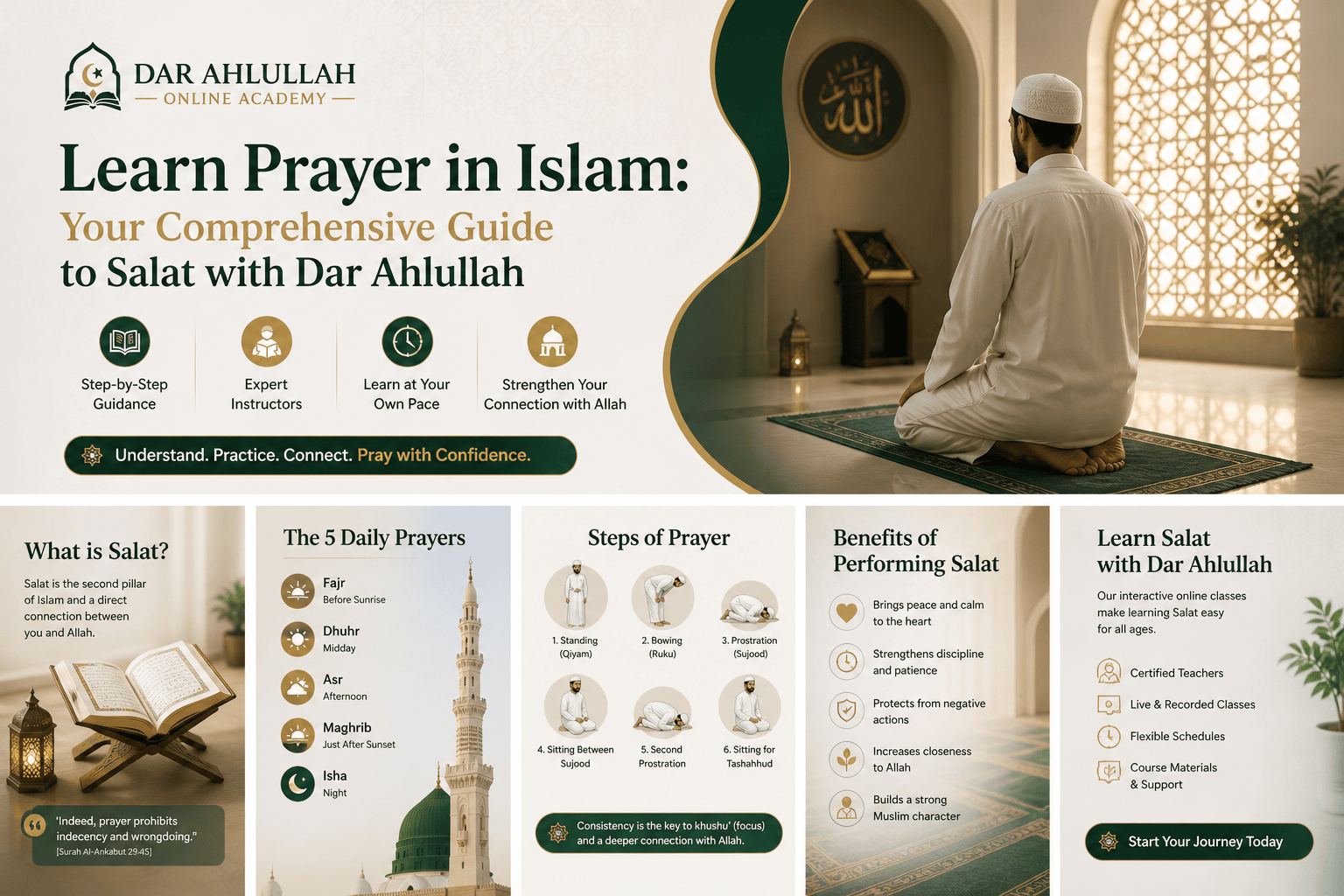
To pray in Islam you make wudu, face the qiblah, and perform salah in a fixed sequence: the opening takbir, standing recitation of al-Fatiha, bowing (ruku), two prostrations (sujud) with a short sitting between them, and the final sitting that ends with the salam. Each of the five daily prayers repeats that cycle two, three or four times. This guide walks through every step in order with what is said in it, then covers the five prayers one by one and the mistakes beginners most often make. If you already know the basics and need a specific case, the salah library at the end links every guide we have written on prayer.
Table of Contents
This guide covers the whole of Salah in order: what it is, what must be true before you start, every position with what is said in it, the five daily prayers one by one, and the mistakes people most often make.
This guide aims to demystify Salah, making the path to spiritual connection accessible and clear for everyone. It covers everything from the foundational 'why' to the practical 'how' of prayer, ensuring you gain a deep understanding and the confidence to perform Salah correctly. From understanding its core concepts to mastering its intricate movements, Dar Ahlullah is here to support you every step of the way.
- Why Salah Is the Anchor of a Muslim’s Day
- Understanding Salat: The Core of Muslim Prayer
- Before You Pray: The Three Prerequisites
- Step-by-Step Guide: How to Pray in Islam (Salah Guide)
- The Five Daily Prayers, One by One
- Beyond the Basics: Meaning and Khushoo
- The Complete Salah Library
- Key Takeaways
- Questions People Ask About Praying
- Conclusion: Start Tonight, Not Perfectly
Now that you have an overview of what's to come, let's explore why learning prayer, especially with Dar Ahlullah, is a profoundly rewarding experience.
Why Salah Is the Anchor of a Muslim’s Day
Additionally, welcome to your journey! The act of prayer in Islam, or Salah, stands as a pillar of faith, offering a unique blend of tranquility and purpose. But why is it so significant, and how can Dar Ahlullah assist you in mastering it?[1]
The Tranquility and Purpose of Islamic Prayer
Indeed, in a world often bustling with noise and distractions, the call to prayer offers a serene pause, a moment for introspection and connection with the Divine. Many Muslims describe Salah as their anchor, a source of peace that grounds them amidst life's challenges. It's more than just a ritual; it's a direct line of communication, a meditative act that fosters spiritual well-being and moral discipline. For most people starting out, that sense of steadiness is the most compelling reason to keep going.
What You'll Learn in This complete Guide
What's more, this guide takes the prayer in order, one position at a time. It walks you through each step, from understanding the spiritual significance of Salah to mastering its physical movements and recitations. Whether you are new to Islam, returning to your faith, or simply curious to understand the practice, this resource is designed to cater to all levels of understanding. Our aim is to ensure that by the end of this guide, you will not only know how to pray, but also understand the deep meaning behind each action, allowing you to truly immerse yourself in the experience.
Learning It With a Teacher
Most of what follows can be learned from a page. The part that cannot is whether your recitation is actually correct — pronunciation, and whether each position is being held long enough. That needs someone listening. Dar Ahlullah teaches one-to-one over Zoom with certified teachers, and the first 30-minute assessment is free, with no card required. We believe that with the right guidance, anyone can confidently learn prayer in Islam and integrate it meaningfully into their daily life.
"Prayer is not just a duty; it is a spiritual ascent, a conversation that nourishes the soul and purifies the heart. Prayer is a direct address to Allah, repeated five times a day." - Imam Zaid Shakir
With a clear understanding of what awaits and the support of Dar Ahlullah, let's explore deeper into the essence of Salah itself.
Understanding Salat: The Core of Muslim Prayer
Also, having glimpsed the profound 'why' behind Islamic prayer, it's time to truly understand what Salah is at its heart and why it holds such paramount importance in the life of a Muslim.
What Salah Actually Is
Primarily, Salah (صلاة), commonly translated as Muslim prayer, is one of the five pillars of Islam and a direct, ritualized form of worship to Allah (God). Linguistically, 'Salah' means 'connection,' and indeed, it serves as a powerful means for believers to connect with their Creator. Islamically, it is a prescribed set of physical movements, recitations, and supplications performed five times a day. The Pew Research Center reports that Salah is widely practiced, with a significant majority of Muslims globally performing it regularly. So the practical steps matter as much as the intention behind them.
The Five Daily Prayers: Timings and Significance
Each day, Muslims are commanded to perform five obligatory prayers, each with specific timings tied to the sun's position. These prayers punctuate the day, offering consistent opportunities for spiritual reflection and gratitude.
- Fajr (Dawn Prayer): Performed before sunrise, it marks the beginning of the day, inviting believers to start with remembrance of God.
- Dhuhr (Noon Prayer): Offered after the sun passes its zenith, it serves as a mid-day spiritual break.
- Asr (Afternoon Prayer): Performed in the late afternoon, it encourages remembrance before the day concludes.
- Maghrib (Sunset Prayer): Recited immediately after sunset, it offers thanks for the day's blessings.
- Isha (Night Prayer): Performed after nightfall, it concludes the day with worship and reflection.
These timings instill discipline and a constant awareness of God in a Muslim's daily life, underscoring the deep importance of prayer in Islam.[2]
Benefits Beyond Ritual: Meaning of Salat in Daily Life
Also, the benefits of Salah extend far beyond mere ritualistic observance. It fosters humility, patience, and a sense of community. Spiritually, it purifies the heart, reduces anxiety, and enhances consciousness of God (Taqwa). Mentally, the rhythmic movements and focused recitation can act as a form of meditation, improving concentration and reducing stress. Studies suggest that the physical postures of prayer can even have physical health benefits, including improved flexibility and circulation.
With this fundamental understanding of what Salah entails, let's prepare ourselves by exploring the necessary prerequisites before we physically begin to pray.
Before You Pray: The Three Prerequisites
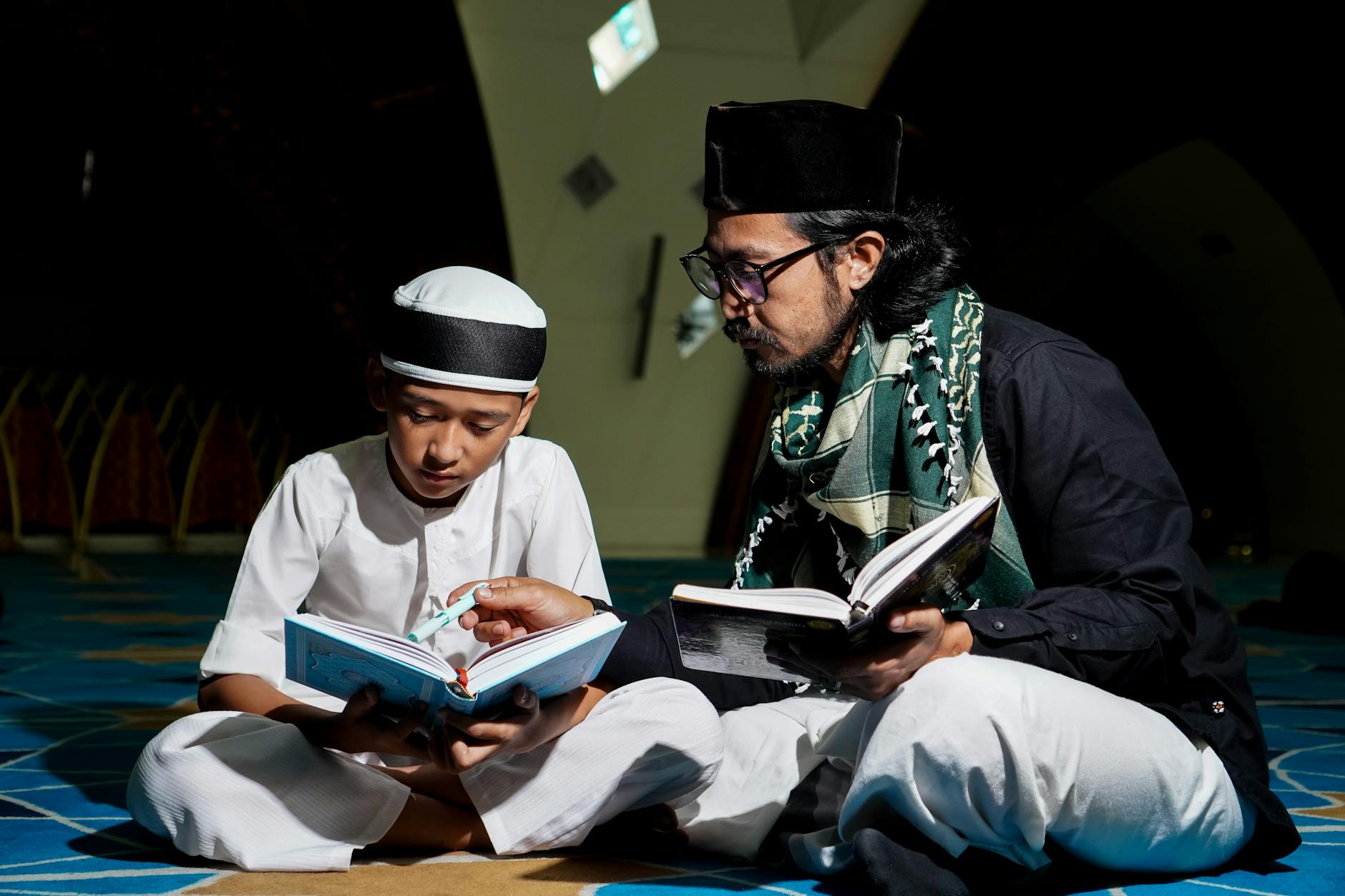
In addition, now that we've grasped the profound meaning and structure of Salah, preparing oneself correctly is the next important step before engaging in this sacred act. There are foundational prerequisites that ensure your prayer is sound and accepted.
Purity (Taharah): Wudu (Ablution) and Ghusl
First, central to Islamic worship is the concept of Taharah, or ritual purity. Before performing Salah, a Muslim must be in a state of ritual cleanliness. This primarily involves two forms:
- Wudu (Ablution): This is a partial washing of specific body parts in a prescribed manner. It involves washing the hands, mouth, nose, face, arms, head, and feet. Wudu is required for minor impurities, such as after sleep, using the restroom, or passing wind. Wudu has its own steps and its own invalidators, both covered in the complete guide to wudu and in what breaks wudu.
- Ghusl (Ritual Bath): This is a full-body ritual bath required after major impurities, such as after sexual activity, menstruation, or childbirth. It involves washing the entire body with water.
These acts of purification ensure that the worshipper approaches God in a state of cleanliness, both physical and spiritual.
Facing the Qibla: Finding Your Direction Towards Mecca
Second, during prayer, all Muslims face the Kaaba in Mecca, Saudi Arabia. This direction is known as the Qibla. Finding the Qibla is essential for performing Salah correctly. Fortunately, various tools and methods are available today:
- Compass: A traditional qibla compass can point you towards Mecca.
- Smartphone Apps: Numerous apps use GPS to accurately determine the Qibla direction from your location.
- Online Qibla Finders: Websites can pinpoint the Qibla using your address or current location.
- Local Mosques: Mosques are always aligned with the Qibla, offering a reliable reference point.
Dress Code and Where You Pray
Also, the appropriate dress and environment also contribute to the reverence and validity of Salah. For men, the covering must be from the navel to the knees, ensuring modesty. For women, the entire body, except for the face and hands, must be covered. Loose-fitting and opaque clothing is encouraged for both genders to maintain modesty and allow for comfortable movement during prayer. The prayer environment should ideally be clean, quiet, and free from distractions, enabling full concentration during the act of worship. A quiet, clean space makes concentration far easier.
| Requirement | Description | Status |
|---|---|---|
| Wudu (Ablution) | Ritual washing for minor impurities | ✓ |
| Ghusl (Ritual Bath) | Full-body washing for major impurities (if needed) | ✓ |
| Qibla Direction | Facing the Kaaba in Mecca | ✓ |
| Proper Attire | Modest clothing covering required areas | ✓ |
| Clean Environment | Prayer area free from distractions | ✓ |
With your physical and environmental preparations complete, you are now ready to embark on the step-by-step performance of Salah itself.[3]
Step-by-Step Guide: How to Pray in Islam (Salah Guide)
Building on this, you are now prepared, both in mind and body, to enter into direct communion with Allah. This section is your detailed, step-by-step companion for performing the Islamic prayer (Salah). For anyone looking to learn prayer in Islam, understanding these steps is fundamental.
Niyyah (Intention): The Foundation of Every Muslim Prayer
First, every act of worship in Islam begins with Niyyah, or intention. This isn't just a spoken word, but a sincere resolve in the heart to perform the prayer purely for Allah's sake. For instance, before you begin, simply intend in your heart to perform the Fajr prayer, or Dhuhr prayer, for example. This internal commitment sets the tone for the whole prayer.
Takbiratul Ihram: Initiating Your Salah
Subsequently, the prayer formally begins with the Takbiratul Ihram, which means 'the opening Takbir' (declaration of Allah's greatness). Standing upright, face towards the Kaaba (Qibla), raise both hands to the level of your shoulders or ears, palms facing forward. While doing so, you declare, "Allahu Akbar" (Allah is the Greatest). This phrase immediately shifts your focus, disconnecting you from worldly distractions and connecting you with the Divine.
Qiyam (Standing) and Recitation: Surah Al-Fatiha and More
Following the Takbiratul Ihram, you maintain the standing position, known as Qiyam, placing your right hand over your left on your chest or naval. During Qiyam, the primary recitation is Surah Al-Fatiha, the opening chapter of the Quran. This essential surah is recited in every rak'ah (unit of prayer) because it contains praises for Allah and a plea for guidance. After Al-Fatiha, it's common practice to recite a short surah or a few verses from the Quran. Every word said at each position — and which are obligatory rather than sunnah — is set out in what to say in salah. For example, many new learners often recite Surah Al-Ikhlas, Al-Falaq, or An-Nas. This recitation phase is central to anyone who wishes to learn prayer in Islam effectively.
"The Prophet Muhammad (peace be upon him) said: 'No prayer is complete without the recitation of the Fatihat al-Kitab (opening of the Book).'"
Ruku (Bowing): Humility Before Allah
Next, you bow down from your waist, keeping your back straight and parallel to the ground. Your hands should rest on your knees, fingers spread apart. In this posture, called Ruku, you say, "Subhana Rabbiyal Adheem" (Glory be to my Lord, the Most Magnificent) three times. Ruku symbolizes humility and respect for Allah's grandeur. The stillness matters as much as the shape — settle before moving on.
Sujud (Prostration): The Closest a Servant is to Allah
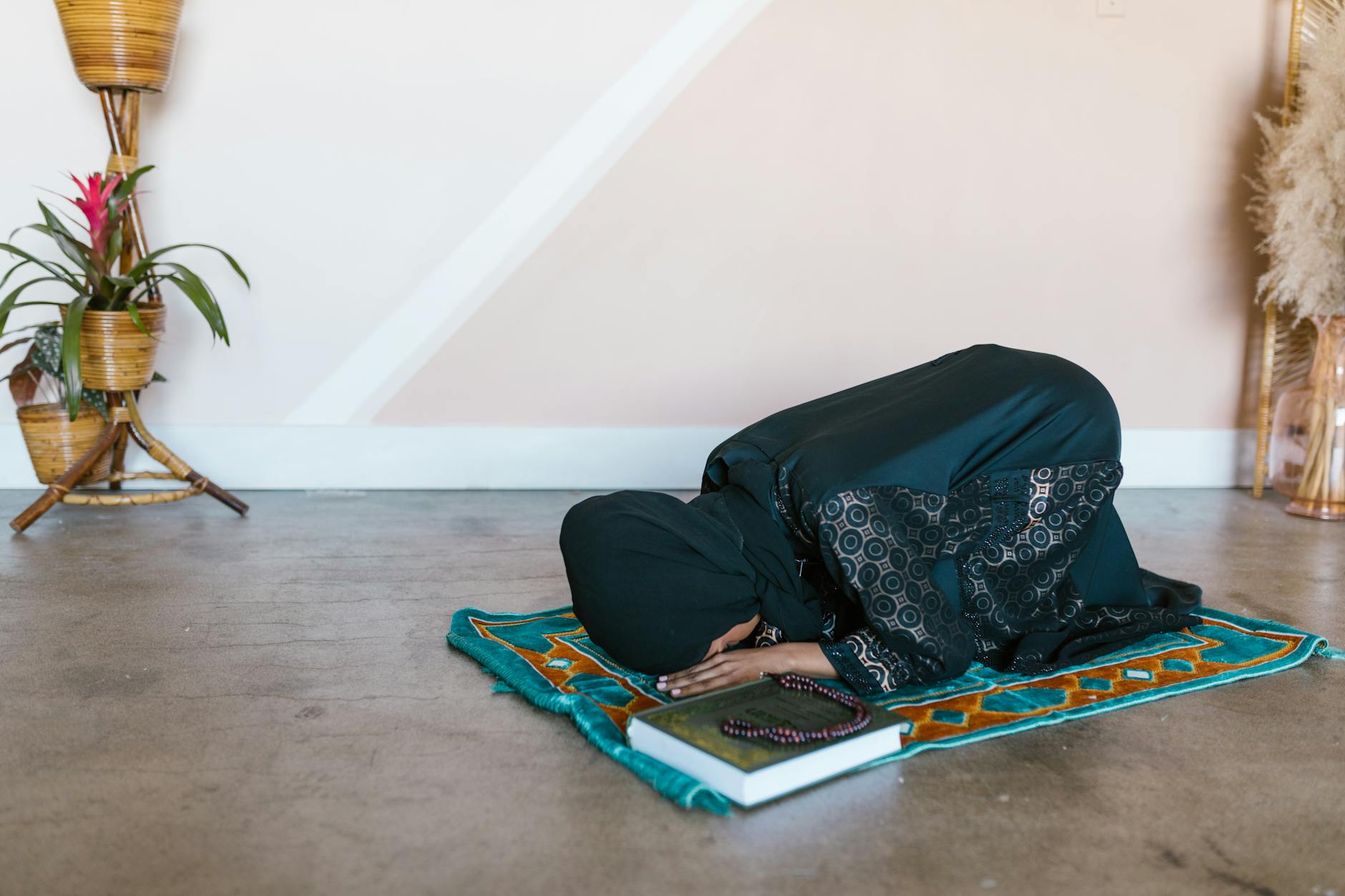
After standing up briefly from Ruku (with the recitation "Sami Allahu Liman Hamidah, Rabbana Lakal Hamd"), you move into Sujud, or prostration. This is considered the closest a servant is to Allah. In Sujud, you place your forehead, nose, palms of your hands, knees, and toes on the ground. While prostrating, you say, "Subhana Rabbiyal A'la" (Glory be to my Lord, the Most High) three times. This is the position of fullest submission, and the one to slow down in.
Julus (Sitting) and Tashahhud: Testifying to Faith
Following the first Sujud, you sit up briefly on your knees, with your hands resting on your thighs. This sitting posture is called Julus. You then perform a second Sujud, identical to the first. After the second Sujud, you sit again for a longer period, known as Tashahhud. During Tashahhud, you recite specific invocations that include testifying to the oneness of Allah and the prophethood of Muhammad, as well as sending blessings upon the Prophet. This sequence completes one rak'ah, and multiple rak'ahs make up a full prayer. [4]
Taslim (Salutation): Concluding Your Salah
Finally, to conclude the prayer, you offer salutations (Taslim). While seated, turn your head to the right and say, "Assalamu Alaikum wa Rahmatullah" (Peace and blessings of Allah be upon you). Then, turn your head to the left and repeat the same salutation. This act signals the end of your formal communion with Allah and is a greeting to the angels and fellow worshippers. It signifies the completion of your spiritual journey for that prayer.
Every Step, and the Mistakes to Avoid
Here's a table summarising the steps and the common pitfalls. If you realise afterwards that something went wrong, what to do if you make a mistake in prayer covers the corrective prostration, and what invalidates salah covers the errors that mean starting again:
| Step | Description | Common Recitation | Common Mistakes to Avoid |
|---|---|---|---|
| Niyyah (Intention) | Resolve in heart for specific prayer. | (Internal) |
|
| Takbiratul Ihram | Raise hands, say "Allahu Akbar". | "Allahu Akbar" |
|
| Qiyam (Standing) | Stand, recite Al-Fatiha & other surah. | Al-Fatiha, short surah |
|
| Ruku (Bowing) | Bow from waist, hands on knees. | "Subhana Rabbiyal Adheem" (x3) |
|
| Sujud (Prostration) | Forehead, nose, hands, knees, toes on ground. | "Subhana Rabbiyal A'la" (x3) |
|
| Julus (Sitting) | Sit briefly between sujoods, then for Tashahhud. | Tashahhud (later) |
|
| Taslim (Salutation) | Turn head right, then left, say "Assalamu Alaikum wa Rahmatullah". | "Assalamu Alaikum wa Rahmatullah" |
|
With a solid grasp of the universal steps of Salah, let's now look at how these actions manifest in each of the five daily prayers, offering a complete picture of your routine.
The Five Daily Prayers, One by One
Having mastered the foundational steps of Salah, it's time to see how these steps are uniquely integrated into each of the five daily prayers, each with its own special rhythm and significance. Each has its own timing, length and character.
Fajr Prayer: The Dawn Awakening
The Fajr prayer is the first prayer of the day, observed before sunrise. It consists of two rak'ahs. This prayer is known for its serene time, bringing tranquility and blessings to the start of your day. It sets a positive, spiritual tone, and many scholars emphasize its reward due to the effort required to wake up early. For those committed to learn prayer in Islam, Fajr is a profound way to begin.
Dhuhr Prayer: Midday Reflection
Next, the Dhuhr prayer is performed at midday, after the sun has passed its zenith. It comprises four rak'ahs. This prayer offers a spiritual break during the busy hours of the day, allowing for reflection and remembrance of Allah. It helps recenter one's focus amidst worldly distractions.
Asr Prayer: Late Afternoon Connection
Following Dhuhr, the Asr prayer takes place in the late afternoon, before sunset. It also consists of four rak'ahs. Asr serves as a important spiritual checkpoint, reminding believers of their purpose before the day concludes. Its timing is significant, often seen as a period of renewed commitment. Dar Ahlullah's systematic approach helps individuals learn prayer in Islam, including these detailed timings.
Maghrib Prayer: Sunset Gratitude
The Maghrib prayer is observed immediately after sunset and is unique with its three rak'ahs. This prayer is a moment of gratitude to Allah for the completion of the day and His blessings. It comes quickly after the day's hustle, prompting an immediate turn to devotion. Imam Ghazali, in his work 'Ihya' 'Ulum al-Din', speaks extensively about the spiritual benefits of adhering to these prayer times, suggesting they provide structure and discipline to life's rhythm. For more information, you can consult resources like IslamQA.info [Source].[5]
Isha Prayer: Night's Embrace
Finally, the Isha prayer is the last prayer of the day, performed after nightfall. Consisting of four rak'ahs, Isha provides a final opportunity for devotion and seeking forgiveness before sleep. It brings a sense of peace and closure to the day, ensuring that even the end of the day is marked with remembrance of Allah. A study by the American Psychological Association (APA) indicated that regular spiritual practices, such as prayer, can reduce stress and improve mental well-being, aligning with the tranquility found in Isha prayer [Source]. Together the five build the rhythm the whole day hangs on.
The Five Prayers Compared
The five prayers side by side:
| Prayer Name | Time of Day | Number of Rak'ahs | Key Significance |
|---|---|---|---|
| Fajr | Before sunrise | 2 | Dawn awakening & fresh start |
| Dhuhr | Midday | 4 | Midday pause & reflection |
| Asr | Late afternoon | 4 | Spiritual checkpoint before day's end |
| Maghrib | After sunset | 3 | Gratitude for day's completion |
| Isha | Nightfall | 4 | Night's repose & final devotion |
As you become comfortable with the routines of each Salah, the next step is to deepen your connection and concentration during prayer, moving beyond the mechanics to the true essence.
Beyond the Basics: Meaning and Khushoo
You've journeyed through the essentials of Salah, from its meaning to its specific forms. Now, let's explore how to elevate your prayer, moving beyond the physical motions to cultivating a deeper, more meaningful connection with Allah. Dar Ahlullah is here to guide you further.
Understanding the Arabic: A Deeper Meaning of Salat
Learning prayer in Islam can be significantly enriched by understanding the core Arabic phrases recited during Salah. While transliteration helps with recitation, comprehending the meanings behind words like Allahu Akbar (Allah is the Greatest) or Al-Fatiha (the opening chapter of the Quran) can transform rote memorization into heartfelt communication. Dar Ahlullah offers specialized courses that break down these phrases, allowing you to connect on a profound level with each supplication and verse.
Khushoo (Concentration): Cultivating Presence in Prayer
Achieving Khushoo, or deep concentration and humility during prayer, is a fundamental goal for every Muslim. Often, it's a challenge, especially for beginners. However, there are practical steps one can take to foster this essential spiritual state.
- Prepare Mentally: Before starting Salah, take a moment to clear your mind from worldly distractions. Focus on the intention (Niyyah).
- Understand Recitations: As mentioned, knowing the meaning of what you recite helps immensely in maintaining focus.
- Mindful Movements: Perform each movement deliberately and calmly, not rushing through the prayer.
- Imagine Allah's Presence: Envision yourself standing before Allah, which can instill awe and reverence.
Our guide to khushu in salah takes each of these further, with the hadith behind them, what a wandering mind does and does not do to the prayer, and the remedy the Prophet ﷺ gave for the whispers.
"Prayer is not asking. It is a longing of the soul. It is daily admission of one's weakness. It is better in prayer to have a heart without words than words without a heart." – Mahatma Gandhi
Where a Teacher Makes the Difference
A teacher is most useful for the things you cannot self-check: whether your Fatiha is pronounced correctly, whether you are rushing the positions, and which of your habits are actually errors. Sessions are one-to-one and priced per teaching hour, and if the pairing is not right you can switch to another certified teacher at no extra cost.[6]
Common Challenges, and What Actually Helps
Most people hit the same few hurdles early on. Here are a few common challenges and practical solutions:
- Forgetting Steps: Practice regularly, use a prayer mat with markings (initially), or refer to a quick guide. Consistency builds memory.
- Distractions: Find a quiet prayer space, turn off notifications, and focus on the meaning of your recitations. Over time, mental discipline improves.
- Time Management: Set reminders for prayer times. Consider praying immediately after the call to prayer (Adhan) to build a routine.
As you continue to refine and deepen your prayer experience, remember the most vital lessons learned. Let's recap the core wisdom from this guide.
The Complete Salah Library
This guide covers the prayer itself. The articles below each take one situation or one part of the prayer and go into the detail that does not fit here.
Before you pray
- How to make wudu, step by step
- What breaks wudu, and what does not
- How to perform ghusl, the full ritual bath
- How to perform tayammum when you cannot use water
- The sutrah: what to pray behind, and walking past someone praying
- How to respond to the adhan, and the du’a after it
Inside the prayer
- What to say in salah, position by position
- Khushu in salah: how to focus in prayer
- What invalidates salah
- What to do if you make a mistake in prayer (sujud as-sahw)
- Joining the prayer late: how to make up missed rak'ahs
- Sajdah tilawah, the prostration of recitation
- Sujood ash-shukr, the prostration of gratitude
- Adhkar after salah: what to say after every prayer
- Morning and evening adhkar: what to say, and when
Prayers beyond the five
- The sunnah rawatib: the twelve rak'ahs around the five prayers
- How to pray duha
- How to pray tahajjud
- How to pray jumuah
- How to pray istikhara
- How to pray salat al-janazah
- How to pray salat al-tawbah, the prayer of repentance
- Tahiyyat al-masjid, the greeting of the mosque
- How to pray salat al-hajah, the prayer of need
- How to pray salat al-tasbih, the prayer of glorification
- How to pray salat al-istisqa, the prayer for rain
- How to pray salat al-kusuf, the eclipse prayer
Situations
- How to pray while traveling
- How to pray when sick
- How to make up missed prayers
- Prayer times at high latitude
Key Takeaways
The parts worth remembering, if you remember nothing else: These are the anchors that will steady your spiritual practice.
The Pillars of Salah
Fundamentally, Salah is composed of specific movements and recitations that form its integral pillars. Always ensure these essential components are met, as they validate your prayer.
Importance of Intention and Purity
Remember that prayer begins before the first invocation. Sincerity (Niyyah) in your heart and physical purity (Wudu) are non-negotiable prerequisites. Your intention sets the spiritual tone for your entire Salah.
Consistency is Key
Praying well is a matter of persistence rather than talent. Regularity, even when challenging, builds spiritual muscle and strengthens your connection with Allah.
Mindfulness During Prayer
Aim for Khushoo—a state of humble devotion and concentration. It's not just about performing movements but about engaging your heart and mind fully in conversation with your Creator.
Keep Learning
Your learning doesn't stop here. Dar Ahlullah encourages continuous improvement and offers dedicated online prayer classes and resources to support your ongoing spiritual development.[7]
The Spiritual Rewards
Ultimately, consistent and mindful prayer brings immense spiritual rewards: inner peace, a strong sense of purpose, forgiveness, and a profound connection with the Divine. It's a transformative practice.
With these profound lessons firmly in mind, you might still have practical questions. Let's address some common queries to ensure clarity and confidence in your Salah.
Questions People Ask About Praying
Even after a complete guide, questions often arise as one embarks on a new practice. Here, we address some of the most frequently asked questions about learning and performing Islamic prayer.
Q1: What if I don't know Arabic to learn prayer in Islam?
While knowing Arabic enhances understanding, it is not a prerequisite to perform Salah. You can initially learn the prayers using transliteration and translations. Dar Ahlullah's courses often provide these resources, and over time, you can gradually learn the Arabic meanings.
Q2: How do I remember all the steps for Muslim prayer?
Practice, practice, practice! Regular repetition is key. Initially, you might use a prayer guide or a visual aid. Many find that joining an online class, like those offered by Dar Ahlullah, provides structured learning and reinforces memorization through consistent guidance.
Q3: Can I pray if I'm not feeling well?
Absolutely. Islam is a religion of ease. If you cannot stand, you may pray sitting; if you cannot sit, you may pray lying down. The intention and effort are what count. For specific guidance, it's always best to consult with a knowledgeable scholar or teacher.
Q4: What if I miss a prayer time?
If a prayer is missed due to forgetfulness or unavoidable circumstances, it should be made up as soon as remembered or possible (known as Qada prayer) — the order and method are covered in how to make up missed prayers. Deliberately missing prayers without a valid reason is sinful, so the aim is to build the habit around the timings rather than catch up after the fact.
Q5: Is there a difference between men's and women's prayer?
The core components and spiritual essence of prayer are the same for both men and women. There are minor differences in physical posture during certain parts of the prayer, which most beginner guides set out.[8]
Q6: Can a teacher help me correct my prayer?
A teacher can hear what you cannot — pronunciation, and whether you are rushing the positions. Our services include live online classes, experienced teachers, personalized feedback, a complete curriculum covering all aspects of Salah, and a community of learners. You can explore our offerings and register on our website.
Q7: Are there any apps or tools to help me learn prayer in Islam?
Yes, many useful apps exist for prayer times, Qibla direction, and learning recitations. Apps like 'Muslim Pro' or 'Salatuk' are popular. However, these tools are best used as supplements to structured learning with a teacher, as provided by organizations like Dar Ahlullah, to ensure correct practice and understanding.
Common Problems and What to Do
| Challenge | Common Question | Dar Ahlullah Solution/Guidance |
|---|---|---|
| Recitation Difficulty | How do I pronounce Arabic words correctly? | Phonetics guides, audio recitations, and direct teacher correction in online classes. |
| Maintaining Focus | I get easily distracted during Salah. What can I do? | Khushoo techniques, understanding meanings, mindful practice, and expert tips from our teachers. |
| Consistency | How can I make prayer a daily habit? | Setting routines, understanding the spiritual benefits, and peer support within Dar Ahlullah's community. |
| Understanding Rituals | Why do we perform certain movements? | In-depth explanations of the wisdom behind each movement and recitation in our curriculum. |
With your questions answered and a deeper understanding solidified, you are now equipped to confidently embrace your journey of prayer, with Dar Ahlullah always by your side.
Conclusion: Start Tonight, Not Perfectly
You have embarked on and completed a significant phase of your spiritual journey, learning prayer in Islam. It's now time to reflect, internalize, and commit to this beautiful act of devotion.
Recap of Your Spiritual Journey
Throughout this guide, we've walked through the meaning, prerequisites, step-by-step instructions, and enhancements for Salah. You've gained foundational knowledge and practical tools to perform your prayers with confidence and devotion. Remember, Salah is not merely a ritual but a direct line of communication with God, a source of peace, and a profound act of submission.
If You Want a Teacher
If you want someone to listen to your prayer and correct it, that is what the one-to-one sessions are for. You can pause, upgrade or switch plans at any time.
Final Encouragement for Consistent Salah
Embrace consistency, for it is through regular practice that the true beauty and benefits of Salah unlock. Be patient with yourself, celebrate small victories, and always turn to Allah with humility and hope. Each prayer is an opportunity for renewal, reflection, and connection.
Dar Ahlullah wishes you peace and success on your continued spiritual evolution. May your prayers bring you endless tranquility and connection.
Sources & References
- Benefits of Namaz - Why We Pray in Islam (muslimplanner.com) — This article explores the numerous benefits of performing Namaz (Salat) in Islam, covering spiritual, mental, and physical advantages. It emphasizes the importance of prayer in a Muslim's life and its impact on overall well-being.
- A Step-by-Step Guide On How To Pray In Islam (Solat) For Beginners (muslim.sg) — This guide provides a complete, step-by-step instruction on how to perform Salat (prayer) in Islam, specifically tailored for beginners. It covers all the essential movements, recitations, and etiquettes of prayer.
- How to Pray As a Muslim: A Complete Guide to Salah (muslimpro.com) — This complete guide details how to perform Salah (Islamic prayer) with clear instructions and explanations. It is designed to assist Muslims in understanding and fulfilling one of the fundamental pillars of Islam.
- How to Perform Salah - Step by Step (sahlah.net) — This resource offers a step-by-step photographic guide on how to perform Salah, making it easy for individuals to learn and follow the prayer movements. It focuses on practical application with visual aids.
- How To Perform Salah (raleighmasjid.org) — This page provides an accessible guide on how to perform Salah, covering the basic steps and requirements for daily prayers. It aims to help individuals understand and practice Islamic prayer correctly.
- The Muslim's Prayer: A Simple Guide On How To Pray (darpdfs.org) — This PDF document presents a simple and straightforward guide on how to pray in Islam. It offers an easy-to-understand resource for learning the fundamental aspects of Muslim prayer.
- How To Pray Salah - A Step-by-Step Guide To Prayer In Islam (myislam.org) — This step-by-step guide from MyIslam.org teaches individuals how to perform Salah, one of the five pillars of Islam. It details the various postures, recitations, and sequences involved in the daily prayers.
- How To Perform Salah (muslimhands.org.uk) — This article from Muslim Hands provides instructions on how to perform Salah, focusing on the practical aspects of the Islamic prayer. It aims to educate individuals on fulfilling this essential act of worship.
Related articles
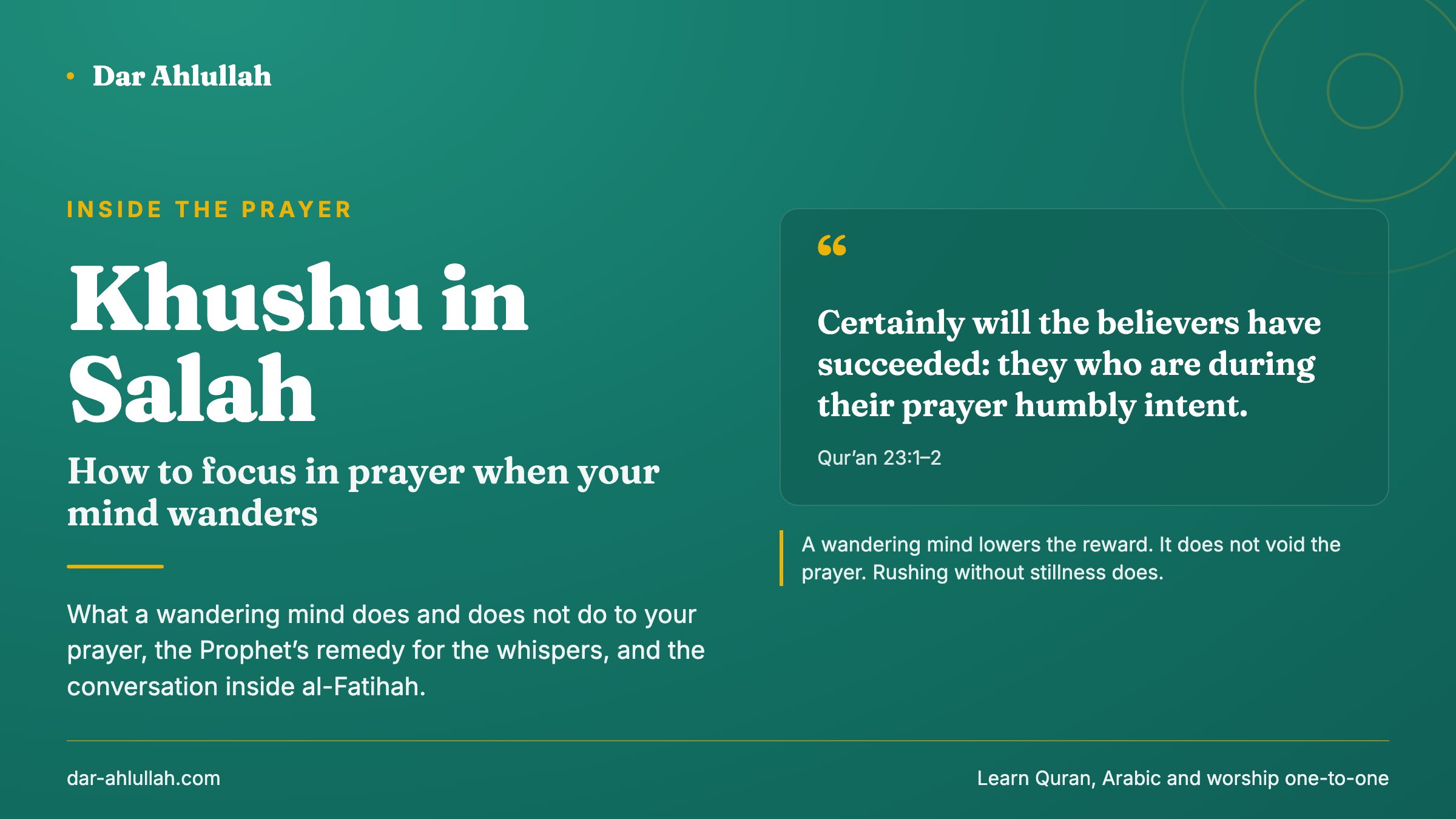
khushu in salah
Khushu in Salah: How to Focus in Prayer When Your Mind Wanders
Khushu is stillness of the body and presence of the heart in prayer. What a wandering mind does and does not do to your salah, what the Sunnah gives you before the takbir, inside the prayer and when the whispers come, and how a non-Arabic speaker learns to mean the words.
26 min read
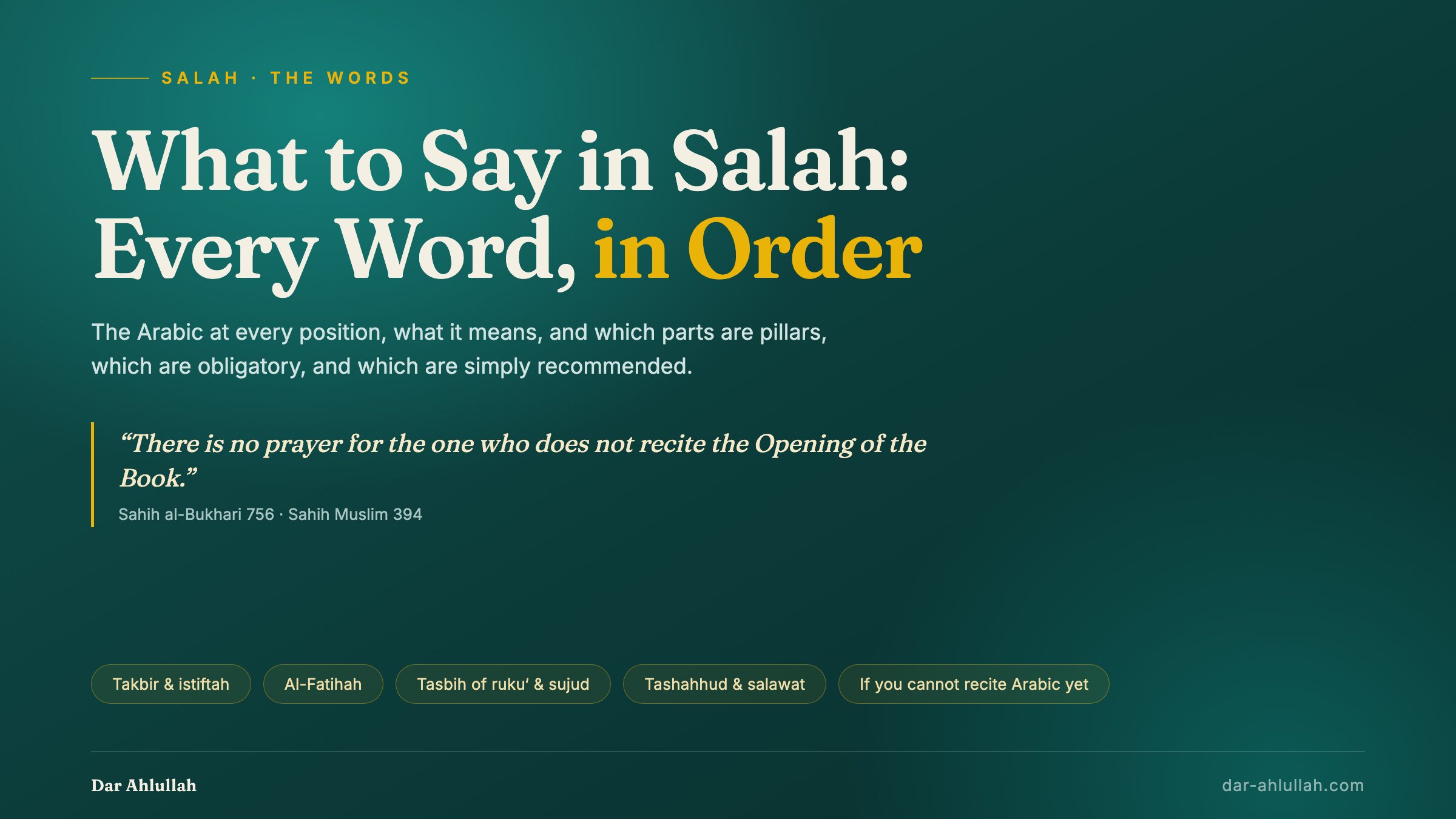
what to say in salah
What to Say in Salah: Every Word of the Prayer, in Order
Most guides to prayer teach the postures and only name the words. This one teaches the words: what you say at every position, what it means, where it comes from, and which parts are pillars, which are obligatory, and which are simply recommended.
19 min read
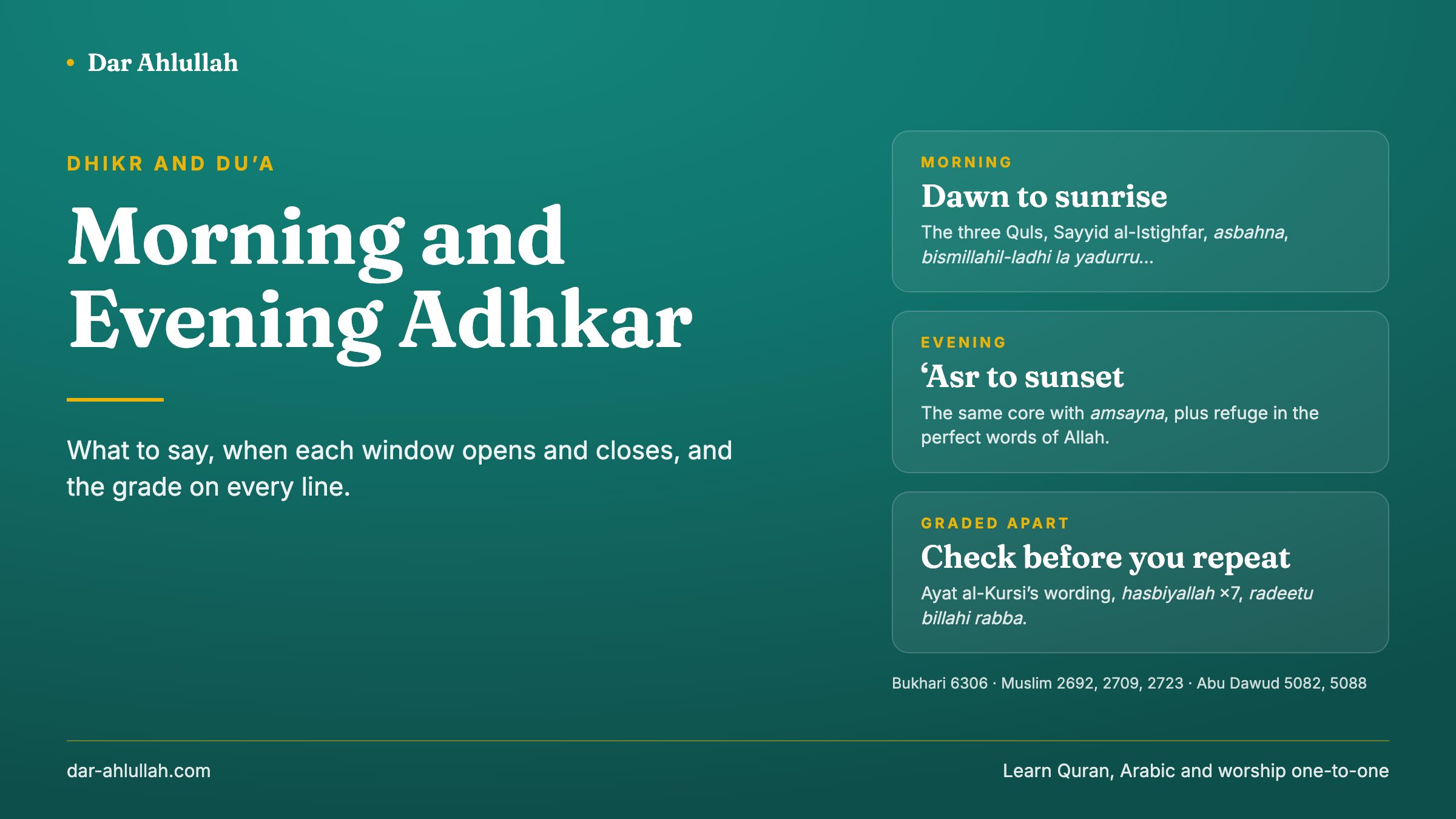
morning and evening adhkar
Morning and Evening Adhkar: What to Say and When
Morning and evening adhkar from the sound reports: the windows from dawn to sunrise and from 'Asr to sunset, the core set with the source and count of each line, and the grade printed on the popular additions the hadith scholars dispute, from Ayat al-Kursi to hasbiyallah seven times.
29 min read