
how to pray salat al-kusuf
How to Pray Salat al-Kusuf: The Eclipse Prayer
Dar Ahlullah team 29 min read
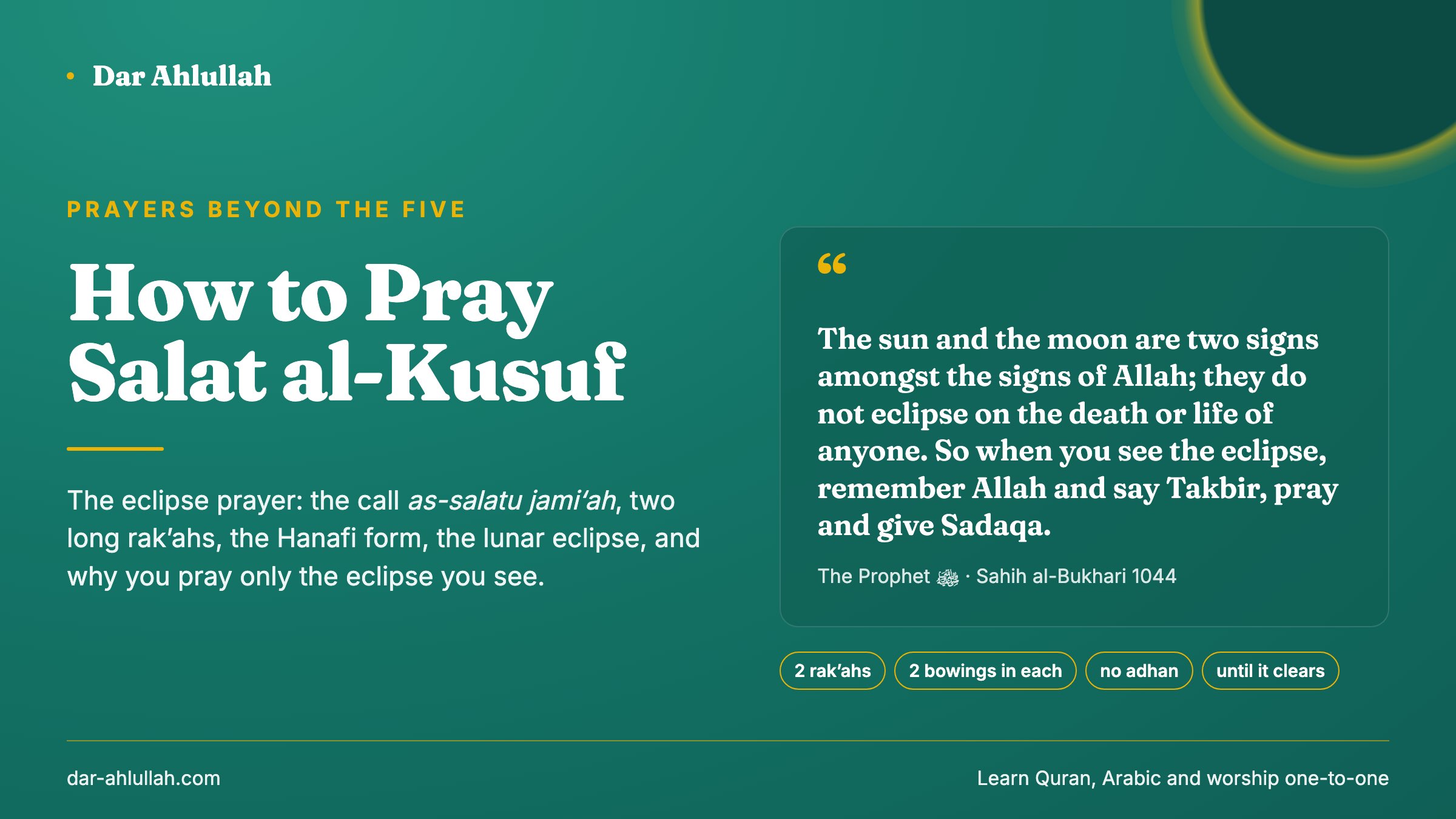
Table of Contents
- Introduction: The Day Ibrahim Died
- The Short Answer
- Kusuf and Khusuf: What the Prayer Is For
- Only an Eclipse You Can See
- How to Pray Salat al-Kusuf, Step by Step
- The Hanafi Form: Two Ordinary Rak’ahs
- Where the Four Schools Differ
- How Many Bowings? What the Reports Say
- The Lunar Eclipse Prayer
- When the Eclipse Ends Mid-Prayer, or Outlasts It
- When It Meets the Five Prayers and the Forbidden Times
- Joining Late: Which Bowing Counts?
- After the Prayer: The Address, the Du‘a and the Charity
- If You Cannot Pray It
- Not to Be Confused With
- Seven Mistakes People Make
- How We Teach This
- Questions People Ask
- Conclusion: Two Signs, and What to Do With Them
Introduction: The Day Ibrahim Died
The sun went dark over Madinah on the day the Prophet’s infant son Ibrahim died, and people drew the conclusion that seemed obvious: the sun had darkened for him. “The people said that the sun had eclipsed because of the death of Ibrahim” (Sahih al-Bukhari 1043). The Prophet ﷺ went out dragging his cloak behind him until he reached the mosque (Sahih al-Bukhari 1040), “afraid that it might be the Hour”, and led a prayer with “the longest Qiyam, bowing and prostration” that Abu Musa had ever seen him perform (Sahih al-Bukhari 1059). Then he corrected them: “The sun and the moon do not eclipse because of the death or life (i.e. birth) of someone. When you see the eclipse pray and invoke Allah” (Sahih al-Bukhari 1043).
That prayer is salat al-kusuf, the eclipse prayer. Most Muslims have never stood in one, because a visible eclipse is a rare event in any one place. And when one does come, the questions arrive with it. Eclipses are now predicted to the minute, so do you pray when the news says it is happening? What if it is cloudy, or the eclipse is only visible in another country? Why does the imam stand back up after the bowing instead of going down into prostration? Why does your Hanafi friend pray it like an ordinary two rak’ahs? And what about the moon going dark at midnight?
This guide answers those questions from the hadith and the four Sunni schools. It covers what the prayer is for, the rule that ties it to what you can actually see, the full prayer step by step, the Hanafi form, the lunar eclipse prayer, the reports on the number of bowings with their grades, and what to do when the eclipse and the prayer do not finish together. If you are new to the prayer itself, start with our step-by-step guide to how to pray in Islam; this article sits in its salah library beside the other prayers beyond the five.
One boundary before we begin. We teach Quran, Arabic and the practical fiqh of worship; we are not a fatwa body. Where the schools differ, as they do on almost every detail here, we set the positions side by side rather than pick one and call it consensus. If your mosque holds the prayer, follow its imam.
The Short Answer
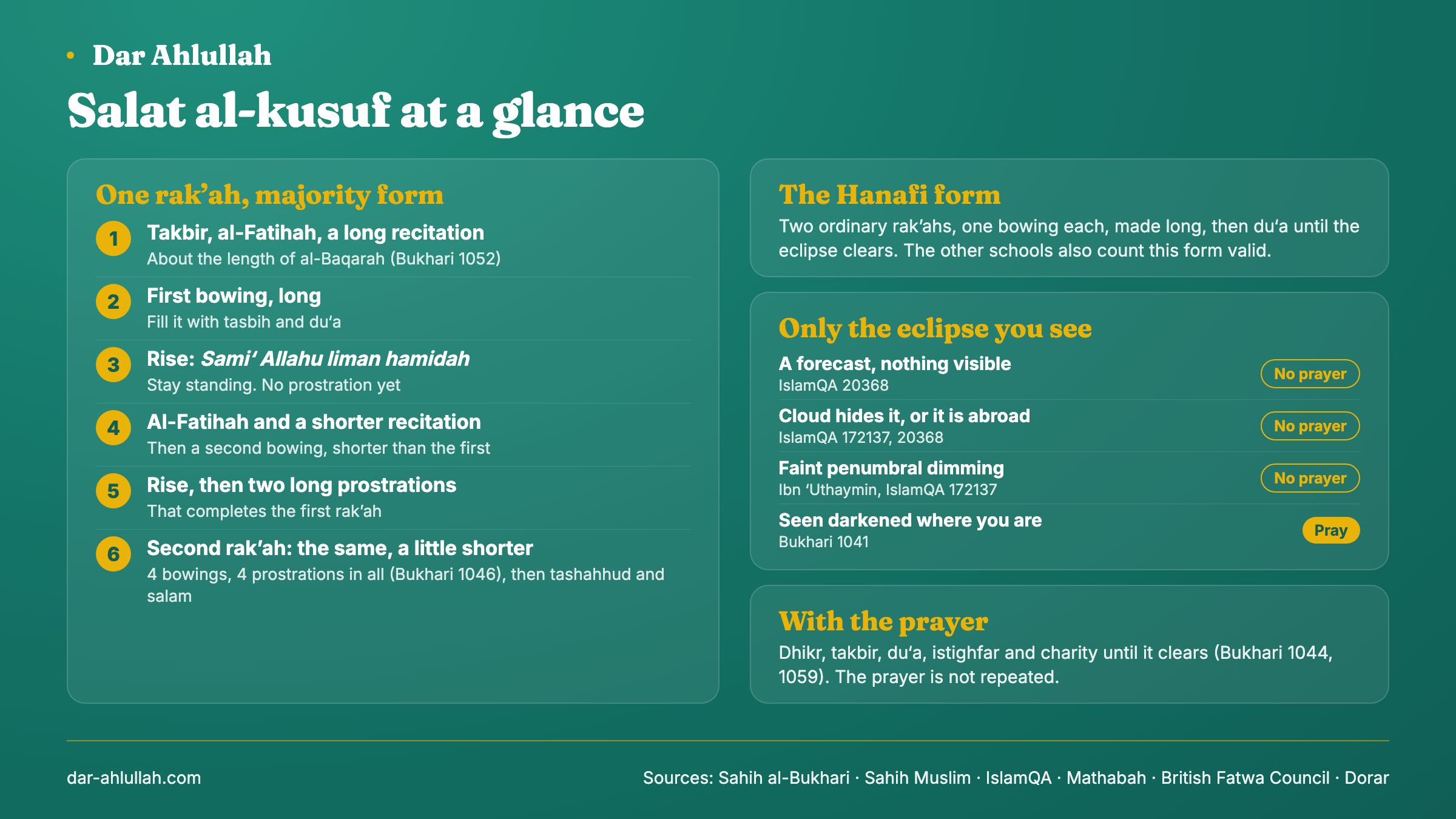
- Salat al-kusuf is two rak’ahs prayed when you see an eclipse of the sun or the moon. It is “a confirmed Sunnah according to the consensus of the scholars” (IslamQA 6111). There is no adhan and no iqamah; the call is as-salatu jami‘ah, “the prayer is gathering”.
- In the Maliki, Shafi‘i and Hanbali schools, each rak’ah has two standings with recitation and two bowings, then the usual two prostrations: “four bowing and four prostrations” in the whole prayer (Sahih al-Bukhari 1046). The Hanafi school prays two ordinary rak’ahs, one bowing each, made long.
- It is prayed only for an eclipse you see where you are, from the moment it becomes visible until it clears. Not on a forecast, not for an eclipse happening in another country, and not for a faint penumbral eclipse that nobody can see (IslamQA 20368, IslamQA 172137).
- If the eclipse clears during the prayer, finish it lightly. If the prayer ends first, keep making dhikr and du‘a until it clears. The prayer is not repeated, and it is not made up if missed.
- The prayer is not the only act. “When you see the eclipse, remember Allah and say Takbir, pray and give Sadaqa” (Sahih al-Bukhari 1044), and “ask for His forgiveness” (Sahih al-Bukhari 1059).
Kusuf and Khusuf: What the Prayer Is For
Kusuf means change. The Dorar fiqh encyclopedia explains that the sun is said to undergo kusuf “when its illumination disappears and it becomes black”, and that some scholars keep kusuf for the sun and khusuf for the moon while others treat the two words as synonyms (Dorar, Summary of Feqh, eclipse prayer section I). The hadith use both verbs for the sun: in one of ‘A’ishah’s reports the sun khasafat (Sahih al-Bukhari 1047). So “salat al-kusuf” is the usual name for both prayers, and “salat al-khusuf” is often used for the lunar one.
The reason for the prayer is given in the Prophet’s own words: the sun and the moon “are the two signs among the signs of Allah by which He frightens his servants and they do not eclipse on account of the death of any one of the people. So when you see anything about them, observe prayer, supplicate Allah till it is cleared from you” (Sahih Muslim 911). The Qur’an makes the same point from the other side: “And of His signs are the night and day and the sun and moon. Do not prostrate to the sun or to the moon, but prostrate to Allah, who created them” (Qur’an 41:37). An eclipse is the moment the two brightest things in the sky are visibly not in charge of themselves. IslamQA also links it to the description of the Last Day, “And the moon darkens. And the sun and the moon are joined” (Qur’an 75:7-9), as a reminder of what is coming (IslamQA 65719).
“But we know exactly when eclipses happen”
This is the question most people ask now, and it has a direct answer. A questioner put it to IslamQA that an eclipse is “nothing but a normal process”, so why pray? The reply, written by Shaykh ‘Abd al-Rahman al-Barrak, notes that the early Muslims did not know when an eclipse would happen, and that when astronomy made eclipses predictable, “the scholars pointed out that this did not change the ruling, and that the Muslims still had to do what they were commanded to do at the time of an eclipse, even if they knew about it in advance” (IslamQA 5901). Notice also what the Prophet ﷺ did on the day itself: he took apart the superstitious reading of the eclipse, not the natural one. Knowing the mechanism tells you when to look up. The Sunnah tells you what to do when you see it.
Is it obligatory?
No. The four Sunni schools agree that the solar eclipse prayer is an emphasised sunnah and not wajib (Mughniyya, Prayer According to the Five Schools). For the lunar eclipse the grading is lighter in two schools: an emphasised sunnah for the Shafi‘is and Hanbalis, recommended (mandub) for the Malikis and praiseworthy (hasan) for the Hanafis, and “No Islamic jurist has made the lunar eclipse prayer mandatory” (Mathabah, The Status of the Lunar Eclipse Prayer). It is recommended for women as for men by agreement of the four schools (Dorar, section I), and on the day itself ‘A’ishah was in the rows, as was her sister Asma’, who stood so long that she had to pour water on her head (Sahih al-Bukhari 1053).
Only an Eclipse You Can See
Every version of the command is tied to sight: “When you see them stand up and pray” (Sahih al-Bukhari 1041). IslamQA draws the ruling out plainly: “those who offer the eclipse prayer on the basis of astronomers’ reports are making a mistake and going against the Sunnah”, and “it is not prescribed for the people who live in a country where the eclipse is not happening to offer the prayer” (IslamQA 20368). The Dorar encyclopedia says the same in one line: astronomical statements that an eclipse will happen at a given time “have no bearing on Sharia rulings. These prayers are not offered until the solar or lunar eclipse is seen” (Dorar, section II).
That rule settles three situations people actually meet:
- The forecast says an eclipse, but the sky is cloudy. Shaykh Ibn ‘Uthaymin was asked exactly this and answered that it is not permissible to pray “relying on what is published in newspapers or stated by some astronomers, if the sky is cloudy and the eclipse is not seen”, adding: “It is possible that Allah, may He be exalted, may conceal this eclipse from some people and not others, in His wisdom” (quoted in IslamQA 172137).
- The eclipse is real, but somewhere else. A livestream of totality over another continent is not an eclipse over you. The prayer is “only prescribed for those who see the eclipse and in whose land it occurs” (IslamQA 20368).
- The eclipse is so slight that nobody can see it. Ibn ‘Uthaymin again: some announced eclipses turn out “partial and so small that it cannot be seen”, and “If it is announced but does not become apparent, it is not permissible to offer the eclipse prayer.” He added that astronomers sometimes use the word for the penumbra, when “the light becomes slightly dimmer, but the eclipse is not clear” (IslamQA 172137).
Seeing it does not mean staring at the sun
The sighting rule sends people outside to check, which is where they get hurt. NASA’s guidance is blunt: “Except during the brief total phase of a total solar eclipse, when the Moon completely blocks the Sun’s bright face, it is not safe to look directly at the Sun without specialized eye protection for solar viewing,” and ordinary sunglasses, “no matter how dark, are not safe for viewing the Sun” (NASA, Eclipse Safety). Use eclipse glasses or a pinhole projection, or let one properly equipped person check for the whole mosque.
The next eclipses on the calendar
These are NASA’s dates for the next few eclipses and the regions they reach (NASA solar eclipses 2021-2030, NASA lunar eclipses 2021-2030). A region on the list is not a promise that you will see it: the sighting rule still decides.
| Date | Eclipse | Where NASA lists it as visible | What the sighting rule means |
|---|---|---|---|
| 6 February 2027 | Annular solar | South America, Antarctica, west and south Africa; the ring itself over Chile, Argentina and the Atlantic | Pray if you see the sun visibly eclipsed where you are |
| 20 February 2027 | Penumbral lunar | The Americas, Europe, Africa, Asia | The moon only dims; no prayer unless it is visibly darkened |
| 18 July 2027 | Penumbral lunar | East Africa, Asia, Australia, the Pacific | As above |
| 2 August 2027 | Total solar | Africa, Europe, the Middle East, west and south Asia; totality over Morocco, Spain, Algeria, Libya, Egypt, Saudi Arabia, Yemen and Somalia | A partial eclipse across a wide area, total along the path; pray where it is seen |
| 17 August 2027 | Penumbral lunar | The Pacific, the Americas | As for the other penumbral eclipses |
| 12 January 2028 | Partial lunar | The Americas, Europe, Africa | Pray where the darkening is seen |
Two things stand out. All three lunar eclipses of 2027 are penumbral, the kind Ibn ‘Uthaymin describes as a slight dimming, so 2027 may pass with no lunar eclipse prayer at all. And the total solar eclipse of 2 August 2027 crosses North Africa and Arabia, including Egypt and Saudi Arabia, and reaches far beyond that path as a partial eclipse. NASA’s dates are for the moment of greatest eclipse; your local date and time, and whether you see it at all, depend on where you are.
How to Pray Salat al-Kusuf, Step by Step
This is the form of the Maliki, Shafi‘i and Hanbali schools, taken from ‘A’ishah’s and Ibn ‘Abbas’s reports and set out step by step in IslamQA 210590, which cites Ibn Qudamah’s al-Mughni and al-Nawawi’s al-Majmu‘. The Hanafi form follows in the next section.
Before it begins. Make wudu and face the qiblah as for any prayer. There is no adhan and no iqamah, a point on which Dorar reports consensus from Ibn Battal, Ibn ‘Abd al-Barr, Ibn Hazm, al-Nawawi and Ibn Daqiq al-‘Id (Dorar, section II). Instead someone calls out as-salatu jami‘ah. The Prophet ﷺ “made a person to announce: ‘Prayer in congregation’” (Sahih al-Bukhari 1065; also Sahih al-Bukhari 1045), and “The Sunnah is for the caller to repeat that until he thinks that the people have heard” (IslamQA 9954).
The first rak’ah
- Opening takbir, then the opening du‘a and the seeking of refuge, as in any prayer.
- First standing: al-Fatihah, then a long recitation. Ibn ‘Abbas says the Prophet ﷺ “stood for a long period equal to the period in which one could recite Surat-al-Baqara” (Sahih al-Bukhari 1052).
- First bowing: a long ruku‘.
- Rise and stay standing. Say Sami‘ Allahu liman hamidah, Rabbana wa lakal-hamd, but do not go down into prostration. ‘A’ishah: “He then did not prostrate but stood up and recited a prolonged recitation which was shorter than the first recitation” (Sahih al-Bukhari 1046).
- Second standing: al-Fatihah again, then another recitation, shorter than the first. IslamQA 6111 suggests something the length of Surah Al ‘Imran.
- Second bowing: long, but shorter than the first.
- Rise again, saying Sami‘ Allahu liman hamidah, Rabbana wa lakal-hamd. IslamQA 6111 gives the fuller praise here: hamdan kathiran tayyiban mubarakan fih, mil’ as-samawati wa mil’ al-ard wa mil’ ma shi’ta min shay’in ba‘d.
- Two long prostrations. The two IslamQA descriptions differ on the sitting between them: 6111 says not to make it too long, while 210590, citing al-Mughni and al-Majmu‘, says to sit for a long time.
The second rak’ah
- Stand and repeat the whole pattern: recitation, bowing, rising, recitation, bowing, rising, then two prostrations.
- Make each part shorter than its match in the first rak’ah. Al-Nawawi reports agreement that the second standing and bowing of each rak’ah are shorter than the first (quoted in Dorar, section III).
- Tashahhud and salam. “Thus he completed four bowing and four prostrations” (Sahih al-Bukhari 1046).
What to say in the long bowings and prostrations
The ordinary words of ruku‘ and sujud, then dhikr and du‘a to fill the length. Qur’an is not recited in bowing or prostration, and the Hanafi guidance at Mathabah says the bowing and prostration “should be filled with supplication and adhkar” (Mathabah, Salat al-Kusuf According to the Hanafi Madhhab). If you want the standard words for each position, our guide to what to say in salah has them in Arabic and English. One report shows the Prophet ﷺ pleading in the last prostration: “My Lord, didst Thou not promise me that Thou wouldst not punish them so long as I will remain among them?” (Sunan Abi Dawud 1194, sahih per al-Albani, hasan per al-Arna’ut).
How long should it be?
As long as the eclipse, roughly. Ibn Taymiyyah, quoted in IslamQA 6111, says a total eclipse calls for a first rak’ah long enough for all of al-Baqarah, and “if it is known that the eclipse will not last for long, or if it started to get less, one should still pray, but the prayer should be shortened. This is the opinion of the majority of scholars.” The length follows the eclipse, not a fixed recitation.
Aloud or silent?
‘A’ishah reports that “The Prophet ﷺ recited (the Qur’an) aloud during the eclipse prayer” (Sahih al-Bukhari 1065; also Jami‘ at-Tirmidhi 563, sahih per al-Albani). Samurah ibn Jundub reports the opposite, “we did not hear his voice”, and his report is graded differently by different scholars: da‘if per al-Albani and hasan sahih per al-Arna’ut in Sunan Abi Dawud 1184; da‘if per al-Albani and Ahmad Shakir in Jami‘ at-Tirmidhi 562. Al-Nawawi reconciles the two for the Shafi‘i school by time of day: “the recitation is done quietly (sirr) for sunnah solar eclipse prayer” because it is prayed in daylight, “and the recitation is loud (jahr) for sunnah lunar eclipse prayer” (al-Majmu‘, quoted by the Federal Territory Mufti’s Office, Malaysia). The Hanbali school recites aloud in both (Dorar, section III). The full split is in the table below.
The Hanafi Form: Two Ordinary Rak’ahs
The Hanafi school prays the eclipse prayer as “a standard two-unit supererogatory prayer with a single bowing and two prostrations in each unit, like in other prayers”, with al-Baqarah recommended in the first rak’ah and Al ‘Imran in the second (Mathabah, Hanafi madhhab). The British Fatwa Council gives the same form, “the general manner of an ordinary two-rak‘ah voluntary prayer”, with the recitation, bowing and prostration all prolonged, and cites al-Hidayah, Bada’i‘ al-Sana’i‘ and al-Fatawa al-Hindiyyah for it (British Fatwa Council).
Three further Hanafi details, all from the Mathabah guide:
- Prayer and du‘a together fill the eclipse. “If the prayer is shortened, then the subsequent supplication should be extended until the eclipse concludes.” After the prayer the imam makes du‘a until the sun reappears, and the people say amin.
- Alone, two or four rak’ahs. “If praying alone, then one is to pray either two or four units; the latter is preferred when praying individually.”
- Recitation is silent for Abu Hanifah, aloud for Abu Yusuf and Muhammad. Mathabah suggests an imam who recites al-Baqarah and Al ‘Imran can lean on the view of the two companions to help the congregation’s concentration.
Why one bowing when ‘A’ishah describes two? The school’s answer, as Mathabah summarises it, is that the several narrations describe “the single historical instance of this prayer with contradictory details in the number of units of prayer, bowing, and prostration”, and that Imam al-Tahawi “presents the preponderance of narrations which depict two standard units of prayer and strengthens them over all other narrations.” Some reports do say only that he “led us in a two-rak‘at prayer till the sun (eclipse) had cleared” (Sahih al-Bukhari 1040). The two reports Fiqh us-Sunnah cites for the one-bowing form, from al-Nu‘man ibn Bashir and Qabisah al-Hilali, are graded weak by the hadith critics: Sunan Abi Dawud 1193 is munkar per al-Albani and da‘if per al-Arna’ut, and Sunan Abi Dawud 1185 is da‘if per al-Albani, al-Arna’ut and Zubair ‘Ali Za’i.
Two points keep this from becoming a fight. The comparative survey by Muhammad Jawad Mughniyya records that in the other three schools, as well as having two bowings per rak’ah, “It is also valid to perform it in the manner of a nafilah salat” (Mughniyya, Prayer According to the Five Schools). And the British Fatwa Council closes its answer this way: “This difference should be understood as a recognised difference of Islamic jurisprudence and should not become a cause of dispute.”
Where the Four Schools Differ
Almost every practical detail is disputed. The table gathers them from the sources named in each cell; the Dorar entries are from its four-part summary (I, II, III, IV), and the Maliki entries also draw on a guide adapted from Mukhtasar Khalil and its commentaries (Maliki Fiqh Q&A).
| Question | Hanafi | Maliki | Shafi‘i | Hanbali |
|---|---|---|---|---|
| Bowings in each rak’ah | One, as in any voluntary prayer (Mathabah; British Fatwa Council) | Two (Dorar III) | Two (Dorar III) | Two (Dorar III) |
| Recitation, solar eclipse | Silent per Abu Hanifah; aloud per Abu Yusuf and Muhammad (Mathabah) | Silent (Maliki Fiqh Q&A); one position in the school says aloud (Dorar III) | Silent (al-Nawawi, al-Majmu‘) | Aloud (Dorar III) |
| Recitation, lunar eclipse | Prayed alone at home, like any voluntary prayer at night (Mathabah; Mughniyya) | Aloud (Dorar III; Maliki Fiqh Q&A) | Aloud (al-Nawawi; Dorar III) | Aloud (Dorar III) |
| When it may be prayed | While the eclipse lasts, but not at sunrise, zenith or after ‘Asr; make du‘a instead until the disliked time passes (Mathabah) | Solar: only from when voluntary prayer is allowed after sunrise until the sun passes its zenith, on the school’s best-known position; other positions allow later (Maliki Fiqh Q&A) | Any time while the eclipse lasts, even the forbidden times (Dorar II) | While the eclipse lasts, not in the forbidden times; a narration from Ahmad allows them (Dorar II) |
| Lunar eclipse: congregation or alone? | Alone at home; not enacted for congregation (Mathabah; Mughniyya) | Alone at home (Mathabah; Maliki Fiqh Q&A) | Congregation in the mosque (Mathabah; Dorar I) | Congregation in the mosque (Mathabah; Dorar I) |
| A khutbah afterwards? | No; the Prophet’s words were a refutation, not a sermon (Mathabah). A position in the school holds a sermon (Dorar IV) | No khutbah, but an admonition is recommended (Dorar IV; Maliki Fiqh Q&A) | Yes, two khutbahs (Dorar IV) | No, on the school’s position; a narration from Ahmad says yes (Dorar IV) |
Two of these rows matter more than they look. The Maliki time limit means that on that school’s best-known position an afternoon solar eclipse is met with dhikr and du‘a, not the prayer. And the forbidden-times row decides what a mosque does with an eclipse that starts after ‘Asr: the Hanafi, Maliki and Hanbali schools wait or make du‘a, while the Shafi‘i school prays, and so do the later Hanbali scholars Ibn Taymiyyah, Ibn Baz and Ibn ‘Uthaymin, who chose that view (Dorar II). Our guide to salat al-tawbah sets out the same forbidden-times split for the other prayers that have a cause.
How Many Bowings? What the Reports Say
If you read around, you will meet eclipse prayers with three, four or five bowings in a rak’ah. They come from real reports, but not all of them are sound. Here they are with the grades the hadith scholars give them.
| Bowings per rak’ah | Report | Where and grade |
|---|---|---|
| Two | ‘A’ishah, Ibn ‘Abbas and Jabir: four bowings and four prostrations in two rak’ahs | Sahih al-Bukhari 1044, 1046, 1052; Sahih Muslim 901a, 904a |
| Three | ‘A’ishah: “In each rak’ah he bowed three times”; Jabir: “six bowings and four prostrations” | Sunan Abi Dawud 1177, da‘if per al-Albani and al-Arna’ut; 1178, shadhdh per al-Albani |
| Four | Ibn ‘Abbas: “eight ruku‘s and four prostrations” | Sahih Muslim 908, 909; the same report in Sunan Abi Dawud 1183 is da‘if per al-Albani, hasan sahih per al-Arna’ut |
| Five | Ubayy ibn Ka‘b: “bowing five times and prostrating himself twice” | Sunan Abi Dawud 1182, da‘if per al-Albani, al-Arna’ut and Zubair ‘Ali Za’i |
| One | Al-Nu‘man ibn Bashir: pairs of rak’ahs until the sun cleared; Qabisah: “pray as you are praying a fresh obligatory prayer” | Sunan Abi Dawud 1193, munkar per al-Albani; 1185, da‘if per al-Albani, al-Arna’ut and Zubair ‘Ali Za’i |
The two-bowing form is the one in the most reports and the soundest ones. Fiqh us-Sunnah quotes Ibn al-Qayyim calling it “the authentic, clear, and prepondering sunnah” (Fiqh us-Sunnah, Salatul Kasuf), and the four-bowing report is the one alternative that Sahih Muslim itself includes. If you pray behind an imam, you pray his form. If you pray alone, the two-bowing form is what the Maliki, Shafi‘i and Hanbali schools teach, and the plain two rak’ahs is what the Hanafi school teaches.
The Lunar Eclipse Prayer
Fiqh us-Sunnah states it simply: “The prayer of the lunar eclipse is similar to that of the solar eclipse.” The schools agree on the principle and differ on the setting, because a lunar eclipse happens at night:
- Shafi‘i and Hanbali: an emphasised sunnah, prayed in congregation in the mosque in the same two-bowing form, recited aloud (Mathabah; Dorar I and III).
- Hanafi: praiseworthy, prayed individually at home. Mughniyya records the school’s view that it “has not been enacted for jama’ah, and has to be performed singly, at home.”
- Maliki: recommended, prayed at home. The Maliki guide describes ordinary two-rak’ah voluntary prayers, recited aloud, repeated until the eclipse ends: “they would do two units, then look outside to see if the eclipse is ongoing. If it is, then they would do two more.”
Mathabah gives the reason for the home preference in the two schools as nightfall “and its dangers”. In a city with lit streets and a mosque that stays open, the Shafi‘i and Hanbali congregation is easy to find; in a small community, the Hanafi and Maliki way means nobody has to go anywhere.
If the moon is still eclipsed when you go out for Fajr, IslamQA says you may start with the eclipse prayer, as some scholars suggest, or with Fajr, which “is also good because the obligatory prayer should come first” and lets those who need to leave do so (IslamQA 65719).
When the Eclipse Ends Mid-Prayer, or Outlasts It
The prayer’s time is the eclipse itself: “from the beginning of the eclipse until it is over” (IslamQA 6111). That leaves four cases.
| What happens | What to do | Source |
|---|---|---|
| The eclipse clears while you are praying | Finish the prayer lightly; do not break it off. On the Shafi‘i and Hanbali view and that of the Maliki Asbagh, you complete it in its normal form, quickly | IslamQA 6111, citing Qur’an 47:33; Dorar II |
| Same, in the Maliki detail | If the first rak’ah is already complete, Sahnun says finish like an ordinary voluntary prayer and Asbagh says keep the extra standing and bowing but go quickly, two views held equally strong. If the first rak’ah is not complete, finish as an ordinary voluntary prayer | Maliki Fiqh Q&A |
| The prayer ends but the eclipse is still there | Do not repeat the prayer. Make dhikr and du‘a until it clears | IslamQA 6111; Dorar I (agreement of the four schools) |
| The eclipse ended before you knew, or you missed it | Nothing is owed. The eclipse prayer is not made up | IslamQA 6111; Dorar I (consensus related by al-Nawawi, Ibn Hajar and al-Shawkani) |
This is also why the Prophet’s words stress du‘a and not just prayer: “pray and invoke (Allah) till the eclipse is over” (Sahih al-Bukhari 1040). If the prayer is short and the eclipse is long, the du‘a carries the rest. ‘Abd al-Rahman ibn Samurah found the Prophet ﷺ during one eclipse “supplicating with his hands, raised, pronouncing Allah-o-Akbar, praising Him, acknowledging that He is One God till the eclipse was over, then he recited two surahs and prayed two rak’ahs” (Sahih Muslim 913a).
When It Meets the Five Prayers and the Forbidden Times
- At ‘Asr. If the sun is eclipsed after the adhan for ‘Asr, pray ‘Asr first and then the eclipse prayer. If it is eclipsed before the adhan, pray the eclipse prayer first, then give the adhan and pray ‘Asr: “It does not matter if the Adhan is given later than the beginning of the time for ‘Asr” (IslamQA 6124).
- At Fajr. Either may come first, as above (IslamQA 65719).
- In the forbidden times (at sunrise, at the zenith, after ‘Asr until sunset). The Hanafi, Maliki and Hanbali schools do not pray it then; the Shafi‘i school does, along with one Maliki position, a narration from Ahmad, and Ibn Taymiyyah, Ibn Baz and Ibn ‘Uthaymin (Dorar II). In the Hanafi school you make du‘a until the disliked time passes, then pray if the eclipse is still visible (Mathabah).
Joining Late: Which Bowing Counts?
Two bowings in a rak’ah raise a question that no other prayer has: if you arrive while the imam is in the second bowing, have you caught the rak’ah? The schools answer differently.
- The first bowing counts, in the answer at IslamQA: “The rak’ah will count in Salat al-Kusoof if you catch up with the first rukoo’.” If you joined at the second bowing of the first rak’ah, then after the imam’s salam “you have to do a whole rak’ah with its two recitations, two rak’ahs [bowings] and two sujoods” (IslamQA 6309).
- The second bowing counts in the Maliki guide: “If one catches the second ruku‘ of the Rak‘a, then they have caught that entire rak‘a.” Join at the second bowing of the first rak’ah and there is nothing to make up; join at the second bowing of the second rak’ah and you make up one rak’ah (Maliki Fiqh Q&A).
In the Hanafi form there is only one bowing, so the ordinary rule for a latecomer applies. For how making up missed rak’ahs works in general, see our guide to joining the prayer late.
After the Prayer: The Address, the Du‘a and the Charity
When the prayer ended, the Prophet ﷺ “delivered the Khutba (sermon) and after praising and glorifying Allah he said, ‘The sun and the moon are two signs amongst the signs of Allah; they do not eclipse on the death or life of anyone. So when you see the eclipse, remember Allah and say Takbir, pray and give Sadaqa’” (Sahih al-Bukhari 1044). Whether that was a formal khutbah is the dispute in the table above. The Shafi‘i school holds two sermons; the Hanafi, Maliki and Hanbali schools do not make a sermon part of the prayer, though the Malikis recommend that the imam admonish the people, “He encourages them to give charity, free slaves, and fast” (Dorar IV). Either way, the content is the same: correct the superstition, remind people of Allah’s power, and tell them what to do.
What to do is a list, not a single act:
- Du‘a and istighfar. “Proceed to remember Allah, invoke Him and ask for His forgiveness” (Sahih al-Bukhari 1059). The British Fatwa Council notes that there is no fixed du‘a authentically prescribed exclusively for after the eclipse prayer, so any du‘a from the Qur’an and Sunnah is fine, and you may ask “in one’s own language”.
- Takbir. “Supplicate Allah, declare His greatness, and give alms” (Sunan Abi Dawud 1191, sahih per al-Albani).
- Charity. In Sahih al-Bukhari 1044, as above.
- Freeing slaves. Asma’ reports that “the Prophet ﷺ ordered people to manumit slaves during the solar eclipse” (Sahih al-Bukhari 1054). IslamQA 6111 reads the list together: an eclipse is a warning, and the remedy is every righteous deed that turns people back to Allah.
If You Cannot Pray It
- There is no congregation near you. Pray it alone. Praying the solar eclipse prayer individually is permissible by agreement of the four schools, though congregation is better (Dorar I; IslamQA 6111).
- You are menstruating or have another excuse. The rest of the list is still yours: “calling upon Allah, giving charity, seeking Allah’s forgiveness, remembering Him, and other deeds by means of which she may draw close to Allah” (IslamQA 228904).
- You are at work or on the road. The prayer is a sunnah, not an obligation, and the dhikr, du‘a and charity that go with it need no prayer-place at all.
Not to Be Confused With
- Salat al-istisqa. The other congregational prayer for something happening in the sky, but in the opposite direction: istisqa asks for rain that has not come. It has one bowing in each rak’ah, and the Maliki Risala says that is “to avoid being like the eclipse prayer”. See how to pray salat al-istisqa.
- Salat al-janazah. The eclipse prayer the Companions described was prayed on the day of a death, and the Prophet ﷺ used it to teach that the sky does not mourn anyone. The prayer for the dead is a separate prayer, prayed standing with four takbirs and no bowing at all. See how to pray salat al-janazah.
- The Eid prayer. The Hanafi school compares the eclipse prayer to the Eid and Friday prayers in its ordinary shape (Fiqh us-Sunnah), but the Eid prayer has extra takbirs and a fixed day, and the eclipse prayer has neither.
- Salat al-ayat. In Shi‘i (Imami) law the eclipse prayer is obligatory, has five bowings in each rak’ah, and is also prayed for earthquakes and frightening signs in the sky (Mughniyya). This guide follows the four Sunni schools.
Seven Mistakes People Make
- Praying on the forecast. The prayer starts when the eclipse is seen, not when the app says it has started (IslamQA 20368).
- Praying for an eclipse on a screen. An eclipse in another country, however well streamed, is not an eclipse over you.
- Going down into prostration after the first bowing. Behind an imam praying the two-bowing form, when he rises and starts reciting again, stay standing.
- Looking at the sun to check. Sunglasses are not eclipse glasses. Use proper solar viewers or a projection (NASA).
- Repeating the prayer because the eclipse is still going. Keep making du‘a instead. The prayer is prayed once.
- Reading the eclipse as an omen. That is the one belief the Prophet ﷺ went out of his way to correct on the day: it is not for anyone’s death or birth (Sahih al-Bukhari 1043).
- Calling the other school’s form wrong. The two-bowing form has the strongest reports behind it, the Hanafi form has its own reasoning, and the other three schools accept the plain form as valid (Mughniyya). Pray the form of your imam or your school.
How We Teach This
The eclipse prayer is rare enough that most people meet it once every few years, usually with no warning about the second bowing until they are already standing in the row. It asks for the same things as every prayer: a secure knowledge of the rak’ah itself, recitation you can sustain for a long standing, and enough Arabic to mean the dhikr and du‘a rather than just pronounce them. Fiqh basics, the prayer among them, are part of our Islamic Studies course, and the Quran and Arabic courses build the recitation and understanding behind every standing and du‘a in this article, one-to-one.
Dar Ahlullah runs one-to-one live sessions with certified teachers, at times that work in your timezone. Teaching is charged at $9 per teaching hour, with monthly plans at $36, $70 and $102 depending on how many hours you want, and a 20% discount for siblings. You can pause, upgrade or switch plans at any time, and if a teacher is not the right fit we rematch you with another certified mentor at no extra cost. If you would like to see where your prayer and recitation stand before committing to anything, the 30-minute assessment is free and does not ask for a card. The details are on our pricing page.
Questions People Ask
What is salat al-kusuf?
The eclipse prayer: two rak’ahs prayed when an eclipse of the sun or moon is seen, with long recitation, bowing and prostration, followed by dhikr, du‘a, istighfar and charity until the eclipse clears. The Prophet ﷺ prayed it on the day his son Ibrahim died (Sahih al-Bukhari 1043).
How many rak’ahs and bowings are in the eclipse prayer?
Two rak’ahs. In the Maliki, Shafi‘i and Hanbali schools each rak’ah has two bowings, four in all, with four prostrations (Sahih al-Bukhari 1046). In the Hanafi school each rak’ah has one bowing, like any voluntary prayer.
Is the eclipse prayer obligatory?
No. The four Sunni schools hold it to be a sunnah, emphasised for the solar eclipse. No jurist of the four schools has made the lunar eclipse prayer mandatory (Mathabah).
What is the difference between kusuf and khusuf?
Many scholars use kusuf for the sun and khusuf for the moon; others treat the words as the same (Dorar I). The prayer is essentially the same for both, with differences in where it is prayed and how the recitation is voiced.
Do I pray if the eclipse is not visible where I live, or it is cloudy?
No. The command is tied to seeing it: the prayer is “only prescribed for those who see the eclipse and in whose land it occurs” (IslamQA 20368), and Ibn ‘Uthaymin said not to pray on a forecast when clouds hide it (IslamQA 172137).
Can I pray salat al-kusuf alone at home?
Yes. It is better in congregation, but praying it alone is permissible (IslamQA 6111). For the lunar eclipse, the Hanafi and Maliki schools prefer that you pray at home.
Is the recitation loud or silent?
Both are reported. The Hanbali school recites aloud for both eclipses; the Shafi‘i school is silent for the sun and aloud for the moon; Abu Hanifah held it silent, and his two companions aloud (Dorar III; al-Nawawi; Mathabah).
Is there an adhan for the eclipse prayer?
No adhan and no iqamah. The call is as-salatu jami‘ah, repeated until people have heard (IslamQA 9954).
What if I join the imam in the second bowing?
On the view in IslamQA 6309 you have missed that rak’ah and make up a full one, with both bowings, after the salam. In the Maliki school the second bowing is the one that counts, so catching it catches the rak’ah.
Can a menstruating woman do anything during an eclipse?
Yes: du‘a, dhikr, istighfar and charity, everything on the list except the prayer itself (IslamQA 228904).
Is there a prayer for earthquakes or storms?
The schools differ. The Maliki and Shafi‘i schools say no other phenomenon calls for a prayer like the eclipse prayer (Dorar I). Mughniyya records that the Hanafis and Malikis recommend two rak’ahs at any frightening event, such as an earthquake, and that the Hanbalis recommend it only for an earthquake.
Conclusion: Two Signs, and What to Do With Them
Strip away the disputes and the prayer is easy to carry in your head. When you see the sun or the moon darken where you are, pray two rak’ahs and make them long: two standings and two bowings in each, if you pray with the majority, or two ordinary rak’ahs if you pray with the Hanafis. If the eclipse is still there when you finish, keep making du‘a. If it clears before you finish, finish lightly. Then give something away.
The schools differ on the bowings, the voice, the hour and the sermon, and each can point to a report. What none of them differs on is the correction the Prophet ﷺ made on the day it began: the sun and the moon do not darken for anyone’s death, and the right response to a sign is to turn to the One who made it. If you want the rest of the prayer in the same detail, the salah library links every guide we have written on it, including the other prayers with a cause, such as salat al-istisqa and salat al-tawbah.
Related articles
how to pray salat al-istisqa
How to Pray Salat al-Istisqa: The Prayer for Rain
Salat al-istisqa is how Muslims ask Allah for rain in a drought: two rak'ahs in open ground, a khutbah of istighfar, raised hands and a turned cloak. The three forms, the method, where the four schools differ, the du'as with their grades, and what to say when the rain comes.
26 min read
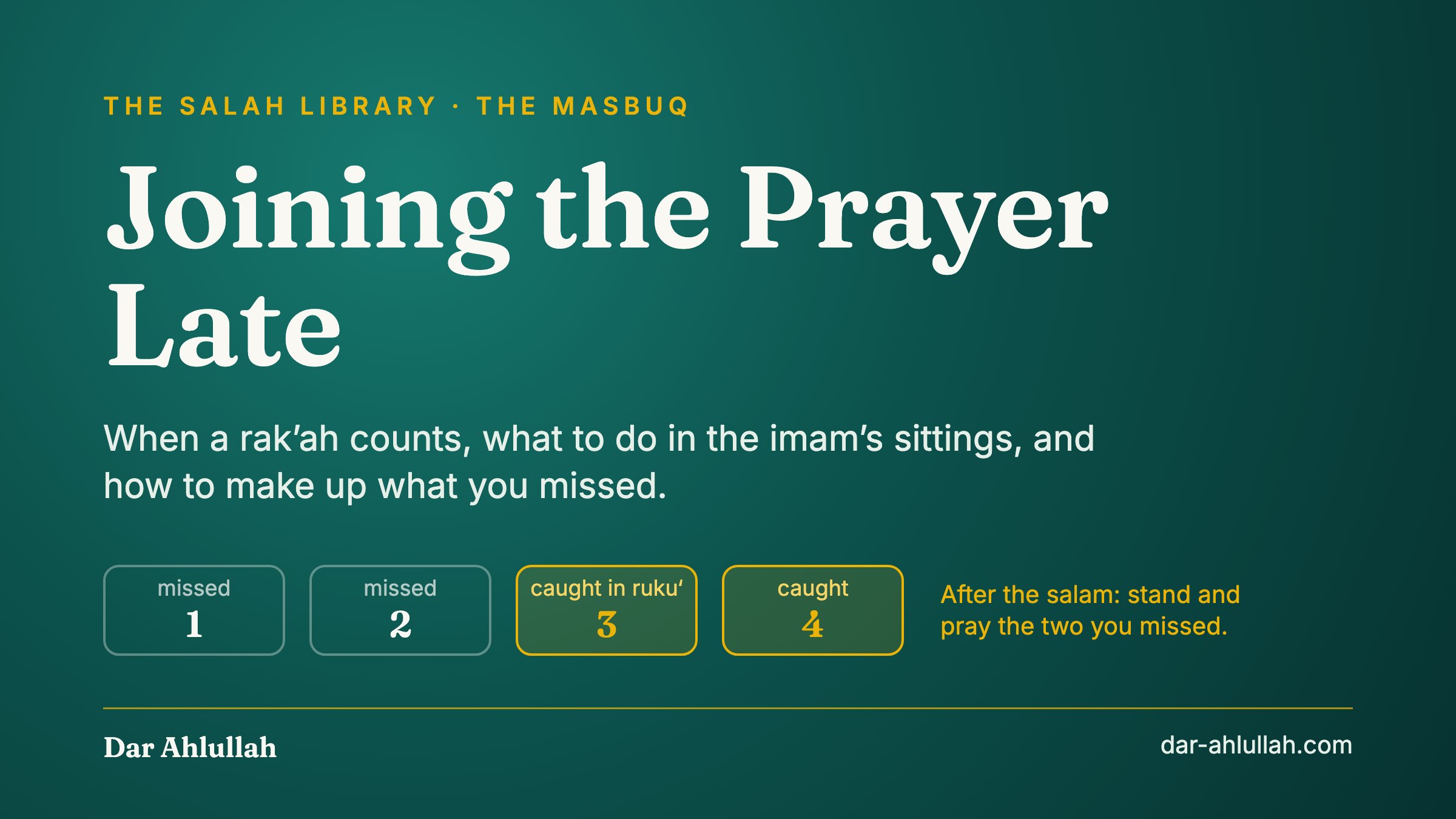
joining the prayer late
Joining the Prayer Late: How to Make Up Missed Rak’ahs
Joining the prayer late has a short, exact procedure: say the takbir standing, join the imam wherever he is, count the rak'ah only if you reached ruku' before he rose, and complete what you missed after his salam. This guide works through every prayer and arrival point, and explains why the person beside you may make up the same rak'ahs with a different recitation.
20 min read
how to pray salat al-janazah
How to Pray Salat al-Janazah: The Funeral Prayer
Salat al-Janazah is four takbirs said standing, with no bowing and no prostration. What you recite after each one, the full supplication for the deceased, what changes for a child, and what to do when you arrive late or missed it entirely.
21 min read