
how to pray salat al-janazah
How to Pray Salat al-Janazah: The Funeral Prayer
Dar Ahlullah team 21 min read
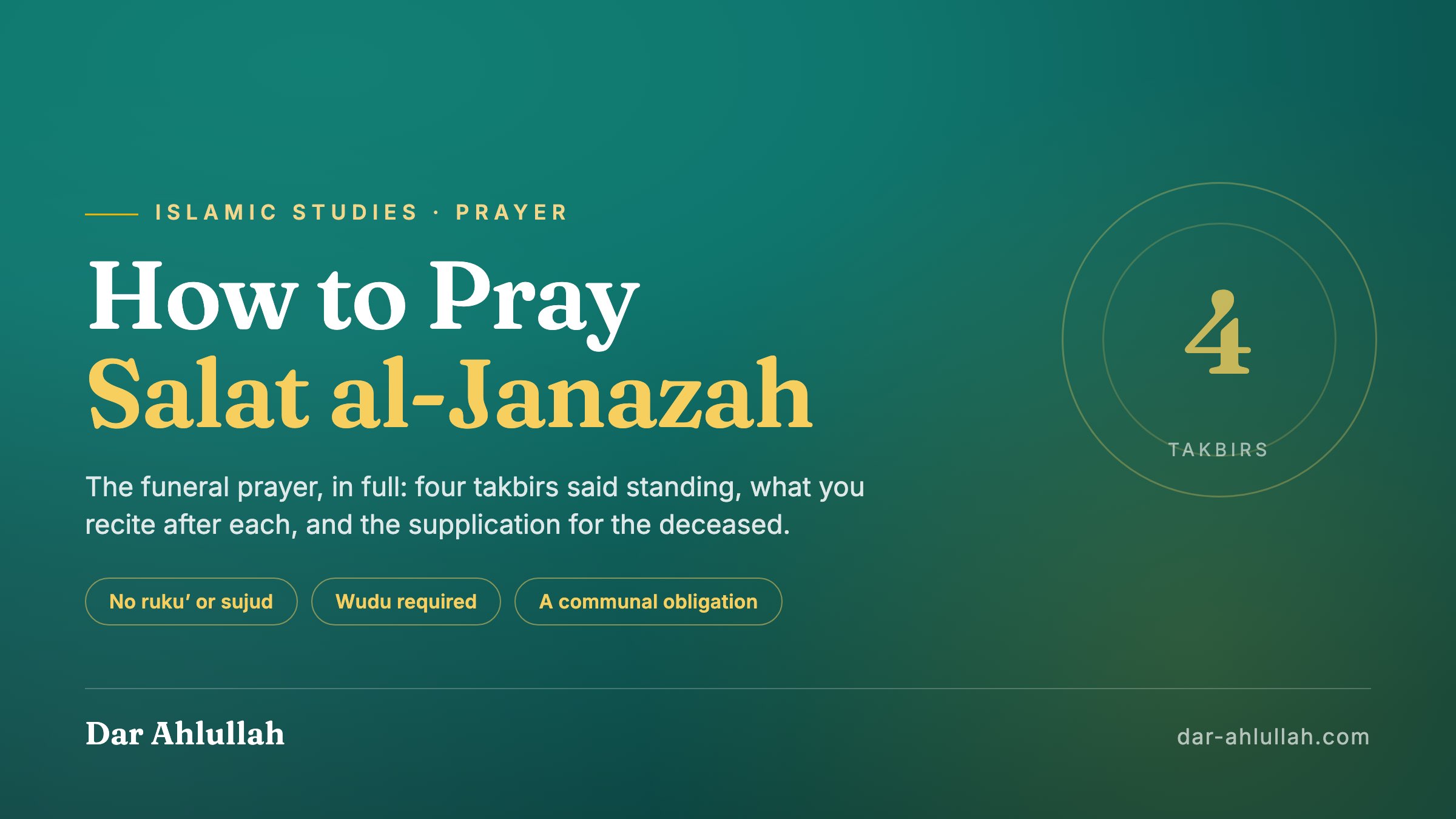
Table of Contents
- Introduction: The Prayer You Learn With Ten Minutes’ Notice
- The Short Answer
- What Salat al-Janazah Actually Is
- Before You Stand: Wudu, Rows, and Where the Imam Goes
- How to Pray Salat al-Janazah, Step by Step
- The Du’a for the Deceased, in Full
- When the Deceased Is a Child
- What Differs Between the Schools
- If You Arrive After It Has Started
- If You Missed It Completely
- Women and the Janazah Prayer
- Why They Straighten You Into Three Rows
- The Questions Nobody Prints: Janazah in the West
- What Salat al-Janazah Is Not For
- Seven Things People Get Wrong
- How We Teach This
- Questions People Ask
- Conclusion: You Will Not Get a Rehearsal
Introduction: The Prayer You Learn With Ten Minutes’ Notice
The message arrives on a Tuesday morning. Someone from the community has died, the janazah is after Zuhr, and it is at a masjid on the other side of the city that you have never been to. You will arrive knowing nobody, you will be handed a place in a row, and at some point a man will say Allahu akbar four times and then everyone will file out. If you have never prayed it before, the entire thing will be over before you have worked out what was supposed to be happening.
That is the specific difficulty with Salat al-Janazah. Every other prayer a Muslim learns comes with practice built in — you pray Fajr again tomorrow, and if you got the sequence wrong you will have a hundred more attempts this year. The funeral prayer arrives without warning, is over in ninety seconds, and gives you no opportunity to rehearse. People go decades attending janazahs and quietly copying the person beside them, never certain what they are meant to be saying in the silences.
This article sets out how to pray Salat al-Janazah completely: the four takbirs, the text said after each one, the full supplication for the deceased in Arabic and English, what changes if the deceased is a woman or a child, what to do when you arrive after it has started, and what to do when you missed it altogether. It also deals with the situations that come up specifically for Muslims in Britain, Germany and the United States — a coroner’s delay, a funeral director who has never handled a Muslim burial, a convert whose family is not Muslim, and a mosque where you will be the only person there who does not speak the imam’s language.
One boundary first. We teach Quran, Arabic and the practical fiqh of worship; we are not a fatwa body, and burial law in your country is not our subject. Where the schools differ we say so rather than picking one and pretending it is the only view. If the obligatory prayers are still new to you, our complete guide to salat covers the daily sequence, and our first ninety days guide puts the pieces of practice in a workable order.
The Short Answer
- What it is: a prayer of four takbirs said standing, with no bowing and no prostration, offered over a deceased Muslim.
- Who has to do it: it is fard kifaya — a communal obligation. If enough of the community pray it, the obligation is discharged for everyone; if nobody does, all who knew are answerable (Funeral prayer, Islam).
- How long it takes: a minute or two. There is no rak’ah in the ordinary sense at all.
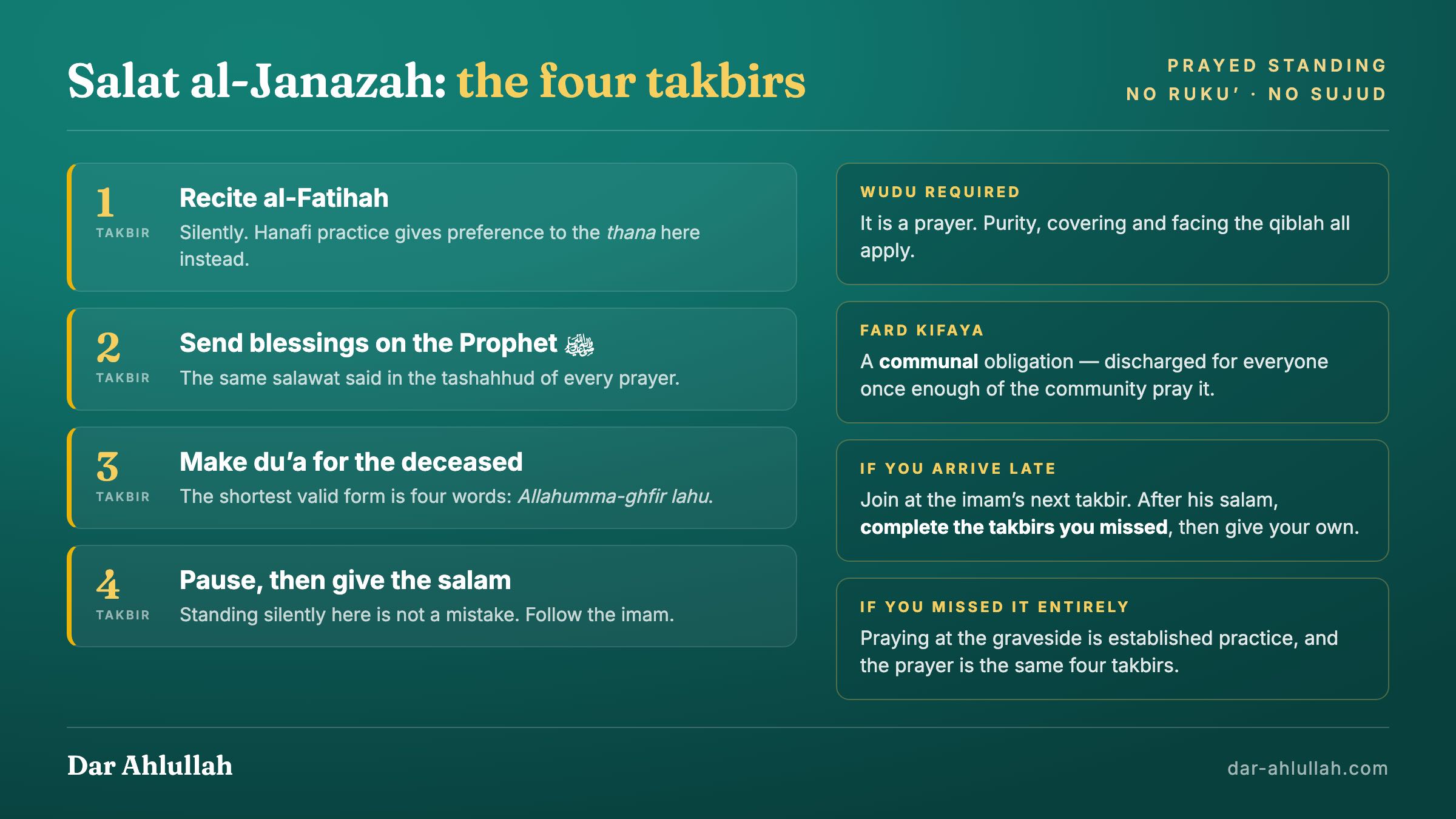
- What you say: after the first takbir, al-Fatihah; after the second, the blessings on the Prophet ﷺ; after the third, the du’a for the deceased; after the fourth, a brief pause and then the salam.
- You need wudu. It is a prayer, and the conditions of prayer apply — purity, covering, facing the qiblah.
- The shortest valid supplication is four words: Allahumma-ghfir lahu — O Allah, forgive him. If you learn nothing else before your first janazah, learn that.
- If you arrive late: join at the next takbir the imam says, and complete the takbirs you missed after he gives the salam.
- The reward: whoever attends until the prayer is offered has one qirat; whoever stays until burial has two, “like two huge mountains” (Sahih al-Bukhari 1325).
What Salat al-Janazah Actually Is
Structurally, the funeral prayer is unlike anything else in the religion. You stand, and you stay standing. There is no ruku’ and no sujud, no sitting, no tashahhud in the usual place. Four times the imam says Allahu akbar, and between those four sayings you recite silently. Then the salam, and it is finished.
The four takbirs are not a later convention. When the Negus of Abyssinia died, the Prophet ﷺ announced his death on the day it happened, went out to the prayer ground, lined the people up in rows, and said four takbirs (Sahih al-Bukhari 1245). That single report establishes the count, and it also establishes the possibility of praying over someone whose body is not present — a point we return to below.
What the prayer is for is worth being clear about, because the form conceals it. This is not a ceremony of farewell and it is not a service in the sense a Western funeral uses the word. It is intercession. The congregation is standing before Allah asking forgiveness for a person who can no longer ask for themselves. Everything in the structure follows from that: no bowing, because the posture of petition is standing; no recitation aloud, because each person is making the request personally; nothing to say to the family and nothing said about the deceased, because the prayer is not addressed to the living.
That is also why it is a communal obligation rather than an individual one. The community owes every one of its dead this act, and the debt is discharged by however many turn up. Nobody is sinning for having been at work. But if a Muslim dies in a town with a hundred Muslims in it and nobody prays over him, the hundred have collectively left an obligation undone.
Before You Stand: Wudu, Rows, and Where the Imam Goes
Salat al-Janazah is a prayer, and the ordinary conditions apply to it. You need to be in a state of wudu; if you are not sure whether yours has held since the morning, our guide to what breaks wudu lists the nullifiers. You face the qiblah, your clothing must cover what it covers in any prayer, and you stand in a straight row like any congregation.
Practical details that nobody tells a first-timer:
- The body is placed in front of the imam, between him and the qiblah, on a bier or on the ground. In most Western masjids it arrives in a plain coffin because the funeral director or the cemetery requires one.
- The imam’s standing position depends on the deceased. Anas ibn Malik prayed over a man standing level with his head, and over a woman standing level with her middle, and confirmed that this was what the Prophet ﷺ did (Sunan Abi Dawud 3194). You will see this observed at almost every janazah once you know to look for it. It is the imam’s concern, not yours.
- You do not need to have known the deceased. None of the wording is personal. Turning up to pray over a stranger is a normal and encouraged thing to do.
- There is no adhan and no iqamah for the funeral prayer. Somebody will simply call the rows to straighten, and it begins.
- Everything is silent except the takbirs and the salam. If you find yourself waiting in a silence wondering whether you have missed a cue, you have not. The silence is the prayer.
How to Pray Salat al-Janazah, Step by Step
Here is the whole thing in order. Read it once before you need it, and it will hold.
- Intend the funeral prayer for this deceased person. The intention is in the heart and there is nothing to say aloud. If you do not know whether the deceased is male or female, intending it for “this deceased” is sufficient.
- First takbir. Say Allahu akbar, raising your hands, and then place them as you would in any standing part of prayer.
- Recite al-Fatihah, silently. Talhah ibn ‘Abdullah reported praying the funeral prayer behind Ibn ‘Abbas, who recited al-Fatihah and said afterwards, “so that you may know that it is the Sunnah” (Sahih al-Bukhari 1335). Some Hanafis recite the opening supplication, the thana, in its place; see the section on the schools below.
- Second takbir. Allahu akbar, and then send blessings on the Prophet ﷺ — the same salawat you already say in the tashahhud of every prayer. If you do not have it by heart yet, the full text is in our guide to what is said in salah, and it is worth memorising for this reason alone.
- Third takbir. Allahu akbar, and then the du’a for the deceased. The full text is in the next section. If you have not learned it, Allahumma-ghfir lahu warhamhu — O Allah, forgive him and have mercy on him — is enough, and so is asking in English.
- Fourth takbir. Allahu akbar, then a short pause. Many recite a brief supplication here — commonly Allahumma la tahrimna ajrahu wa la taftinna ba‘dahu, O Allah, do not deprive us of his reward and do not put us to trial after him — and the schools differ on whether anything is said at this point at all (IslamQA 31139). Standing silently is not a mistake.
- The salam. Turn your head to the right and say as-salamu ‘alaykum wa rahmatullah. Some congregations give it once and some twice; follow the imam.
That is the entire prayer. Four takbirs, four things said, one salam. If it feels too short for the weight of the occasion, that impression is worth sitting with: the brevity is deliberate, and the length of the ritual was never what was being asked of you.
The Du’a for the Deceased, in Full
The best-known supplication for the deceased comes from ‘Awf ibn Malik, who said he heard the Prophet ﷺ say it over a dead man and memorised it so well that he wished he had been the one being prayed for (Sahih Muslim 963).
Allahumma-ghfir lahu warhamhu, wa ‘afihi wa‘fu ‘anhu, wa akrim nuzulahu, wa wassi‘ mudkhalahu, waghsilhu bil-ma’i wath-thalji wal-barad, wa naqqihi min al-khataya kama naqqayta ath-thawb al-abyad min ad-danas.
Wa abdilhu daran khayran min darihi, wa ahlan khayran min ahlihi, wa zawjan khayran min zawjihi, wa adkhilhu-l-jannah, wa a‘idhhu min ‘adhab al-qabr wa ‘adhab an-nar.
In English:
O Allah, forgive him and have mercy on him, keep him safe and pardon him, receive him honourably, make his grave spacious, and wash him with water, snow and hail. Cleanse him of his sins as a white garment is cleansed of dirt.
Give him a home better than his home, a family better than his family, and a spouse better than his spouse. Admit him into the Garden, and protect him from the punishment of the grave and the punishment of the Fire.
Three notes on using it.
The pronoun changes with the deceased. Lahu (him) becomes laha (her) for a woman and lahum (them) when several are prayed over together, and the endings that follow move with it — warhamha, wa ‘afiha, and so on. Nobody expects a learner to conjugate this correctly under pressure. If you say the whole thing in the masculine because that is the form you memorised, the prayer is not invalidated; the request is understood.
The short form is genuinely enough. Allahumma-ghfir lahu is a complete supplication. Learn that first, add warhamhu when you can, and build the rest over months. A congregation of people silently making a four-word du’a with full attention is doing precisely what the prayer requires.
You may ask in your own language. Al-Fatihah is Qur’an and is recited in Arabic as it is in any prayer, but the supplication for the deceased is du’a, and du’a has never required Arabic. If the Arabic text above is not yet in your memory, ask for the person’s forgiveness in English and mean it. That is the same practical latitude that applies elsewhere in worship — our article on praying when you are ill covers the same principle for a body that cannot manage the standard form.
When the Deceased Is a Child
The supplication above asks for forgiveness of sins, and it is not what is said over a child who died before the age of responsibility. What is transmitted instead is a request that the child be a cause of reward for those left behind: Allahumma-j‘alhu lana faratan wa salafan wa ajran — O Allah, make him for us a forerunner, a preceding reward, and a source of recompense. Al-Hasan al-Basri is reported to have recited al-Fatihah over a child and then said this (Hisn al-Muslim 161).
Another form circulates widely and is also cited by the scholars in this context: Allahumma-j‘alhu dhukhran li-walidayhi wa faratan wa shafi‘an mujaban — O Allah, make him a treasure stored up for his parents, a forerunner, and an intercessor whose intercession is answered (IslamQA 31139).
If you are standing at the janazah of a child and none of that is in your memory, ask in your own words for the parents to be given patience and for the child to be a means of their reward. Do not stay away from the prayer because you do not have the correct text. The community turning up is a large part of what is being offered.
What Differs Between the Schools
You will pray this behind imams trained in different madhhabs, sometimes in the same month, and the small variations are the source of most of the anxiety beginners have about getting it wrong. Here is what actually moves:
- After the first takbir. The Shafi’i and Hanbali schools have you recite al-Fatihah. Hanafi practice gives preference to the thana, the opening supplication (Funeral prayer, Islam). Both positions rest on evidence; neither congregation is doing something irregular.
- Raising the hands. Shafi’is and Hanbalis raise the hands at every takbir. Hanafis raise them at the first and keep them folded thereafter (Darul Iftaa Birmingham). This is the difference you will actually see with your eyes, and it is the one people worry about most and should worry about least.
- After the fourth takbir. Some schools have a supplication here, some go straight to the salam.
- The salam. One turn or two, depending on where the imam trained.
The practical rule is the same as it is for any congregational prayer: follow the imam, do not audit him, and do not correct anybody afterwards. Four takbirs, standing, silent recitation and a salam are common to all four schools. Everything above is detail inside a shared frame — the same picture our guide to fiqh for beginners sets out for worship generally.
If You Arrive After It Has Started
This will happen, because you will be parking a car at a masjid you do not know while the prayer begins without you. It is not a problem, and there is a fixed procedure for it.
Do not join in the middle of a silence. Wait until the imam says the next takbir, and say it with him — that becomes your opening takbir. Follow him for the remainder. When he gives the salam, do not leave: stand where you are and complete the takbirs you missed so that you have said four in total, and then give your own salam (IslamQA 22486).
Two refinements from the fuqaha. Between those make-up takbirs you may say the supplications that belong to them, in order. And if the bier is being lifted to be carried out while you are still completing, you may say the remaining takbirs quickly with nothing in between and then give the salam, so as not to hold up the burial.
You will see people leave the moment the imam says salam without completing. Complete quietly and do not comment. Nobody has ever been helped by a correction delivered at a funeral.
If You Missed It Completely
Two doors remain open, and both come straight from the Sunnah.
Praying at the grave. A person who used to sweep the mosque died, and the Prophet ﷺ was not told. When he asked after them and learned what had happened, he asked to be shown the grave, went to it, and prayed over it (Sahih al-Bukhari 1337). If you learn of a death after the burial, praying at the graveside is established practice, and the prayer is the same four takbirs. In a British or American Muslim cemetery this is unremarkable; it happens most weeks.
Praying in absentia. The Najashi hadith above is the basis for salat al-gha’ib, the funeral prayer for someone whose body is elsewhere — a parent who died in Cairo or Karachi while you are in Chicago, which is one of the more common griefs of a diaspora community. Note that the schools differ substantially on how far this extends: some restrict it to a person who died where nobody prayed over them, some allow it generally, and some read the Najashi report as particular to him. If it matters to your situation, ask a scholar you trust rather than acting on a summary paragraph, this one included.
What you should not do is conclude that the opportunity is gone. The du’a for a deceased Muslim is available to you at any time afterwards, in any language, with no prayer attached to it at all.
Women and the Janazah Prayer
Women pray Salat al-Janazah. This gets muddled in practice because two different questions are collapsed into one.
The first question is whether a woman may pray over the deceased, and the answer is yes. When Sa‘d ibn Abi Waqqas died, the wives of the Prophet ﷺ sent word that his bier should be brought into the mosque so that they could pray over him, and it was; when people objected, ‘A’ishah pointed out that the Prophet ﷺ had himself prayed over Suhayl ibn Bayda’ in the mosque (Sahih Muslim 973).
The second question is about accompanying the funeral procession to the cemetery. Umm ‘Atiyyah reported that women were forbidden from following the bier, but that it was not made binding on them — and the schools have read that report differently ever since, which is why practice varies from masjid to masjid and from family to family.
The upshot for a woman standing in a Western masjid: praying the janazah is yours to do. Whether you go on to the burial is a question of the ruling you follow and, in practice, the custom of the community you are in. Ask before the day rather than at the graveside.
Why They Straighten You Into Three Rows
If you have been to a small janazah, you may have seen the imam ask a thin gathering to reorganise itself into three short rows rather than one long one. That is not aesthetic. Malik ibn Hubayrah used to do exactly this whenever he found the numbers small, on the strength of a report that if three rows of Muslims pray over a deceased person, it is assured for him (Sunan Abi Dawud 3166).
The reward for attending at all is worth knowing, because it is the reason people rearrange their working day for the funeral of someone they barely knew. Abu Hurayrah reported the Prophet ﷺ saying that whoever attends the funeral until the prayer is offered has one qirat, and whoever stays until the burial has two. Asked what the two qirats were, he said: “like two huge mountains” (Sahih al-Bukhari 1325).
Two qirats for an hour of a Tuesday is the plainest arithmetic in the religion, and it explains a great deal about why Muslim funerals fill up with people who never met the deceased.
The Questions Nobody Prints: Janazah in the West
Every guide will tell you the four takbirs. Almost none of them address what actually goes wrong for a Muslim living where the burial system was not built for Muslims.
The burial is not going to be tomorrow
Prompt burial is the Islamic norm, and in Muslim-majority countries a person who dies in the morning is often buried the same evening. In much of Europe and North America a death certificate, a coroner’s or medical examiner’s release, and a cemetery booking sit between the death and the grave, and a delay of several days is common. That delay is a matter of law, not of anybody’s negligence, and it does not change the prayer. Find out now which cemeteries near you accept Muslim burials and which funeral directors have done one before — that research is unbearable to do in the first twenty-four hours of a bereavement, and trivially easy to do on an ordinary afternoon.
You will not understand the announcement
At many Western masjids the janazah will be announced, and any words said around it will be in Arabic, Urdu, Bengali, Turkish or Somali. The prayer itself is silent, so this costs you nothing liturgically — but arriving without knowing whether you have understood the timing is genuinely stressful. Ask one person at the door, in English, whether the janazah is after this prayer. They will tell you. It is the same practical problem our article on praying Jumu’ah takes up for the Friday sermon.
Your family may not be Muslim
For converts this is the hardest section of any funeral article, and the honest answer has two halves. Salat al-Janazah is prayed for a deceased Muslim; it is not offered for a non-Muslim, and the Qur’an addresses this directly (9:84). Attending the funeral of a non-Muslim relative is a separate question with a separate answer: the classical position reported from al-Shafi’i and from al-Nawawi is that it is not disliked for a Muslim to attend the funeral of a non-Muslim relative, on the strength of the command to treat parents well, provided one does not take part in rites that contradict the religion (IslamOnline, Fiqh). Being present at your father’s funeral and praying Salat al-Janazah over him are two different acts, and only one of them is at issue.
What to say to the family
There is no set formula for condolence and no requirement to produce eloquence. Muslims usually say inna lillahi wa inna ilayhi raji‘un — “indeed we belong to Allah, and to Him we return” — which is the Qur’an’s own words for those struck by calamity (2:156). Say that, ask Allah to have mercy on the deceased and to give the family patience, and then stop talking. Cook something and take it to their house. In this specific setting, brevity is not coldness; it is competence.
What Salat al-Janazah Is Not For
- It is not a eulogy. Nothing is said about the deceased’s life inside the prayer. If a talk is given, that is a separate thing happening before or after it.
- It is not conditional on knowing the person. The whole wording is generic, and praying over a stranger is normal.
- It is not prayed for a non-Muslim. This is the boundary described above, and it is about the prayer, not about your presence, your grief or your kindness to the family.
- It does not settle anyone’s fate. The congregation is asking, not certifying. A large janazah is not a verdict on the deceased and a small one is not either.
- It is not the only thing you can offer. Du’a for the dead, charity given on their behalf and kindness to the family they left are all available long after the burial — unlike the prayer, they have no closing window.
Seven Things People Get Wrong
- Waiting for a ruku’ that never comes. The most common first-janazah error is starting to bow at a takbir. There is no bowing and no prostration; you stay standing throughout.
- Turning up without wudu. It is a prayer. People arrive straight from work assuming it is a graveside gathering and find they cannot join.
- Leaving when the imam says salam, mid-catch-up. If you joined late, complete your takbirs first.
- Declining to pray because you do not know the du’a. Allahumma-ghfir lahu is enough, and English is permitted for the supplication.
- Assuming a delay means something went wrong. In the West a coroner’s release takes as long as it takes, and it is nobody’s failure.
- Correcting other people’s hand position. The schools differ on raising the hands at each takbir. A funeral is the worst possible venue for that conversation.
- Believing you have missed your chance. Praying at the grave is established, and du’a for the deceased never closes.
How We Teach This
Most of the above is reading. The part that is not — whether your al-Fatihah is actually sound under pressure, whether the salawat and the du’a for the deceased are coming out as words rather than as remembered sounds — needs somebody listening to you say them.
Dar Ahlullah runs one-to-one live sessions with certified teachers, scheduled in your own timezone. Teaching is charged at $9 per teaching hour, with monthly plans at $36, $70 and $102 depending on how many hours you want, and a 20% discount for siblings. You can pause, upgrade or switch plans at any time, and if a teacher is not the right fit we rematch you with another certified mentor at no extra cost. If you want to know where your recitation currently stands before committing to anything, the 30-minute assessment is free and does not ask for a card — the details are on our pricing page.
Questions People Ask
How many takbirs are in Salat al-Janazah?
Four. The Prophet ﷺ said four takbirs when he prayed over the Negus, and that is the count across all four Sunni schools.
Is there ruku’ or sujud in the funeral prayer?
No. The entire prayer is performed standing. There is no bowing, no prostration and no sitting.
Do I need wudu for Salat al-Janazah?
Yes. It is a prayer and the ordinary conditions of prayer apply, including purity and facing the qiblah.
What do I say after each takbir?
Al-Fatihah after the first, the blessings on the Prophet ﷺ after the second, the supplication for the deceased after the third, and after the fourth a brief pause before the salam.
What is the shortest valid du’a for the deceased?
Allahumma-ghfir lahu — O Allah, forgive him. Learn that first and add the longer supplication of ‘Awf ibn Malik over time.
What do I do if I arrive late to the janazah prayer?
Join at the imam’s next takbir, follow him to the end, and after his salam complete the takbirs you missed so you have said four, then give your own salam.
Can women pray Salat al-Janazah?
Yes. The wives of the Prophet ﷺ prayed over Sa‘d ibn Abi Waqqas in the mosque. Whether women accompany the procession to the cemetery is a separate question on which the schools and communities differ.
Can I pray the funeral prayer for someone who has already been buried?
Yes, at the grave. The Prophet ﷺ asked to be shown the grave of a person he had not been told about, and prayed over it.
Can I pray Salat al-Janazah for someone who died abroad?
This is salat al-gha’ib, and its basis is the prayer for the Negus. The schools differ on how widely it applies, so ask a scholar you trust about your particular case.
Is Salat al-Janazah prayed for a non-Muslim?
No. Attending a non-Muslim relative’s funeral out of kinship is a separate question, and classical scholars including al-Nawawi held it is not disliked, provided one does not participate in rites contrary to the religion.
Can I say the supplication in English?
Yes for the du’a. Al-Fatihah is Qur’an and is recited in Arabic as in any prayer.
Conclusion: You Will Not Get a Rehearsal
Salat al-Janazah is the one prayer nobody schedules. It arrives on someone else’s worst day, in a building you may not know, and it asks you to stand in a straight line and quietly ask forgiveness for a person whose account is now closed. There is no rehearsal, and the first time you pray it you will almost certainly be watching the people around you.
Which is exactly why it is worth learning in an ordinary week. Four takbirs. Al-Fatihah, the salawat, the du’a, the salam. Standing throughout, silent throughout, and over in the time it takes to boil a kettle. Learn Allahumma-ghfir lahu today and you already have the part that cannot be improvised.
Then there is the other half of it, which is not fiqh at all. Every person in that row will one day be the one lying in front of it, and the community that turns out for them is the same community they turned out for. Attending a janazah for a stranger is not a favour done to the dead. It is a deposit, made in advance, into an obligation that will one day be owed to you.
Related articles
how to pray salat al-kusuf
How to Pray Salat al-Kusuf: The Eclipse Prayer
Salat al-kusuf is the prayer Muslims pray when they see the sun or moon eclipsed: two long rak'ahs, with two bowings in each on the majority view and one in the Hanafi school. The method, the sighting rule, the lunar eclipse, the reports with their grades, and what to do when the eclipse and the prayer do not end together.
29 min read
joining the prayer late
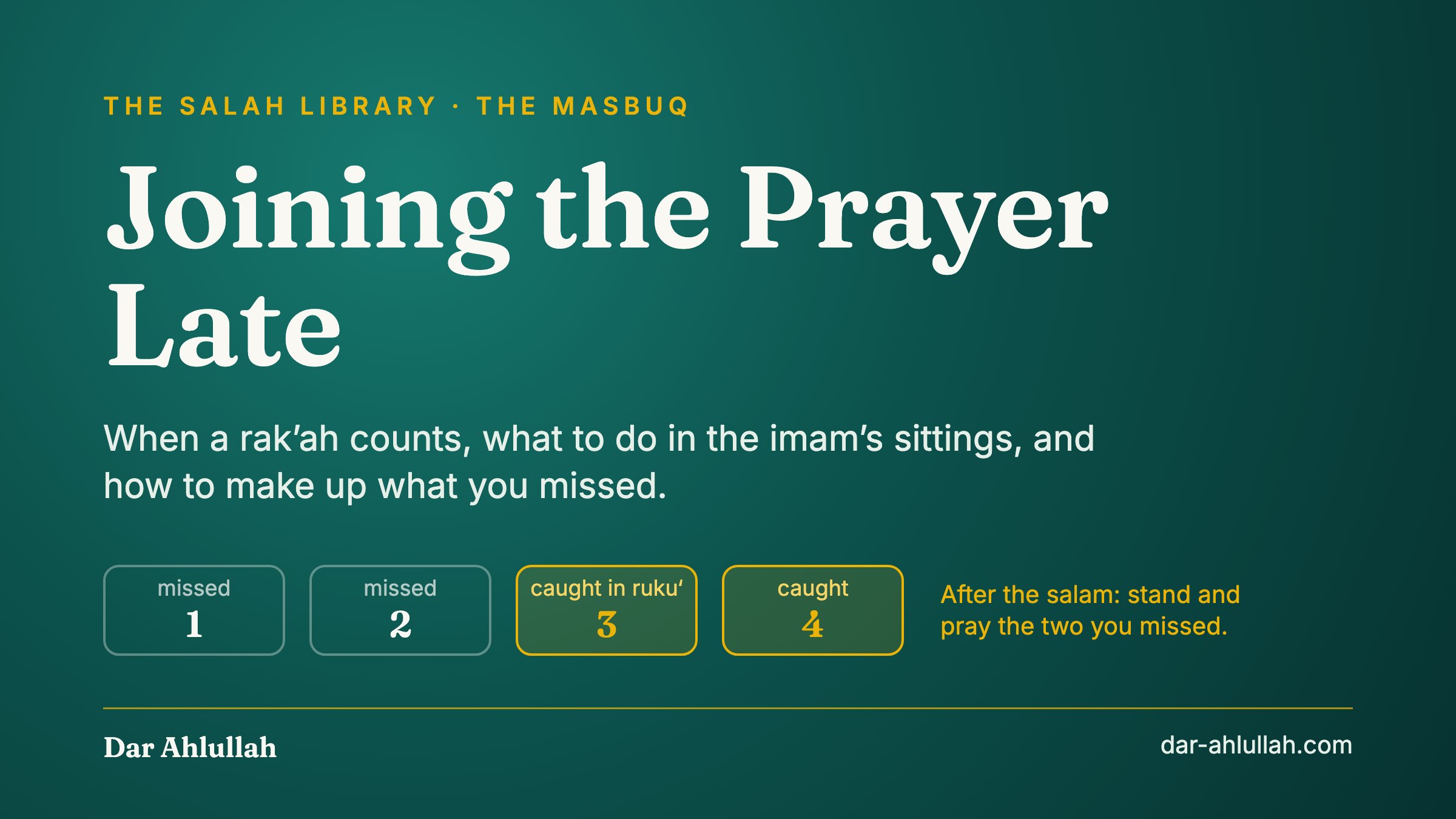
Joining the Prayer Late: How to Make Up Missed Rak’ahs
Joining the prayer late has a short, exact procedure: say the takbir standing, join the imam wherever he is, count the rak'ah only if you reached ruku' before he rose, and complete what you missed after his salam. This guide works through every prayer and arrival point, and explains why the person beside you may make up the same rak'ahs with a different recitation.
20 min read
morning and evening adhkar
Morning and Evening Adhkar: What to Say and When
Morning and evening adhkar from the sound reports: the windows from dawn to sunrise and from 'Asr to sunset, the core set with the source and count of each line, and the grade printed on the popular additions the hadith scholars dispute, from Ayat al-Kursi to hasbiyallah seven times.
29 min read