
sajdah tilawah
Sajdah Tilawah: What to Do at a Prostration Verse
Dar Ahlullah team 26 min read
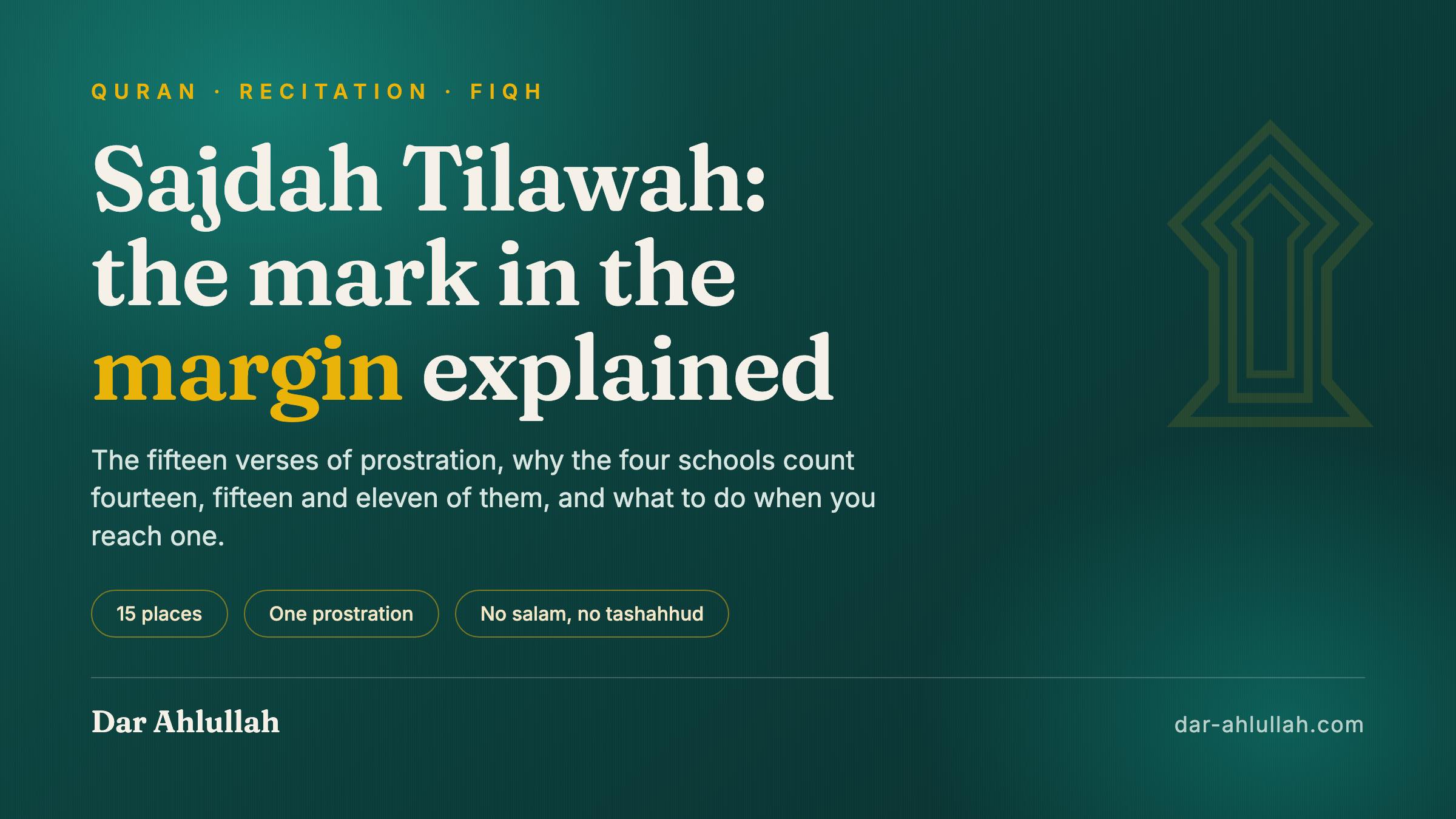
Table of Contents
- Introduction: The Little Symbol in the Margin
- The Short Answer
- What Sajdah Tilawah Is
- Where the Verses Are
- Why Your Mushaf Says Fourteen and Your Teacher Says Fifteen
- Wajib or Sunnah: the One Split That Changes What You Do
- How to Perform It, Step by Step
- What You Say In It
- When It Happens Inside Salah
- The Questions a Reciter Outside the Muslim World Actually Hits
- The Hifz Problem: Twenty Repetitions of the Same Verse
- What Sajdah Tilawah Is Not
- Seven Mistakes People Keep Making
- How We Teach This
- Questions People Ask
- Conclusion: One Prostration, and Back to the Page
Introduction: The Little Symbol in the Margin
This article assumes you already pray and know what a prostration is. If you are still learning the prayer itself, start with our step-by-step guide to salah and come back to this one.
Somewhere in your first few months of reading the Qur’an you will hit a small domed mark in the margin — ۩ — usually with a line above the verse it belongs to. Nobody warned you it was coming. If you are reading alone, at a kitchen table in Birmingham or on a train into Chicago, the honest reaction is to slow down, look at it, decide it is probably a decoration, and carry on reading.
It is not a decoration. It marks a verse where the Prophet ﷺ stopped reciting and put his forehead on the ground, and where the people listening to him did the same. The act has a name — sajdah tilawah, the prostration of recitation — and it is one of the very few things in Islamic practice that is triggered by reading rather than by a clock, a place or a state.
It is also, for anyone learning the Qur’an outside a Muslim-majority country, unusually badly served by the material that comes up when you search for it. You will find the method in three lines and the list of verses in a table, and then nothing at all about the situations you are actually in: reading at a desk in an open-plan office, listening to a recitation app on headphones, sitting in a live online lesson when your teacher reaches one of these verses, or drilling the same page of Surah as-Sajdah twenty times because you are trying to memorise it. Every one of those has an answer. None of them is in the three lines.
This article gives the fiqh from the sound reports, then spends most of its length on the second set of questions. If you are still early in decoding the script, our guide to how to read the Qur’an for beginners comes first — the markers in the margin are part of a mushaf’s notation system, which our Arabic alphabet guide introduces and deliberately leaves for later. And if you want the wider picture of how recitation is taught and learned online, that sits in our complete guide to learning Qur’an online.
One boundary first, as always. We teach Qur’an, Arabic and the practical fiqh of worship. We are not a fatwa body, and where the schools genuinely differ — and on this subject they differ more than on almost any other small act — we set out the positions rather than pick one for you.
The Short Answer
- What it is: a single prostration, performed after reciting or hearing one of the Qur’an’s verses of prostration.
- How many: one. The jurists agree it is one prostration, not two.
- The ruling: wajib in the Hanafi school; a confirmed sunnah in the Maliki, Shafi‘i and Hanbali schools. No school makes it a pillar of anything.
- How many verses: fifteen on the widest count, fourteen in the Hanafi school, fourteen — but a different fourteen — in the Shafi‘i school, and eleven in the Maliki school.
- The method: takbir, go down, say what you say in any prostration, takbir, get up. No tashahhud, no salam, no rak‘ah.
- Wudu: required on the majority view; not required on the view IslamQA considers stronger, because this is not prayer.
- Recordings: hearing a verse of prostration from an app or a recording does not oblige it, on the reasoning that the condition is a live recitation.
- The one real trap: assuming the count printed in your mushaf is the count everyone uses. It is not.
What Sajdah Tilawah Is
Tilawah means recitation. Sajdah tilawah is therefore the prostration that belongs to recitation, as distinct from the prostrations inside a prayer and from sujood ash-shukr, the prostration of gratitude at unexpected good news.
It is worth being precise about the category, because almost every practical question further down this page is settled by it. Sajdah tilawah is not a prayer. It has no takbirat al-ihram that opens a sacred state, no rak‘ah, no tashahhud, no salam that closes it. It is a single act of submission attached to a specific set of verses — most of which either describe creation prostrating to Allah, or command prostration outright, or rebuke those who hear the Qur’an and do not fall down.
The behaviour it imitates is recorded plainly. Ibn ‘Umar said that when the Prophet ﷺ recited a surah containing a prostration he would prostrate, and the people would prostrate with him, until “some of us could not find a place for prostration” (Sahih al-Bukhari 1075). Ibn ‘Abbas reported that when he recited Surah an-Najm and prostrated, everyone present prostrated with him (Sahih al-Bukhari 1071).
And on why it is worth doing at all, the most quoted narration is from Abu Hurayrah, in Sahih Muslim: when the son of Adam recites a verse of prostration and prostrates, Satan withdraws weeping and says, “Woe to me! The son of Adam was commanded to prostrate and he prostrated, so Paradise is his. I was commanded to prostrate and I refused, so Hellfire is mine” (Sahih Muslim 81). The verse that triggers the act and the reason it matters are the same thing: a refusal to prostrate is what the Qur’an is describing in most of these passages, and the prostration is the reader declining to join it.
Where the Verses Are
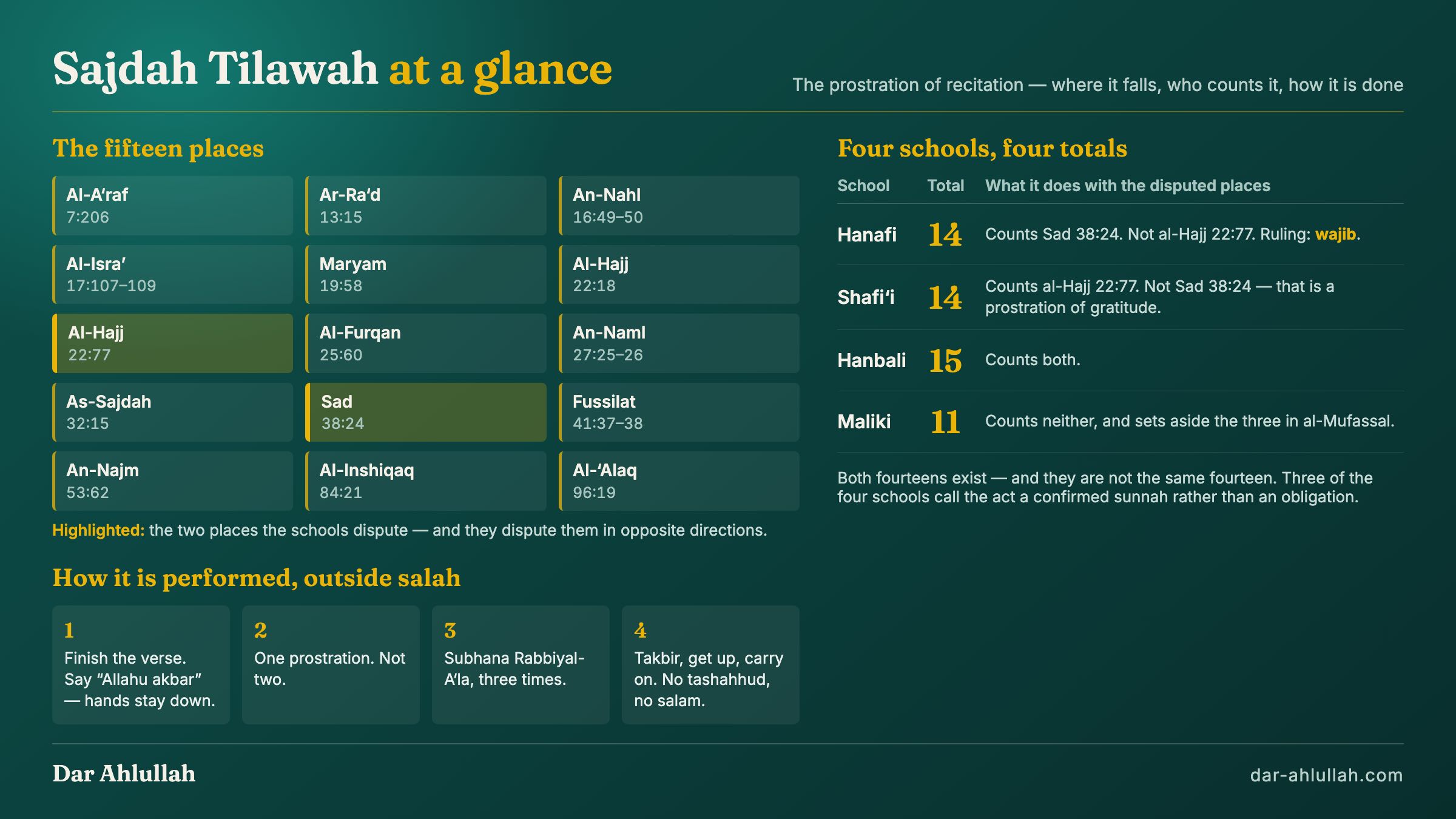
The widest list has fifteen places. Its textual basis is the report of ‘Amr ibn al-‘As that the Prophet ﷺ taught him fifteen prostrations in the Qur’an, three of them in al-Mufassal and two in Surah al-Hajj (Sunan Abi Dawud 1401). The chain of that report is contested — IslamQA notes that scholars debated its authenticity and that al-Albani criticised it for unknown narrators — but the individual prostrations in it are corroborated elsewhere, which is why the fifteen-place list is still the one most reference works print.
| # | Surah | Where the prostration falls |
|---|---|---|
| 1 | Al-A‘raf (7) | 7:206 |
| 2 | Ar-Ra‘d (13) | 13:15 |
| 3 | An-Nahl (16) | 16:49–50 |
| 4 | Al-Isra’ (17) | 17:107–109 |
| 5 | Maryam (19) | 19:58 |
| 6 | Al-Hajj (22) | 22:18 |
| 7 | Al-Hajj (22) | 22:77 |
| 8 | Al-Furqan (25) | 25:60 |
| 9 | An-Naml (27) | 27:25–26 |
| 10 | As-Sajdah (32) | 32:15 |
| 11 | Sad (38) | 38:24 |
| 12 | Fussilat (41) | 41:37–38 |
| 13 | An-Najm (53) | 53:62 |
| 14 | Al-Inshiqaq (84) | 84:21 |
| 15 | Al-‘Alaq (96) | 96:19 |
Two notes on reading that table. First, several entries are given as a range rather than a single number, because the sentence that ends in the prostration begins a verse or two earlier and editions divide it differently — you will see 16:49 in one list and 16:50 in another for the same place in the text. Nothing turns on it; the marker in your copy sits where your copy’s numbering puts it.
Second, the list is a list of places, not a list every school accepts in full. That is the next section, and it is the part that catches people.
Why Your Mushaf Says Fourteen and Your Teacher Says Fifteen
This is the single most confusing thing about sajdah tilawah, and almost no English-language guide states it cleanly. Two of the fifteen places above are disputed, and the schools dispute them in opposite directions. The result is four different totals:
| School | Total | What it does with the two disputed places |
|---|---|---|
| Hanafi | 14 | Counts Sad 38:24. Does not count the second al-Hajj, 22:77. |
| Shafi‘i | 14 | Counts al-Hajj 22:77. Does not count Sad 38:24 as a prostration of recitation. |
| Hanbali | 15 | Counts both. |
| Maliki | 11 | Counts neither, and also sets aside the three in al-Mufassal — an-Najm 53:62, al-Inshiqaq 84:21 and al-‘Alaq 96:19. |
Look at the first two rows again. The Hanafis and the Shafi‘is both arrive at fourteen, and it is not the same fourteen. A student who has been told “there are fourteen” by one teacher and “there are fourteen” by another has not necessarily been told the same thing.
The reasoning in each case is short and worth knowing, because it is what lets you recognise which count a given book or app is using.
Sad 38:24. Ibn ‘Abbas said: “The prostration of Sad is not one of the obligatory prostrations, but I saw the Prophet ﷺ prostrating while reciting it” (Sahih al-Bukhari 1069). Everyone accepts that he prostrated there. The disagreement is about what kind of prostration it was. The Shafi‘is read Ibn ‘Abbas’s exclusion as decisive and classify it as a prostration of gratitude — the verse describes Dawud repenting and Allah forgiving him — rather than a prostration of recitation. The Hanafis treat it as an ordinary prostration of recitation and therefore wajib.
Al-Hajj 22:77. The verse commands the believers to bow and prostrate. Abu Hanifah and Malik read it as a command to the prostration of the ritual prayer, not to a prostration of recitation, and so do not count it. Ash-Shafi‘i and Ahmad count it, on the strength of reports giving Surah al-Hajj a distinction for containing two prostrations rather than one.
The three in al-Mufassal. The Maliki position rests on a report that the Prophet ﷺ did not prostrate in any of al-Mufassal after moving to Madinah, which is read as abrogating the earlier Makkan practice. The other three schools hold the opposite, and IslamWeb, among others, calls the Maliki view weak here, since there are sound reports of prostration in exactly these surahs.
The practical consequence for a learner is smaller than it looks, and it is this: count the markers in your own copy and know which count you are holding, so that a mismatch between your mushaf, your app and your teacher registers as a school difference rather than as a printing error or a mistake on your part. If you follow a particular school, follow its count. If you do not yet follow one — which is where most people learning online genuinely are — prostrating at any of the fifteen is safe in the sense that no school considers a prostration there sinful, and the two the Hanafis and Shafi‘is each drop, they drop as not required, not as forbidden. The one exception to that generosity is inside the prayer, which is dealt with below.
Wajib or Sunnah: the One Split That Changes What You Do
The Hanafi school holds sajdah tilawah to be wajib — necessary. Its main textual argument is the form of the rebuke in Surah al-Inshiqaq: “And when the Qur’an is recited to them, they do not prostrate” (84:21). A censure for not doing something, on this reading, establishes that it was owed.
The Maliki, Shafi‘i and Hanbali schools hold it to be a confirmed sunnah — strongly encouraged, not owed. Their two strongest pieces of evidence are both incidents rather than statements.
The first is Zayd ibn Thabit: he recited Surah an-Najm to the Prophet ﷺ, and the Prophet did not prostrate (Sahih al-Bukhari 1073). An-Najm is one of the least disputed places on the list. If the prostration were owed, this is the last place it would have been left.
The second is ‘Umar ibn al-Khattab, and it is the more instructive of the two because it happened twice. He recited Surah an-Nahl from the minbar on a Friday, reached the verse of prostration, came down and prostrated, and the people prostrated with him. The following Friday he recited the same surah, reached the same verse, and told the congregation: when we recite the verses of prostration, whoever prostrates has done right, and there is no sin on the one who does not. And ‘Umar did not prostrate that day (Sahih al-Bukhari 1077).
Ibn ‘Uthaymin’s summary of the majority position is that sajdah tilawah is sunnah rather than obligatory, and he cites precisely this incident. IslamQA states the conclusion plainly: it is mustahabb, encouraged, for both the reciter and the listener, and not obligatory (IslamQA 73402).
Where does that leave you in practice? If you follow the Hanafi school, treat it as owed and make it up if you miss it. If you follow one of the other three, or you follow no school in particular, treat it as a good you take rather than a debt you accrue — and in either case do not let a missed prostration turn into the kind of anxiety that ends up shortening your reading sessions. That is a real pattern, and it is the opposite of what these verses are for.
How to Perform It, Step by Step
Outside the prayer, the whole thing takes about fifteen seconds.
- Finish the verse. The prostration belongs to the completed verse, so read to the end of it rather than stopping at the marker.
- Face the qiblah if you reasonably can, and be covered as you would be for prayer. Both are conditions on the majority view; see the section below for what happens when neither is available.
- Say “Allahu akbar” as you go down. You do not raise your hands for it — there is no takbirat al-ihram here, because you are not entering a prayer.
- Prostrate once. On the same seven points of contact as any prostration in salah: forehead and nose, both palms, both knees, the toes of both feet.
- Say what you say in prostration — Subhana Rabbiyal-A‘la, and then whichever du‘a you want to add. The next section gives the one narrated specifically for this prostration.
- Say “Allahu akbar” and get up. IslamQA notes that outside the prayer there is no salam at the end, and the takbir on rising is reported as part of the practice rather than as an obligation (IslamQA 22650).
- Sit back down and carry on reading. That is the end of it.
Two things that are not in that list, and which people add anyway: there is no tashahhud, and there is no closing salam. Both belong to prayer, and this is not one. The Hanafi manuals put the same point as one prostration between two takbirs, with no raising of the hands, no tashahhud and no salams.
Note also that the jurists agree it is a single prostration, not the pair you make in each rak‘ah of salah (IslamQA 32750). Doing two is the most common execution error among people who have only ever prostrated inside a prayer, where they always come in twos.
What You Say In It
The obligatory content is the same as any prostration: Subhana Rabbiyal-A‘la — “Glory be to my Lord, the Most High” — said an odd number of times, three being usual.
There is also a du‘a narrated specifically for this prostration. ‘A’ishah reported that when the Messenger of Allah ﷺ prostrated for the recitation of the Qur’an at night, he would say: Sajada wajhi lilladhi khalaqahu wa shaqqa sam‘ahu wa basarahu bi hawlihi wa quwwatih — “My face has prostrated to the One who created it and brought forth its hearing and its sight, by His power and His strength.” At-Tirmidhi graded it hasan sahih (Jami‘ at-Tirmidhi 580; also Sunan an-Nasa’i 1129).
If your Arabic is not yet at the point where you can say that from memory, say the tasbih you already know and add whatever you want in English. Nothing in the sources restricts the supplication in this prostration to Arabic, and reaching for a phrase you cannot yet pronounce is a good way to make a fifteen-second act feel like an exam. Building the pronunciation is a separate project, and it is what tajweed for beginners is for.
When It Happens Inside Salah
Reciting a verse of prostration during your own prayer is perfectly ordinary, and the procedure is short: say the takbir, go down into a prostration, say the tasbih, say the takbir, stand back up, and continue from where you were. It does not count as a rak‘ah and it does not need to be compensated for afterwards.
Behind an imam, the rule is simpler still: follow him. If he prostrates, you prostrate. If he does not, you do not — you do not prostrate on your own behind an imam who has carried on, and you do not go down before him. Some jurists hold that the prayer of someone who fails to follow the imam here is still valid, on the grounds that the prostration of recitation is not one of the core actions of the prayer, but the question does not arise if you simply do what he does.
There is one genuine trap here, and it is the only place where the school differences above have consequences rather than being an interesting fact. On the Shafi‘i view, Sad 38:24 is a prostration of gratitude, not of recitation — and a prostration of gratitude performed inside the prayer invalidates it. So a Shafi‘i who recites Sad in his own prayer must not prostrate there, while a Hanafi in the same position must. That is the same verse producing opposite instructions, and it is worth knowing which side of it you are on before you meet it.
A related courtesy, from the Hanafi manuals: an imam is discouraged from choosing a verse of prostration in Jumu‘ah, in Eid prayers, in any very large congregation, or in a prayer where the recitation is silent — precisely because half the rows will not know what has happened. If you have ever been in a congregation where a third of the people went down and the rest stood looking at each other, that is what the guidance is trying to prevent. For the wider mechanics of Friday prayer, see our guide to how to pray Jumu‘ah.
And if a prostration of recitation does go wrong — you prostrated when you should not have, or added one you did not mean to — that is ordinary territory for sujood as-sahw, the prostration of forgetfulness, which is a different prostration again and has its own triggers and timing.
The Questions a Reciter Outside the Muslim World Actually Hits
Everything above is in most guides. What follows generally is not, and it is the part that decides whether you actually do this or quietly skip it for a year.
I am reading and I am not in wudu
The majority view treats purification as a condition, on the reasoning that a prostration takes the rulings of prayer. The view IslamQA considers stronger is the opposite: “it is not essential to have wudu for sujud al-tilawah”, because sajdah tilawah is not prayer but an act of submission and dhikr, and does not come under the rulings of prayer (IslamQA 22650). The Maliki school likewise permits it without ritual purity, though purity remains preferred.
Practically: if you are in wudu, prostrate. If you are not and water is a minute away, get up and do it. If you are not and it is genuinely inconvenient — you are on a train, in a waiting room, halfway through a lesson — there is a recognised position permitting you to prostrate anyway, and there is no school in which finishing your reading without prostrating is a sin. What is not a good outcome is closing the mushaf. If you want the ablution rules themselves, we have a guide to what breaks wudu and one to performing wudu properly.
I am at a desk in an open-plan office
Facing the qiblah and covering the ‘awrah are conditions on the majority view, and neither of them is a small ask in a shared workspace at two in the afternoon. Two honest options: note the place and prostrate when you next have a minute of privacy, which most jurists accommodate for a sunnah act; or read at a time and place where you can, and treat the office as reading-without-prostration territory. Both are better than the third option, which is not reading at work at all.
I am listening rather than reciting
The distinction that matters is live versus recorded, and it is sharper than most people expect. In the Hanafi school the prostration becomes necessary for someone who hears a verse of prostration recited by a person, but a recording does not trigger it: the condition is a live recitation, so the ruling does not attach to audio played back from a device. Ustadh Tabraze Azam, citing Shurunbulali’s Maraqi al-Falah and ‘Ala’ al-Din ‘Abidin’s al-Hadiyya al-‘Ala’iyya, sets it out in exactly those terms (SeekersGuidance).
So: a recitation app on your commute, a YouTube khatm, a Qur’an playing in the car — no prostration due, though contemporary scholars note that doing it out of devotion is virtuous. A live lesson is the other case entirely. If your teacher recites a verse of prostration to you over a video call, that is a person reciting, not a recording. And the ordinary etiquette applies: the listener follows the reciter, and does not prostrate unless the reciter does.
I am menstruating
IslamQA holds that a woman who hears a verse of prostration during her period may perform sajdah tilawah, and that wudu is not a condition for the listener, on the same reasoning as above: this is not prayer, it is an act of submission and worship like other kinds of dhikr (IslamQA 4862). Not every school agrees, and the schools that treat purity as a condition apply that condition here too — but the position exists and is held by serious scholars, and it is worth knowing before you assume the answer is no.
It is after Fajr, or after ‘Asr
There are windows in the day when voluntary prayer is not performed, and reading often lands in them — the hour after Fajr is one of the best reading hours there is. The more correct view is that sajdah tilawah is permitted at those times, on two grounds: it is not a prayer, and even if it were, acts performed for a specific cause are excepted from the prohibition in the same way as the eclipse prayer and the two rak‘ahs after tawaf (IslamQA 34668).
My app does not show the marker
Some reading apps render the ۩ symbol, some show a coloured band across the verse, some announce it with a chime, and some show nothing at all. If yours shows nothing, the fifteen places are in the table above and there are only fifteen of them — a list short enough to keep in a note on your phone until you know them. Two of them are in Surah al-Hajj and three in the last three juz’, which is where most people are reading in the early years.
The Hifz Problem: Twenty Repetitions of the Same Verse
This deserves its own section because it is the question memorisation raises immediately, and the standard guides do not touch it.
Memorisation works by repetition. A student working on Surah as-Sajdah, or on the end of al-Inshiqaq, or on Surah al-‘Alaq, will recite the verse of prostration ten or twenty times in a single sitting. Does each repetition oblige a prostration?
No. The majority position is that one prostration is enough: prostrate the first time the verse is recited, and do not repeat it thereafter, precisely in order to avoid hardship. The Hanafi refinement is that repetition within a single sitting requires only one prostration, while repeating the verse in two separate sittings brings the prostration back. Ibn ‘Uthaymin’s reasoning runs through the ‘Umar incident: he recited the same verse on two consecutive Fridays and prostrated only once (IslamQA 171666).
One exception noted in the same answer: Surah al-Hajj contains two distinct prostration verses, so a reciter may prostrate at each of them even without a long interval between the two, because they are separate places rather than a repetition of one.
If you are building or fixing a memorisation routine and this kind of practical detail is what keeps tripping it up, our guide to revising Qur’an memorisation deals with the structure of the drilling itself, and memorising similar verses handles the other problem these surahs create.
What Sajdah Tilawah Is Not
- Not a prayer. No opening takbir with raised hands, no tashahhud, no salam.
- Not two prostrations. One. The jurists agree on this.
- Not a rak‘ah, when it happens inside salah. It does not add to your count.
- Not obligatory in three of the four schools, and not a pillar of anything in the fourth.
- Not triggered by a recording, on the reasoning that the condition is a live recitation.
- Not the same as sujood ash-shukr (gratitude) or sujood as-sahw (forgetfulness), which have different causes and different rules.
- Not a reason to stop reading. If circumstances make the prostration impossible right now, the reading is still the point.
Seven Mistakes People Keep Making
- Prostrating twice. Muscle memory from salah, where prostrations come in pairs. It is one.
- Adding a salam at the end. There is nothing to close, because nothing was opened.
- Raising the hands for the takbir. The takbir here is not takbirat al-ihram, and the hands stay down.
- Assuming your count is universal. Fourteen and fifteen are both correct answers to different questions, and two different fourteens exist.
- Prostrating for every repetition during memorisation. One in a sitting is the majority position; the alternative is a hifz session that becomes physically impractical.
- Prostrating at a recording on the assumption that it is owed. Virtuous if you want to, but not required — and worth distinguishing from a live lesson, where the etiquette is different.
- Skipping the verse to avoid the question. Some readers quietly stop reading Surah as-Sajdah at all because they are not sure what they are supposed to do. The whole of this article is cheaper than that.
How We Teach This
Most of what is above you can read once and have. The part you cannot read your way into is the recitation itself — whether the verse you are stopping at is coming out as words rather than approximations of words, and whether you would recognise a prostration verse in a page you have never read before.
Dar Ahlullah runs one-to-one live sessions with certified teachers, scheduled in your own timezone. Teaching is charged at $9 per teaching hour, with monthly plans at $36, $70 and $102 depending on how many hours you want, and a 20% discount for siblings. You can pause, upgrade or switch plans at any time, and if a teacher is not the right fit we rematch you with another certified mentor at no extra cost. If you would like to know where your recitation currently stands before committing to anything, the 30-minute assessment is free and does not ask for a card — details are on our pricing page.
Questions People Ask
How many sajdah are in the Quran?
Fifteen places on the widest count. The Hanbalis take all fifteen; the Hanafis fourteen (including Sad, excluding the second al-Hajj); the Shafi‘is fourteen (including the second al-Hajj, excluding Sad); the Malikis eleven.
Is sajdah tilawah obligatory?
Wajib in the Hanafi school. A confirmed sunnah in the Maliki, Shafi‘i and Hanbali schools, on the strength of the Prophet ﷺ not prostrating when Zayd ibn Thabit recited an-Najm to him, and ‘Umar’s statement from the minbar that there is no sin on one who does not prostrate.
Do I need wudu for sajdah tilawah?
The majority say yes. IslamQA considers the stronger of the two positions to be that wudu is not essential, because sajdah tilawah is not prayer. The Malikis also permit it without purity, while preferring purity.
How many prostrations is sajdah tilawah?
One. Not two. The jurists are agreed on this, and it is the most common execution mistake.
Do I say tashahhud or salam after it?
No to both, outside the prayer. There is no salam at the end of sujud at-tilawah and no tashahhud in it.
What do I say in sajdah tilawah?
Subhana Rabbiyal-A‘la, three times, as in any prostration. The du‘a narrated specifically for it is Sajada wajhi lilladhi khalaqahu wa shaqqa sam‘ahu wa basarahu bi hawlihi wa quwwatih, graded hasan sahih by at-Tirmidhi.
Do I prostrate if I hear a verse of prostration on a recitation app?
It is not required, on the reasoning that the obligation attaches to a live recitation rather than to playback. Doing it out of devotion is still virtuous. A live lesson over video is a live recitation, not a recording.
What if I recite a prostration verse in my own prayer?
Say the takbir, prostrate once, say the takbir, stand up and continue. It is not a rak‘ah. Behind an imam, follow him: prostrate if he does, and do not if he does not.
Do I prostrate every time I repeat the verse while memorising?
No. One prostration for a sitting is the majority position, adopted specifically to avoid hardship. Surah al-Hajj is the exception, because its two prostration verses are separate places rather than a repetition.
Can I do sajdah tilawah after Fajr or after ‘Asr?
Yes, on the more correct view — it is not a prayer, and acts performed for a specific cause are excepted from the prohibited times in any case.
Why do my mushaf and my app mark a different number of verses?
Because they are following different schools. Count the markers in your own copy so that the difference reads as what it is rather than as an error.
Conclusion: One Prostration, and Back to the Page
Strip away the school comparisons and the edge cases and what is left is very small: a mark in the margin, one prostration, fifteen seconds, and you are reading again. That is genuinely all it is, and the reason this article is long is not that the act is complicated but that the situations people read in are.
The part worth carrying away is the shape of the thing rather than the details. Sajdah tilawah is not prayer, which is why the conditions on it are lighter than you assumed, why a recording does not oblige it, why a period does not necessarily bar it and why the forbidden times do not apply. And it is one prostration, not two, and it closes with nothing.
The rest is the ordinary business of learning to read the Qur’an with a teacher rather than around one: knowing which count you are holding, knowing what your imam will do, knowing what to do when your hifz drill puts you on the same verse for the twentieth time. Those are questions with answers, and they were answered a long time ago. Most of them just never made it into English.
Related articles
how to read the Quran for beginners
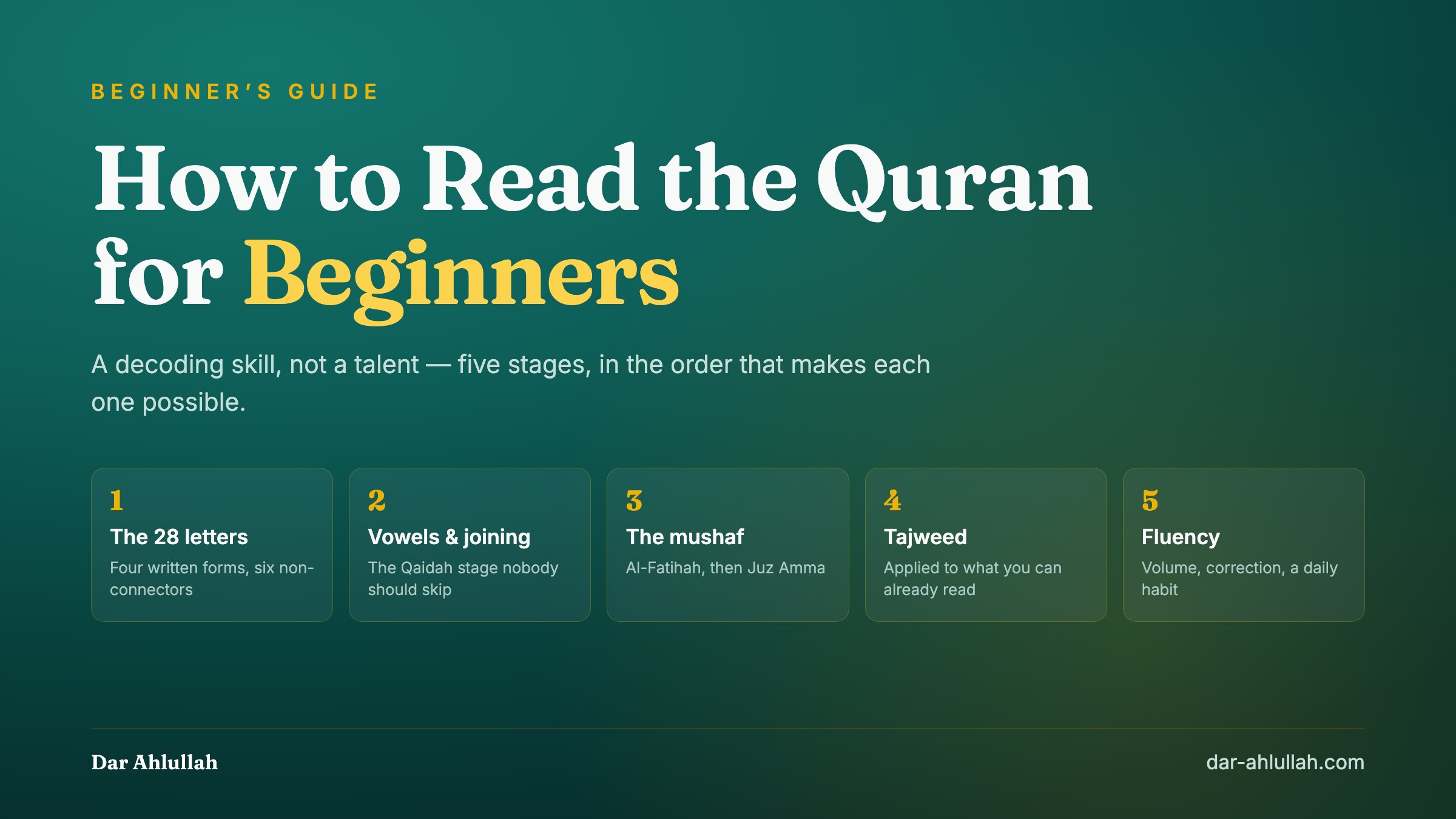
How to Read the Quran for Beginners: A Step-by-Step Route
Reading the Quran is a decoding skill, not a talent — and almost every beginner who stalls stalled on the order, not the difficulty. Here are the five stages, what marks the end of each, and why the Qaidah is the one nobody should skip.
20 min read
sujood ash-shukr
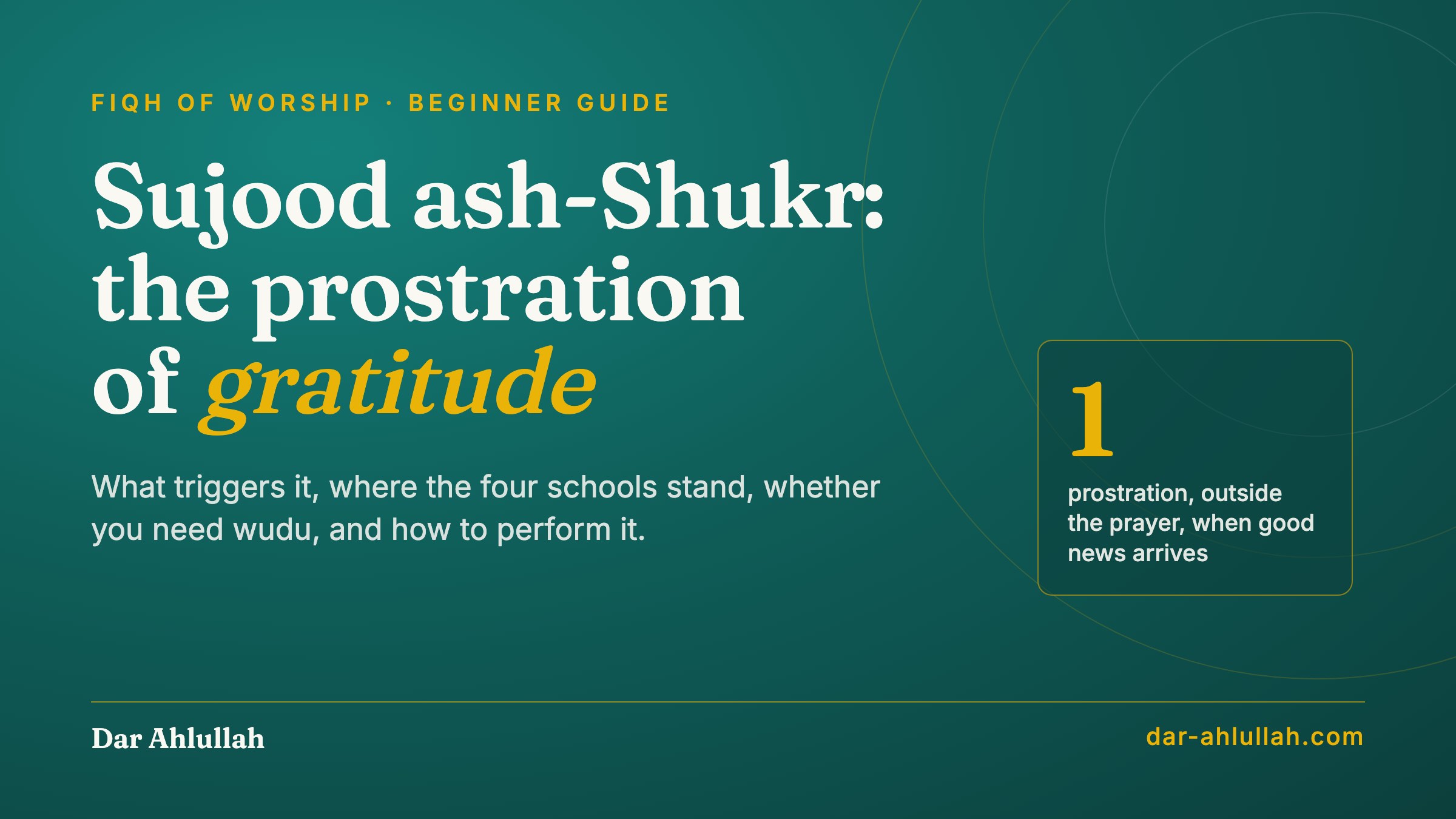
Sujood ash-Shukr: The Prostration of Gratitude
Sujood ash-shukr is the single prostration a Muslim makes when good news arrives or a harm is lifted. What actually triggers it, why the four schools do not agree on its status, whether you need wudu, how to perform it, what to say, and the answers for an exam result, a hospital corridor and an office desk.
25 min read
Noorani Qaida
Noorani Qaida: What It Is and How to Actually Finish It
Every Quran teacher says “we will start with the Qaida” as if you already know what that means. Here is what the book is, what each block of lessons trains, why the order is not negotiable, and the five habits that leave people stuck on page nine.
20 min read