
how to pray salat al-tasbih
How to Pray Salat al-Tasbih: The Prayer of Glorification
Dar Ahlullah team 22 min read
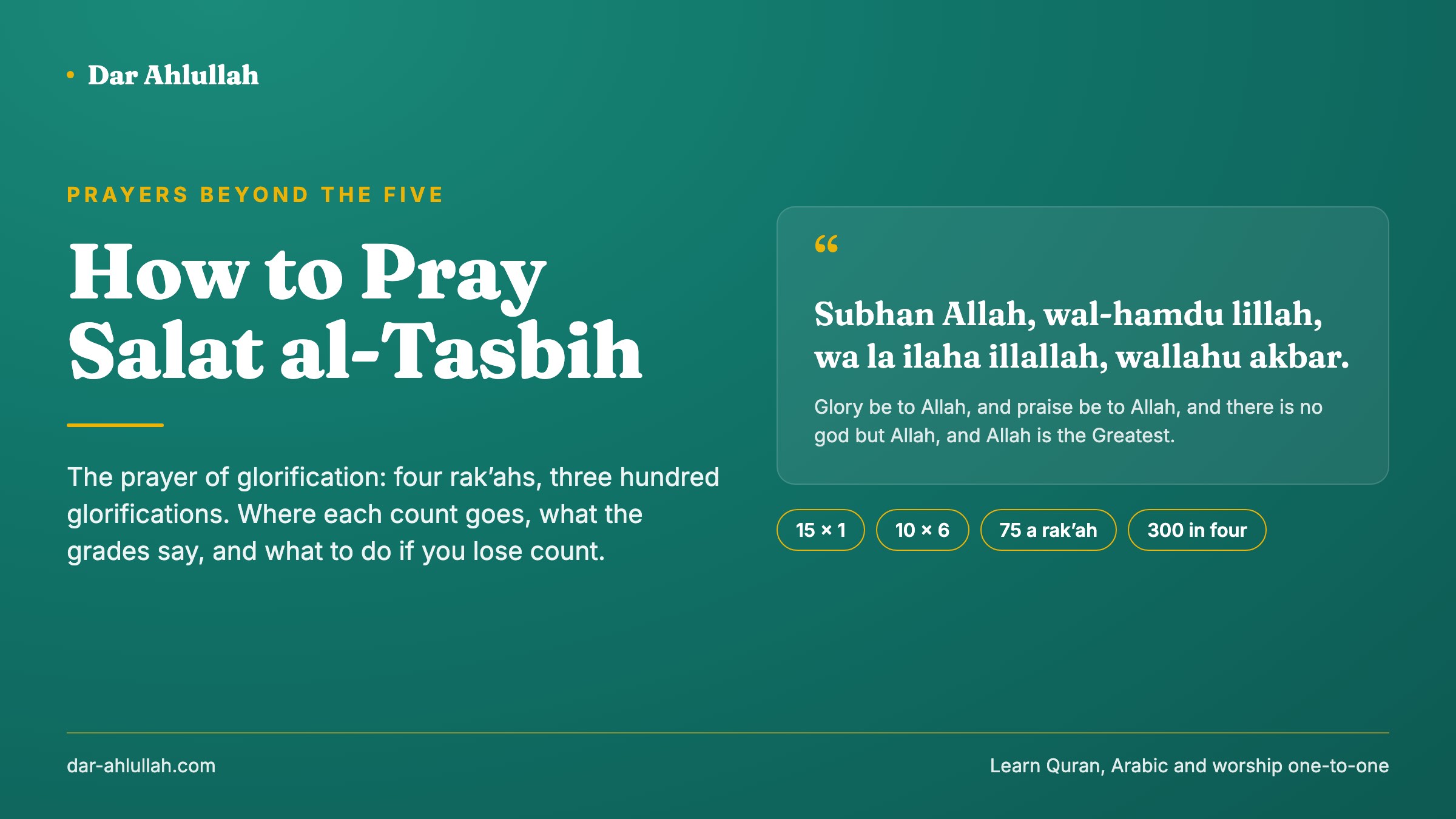
Table of Contents
- Introduction: Three Hundred Glorifications
- The Short Answer
- The Words You Repeat
- Where the Prayer Comes From: The Reports and Their Grades
- What the Scholars Make of It
- How to Pray Salat al-Tasbih, Step by Step
- The Two Orders of the Seventy-Five
- Counting Without Losing Your Place
- If You Lose Count or Forget a Position
- When and How Often
- Alone or in Congregation?
- Not to Be Confused With
- Six Mistakes People Make
- How We Teach This
- Questions People Ask
- Conclusion: Once in a Lifetime, at Least
Introduction: Three Hundred Glorifications
Most voluntary prayers are easy to describe. Two rak’ahs, prayed like the sunnah before Fajr, with a du‘a before or after. Salat al-tasbih, the prayer of glorification, is the exception. It is four rak’ahs in which one short sentence of praise is repeated three hundred times, seventy-five in every rak’ah, spread across every standing, bowing, prostrating and sitting position of the prayer. Getting the numbers right is half the work, and it is the half that most guides rush.
The other half is the question underneath it. Search for the prayer and within a few results you will find one page calling it a great sunnah that forgives sins “first and last, old and new”, and another calling it an innovation that nobody should pray. Both cite scholars. Both cite hadith. Neither tells you that the two sides are reading the same handful of reports and grading them differently.
This guide does both halves. It sets out the reports with their grades, the scholars on each side and what they actually said, then the method position by position, the two different orders in which the seventy-five are placed, how to count without losing your place, and what the scholars say happens when you do lose it. If you are new to the prayer itself, start with our step-by-step guide to how to pray in Islam; this article sits in its salah library beside the other voluntary prayers.
One boundary before we begin. We teach Quran, Arabic and the practical fiqh of worship; we are not a fatwa body. Where the scholars genuinely differ, as they do here, we set the positions side by side rather than pick one and call it consensus.
The Short Answer
- Salat al-tasbih is four rak’ahs with 300 repetitions of one phrase: Subhan Allah, wal-hamdu lillah, wa la ilaha illallah, wallahu akbar. In each rak’ah you say it fifteen times once and ten times in six other positions: seventy-five a rak’ah.
- It comes from the Prophet ﷺ teaching it to his uncle al-‘Abbas (Sunan Abi Dawud 1297, sahih per al-Albani). No report says the Prophet ﷺ prayed it himself.
- The scholars differ on the hadith. Ibn Hajar, al-Suyuti and al-Albani graded it sound, and IslamWeb and SeekersGuidance hold the prayer recommended. Imam Ahmad, Ibn al-Jawzi and Ibn Taymiyyah weakened it, and IslamQA holds that it is not prescribed. Even al-Tirmidhi said little in the reports is sound.
- Two orders of the seventy-five are reported. In the hadith of Ibn ‘Abbas the fifteen come after the recitation and the last ten in the sitting after the second prostration. In the method of ‘Abdullah ibn al-Mubarak the fifteen come before the recitation and there is nothing in that sitting. Both make seventy-five.
- If you lose count, the prayer is still valid. IslamWeb, citing Ibn Hajar, says the glorifications are not obligatory and a missed count needs no compensation. Ibn al-Mubarak said the prostrations of forgetfulness do not get tens of their own: “it is only three hundred.”
The Words You Repeat
Subhan Allah, wal-hamdu lillah, wa la ilaha illallah, wallahu akbar.
Glory be to Allah, and praise be to Allah, and there is no god but Allah, and Allah is the Greatest.
That sentence is the whole of the “tasbih” in this prayer. It is four phrases joined into one, and one repetition means all four. In South Asian teaching it is often called the third kalimah, which is how Mufti Ebrahim Desai’s answer on the prayer names it (Darul Iftaa, Madrasah In’aamiyyah).
Whatever you conclude about the prayer, the sentence itself is beyond dispute. The Prophet ﷺ said: “The dearest phrases to Allah are four: Subhan Allah, al-hamdu lillah, la ilaha illallah and Allahu akbar. It does not matter which of them you begin with” (Sahih Muslim 2137). The dispute below is about a prayer built on repeating these words in a fixed pattern. The words are in Sahih Muslim.
The versions differ slightly in order. Abu Dawud’s wording of the Ibn ‘Abbas hadith and Ibn Majah’s give Subhan Allah first; al-Tirmidhi’s wording of the Abu Rafi‘ report puts Allahu akbar first. Given the hadith just quoted, the order is not something to worry about. Say the four phrases in the order you learned them and keep that order all the way through, because a consistent sentence is easier to count.
Because it is Arabic, and you will say it three hundred times, it is worth learning properly before you start: the long vowels in Subhan and Allah, the ha at the start of al-hamdu, which is not an English h, and a clear la ilaha illallah rather than a blur. Our guide to what to say in salah, position by position has the other words of the prayer that sit around it.
Where the Prayer Comes From: The Reports and Their Grades
There is no single “hadith of salat al-tasbih”. There is a cluster of reports, from different Companions, that agree on the core and differ in the details. That is the key to understanding why the grading is disputed, so here they are one at a time. The modern grades are the ones printed beside each hadith in the standard editions.
| Report | Where it is | What it contains | Grade |
|---|---|---|---|
| Ibn ‘Abbas: the Prophet ﷺ teaches his uncle al-‘Abbas “ten things” | Sunan Abi Dawud 1297, Sunan Ibn Majah 1387 | The full method: four rak’ahs, fifteen after the recitation, ten in six positions including the sitting after the second prostration. The daily-to-lifetime scale | Sahih per al-Albani and Muhammad Muhyi al-Din ‘Abd al-Hamid; isnad hasan per Zubair ‘Ali Za’i. Sahih per al-Albani and Muhammad Fu’ad ‘Abd al-Baqi in Ibn Majah |
| Abu Rafi‘: the same teaching to al-‘Abbas | Jami’ at-Tirmidhi 482, Sunan Ibn Majah 1386 | The same order, with the total spelled out: seventy-five a rak’ah, three hundred in four | Al-Tirmidhi: gharib. Sahih per al-Albani and Ahmad Shakir; hasan per Zubair ‘Ali Za’i. In Ibn Majah, hasan li-ghayrihi per Shu‘ayb al-Arna’ut |
| A Companion thought to be ‘Abdullah ibn ‘Amr: “When the day declines, stand and pray four rak’ahs” | Sunan Abi Dawud 1298 | The same prayer, with a suggested time after midday, and permission to pray it “by night or by day” | Hasan sahih per al-Albani; da‘if per Shu‘ayb al-Arna’ut and Zubair ‘Ali Za’i. Abu Dawud notes it was also narrated as the saying of the Companion himself |
| An Ansari: the Prophet ﷺ says it to Ja‘far | Sunan Abi Dawud 1299 | “In like manner”, addressed to Ja‘far rather than al-‘Abbas | Sahih per al-Albani; hasan per Shu‘ayb al-Arna’ut |
The Ibn ‘Abbas report is the fullest, and its wording is worth reading, because it is the source of the prayer’s reputation. The Prophet ﷺ asks his uncle three times over whether he may give him a gift, then says that if he does these ten things Allah will forgive his sins, “first and last, old and new, involuntary and voluntary, small and great, secret and open.” Then comes the method, and then the scale: “If you can observe it once daily, do so; if not, then once weekly; if not, then once a month; if not, then once a year; if not, then once in your lifetime.”
The Abu Rafi‘ report in al-Tirmidhi gives the same order and states the arithmetic that everyone quotes, “seventy-five in every rak’ah, which is three hundred in four rak’ahs,” and adds that al-‘Abbas asked who could manage it every day. Al-Tirmidhi’s own verdict on it is one word: gharib, a report with a single narrow chain.
Al-Tirmidhi’s chapter is where the dispute is clearest, because the collector himself stated it. He opened the chapter on salat al-tasbih not with the prayer but with a report of Anas, that Umm Sulaym asked the Prophet ﷺ for words to say in her prayer and was told to say Allahu akbar ten times, Subhan Allah ten times and al-hamdu lillah ten times, and then ask for whatever she wanted (Jami’ at-Tirmidhi 481, hasan isnad per al-Albani and Ahmad Shakir). Then he wrote: more than one hadith has been narrated from the Prophet ﷺ about salat al-tasbih, and not much of it is sound; Ibn al-Mubarak and more than one of the people of knowledge held the prayer and mentioned its virtue. Weak reports, and a line of scholars who acted on them anyway. That sentence, from the ninth century, is the modern debate in miniature.
Why the graders split. Look at the table again. The same teaching arrives through Ibn ‘Abbas, Abu Rafi‘, ‘Abdullah ibn ‘Amr and an unnamed Ansari; it is addressed to al-‘Abbas in some and to Ja‘far in another; one version puts it after midday; and Abu Dawud himself records that some narrators gave it as the words of a Companion rather than of the Prophet ﷺ. A grader who weighs those routes as supporting one another can reach hasan or sahih. Ibn Hajar and al-Albani did, and Shu‘ayb al-Arna’ut’s grade for the Ibn Majah route, hasan li-ghayrihi, means exactly that: sound because of the routes that support it. A grader who sees them as one report that could not keep its own shape calls it mudtarib, inconsistent, and weak, which is Ibn ‘Uthaymin’s word for it.
One more point that is easy to miss. IslamWeb, which holds the prayer recommended, still says plainly that it is not aware of any hadith showing that the Prophet ﷺ ever prayed it himself (IslamWeb fatwa 83600). Everything rests on it being taught, not on it being practised.
What the Scholars Make of It
With the reports laid out, the two positions are easy to follow.
| Position | Held by | What they said |
|---|---|---|
| The hadith is sound and the prayer is a recommended sunnah | IslamWeb, naming as graders of the hadith al-Daraqutni, al-Khatib al-Baghdadi, Abu Musa al-Madini, Abu Bakr ibn Abi Dawud, al-Hakim, al-Suyuti, Ibn Hajar and al-Albani (IslamWeb fatwa 83877); SeekersGuidance (The Prayer of Glorification); Mufti Ebrahim Desai for the Hanafi Darul Iftaa of Madrasah In’aamiyyah | “The preponderant position” is that the prayer is sunnah (IslamWeb). “Most hadith masters accepted this as a sound hadith — and the jurists considered it a recommended sunna” (SeekersGuidance). “Among the optional prayers, this prayer is given great eminence” (Mufti Desai) |
| The hadith is weak and the prayer is not prescribed | IslamQA (145112, 14320), quoting Imam Ahmad, al-Nawawi in al-Majmu‘, Ibn Taymiyyah, Ibn ‘Uthaymin and the Standing Committee; IslamWeb adds Ibn al-Jawzi and Siraj al-Din al-Qazwini to those who weakened it | Ahmad: “I do not like it. There is nothing sahih about it.” Al-Nawawi: the hadith is weak and the prayer changes the normal form of the prayer. The Standing Committee: an innovation, its hadith munkar |
On Imam Ahmad the two sides report different things, and both are worth knowing. IslamQA quotes his dislike of the prayer from Ibn Qudamah’s al-Mughni. IslamWeb reports that Ibn Hajar narrated a change in Ahmad’s opinion on the hadith’s weakness. Whichever is the later word, the fact that it is argued over tells you how close the grading question is.
Ibn ‘Uthaymin’s case, as IslamQA summarises it, has four parts: acts of worship need proven evidence; the hadith is inconsistent; none of the imams held the prayer to be recommended; and a prayer with a reward this large would have been reported widely if it were authentic. He also pointed to the scale itself, daily down to once in a lifetime, as a sign that something in the reports is unusual.
The recommending side’s case is al-Tirmidhi’s sentence above, carried forward: the routes strengthen each other, a long line of hadith masters accepted the result, and scholars from Ibn al-Mubarak onwards acted on it. SeekersGuidance quotes Ibn ‘Abidin’s Radd al-Muhtar on its reward.
What both sides agree on is more than it looks. Nobody holds the prayer obligatory. Nobody disputes the four phrases themselves, which are the dearest words to Allah in Sahih Muslim. Nobody objects to you praying ordinary voluntary rak’ahs and filling your day with Subhan Allah, al-hamdu lillah, la ilaha illallah and Allahu akbar. The disagreement is about one thing: whether a prayer that places those words in a fixed pattern, three hundred times, is a sunnah. If you follow a school or a teacher, follow them. If you do not, you now have both positions and their reasons in front of you.
How to Pray Salat al-Tasbih, Step by Step
This is the method in the wording of the Ibn ‘Abbas hadith, which is the one Abu Dawud, Ibn Majah and al-Tirmidhi all carry. The alternative order that Ibn al-Mubarak described is in the next section, with a table comparing them.
1. Make wudu and intend four rak’ahs of salat al-tasbih
Wudu as for any prayer; our step-by-step guide to wudu has the method. The intention is knowing, in your heart, that you are standing to pray the four rak’ahs of salat al-tasbih. Nothing needs to be said aloud. Decide before you begin whether you will pray the four together or as two and two; that choice is covered below.
2. Begin as in any prayer, and recite
Opening takbir, the opening supplication, al-Fatihah and a surah. The hadith says only “a surah”; some guides name particular surahs for each rak’ah, but nothing in the reports above fixes them, so any surah you know is fine.
3. Still standing, after the recitation: fifteen
Before you bow, say the phrase fifteen times.
4. In ruku‘: ten
Bow, say the ordinary glorification of bowing, Subhana Rabbiyal-‘Azim, then the phrase ten times. Ibn al-Mubarak said to begin in ruku‘ with Subhana Rabbiyal-‘Azim and in sujud with Subhana Rabbiyal-A‘la, three times, and only then say the glorifications (reported under Jami’ at-Tirmidhi 481). The tens are added to the prayer’s own words, not substituted for them.
5. Rising from ruku‘: ten
Rise with Sami‘a Allahu liman hamidah, say Rabbana wa lakal-hamd, then the phrase ten times while standing.
6. In the first sujud: ten
Prostrate, say Subhana Rabbiyal-A‘la, then the phrase ten times.
7. Sitting between the two prostrations: ten
Sit up and say the phrase ten times.
8. In the second sujud: ten
Prostrate again, Subhana Rabbiyal-A‘la, then ten.
9. Sitting after the second sujud, before you stand: ten
Raise your head and sit, and say the phrase ten times before standing for the next rak’ah. That completes seventy-five. In the second and fourth rak’ahs this sitting is the tashahhud sitting; say the ten first, then the tashahhud. IslamWeb gives that order from al-Sawi’s Maliki commentary: the last ten are said in the sitting “before tashahhud” (IslamWeb fatwa 189987).
10. Repeat in rak’ahs two, three and four, then the salam
Each rak’ah is the same: fifteen, then six tens. Four rak’ahs make three hundred. Finish with the tashahhud, the blessings on the Prophet ﷺ, any du‘a you wish, and the salam.
The Two Orders of the Seventy-Five
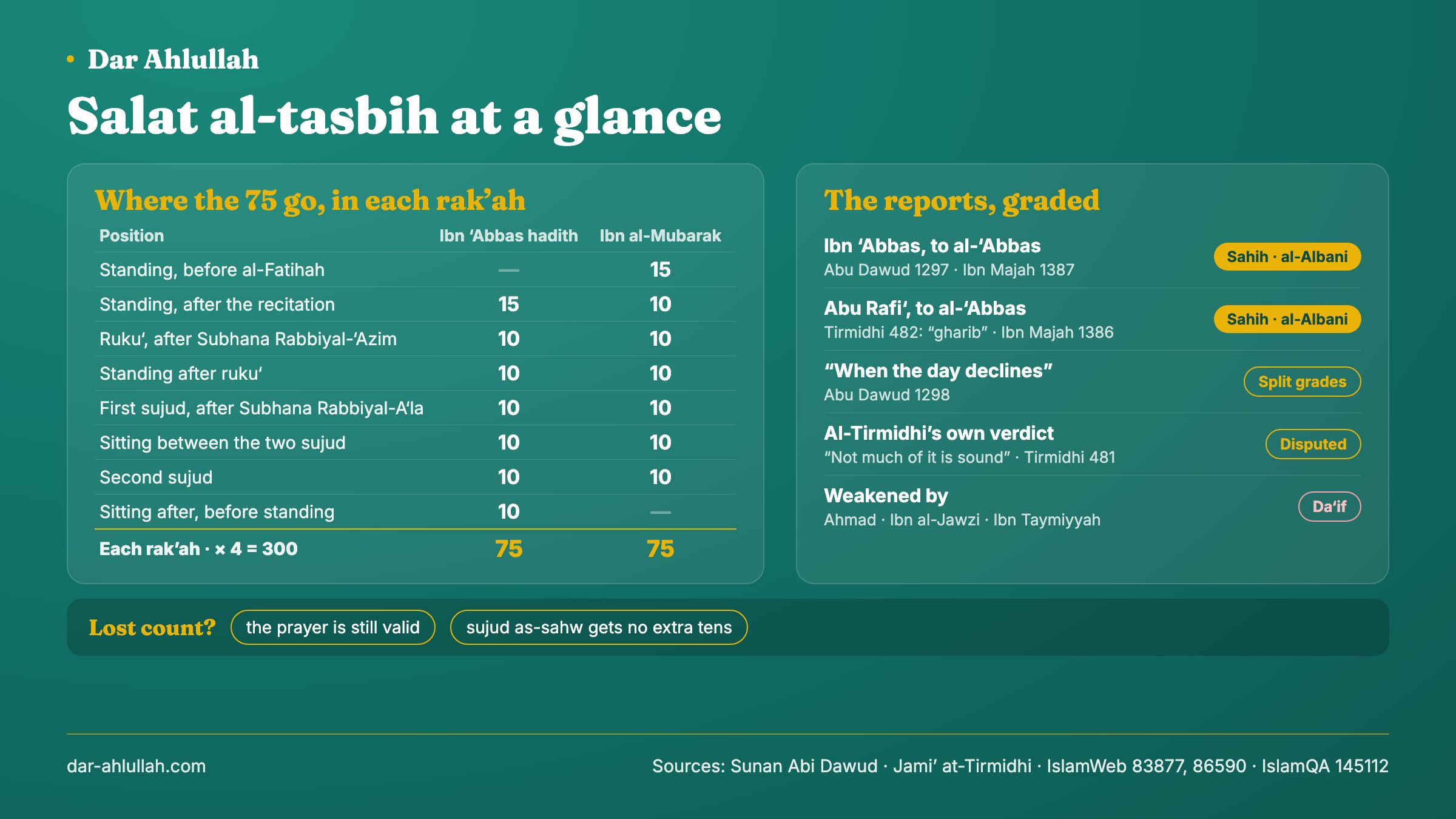
‘Abdullah ibn al-Mubarak, the second-century scholar al-Tirmidhi names first among those who acted on this prayer, was asked how it is prayed. His answer, recorded by al-Tirmidhi under the chapter’s first hadith, places the counts differently: the fifteen come after the opening supplication and before the recitation, then ten after the recitation, then ten in each position down to the second prostration, and nothing in the sitting after it (Jami’ at-Tirmidhi 481). Both orders reach seventy-five.
| Position in each rak’ah | Order of the Ibn ‘Abbas hadith | Order of Ibn al-Mubarak |
|---|---|---|
| Standing, after the opening supplication, before al-Fatihah | — | 15 |
| Standing, after al-Fatihah and the surah | 15 | 10 |
| In ruku‘, after Subhana Rabbiyal-‘Azim | 10 | 10 |
| Standing after ruku‘ | 10 | 10 |
| First sujud, after Subhana Rabbiyal-A‘la | 10 | 10 |
| Sitting between the two sujud | 10 | 10 |
| Second sujud | 10 | 10 |
| Sitting after the second sujud, before standing | 10 | — |
| Total in the rak’ah | 75 | 75 |
Which should you use? Many guides label one order “Hanafi” and the other “Shafi‘i”, but the Hanafi fatwas themselves do not line up that neatly: SeekersGuidance’s article teaches Ibn al-Mubarak’s order, while Mufti Ebrahim Desai’s Hanafi answer teaches the order of the Ibn ‘Abbas hadith. Both are reported, both are acted on, and both total three hundred. If your teacher or school prefers one, use it.
Our own advice is a teaching one, not a ruling: choose one order and keep it, every time. The count only becomes automatic when your body knows where the fifteen goes. Switching between the two is the easiest way to end a rak’ah unsure whether you still owe ten.
A shape that works for both orders: one fifteen, then six tens. In the hadith’s order the fifteen follows the recitation and the sixth ten is the sitting before you stand up. In Ibn al-Mubarak’s order the fifteen comes before the recitation and the sixth ten is the second prostration.
Counting Without Losing Your Place
Three hundred is a lot to track while also concentrating on the prayer, which is why the method matters more here than in any other voluntary prayer.
- Count on your fingers, silently. Mufti Ebrahim Desai’s answer says the counting should not be done aloud, because that would disturb the prayer, but by pressing the fingers, in whatever position the hand happens to be.
- Only ever count to ten or fifteen. You are never counting to seventy-five or three hundred. The positions do the big counting for you: when the ten in the second sujud is done, the rak’ah is done.
- Learn the phrase to fluency first. If you are still reading the words, you cannot also count them. Say the sentence outside the prayer, in the adhkar after an obligatory prayer or while walking, until it runs without effort.
- Pray it where you will not be interrupted. Four rak’ahs with three hundred repetitions take noticeably longer than an ordinary four. Give it a time when you are not watching the clock.
If You Lose Count or Forget a Position
This is the question that stops most people from praying salat al-tasbih a second time, and the answer is gentler than they expect.
The prayer is still valid. Asked by someone who had said ten instead of fifteen, IslamWeb answered that the glorifications in this prayer are not obligatory, and whoever leaves them, or some of them, owes nothing and his prayer is valid. It cites Ibn Hajar, who gave them the same ruling as the extra takbirs of the Eid prayer (IslamWeb fatwa 86590). You do not repeat the prayer because the numbers came out wrong.
If you want to make up a missed count, the Hanafi answer from Mufti Ebrahim Desai says to make it up in the next position, but not in the standing after ruku‘ nor in the sitting between the two prostrations, the two short positions. So if you forget the ten after rising from ruku‘, you add them in the first sujud and say twenty there.
The prostrations of forgetfulness are not extra positions. Ibn al-Mubarak was asked whether, if a person makes a mistake in this prayer, he says the glorifications ten and ten in the two prostrations of forgetfulness. He said no: “it is only three hundred glorifications” (reported under Jami’ at-Tirmidhi 481). Note what that answer is about. It does not say forgetfulness never calls for sujud as-sahw; it says those two prostrations do not add twenty to the total. Mufti Desai’s answer agrees, and adds that a count you had missed may be made up inside them. For when sujud as-sahw is due in the first place, see what to do if you make a mistake in prayer.
When and How Often
How often
The hadith gives a descending scale and no fixed day: daily if you can, otherwise once a week, once a month, once a year, or once in a lifetime (Sunan Abi Dawud 1297). In both Abu Dawud and al-Tirmidhi the second step is jumu‘ah, which the English translations render either as “every Friday” or as “once weekly”; the Arabic word is both the name of Friday and a word for the week, so either reading is available. Nothing in the reports ties the prayer to Ramadan or to Laylat al-Qadr.
What time of day
Any time outside the windows in which voluntary prayer is prohibited. “There is no prayer after the morning prayer until the sun rises, and there is no prayer after the ‘Asr prayer until the sun sets” (Sahih al-Bukhari 586), and ‘Uqbah ibn ‘Amir added the moment the sun stands at its height (Sahih Muslim 831). Salat al-tasbih is not tied to an occasion, so it is held back in those windows like any ordinary voluntary prayer; the school difference over prayers that do have a reason is set out in our guide to tahiyyat al-masjid. The Abu Dawud 1298 version suggests praying it after midday, “when the day declines”, and in the same report permits it “by night or by day”; its grading is split, as the table shows.
Four together, or two and two?
The hadith describes four rak’ahs without mentioning a salam in the middle. Ibn al-Mubarak said that at night he preferred a salam after every two rak’ahs, and by day you may do either (Jami’ at-Tirmidhi 481; IslamWeb fatwa 89834). His night preference matches the Prophet’s ﷺ description of the night prayer as two rak’ahs followed by two (Sahih al-Bukhari 990). If you pray it in the last third of the night, as part of your tahajjud, two and two is the natural shape.
Alone or in Congregation?
Every report teaches salat al-tasbih to one man, al-‘Abbas or Ja‘far, to pray himself. Where it is organised as a congregation, for example on a night in Ramadan, the Hanafi school raises an objection that applies to voluntary prayers in general. The Darul Iftaa Birmingham answer on exactly this question says that voluntary prayer in congregation becomes an innovation and disliked “if it is done regularly and people are invited to it, or the congregation consists of three or more people”, citing Bada’i‘ al-Sana’i‘, Radd al-Muhtar and Maraqi al-Falah (Darul Iftaa Birmingham). The same questioner’s group was praying it after ‘Asr, before Maghrib, which runs into the prohibited window as well. If your masjid holds a congregational salat al-tasbih, ask the imam which view it is following; if you are praying at home, the question does not arise.
Not to Be Confused With
The word tasbih covers several different things in the prayer, and a search for one often turns up the others.
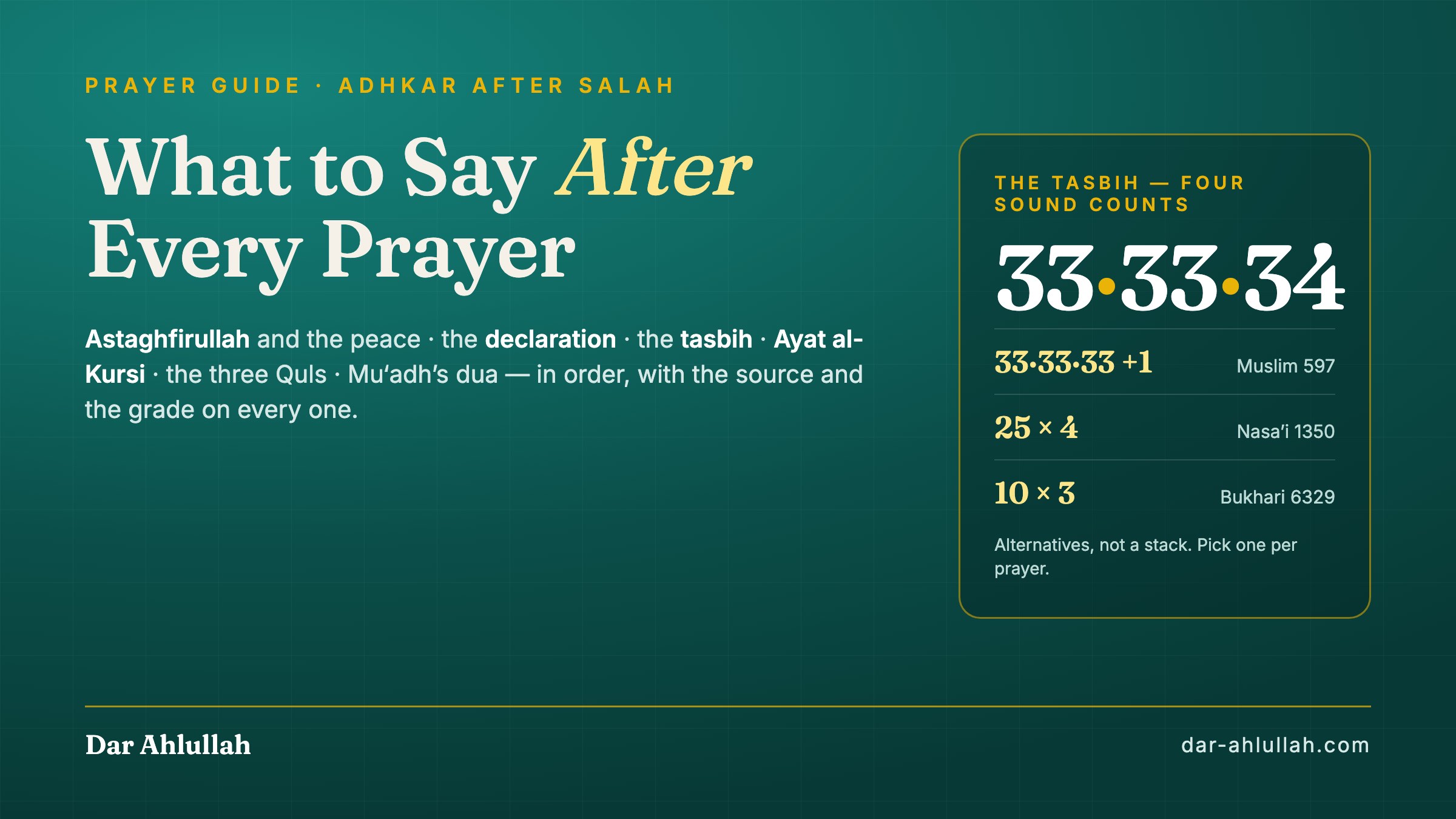
- The tasbih after prayer. Subhan Allah thirty-three times, al-hamdu lillah thirty-three and Allahu akbar thirty-four after every obligatory prayer is a different practice, with its own sound reports and four sound counts. It is covered in adhkar after salah.
- The tasbih of ruku‘ and sujud. Subhana Rabbiyal-‘Azim and Subhana Rabbiyal-A‘la are part of every prayer, and stay in this one too. See what to say in salah.
- Tasbih beads. The misbahah is also called a tasbih. That is a counting aid for dhikr outside the prayer, not a prayer.
- The other prayers with a purpose. Salat al-tasbih is not prayed for a particular need or a particular decision. For those, see salat al-hajah, the prayer of need, salat al-tawbah, the prayer of repentance, and istikhara for a decision.
Six Mistakes People Make
- Switching orders halfway. Starting with Ibn al-Mubarak’s fifteen before al-Fatihah and then also doing the hadith’s ten after the second sujud leaves you on eighty-five. Pick one order before you start.
- Replacing the prayer’s own words. The tens are added after Subhana Rabbiyal-‘Azim and Subhana Rabbiyal-A‘la, not said instead of them.
- Counting out loud. Count by pressing your fingers, silently.
- Repeating the whole prayer because the count went wrong. On the view that recommends the prayer, a missed count needs no compensation and the prayer is valid.
- Adding tens to the prostrations of forgetfulness. “It is only three hundred.”
- Praying it after ‘Asr or after Fajr. It is an ordinary voluntary prayer as far as the prohibited windows go.
How We Teach This
Salat al-tasbih is a four-rak’ah prayer with one Arabic sentence said three hundred times, which makes it a very honest test of two things: whether your prayer is solid enough that you can think about something else while doing it, and whether your Arabic is clear enough that three hundred repetitions stay words rather than sound. Both are what we teach. Fiqh basics, the prayer among them, are part of our Islamic Studies course, and the Quran and Arabic courses build the recitation and the understanding that go into every position of it, one-to-one.
Dar Ahlullah runs one-to-one live sessions with certified teachers, scheduled in your own timezone. Teaching is charged at $9 per teaching hour, with monthly plans at $36, $70 and $102 depending on how many hours you want, and a 20% discount for siblings. You can pause, upgrade or switch plans at any time, and if a teacher is not the right fit we rematch you with another certified mentor at no extra cost. If you would like to see where your prayer and recitation stand before committing to anything, the 30-minute assessment is free and does not ask for a card. The details are on our pricing page.
Questions People Ask
What is salat al-tasbih?
The prayer of glorification: four rak’ahs in which the phrase Subhan Allah, wal-hamdu lillah, wa la ilaha illallah, wallahu akbar is said seventy-five times in each rak’ah, three hundred in all. The Prophet ﷺ taught it to his uncle al-‘Abbas (Sunan Abi Dawud 1297).
Is salat al-tasbih authentic?
The scholars differ. Ibn Hajar, al-Suyuti and al-Albani graded the hadith sound, and IslamWeb and SeekersGuidance hold the prayer a recommended sunnah. Imam Ahmad, Ibn al-Jawzi, Ibn Taymiyyah and Ibn ‘Uthaymin weakened it, and IslamQA holds that it is not prescribed. Al-Tirmidhi said that not much in its reports is sound, and that Ibn al-Mubarak and other scholars acted on it.
How many rak’ahs is salat al-tasbih?
Four. Ibn al-Mubarak preferred praying them as two and two at night; by day either is fine.
How many times do I say the tasbih in each position?
Fifteen once and ten in six other positions, seventy-five per rak’ah. In the hadith’s order the fifteen follow the recitation and the last ten are in the sitting after the second sujud; in Ibn al-Mubarak’s order the fifteen come before al-Fatihah and ten follow the recitation.
Which surahs should I recite in salat al-tasbih?
Al-Fatihah and any surah in each rak’ah. The reports say only “a surah”.
Do I still say Subhana Rabbiyal-‘Azim in ruku‘?
Yes. Ibn al-Mubarak said to begin with the ordinary glorification of ruku‘ and sujud, three times, and then add the ten.
Where do the ten go in the tashahhud sitting?
Before the tashahhud, following the order IslamWeb gives from al-Sawi. This only arises in the hadith’s order, where the last ten are in the sitting after the second sujud.
What if I lose count?
The prayer is valid. IslamWeb, citing Ibn Hajar, says the glorifications are not obligatory and a missed count needs no compensation. The Hanafi answer allows making it up in the next position, though not in the standing after ruku‘ or between the prostrations.
Can I pray salat al-tasbih at night?
Yes. Abu Dawud 1298 allows it “by night or by day”, and Ibn al-Mubarak described how to pray it at night.
Can I pray salat al-tasbih on Friday or in Ramadan?
Yes, as on any day, outside the prohibited windows. The reports give a scale of daily, weekly, monthly, yearly and once in a lifetime, and do not tie it to Friday, Ramadan or Laylat al-Qadr.
Can salat al-tasbih be prayed in congregation?
Every report teaches it to one person. The Hanafi school dislikes voluntary prayer in a congregation that is regular and announced, or of three or more people behind the imam.
Can I pray salat al-tasbih during my period?
No, because prayer is not prayed then. The four phrases themselves, and every other dhikr, are open to you at any time.
Conclusion: Once in a Lifetime, at Least
Strip away the arguments and the method is short enough to carry in your head: four rak’ahs, and in each one, fifteen then six tens of the four dearest phrases to Allah. Choose one of the two reported orders, count on your fingers, add the tens to the prayer’s own words rather than replacing them, and if the numbers come out wrong, the prayer still stands.
Whether it is a sunnah is a question the scholars have argued over since al-Tirmidhi wrote that little in its reports is sound, and that Ibn al-Mubarak prayed it anyway. Follow your school or your teacher on that. What nobody argues over is the sentence at its centre, and that you may say it as often as you like. If you want the rest of the prayer in the same detail, the salah library links every guide we have written on it, including the other voluntary prayers such as salat al-hajah and duha.
Related articles
how to pray salat al-hajah
How to Pray Salat al-Hajah: The Prayer of Need
Salat al-hajah is two rak'ahs prayed when you need something, then asking Allah for it. The four reports behind it and their grades, the method step by step, du'as with sound chains, asking in English inside the prayer by school, and what to do when the answer is slow.
25 min read
how to pray salat al-tawbah
How to Pray Salat al-Tawbah: The Prayer of Repentance
Salat al-tawbah is two rak'ahs after a sin, taught in one sahih hadith. The method, what to say in sujud and after the salam, the forbidden-times question by school, praying it again after a relapse, sins against people, and what a new Muslim owes for the past.
25 min read
adhkar after salah
Adhkar After Salah: What to Say After Every Prayer
The adhkar after salah are the remembrances said in the minutes after the salam. This guide gives them in order with their sources, sets the 33-33-34, 33-33-33, 25-by-four and 10-by-three reports side by side so the counts stop looking like a contradiction, prints the grade on every famous reward, and works out which to keep when you pray Zuhr in a stairwell at work.
34 min read