
how to pray salat al-tawbah
How to Pray Salat al-Tawbah: The Prayer of Repentance
Dar Ahlullah team 25 min read
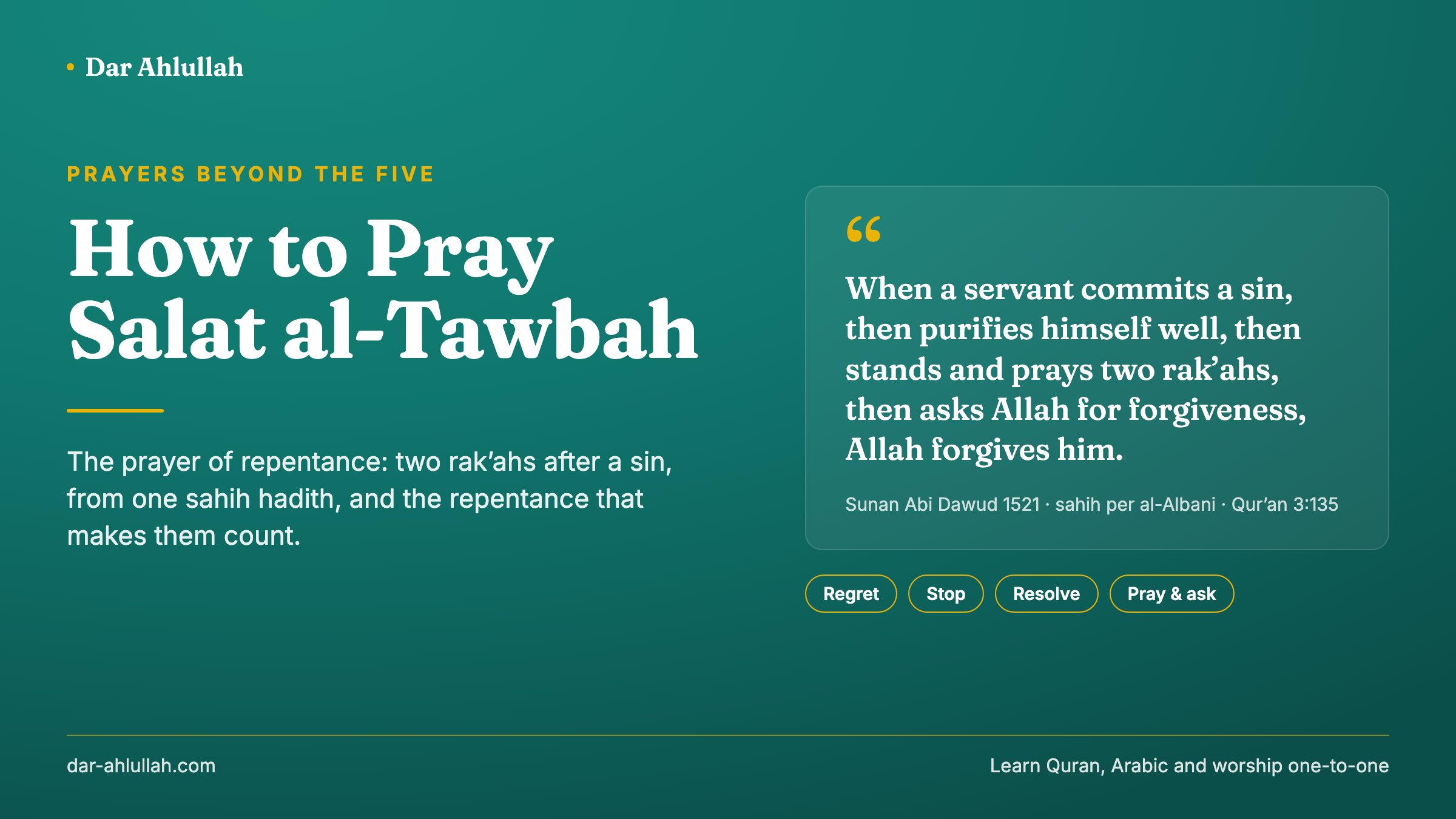
Table of Contents
- Introduction: After the Sin
- The Short Answer
- Where the Prayer Comes From
- What the Hadith Asks For, and What It Does Not
- How to Pray Salat al-Tawbah, Step by Step
- The Repentance That Makes the Prayer Count
- Which Sins It Covers
- When to Pray It, and the Forbidden Times
- Can I Pray It Again for the Same Sin?
- When the Sin Was Against Someone
- Missed Prayers: Two Separate Debts
- For New Muslims: What About Everything Before Islam?
- When You Cannot Pray It
- Five Situations, Worked Through
- Seven Mistakes People Make
- How We Teach This
- Questions People Ask
- Conclusion: Abu Bakr Told the Truth
Introduction: After the Sin
It happened again. The thing you told yourself last week you had finished with, or something new you never expected of yourself: a lie that grew bigger than you meant it to, words to a parent you cannot take back, a night that went somewhere it should not have gone. What follows is a particular kind of heaviness, and with it a question most Muslims ask at least once: is there something I am supposed to do now, beyond feeling bad?
There is. The Prophet ﷺ described it in one sentence: purify yourself well, stand and pray two rak’ahs, then ask Allah for forgiveness, and He forgives. The prayer that sentence describes is known as salat al-tawbah, the prayer of repentance. It is short, it has no special wording, and it can be prayed tonight. But it sits inside something larger, repentance itself, tawbah, and nearly every question people ask about the prayer turns out to be a question about that larger thing. What if I do it again? What if I hurt someone? What if the sin was missing prayers? What if I cannot pray right now?
This guide covers how to pray salat al-tawbah: where it comes from and how strong its evidence is, the method step by step, what to say in it and after it, when it may be prayed, and the conditions of repentance that give it its meaning. Then it works through the situations that make people hesitate. If the prayer itself is still new to you, start with our step-by-step guide to how to pray in Islam; this article sits in its salah library beside the other voluntary prayers. If you became Muslim recently and the question on your mind is really about your life before Islam, there is a section for exactly that, and the short version is good news.
One boundary before we begin. We teach Quran, Arabic and the practical fiqh of worship; we are not a fatwa body. Where the scholars genuinely differ we set the positions side by side rather than pick one and call it consensus, and where a situation needs someone who can hear its details, we say so.
The Short Answer
- Salat al-tawbah is two voluntary rak’ahs prayed after a sin, followed by asking Allah’s forgiveness. It rests on the hadith of Abu Bakr in Sunan Abi Dawud 1521, graded sahih by al-Albani, and the four schools agree that it is recommended.
- The method is the method of any two-rak’ah sunnah prayer. Make wudu well, intend it in your heart, pray two rak’ahs with al-Fatihah and any surah, and ask forgiveness in sujud and after the salam. No particular surah, du’a or count is reported for it.
- The prayer carries the repentance; it does not replace it. Repentance is regret, stopping the sin, and resolving not to return to it, plus putting things right with anyone you wronged. Without those, two rak’ahs are a good deed, but they are not yet a tawbah.
- Pray it soon after the sin, at any time prayer is allowed. Whether it may also be prayed in the windows after Fajr and after ‘Asr is a genuine school difference, set out below. The istighfar itself never has to wait.
- You can pray it again for the same sin, as many times as it takes. A relapse does not cancel a repentance that was sincere, and the door stays open until the soul reaches the throat.
Where the Prayer Comes From
The whole prayer rests on one report, and it is worth reading in full because its chain carries a detail that is hard to forget. ‘Ali ibn Abi Talib said that whenever one of the Companions narrated a hadith to him, he would ask them to swear to it before he accepted it. Then he added: “Abu Bakr narrated to me, and Abu Bakr told the truth.” No oath was needed. What Abu Bakr narrated was this:
“When a servant commits a sin, then purifies himself well, then stands and prays two rak’ahs, then asks Allah for forgiveness, Allah forgives him.” Then he recited: “And those who, when they commit an immorality or wrong themselves, remember Allah and seek forgiveness for their sins, and who can forgive sins except Allah? And they do not persist in what they have done while they know.”
That is Sunan Abi Dawud 1521, and the verse the Prophet ﷺ recited is Al ‘Imran 3:135. The same report is in Jami’ at-Tirmidhi 406, again at Tirmidhi 3006 under the explanation of that verse, and in Sunan Ibn Majah 1395. Al-Albani graded the Abu Dawud narration sahih and the Tirmidhi and Ibn Majah narrations hasan; Shu‘ayb al-Arna’ut graded it hasan, and Zubair ‘Ali Za’i called its chain hasan. There is no serious dispute about it. That is unusual for a named voluntary prayer, and worth knowing if you have read that some of the others rest on weak reports.
Two further reports fill in the picture. The first is the well-known hadith of ‘Uthman’s wudu: having shown how the Prophet ﷺ made wudu, ‘Uthman reported him saying that whoever makes wudu like this and then prays two rak’ahs without letting his mind wander, his past sins are forgiven (Sahih al-Bukhari 164, Sahih Muslim 226). The second, from Abu al-Darda in Musnad Ahmad, describes the same sequence, wudu done well, a prayer with the mind present, then asking forgiveness, but with “two rak’ahs or four”, one of the narrators being unsure which. IslamQA quotes it with the verdict of the Musnad’s editor that its chain is good, and notes that al-Albani included it in his Silsilah al-Sahihah (IslamQA 98030). Two is the number in Abu Bakr’s report, and the one to use; the second report is simply why you will sometimes see four mentioned.
On the prayer’s status there is agreement. IslamQA states that the scholars unanimously agree the prayer of repentance is prescribed, and IslamWeb that it is recommended by agreement of the four schools of fiqh (IslamWeb fatwa 338983). It is a sunnah, not an obligation: nobody is sinful for leaving it. What is obligatory is the repentance, which the Qur’an commands directly: “O you who have believed, repent to Allah with sincere repentance” (at-Tahrim 66:8).
What the Hadith Asks For, and What It Does Not
Read Abu Bakr’s report slowly and it contains exactly five things:
- A sin. The prayer has a cause. It is prayed because something happened, which puts it with the prayers that have a reason, like the greeting of the mosque, rather than the prayers that have a time, like duha.
- Purification, done well. The point of the wording is care, not a special kind of wudu.
- Standing to pray. A prayer, not only a du’a.
- Two rak’ahs. That is Abu Dawud’s wording. Tirmidhi’s says only “then prays”, and one narrator in Ibn Majah’s chain, Mis‘ar, reported it the same way.
- Asking Allah for forgiveness. After the prayer, in the order of the hadith.
And here is what it does not contain, which matters just as much, because a good deal has been added to it since:
- No particular surahs. IslamQA: there is no report from the Prophet ﷺ making it recommended to recite any particular surahs in these two rak’ahs. Recite al-Fatihah and whatever you know.
- No fixed du’a. Any sincere way of asking forgiveness fulfils it. There are excellent reported forms, given below, but none of them is tied to this prayer.
- No fixed time. It is prayed when its cause arises.
- No spoken intention. The intention is knowing what you are standing to pray. You will find Arabic intention sentences for salat al-tawbah online; none of them is from the hadith.
- No congregation. IslamQA: it is prescribed for the one repenting to pray alone, because it is one of the voluntary prayers that is not prescribed in congregation.
- No count. Neither of istighfar, nor of how often the prayer may be repeated.
How to Pray Salat al-Tawbah, Step by Step
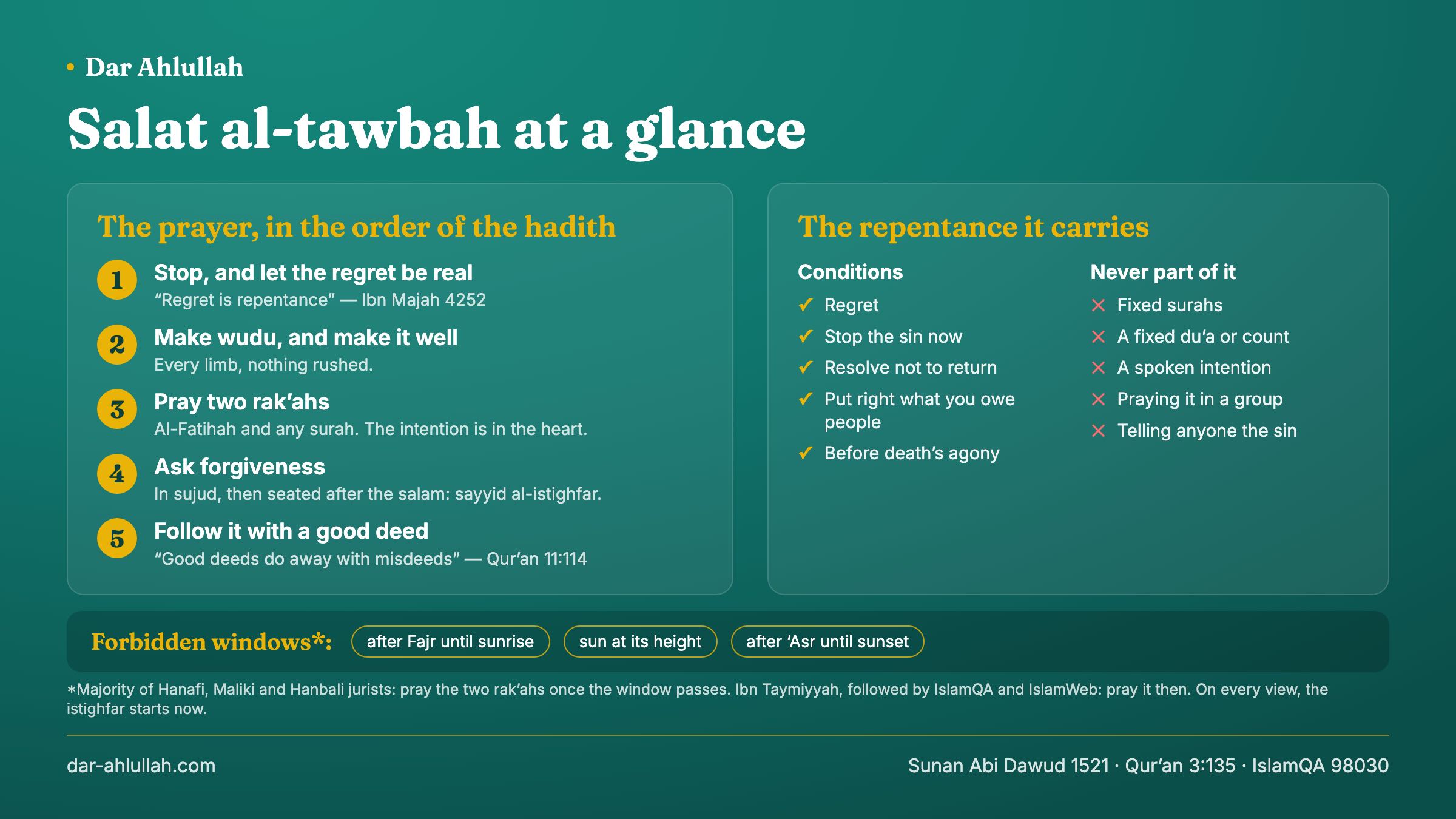
1. Stop, and let the regret be real
The repentance starts before the prayer does. If you are still inside the sin, the tab still open, the conversation still going, the money still in your account, the first act of tawbah is to stop. The Prophet ﷺ said, “Regret is repentance” (Sunan Ibn Majah 4252, sahih per al-Albani). The heaviness you feel is not an obstacle to the prayer. It is what the prayer is made of.
2. Make wudu, and make it well
The hadith says “purifies himself well”, so take the minute to do it properly: every limb, nothing rushed. Our step-by-step guide to wudu has the method. A sin does not break wudu (see what breaks wudu, and what does not), so if you are already in wudu the prayer is valid on it; if that wudu was a hurried one, renewing it costs a minute and matches the wording of the hadith more closely.
Notice the du’a the Prophet ﷺ taught for the end of every wudu: Allahumma j‘alni min at-tawwabin, wa j‘alni min al-mutatahhirin, “O Allah, make me among those who repent often, and make me among those who purify themselves” (Jami’ at-Tirmidhi 55, sahih per al-Albani and Ahmad Shakir, da‘if per Zubair ‘Ali Za’i). It echoes the verse “Allah loves those who are constantly repentant and loves those who purify themselves” (al-Baqarah 2:222). Washing and repenting were paired long before anyone called this a named prayer.
3. Intend it in your heart
Know that you are standing to pray two rak’ahs of repentance. That knowing is the intention. Nothing needs to be said aloud.
4. Pray two rak’ahs like any sunnah prayer
Opening takbir, al-Fatihah, any surah you know, ruku‘, sujud, the sitting and the salam, exactly as in the two sunnah rak’ahs before Fajr. IslamWeb describes its manner as that of any two-rak’ah voluntary prayer, such as the greeting of the mosque. If you need the words of each position, what to say in salah, position by position gives them in order. Pray with your attention on what you are saying: the reports of ‘Uthman and Abu al-Darda both describe a prayer in which the mind stays present.
5. Ask for forgiveness in sujud
“The nearest a servant comes to his Lord is when he is prostrating, so make supplication” (Sahih Muslim 482). IslamWeb suggests any formula of seeking forgiveness here, such as Astaghfirullah (I seek Allah’s forgiveness) or Allahumma ighfir li (O Allah, forgive me). If your Arabic stops there, that is enough. The majority position, set out in our guide to what to say in salah, allows someone who cannot yet speak Arabic to make the supplications in their own language.
6. After the salam, stay seated and ask
This is the part the hadith actually names: after the prayer, ask Allah for forgiveness. Stay where you are. Name the sin to Allah, and to no one else. Say what you regret and what you intend. Then, if you can, add the form the Prophet ﷺ called the best way of asking forgiveness, known as sayyid al-istighfar (Sahih al-Bukhari 6306):
Allahumma anta Rabbi, la ilaha illa ant. Khalaqtani wa ana ‘abduk, wa ana ‘ala ‘ahdika wa wa‘dika mastata‘t. A‘udhu bika min sharri ma sana‘t. Abu’u laka bi ni‘matika ‘alayya, wa abu’u bi dhanbi, faghfir li, fa innahu la yaghfiru adh-dhunuba illa ant.
O Allah, You are my Lord; there is no god but You. You created me and I am Your servant, and I hold to Your covenant and Your promise as far as I am able. I seek refuge in You from the evil of what I have done. I acknowledge Your favour upon me, and I acknowledge my sin, so forgive me, for none forgives sins but You.
The hadith attaches a promise of its own to it: whoever says it during the day with conviction and dies before the evening, or at night and dies before the morning, is among the people of Paradise. It is not specific to salat al-tawbah. It is simply the best-evidenced thing to say at this moment, and worth learning by heart for that reason alone.
7. Follow it with a good deed
“Indeed, good deeds do away with misdeeds” (Hud 11:114). IslamQA advises the penitent to strive in righteous deeds alongside the prayer, and names charity as one of the greatest means of expiating sin. A quiet donation, a call to a parent, an hour given to someone who needs it: something that moves in the opposite direction from the sin.
The Repentance That Makes the Prayer Count
IslamWeb makes a point that changes how the whole hadith reads. The “asks Allah for forgiveness” in it means genuine repentance: regretting the sin, ceasing it, and being determined never to return to it. The istighfar is not a password. It is the spoken face of something that has to be true inside.
The scholars set repentance out as conditions. IslamQA’s answer on how to repent lists them, and they fit in one table:
| Condition | What it means in practice | Where it comes from |
|---|---|---|
| Regret (nadam) | Real sorrow that you disobeyed Allah, not only that you were caught or that it cost you something | “Regret is repentance” (Ibn Majah 4252) |
| Stopping (iqla‘) | Giving the sin up now, not after one last time | “And they do not persist in what they have done while they know” (3:135) |
| Resolve (‘azm) | Intending, sincerely and at the time, not to go back to it | IslamQA 14289 |
| Restoring rights | Only if a person was wronged: returning what was taken, or asking their pardon | Sahih al-Bukhari 2449 |
| In time | Before the agony of death, and before the sun rises from the west | Tirmidhi 3537; Sahih Muslim 2703; an-Nisa’ 4:18 |
That list can look like a row of hurdles. IslamQA’s answer on why regret is repentance puts it the other way round: regret is sufficient, because giving up the sin and resolving not to go back to it stem from regret and do not occur independently of it. If the sorrow is real, the rest follows from it. That is why the hadith can say, in two words, that regret is repentance.
The last row is the one with a deadline. The Prophet ﷺ said that Allah accepts the repentance of a servant as long as the soul has not reached the throat (Jami’ at-Tirmidhi 3537, graded hasan by al-Albani, Ahmad Shakir, Bashar ‘Awwad and Zubair ‘Ali Za’i alike), and that whoever repents before the sun rises from the west, Allah turns to him (Sahih Muslim 2703). The Qur’an names the case that falls outside: the one who keeps on sinning until death arrives and only then says “now I repent” (an-Nisa’ 4:18). The door is wide, but it is a door you walk through while you still can.
Which Sins It Covers
Any. There is no sin too large for repentance: “Say, O My servants who have transgressed against themselves, do not despair of the mercy of Allah. Indeed, Allah forgives all sins” (az-Zumar 39:53). Nor is the prayer reserved for the large ones. The hadith says only “a sin”.
It helps to see how the pieces fit, because the texts describe two ways that sins are wiped, and salat al-tawbah uses both at once. The first is good deeds, above all prayer. A man once came to the Prophet ﷺ having kissed a woman who was not his wife; the verse “establish prayer at the two ends of the day and at the approach of the night; indeed, good deeds do away with misdeeds” was revealed, and when the man asked whether it was for him alone, the Prophet ﷺ said it was for all of his community (Sahih al-Bukhari 526, Sahih Muslim 2763). The five prayers expiate what falls between them “if major sins are not committed” (Sahih Muslim 233).
That qualifier is where the second way comes in. What the daily prayers do not reach, repentance does, with no qualifier at all. Salat al-tawbah is a good deed with a repentance inside it, which is why it is the natural response to either kind of sin, and why you never need to decide which kind yours was before you pray it.
When to Pray It, and the Forbidden Times
As soon as you can after the sin. The Qur’an describes the repentance Allah accepts as belonging to those who do wrong in ignorance “and then repent soon after” (an-Nisa’ 4:17). The prayer has no time of its own; its time is its cause.
If the moment comes at night, the last third of the night has a particular promise: Allah descends to the nearest heaven and says, “Is there anyone seeking My forgiveness, so that I may forgive him?” (Sahih al-Bukhari 1145). Salat al-tawbah fits naturally inside a night prayer, and our guide to how to pray tahajjud covers that window. But do not hold the repentance back for it. The best time is the one you are in.
The forbidden windows: a genuine difference
Voluntary prayer is not offered in certain windows: from after the Fajr prayer until the sun has risen, while the sun is at its height, and from after the ‘Asr prayer until the sun has set (Sunan Abi Dawud 1277, sahih per al-Albani). The schools differ on whether a prayer that has a reason, such as salat al-tawbah or the greeting of the mosque, is held back in those windows too:
| Position | Held by | What you do |
|---|---|---|
| Prayers with a reason are held back until the window passes | The majority of Hanafi, Maliki and Hanbali jurists | Repent and seek forgiveness now; pray the two rak’ahs once the window has passed |
| Prayers with a reason may be prayed in the window | The Shafi‘i school, and a narration within the Hanbali school | Pray when the reason arises; ask a teacher of the school how it applies to this prayer |
| Salat al-tawbah specifically is not delayed | Ibn Taymiyyah; IslamQA and IslamWeb follow him | Pray it straight away, because a prayer with a reason that is delayed may be missed |
The general split is set out by Shaykh Khalid al-Musleh, using the greeting of the mosque as the case (al-Musleh on prayers with a reason in the prohibited times), and the Hanafi position, that no voluntary prayer is offered after Fajr and ‘Asr whatever its reason, is explained by the Islamic Portal. Follow your school. And notice what no position asks you to delay: the repentance. The regret, the stopping and the istighfar happen now on every view. The only thing that might wait is the two rak’ahs, and on the strictest view the wait lasts until the sun has set.
Can I Pray It Again for the Same Sin?
Yes. This question keeps more people from repenting than any other, and the answer is in both Sahihs. The Prophet ﷺ told of a servant who sinned and said, “My Lord, I have sinned, so forgive me,” and Allah said: “My servant knew that he has a Lord who forgives sins and holds to account for them. I have forgiven My servant.” Then he sinned again, and asked again, and was forgiven again, and a third time after that (Sahih al-Bukhari 7507, Sahih Muslim 2758).
The hadith is not a licence. The servant in it is sincere each time, and the resolve not to go back has to be real when you make it. But a relapse does not reach back and cancel a repentance that was sincere when it was made. You repent again, you pray again, and the count does not run out. Allah is more delighted by the repentance of His servant, the Prophet ﷺ said, than a man who has lost his camel in the desert and then finds it (Sahih al-Bukhari 6309, Sahih Muslim 2747).
The Prophet ﷺ himself, whose past and future had already been forgiven (al-Fath 48:2), said: “By Allah, I seek Allah’s forgiveness and turn to Him in repentance more than seventy times a day” (Sahih al-Bukhari 6307), and in another narration, a hundred times (Sahih Muslim 2702). And “every son of Adam sins, and the best of those who sin are those who repent” (Jami’ at-Tirmidhi 2499, hasan per al-Albani and Ahmad Shakir, da‘if per Zubair ‘Ali Za’i).
With a habit, the part of the resolve you can act on today is usually the route back to it: the app, the contact, the place, the hour. Closing that route is not a separate condition of repentance, but it is what makes the resolve honest rather than hopeful.
When the Sin Was Against Someone
Salat al-tawbah settles what is between you and Allah. It does not settle what is between you and the person you wronged. The Prophet ﷺ said that whoever has wronged another, in their honour or anything else, should seek their pardon now, before the Day on which there is no money, when good deeds are taken from the wrongdoer in proportion to the wrong, and if he has none, the sins of the one he wronged are loaded onto him (Sahih al-Bukhari 2449).
So the fourth condition applies: return what was taken, pay what is owed, correct what was said, or ask to be forgiven. IslamQA notes one mercy for wrongs against someone’s reputation, such as backbiting, where telling the person would cause more harm than it repairs: instead, pray for them, ask forgiveness for them, and speak well of them where you spoke badly (IslamQA 14092). Where it is money or property, it has to go back to them. The two rak’ahs are still worth praying. They are the half of the repentance that faces Allah; the other half faces a person, and only you can do it.
Missed Prayers: Two Separate Debts
People sometimes pray salat al-tawbah for prayers they skipped and feel the matter is closed. On the position of all four schools it is not. Missing an obligatory prayer without an excuse needs repentance, and the missed prayer itself remains a debt to be made up: two obligations, not alternatives. There is a minority view on prayers abandoned deliberately, and both are set out in our guide to how to make up missed prayers. Either way, salat al-tawbah is a good way to begin. Then start on the backlog.
For New Muslims: What About Everything Before Islam?
If you became Muslim as an adult, you may be carrying years you now see differently and wondering whether salat al-tawbah is meant for all of them. It is not needed for them. When ‘Amr ibn al-‘As came to accept Islam, he held back his hand at the pledge and asked for a condition: that he be forgiven. The Prophet ﷺ said, “Are you not aware that Islam wipes out what came before it?” (Sahih Muslim 121). The Qur’an says the same: “if they cease, what has previously occurred will be forgiven for them” (al-Anfal 8:38), and of those who repent, believe and do good, “Allah will replace their evil deeds with good” (al-Furqan 25:70). Entering Islam did for those years what repentance does for a sin.
Two things to keep straight. First, rights still owed to a person, a debt for instance, are a separate question from sin, and one worth asking a scholar about in detail if it applies to you. Second, salat al-tawbah is for the Muslim life you are living now. When you slip, and everyone does, this is the prayer for it, and the section above on repeating it was written for you as much as anyone. Our guide to your first 90 days as a new Muslim puts it in order with everything else you are learning.
When You Cannot Pray It
Look at the conditions again: none of them is a prayer. Salat al-tawbah is a recommended way of carrying the repentance, not a gate in front of it, so a moment when you cannot pray is never a moment when you cannot repent.
- During a period or postnatal bleeding. The prayer is not prayed, and the repentance is complete without it. Regret, stop, resolve, seek forgiveness, say sayyid al-istighfar, and give charity if you can.
- At work, on a train, in the middle of a shift. Repent where you are, in your heart and under your breath. Pray the two rak’ahs at the first chance you get.
- With no water. A valid tayammum permits voluntary prayer just as wudu does. See how to perform tayammum for when it is allowed and when it is not.
- In a forbidden window. See the table above. On every view, the istighfar starts now.
Five Situations, Worked Through
The habit you have repented from before
You have prayed salat al-tawbah for this before, more than once, and here you are again. Pray it again. The hadith of the servant who sinned and asked and was forgiven three times is about exactly this. Then spend five minutes on the route back to the sin and close what you can of it tonight, because that is the part of your resolve you can make real straight away.
The harsh words to your mother
Pray the two rak’ahs; ask Allah’s forgiveness. Then go to her. A wrong against a person is settled with the person, and an apology to a parent is also a good deed of its own. Do it today rather than waiting for a better moment.
The Fajr you switched the alarm off for
You woke at eight, the sun well up, and you know you did not simply oversleep. Pray Fajr as a make-up prayer first, since it is the debt. Repent for having let it go. Then pray the two rak’ahs of tawbah. Three acts, in that order, and a better alarm plan for tomorrow.
After ‘Asr, on the way home
Something happened on the commute and you want to pray salat al-tawbah the moment you are through the door, but ‘Asr has already been prayed. Repent now, in the car or on the platform. On the majority view, hold the two rak’ahs until after the sun has set; on the view of Ibn Taymiyyah, followed by IslamQA and IslamWeb, pray them when you get in. Either way, nothing about the repentance itself is late.
The sin nobody knows about
Keep it that way. The Prophet ﷺ said that all of his community will be forgiven except those who make their sins public, and gave the example of a man who sins at night, screened by his Lord, then tells people about it in the morning and removes Allah’s screen from himself (Sahih al-Bukhari 6069). Repentance in Islam does not require confessing to anyone. You tell Allah, and He already knows. The only exception is the one above: if a person was wronged, the matter has to be put right with them.
Seven Mistakes People Make
- Treating the two rak’ahs as the whole repentance. The hadith promises forgiveness to the one who prays and then asks, and the asking means real regret, stopping and resolve. The prayer is the vessel, not the contents.
- Waiting until you feel worthy to pray it. You pray it because you sinned. It was never meant for the people who had not.
- Adding fixed surahs, du’as, counts or a spoken intention and calling them sunnah. None is in the hadith. Any surah, any sincere istighfar, and an intention in the heart are what was taught.
- Making it a group event. It is prayed alone. Repentance is between you and Allah.
- Telling people about the sin. Exposing a sin that Allah has screened is its own wrong.
- Assuming a relapse means the first repentance was fake. It does not, and despair is the one response the Qur’an explicitly forbids here: “do not despair of the mercy of Allah.”
- Thinking the prayer pays off what you owe people. It does not. Rights owed to a person are settled with the person.
How We Teach This
Salat al-tawbah is two rak’ahs, and once understood it rarely needs a teacher again. What does need one is the layer underneath: a two-rak’ah prayer prayed correctly, al-Fatihah recited properly, and enough Arabic to mean what you are saying in sujud rather than reciting sounds. Fiqh basics, the prayer among them, are part of our Islamic Studies course, and the Quran and Arabic courses build the recitation and the understanding that go into it, one-to-one.
Dar Ahlullah runs one-to-one live sessions with certified teachers, scheduled in your own timezone. Teaching is charged at $9 per teaching hour, with monthly plans at $36, $70 and $102 depending on how many hours you want, and a 20% discount for siblings. You can pause, upgrade or switch plans at any time, and if a teacher is not the right fit we rematch you with another certified mentor at no extra cost. If you would like to see where your prayer and recitation stand before committing to anything, the 30-minute assessment is free and does not ask for a card. The details are on our pricing page.
Questions People Ask
What is salat al-tawbah?
The prayer of repentance: two voluntary rak’ahs prayed after a sin, followed by asking Allah’s forgiveness. It comes from the hadith of Abu Bakr in Sunan Abi Dawud 1521, and the four schools agree that it is recommended.
How many rak’ahs is salat al-tawbah?
Two, which is the number in Abu Bakr’s report. A report from Abu al-Darda in Musnad Ahmad says “two or four”, with the narrator unsure which, and that is why four is sometimes mentioned.
What do I recite in salat al-tawbah?
Al-Fatihah and any surah you know, in each rak’ah. No particular surahs are reported for this prayer.
Is there a special du’a for salat al-tawbah?
No fixed one. Ask forgiveness in your own words, in sujud and after the salam. The best-evidenced form to add is sayyid al-istighfar from Sahih al-Bukhari 6306, given in full above.
Can I pray salat al-tawbah at night, or at any time?
At any time prayer is allowed, as soon as you can after the sin. Night is excellent, and the last third of the night carries a particular promise of forgiveness. Whether it may be prayed after Fajr and after ‘Asr is a school difference: the majority of Hanafi, Maliki and Hanbali jurists hold prayers back in those windows, while Ibn Taymiyyah, followed by IslamQA and IslamWeb, allows salat al-tawbah in them.
Can I pray salat al-tawbah more than once for the same sin?
Yes, as often as it takes. Sahih al-Bukhari 7507 and Sahih Muslim 2758 describe a servant who sinned, repented and was forgiven three times over. A relapse does not cancel a sincere repentance.
Is salat al-tawbah obligatory?
No. The prayer is recommended. Repentance itself is obligatory, and it is complete without the prayer when its conditions are met.
Can I pray salat al-tawbah on my period?
No, because prayer is not prayed then. But your repentance does not wait: regret, stop, resolve, seek forgiveness and make du’a. None of the conditions of repentance is a prayer.
Does salat al-tawbah make up for missed prayers?
No. On the position of the four schools, missed obligatory prayers are still owed and are made up separately. Salat al-tawbah covers the repentance for having missed them, not the prayers themselves.
Do I have to tell anyone about my sin?
No. Repentance is between you and Allah, and making a screened sin public is discouraged in Sahih al-Bukhari 6069. The one exception is a wrong against a person, which has to be put right with them.
Conclusion: Abu Bakr Told the Truth
‘Ali made the other Companions swear before he accepted what they narrated, and did not ask it of Abu Bakr. What Abu Bakr told him has been prayed on ever since: purify yourself well, stand, pray two rak’ahs, and ask. Everything else in this guide is the edge of that one sentence, the regret that gives it meaning, the person you may still owe, the window you may need to wait out, and the door that stays open however many times you come back to it.
So the next time the heaviness comes, do not sit in it. Stop, make wudu, pray, and ask. Then do one good thing that moves the other way. If you want the rest of the prayer in the same detail, the salah library links every guide we have written on it, including the other prayers with a reason, such as how to pray istikhara, and the sunnah rawatib that surround the five.
Related articles

sunnah rawatib
The Sunnah Rawatib: The Twelve Rak’ahs Around the Five Prayers
The sunnah rawatib are the regular voluntary rak’ahs attached to the five daily prayers: twelve in a day on the fullest count, ten on the other. Which goes before and which after, why the two counts differ, what each school holds, where to pray them, how to make one up, and which to keep when you only have five minutes.
27 min read
how to pray duha
How to Pray Duha: The Prayer Between Sunrise and Noon
Duha is a voluntary prayer of the forenoon: two rak'ahs or more, any time between the end of sunrise and just before midday. The window and how to compute it where you live, the rak'ah counts, the contradiction in the hadith resolved, and the grade on every reward you have been quoted.
22 min read
how to pray istikhara
How to Pray Istikhara: The Prayer Before a Decision
Istikhara is two rak'ahs and a supplication, prayed at any valid time about a real fork in the road. The full du'a, what the answer actually looks like, why the dream is a myth, and what to do when nothing becomes clear.
23 min read