
khushu in salah
Khushu in Salah: How to Focus in Prayer When Your Mind Wanders
Dar Ahlullah team 26 min read
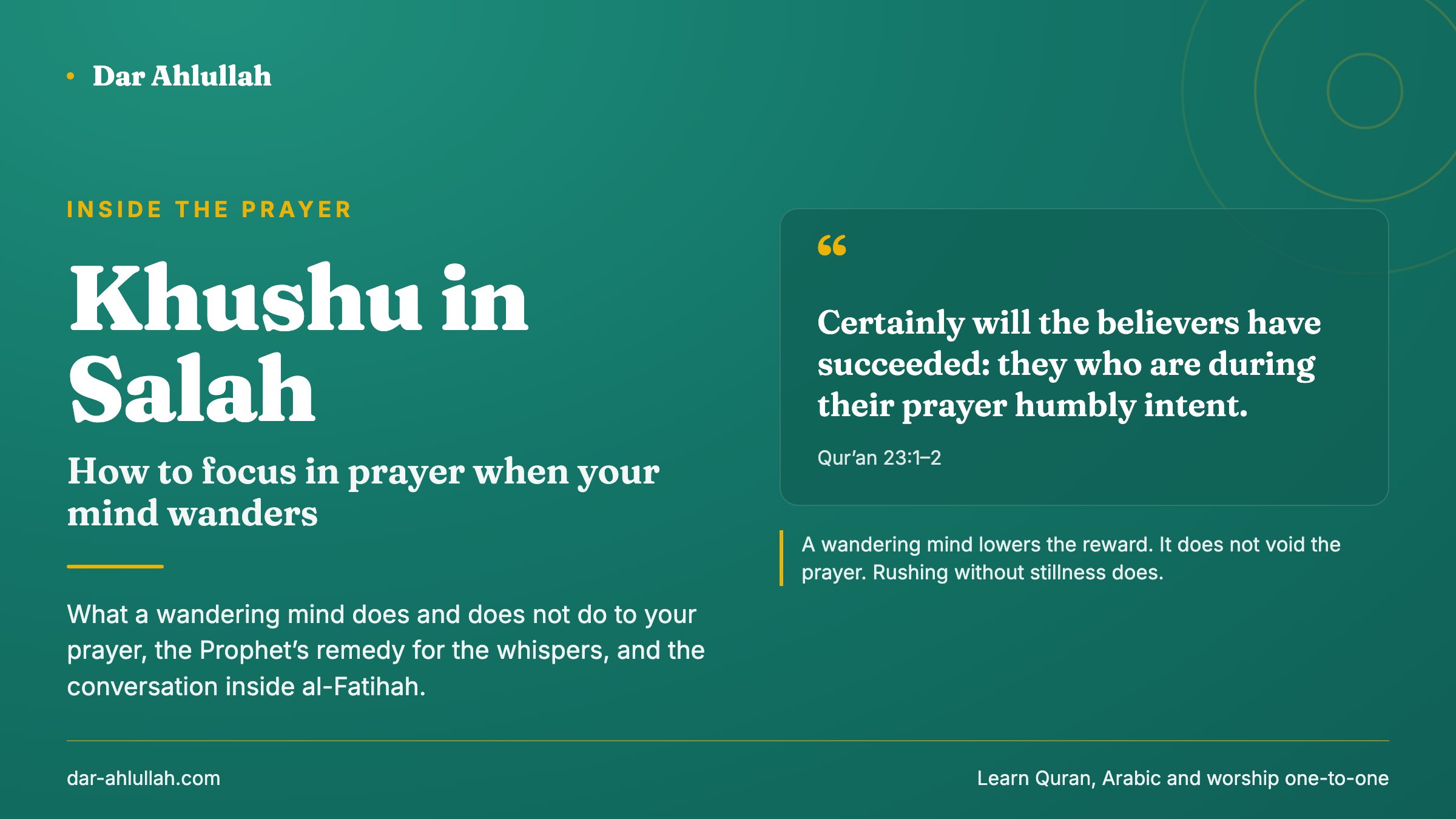
Table of Contents
- Introduction: The Whisper the Prophet Described
- The Short Answer
- What Khushu Is, and What It Is Not
- Does a Wandering Mind Break the Prayer?
- Five Kinds of People at Prayer
- Before You Say Allahu Akbar
- Inside the Prayer: What the Sunnah Gives You
- The Conversation Inside al-Fatihah
- When the Whispers Come
- Praying in Words You Do Not Understand Yet
- Work, Children, Tiredness and the Mosque
- Four Things People Get Wrong About Khushu
- How We Teach This
- Questions People Ask
- Conclusion: The Struggle Is Part of the Prayer
Introduction: The Whisper the Prophet Described
You raise your hands, say Allahu akbar, and the next thing you notice is the salam. Somewhere in between you answered an email in your head, planned dinner, replayed an argument and, for a moment, lost track of whether that was the third rak’ah or the fourth. If that sounds familiar, you are in old company. The Prophet ﷺ described it exactly: after the iqamah, Satan returns “till he whispers into the heart of the person (to divert his attention from his prayer) and makes him remember things which he does not recall to his mind before the prayer and that causes him to forget how much he has prayed” (Sahih al-Bukhari 608).
The word for what goes missing is khushu (also written khushoo or khushu’): the humble, settled presence that the Qur’an makes a mark of the believers who succeed, “they who are during their prayer humbly intent” (Qur’an 23:1–2). Most advice on it arrives as a list of tips. This guide starts a step earlier, with the questions people actually worry about. Does a wandering mind invalidate the prayer? Should I repeat it? Do I owe a prostration of forgetfulness? Can I close my eyes? Then it sets out what the Sunnah gives you to work with before the prayer, inside it, and when the whispers come, and it takes on the problem most guides skip: praying five times a day in a language you are still learning.
If you are still learning the movements themselves, start with our step-by-step guide to how to pray in Islam. This article sits in its salah library beside the other guides to what happens inside the prayer.
One boundary before we begin. We teach Quran, Arabic and the practical fiqh of worship; we are not a fatwa body. Where the scholars differ, we say so and name who holds what.
The Short Answer
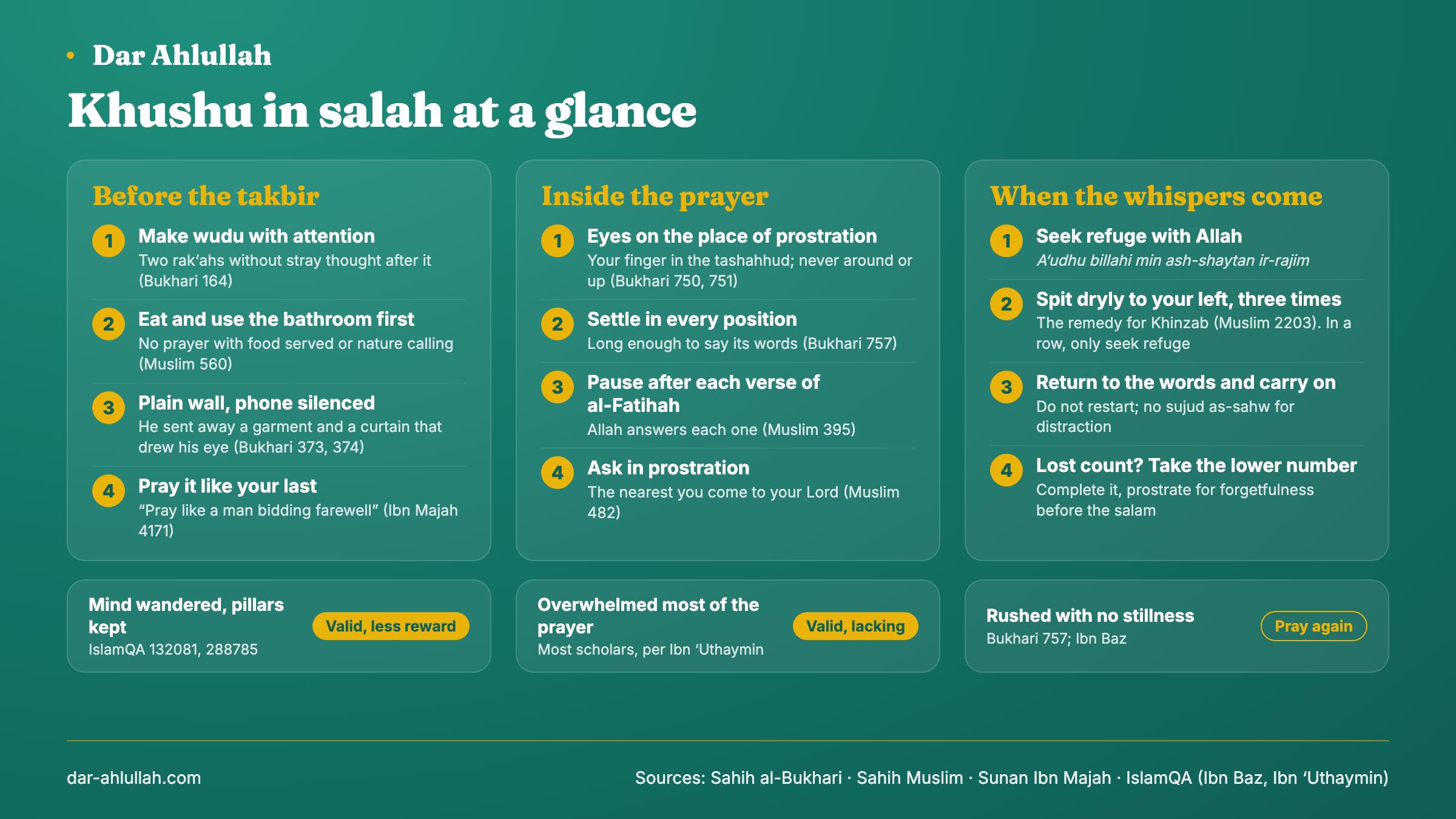
- Khushu is stillness of the body and presence of the heart. Ibn Baz called focus and humility “the essence of the prayer”, and counted praying “in a tranquil and unhurried manner” in every bowing, prostration and rising as one of its most important aspects (IslamQA 132081).
- A wandering mind does not invalidate the prayer. Rushing through it does. If you keep the pillars and settle in each position, thoughts that drift in and out leave the prayer valid but cost you reward. Pecking through the positions without settling is what the Prophet ﷺ told a man to repeat: “Go back and pray, for you have not prayed” (Sahih al-Bukhari 757).
- Reward follows attention. A man may finish his prayer with a tenth of it recorded for him, or a ninth, and so on up to half (Sunan Abi Dawud 796, hasan per al-Albani and al-Arna’ut, da‘if per Zubair ‘Ali Za’i).
- You do not repeat the prayer, and you do not owe sujud as-sahw, for a wandering mind. The prostration of forgetfulness is for adding, omitting or doubting, not for distraction, because “it is not possible to avoid it, so it is forgiven” (al-Buhuti, quoted in IslamQA 34570).
- For persistent whispers the Prophet ﷺ gave a remedy: seek refuge with Allah and spit dryly to your left three times (Sahih Muslim 2203a). Standing in a congregation row, just seek refuge.
- Remove the pull before you start. There is no prayer when food is served or when you are holding back the call of nature (Sahih Muslim 560a), and the Prophet ﷺ sent away a garment and a curtain because their patterns caught his eye in prayer (Sahih al-Bukhari 373, 374).
- For a non-Arabic speaker, the biggest lever is meaning. Allah answers each verse of al-Fatihah as you recite it (Sahih Muslim 395a). Knowing what you are saying is what turns the recitation into that conversation.
What Khushu Is, and What It Is Not
The Qur’an names khushu as a quality of the believers in prayer, “they who are during their prayer humbly intent [khashi‘un]” (Qur’an 23:2), and ties it to certainty about the meeting with Allah: seeking help through prayer “is difficult except for the humbly submissive [al-khashi‘in], who are certain that they will meet their Lord and that they will return to Him” (Qur’an 2:45–46).
Two things are packed into the word, and the scholars keep them together. One is outward: stillness. Ibn Baz, explaining it, said that praying calmly “so that at every stage of the prayer, the vertebrae may settle into place” is called tuma’ninah, and “is also called khushu’” (IslamQA 132081). The other is inward: a heart that knows where it is standing. The Prophet ﷺ described the highest level of worship as worshipping Allah “as if you see Him, and if you cannot achieve this state of devotion then you must consider that He is looking at you” (Sahih al-Bukhari 50). And he tied the body to the heart: “There is a piece of flesh in the body if it becomes good (reformed) the whole body becomes good but if it gets spoilt the whole body gets spoilt and that is the heart” (Sahih al-Bukhari 52).
It helps just as much to say what khushu is not, because the wrong picture puts people off trying.
- It is not a feeling you have to manufacture. Weeping from humility is part of the Sunnah: the Prophet ﷺ prayed with “a sound coming from his chest like the sound of water boiling” (Sunan an-Nasa’i 1214, sahih per al-Albani). But the definition the scholars give is stillness and attention, not emotion. A dry-eyed prayer said with attention has khushu.
- It is not a trance. The Prophet ﷺ stayed aware of the people around him. He shortened his prayer when he heard a child crying, “as I dislike to trouble the child’s mother” (Sahih al-Bukhari 707), and he prayed carrying his granddaughter Umamah, putting her down to prostrate and picking her up when he stood (Sahih al-Bukhari 516). Being present with Allah does not mean being absent from the room.
- It is not all or nothing. It comes in degrees, and as the next section shows, so does the reward.
Does a Wandering Mind Break the Prayer?
This is the question behind most searches on the subject, and the answer is reassuring without being an excuse.
Ibn Baz drew the line at haste. If the worshipper “is at ease and performs his prayer in an unhurried manner, but sometimes his mind wanders and sometimes he forgets, this does not render his prayer invalid, but he will not have any reward for his prayer except inasmuch as his mind was focused” (IslamQA 132081). What does invalidate it is praying so hastily “that it is as if he is pecking his way through the prayer”, bowing without taking the time to settle. Ibn ‘Uthaymin addressed the worst case, someone overwhelmed by thoughts through most of the prayer: “most scholars are of the view that his prayer is still valid and that it is not invalidated by this waswaas, but it is severely lacking” (IslamQA 34570).
| What happened | Is the prayer valid? | What it costs | Source |
|---|---|---|---|
| Your mind drifted, but you kept every pillar and settled in each position | Yes | The reward of the parts you were absent for | Ibn Baz, IslamQA 132081; Ibn ‘Uthaymin, IslamQA 288785 |
| Thoughts overwhelmed you for most of the prayer | Yes, on the view of most scholars | Much of the reward; “severely lacking” | Ibn ‘Uthaymin, IslamQA 34570 |
| You rushed, with no stillness in the bowing, the rising, the prostration or the sitting between | No; pray it again | The prayer itself | Sahih al-Bukhari 757; Ibn Baz, IslamQA 132081 |
| You lost count of the rak’ahs | Yes, with the doubt rule | Take the lower number, complete the prayer, prostrate for forgetfulness before the salam | Ibn Baz, IslamQA 34570 |
| You turned your head to look at something | Yes, if your body stayed towards the qiblah | “A way of stealing by which Satan takes away (a portion) from the prayer” | Sahih al-Bukhari 751 |
The line between turning your head and turning away from the qiblah altogether, and the other things that really do end a prayer, are set out in our guide to what invalidates salah.
The reward point has a hadith of its own. The Prophet ﷺ said: “A man returns after saying his prayer while a tenth part of his prayer, or a ninth part, or an eight part, or a seventh part, or a sixth part, or a fifth part, or a third part, or half of it, is recorded for him” (Sunan Abi Dawud 796). Al-Albani, Muhyi ad-Din ‘Abd al-Hamid and Shu‘ayb al-Arna’ut graded it hasan; Zubair ‘Ali Za’i graded it da‘if. Ibn ‘Uthaymin cites it for exactly this point: the prayer stands, but what is recorded is what you were present for (IslamQA 34570).
So the honest summary is neither “it doesn’t count” nor “it doesn’t matter.” It counts, and the obligation is discharged. What you lose is what you were absent for.
Five Kinds of People at Prayer
Ibn al-Qayyim, in al-Wabil al-Sayyib, sorted people at prayer into five ranks. The list is worth knowing because it shows where most of us actually are, and that where most of us are is not a failure.
| Rank | Who they are | Ibn al-Qayyim’s verdict |
|---|---|---|
| 1 | The one who wrongs himself: careless with the wudu, the times, the limits and the pillars of the prayer | Mu‘aqab: punished |
| 2 | Keeps the times, the limits, the outward pillars and the wudu, but has given up struggling with the whispers and goes wherever his thoughts take him | Muhasab: called to account |
| 3 | Keeps the limits and pillars and fights the whispers and thoughts, busy struggling with his enemy so that it does not steal his prayer; he is “in prayer and in struggle” at once | Mukaffar ‘anhu: his sins are expiated |
| 4 | Completes its rights, pillars and limits, his whole concern taken up with performing it as it should be performed | Muthab: rewarded |
| 5 | Does all of that, and has also placed his heart before his Lord, watching Him with his heart, filled with love and awe of Him, as if he sees Him | Muqarrab: brought near to his Lord |
The translation is ours, from the Arabic text quoted in IslamWeb fatwa 269095. Look closely at the third rank. The person whose prayer is a running fight with distraction is not in the second rank. Pulling yourself back, again and again, is the struggle Ibn al-Qayyim describes, and on his account it earns expiation. The person in trouble is the one who has stopped pulling back.
Before You Say Allahu Akbar
Much of the work happens before the prayer begins, and here the Sunnah is unusually practical.
Make the wudu the first minute of the prayer
‘Uthman ibn ‘Affan demonstrated the Prophet’s wudu and then reported him saying: “If anyone performs ablution like that of mine and offers a two-rak‘at prayer during which he does not think of anything else (not related to the present prayer) then his past sins will be forgiven” (Sahih al-Bukhari 164). In Sahih Muslim the promise for two rak‘ahs prayed after a good wudu, “setting about them with his heart as well as his face”, is Paradise (Sahih Muslim 234a). Both reports put the wudu and the attentive prayer in one breath. Treat the wudu as the first minute of the prayer rather than the chore before it; our wudu guide walks through it step by step.
Deal with what will pull at you
The Prophet ﷺ said: “No prayer can be (rightly said) when the food is there (before the worshipper), or when he is prompted by the call of nature” (Sahih Muslim 560a). Al-Nawawi explained the reason: it is disliked to pray in those states “because that will distract you from the prayer and you will not be able to focus properly” (quoted in IslamQA 159503). So eat the meal that is already on the table, use the bathroom, and then pray with nothing tugging at you. The modern versions follow the same logic: put the phone in another room or silence it, close the laptop, and finish the call you are waiting for first.
The Prophet ﷺ applied this to himself. He prayed in a patterned garment and afterwards said: “Take this Khamisa of mine to Abu Jahm and get me his Inbijaniya (a woolen garment without marks) as it (the Khamisa) has diverted my attention from the prayer” (Sahih al-Bukhari 373). When ‘A’ishah hung a patterned curtain, he said: “Take away this Qiram of yours, as its pictures are still displayed in front of me during my prayer” (Sahih al-Bukhari 374). If the Prophet ﷺ cleared a pattern from his field of view, it is reasonable for you to pray facing a plain wall rather than the television, an open laptop or a window onto the street. If you are praying in an open space, our guide to the sutrah covers what to place in front of you.
Do not leave it until you are half asleep
“If anyone of you feels drowsy while praying he should go to bed (sleep) till his slumber is over because in praying while drowsy one does not know whether one is asking for forgiveness or for a bad thing for oneself” (Sahih al-Bukhari 212). That is no licence to let an obligatory prayer’s time pass, but it is a good reason not to leave ‘Isha until you are falling asleep on the prayer mat. Pray it while you are still awake enough to mean it.
Pray it as if it were your last
A man asked the Prophet ﷺ for brief advice, and the first thing he said was: “When you stand to pray, pray like a man bidding farewell” (Sunan Ibn Majah 4171; hasan per al-Albani and Muhammad Fu’ad ‘Abd al-Baqi, da‘if per Zubair ‘Ali Za’i). Before the takbir, take one breath and ask what you would do differently if you knew this was the last prayer you would pray.
Expect the interruption
The hadith that describes the whisper also says when it comes. Satan flees at the adhan, returns, flees again at the iqamah, and comes back once it is finished (Sahih al-Bukhari 608). The distraction at the start of the prayer is not a sign that something is wrong with you. It is the expected attack, and knowing that it is coming makes it easier to name and set aside.
Inside the Prayer: What the Sunnah Gives You
Where to look
The majority of scholars, Abu Hanifah, al-Shafi‘i and Ahmad among them, hold that you keep your gaze on the place where you prostrate, and some of them make an exception for the tashahhud, when you look at your pointing finger (IslamQA 25848). The finger has its own report: the Prophet ﷺ “kept his look fixed on the finger he was pointing” (Sunan Abi Dawud 990; hasan sahih per al-Albani, sahih per al-Arna’ut). Some scholars read “turn your face toward al-Masjid al-Haram” (Qur’an 2:144) as meaning you look straight ahead; IslamQA calls that the less correct view. Two directions are ruled out. Glancing around is theft from the prayer (Sahih al-Bukhari 751). Looking up is worse: of people who look towards the sky in prayer, the Prophet ﷺ said, “They should stop (looking towards the sky during the prayer); otherwise their eyesight would be taken away” (Sahih al-Bukhari 750).
Can you close your eyes?
Closing the eyes for no reason is disliked. IslamQA records the jurists agreeing on that, with the Hanafi al-Kasani explaining that the Sunnah is to look at the place of prostration (IslamQA 22174). The same answer quotes al-‘Izz ibn ‘Abd al-Salam permitting it when it helps you focus, and Ibn al-Qayyim going further. If you focus better with your eyes open, keep them open; if there are decorations or other distractions in front of you, closing them “is not disliked at all”, and calling it recommended in that case “is closer to the aims and principles of Shari‘ah than saying that it is disliked” (Zad al-Ma‘ad, quoted in IslamQA 22174). So: eyes open by default with your gaze down, and closed when what is in front of you is the problem.
Hold each position until it settles
The Prophet ﷺ taught the man who rushed: “bow till you feel at ease. Then raise your head and stand up straight, then prostrate till you feel at ease during your prostration, then sit with calmness till you feel at ease (do not hurry) and do the same in all your prayers” (Sahih al-Bukhari 757). This stillness is the part of khushu that the prayer’s validity depends on, which is why Ibn Baz treated pecking through the positions as invalidating. He gave a practical measure: stay in each position long enough to say its words, Subhana Rabbiy al-‘Azim in the bowing, Rabbana wa laka’l-hamd on rising, Subhana Rabbiy al-A‘la in the prostration and Rabb ighfir between the prostrations (IslamQA 132081). The words for every position, with their meanings, are in our guide to what to say in salah.
Respond to what you recite
Hudhayfah prayed with the Prophet ﷺ one night and noticed that “when he recited the verses which referred to the Glory of Allah, he glorified … and when he recited the verses which tell (how the Lord) is to be begged, he (the Holy Prophet) would then beg (from Him), and when he recited the verses dealing with protection from the Lord, he sought (His) protection” (Sahih Muslim 772). That was a voluntary night prayer, and whether it carries over to the obligatory prayers is a known difference. Al-Nawawi reports that al-Shafi‘i and his school recommend it for every reciter in every prayer, obligatory or voluntary; the Hanbali manual Kashshaf al-Qina‘ permits it in both; and al-Nawawi records that Abu Hanifah disliked it during the prayer. Behind an imam reciting aloud, Ibn ‘Uthaymin advised listening rather than speaking over him, unless the imam pauses at such a verse (IslamQA 96028). Your own night prayer is the natural place to start; our guide to how to pray tahajjud covers it.
Ask where you are closest
“The nearest a servant comes to his Lord is when he is prostrating himself, so make supplication (in this state)” (Sahih Muslim 482). Prostration is where the prayer most easily becomes personal. Whether your own words in your own language are allowed there depends on your school; our guide to salat al-hajah sets out the positions, and the path that is safe on every view, which is to keep non-Arabic du‘a for after the salam.
The Conversation Inside al-Fatihah
If you change only one thing, change this. Abu Hurayrah reported that Allah said: “I have divided the prayer into two halves between Me and My servant, and My servant will receive what he asks,” and then described a reply to each verse of al-Fatihah (Sahih Muslim 395a):
| You recite | Allah says |
|---|---|
| Al-hamdu lillahi Rabbil-‘alamin Praise be to Allah, the Lord of the worlds |
“My servant has praised Me.” |
| Ar-Rahmanir-Rahim The Most Compassionate, the Merciful |
“My servant has lauded Me.” |
| Maliki yawmid-din Master of the Day of Judgment |
“My servant has glorified Me.” |
| Iyyaka na‘budu wa iyyaka nasta‘in You alone we worship, and of You alone we ask help |
“This is between Me and My servant, and My servant will receive what he asks for.” |
| Ihdinas-siratal-mustaqim to the end Guide us to the straight path … |
“This is for My servant, and My servant will receive what he asks for.” |
Now put that beside how the Prophet ﷺ recited it. Umm Salamah said he would recite “Al-Hamdulillahi Rabbil-‘Alamin” then stop, “Ar-Rahmanir-Rahim” then stop (Jami‘ at-Tirmidhi 2927, sahih per Ahmad Shakir and al-Albani, da‘if per Zubair ‘Ali Za’i; also Sunan Abi Dawud 4001). Pausing at the end of each verse is how he recited, and Sahih Muslim 395a tells you what the pause holds: it is where the reply comes. Recite one verse, stop for a breath, and know what has just been said back to you. It costs one breath per verse.
When the Whispers Come
‘Uthman ibn Abi al-‘As came to the Prophet ﷺ and said: “Allah’s Messenger, the Satan intervenes between me and my prayer and my reciting of the Qur’an and he confounds me.” The Prophet ﷺ replied: “That is (the doing of a) Satan (devil) who is known as Khinzab, and when you perceive its effect, seek refuge with Allah from it and spit three times to your left.” ‘Uthman said: “I did that and Allah dispelled that from me” (Sahih Muslim 2203a).
In practice, as Ibn Baz and Ibn ‘Uthaymin explained it (IslamQA 34570 and 288785):
- When you notice your mind has gone, say A‘udhu billahi min ash-shaytan ir-rajim (I seek refuge with Allah from the accursed Satan) quietly to yourself.
- Spit dryly to your left three times, as Ibn Baz put it, seeking refuge three times.
- If you are standing in a congregation row with someone on your left, leave out the spitting and just seek refuge, repeating it as you need to (Ibn ‘Uthaymin).
- Come back to the words wherever you are. Do not restart the prayer, and do not add a prostration of forgetfulness for the distraction itself.
- If the distraction has left you unsure how many rak‘ahs you have prayed, take the lower number, complete the prayer, and prostrate for forgetfulness before the salam, as Ibn Baz advised (IslamQA 34570). Our guide to what to do if you make a mistake in prayer covers the other cases.
One different kind of whisper deserves its own sentence. If the doubts are about whether your wudu or your prayer is valid at all, and you find yourself repeating them, the scholarly advice is the opposite of engaging: “the remedy is to turn away from them and not pay attention to them” (IslamWeb fatwa 269095, our translation). Pray on what you are sure of, and speak to a teacher you trust if it persists.
Praying in Words You Do Not Understand Yet
Every guide to khushu says “understand what you are reciting.” For a reader whose first language is English, French or German, that is not a tip; it is the whole problem. Seventeen obligatory rak‘ahs a day are prayed in a language you may still be learning, and the words you are asked to be present for are the ones you understand least.
The Qur’an’s own wording names the target. The verse that forbade approaching prayer while intoxicated set the limit “until you know what you are saying” (Qur’an 4:43). The verse is about intoxication, not language, but its measure of a prayer is knowing what you say, and that is something a learner can build towards deliberately.
The recitation itself stays in Arabic. On the majority position a translation of al-Fatihah is an interpretation of the Qur’an rather than the Qur’an, so it cannot replace it; our guide to what to say in salah gives every phrase with its meaning, and explains what someone who cannot yet recite should do. What you can change is how much of that Arabic you understand. A practical order, because these words come round in every prayer:
- Al-Fatihah, verse by verse. It comes round in every one of the seventeen rak‘ahs. Learn the meaning of each verse and the reply that follows it, in the table above.
- The words of the movements. Allahu akbar, Subhana Rabbiy al-‘Azim, Sami‘a Allahu liman hamidah, Rabbana wa laka’l-hamd, Subhana Rabbiy al-A‘la, Rabb ighfir li. They are short, and each one names what the body is doing.
- The tashahhud, said in every prayer.
- The short surahs you actually recite. Most people rotate between a handful. Learn the meaning of those before memorising new ones, and then recite the ones you understand.
Then keep going past the fixed parts. Our guide to the most common words in the Quran starts from exactly this point, al-Fatihah word by word, and shows how much of the Qur’an’s most frequent vocabulary is already in it; our guide to learning Quranic Arabic sets out the longer path.
Work, Children, Tiredness and the Mosque
| Situation | What the texts say | What to do |
|---|---|---|
| A toddler climbs on you or a baby cries | The Prophet ﷺ prayed carrying Umamah (Sahih al-Bukhari 516) and shortened his prayer for a crying child (Sahih al-Bukhari 707) | Attending to a child is not a failure of khushu. Keep your own movement small and carry on; shorten the recitation if the child needs you |
| Dinner is on the table, or you need the bathroom | No prayer when food is served or while holding back the call of nature (Sahih Muslim 560a) | Eat or go first, then pray |
| It is late and you are exhausted | The drowsy worshipper may not know what he is asking for (Sahih al-Bukhari 212) | Pray ‘Isha before you are half asleep |
| A shared office or a busy prayer room | The Prophet ﷺ removed patterns that drew his eye (Sahih al-Bukhari 373, 374) | Face a plain wall, silence your phone, keep your gaze on the place of prostration |
| You are ill and standing takes everything you have | Our guide to praying when sick uses the loss of khushu as one test for when sitting is allowed | See how to pray when sick |
| You focus better alone than in the mosque | IslamQA, which holds congregational prayer obligatory, calls this a temptation from Satan meant to keep you from the congregation (IslamQA 6295) | Go to the congregation and work on khushu in the row |
| The imam recites a verse of mercy or of warning | Listen; respond only if he pauses (Ibn ‘Uthaymin, IslamQA 96028) | Let his recitation carry you |
Four Things People Get Wrong About Khushu
1. “If his heart were humble, his limbs would be humble” is not a hadith of the Prophet ﷺ
It is widely quoted as the Prophet’s words about a man fiddling in his prayer. The version attributed to him through Abu Hurayrah was judged fabricated by al-Albani (Irwa’ al-Ghalil 373) and weak by Ibn ‘Uthaymin (al-Sharh al-Mumti‘ 3/233), as collected in the Dorar hadith encyclopedia. The idea behind it is sound and has a sahih source of its own: the heart is the piece of flesh whose soundness makes the whole body sound (Sahih al-Bukhari 52). Quote that instead.
2. The story of ‘Ali and the cloak has no basis
A popular story says the Prophet ﷺ offered his cloak to whoever could pray without thinking of anything else, and that ‘Ali nearly did, until he wondered which cloak he would be given. IslamQA could find no basis for it and no scholar who mentions it, and warns that passing it on falls under telling lies about the Prophet ﷺ and his Companions (IslamQA 288785).
3. Surah al-Ma‘un is not a verdict on a wandering mind
“So woe to those who pray, [but] who are heedless of their prayer” (Qur’an 107:4–5) frightens people who struggle to focus. Ibn Kathir lists what it describes: the hypocrites who pray in public but not in private, and those who push the prayer out of its time or habitually to its end. He then quotes ‘Ata’ ibn Dinar: “All praise is due to Allah, the One Who said, ‘with their Salah are Sahun’ and He did not say, ‘those who are absent minded in their prayer’” (Tafsir Ibn Kathir on 107:5). Ibn Kathir adds that the wording also takes in praying without humility and reflection, so the verse is still a warning, but it is a warning about being heedless of the prayer, not a declaration that every distracted prayer is worthless.
4. You do not owe sujud as-sahw for a wandering mind
Some people add the two prostrations of forgetfulness to every prayer, reasoning that their mind is bound to have wandered somewhere. Distraction is not one of its causes. It is for adding something, omitting something, or doubting the count, and the wandering mind is forgiven because it cannot be avoided (al-Buhuti, Kashshaf al-Qina‘, quoted in IslamQA 34570).
How We Teach This
Khushu cannot be taught like a rule, but its two foundations can: a prayer whose movements and words are secure enough that they no longer use up your attention, and enough Arabic to mean what you say. A teacher helps most with what you cannot check alone: whether you are rushing the positions, whether your al-Fatihah is pronounced correctly, and which words of the prayer you are still saying without understanding them. Fiqh basics, the prayer among them, are part of our Islamic Studies course, and our Arabic Language and Tajweed courses build the understanding and the recitation behind every rak‘ah, one-to-one.
Dar Ahlullah runs one-to-one live sessions with certified teachers, at times that work in your timezone. Teaching is charged at $9 per teaching hour, with monthly plans at $36, $70 and $102 depending on how many hours you want, and a 20% discount for siblings. You can pause, upgrade or switch plans at any time, and if a teacher is not the right fit we rematch you with another certified mentor at no extra cost. If you would like to see where your prayer and recitation stand before committing to anything, the 30-minute assessment is free and does not ask for a card. The details are on our pricing page.
Questions People Ask
What does khushu mean in salah?
Humble, settled presence in the prayer: stillness of the body in each position, and a heart attentive to what is being said and to Whom. The Qur’an names it as a quality of the believers who succeed (Qur’an 23:1–2), and Ibn Baz called it “the essence of the prayer” (IslamQA 132081).
Is my prayer valid if my mind wanders?
Yes, as long as you kept the pillars and settled in each position. You lose the reward of the parts you were absent for, but the prayer is not invalidated (IslamQA 132081, 288785).
Do I need to repeat a prayer I prayed without focus?
No. Ibn Baz told a woman whose mind wandered a great deal that she did not have to repeat her prayer because of the whispers (IslamQA 34570). Rushing through the positions without stillness is different; that is the prayer the Prophet ﷺ told a man to pray again (Sahih al-Bukhari 757).
Should I do sujud as-sahw because I was distracted?
No. Distraction is not one of its causes. It is for adding, omitting or doubting something (IslamQA 34570).
Can I close my eyes in salah to focus?
Without a reason it is disliked. If something in front of you is distracting you, Ibn al-Qayyim held that closing them is not disliked, and closer to being recommended (IslamQA 22174).
Where should I look during prayer?
At the place where you prostrate, on the majority view, and at your pointing finger in the tashahhud (IslamQA 25848; Sunan Abi Dawud 990). Not around you, and never up.
How do I stop Satan’s whispers in prayer?
Seek refuge with Allah and spit dryly to your left three times, as the Prophet ﷺ taught ‘Uthman ibn Abi al-‘As (Sahih Muslim 2203a). In a congregation row, seek refuge without the spitting.
Is it better to pray alone if I focus better that way?
IslamQA, which holds congregational prayer obligatory, calls that reasoning a temptation from Satan meant to keep you from the congregation (IslamQA 6295). Work on khushu in the row rather than leaving it.
Can I recite al-Fatihah in English so that I understand it?
On the majority position, no: a translation is an interpretation of the Qur’an, not the Qur’an. Learn the meaning alongside the Arabic instead; our guide to what to say in salah gives both and explains what to do while you cannot yet recite.
Is crying in prayer part of khushu?
Weeping from humility is from the Sunnah: the Prophet ﷺ prayed with a sound in his chest like water boiling (Sunan an-Nasa’i 1214). But khushu does not depend on tears. Stillness and attention are its core.
Conclusion: The Struggle Is Part of the Prayer
Khushu is not a mood that either arrives or does not. It is built out of small things the Sunnah spells out: a wudu done with attention, the meal eaten and the phone silenced first, the eyes on the place of prostration, each position held until it settles, a pause after each verse of al-Fatihah for the reply, and a quiet a‘udhu billah when the whisper comes. Behind all of it is the longer work of understanding the words, so that the prayer is said in a language you know.
Your mind will wander again tomorrow. The person Ibn al-Qayyim worried about is not the one who keeps pulling back; it is the one who has stopped. Every time you notice and return, you are in the rank he described as “in prayer and in struggle” at once. For the rest of the prayer in the same detail, the salah library links every guide we have written on it, including what to say in salah and what invalidates salah.
Related articles
what invalidates salah
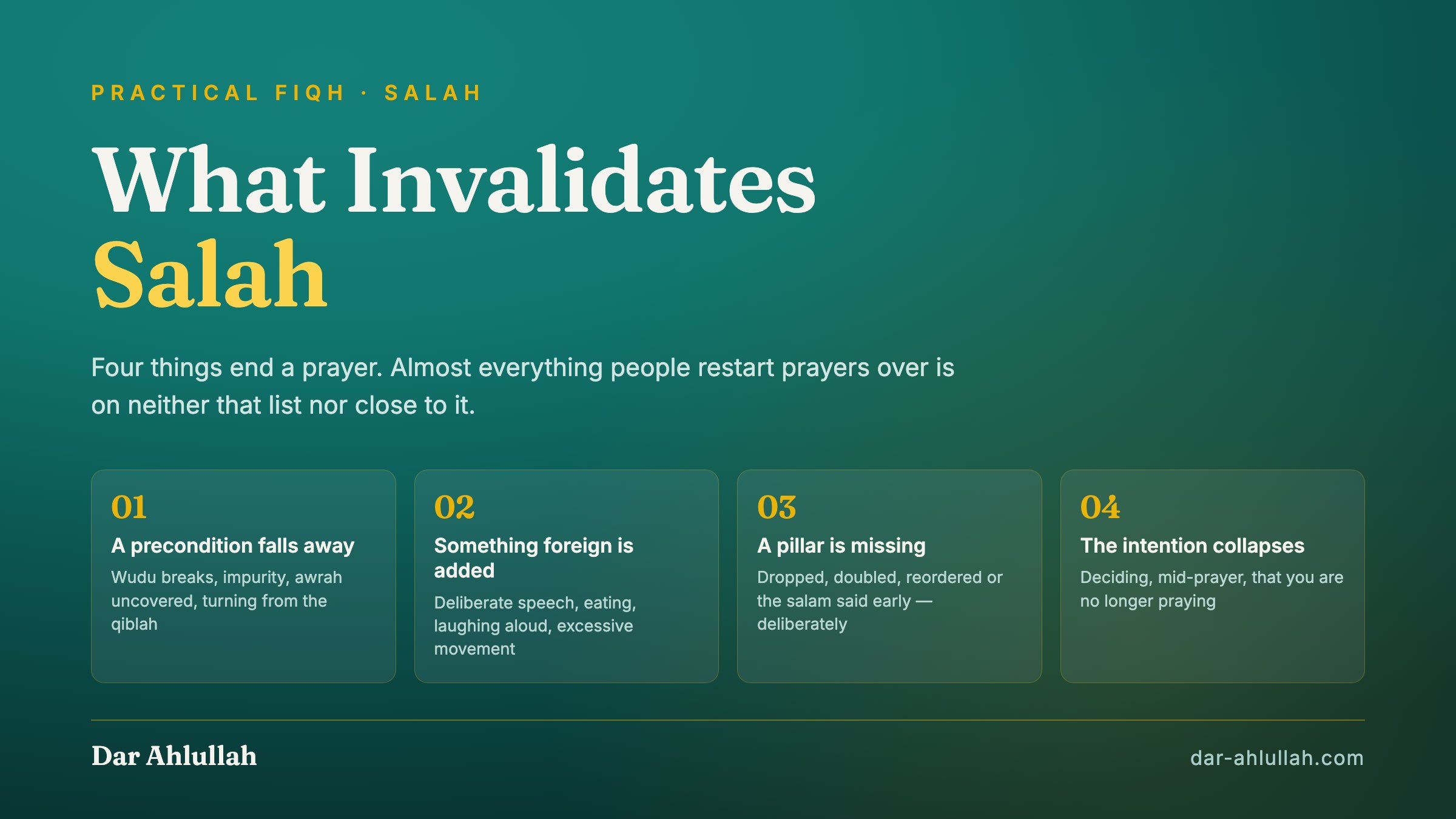
What Invalidates Salah: The Things That Really Break Your Prayer
Four things end a prayer: a precondition falls away, something foreign is added, a structural part is deliberately dropped, or the intention is withdrawn. Almost everything else people restart prayers over is on neither that list nor close to it.
19 min read
what to say in salah
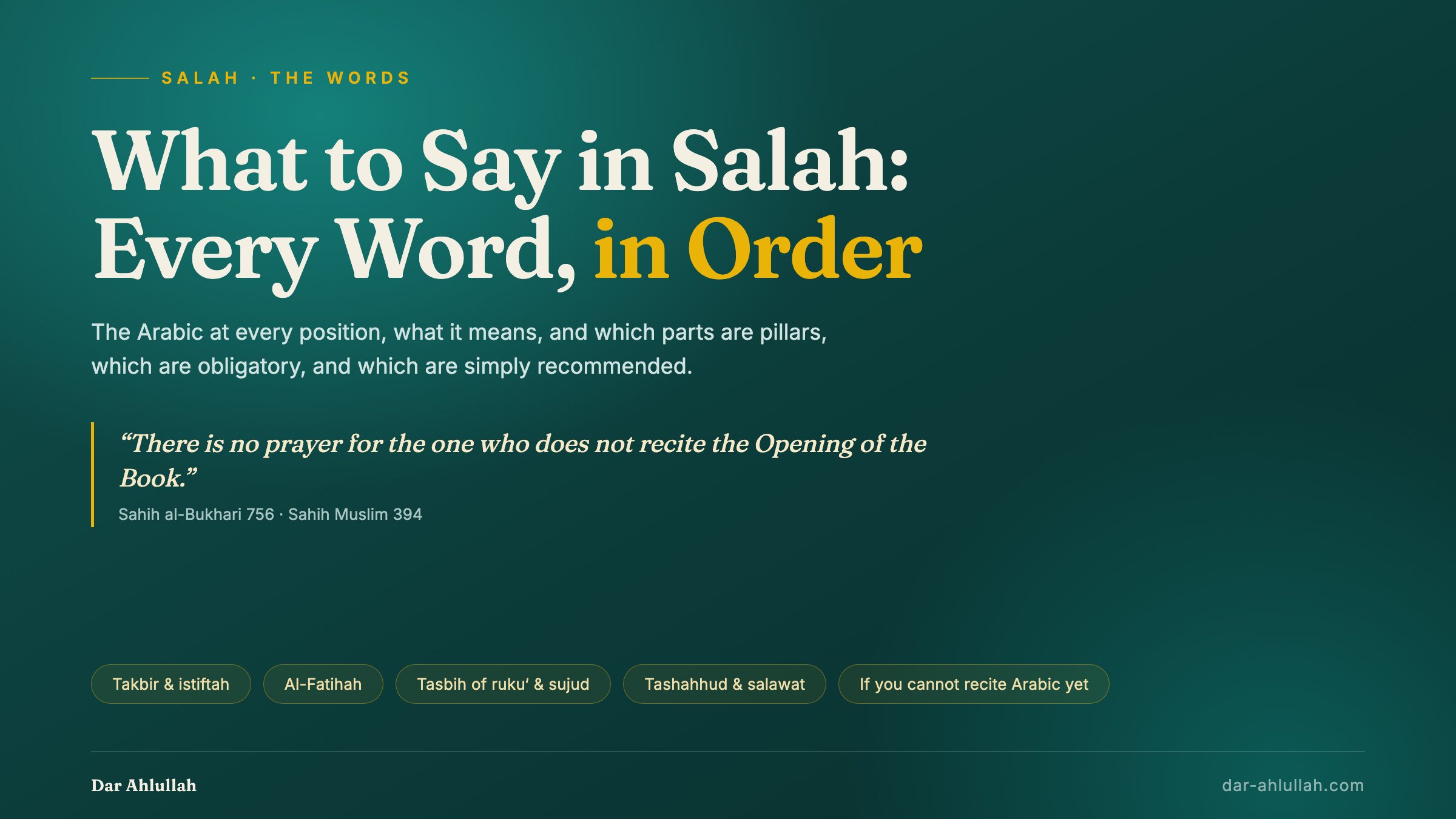
What to Say in Salah: Every Word of the Prayer, in Order
Most guides to prayer teach the postures and only name the words. This one teaches the words: what you say at every position, what it means, where it comes from, and which parts are pillars, which are obligatory, and which are simply recommended.
19 min read
what to do if you make a mistake in prayer
What to Do If You Make a Mistake in Prayer (Sujood as-Sahw)
Most mistakes in salah do not require you to start again. Three things trigger the prostration of forgetfulness — adding, omitting, doubting — and which side of the salam it falls on depends on which one you did.
18 min read