
sujood ash-shukr
Sujood ash-Shukr: The Prostration of Gratitude
Dar Ahlullah team 25 min read
You have probably seen it before you knew its name: a footballer drops to his forehead after a goal, a father folds to the floor of a hospital corridor when the surgeon says the word fine, a student reads an acceptance email and is suddenly on the carpet. That is sujood ash-shukr, the prostration of gratitude — one of the three prostrations in Islam that are not part of a prayer, and the one almost nobody is formally taught, because it is not on the syllabus of any beginner course. It gets picked up by watching, if it gets picked up at all.
This guide is for the reader who has not grown up watching. It covers what the act is and what it is not, what actually triggers it (narrower than most people assume), where the four schools stand on it (less agreed than most people assume), whether you need wudu, how to perform it, what to say in it, and the situations a Muslim in Europe or North America actually meets — an open-plan office, a moving car, a period, a piece of news that arrives at 2am. If you are working through the basics of the prayer itself, start with our guide to learning salah; this article assumes you know what a prostration is and picks up from there.
Table of Contents
- The Short Answer
- What Sujood ash-Shukr Is
- The Three Prostrations That Are Not Prayer
- The Evidence: What the Prophet and His Companions Did
- What Triggers It, and What Does Not
- Where the Four Schools Stand
- Do You Need Wudu? The Conditions Debate
- How to Perform It, Step by Step
- What You Say In It
- Why It Never Goes Inside a Prayer
- There Is No “Prayer of Gratitude”
- The Situations You Will Actually Meet
- Common Mistakes
- How We Teach This
- Questions People Ask
- Conclusion
The Short Answer
Sujood ash-shukr is a single prostration made to Allah when a new blessing arrives or a harm is averted. It is not a prayer. It is one prostration, not two, done outside salah, and it closes with nothing that a prayer closes with. The Prophet ﷺ did it whenever news that pleased him reached him, and his Companions did the same for the acceptance of repentance, the conversion of a tribe and victory in battle.
Its status is a genuine point of difference: recommended in the Shafi‘i and Hanbali schools, recommended according to Abu Yusuf and Muhammad in the Hanafi school, and disliked in the classical Maliki position. Whether it needs wudu is a second point of difference: the majority say treat it like prayer, while Ibn Taymiyyah, Ibn al-Qayyim, ash-Shawkani and most contemporary scholars say it needs no conditions at all, because the Prophet ﷺ fell into it on the spot. Say the takbir, go down, glorify and thank Allah, come up. Fifteen seconds. The rest of this article is the fine print.
What Sujood ash-Shukr Is
Sujood (or sajdah) is prostration — forehead, nose, both palms, both knees and the toes of both feet on the ground. Shukr is thanks. Sujood ash-shukr is therefore the prostration of thanks: the body doing, in one movement, what alhamdulillah does in one word. The prostration is the lowest posture a human being can take, and Islam reserves it for Allah alone. To fall into it at the moment good news lands is to say, physically and immediately, that the news came from Him.
The Qur’an ties gratitude to increase in a verse most Muslims know by heart: “If you are grateful, I will surely increase you” (Surah Ibrahim 14:7). Sujood ash-shukr is one of the ways the Sunnah gives that gratitude a form. It has no fixed words, no fixed number beyond one, no fixed time and no fixed place. What it has is a fixed cause: something good that has just happened.
The Three Prostrations That Are Not Prayer
Most confusion about sujood ash-shukr comes from mixing it up with its two cousins. Islam has three prostrations that stand outside the ordinary prostrations of salah, and each has a different trigger, a different relationship to the prayer, and a different set of rules.
| Prostration | Trigger | Inside a prayer? | How many |
|---|---|---|---|
| Sujood ash-shukr (gratitude) | Good news arrives, or a harm is lifted | Never — it belongs outside salah | One |
| Sujood at-tilawah (recitation) | Reciting or hearing one of the verses of prostration | Either — inside if the verse is recited in prayer, outside if it is not | One |
| Sujood as-sahw (forgetfulness) | A slip in the prayer: an omission, an addition, a doubt | Only inside — it is a repair to the prayer itself | Two |
We have separate guides to the other two: sajdah tilawah, the prostration of recitation, and sujood as-sahw, what to do when you make a mistake in prayer. Keep the table in mind, because the single most useful thing to know about sujood ash-shukr is which column it lives in: outside the prayer, one prostration, triggered by an event rather than by a verse or a slip.
The Evidence: What the Prophet and His Companions Did
The foundation is a report from the Companion Abu Bakrah: when anything came to the Prophet ﷺ that pleased him, or that he was glad of, he fell down in prostration in gratitude to Allah. It is recorded in Sunan Abi Dawud 2774, Jami‘ at-Tirmidhi 1578 and Sunan Ibn Majah 1394. At-Tirmidhi grades it hasan gharib — sound, though known through a single route — and adds the line that matters for practice: this is acted upon according to most of the people of knowledge, who held that one may perform the prostration of gratitude.
Two further reports fill in what “pleased him” looked like. In a narration from Sa‘d ibn Abi Waqqas recorded by Abu Dawud, the Prophet ﷺ stopped on a journey, raised his hands in supplication and then fell into a long prostration, and did so more than once; he explained afterwards that he had asked Allah for intercession for his community, been granted a third of them, prostrated in thanks, asked again, been granted another third, and prostrated again. And in a report from ‘Abd ar-Rahman ibn ‘Awf recorded by Ahmad, he prostrated when Jibril brought him the news that Allah sends blessings on whoever sends blessings on him. Both are set out with their references in the Dar al-Ifta fatwa on the prostration of gratitude.
The Companions understood the act as something to imitate, not something particular to the Prophet ﷺ. The most vivid example is Ka‘b ibn Malik, one of the three men left behind from the expedition to Tabuk and boycotted for fifty days until the Qur’an announced that their repentance had been accepted. Ka‘b tells the story himself in Sahih al-Bukhari 4418 and Sahih Muslim 2769: on the fiftieth morning he heard a man shouting from the top of Mount Sal‘, “O Ka‘b ibn Malik, be glad!” — and he fell down in prostration, because he knew relief had come. The classical fiqh manuals add ‘Ali prostrating when told that the Yemeni tribe of Hamdan had accepted Islam, and Abu Bakr prostrating at the news of the false prophet Musaylimah’s death; both are collected in the chapter on the prostration of thankfulness in Fiqh us-Sunnah.
Notice the range: a personal forgiveness, a community’s conversion, a military victory, a promise about the Hereafter. The trigger is not the size of the news. It is that the news is good, and that it has just arrived.
What Triggers It, and What Does Not
This is where most English-language treatments are vague, and the vagueness matters, because it turns a specific Sunnah into a general mood. The jurists are precise. Sujood ash-shukr is for a new blessing, or for the lifting of a harm. It is not for the blessings you already have.
The Shafi‘i and Hanbali texts put it in terms of a blessing that arrives — one that might or might not have reached you — as opposed to a continuous blessing like sight, health or faith, which you thank Allah for with your tongue and your life rather than with a prostration at a particular moment. IslamQA’s long treatment, “All about the prostration of gratitude”, lists the classical examples on both sides. Triggers include:
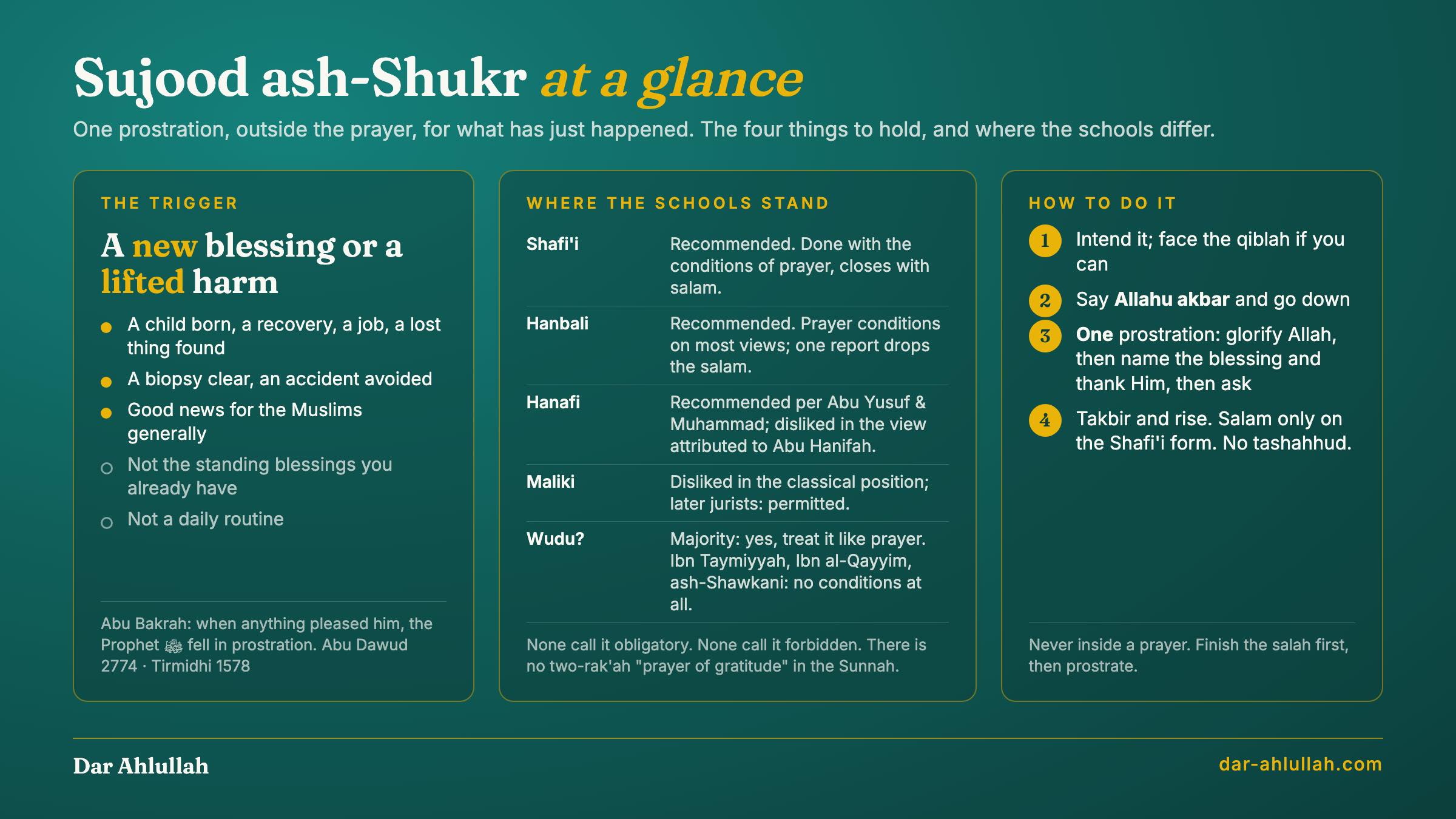
- A new blessing to you personally — a child born, a recovery from illness, a job or a qualification, a lost thing found, a debt cleared, a relative’s return.
- A harm averted — the classical books say “saved from burning or drowning”; the modern equivalents are the biopsy that comes back clear and the accident that did not happen.
- A blessing to the Muslims generally — the conversion of a people, relief from a plague, a victory. This is why Ka‘b’s prostration was for himself and ‘Ali’s was for Hamdan.
Not triggers, on the same reasoning:
- The standing blessings. You do not prostrate every morning because you woke up with your sight. That gratitude has other forms.
- A blessing you are anticipating. The prostration follows the news, not the hope of it. Before the news, the Sunnah is istikharah and du‘a.
- A pleasant thing that is not really a blessing. The jurists do not police this line closely, and you should not either; but if the “good news” is something you would be embarrassed to thank Allah for aloud, that is your answer.
A useful test: could you finish the sentence “Alhamdulillah, it just happened that…”? If yes, it is a sujood ash-shukr moment. If the honest sentence is “Alhamdulillah, I have always had…”, it is gratitude, and a good thing, but it is not this Sunnah.
Where the Four Schools Stand
Unlike the prostration of recitation, where the four schools agree the act is legislated and disagree only on how strongly, sujood ash-shukr is a point on which the schools disagree about whether it is recommended at all. That surprises people, given the hadith above, and the reasons are worth knowing so that you can recognise the position your own teacher or masjid holds.
| School | Position on sujood ash-shukr | Note |
|---|---|---|
| Shafi‘i | Recommended (sunnah) | Performed with the conditions of a voluntary prayer: purity, covering, qiblah, takbir, salam. |
| Hanbali | Recommended (sunnah) | Most authorities require the prayer conditions; one report from Imam Ahmad drops the closing salam as unproven. |
| Hanafi | Recommended according to Abu Yusuf and Muhammad | The position attributed to Abu Hanifah himself is that it is disliked; Dar al-Ifta cites the two students’ view as the school’s practice. |
| Maliki | Disliked (makruh) in the classical position | Later Maliki jurists such as az-Zurqani classed it as merely permitted; some Maliki texts direct the grateful person to a voluntary prayer instead. |
The school positions are summarised in the Dar al-Ifta fatwa and in the encyclopaedia entry on the prostration of thanksgiving. The Shafi‘i and Hanbali position, and the view of the majority of later scholars, rests on the Abu Bakrah hadith and the Companions’ practice: the act is reported from the Prophet ﷺ and imitated by the best of his followers, and that is the definition of a Sunnah.
What this means for you is simple. If you follow the Shafi‘i or Hanbali school, or take the Hanafi view of Abu Yusuf and Muhammad, sujood ash-shukr is a recommended act you should feel free to do. If you follow the Maliki school, you will find your teachers directing you to thank Allah in other ways — and that is a legitimate position, not an oversight. None of the schools calls it obligatory, and none calls it forbidden. Nobody who does it or leaves it is in sin.
Do You Need Wudu? The Conditions Debate
This is the question everyone actually asks, because the moment of good news does not come with a wudu area attached. There are two positions, and you should know both rather than absorbing one as though it were the only one.
The majority position — the Shafi‘i school, most Hanbalis and many Hanafis and Malikis — treats sujood ash-shukr as a prostration in the manner of the prostration of recitation, and applies the conditions of prayer to it: wudu, covering the ‘awrah, facing the qiblah, a clean place, an opening takbir and (for the Shafi‘is) a closing salam. On this view, if the news reaches you without wudu, you make wudu and then prostrate.
The second position, held by Ibn Taymiyyah, Ibn al-Qayyim and ash-Shawkani among the classical scholars and by Ibn Baz and Ibn ‘Uthaymin among the modern ones, is that no condition of prayer applies, because sujood ash-shukr is not prayer and there is no evidence that makes it one. Ash-Shawkani’s line, quoted in Fiqh us-Sunnah, is that there is nothing in the hadith to prove that ablution and purity of the clothes and place are required. IslamQA adopts this as the stronger view in answer 140804, on two arguments: that a condition of worship needs evidence from the Qur’an, the Sunnah or consensus, and there is none; and that the Abu Bakrah hadith says the Prophet ﷺ fell into prostration — the picture is of an immediate response, not of a man going to make wudu first.
How to hold this in practice: if you have wudu, the question does not arise. If you do not, and you follow a school that requires it, make wudu and prostrate; the delay does not cancel the act. If you take the second view, prostrate where you are. What you should not do is let the uncertainty talk you out of the Sunnah altogether, which is the most common outcome for people who have heard both positions and settled neither. For the conditions of purity themselves, see our wudu guide and what breaks wudu.
How to Perform It, Step by Step
The physical act is the prostration you already know from the prayer. What differs is what surrounds it, and the two positions above give two slightly different wrappers. Here is the fuller, Shafi‘i-style form first, with the elements the second view drops marked.
- Intend it. No words are needed; the intention is knowing that you are prostrating to Allah in thanks for this thing.
- Face the qiblah if you can (a condition on the majority view; preferred but not required on the second view).
- Say the takbir, Allahu akbar, and go down into prostration. On the Shafi‘i form you say it standing and raise the hands as in the opening of prayer; on the second view it is simply the takbir of going down.
- Prostrate once, on the seven limbs: forehead and nose, both palms, both knees, the toes of both feet.
- Glorify Allah, then thank Him — the wording is in the next section. Stay as long as you like. The Prophet’s prostrations of thanks on the journey were described as long.
- Say the takbir and come up. That is the end on the second view.
- Sit and give salam (the Shafi‘i form; omitted on the report from Imam Ahmad and on the second view). There is no tashahhud on any view.
The step-by-step forms, majority and minority, are laid out in the IslamOnline fiqh entry and in IslamQA 5110. Two things are the same on every view: it is one prostration, and it is done outside the prayer. Getting those two right puts you ahead of most people who perform it.
What You Say In It
There is no du‘a narrated specifically for sujood ash-shukr, and IslamQA says so plainly: there is no particular dhikr that is required; one praises Allah, thanks Him, asks Him and seeks His forgiveness. In practice that gives you a natural three-part shape, in whatever language you actually think in:
- The glorification of any prostration: Subhana Rabbiyal-A‘la (“Glory be to my Lord, the Most High”), three times, as you would in salah.
- The thanks, named. Alhamdulillah, and then say what for. Naming the blessing is the point of the act; a prostration of gratitude for something unspecified is a contradiction.
- Whatever else you want to ask. The prostration is the posture in which, the Prophet ﷺ said, a servant is closest to his Lord, and he told us to make much du‘a in it (Sahih Muslim 482). The news that put you on the floor is usually the start of something, not the end; ask for what comes next.
Arabic is not a condition here. The prayer’s fixed recitations are in Arabic because they are the prayer; sujood ash-shukr has no fixed recitation, so the thanks can be in English, and the second and third parts usually should be if that is the language your gratitude comes in. If you are working on being able to say the fixed parts of the prayer correctly, our guide to what to say in salah covers them in order.
Why It Never Goes Inside a Prayer
Here sujood ash-shukr parts company from its cousin. The prostration of recitation can be performed inside the prayer, because its trigger — a verse of prostration — can occur inside the prayer as part of the recitation. Sujood ash-shukr’s trigger is an external event, and an external event has no place in the prayer. If you are praying and good news reaches you — a phone lighting up with a message you can read, a voice from the next room — you finish the prayer and prostrate afterwards. Adding a prostration of gratitude in the middle of salah is, in the Shafi‘i and Hanbali schools, an addition that invalidates the prayer, and IslamQA states the same in answer 140804.
There is exactly one place the two cousins touch, and it is a good example of how the categories matter. The verse in Surah Sad (38:24) describes Dawud falling down in repentance, and the Prophet ﷺ prostrated when reciting it. The Hanafis, Malikis and Hanbalis count it as a verse of recitation; the Shafi‘is class it as a prostration of gratitude — done in imitation of Dawud’s thanks for being forgiven — and for exactly the reason in the previous paragraph they do not perform it inside the prayer. That is why a Shafi‘i imam who reaches Sad in Fajr will keep reciting where a Hanbali one will go down. The full account of that verse, and of the fifteen verses of prostration, is in our sajdah tilawah guide, and the reading skills to recognise a prostration verse on a page you have not seen before are what our learn Quran online guide is built around.
There Is No “Prayer of Gratitude”
A related confusion, common enough that Egypt’s Dar al-Ifta wrote a fatwa on it. Some Muslims, on receiving good news, pray two rak‘ahs which they call salat ash-shukr, the prayer of gratitude. The fatwa’s answer is that there is no such prayer in the Sunnah: what is legislated is the single prostration, and the sources that people cite for a “prayer of thanks” are either about the prostration or about voluntary prayer in general. A voluntary prayer of two rak‘ahs on receiving good news is not wrong — voluntary prayer is always good, and some Maliki texts prefer it — but it is not a specific Sunnah with a specific name, and it should not be presented as one. The specific Sunnah is the prostration. The voluntary prayers that do have names and forms — Duha, tahajjud, istikharah — each have their own guide.
The Situations You Will Actually Meet
Everything above was worked out in societies where good news arrived in person and the floor was a prayer floor. Here are the cases that a Muslim living in Europe or North America actually raises, with the answer each of the two conditions positions gives where they differ.
The news arrives by phone, at a desk, in an open-plan office
The act is one prostration, not a prayer, and it takes a few seconds. If you can go down where you are without making a scene — a clean patch of floor beside your desk — do it; if not, the prostration does not expire by the time you reach the quiet room, the stairwell or the car park. The Shafi‘i and Hanbali position gives you a further reason to wait: you may need wudu first. Delaying to reach a suitable place is not the same as abandoning the act.
I am in a moving car, on a train, or otherwise cannot prostrate
The fiqh literature answers this for the rider, and the answer transfers. IslamQA’s summary is that someone riding who cannot dismount leans forward as far as they can, as a gesture of prostration; the same is reasonable for a passenger who cannot reach the floor. If you would rather wait until you can prostrate properly, that is also fine. What is not intended is a person driving trying to prostrate.
I am not in wudu
Covered above, but to put the two positions side by side once more: on the majority view, make wudu and then prostrate; on the view of Ibn Taymiyyah and the contemporary scholars who follow him, prostrate as you are. Either way, the wudu question is a reason to do it later, never a reason not to do it.
I am menstruating
Follow the position you hold on conditions. On the majority view, which treats the prostration like prayer, the same bar that applies to prayer applies here, and you thank Allah with your tongue instead. On the second view, which holds that sujood ash-shukr is not prayer and takes none of its conditions, there is no bar. This is one place where knowing which view you follow, rather than half-remembering both, actually changes what you do.
The news is bad and good at once
A recovery after a frightening diagnosis; a relative found safe after an accident that hurt others; a job offer on the day a friend loses theirs. The trigger is the lifting of a harm or the arrival of a good, and it is not cancelled by the fact that the world contains other things. Ka‘b prostrated for his own forgiveness on a morning when two other men were still waiting for theirs. Thank Allah for what He gave; ask Him for the rest.
I missed the moment
The prostration is tied to the news, and the fullest form of the Sunnah is to do it when the news lands. If it went past — you did not know about the Sunnah, or you were somewhere it was impossible — IslamQA notes that the scholars discuss whether it is made up later rather than settling it. Prostrating when you remember, with the same thanks in mind, costs nothing and is the natural reading of a Sunnah whose whole point is a response of the heart. Do not, however, turn it into a debt you owe; it is not one. On what is and is not a debt in worship, our guide to missed prayers draws the line.
I am new to Islam and the news is my own shahadah
This is the clearest case in the whole article. The Companions prostrated when other people accepted Islam; you have every reason to prostrate when you do. It is, in a real sense, the first act of worship you are free to perform, before you have learned a single word of the prayer. If you are at that stage, our new Muslim guide is written for the weeks that follow.
Common Mistakes
- Two prostrations. It is one. Two is the pattern of the prayer, and of sujood as-sahw, and people carry it across by habit.
- Doing it inside the prayer. Never. Finish the prayer, then prostrate. The exception that looks like one — the Shafi‘i handling of Surah Sad — is actually the rule being applied, not broken.
- Inventing a “prayer of gratitude”. Two rak‘ahs are fine as voluntary prayer; they are not a Sunnah with that name.
- Turning it into a routine. A daily prostration of gratitude “for everything” is not what the Sunnah describes. It is a response to something that just happened.
- Letting the wudu question cancel the act. Two positions exist; both of them end in a prostration. Pick one and prostrate.
- Thanking Allah in a prostration without naming the blessing. Say what it was for. That is the whole of it.
How We Teach This
Sujood ash-shukr is not on our syllabus as a topic, for the honest reason that it takes ten minutes to teach and a lifetime to remember to do. Where it comes up is in the fiqh-of-worship strand of our Islamic studies sessions, alongside the other two prostrations and the voluntary prayers, and in the questions students bring to a lesson when something has happened to them that week. The table in this article — three prostrations, three triggers, three answers to “inside the prayer?” — is the one we draw on the whiteboard, because it is the map that keeps the three from blurring into each other.
Dar Ahlullah runs one-to-one live sessions with certified teachers, scheduled in your own timezone. Teaching is charged at $9 per teaching hour, with monthly plans at $36, $70 and $102 depending on how many hours you want, and a 20% discount for siblings. You can pause, upgrade or switch plans at any time, and if a teacher is not the right fit we rematch you with another certified mentor at no extra cost. If you would like to find out where your prayer and recitation currently stand before committing to anything, the 30-minute assessment is free and does not ask for a card — details are on our pricing page. If you are starting from the very beginning of the rules of worship, our fiqh for beginners guide is the place to orient yourself first.
Questions People Ask
What is sujood ash-shukr?
A single prostration to Allah made on receiving a new blessing or on being relieved of a harm. It is not a prayer and is done outside the prayer.
Is sujood ash-shukr sunnah or bid‘ah?
It is reported from the Prophet ﷺ in Abu Dawud, at-Tirmidhi and Ibn Majah and from several Companions, and at-Tirmidhi records that most scholars act on it. It is recommended in the Shafi‘i and Hanbali schools and by Abu Yusuf and Muhammad among the Hanafis; the classical Maliki position is that it is disliked. No school calls it an innovation.
Do I need wudu for sujood ash-shukr?
The majority say yes, treating it like prayer. Ibn Taymiyyah, Ibn al-Qayyim, ash-Shawkani, Ibn Baz and Ibn ‘Uthaymin say no, because it is not prayer and there is no evidence for the condition. IslamQA considers the second view stronger.
How many prostrations is it?
One.
Do I face the qiblah?
Required on the majority view; preferred but not required on the second.
Do I say salam at the end?
In the Shafi‘i form, yes. On one report from Imam Ahmad, and on the view that no prayer conditions apply, no. There is no tashahhud on any view.
What do I say in it?
Nothing is prescribed. Subhana Rabbiyal-A‘la as in any prostration, then alhamdulillah with the blessing named, then whatever du‘a you wish, in any language.
Can I do sujood ash-shukr during salah?
No. Its trigger is an external event and it belongs outside the prayer; adding it inside invalidates the prayer in the Shafi‘i and Hanbali schools. Finish, then prostrate.
Is there a “prayer of gratitude” of two rak‘ahs?
Not as a named Sunnah. Dar al-Ifta’s fatwa is that what is legislated is the prostration; two voluntary rak‘ahs are fine as ordinary voluntary prayer.
Should I prostrate for a blessing I have always had?
No. The Sunnah is for a blessing that has newly arrived or a harm newly lifted. Standing blessings are thanked in other ways.
Can a woman prostrate in gratitude during her period?
On the majority view, which treats the act like prayer, no; on the view that it is not prayer, yes. Follow the position you hold on wudu.
What is the difference between sujood ash-shukr and sajdah tilawah?
The trigger and the place. Sajdah tilawah is triggered by a verse of prostration and can occur inside or outside the prayer. Sujood ash-shukr is triggered by an event and occurs only outside it. Both are one prostration.
Conclusion: The Body Saying Alhamdulillah
Strip out the school comparisons and what remains is very small, and very old: when something good reaches you, go down to the ground and say thank you. The Prophet ﷺ did it so reliably that a Companion could describe it as his habit. Ka‘b did it before he had even seen the face of the man shouting his name. The jurists have argued for thirteen centuries about whether you need wudu first, and the argument has never once been about whether the act itself was beautiful.
The details are worth carrying: one prostration, not two; outside the prayer, not inside; for what has just happened, not for what you have always had; and no prayer of gratitude except the prostration itself. Hold those four and you have the Sunnah. Then the only question left is the one no article can answer for you, which is whether, the next time the news is good, you will remember.
Related articles
joining the prayer late
Joining the Prayer Late: How to Make Up Missed Rak’ahs
Joining the prayer late has a short, exact procedure: say the takbir standing, join the imam wherever he is, count the rak'ah only if you reached ruku' before he rose, and complete what you missed after his salam. This guide works through every prayer and arrival point, and explains why the person beside you may make up the same rak'ahs with a different recitation.
20 min read
what to do if you make a mistake in prayer
What to Do If You Make a Mistake in Prayer (Sujood as-Sahw)
Most mistakes in salah do not require you to start again. Three things trigger the prostration of forgetfulness — adding, omitting, doubting — and which side of the salam it falls on depends on which one you did.
18 min read
how to perform tayammum
How to Perform Tayammum: Dry Ablution When You Cannot Use Water
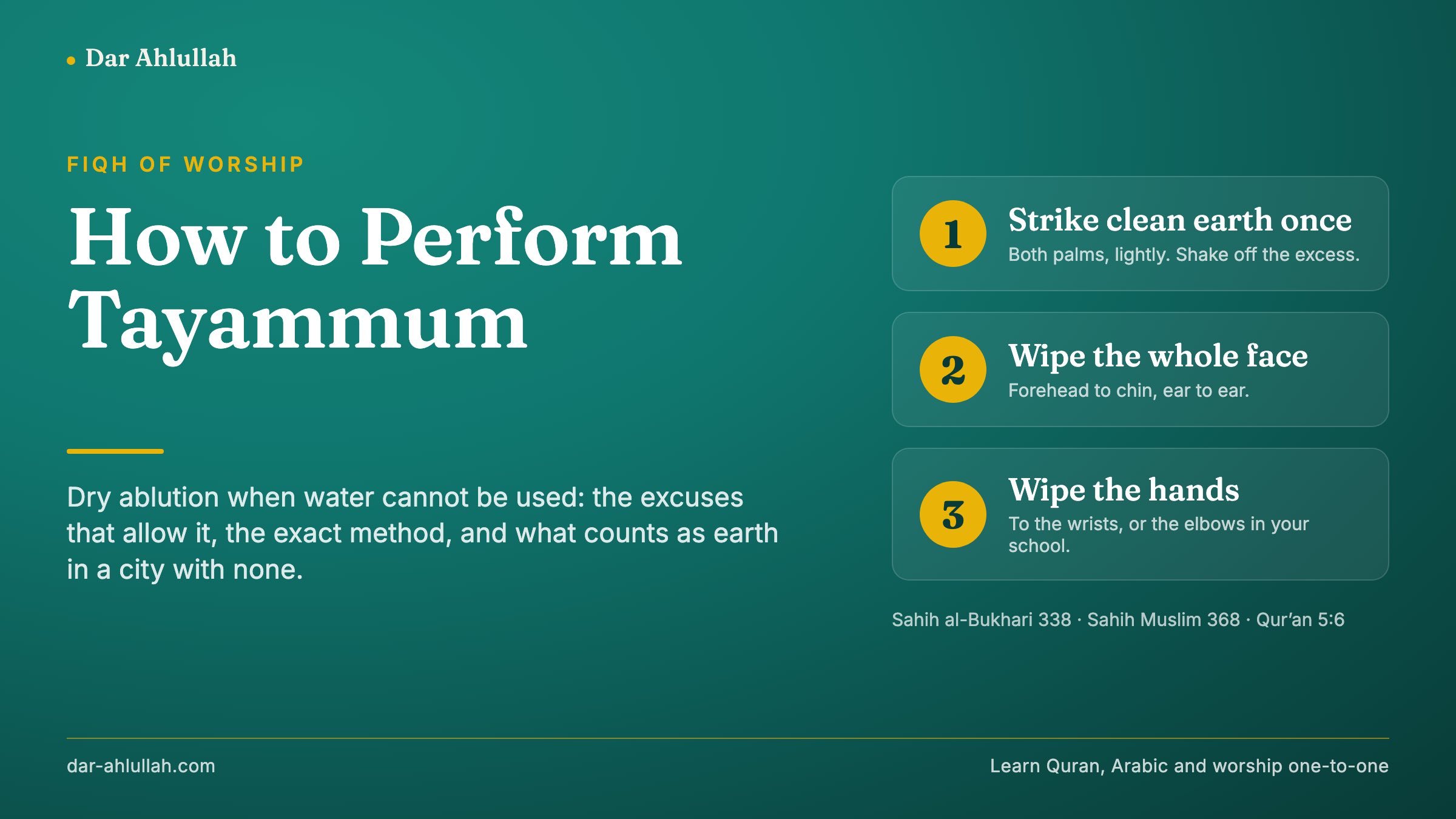
Tayammum is the purification you make with earth when water cannot be used. The rule is short: strike clean earth, wipe your face, wipe your hands. The difficulty for a Muslim in Europe or America is everything around the rule: what counts as a real excuse, what counts as earth in a building with none, how long it lasts, and what you do on a plane or in a hospital bed when there is neither water nor dust.
28 min read