
how to pray salat al-hajah
How to Pray Salat al-Hajah: The Prayer of Need
Dar Ahlullah team 25 min read
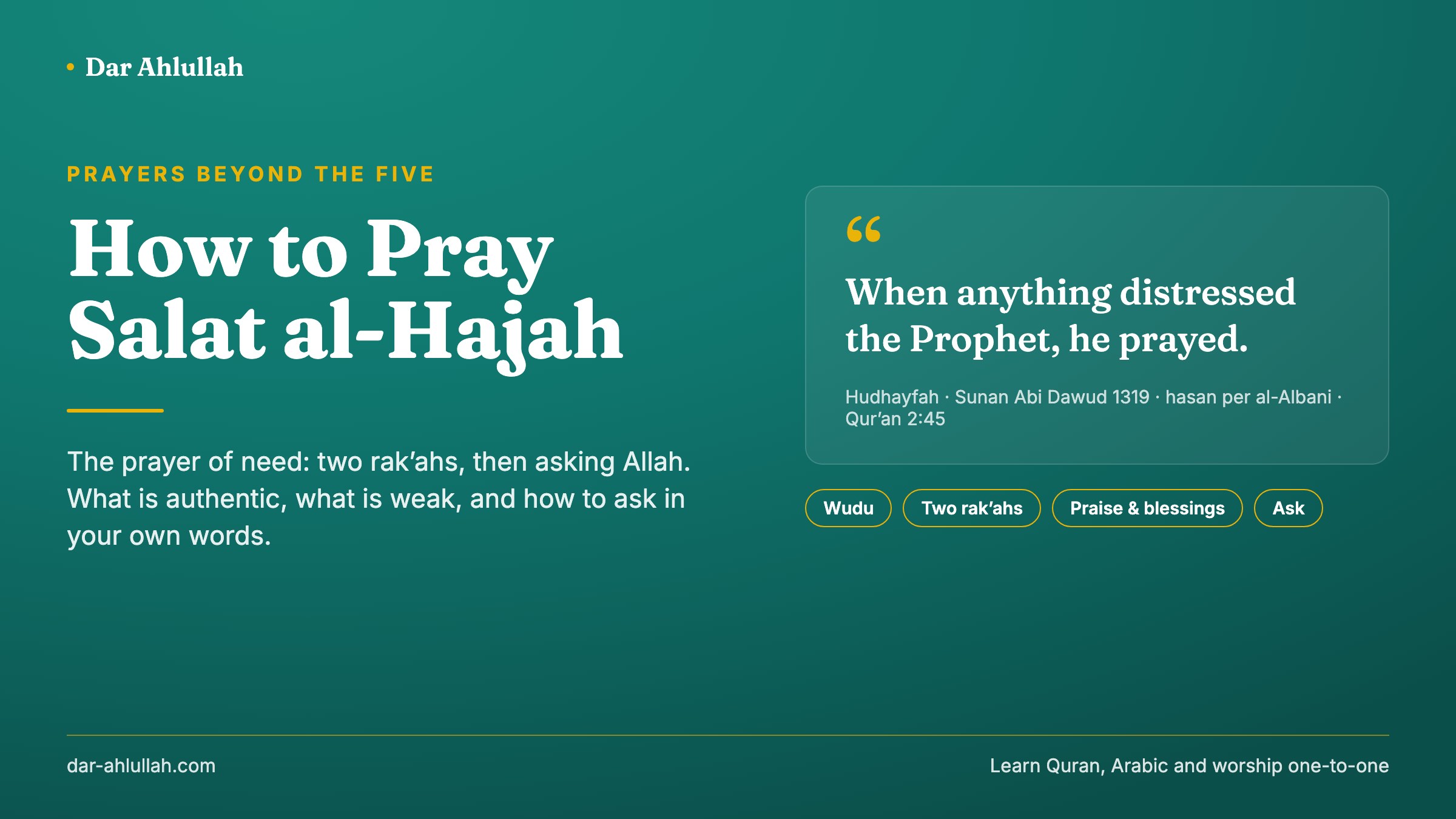
Table of Contents
- Introduction: When You Need Something
- The Short Answer
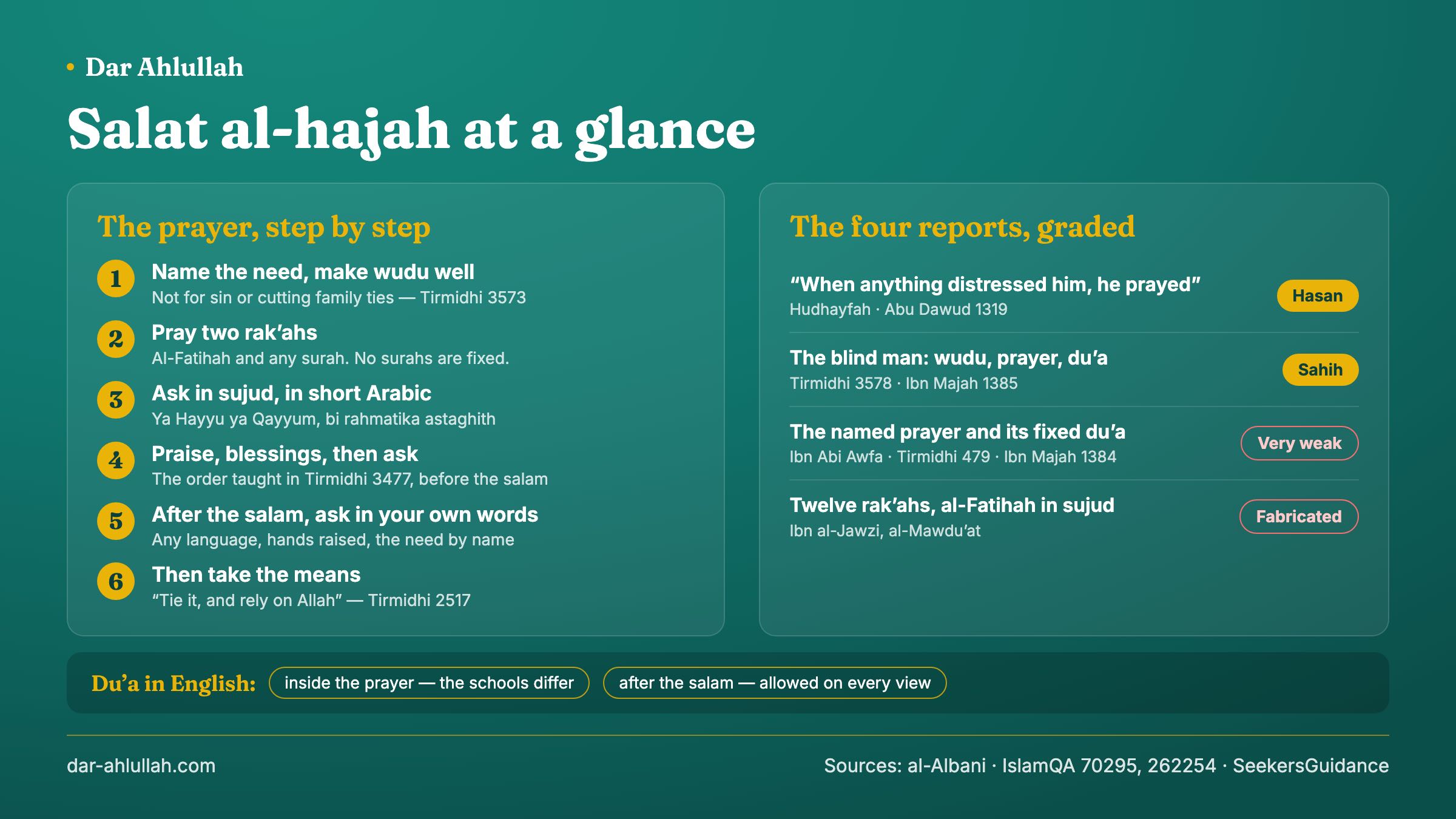
- Where the Prayer Comes From: Four Reports, Four Grades
- What the Scholars Make of It
- How to Pray Salat al-Hajah, Step by Step
- What to Say: Du’as With Sound Chains
- Can I Ask in English Inside the Prayer?
- Hajah, Istikhara or Tawbah?
- When to Pray It
- When the Answer Does Not Come
- When You Cannot Pray It
- Five Situations, Worked Through
- Seven Mistakes People Make
- How We Teach This
- Questions People Ask
- Conclusion: He Stood Up and Prayed
Introduction: When You Need Something
The interview is at nine tomorrow morning. The visa application has said “in process” for five months. Your mother is in a hospital in another country and the earliest flight is on Thursday. Or the need has no date on it at all: a debt that will not shrink, a marriage that has not come, a child who is struggling and you cannot see why. At some point most Muslims hear that there is a prayer for exactly this, salat al-hajah, the prayer of need, and go looking for how to do it.
What they find is confusing. One page gives a long Arabic du‘a to recite after two rak’ahs. Another describes twelve rak’ahs with al-Fatihah recited seven times in prostration. A third says there is no such prayer at all. They cannot all be right, and when you are anxious about something real, the last thing you want is to be told to study hadith grading before you are allowed to ask Allah for help.
So here is the reassuring part first. Every scholar in this discussion agrees that you may stand, pray, and ask Allah for what you need. The Prophet ﷺ did exactly that whenever something distressed him. The disagreement is much narrower than the internet makes it look: it is about one report, one fixed wording, and whether those make a separate named prayer. This guide sets out which reports are authentic, which are weak and which are fabricated, then gives the method, the du‘as with sound chains, the question of asking in English, and the situations that make people hesitate.
If the prayer itself is still new to you, start with our step-by-step guide to how to pray in Islam; this article sits in its salah library beside the other voluntary prayers. One boundary before we begin. We teach Quran, Arabic and the practical fiqh of worship; we are not a fatwa body. Where the scholars genuinely differ we set the positions side by side rather than pick one and call it consensus.
The Short Answer
- Salat al-hajah is voluntary prayer offered when you need something, followed by asking Allah for it. The practice rests on firm ground: Hudhayfah reported that when anything distressed the Prophet ﷺ, he prayed (Sunan Abi Dawud 1319, hasan per al-Albani).
- The named prayer with its fixed du‘a comes from one report, in Jami’ at-Tirmidhi 479 and Sunan Ibn Majah 1384, which al-Albani, Ahmad Shakir and Shu‘ayb al-Arna’ut grade very weak. IslamWeb says the four schools act on it; IslamQA says it is not established as a specific prayer. Both tell you to pray and ask.
- The method is two rak’ahs like any sunnah prayer, then asking. Make wudu well, pray, ask in sujud, and in the final sitting praise Allah, send blessings on the Prophet ﷺ and then ask, which is the order a sahih hadith teaches for every du‘a (Tirmidhi 3477). Then ask again after the salam.
- Inside the prayer the schools differ on du‘a in English; after the salam, none of them restricts it. The safe path on every view: short Arabic du‘as you understand inside the prayer, everything else in your own words after it.
- Then take the means. Pray for the interview and prepare for it. “Tie it, and rely on Allah” (Tirmidhi 2517, hasan per al-Albani).
Where the Prayer Comes From: Four Reports, Four Grades
Almost every confusing thing you will read about salat al-hajah comes from mixing up four different reports. Taken one at a time, they are not confusing at all.
| Report | Where it is | What it contains | Grade |
|---|---|---|---|
| Hudhayfah: “When anything distressed the Prophet ﷺ, he prayed” | Sunan Abi Dawud 1319 | The practice itself. No number of rak’ahs, no fixed wording | Hasan per al-Albani; da‘if per Zubair ‘Ali Za’i |
| ‘Abdullah ibn Abi Awfa: “Whoever has a need from Allah, or from one of the sons of Adam…” | Jami’ at-Tirmidhi 479, Sunan Ibn Majah 1384 | The named prayer: wudu, two rak’ahs, praise, blessings on the Prophet ﷺ, and a fixed du‘a | Very weak per al-Albani, Ahmad Shakir, Shu‘ayb al-Arna’ut and Muhammad Fu’ad ‘Abd al-Baqi; weak per Zubair ‘Ali Za’i and Bashar ‘Awwad Ma‘ruf |
| ‘Uthman ibn Hunayf: the blind man who asked the Prophet ﷺ to pray for his sight | Jami’ at-Tirmidhi 3578, Sunan Ibn Majah 1385 | Wudu and a du‘a; Ibn Majah’s wording adds two rak’ahs | Sahih per al-Albani and Ahmad Shakir; hasan sahih per Bashar ‘Awwad Ma‘ruf |
| Attributed to Ibn Mas‘ud: twelve rak’ahs, with al-Fatihah recited seven times in prostration | Ibn al-Jawzi, al-Mawdu‘at | A long ritual with Qur’an recited in sujud | Fabricated per Ibn al-Jawzi, with al-Zayla‘i agreeing |
The Hudhayfah report is the foundation, and it is short enough to memorise: when a matter distressed him, he prayed. It sets no count and no wording, which is exactly why it is useful. It describes a habit, not a ritual. The Qur’an says the same thing as a command: “And seek help through patience and prayer” (al-Baqarah 2:45, and again at 2:153). IslamQA quotes Ibn Kathir on that verse and al-Albani’s grading of Hudhayfah’s report together in its answer on reconciling the hadith of Hudhayfah with salat al-hajah.
The habit is older than this ummah. In Sahih al-Bukhari, when Sarah, the wife of Ibrahim ﷺ, was brought before a tyrant king, she got up, made wudu, prayed, and said: “O Allah, if I have believed in You and Your Messenger… do not let this disbeliever overpower me” (Sahih al-Bukhari 2217). Wudu, prayer, then asking. That is the whole shape of the prayer of need, in a story the Prophet ﷺ told.
The Ibn Abi Awfa report is where the name and the fixed du‘a come from, and it is the one with the problem. Al-Tirmidhi himself called it gharib and pointed to a weak narrator in its chain, Fa’id ibn ‘Abd al-Rahman, as IslamQA sets out in its answer on salat al-hajah. Most of the modern graders place it below ordinary weakness, at very weak. Its wording is still worth reading, and it is printed in full in the du‘a section below, because its meaning is good and because many people will have been taught it.
The blind man’s report is authentic, and some books list it under salat al-hajah because in Ibn Majah’s wording the Prophet ﷺ told the man to make wudu, pray two rak’ahs and then supplicate. Its du‘a turns to Allah through the Prophet ﷺ, and what that permits after his lifetime is a long-running question of creed, known as tawassul, on which scholars have taken different positions (Wikipedia: Tawassul). That debate is beyond this guide. The part of the report nobody disputes is its sequence: wudu, prayer, then asking Allah.
The twelve-rak’ah version can be set aside. Ibn al-Jawzi included it in his collection of fabricated reports and said there was no doubt it was fabricated; al-Zayla‘i agreed (IslamQA 70295). It also collides with a sahih hadith: ‘Ali said the Prophet ﷺ forbade him to recite the Qur’an while bowing or prostrating (Sahih Muslim 480). A ritual built on reciting al-Fatihah in sujud is built on the one thing that position was kept free of.
What the Scholars Make of It
With the reports separated, the scholarly positions are easy to follow. There are two, and they share more than they differ on.
| Position | Held by | What you do |
|---|---|---|
| Salat al-hajah is a recommended prayer in its own right, with the du‘a from the Ibn Abi Awfa report | IslamWeb, which states that the four schools of fiqh agreed on performing it (IslamWeb fatwa 82384); Shaykh Faraz Rabbani for SeekersGuidance, citing the Hanafi works Sharh Munyat al-Musalli, al-Fatawa al-Hindiyya and Ibn ‘Abidin’s Radd al-Muhtar (SeekersGuidance) | Two rak’ahs, or four; then praise, blessings on the Prophet ﷺ and the transmitted du‘a |
| No specific prayer of need is established; pray and ask in general | IslamQA (10387, 2161, 160746), relying on al-Albani’s grading and quoting the Standing Committee | Pray voluntary rak’ahs when troubled, as the Prophet ﷺ did, and ask for your need in whatever words you choose, with no set count or wording |
The disagreement comes down to one judgement. SeekersGuidance describes the weakness in the Ibn Abi Awfa report as slight, and notes that such hadiths are acted upon for virtuous deeds by general agreement of Sunni scholarship. The graders in the table above describe it as very weak. If it is slightly weak, it can carry a recommended prayer with its own du‘a. If it is very weak, it cannot, and what remains is the general practice in Hudhayfah’s report. That is the whole dispute.
What both positions agree on is most of what you will actually do: make wudu, pray, ask Allah for your need, use the times when du‘a is most hoped to be answered, and do not treat any of it as an obligation. If you follow a school, follow it. If you do not, you can pray the two rak’ahs described below on either view: the only practical difference is whether you treat the Ibn Abi Awfa words as the du‘a of this prayer or as good words among many.
How to Pray Salat al-Hajah, Step by Step
1. Name the need, and check it
Before you stand, know what you are going to ask for. Say it to yourself in plain words: the job, the recovery, the visa, the debt paid off. One check belongs here. The promise of an answer carries a condition, “as long as he does not supplicate for something sinful, or the severing of the ties of kinship” (Jami’ at-Tirmidhi 3573, hasan sahih per al-Albani). If the need is a good one, you are ready.
2. Make wudu, and make it well
Every version of this prayer, weak or authentic, starts with wudu done carefully. Our step-by-step guide to wudu has the method. If you are ill or have no access to water, tayammum takes its place as it does for any prayer.
3. Intend it in your heart
Know that you are standing to pray two voluntary rak’ahs for your need. That knowing is the intention. You will find intention sentences for salat al-hajah online in Arabic and English; nothing needs to be said aloud.
4. Pray two rak’ahs like any sunnah prayer
Opening takbir, al-Fatihah, any surah you know, ruku‘, sujud, the sitting and the salam, exactly as in the two sunnah rak’ahs before Fajr. SeekersGuidance allows four instead of two. Some guides recommend particular surahs, most often Ayat al-Kursi and al-Ikhlas. They are excellent to recite, but no authentic report ties them to this prayer, so do not worry if you use others. If you need the words of each position, what to say in salah, position by position gives them in order.
5. Ask in sujud
“The nearest a servant comes to his Lord is when he is prostrating, so make supplication” (Sahih Muslim 482). After your Subhana Rabbiyal-A‘la, ask. A short Arabic du‘a you understand is safe on every view; one of the best for this moment is Ya Hayyu ya Qayyum, bi rahmatika astaghith, “O Ever-Living, O Sustainer of all, by Your mercy I seek help,” which the Prophet ﷺ said whenever a matter distressed him (Jami’ at-Tirmidhi 3524, hasan per al-Albani). Whether you may also ask in English here is a school difference, covered below. Do not recite verses of the Qur’an as recitation in sujud (Sahih Muslim 480).
6. In the final sitting: praise, blessings, then ask
The Prophet ﷺ heard a man making du‘a in his prayer without praising Allah or sending blessings on him, and said, “This one has rushed.” Then he taught: begin by praising Allah, then send blessings on the Prophet, then ask for whatever you wish (Jami’ at-Tirmidhi 3477, Sunan Abi Dawud 1481, both sahih per al-Albani). The final sitting of every prayer is already built in that order: the tashahhud praises Allah, the salat Ibrahimiyyah sends blessings on the Prophet ﷺ, and the moment before the salam is the place for your own du‘a. This is the same sequence the weak report describes, taught instead by an authentic one.
7. After the salam: stay seated and ask
Stay where you are. Raise your hands: “Your Lord is generous and is too shy to turn away empty the hands of His servant when he raises them to Him” (Sunan Abi Dawud 1488, sahih per al-Albani). Praise Allah, send blessings on the Prophet ﷺ, and then ask for your need by name, in whatever language your heart speaks. Ask decisively. The Prophet ﷺ said none of you should say “O Allah, forgive me if You wish”, but should ask with determination (Sahih al-Bukhari 6339). Add any of the du‘as in the next section.
8. Then get up and take the means
A man asked the Prophet ﷺ whether he should tie his camel and rely on Allah, or leave it loose and rely on Allah. He said, “Tie it, and rely on Allah” (Jami’ at-Tirmidhi 2517, hasan per al-Albani). Salat al-hajah is the second half of that sentence, not a replacement for the first. Pray for the interview, then prepare for it. Pray for the visa, then chase the missing document.
What to Say: Du‘as With Sound Chains
You never need a fixed formula to ask Allah for something. But if you want words the Prophet ﷺ used in distress, these four have sound chains.
The du‘a of distress
La ilaha illallahul-‘Azimul-Halim. La ilaha illallahu Rabbul-‘arshil-‘azim. La ilaha illallahu Rabbus-samawati wa Rabbul-ardi wa Rabbul-‘arshil-karim.
There is no god but Allah, the Mighty, the Forbearing. There is no god but Allah, Lord of the Mighty Throne. There is no god but Allah, Lord of the heavens, Lord of the earth, and Lord of the Noble Throne.
Ibn ‘Abbas reported that the Prophet ﷺ used to say this at times of distress (Sahih al-Bukhari 6346, Sahih Muslim 2730). Notice how close it is to the opening of the weak Ibn Abi Awfa du‘a below: the Forbearing, the Lord of the Mighty Throne. If those meanings are what drew you to the prayer of need, the authentic form is here, in both Sahihs.
The du‘a of Yunus
La ilaha illa anta, subhanaka, inni kuntu minaz-zalimin.
There is no god but You. Glory be to You. Indeed, I have been among the wrongdoers.
This is the prayer of Yunus ﷺ in the belly of the whale (al-Anbiya’ 21:87), and the Prophet ﷺ said that no Muslim supplicates with it for anything but that Allah responds to him (Jami’ at-Tirmidhi 3505, sahih per al-Albani). Because it is a verse of the Qur’an, the simplest course is to say it after the salam or outside the prayer rather than in sujud.
The words taught to Asma’ bint ‘Umays
Allahu, Allahu Rabbi, la ushriku bihi shay’a.
Allah, Allah is my Lord; I do not associate anything with Him.
The Prophet ﷺ taught these words to Asma’ bint ‘Umays to say in distress (Sunan Abi Dawud 1525, sahih per al-Albani). They are short enough to say at a hospital bedside or in a waiting room.
The call for help by His mercy
Ya Hayyu ya Qayyum, bi rahmatika astaghith.
O Ever-Living, O Sustainer of all, by Your mercy I seek help.
Anas reported that the Prophet ﷺ said this whenever a matter distressed him (Jami’ at-Tirmidhi 3524, hasan per al-Albani). It is the one suggested for sujud above, because it is short, Arabic, and easy to mean.
The du‘a from the Ibn Abi Awfa report
La ilaha illallahul-Halimul-Karim. Subhanallahi Rabbil-‘arshil-‘azim. Al-hamdu lillahi Rabbil-‘alamin. As’aluka mujibati rahmatik, wa ‘aza’ima maghfiratik, wal-ghanimata min kulli birr, was-salamata min kulli ithm. La tada‘ li dhanban illa ghafartah, wa la hamman illa farrajtah, wa la hajatan hiya laka ridan illa qadaytaha, ya Arhamar-rahimin.
There is no god but Allah, the Forbearing, the Generous. Glory be to Allah, Lord of the Mighty Throne. Praise be to Allah, Lord of the worlds. I ask You for what makes Your mercy certain and Your forgiveness sure, a share of every good, and safety from every sin. Leave me no sin but that You forgive it, no worry but that You relieve it, and no need that pleases You but that You fulfil it, O Most Merciful of those who show mercy.
This is the wording in Jami’ at-Tirmidhi 479, graded very weak by al-Albani and Ahmad Shakir. On the first position above it is the du‘a of this prayer. On the second, it is not tied to the prayer, but nothing in its meaning is objectionable, and IslamQA’s point is that you may ask with whatever words you wish. Notice its own last line: it asks for the need that pleases Allah. That is a good way to ask for anything.
Can I Ask in English Inside the Prayer?
For most readers of this site, this is the real question. You know what you need, you can say it in English, and your Arabic runs out after the adhkar you memorised. The schools do not answer it the same way:
| School | Du‘a in your own language, inside the prayer |
|---|---|
| Hanafi | Disliked, as contrary to what is preferred. Darul Iftaa Birmingham, citing Nur al-Idah, gives Imam Abu Hanifah’s view as not permissible for someone familiar with Arabic (islamqa.org) |
| Maliki | Prohibited in general, with an allowance reported where the meaning is known |
| Shafi‘i | Making up a du‘a in your own words in another language invalidates the prayer; a transmitted du‘a may be said in translation only by someone who cannot say it in Arabic (SeekersGuidance, Shafi‘i, citing al-Majmu‘) |
| Hanbali, and Ibn Taymiyyah | Permitted for someone who cannot speak Arabic |
The summary of the four schools is from IslamQA’s answer on making du‘a in a language other than Arabic, which itself concludes that it is permissible for someone whose language that is, especially when learning Arabic is hard for them. But look at the Shafi‘i row before you rely on that: on that school, a heartfelt English du‘a in sujud does not just lose some reward; it breaks the prayer.
Now the part every school agrees on: outside the prayer, du‘a in any language is permitted, and after the salam you are outside the prayer. SeekersGuidance’s Shafi‘i answer makes exactly this point: one can and should supplicate after the prayer in any language one is comfortable with. So the path that is safe on every view is simple:
- Inside the prayer: short Arabic du‘as whose meaning you know, such as Ya Hayyu ya Qayyum, bi rahmatika astaghith, or Allahumma inni as’aluka min fadlik, “O Allah, I ask You of Your bounty” (Sahih Muslim 713).
- After the salam: everything else, in English or any language, for as long as you like, with your hands raised.
Nothing is lost by this. The need is named, the prayer is sound on every view, and the longest, most personal part of the asking happens where no school restricts it.
Hajah, Istikhara or Tawbah?
Three voluntary prayers get confused because each is two rak’ahs prayed for a reason. The reason is what separates them.
| Istikhara | Hajah | Tawbah | |
|---|---|---|---|
| Prayed when | You have a decision to make | You need something, or something distresses you | You have sinned |
| You ask for | Allah to choose for you | The thing itself, or relief | Forgiveness |
| Main evidence | Sahih al-Bukhari 1166 | Abu Dawud 1319 (hasan); the named form in Tirmidhi 479 (very weak) | Sunan Abi Dawud 1521 (sahih) |
| Fixed du‘a | Yes, taught word for word | Disputed | No |
The difference between the first two matters in practice. If you have two job offers, the question is which one; that is istikhara, and its du‘a leaves the choice with Allah. If you have no offer and need one, that is the prayer of need, and you ask for the job. Real situations often hold both, and nothing stops you asking for your needs after the salam of an istikhara as well. If the heaviness you are carrying is a sin rather than a need, the prayer you are looking for is salat al-tawbah.
When to Pray It
When the need arises. Salat al-hajah has no time of its own; Hudhayfah’s report ties it to the distress, not the clock. The only limits are the three windows in which voluntary prayer is not offered: from after the Fajr prayer until the sun has risen, while the sun is at its height, and from after the ‘Asr prayer until it has set (Sunan Abi Dawud 1277, sahih per al-Albani). Praying outside those windows is sound on every view. If the need hits you after ‘Asr, make your du‘a straight away, since du‘a has no forbidden time, and pray the two rak’ahs after Maghrib.
Some times are better than others for the asking. IslamQA lists them in its answer on what salat al-hajah is: the depths of the night, between the adhan and the iqamah, the end of each prayer before the salam, and Fridays. Two have their own hadith:
- The last third of the night. Allah descends to the nearest heaven and says: “Is there anyone to ask Me, so that I may grant him his request?” (Sahih al-Bukhari 1145). If you can wake before Fajr, the prayer of need fits naturally into a night prayer; our guide to how to pray tahajjud covers that window.
- Between the adhan and the iqamah. “The supplication made between the adhan and the iqamah is not rejected” (Jami’ at-Tirmidhi 212, sahih per al-Albani). At a mosque, the gap before the congregation stands is a ready-made moment.
But do not hold a pressing need back for a better hour. If the interview is in the morning, pray tonight.
When the Answer Does Not Come
This is where most people’s trust in the prayer of need actually gets tested, and the hadith speak to it directly.
Do not decide it has failed. “The supplication of any one of you is answered as long as he is not hasty and says: I supplicated and was not answered” (Sahih al-Bukhari 6340, Sahih Muslim 2735). Giving up is the one thing the hadith names as cutting the answer off.
An answer is not always the thing you named. “There is not a Muslim on the earth who calls upon Allah with any supplication, except that Allah grants it to him, or turns away from him the like of it in evil.” When a man among them said they would ask for more, he replied: “Allah has more” (Jami’ at-Tirmidhi 3573, hasan sahih per al-Albani). The job that did not come may be the harm that was turned away.
Ask as someone who expects to be answered. “Call upon Allah while being certain of being answered, and know that Allah does not respond to a supplication from a heart that is heedless and distracted” (Jami’ at-Tirmidhi 3479, hasan per al-Albani, da‘if per Zubair ‘Ali Za’i). And the Qur’an: “Call upon Me; I will respond to you” (Ghafir 40:60); “I am near. I respond to the call of the caller when he calls upon Me” (al-Baqarah 2:186).
Look at what you are living on. The Prophet ﷺ described a traveller, dishevelled and dusty, raising his hands and calling “O Lord, O Lord”, while his food, drink and clothing were unlawful, and asked how such a person could be answered (Sahih Muslim 1015). If there is something haram in your income, fixing it is part of asking.
Keep praying it. Nothing limits how many times you pray for the same need. Hudhayfah’s wording describes a habit, whenever something distressed him, not a single attempt.
When You Cannot Pray It
On your period, or during postnatal bleeding, you do not pray, so the two rak’ahs are not open to you. Everything else is. Du‘a has no condition of purity and no language restriction outside the prayer, so ask in your own words, at the times of acceptance, with the du‘as above. SeekersGuidance puts it simply: when circumstances do not permit praying two rak’ahs, one should still turn to Allah in supplication, for He answers and loves to be asked.
At work with nowhere to pray, or on a train, or at the hospital: the du‘a is not waiting for the prayer. Ask now, and pray the two rak’ahs when you reach a place and a time that allow them.
When the need is someone else’s, pray for them just the same. “There is no believing servant who supplicates for his brother in his absence but that the angels say: and the same for you” (Sahih Muslim 2732). A prayer of need for a sick parent or a struggling friend is one of the most natural uses of it there is.
Five Situations, Worked Through
1. “My interview is at nine tomorrow.”
Pray two rak’ahs tonight, after ‘Isha or, if you can wake, in the last third of the night. In sujud, Ya Hayyu ya Qayyum, bi rahmatika astaghith. After the salam, ask in English for the job if it is good for you, and for calm and clear words in the room. Then close the prayer mat and prepare your answers; that is the tying of the camel. If you are choosing between two offers rather than hoping for one, add istikhara.
2. “My visa has been ‘in process’ for five months.”
This is the long-need case, and the hadith on haste was made for it. Keep praying the prayer of need as often as the worry returns, keep asking decisively, and keep taking the means: the missing document, the follow-up email, the advice of someone who knows the system. A delay is not evidence that the prayer has failed, any more than an approval would be evidence that a particular method works.
3. “My mother is in hospital in another country.”
Pray for her tonight, and the angels’ reply in Sahih Muslim 2732 is part of what you are given for it. Keep the du‘a of distress on your tongue while you wait for news, and the words taught to Asma’ bint ‘Umays for the moments you cannot pray. Take the means too: the call to the doctor, the flight, the sibling who is closer.
4. “My exam results are out tomorrow and I am on my period.”
No prayer, but the asking is fully open to you. Make du‘a tonight in your own language, raise your hands, send blessings on the Prophet ﷺ first, and use the du‘a of Yunus, which the Prophet ﷺ said is answered for whoever asks with it. The answer does not depend on the two rak’ahs.
5. “I have been asking for the same thing for two years.”
First, do not stop; stopping is the one thing Sahih al-Bukhari 6340 names as cutting the answer off. Second, check the two things the hadith tie to answered du‘a: that the request is not for something sinful, and that what you live on is lawful. Third, remember Tirmidhi 3573: an unanswered-looking du‘a may be one whose answer was the harm you never saw. And if the need is marriage, work or a place to live, keep a teacher or a trusted person in the loop; the means include other people.
Seven Mistakes People Make
- Believing it only works with the fixed Arabic formula. The only report that fixes a wording is graded very weak by most modern graders. You may use it, but your need does not depend on it.
- Reciting al-Fatihah in sujud. That comes from the twelve-rak’ah version Ibn al-Jawzi judged fabricated, and it contradicts Sahih Muslim 480.
- Treating “it worked for me” as proof. IslamQA 70295 quotes al-Shawkani: the Sunnah cannot be proven by experience, and an answered du‘a does not show that a method was authentically narrated. The same logic protects you when an answer is slow: it does not show you prayed wrongly.
- Making up a long English du‘a inside the prayer when you follow the Shafi‘i school. On that school it invalidates the prayer. Move it to after the salam.
- Praying it in a forbidden window. After ‘Asr, make the du‘a now and the two rak’ahs after Maghrib.
- Praying instead of acting. The camel still needs tying (Tirmidhi 2517).
- Asking for something you should not want. The promise excludes du‘a for sin and for cutting family ties (Tirmidhi 3573).
How We Teach This
The prayer of need is two rak’ahs and a question, and once understood it rarely needs a teacher again. What does need one is the layer underneath: a two-rak’ah prayer prayed correctly, al-Fatihah recited properly, and enough Arabic to say a short du‘a in sujud and mean every word of it, instead of saving all your asking for after the salam. Fiqh basics, the prayer among them, are part of our Islamic Studies course, and the Quran and Arabic courses build the recitation and the understanding that go into it, one-to-one.
Dar Ahlullah runs one-to-one live sessions with certified teachers, scheduled in your own timezone. Teaching is charged at $9 per teaching hour, with monthly plans at $36, $70 and $102 depending on how many hours you want, and a 20% discount for siblings. You can pause, upgrade or switch plans at any time, and if a teacher is not the right fit we rematch you with another certified mentor at no extra cost. If you would like to see where your prayer and recitation stand before committing to anything, the 30-minute assessment is free and does not ask for a card. The details are on our pricing page.
Questions People Ask
What is salat al-hajah?
The prayer of need: voluntary rak’ahs prayed when you need something from Allah or something distresses you, followed by asking Him for it. The practice rests on Hudhayfah’s report that the Prophet ﷺ prayed whenever something distressed him (Sunan Abi Dawud 1319).
Is salat al-hajah authentic?
The practice of praying and then asking when in need is authentic. The named prayer with its fixed du‘a comes from Tirmidhi 479 and Ibn Majah 1384, which al-Albani, Ahmad Shakir and Shu‘ayb al-Arna’ut grade very weak. IslamWeb and SeekersGuidance hold it recommended; IslamQA holds that no specific prayer of need is established.
How many rak’ahs is salat al-hajah?
Two, which is the number in the Ibn Abi Awfa report and in Ibn Majah’s wording of the blind man’s report. SeekersGuidance also allows four. The twelve-rak’ah version is fabricated.
What surahs do I recite in salat al-hajah?
Al-Fatihah and any surah you know, in each rak’ah. No authentic report fixes particular surahs for this prayer.
What is the du‘a for salat al-hajah?
There is no du‘a you are obliged to use. The wording from Tirmidhi 479 is printed above with its grade. Authentic du‘as for distress include the du‘a of distress in Sahih al-Bukhari 6346 and Sahih Muslim 2730, the du‘a of Yunus in Tirmidhi 3505, and Ya Hayyu ya Qayyum, bi rahmatika astaghith in Tirmidhi 3524.
When is the best time to pray salat al-hajah?
Whenever the need arises, outside the three windows after Fajr, at the sun’s height and after ‘Asr. The last third of the night and the time between the adhan and the iqamah are especially hoped for.
Can I make du‘a in English in salat al-hajah?
After the salam, yes, on every view. Inside the prayer the schools differ: the Hanbali school allows it for someone who cannot speak Arabic, the Hanafi school dislikes it, and on the Shafi‘i school a du‘a made up in your own words in another language invalidates the prayer. The safe path is short Arabic du‘as inside and English after.
Can I pray salat al-hajah for someone else?
Yes. Praying for a Muslim in their absence is itself rewarded: the angels say “and the same for you” (Sahih Muslim 2732).
Can I pray salat al-hajah every day?
Yes. Nothing limits how often you pray for a need, and Hudhayfah’s report describes a habit rather than a single act.
Can I pray salat al-hajah on my period?
No, because prayer is not prayed then. Du‘a is fully open to you, in any language and at any time.
Conclusion: He Stood Up and Prayed
Strip away the fabricated twelve rak’ahs, set the disputed formula to one side, and what is left is short enough to remember in any crisis. When something distressed the Prophet ﷺ, he prayed. When Sarah stood before a tyrant, she made wudu, prayed and asked. That is the prayer of need: purify yourself, stand, pray two rak’ahs, praise Allah, send blessings on His Messenger, and ask for what you need by name. Then get up and tie the camel.
The scholars differ on whether that deserves its own name. None of them differs on whether you should do it. If you want the rest of the prayer in the same detail, the salah library links every guide we have written on it, including the other prayers with a reason, such as how to pray istikhara and salat al-tawbah, and the adhkar after salah that surround every prayer.
Related articles
how to pray salat al-tawbah
How to Pray Salat al-Tawbah: The Prayer of Repentance
Salat al-tawbah is two rak'ahs after a sin, taught in one sahih hadith. The method, what to say in sujud and after the salam, the forbidden-times question by school, praying it again after a relapse, sins against people, and what a new Muslim owes for the past.
25 min read
how to pray istikhara
How to Pray Istikhara: The Prayer Before a Decision
Istikhara is two rak'ahs and a supplication, prayed at any valid time about a real fork in the road. The full du'a, what the answer actually looks like, why the dream is a myth, and what to do when nothing becomes clear.
23 min read
tahiyyat al-masjid
Tahiyyat al-Masjid: How to Pray the Greeting of the Mosque
Tahiyyat al-masjid is two rak'ahs prayed on entering a mosque, before sitting. The method, the prayers that fulfil it for you, what to do if you already sat, the iqamah, the Friday khutbah and forbidden times by school, and whether a prayer room counts.
24 min read