
how to respond to the adhan
How to Respond to the Adhan: What to Say and the Dua After
Dar Ahlullah team 29 min read
Table of Contents
- Introduction: The Call That Asks for an Answer
- The Short Answer
- Is Responding to the Adhan Obligatory?
- Phrase by Phrase: What He Says and What You Say
- The Fajr Line: As-Salatu Khayrun Min an-Nawm
- At the Testimony: “And I Too”
- When the Adhan Ends: Salawat, Then the Du’a
- Two Additions to the Du’a, and Their Status
- Between the Adhan and the Iqamah
- Do You Respond to the Iqamah?
- When You Are Busy: Praying, Reading, Eating, in the Bathroom
- More Than One Adhan
- The Adhan on Your Phone, a Clock, the Radio or a Livestream
- Women, and Responding During a Period
- Walking Into the Mosque During the Adhan
- Wordings People Add, and What Stands Behind Them
- What You Are Actually Saying
- How We Teach This
- Questions People Ask
- Conclusion: Two Minutes, Five Times a Day
Introduction: The Call That Asks for an Answer
The adhan is addressed to you. It is not background sound, and it is not only an announcement that the time has come. It is a call, and the Sunnah gives the person who hears it a part to play: while the muezzin calls, the listener answers, phrase by phrase, in words the Prophet ﷺ set out one line at a time. When the call ends there is a blessing to send, a du’a to say, and a stretch of time before the prayer in which, by a sound hadith, supplication is not turned back.
Very little of this is hard. Most of the response is simply repeating what you hear, and the whole of it takes about as long as the adhan itself. What makes it confusing is the material written about it. One page tells you to say sadaqta wa bararta at the Fajr line; the next says that has no basis. One version of the du’a after the adhan ends at alladhi wa‘adtah; another adds innaka la tukhliful-mi‘ad; a third adds wad-darajata r-rafi‘ah. The three are rarely told apart, although the first two have a chain of narration and the third, by the account of the hadith scholar al-Sakhawi, has none. Whether you also respond to the iqamah is a real disagreement among scholars, and it is usually presented as if it were settled one way or the other.
And almost all of it assumes a minaret within earshot. In a city where no adhan is called aloud, the call reaches you some other way — a phone app, a clock on the shelf, a mosque’s livestream, the muezzin at Friday prayer — and whether a recording is an adhan you answer is a question that two of the best-known scholars of the last generation answered differently.
This article sets out the response from the sound reports, with the source and, where it matters, the grade printed on each piece. It separates what is agreed from what is disputed, and where the schools or the scholars differ it lays the views side by side instead of choosing one for you. Then it works through the situations that actually come up: hearing the adhan while you are praying, reading Qur’an, eating your iftar or in the bathroom; hearing two mosques at once; and hearing it from your phone.
One boundary first. We teach Quran, Arabic and the practical fiqh of worship; we are not a fatwa body. If the prayer itself is still new to you, our complete guide to salat is where to start, and the first ninety days guide puts all of this in a sensible order of priority. The words said inside the prayer have their own article, what to say in salah, and the remembrances after it are in adhkar after salah. This one covers the minutes before the prayer begins.
The Short Answer
- What it is: saying after the muezzin what he says, as he says it. “Whenever you hear the Adhan, say what the Mu’adh-dhin is saying” (Sahih al-Bukhari 611; Sahih Muslim 383).
- The ruling: recommended, not obligatory, in all four schools. Nothing is owed if you miss it.
- The two exceptions: at hayya ‘ala s-salah and hayya ‘ala l-falah, say la hawla wa la quwwata illa billah instead (Sahih Muslim 385).
- The Fajr line: at as-salatu khayrun min an-nawm, repeat it as it is. Sadaqta wa bararta, which some jurists recommended, has no sound report behind it.
- When he finishes: send blessings on the Prophet ﷺ, then say Allahumma rabba hadhihi d-da‘wati t-tammah… (Sahih Muslim 384; Sahih al-Bukhari 614). The promise attached is the Prophet’s intercession.
- Then: until the iqamah you are in a time when “the supplication… is not rejected” (Sunan Abi Dawud 521, sahih per al-Albani).
- The iqamah: the majority respond to it as to the adhan; Ibn ‘Uthaymin and some Hanafis held that you do not.
- A recorded adhan on an app or a clock: scholars differ. Ibn ‘Uthaymin: a recording is not an adhan, so there is nothing to answer. Ibn Baz: if it plays at the time of the prayer, answer it.
Is Responding to the Adhan Obligatory?
No, on the view of all four schools. The Dorar fiqh encyclopedia records that responding is recommended by agreement of the Hanafis, Malikis, Shafi‘is and Hanbalis, citing Ibn ‘Abidin, al-Hattab, al-Nawawi and al-Buhuti respectively, and quotes Ibn Qudamah in al-Mughni: “I know of no disagreement among the people of knowledge that this is recommended” (Dorar, the ruling on responding to the muezzin). Al-Nawawi called it the view of the majority, and noted that al-Tahawi reported some of the early generations holding it obligatory (IslamQA 101582, quoting al-Majmu‘).
The hadith is worded as a command — “say what he says” — so the scholars who read it as a recommendation gave reasons. Three of them are worth knowing, because they are also the clearest window onto how the first generations treated it:
- The Prophet ﷺ himself once answered differently. On an expedition at dawn he heard a man call Allahu akbar, Allahu akbar and said, “He is following al-Fitra”; at the testimony he said, “You have come out of the Fire”. It was a goatherd (Sahih Muslim 382). Al-Tahawi drew the conclusion: he heard the caller and said something other than what the caller said, which shows the instruction is a recommendation and an encouragement to good, not a duty (quoted in Dorar, above).
- In ‘Umar’s time, people talked during the Friday adhan. Tha‘labah ibn Abi Malik reported that when ‘Umar sat on the minbar and the muezzins called, “We would sit and talk”, falling silent only when ‘Umar stood to give the khutbah (Muwatta’ Malik). Al-Albani: “This report indicates that it is not obligatory to repeat the words of the muezzin, because what was done at the time of ‘Umar was that people spoke during the adhaan, and ‘Umar did not say anything about that” (IslamQA 101582, quoting Tamam al-Minnah).
- A delegation taught the prayer was not taught this. Ibn ‘Uthaymin pointed to the instruction given to Malik ibn al-Huwayrith’s group, who stayed twenty days and needed everything explained: “When the time for prayer comes, let one of you give the adhaan and let the oldest of you lead you in prayer”, with no mention of responding (IslamQA 101582, quoting al-Sharh al-Mumti‘).
The Hanafi school adds a distinction that answers the question more precisely than “yes” or “no”. It speaks of two responses. The response with the tongue, repeating the words, is recommended. The response with the feet, walking to the mosque, is the one with weight: a Hanafi answer published by ShariahBoard puts it as “responding to athan verbally is considered mustahab and … walking towards the mosque is considered wajib” (ShariahBoard, etiquettes of listening to the adhan), and Shaykh Yusuf Badat of Mathabah calls proceeding to the congregation “a prophetic imperative” (Mathabah, responding to multiple adhans). Who exactly the congregation is owed by is its own subject. The point here is that the words are the light part.
Not owed is not the same as small. The reports attach some of the largest promises in the Sunnah to this two-minute act. In ‘Umar’s report, the one who answers the adhan line by line, “from the heart”, “will enter Paradise” (Sahih Muslim 385). “Whoever says the same as this with certainty, he will enter Paradise” (Sunan an-Nasa’i 674, hasan per al-Albani). When a man complained that the muezzins outdid everyone else in reward, the answer was: “Say (the same words) as they say, and when you come to the end, make a petition and that will be granted to you” (Sunan Abi Dawud 524, hasan sahih per al-Albani). A missed response is no sin, but, as IslamQA 101582 puts it, “by doing that he is missing out on a great reward”.
Phrase by Phrase: What He Says and What You Say
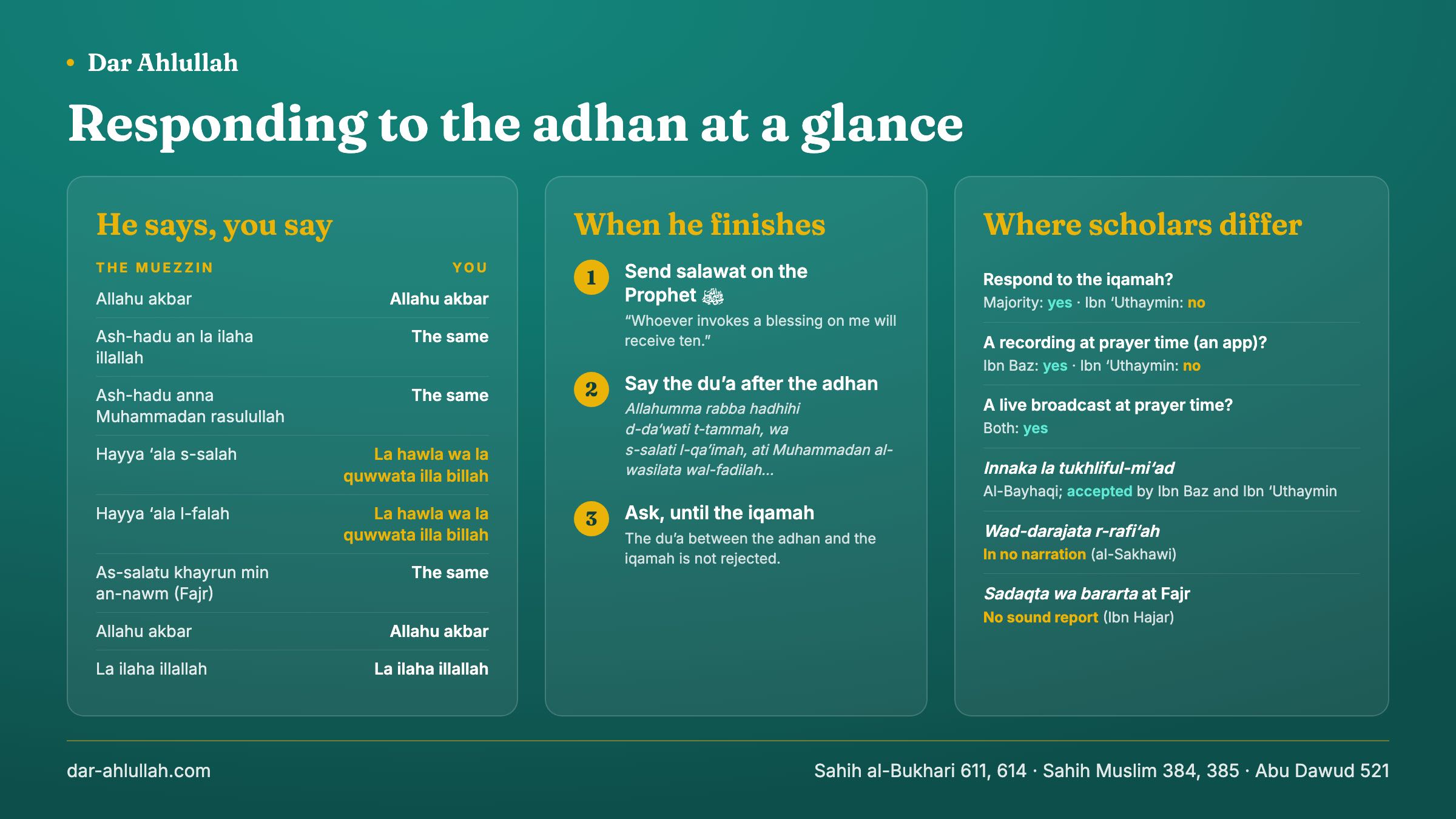
The fullest single report is ‘Umar’s, in Sahih Muslim 385, which goes through the adhan line by line. Mu‘awiyah did the same as he heard a muezzin and said, “We heard your Prophet saying the same” (Sahih al-Bukhari 613). Set out as a table:
| The muezzin says | You say | Source |
|---|---|---|
| Allahu akbar, Allahu akbar | Allahu akbar, Allahu akbar | Sahih Muslim 385 |
| Ash-hadu an la ilaha illallah | Ash-hadu an la ilaha illallah | Sahih Muslim 385 |
| Ash-hadu anna Muhammadan rasulullah | Ash-hadu anna Muhammadan rasulullah | Sahih Muslim 385 |
| Hayya ‘ala s-salah (come to prayer) | La hawla wa la quwwata illa billah | Sahih Muslim 385; Sahih al-Bukhari 613 |
| Hayya ‘ala l-falah (come to success) | La hawla wa la quwwata illa billah | Sahih Muslim 385 |
| As-salatu khayrun min an-nawm (Fajr only) | As-salatu khayrun min an-nawm | The general wording of Bukhari 611; see the next section |
| Allahu akbar, Allahu akbar | Allahu akbar, Allahu akbar | Sahih Muslim 385 |
| La ilaha illallah | La ilaha illallah | Sahih Muslim 385 |
Three practical notes.
Follow your muezzin, not the table. ‘Umar’s report gives each phrase once, as the pattern. The adhan you hear repeats most of them, and the schools differ slightly in how it opens; you repeat whatever he actually says, as many times as he says it.
Answer each phrase after he says it. The report is built that way: “When the Mu’adhdhin says … and one of you should make this response …”. You do not need to keep pace syllable by syllable, and you do not need to be loud. It is your own dhikr, not a second adhan.
Say la hawla at both. ‘Umar’s report has it twice, once for each hayya line. The fit is easy to see: the muezzin invites you to the prayer and to success, and you answer that there is no might and no power to accept the invitation except with Allah.
The Fajr Line: As-Salatu Khayrun Min an-Nawm
The Fajr adhan carries one extra line, as-salatu khayrun min an-nawm, “prayer is better than sleep”. ‘Umar’s report does not mention it, so two answers have circulated.
| What to say | Who said it | Basis |
|---|---|---|
| Repeat it: as-salatu khayrun min an-nawm | Ibn ‘Uthaymin (“The correct view”, in al-Sharh al-Mumti‘); some Maliki jurists; Shaykh Muhammad ibn Ibrahim | The general command, “say what he says” (Bukhari 611) |
| Sadaqta wa bararta (“you have spoken the truth and done well”) | Some jurists regarded it as recommended | Ibn Hajar: “There is no basis for what is mentioned about the response to As-salatu khayrun min an-nawm” (al-Talkhis al-Habir). Al-San‘ani: no sound report from the Prophet ﷺ proves it. Muhammad ibn Ibrahim: it is only mentioned in a weak hadith. |
All of this is collected in IslamQA 81427, which also notes the habit of saying both together, as-salatu khayrun min an-nawm, sadaqta wa bararta, and quotes Muhammad ibn Ibrahim on it: “there is no basis for that”. The answer with the hadith behind it is to repeat the line as you hear it.
At the Testimony: “And I Too”
Two further reports attach something to the two testimonies, and both are sound.
“And I too, and I too.” ‘A’ishah reported that when the Prophet ﷺ heard the muezzin uttering the testimony, he would say wa ana, wa ana, “And I too, and I too” (Sunan Abi Dawud 526, sahih per al-Albani).
The declaration that forgives sins. Sa‘d ibn Abi Waqqas reported: “If anyone says on hearing the Mu’adhdhin: I testify that there is no god but Allah alone, Who has no partner, and that Muhammad is His servant and His Messenger, (and that) I am satisfied with Allah as my Lord, with Muhammad as Messenger, and with Islam as din, his sins would be forgiven” (Sahih Muslim 386). In Arabic: ash-hadu an la ilaha illallahu wahdahu la sharika lah, wa anna Muhammadan ‘abduhu wa rasuluh, raditu billahi rabban, wa bi-Muhammadin rasulan, wa bil-islami dina. One narrator’s version begins wa ana ash-hadu, “and I bear witness”, the same “and I too” spelled out.
The report ties the declaration to hearing the muezzin and does not fix the exact moment. Saying it as he reaches the testimonies, where “and I too” belongs, and saying it once the adhan is over both fall within its wording.
What you should not add at the testimony, in IslamQA’s view, is sallallahu ‘alayhi wa sallam when the muezzin says the Prophet’s name. Its reasoning is that the response was taught phrase by phrase and none of the Companions is known to have added to it, and it quotes Ibn al-Qayyim that the adhan is not among the places for salawat: “after the muezzin finishes, one should send blessings upon the Prophet” (IslamQA 100859). That is the next step.
When the Adhan Ends: Salawat, Then the Du’a
The order comes from one hadith. ‘Abdullah ibn ‘Amr reported: “When you hear the Mu’adhdhin, repeat what he says, then invoke a blessing on me, for everyone who invokes a blessing on me will receive ten blessings from Allah; then beg from Allah al-Wasila for me, which is a rank in Paradise fitting for only one of Allah’s servants, and I hope that I may be that one. If anyone who asks that I be given the Wasila, he will be assured of my intercession” (Sahih Muslim 384).
So there are three steps, in this order:
- Repeat the adhan, as above.
- Send blessings on the Prophet ﷺ. Any salawat fulfils it. The wording he taught when the Companions asked how to send blessings on him is the one you already say in the tashahhud: Allahumma salli ‘ala Muhammadin wa ‘ala ali Muhammad, kama sallayta ‘ala Ibrahima wa ‘ala ali Ibrahim, innaka hamidun majid… (Sahih al-Bukhari 3370).
- Ask for al-wasilah, which is what the du’a after the adhan does.
The du’a is in Sahih al-Bukhari, from Jabir ibn ‘Abdullah:
Allahumma rabba hadhihi d-da‘wati t-tammah, wa s-salati l-qa’imah, ati Muhammadan al-wasilata wal-fadilah, wab‘athhu maqaman mahmudan alladhi wa‘adtah.
“O Allah, Lord of this perfect call and of the prayer about to be established, give Muhammad al-wasilah and al-fadilah, and raise him to the praised station that You promised him.”
The promise: whoever says it after listening to the adhan, “then my intercession for him will be allowed on the Day of Resurrection” (Sahih al-Bukhari 614; also Jami‘ at-Tirmidhi 211 and Sunan Ibn Majah 722, both sahih per al-Albani).
Three words in it carry the meaning. Al-wasilah is defined in the hadith above: a single rank in Paradise, for one servant of Allah. Al-fadilah is rendered “eminence” in the translations; Shaykh Gibril Haddad explains it as “the exalted level”. Al-maqam al-mahmud, the praised station, is the one named in the Qur’an: “It may be that your Lord will raise you to a praised station” (Surah al-Isra’ 17:79). You are asking for the Prophet ﷺ what Allah has already promised him, and the reward named for asking is his intercession for you.
Two Additions to the Du’a, and Their Status
Printed versions of this du’a often end with one or both of two extra phrases. They do not have the same standing.
| The addition | Where it comes from | What the scholars said |
|---|---|---|
| Innaka la tukhliful-mi‘ad, “You do not break Your promise”, at the end | Al-Bayhaqi, al-Sunan al-Kubra (1/410), “with the same chain as in Bukhari” (HadithAnswers, the complete du’a after the adhan) | Accepted by the scholars quoted here. Ibn Baz: al-Bayhaqi added it “with a hasan isnaad” (IslamQA 87667). Ibn ‘Uthaymin: sound, an accepted addition from a trustworthy narrator, and in the words of the believers’ prayer in Qur’an 3:194 (his Madinah lessons). IslamWeb: no harm in keeping to al-Bukhari’s wording or adding it. |
| Wad-darajata r-rafi‘ah, “and the lofty rank”, after al-fadilah | Devotional literature, including al-Jazuli’s Dala’il al-Khayrat (per Shaykh Gibril Haddad) | No narration has it. Al-Sakhawi, in al-Maqasid al-Hasanah: “I have not seen it in any of the narrations” (IslamWeb 35197). Haddad calls it a gloss that became interpolated into the text; in his view it clarifies the meaning and is not a bid‘ah, but the better wording is the one in the Sahih and the Sunan (Qibla, commonly recited wordings). |
The upshot is simple. The wording in al-Bukhari is agreed on by everyone. Ending it with innaka la tukhliful-mi‘ad has scholarly backing. Both sources that discuss wad-darajata r-rafi‘ah prefer the transmitted wording without it.
Between the Adhan and the Iqamah
Once the du’a is said, the time does not go back to being ordinary. “The supplication made between the adhan and the iqamah is not rejected” (Sunan Abi Dawud 521; Jami‘ at-Tirmidhi 212; both sahih per al-Albani). Read alongside Abu Dawud 524 — “when you come to the end, make a petition and that will be granted to you” — the end of the adhan is a door, and the minutes after it are among the times the Sunnah names for asking.
What to ask for is open. A longer version of the Tirmidhi hadith has the Companions asking “So what should we say?” and being told to ask for al-‘afiyah, well-being in this world and the next; that version is graded munkar by al-Albani (Jami‘ at-Tirmidhi 3594). Asking for ‘afiyah is a good du’a, but no wording is fixed for this time. IslamQA’s summary of the whole sequence is a useful map: no du’a before the adhan, the response during it, the du’a after it, du’a encouraged between the adhan and the iqamah, and nothing specific after the iqamah (IslamQA 5666).
The same gap is where the “before” sunnah prayers go — “There is a prayer between the two Adhans (Adhan and Iqama)” (Sahih al-Bukhari 624) — which our guide to the sunnah rawatib sets out prayer by prayer, including what to do when no adhan is called where you pray. If you have a particular need, the prayer of need article lists this window among the times its du’a is made.
Do You Respond to the Iqamah?
This is a genuine disagreement, and it is often presented as if it were settled.
| View | Held by | Reasoning |
|---|---|---|
| Respond to the iqamah as to the adhan, including la hawla at the hayya lines, then salawat and the du’a | The Shafi‘is, the Hanbalis and most Hanafis; among contemporaries, the Standing Committee for Fatwas, Ibn Baz and al-Albani | “Between every two adhans there is a prayer” (Bukhari 624) calls the iqamah an adhan, so “when you hear the muezzin, say what he says” covers it |
| Do not respond to the iqamah; the response belongs to the adhan | Some Hanafis; among contemporaries, Ibn ‘Uthaymin | “Two adhans” is a figure of speech that names two things by one of them, not a ruling that the iqamah is an adhan |
Both views are set out in IslamQA 111791. Those who respond differ on one line. At qad qamati s-salah, the Hanafi text al-Durr al-Mukhtar has the listener say aqamaha Allahu wa adamaha, “may Allah establish it and keep it established”. The Standing Committee says to repeat qad qamati s-salah instead, because the hadith for aqamaha Allahu wa adamaha is weak — and it is graded so: Sunan Abi Dawud 528, da‘if per al-Albani and the other graders listed with it.
In practice the iqamah gives you very little time. If you respond to it, keep it short and be ready to stand in the row when it ends.
When You Are Busy: Praying, Reading, Eating, in the Bathroom
The adhan does not wait for you to be free. The scholars addressed the common cases directly.
You are in the middle of a prayer
Carry on and do not respond. Ibn Baz: “The worshipper should carry on praying, and not repeat after the mu’adhdhin, because he is busy with his prayer” (IslamQA 148194). Elsewhere he allowed making it up afterwards: for the one praying, after the salam, and for the one relieving himself, after finishing, “there is no harm” (quoted in Dorar, responding to more than one mosque).
You are reading Qur’an
Stop and respond, then go back to your reading. Al-Nawawi, in al-Tibyan: “When he hears the Mu’adhdhin, he should stop reading and follow the Mu’adhdhin, repeating the words of the Adhan and Iqamah, then go back to his reading. This is what is agreed upon by our companions.” Ibn ‘Uthaymin explained why the lesser act wins here: the Qur’an is the best of dhikr, but reading it is not tied to a time, while responding to the muezzin is tied to hearing the adhan (IslamQA 149053).
You are breaking your fast at Maghrib
Eat. This is the exact question IslamQA 101582 was asked, and its answer, since the response is not obligatory, is that there is no sin in missing it, “whether that is because he is busy with eating or anything else”.
You are in the bathroom
Do not respond there. The Hanafi ShariahBoard answer lists “in the washroom” and while relieving oneself among the situations in which one refrains, and Ibn Baz’s permission above covers saying it once you have come out.
Other situations the Hanafi answer lists
The same ShariahBoard answer adds: during the khutbah of Jumu‘ah or Eid, during the funeral prayer, while engaged in religious education, and in a state of janabah. On the Friday khutbah, Ibn ‘Uthaymin reached the same place by another route: listening to the khutbah is obligatory, and responding to the muezzin is not (IslamQA 11960).
You have already prayed
Ibn ‘Uthaymin noted that the jurists said if you have already offered the prayer the adhan is calling to, you do not have to respond (IslamQA 148871). Another answer observes that the apparent meaning of the hadith is general, and that responding anyway, as dhikr, “is fine” (IslamQA 108374).
More Than One Adhan
In a neighbourhood with several mosques, or a mosque that calls twice for Fajr or Jumu‘ah, you may hear the adhan more than once. The Dorar encyclopedia sets out the main view: respond to every muezzin you hear, as long as his adhan is a legitimate one. That is the Hanbali position, the view of some Hanafis and some Shafi‘is and one view among the Malikis, and it was chosen by Ibn Taymiyyah, al-Shawkani, al-San‘ani, Ibn Baz and Ibn ‘Uthaymin (Dorar 763). The reasoning, in the words of the Hanafi Ibn ‘Abidin: answer all of them by speech, because the cause, which is hearing, has been repeated.
Within that view there are refinements worth knowing:
- The first is better, except at Fajr and Jumu‘ah. Al-‘Izz ibn ‘Abd al-Salam (Shafi‘i): answer each, and answering the first is better, except at Fajr and Jumu‘ah, where both are equal because both are prescribed (via Ibn Hajar, Fath al-Bari, in Dorar 763).
- Once you have prayed, the second is not calling you. Burhan al-Din Ibn Muflih (Hanbali): if you answered one muezzin and prayed in congregation, you do not answer the second, because you are not the one being called by it (Dorar 763).
- Several at once. If the calls come one after another, the Hanafi ShariahBoard answer says it is better to respond to each; if they overlap, to the mosque you pray in. Ibn ‘Abidin relays a view that you answer the first, whether or not it is your own mosque’s.
- The first one is enough. Shaykh Yusuf Badat: “it is praiseworthy to respond to every adhan by repeating its words, although repeating the words of the first adhan will suffice” (Mathabah).
The Adhan on Your Phone, a Clock, the Radio or a Livestream
Where no mosque calls aloud, the adhan you hear on most days may come out of a speaker. Is that an adhan you respond to? Two of the most widely followed scholars of the last generation gave different answers, and the difference is not about technology. It is about what makes an adhan an adhan.
| What you hear | Ibn ‘Uthaymin | Ibn Baz |
|---|---|---|
| A muezzin calling live, at the time of the prayer, carried by radio, TV or a mosque stream | Respond: it is a real adhan, and the general command covers it | Respond: “If that is at the time of prayer then it is prescribed to respond to it” |
| A recording that plays at the time of the prayer: a phone app, an adhan clock | Do not respond: “it is not a real adhaan, i.e., the man is not giving it at the time it is commanded to give it; rather it is an audio recording of a previous adhaan” | Respond, even if it is a tape or the radio, as long as it is at the time |
| A recording at any other time: a video, a ringtone, a playlist | Do not respond | Do not respond: if it is not at the time, then no |
Sources: Ibn ‘Uthaymin in IslamQA 148871, whose questioner had exactly the modern case — an adhan clock at home in a city with no mosques — and in Dorar 757; Ibn Baz in IslamQA 87667 and, for the tape, as quoted in Dorar 763 from Sa‘id ibn Wahf al-Qahtani’s book on responding to the muezzin.
So the app on your phone falls exactly on the line between them. On Ibn ‘Uthaymin’s view it is a reminder that the time has come, not a call; on Ibn Baz’s, a call at the right time is answered whatever carries it. Both are serious positions held by scholars of the same school and the same country, and this is a matter on which you can follow your teacher or your community without worrying that you have the wrong one.
One case neither answer addresses directly: watching a live adhan from another city whose prayer time is not yours — Makkah’s Maghrib streamed into a London afternoon, for example. It is live, but it is not the time of your prayer. We have not found a ruling on it in the sources above, and it is a question for a teacher rather than for an article.
IslamQA’s answer to the questioner with the adhan clock ended with a different suggestion: give the adhan yourself. Abu Sa‘id al-Khudri told a man who kept sheep in open country to raise his voice when he called the adhan, “for whoever hears the Adhan, whether a human being, a jinn or any other creature, will be a witness for you on the Day of Resurrection”, and said he had heard it from the Prophet ﷺ (Sahih al-Bukhari 609).
Women, and Responding During a Period
The response is for everyone who hears the adhan. Ibn ‘Uthaymin, explaining the phrase “it is Sunnah for the one who hears it”, said it includes the male and the female (al-Sharh al-Mumti‘, quoted in Dorar 763).
A woman on her period can respond as well. The response and the du’a after it are dhikr and supplication, and IslamQA’s answer on what a menstruating woman may and may not do says of dhikr, takbir, saying SubhanAllah, praising Allah and du’as: “none of these things are forbidden to her” (IslamQA 70438). The Hanafi ShariahBoard answer, as noted above, lists janabah among the states in which one refrains from responding; it does not mention menstruation.
Walking Into the Mosque During the Adhan
If you arrive while the adhan is being called, the greeting of the mosque and the response compete for the same minute. Ibn ‘Uthaymin’s answer: for an ordinary prayer, remain standing until you have responded to the muezzin and said the du’a, then pray the two rak‘ahs, so that you have done both acts of worship. If it is the Jumu‘ah adhan called while the khatib is on the minbar, pray the greeting at once, because preparing to listen to the khutbah matters more than the response (IslamQA 11960). The rest of the greeting’s rules — what if you have already sat down, what if the iqamah is already being called — are in our article on tahiyyat al-masjid, and the Friday sequence is in how to pray Jumu‘ah.
Wordings People Add, and What Stands Behind Them
A number of phrases and gestures travel with the adhan in different communities. Some have no report behind them at all, some rest on weak reports, and one is a real difference between schools. They are listed here with what the sources say, so that you can tell which is which.
| The practice | What stands behind it |
|---|---|
| Sadaqta wa bararta at the Fajr line | No sound report; Ibn Hajar: “no basis” (IslamQA 81427) |
| Wad-darajata r-rafi‘ah in the du’a | In no narration, per al-Sakhawi (IslamWeb 35197) |
| Saying sallallahu ‘alayhi wa sallam at the Prophet’s name during the adhan | Not part of the taught response; the salawat comes after the adhan (IslamQA 100859) |
| Aqamaha Allahu wa adamaha at the iqamah | In Hanafi texts; the hadith for it is da‘if (Abu Dawud 528) |
| Asking specifically for ‘afiyah between the adhan and the iqamah, as an instruction | The version with that instruction is graded munkar (Tirmidhi 3594); the du’a itself is a good one |
| The Maghrib du’a, Allahumma inna hadha iqbalu laylika wa idbaru naharika wa aswatu du‘atika faghfir li | Graded differently: da‘if per al-Albani, isnad hasan per Zubair Ali Za’i (Sunan Abi Dawud 530); the Hanafi ShariahBoard answer includes it among the etiquettes |
Kissing the thumbs at the Prophet’s name
This one is a difference of opinion rather than a simple error, and it is worth seeing whole. The practice is to kiss the thumbs or fingertips and wipe them over the eyes when the muezzin says ash-hadu anna Muhammadan rasulullah. It rests on a report, related by al-Daylami, that Abu Bakr did this and that the Prophet ﷺ promised his intercession to whoever did the same. There are three positions:
- An innovation. IslamQA: “That is an innovation (bid’ah)”; what is prescribed on hearing his name is to send blessings on him (IslamQA 68837).
- Permissible, but never to be treated as necessary. Darul Iftaa Birmingham (Hanafi): the hadith is weak, weak narrations have leeway in virtuous acts, so there is nothing wrong in doing it, and Mufti Taqi Usmani said it is not sinful or bid‘ah when done out of love for the Prophet ﷺ; “what is wrong is that some people deem the aforementioned act as something necessary” (Darul Iftaa Birmingham).
- A recommended extra devotion in the Shafi‘i books. Shaykh Afifi al-Akiti: the hadith is weak but not fabricated, and the act is classed among fada’il al-a‘mal, recommended but never obligatory (SeekersGuidance, Shafi‘i).
What all three agree on is that the report behind it is not sound. The Hanafi answer adds that treating it as necessary is where the real problem lies.
What You Are Actually Saying
Because the response is mostly repetition, it is easy to say it without hearing it. The meanings are short:
- Allahu akbar: “Allah is the Greatest.” When the Prophet ﷺ heard a goatherd say it, he said, “He is following al-Fitra” (Muslim 382).
- Ash-hadu an la ilaha illallah: “I testify that there is no god but Allah.” At the same goatherd’s testimony: “You have come out of the Fire.”
- Ash-hadu anna Muhammadan rasulullah: “I testify that Muhammad is the Messenger of Allah.”
- Hayya ‘ala s-salah, hayya ‘ala l-falah: “Come to prayer, come to success.” The only lines addressed to you rather than about Allah, and the only lines you do not repeat.
- La hawla wa la quwwata illa billah: “There is no might and no power except with Allah.” Your answer to the invitation.
- La ilaha illallah: “There is no god but Allah.” The last line, after which ‘Umar’s report gives the promise of Paradise to the one who answers from the heart.
How We Teach This
Most of what is above is reading, and reading is enough for it. What reading cannot do is tell you whether the du’a after the adhan, which you may say thousands of times in your life, is coming out as the words in Sahih al-Bukhari or as an approximation of them. Like the adhkar, it is usually learned by ear, and anything said five times a day sets hard, errors included.
Dar Ahlullah runs one-to-one live sessions with certified teachers, scheduled in your own timezone. Teaching is charged at $9 per teaching hour, with monthly plans at $36, $70 and $102 depending on how many hours you want, and a 20% discount for siblings. You can pause, upgrade or switch plans at any time, and if a teacher is not the right fit we rematch you with another certified mentor at no extra cost. If you want to know where your recitation currently stands before committing to anything, the 30-minute assessment is free and does not ask for a card — the details are on our pricing page.
Questions People Ask
How do I respond to the adhan?
Repeat each phrase after the muezzin says it, except at hayya ‘ala s-salah and hayya ‘ala l-falah, where you say la hawla wa la quwwata illa billah (Sahih Muslim 385). When he finishes, send blessings on the Prophet ﷺ and say the du’a Allahumma rabba hadhihi d-da‘wati t-tammah… (Sahih Muslim 384; Sahih al-Bukhari 614).
What is the du’a after the adhan?
Allahumma rabba hadhihi d-da‘wati t-tammah, wa s-salati l-qa’imah, ati Muhammadan al-wasilata wal-fadilah, wab‘athhu maqaman mahmudan alladhi wa‘adtah: “O Allah, Lord of this perfect call and of the prayer about to be established, give Muhammad al-wasilah and al-fadilah, and raise him to the praised station that You promised him.” Whoever says it is promised the Prophet’s intercession (Sahih al-Bukhari 614).
Is it obligatory to repeat after the muezzin?
No. All four schools hold it recommended, and Ibn Qudamah said he knew of no disagreement that it is recommended. The Hanafis distinguish the verbal response, which is recommended, from going to the mosque, which they hold wajib.
What do I say when the muezzin says as-salatu khayrun min an-nawm?
Repeat it: as-salatu khayrun min an-nawm. That is Ibn ‘Uthaymin’s view and follows the general wording of the hadith. Sadaqta wa bararta has no sound report; Ibn Hajar said there is no basis for it (IslamQA 81427).
Is innaka la tukhliful-mi‘ad part of the du’a?
It is not in al-Bukhari’s wording; al-Bayhaqi reports it. Ibn Baz graded its chain hasan and Ibn ‘Uthaymin accepted it, so you may add it. Wad-darajata r-rafi‘ah is different: al-Sakhawi found it in no narration.
Should I respond to the adhan on my phone app?
Scholars differ. Ibn ‘Uthaymin held that a recorded adhan is not a real adhan and is not responded to (IslamQA 148871). Ibn Baz held that an adhan heard at the time of the prayer is responded to even from a tape or the radio (Dorar 763). A live broadcast at prayer time is responded to on both views.
Do I respond to the iqamah?
The majority, including the Shafi‘is, the Hanbalis, most Hanafis, Ibn Baz and al-Albani, say yes, in the same way as the adhan. Ibn ‘Uthaymin and some Hanafis held that the response is for the adhan only (IslamQA 111791).
Can I respond to the adhan during my period?
Yes. The response is dhikr and du’a, and dhikr and du’a are not forbidden to a menstruating woman (IslamQA 70438).
What if I hear the adhan while I am praying?
Carry on with your prayer and do not respond (Ibn Baz, IslamQA 148194). He also said there is no harm in saying it after the salam.
Can I talk during the adhan?
The response is not obligatory, and in ‘Umar’s time people sat and talked during the Friday adhan, which al-Albani took as evidence of that (IslamQA 101582). The Hanafi etiquettes list not talking during the adhan, and staying quiet so that you can respond is the better course.
Conclusion: Two Minutes, Five Times a Day
Stripped of what has been added to it, the response to the adhan is very small. Say what the muezzin says. At the two lines that call you, answer that there is no might and no power except with Allah. When he finishes, send blessings on the Prophet ﷺ and ask for him the rank he was promised. Then ask for what you need before the prayer begins. None of it is owed, and every part of it carries a promise from a sound report: Paradise for the one who answers from the heart, forgiveness for the declaration, the Prophet’s intercession for the du’a, and an answer for the asking that follows it.
The rest of this article was mostly about telling apart what is in the reports from what has grown around them, and about the places where serious scholars disagree — the iqamah, the additions to the du’a, the phone in your pocket — so that a difference of opinion is recognised as one, and not mistaken for an error on your part.
A man once told the Prophet ﷺ that the muezzins were getting ahead of everyone else in reward. He was not told to become a muezzin. He was told to say what they say, and then to ask. The next adhan is where that starts.
Related articles
tahiyyat al-masjid
Tahiyyat al-Masjid: How to Pray the Greeting of the Mosque
Tahiyyat al-masjid is two rak'ahs prayed on entering a mosque, before sitting. The method, the prayers that fulfil it for you, what to do if you already sat, the iqamah, the Friday khutbah and forbidden times by school, and whether a prayer room counts.
24 min read
adhkar after salah
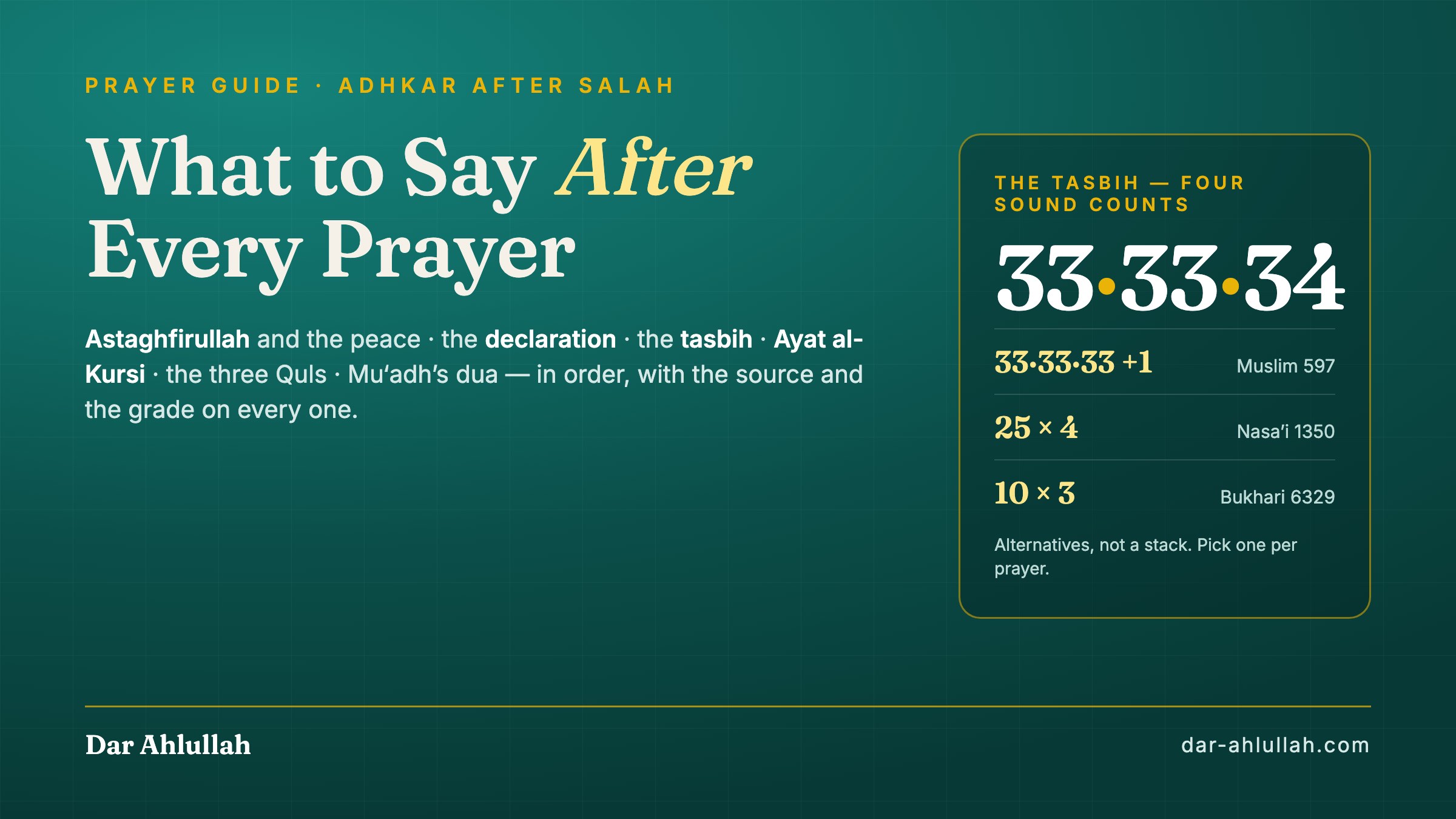
Adhkar After Salah: What to Say After Every Prayer
The adhkar after salah are the remembrances said in the minutes after the salam. This guide gives them in order with their sources, sets the 33-33-34, 33-33-33, 25-by-four and 10-by-three reports side by side so the counts stop looking like a contradiction, prints the grade on every famous reward, and works out which to keep when you pray Zuhr in a stairwell at work.
34 min read

sunnah rawatib
The Sunnah Rawatib: The Twelve Rak’ahs Around the Five Prayers
The sunnah rawatib are the regular voluntary rak’ahs attached to the five daily prayers: twelve in a day on the fullest count, ten on the other. Which goes before and which after, why the two counts differ, what each school holds, where to pray them, how to make one up, and which to keep when you only have five minutes.
27 min read