
how to pray duha
How to Pray Duha: The Prayer Between Sunrise and Noon
Dar Ahlullah team 22 min read
Table of Contents
- Introduction: The Prayer That Lands in Your Working Day
- The Short Answer
- What Salat ad-Duha Actually Is
- Duha, Ishraq, Chasht, Awwabin: One Prayer or Four?
- When the Window Opens and Closes
- Finding the Window Where You Actually Live
- How Many Rak’ahs
- How to Pray Duha, Step by Step
- What You Recite
- The Evidence, and the Contradiction Inside It
- The Rewards People Quote, and How They Are Graded
- Praying Duha Inside a Working Day
- If You Miss It
- What Duha Is Not
- Seven Mistakes People Keep Making
- How We Teach This
- Questions People Ask
- Conclusion: Two Rak’ahs, Before the Sun Reaches the Top
Introduction: The Prayer That Lands in Your Working Day
Most of the voluntary prayers are considerate about where they fall. Tahajjud belongs to a part of the night when nobody expects anything of you. The sunan attached to the five fit into the minutes either side of a prayer you were already making. Duha does not do this. Its entire window sits between the morning commute and lunch — which, for a Muslim working in Manchester or Frankfurt or New Jersey, is the least available stretch of the entire day.
That is probably why it is the voluntary prayer people have heard of and never prayed. And when they do go looking, the English-language material has a second problem waiting. Search for it and you will be told, in the first paragraph of most results, that twelve rak’ahs earns a palace of gold in Paradise, that praying it wipes out sins though they be like the foam of the sea, and that two rak’ahs after sunrise carries the reward of a complete Hajj and ‘Umrah. Two of those three narrations are graded weak. The third is a single-route report its own collector flagged. Meanwhile the material that is in Bukhari and Muslim — which is considerable, and better — barely gets a mention.
This article sets out how to pray Duha from the sound reports: what the prayer is, when its window opens and shuts, how many rak’ahs, and what you say. Then it does two things the ranking pages skip. It works through the apparent contradiction in the hadith — ‘A’ishah is narrated as saying the Prophet ﷺ never prayed it, and also as saying he prayed four — because anyone reading hadith in English without a teacher hits that within ten minutes and has nobody to ask. And it deals with the practical problem of a window defined by two moving solar events in a country where sunrise wanders across the morning by hours between June and December.
One boundary first. We teach Quran, Arabic and the practical fiqh of worship; we are not a fatwa body, and where the schools differ we say so rather than picking for you. If the five obligatory prayers are still new, our complete guide to salat covers the sequence Duha is prayed on top of. If you are early in your practice generally, the first ninety days guide puts the voluntary prayers into a sensible order of priority — and Duha is not the first thing on that list.
The Short Answer
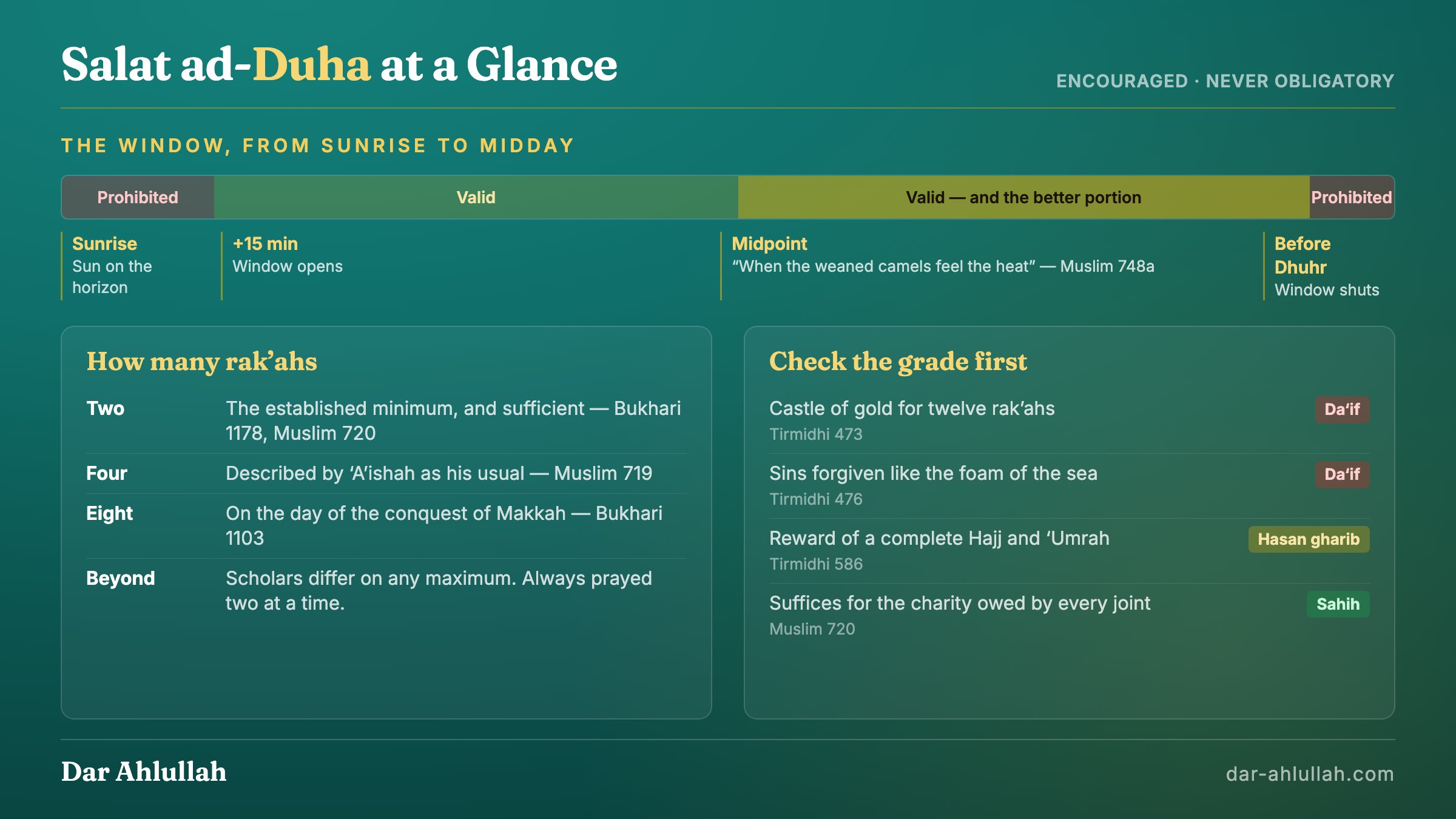
- What it is: a voluntary prayer of the forenoon, prayed in units of two, any time between the end of sunrise and just before midday.
- The ruling: mustahabb — encouraged, and never obligatory. Nothing is owed if you never pray it.
- When it opens: roughly a quarter of an hour after sunrise, once the sun has cleared the horizon and the short prohibited window has passed.
- When it shuts: about ten minutes before Dhuhr, before the sun reaches its zenith.
- The best part of the window: the later half, when the heat has come up — not the minute the window opens.
- How many: two at minimum. Four is what ‘A’ishah reported as his usual. Eight is recorded on the day of the conquest of Makkah. Beyond that, pray in twos.
- What you recite: al-Fatihah and whatever else you know. There is no fixed surah for it.
- The one real trap: repeating reward hadith you have not checked the grade on. The sound material is more than enough on its own.
What Salat ad-Duha Actually Is
Duha is the Arabic word for the forenoon — the part of the morning after the sun has properly risen and before it stands overhead. The prayer takes its name from its window rather than from anything it contains, which is worth noticing straight away: there is no special posture in it, no extra takbir, no distinctive recitation. It is an ordinary voluntary prayer whose only distinguishing feature is when.
The ruling is mustahabb — encouraged, not obligatory (IslamQA 209657). No school treats it as owed. That has a practical consequence people get wrong in both directions: you cannot sin by skipping it, and you also cannot repay it the way you repay a missed Fajr. It is not a debt.
What the sound narrations attach to it is a kind of daily settling-up. Abu Dharr reported the Prophet ﷺ as saying that in the morning a charity is due from every bone in the body — every glorification a charity, every praise a charity, every declaration of His oneness a charity, enjoining good a charity, forbidding wrong a charity — “and two rak’ahs which one prays in the forenoon will suffice” for all of it (Sahih Muslim 720). That is the clearest statement of what the prayer is for. It is not a bid for a palace. It is two rak’ahs that discharge, on your behalf, a debt of gratitude you accrued simply by waking up with a working body.
Abu Hurayrah placed it among the three practices he was told to hold to: “My friend advised me to do three things and I shall not leave them till I die: to fast three days every month, to offer the Duha prayer, and to offer witr before sleeping” (Sahih al-Bukhari 1178, and the same in Sahih Muslim 721). Note the company it keeps. Three fasts a month and witr before sleep are both modest, repeatable and unglamorous. Duha belongs to that category of practice: small, daily, sustainable. Not an occasion.
Duha, Ishraq, Chasht, Awwabin: One Prayer or Four?
This confuses more converts and second-generation Muslims than any other point, and for a good reason: it is genuinely confusing, and the confusion is partly linguistic and partly a real scholarly disagreement.
Start with the words. Duha is Arabic for the forenoon. Chasht is the Persian and Urdu name for the same prayer, which is what you will hear if you learned your practice in a South Asian family or masjid. Ishraq comes from the root for sunrise and is used for a prayer offered at the earliest end of the window. So the first two are the same word in two languages, and nobody disputes that.
Ishraq is where the disagreement sits. As SeekersGuidance summarises it, “the majority of jurists held that they are one and the same prayer” — Ishraq being simply Duha prayed early — while a minority treat them as two distinct prayers, and “if one prays them separately as two distinct prayers this would be valid” (SeekersGuidance, Ishraq, Chasht and Awwabin). In practice this means you are not behind on anything. If you pray two rak’ahs shortly after sunrise and two more at mid-morning, that is fine. If you pray once, in the middle of the window, that is also fine and is what the majority position describes.
Awwabin is the genuinely awkward one, because the word attaches to two different prayers depending on which tradition taught you. In Sahih Muslim it is Duha: Zayd ibn Arqam, seeing people praying in the forenoon, said they knew that a different hour was better, “for Allah’s Messenger ﷺ said: the prayer of those who are penitent is observed when your weaned camels feel the heat of the sun” (Sahih Muslim 748a). But in common Hanafi usage — and therefore across much of South Asia and the diaspora — salat al-awwabin names a voluntary prayer between Maghrib and ‘Isha, which SeekersGuidance treats separately in the same answer.
So if an uncle tells you awwabin is after Maghrib and an article tells you awwabin is Duha, neither is wrong. They are using one word for two practices. Nothing about your Duha changes either way.
When the Window Opens and Closes
Duha’s window is bounded on both sides by the times in which prayer is discouraged, which is the cleanest way to hold it in your head. There are three such windows in the day: a short one as the sun rises, a very short one as it stands at its zenith, and one as it sets. Duha begins after the first has passed and ends before the second begins. It is, quite literally, the whole of the morning minus its edges.
For the opening edge, the classical description is that the sun has risen “to the height of a spear” — an observational measure from a world without clocks. Shaykh Ibn ‘Uthaymin converted it: the window runs from roughly a quarter of an hour after sunrise until about ten minutes before Dhuhr (IslamQA 22389). Those two figures are a safety margin around the prohibited edges rather than exact boundaries, and treating them as approximate is the point.
Within that window there is a preferred portion, and it is not the beginning. The hadith of Zayd ibn Arqam above puts the best hour at the point when the young camels feel the heat of the sand underfoot — that is, the later part of the morning, once the sun has come up in earnest, roughly from the midpoint of the window onwards. IslamQA gives the same conclusion: it is better to pray it after the sun’s heat has become intense.
Two things follow from this that people find counterintuitive. First, the “correct” time is later than most people assume — a prayer at 11am is closer to the described optimum than one at 7:30am. Second, praying at the earlier end is not a mistake; it is Ishraq, and it is inside the window. The distinction is between valid and better, not between valid and invalid.
Finding the Window Where You Actually Live
Here is where guides written for Cairo or Karachi stop being useful. In a country near the equator, sunrise and midday sit in roughly the same place all year, so “mid-morning” is a reliable instruction. In northern Europe it is not an instruction at all. Sunrise in Britain, Germany or Scandinavia moves across the morning by hours between midsummer and midwinter, and Dhuhr shifts with it. A habit built on a clock time will drift out of the window entirely within a couple of months and you will not notice.
The fix is arithmetic rather than memory. Your prayer app already gives you the two numbers that define the window:
- Opens: sunrise, plus about fifteen to twenty minutes.
- Closes: Dhuhr, minus about ten minutes.
- Best portion: the second half of what is left — take the midpoint between those two and aim after it.
Do that sum once a month rather than once, and the habit survives the seasons. In deep winter in the north the whole window can be startlingly short; in June it can run for the better part of the working day.
There is one piece of genuinely good news for anyone praying at high latitude. The estimation problems that make Fajr and ‘Isha difficult in northern summers — where the sun never dips far enough below the horizon for the defining twilight to occur, and the times on your app are the output of a scholarly convention rather than an observation — do not touch Duha at all. Sunrise and the sun’s zenith are directly observable solar events at every latitude on earth, every day of the year. Whatever your app is doing to your Fajr, it is not doing it to your Duha window. Our guide to prayer times at high latitude explains which times are estimates and which are not, and why it matters.
How Many Rak’ahs
The floor is two, and it is a real floor rather than a grudging minimum — two rak’ahs are what both of the strongest narrations name. Above that, the sound reports give a range rather than a number:
| Number | Where it comes from | Status |
|---|---|---|
| Two | Abu Dharr on the charity of the joints (Muslim 720); Abu Hurayrah’s three practices (Bukhari 1178) | The established minimum, and sufficient |
| Four | Mu’adhah asked ‘A’ishah how many he prayed; she said “four rak’ahs, but sometimes more as he pleased” (Muslim 719) | Described as his usual practice |
| Eight | Umm Hani’ saw him pray eight on the day of the conquest of Makkah, light but with complete bowing and prostration (Bukhari 1103) | Recorded; often given as the fullest form |
| Twelve | Attached to the “castle of gold” narration | See the section on gradings below |
On the ceiling, scholars differ. IslamQA takes the view that no text fixes a maximum, so a person may pray as many as they wish provided they are prayed two at a time. The Hanafi position summarised by SeekersGuidance puts the minimum at two and the maximum at eight, with some holding twelve, “though eight is preferable to all”. Either way the mechanics are the same: you pray two, give the salam, and start again if you want more. There is no single continuous block of four or eight in the way there is for the four sunnah rak’ahs before Dhuhr.
If you are choosing, choose two and keep them. The narration Abu Hurayrah preserved is about a practice held to for a lifetime, and two rak’ahs every morning for a year is worth more than eight once.
How to Pray Duha, Step by Step
There is almost nothing new here. If you can pray two rak’ahs of any voluntary prayer you already know the whole thing.
- Check the window. Sunrise plus a quarter of an hour at the earliest; ten minutes before Dhuhr at the latest. Later in the window is better than earlier.
- Be in wudu. Ordinary purity for prayer, nothing extra. If you are not sure yours is still valid, our guide to what breaks wudu lists the nullifiers.
- Intend two rak’ahs of voluntary prayer. The intention is in the heart. There is nothing to say aloud, and no formula to get right.
- Pray them exactly as you would any two rak’ahs. Al-Fatihah in each, then whatever else you know, with the usual bowing and prostration. The recitations in order are in our guide to what is said in salah.
- Give the salam. That is one complete Duha.
- Add more in twos if you want to. Two more, salam. Two more, salam. Stop whenever you like — there is no obligation to reach four or eight once you have begun.
Umm Hani’s description of the eight rak’ahs contains a detail worth carrying over: she said she never saw him pray such a light prayer, “but he performed perfect prostration and bowing”. Short is permitted. Rushed is not. If you are praying this in fifteen minutes between meetings, take the shorter surahs rather than the shorter postures.
What You Recite
Al-Fatihah in each rak’ah, as in every prayer, and after it whatever you know. No surah is specified for Duha in the sound narrations. Surah ad-Duha, chapter 93, shares the prayer’s name and is sometimes recited in it out of a fitting resonance rather than an instruction — it is a short chapter about relief arriving after a difficult silence, which suits the hour, but reciting it is a choice and not a requirement.
If your memorised material is thin, this is a prayer that rewards building it. Two rak’ahs every morning is a natural place to rotate through the short surahs you are working on. Our guide to which surahs to memorise first sets out a sequence, and the short chapters at the end of the Quran are exactly the right length for a light prayer.
The Evidence, and the Contradiction Inside It
Anyone who reads hadith in English for a fortnight will run into this, and it is worth handling squarely rather than hoping it does not come up.
In Sahih Muslim, ‘Abdullah ibn Shaqiq asked ‘A’ishah whether the Messenger of Allah ﷺ used to observe the forenoon prayer. Her answer: “No, but when he came back from the journey” (Sahih Muslim 717a). Three pages earlier in the same collection, Mu’adhah asked ‘A’ishah how many rak’ahs he prayed at the forenoon prayer, and she answered: “Four rak’ahs, but sometimes more as he pleased” (Muslim 719). The same narrator, the same collection, apparently opposite answers.
The resolution is in a third report from her, and it is unusually explicit. ‘Urwah narrated that ‘A’ishah said: “I have never seen the Messenger of Allah ﷺ observing the supererogatory prayer of the forenoon, but I observed it. And if the Messenger of Allah ﷺ abandoned any act which he in fact loved to do, it was out of fear that if the people practised it constantly, it might become obligatory for them” (Sahih Muslim 718).
Three things are settled by that single narration. She is describing what she personally witnessed, not issuing a ruling — and the forenoon is precisely the hour when the Prophet ﷺ was least likely to be in any one house. She prayed it herself, which she would not have done had she understood her own report as a denial of its legitimacy. And she supplies the reason he would deliberately drop a practice he loved: to keep it from hardening into an obligation on the community.
This is a pattern worth learning, because it recurs across the voluntary acts. An apparent negation in the hadith is very often a negation of constant, witnessed performance, sitting alongside clear positive commands to others — Abu Hurayrah’s three practices, Abu Dharr’s charity of the joints. Both stand. Nothing needs to be discarded. Our introduction to fiqh for beginners covers how the scholars reconcile reports of this kind, which is a large part of what the discipline exists to do.
The Rewards People Quote, and How They Are Graded
Search “Duha prayer benefits” in English and you will be given a list within seconds: a castle of gold, sins forgiven like the foam of the sea, the reward of a complete Hajj and ‘Umrah. These circulate everywhere, usually without a reference and almost never with a grade. Sunnah.com prints the grade on the page. Here is what it says.
| The claim | Source | Grade |
|---|---|---|
| Twelve rak’ahs of Duha earns a castle of gold in Paradise | Jami‘ at-Tirmidhi 473 | Da‘if (weak). At-Tirmidhi himself called it gharib — “we do not know it except from this route” |
| Praying the two rak’ahs consistently forgives sins “though they be like the foam of the sea” | Jami‘ at-Tirmidhi 476 | Da‘if (weak) |
| Fajr in congregation, then dhikr until sunrise, then two rak’ahs, earns the reward of a complete Hajj and ‘Umrah | Jami‘ at-Tirmidhi 586 | Hasan gharib — acceptable, but reported through a single route, and scholars have differed over it |
| Two rak’ahs in the forenoon suffice for the charity owed by every joint in the body | Sahih Muslim 720 | Sahih |
| It was among the three practices the Prophet ﷺ advised Abu Hurayrah to hold to for life | Sahih al-Bukhari 1178 | Sahih |
Read that table from the bottom and the point becomes obvious. Duha does not need the weak material. The sound narrations already establish it as a prayer the Prophet ﷺ prayed, instructed others to keep, and described as settling a daily obligation of gratitude on behalf of the entire body. That is a strong case. Bolting a palace onto it adds nothing and costs something.
What it costs is worth being clear about. Attributing a statement to the Prophet ﷺ is a serious act, and a weak chain means the scholars who examined it were not satisfied it reaches him. There is also a quieter cost: a practice sold on a spectacular reward tends to be dropped when the feeling wears off, while one understood as two rak’ahs of daily thanks tends to survive. Scholars have long permitted the circulation of weak narrations in matters of virtue under conditions, so this is not a claim that anyone quoting them is sinning — but you should know which category you are in when you repeat something, and most people repeating these do not.
The habit to build is small: before you pass on a reward hadith, open it on sunnah.com and read the grade line. It takes about ten seconds and it is the single most useful piece of hygiene available to someone learning their religion in English from the internet.
Praying Duha Inside a Working Day
This is the practical obstacle, and it is specific to living where we live. In a Muslim-majority country the mid-morning is porous — there is a masjid within walking distance and a culture that expects people to step out. In an office in Birmingham or a hospital in Chicago it is the densest part of the day, and there is often no prayer room.
Some things that actually help:
- Work out which side of your commute the window opens on. This inverts by season in northern countries. In summer the window opens well before you leave the house, so Duha is a home prayer. In winter sunrise is late enough that the window may not open until you are already at your desk. The prayer does not change; where you will be praying it does, and knowing that in advance is most of the battle.
- Use the later end of the window deliberately. Since the preferred portion is the second half, a mid-morning break is closer to the described optimum than a rushed attempt at 7:30. The scheduling constraint and the Sunnah point the same way here, which is unusual and worth taking.
- Two rak’ahs is the whole obligation, and there isn’t one. Four minutes in an empty meeting room is a complete Duha. There is no shortfall to make up.
- It is a voluntary prayer, so ordinary voluntary-prayer flexibility applies. Any clean place, and no congregation required — Duha is not prayed in jama‘ah as a rule.
- Do not let it displace the obligatory. If the choice on a given morning is between praying Duha and praying Dhuhr properly on time, that is not a choice. Voluntary prayers are built on top of a complete set of obligatory ones, never in place of them.
That last point deserves a sentence more, because it is the most common way sincere people get this wrong. A missed obligatory prayer is a debt with its own procedure; a missed voluntary prayer is not a debt at all. If you have a backlog of the first kind, deal with that before adding the second — our guide to making up missed prayers sets out how.
If You Miss It
The morning gets away from people. A meeting overruns, a child is ill, and by the time you look up the sun is overhead and the window has shut. What then?
Nothing is owed. That is the first and most important answer, and it follows directly from the ruling: an encouraged act that is not performed leaves no debt behind.
On whether you may nonetheless make it up later, the scholars differ. IslamQA reports the disagreement plainly: some hold that it should be made up, which is the position of the Shafi‘is and some Hanbalis, with an-Nawawi among those supporting it, while Hanafis, Malikis and other Hanbalis hold that it should not. Shaykh Ibn ‘Uthaymin took the second view, on the reasoning that “if the time for Duha prayer is missed, then the prayer has been missed, because it is limited to that time” (IslamQA 72828).
For most people the practical upshot is the same either way: pray two rak’ahs of ordinary voluntary prayer later if you want to, without treating it as a repayment, and pick the window up again tomorrow. What you should not do is accumulate a mental ledger of missed Duhas. That misunderstands the category, and in our experience it is the fastest way to abandon a voluntary practice altogether.
What Duha Is Not
- Not obligatory, in any school. Nobody sins by not praying it.
- Not a substitute for a missed obligatory prayer. Different category, different rules.
- Not a congregational prayer. It is prayed individually as a matter of course.
- Not tied to a particular surah. Surah ad-Duha is a fitting choice, not a requirement.
- Not a fixed clock time. The window is astronomical and moves with the year.
- Not three separate prayers because you have heard three names for it.
- Not the first voluntary prayer to take on. The sunan attached to the five daily prayers come first in almost every scholar’s ordering; Duha is added once those are steady.
Seven Mistakes People Keep Making
- Treating “mid-morning” as a clock time. Set at 9am in October, still 9am in June, and by then it is well inside the window but nowhere near its better half. Recompute from sunrise and Dhuhr every few weeks.
- Praying in the minutes right after sunrise. There is a short prohibited window as the sun comes up. Waiting the quarter of an hour costs nothing and removes the question.
- Repeating the castle-of-gold narration as established. It is graded weak, and the sound material is better anyway.
- Believing twelve rak’ahs is the target and two is a failure. Two is the number in both of the strongest narrations. Four was his usual.
- Keeping a ledger of missed Duhas. There is no debt. A voluntary prayer you did not pray is simply a good you did not take.
- Confusing the names into extra obligations. Duha, Chasht and, on the majority view, Ishraq are one prayer. Awwabin is the same prayer in Sahih Muslim and a different one in common Hanafi usage — and neither reading adds anything to your day.
- Adding it before the sunan of the five are steady. Building the roof before the walls. The order matters more than the enthusiasm.
How We Teach This
Most of what is above is reading, and reading is enough for it. The part that is not — whether the two rak’ahs you are praying are actually sound, whether your al-Fatihah is coming out as words rather than approximations of words — needs somebody listening.
Dar Ahlullah runs one-to-one live sessions with certified teachers, scheduled in your own timezone. Teaching is charged at $9 per teaching hour, with monthly plans at $36, $70 and $102 depending on how many hours you want, and a 20% discount for siblings. You can pause, upgrade or switch plans at any time, and if a teacher is not the right fit we rematch you with another certified mentor at no extra cost. If you want to know where your recitation currently stands before committing to anything, the 30-minute assessment is free and does not ask for a card — the details are on our pricing page.
Questions People Ask
What time is Duha prayer?
From roughly a quarter of an hour after sunrise until about ten minutes before Dhuhr. The better part of that window is its second half, once the sun’s heat has come up.
How many rak’ahs is Duha?
Two at minimum, prayed in units of two. ‘A’ishah described four as his usual practice, and eight is recorded on the day of the conquest of Makkah. Scholars differ on whether there is any maximum at all.
Is Duha prayer sunnah or obligatory?
It is mustahabb — encouraged. It is not obligatory in any school, and no sin attaches to leaving it.
Is Ishraq the same as Duha?
On the majority view, yes — Ishraq is Duha prayed at the early end of its window. A minority treat them as two distinct prayers, and praying them separately is valid on that view.
Which surah should I recite in Duha?
Al-Fatihah and then whatever you know. No surah is specified. Surah ad-Duha is a fitting choice because of the name and the meaning, not because it is required.
Can I make up Duha if I miss it?
Scholars differ. The Shafi‘is and some Hanbalis permit making it up; Hanafis, Malikis and others hold that the prayer is tied to its time. Either way nothing is owed, so there is no backlog to clear.
Can I pray Duha at home before work?
Yes, provided the window has opened — sunrise plus about a quarter of an hour. In northern countries that is usually possible in summer and often not in winter, so check rather than assume.
Do I pray Duha in congregation?
No, it is prayed individually as a matter of course, like the other voluntary prayers of the day.
Does praying twelve rak’ahs really build a palace in Paradise?
That narration is graded weak. The rewards established in Sahih Muslim and Sahih al-Bukhari are substantial on their own and do not depend on it.
Should I pray Duha or Tahajjud if I can only manage one?
Both are voluntary and neither is owed, so this is a question of what you can actually keep. Tahajjud carries a greater weight in the texts but demands the harder hour; our guide to how to pray Tahajjud sets out what it involves. Duha asks less of you and is easier to hold to daily, which the narration of Abu Hurayrah suggests is much of the point.
Conclusion: Two Rak’ahs, Before the Sun Reaches the Top
The fiqh of Duha is genuinely short. A window that opens once the sun is properly up and closes before it stands overhead, two rak’ahs in it, nothing special recited, nothing owed if you miss it. You could learn the whole ruling in a minute and the rest of this article is context around that minute.
What the context is for is mostly protective. It is there so that you compute the window instead of guessing at it and quietly drifting out of it as the year turns. So that the apparent contradiction in ‘A’ishah’s narrations does not unsettle you when you meet it at midnight on sunnah.com with nobody to ask. And so that you are not carrying, as the reason for a daily act of worship, three claims that the scholars who examined them were not satisfied reach the Prophet ﷺ at all.
What is left when you strip those out is better than what they were covering. A body that woke up working owes something for that, and every joint of it owes separately. The sound narration says two rak’ahs in the forenoon settle the account — and then you go back to your morning.
Related articles
sunnah rawatib
The Sunnah Rawatib: The Twelve Rak’ahs Around the Five Prayers
The sunnah rawatib are the regular voluntary rak’ahs attached to the five daily prayers: twelve in a day on the fullest count, ten on the other. Which goes before and which after, why the two counts differ, what each school holds, where to pray them, how to make one up, and which to keep when you only have five minutes.
27 min read
how to pray istikhara
How to Pray Istikhara: The Prayer Before a Decision
Istikhara is two rak'ahs and a supplication, prayed at any valid time about a real fork in the road. The full du'a, what the answer actually looks like, why the dream is a myth, and what to do when nothing becomes clear.
23 min read
how to perform tayammum
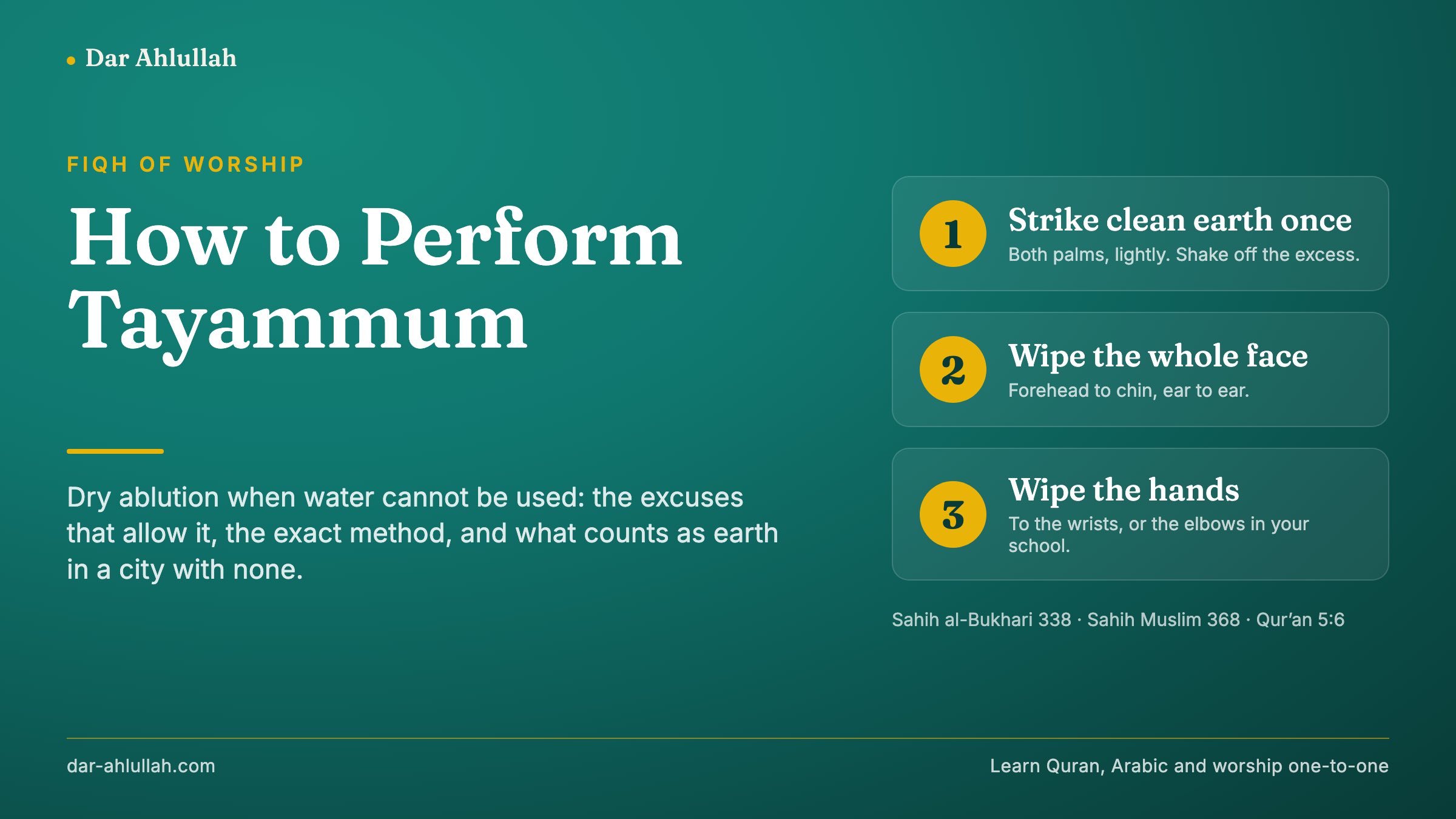
How to Perform Tayammum: Dry Ablution When You Cannot Use Water
Tayammum is the purification you make with earth when water cannot be used. The rule is short: strike clean earth, wipe your face, wipe your hands. The difficulty for a Muslim in Europe or America is everything around the rule: what counts as a real excuse, what counts as earth in a building with none, how long it lasts, and what you do on a plane or in a hospital bed when there is neither water nor dust.
28 min read