
how to make up missed prayers
How to Make Up Missed Prayers (Qada Salah)
Dar Ahlullah team 19 min read
Table of Contents
- Introduction: The Number in the Back of Your Mind
- The Short Answer
- What Qada Actually Is
- Which Missed Prayers Are Actually Owed
- The One Genuine Disagreement
- Does the Order Matter?
- The Missed Prayer and the Prayer in Front of You
- How to Pray a Qada Prayer, Step by Step
- When It Is Years, Not Days
- Counting What You Cannot Count
- Five Things Qada Is Not
- Why the Prayers Were Missed in the First Place
- How We Teach This
- Questions People Ask
- Conclusion: Start With Today’s
Introduction: The Number in the Back of Your Mind
Most people who look this up are not asking a technical question. They are carrying a number — a rough, unwelcome estimate of prayers missed over months or years — and what they actually want to know is whether that number can be cleared, and how.
It can. The mechanism has a name, qada, and it is one of the more forgiving pieces of Islamic law once you see how it is put together. But the question is badly served online, because the answers people find fall into two unhelpful groups: one-line reassurances that skip everything you need in order to act, and dense fiqh discussions that assume you already know what tartib means and which school you follow.
This guide sets out how to make up missed prayers in the order the questions actually arise: what is owed and what is not, which prayer comes first, how the prayer itself differs from an on-time one, how to build a plan when the backlog runs into years, and where qualified scholars genuinely disagree. It assumes no prior fiqh vocabulary and defines each term as it appears.
One boundary before we start. We teach Quran, Arabic and the practical fiqh of worship; we are not a fatwa body. Where the schools of law differ, we say so and point you to scholars rather than compressing a real difference into one confident sentence. If you are earlier in the journey than this — still assembling the prayer itself, or new to Islam altogether — the sequence to work through is mapped in our guide to your first 90 days in Islam, and the prayer itself is taught step by step in our guide to learning prayer in Islam.
The Short Answer
If you have three minutes rather than thirty, this is the whole system.
- A prayer missed because you slept through it or forgot it is owed, and no sin attaches to it. You pray it as soon as you remember, and that is the entire expiation.
- A qada prayer is the same prayer, not a reduced version of it. Same number of rak’ahs, same recitation, same everything — only the time is different.
- Make up missed prayers in the order they were owed, and pray a missed prayer before the current one, unless the current prayer’s time is about to run out.
- Missed prayers may be made up at any hour, including the parts of the day when voluntary prayer is discouraged.
- Prayers missed during menstruation or postnatal bleeding are not owed at all, and neither are prayers from before a person became Muslim.
- Prayers abandoned deliberately are the one real disagreement. The four schools say make them up; a serious minority position says repentance and voluntary prayer are what is prescribed instead. Both views are held by qualified scholars, and the section below sets out each.
- For a large backlog, pair the make-ups with your daily prayers rather than attempting a marathon, and keep going until you are reasonably certain the debt is cleared.
What Qada Actually Is
Qada means performing an act of worship after its appointed window has closed. Its opposite is ada — performing it on time. The distinction exists because prayer is not a quota to be filled at leisure; it is fixed to specific times, which the Qur’an states directly in Qur’an 4:103: prayer is prescribed for the believers at stated times.
That is exactly why a make-up mechanism has to exist. If the times are real, then missing one is a real event and needs a real remedy — not a shrug, and not a permanent deficit either.
The remedy is stated in one of the most quoted hadiths on the subject. In Sahih al-Bukhari 597, also recorded in Sahih Muslim, the Prophet ﷺ said that whoever forgets a prayer should pray it when he remembers, and that there is no expiation for it other than that. He then recited Qur’an 20:14 — “establish prayer for My remembrance.”
Read that carefully, because two things in it get missed. The first is no expiation other than that: there is no additional penalty, no compensating charity, no fixed number of extra prayers. Praying it is the whole remedy. The second is the timing: when he remembers, not at the same hour tomorrow. The obligation is immediate, not scheduled.
It happened to the Prophet ﷺ himself
This is not a marginal ruling reasoned out from silence. Two well-known incidents put it in the Prophet’s own practice.
On the day of the Trench, in Sahih al-Bukhari 596, ‘Umar came to the Prophet ﷺ saying he had barely been able to pray ‘Asr before sunset. The reply was that he had not prayed it either. They went to Buthan, performed wudu, prayed ‘Asr after the sun had set, and then prayed Maghrib.
On a journey, in Sahih Muslim 681, the entire party slept through Fajr and only woke as the sun was rising. They moved from that place, Bilal called the adhan, and the Prophet ﷺ prayed the two rak’ahs of the sunnah followed by Fajr itself. When the companions began to worry aloud about their negligence, he told them there is no negligence in sleep — negligence belongs to the one who delays a prayer while awake until the time of the next one comes in.
That last sentence is worth holding on to if guilt is what brought you here. The category the texts treat harshly is not the person making up prayers. It is the person who is awake, aware, and letting the time pass.
Which Missed Prayers Are Actually Owed
Before you count anything, sort it. Not everything that feels like a debt is one.
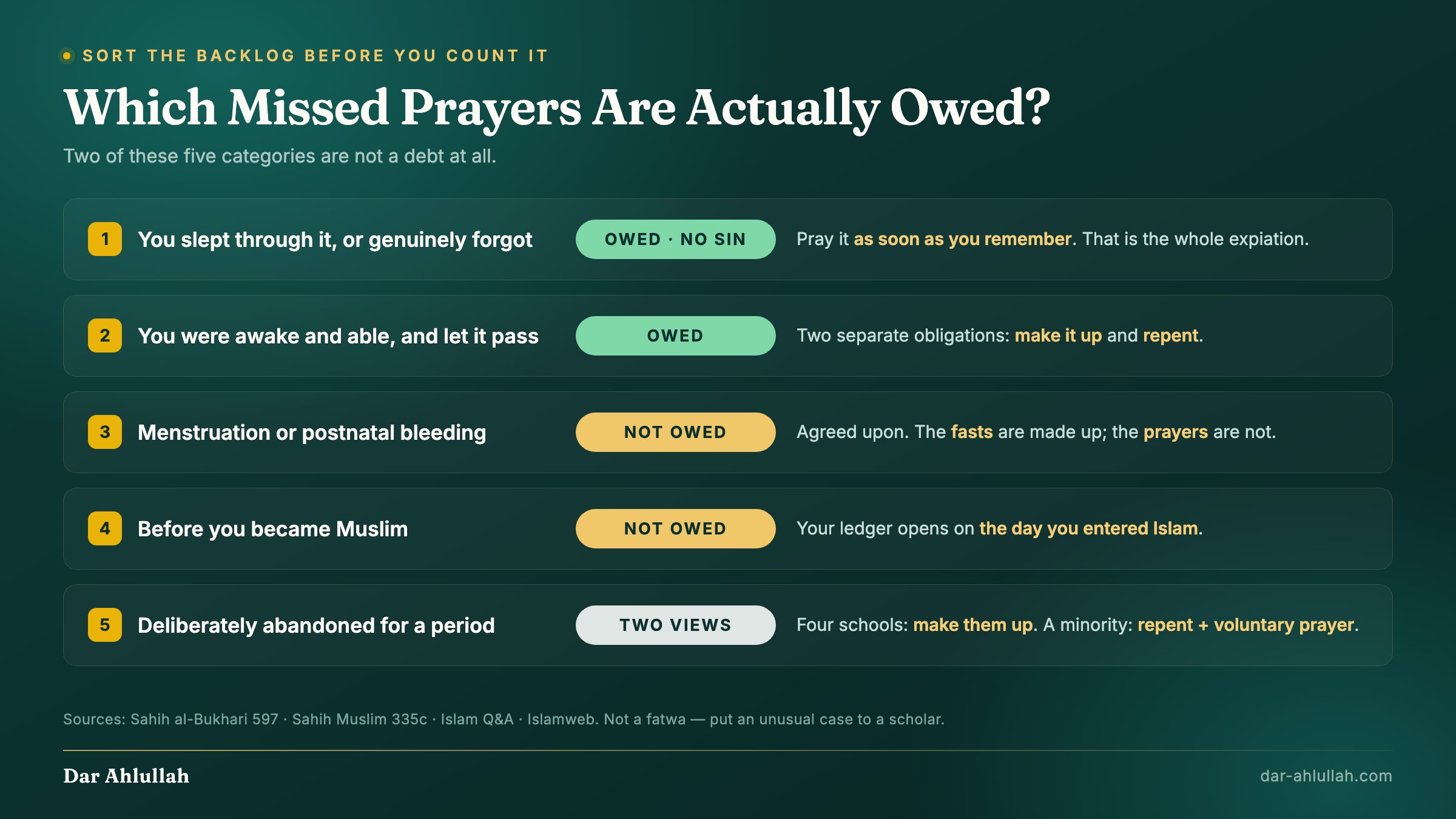
Owed, with no sin attached: sleep and genuine forgetfulness
This is the case the hadith addresses head-on. You are not sinful, and the prayer is still owed. Pray it when you remember.
Owed: prayers missed while awake and able
Overrunning at work, a long drive, a shift you did not plan around. These are owed, and unlike the previous category there is something to repent for as well as something to pray. The repentance and the make-up are separate obligations, not alternatives.
Not owed: menstruation and postnatal bleeding
Prayers missed during menstruation or postnatal bleeding are not made up, and this is agreed upon. ‘A’ishah was asked precisely this question and answered that they were ordered to make up the fasts and were not ordered to make up the prayers — Sahih Muslim 335c. Fasts missed in Ramadan for the same reason are made up; prayers are not. Women new to practice often carry this as a debt for years without ever checking, so it is worth stating plainly: there is nothing here to pay back.
Not owed: prayers from before Islam
A person who accepts Islam does not make up the prayers of the years before. This is the position of the large majority of scholars, and it is why no convert has ever been told to count back to puberty. If you are new to Islam, your ledger opens on the day you entered it.
The disputed category: prayers abandoned deliberately
This one has its own section, because the disagreement is real and both sides are held by serious scholars.
There is also a set of genuine edge cases — prolonged unconsciousness, anaesthesia, severe illness, medication that removes awareness — where the schools diverge on how much is owed and from when. If your situation is one of those, that is a question for an imam who can hear the details, not for an article.
The One Genuine Disagreement
If you deliberately stopped praying for a period — and this is by far the most common reason people search for this topic — you will find two answers, and you should know that before you commit to one.
View one: they are owed, and you make them up
This is the position of all four Sunni schools of law. Missing a prayer without excuse is a major sin; the sin is dealt with by repentance, and the prayer itself is still a debt to be discharged. Islamweb states this in its fatwa on the ruling and method of making up missed prayers, adding that a person should keep at it until reasonably certain the backlog is cleared.
View two: repent, and turn to voluntary prayer instead
A minority position, associated most strongly with Ibn Taymiyyah and before him Ibn Hazm, holds that a prayer deliberately abandoned cannot be recovered by praying it later at all. The reasoning is that the texts which prescribe making up a prayer speak specifically about sleep and forgetfulness. On this view what is required is sincere repentance, plus an abundance of voluntary prayer, which the Islam Q&A treatment of the ruling on making up missed prayers adopts as the more correct opinion.
What to do with two answers
Notice first that the two views agree on more than they differ on. Both require repentance. Both require prayer going forward. Both push the person toward more prayer, not less. And Islamweb, in its fatwa on making up for prayers missed deliberately, explicitly says there is no harm in following the view that they need not be made up.
Practically: if you follow a school, follow it. If you do not, ask an imam in your own community and then commit — because the failure mode here is not choosing wrongly, it is oscillating between the two for years and doing neither. If the backlog is so large that view one feels crushing and view two feels like an escape hatch, take that feeling to a person rather than to a search engine. Understanding how scholars reach different conclusions from the same texts is itself a subject, and it is the terrain our introduction to fiqh for beginners is meant to make navigable.
Does the Order Matter?
Yes, in the ordinary case. Missed prayers are made up in the sequence they were owed: if you missed Dhuhr and ‘Asr, you pray Dhuhr first. Islam Q&A sets out the majority position on making up missed prayers in order, and it is the default you should assume applies to you.
The obligation of sequence is not absolute, though, and the exceptions are the part that matters in practice.
- Forgetting or not knowing the rule waives it. If you prayed them out of order without realising, they count.
- A closing time window waives it. If praying the missed ones first would push the current prayer past its own deadline, the current prayer comes first.
- A large backlog waives it in several schools. Once the number of missed prayers passes a threshold — commonly stated as more than a day and a night’s worth — sequence is no longer required. Islamweb discusses this in its fatwa on observing order when making up many missed prayers.
That third point is the one that unblocks people. If you are trying to clear years, you are not required to reconstruct a chronological ledger. Order applies to a handful of prayers, not to an archive.
The Missed Prayer and the Prayer in Front of You
The most common live version of the ordering question: it is Maghrib time, you have just realised you never prayed ‘Asr. Which one first?
The missed one, then the current one. Islam Q&A addresses this directly in its answer on whether one should pray the missed prayer first, resting on the same instruction — pray it when you remember. The exception is time pressure: if only enough of the current prayer’s window remains for the current prayer itself, pray that first and make up the missed one immediately afterwards. And if you pray them out of order without knowing the rule, the prayers are valid.
Remembering in the middle of a prayer
Occasionally it lands mid-rak’ah: you are already praying ‘Isha when you remember Maghrib. Here the schools genuinely differ, and Islam Q&A lays out the range in its answer on remembering a missed prayer during the current prayer — the Hanafi and Maliki schools direct you to break off and pray the missed one first, while the Shafi’i and Hanbali positions have you complete what you are in, pray the missed prayer, and then repeat the one you were in. The safest course, and the one the answer recommends, is that last sequence.
What you should not do is what most people do, which is to stop, panic, and abandon both. Whichever school you follow, both prayers end up prayed.
How to Pray a Qada Prayer, Step by Step
The mechanics are far simpler than the rules about when. A make-up prayer is the same prayer, moved.
- Purify as normal. Wudu is required exactly as it would be for an on-time prayer, on the same conditions. If wudu is the shaky part, our complete guide to wudu covers it properly.
- Intend the specific prayer. The intention is in the heart and is not spoken aloud: this is the Dhuhr of yesterday, this is the Fajr of this morning. A vague intention to “pray something I owe” is not enough, because prayers are distinguished by which one they are.
- Pray the full number of rak’ahs. Two for Fajr, four for Dhuhr, four for ‘Asr, three for Maghrib, four for ‘Isha. Nothing is reduced because the prayer is late. The one exception is a prayer that was owed as a shortened traveller’s prayer, which several schools hold is made up in its shortened form — if that applies to you, ask.
- Recite as that prayer is normally recited. A Fajr made up at ten in the morning is still recited aloud, because that is how Fajr is prayed. Islam Q&A confirms this in its answer on whether recitation is aloud or quiet when making up Fajr.
- Do not wait for a “good” time. A missed obligatory prayer may be made up in the periods when voluntary prayer is discouraged — after Fajr, after ‘Asr, at the sun’s zenith. Islam Q&A covers this in its answer on making up a missed prayer after ‘Asr. The rule that clears the calendar is that make-ups are not voluntary prayers; they are obligations arriving late.
If you make a mistake inside a qada prayer, the repair is exactly the same as in any other prayer — nothing about the make-up changes how the prostration of forgetfulness works.
When It Is Years, Not Days
A day of missed prayers is arithmetic. Six years is a project, and it fails for predictable reasons: people attempt an unsustainable first week, exhaust themselves, stop, and conclude the whole thing is impossible.
The structure that works is repayment alongside the daily obligation rather than instead of it.
Attach make-ups to prayers you already pray
After each of the five daily prayers, pray one make-up of the same kind. Five daily prayers plus five make-ups clears one full day of backlog per day, at a cost of roughly twenty extra minutes spread across the day, and it needs no new habit — you are already standing there.
Aim higher if you can carry it
Islamweb’s fatwa on the ruling and method of making up missed prayers mentions the standard of making up two days’ worth in each day, which halves the timeline, and cites the Maliki articulation of it. The same fatwa is explicit that the standard is relaxed where the effort would damage your health or your ability to earn a living. This is not an ascetic endurance test; it is a debt with a realistic instalment plan.
Do the arithmetic once, then stop thinking about it
At one day cleared per day, a year of missed prayers takes a year, and two years take two. That sounds discouraging until you compare it with the alternative, which is that the number stays exactly where it is. Someone who starts today and pairs each prayer with one make-up will, in a year, have cleared a year’s backlog while also praying a year on time.
Keep a written count
Not for the record-keeping itself but because an uncounted debt is psychologically infinite. A note on your phone with a number you decrement daily converts an anxiety into a task. The same fatwa frames the endpoint as continuing until you are reasonably certain you have made up what you neglected — and “reasonably certain” is a standard you can actually reach, unlike perfect accuracy.
Counting What You Cannot Count
Almost nobody knows their real number. You are not expected to.
The method scholars give is estimation in good faith, leaning slightly toward the higher figure so that the debt is likelier to be over-paid than under-paid. In practice that means fixing a start date — the age you became responsible, or the point at which prayer lapsed — and an approximate rate, then multiplying.
Two adjustments make the estimate honest rather than punitive:
- Subtract what was never owed. For women, that is roughly a week of prayers each month across the whole period. Over several years this is a substantial correction, and it is a correction people routinely forget to make.
- Subtract the periods you did pray. Very few backlogs are uninterrupted. Ramadans, phases of practice, the year you were regular — those days are not part of the debt.
Then commit to the number and stop revisiting it. Endlessly re-auditing an estimate is not caution; it is the same paralysis that produced the backlog, wearing a more respectable coat.
Five Things Qada Is Not
- It is not a lesser prayer. A prayer made up is a valid, complete, accepted prayer. There is no permanent asterisk on it.
- It is not paid in money. There is no charity that substitutes for a missed prayer during your lifetime, and the hadith is explicit that praying it is the only expiation.
- It does not cover the sunnah prayers. The obligation concerns the five daily obligatory prayers. The voluntary prayers attached to them are not part of the debt, and while making them up is discussed by scholars, missing them is not something to add to your count.
- It is not a substitute for repentance. If prayers were abandoned deliberately, the make-up is one obligation and the repentance is another. Praying them does not, by itself, discharge the sin.
- It is not a reason to stop praying on time. This sounds obvious and is the most common failure in practice: people become so preoccupied with the backlog that today’s prayers start slipping. Today’s prayers are the priority. The backlog is what you do in addition.
Why the Prayers Were Missed in the First Place
Anyone clearing a backlog while still generating new ones is bailing out a boat without patching it. In our experience teaching adults and teenagers, missed prayers cluster around three causes, and only one of them is about willingness.
The first is a schedule that was never designed around the prayer times. The prayers most commonly missed are Fajr and ‘Asr — one because of when you sleep, the other because it lands inside the working day. Both are solved by an arrangement made in advance, not by resolve applied at the moment.
The second is a prayer that was learned in fragments and never quite became fluent. When the words are stored as approximate sounds rather than as text you can read, praying is effortful, and effortful things get postponed. This is a much more common cause than people admit, partly because it is embarrassing to say out loud after years of practice. The remedy is unglamorous: learn to read the Arabic script, even slowly, so that the prayer becomes an act of reading rather than of recall. Our guide to reading the Quran as a beginner is the entry point.
The third is that the prayer had become a chore with no interior content — correct in form, empty in experience. That is not fixed by better logistics. It is usually fixed by understanding what you are saying, which is why so many adults report that studying the meaning of the Qur’an changed their relationship with salah more than any scheduling change did.
How We Teach This
At Dar Ahlullah, the practical fiqh of worship sits alongside Quran and Arabic rather than being treated as an advanced elective, because a learner who is unsure whether their prayers count will eventually pray less rather than more. Lessons are one-to-one and live over Zoom with a certified mentor, so the material can be adapted to a real situation — a specific backlog, a specific schedule, a specific school of law — instead of delivered as general advice.
You can start with a free 30-minute assessment, with no credit card and no obligation, where a mentor works out what is actually shaky and what to teach first. Beyond that, our rate is about $9 per teaching hour, with monthly plans at $36, $70 and $102 and a 20% discount for siblings. You can pause, upgrade or switch plans at any time, and if the pairing is not right we will rematch you with another certified mentor at no extra cost. The full breakdown is on our pricing page.
Where a question is genuinely a matter of fatwa rather than instruction — an unusual case, or whether a specific past period is owed — our mentors will say so and point you to a scholar rather than improvise a ruling. That boundary is deliberate, and it matters more on this topic than on most.
Questions People Ask
Can I make up years of missed prayers?
According to the four schools of law, yes, and you should. Pair one make-up with each daily prayer so that you clear a day of backlog per day, and keep going until you are reasonably certain the debt is discharged. A minority scholarly view holds that prayers abandoned deliberately are not made up at all but answered with repentance and voluntary prayer; both positions are set out above.
How many missed prayers should I pray each day?
There is no fixed number in the texts. One make-up after each of the five daily prayers is the sustainable default; two days’ worth in a day is mentioned by scholars as a higher standard, explicitly relaxed where it would harm your health or your livelihood.
Do I have to make them up in order?
For a small number, yes — in the sequence they were owed. For a large backlog, several schools waive the requirement once the number exceeds a day and a night’s worth. You are not expected to reconstruct years chronologically.
Can I make up a prayer at any time of day?
Yes, including the periods when voluntary prayer is discouraged. A missed obligatory prayer is an obligation arriving late, not a voluntary prayer, so the restrictions on voluntary prayer do not apply to it.
Do I make up prayers missed during my period?
No. Fasts missed for that reason are made up; prayers are not. This is agreed upon and is established by ‘A’ishah’s own answer to the same question.
I became Muslim last year. Do I owe prayers from before that?
No. The large majority of scholars hold that entering Islam does not carry a debt of prayers from before it. Your obligation starts from the day you became Muslim.
I slept through Fajr. Is that a sin?
Not in itself. The prayer is owed and you pray it on waking, but the hadith is explicit that there is no negligence in sleep. What is blameworthy is deliberately arranging your night so that missing Fajr becomes certain — that is a decision made while awake.
Can I pay charity instead of praying them?
No. There is no monetary substitute for a missed prayer during a person’s lifetime. The hadith states that there is no expiation for it other than praying it.
Should I make up the sunnah prayers too?
The obligation concerns the five obligatory prayers. Missed voluntary prayers are not part of the debt you are clearing, and adding them will usually just make the plan unsustainable.
What if I remember a missed prayer while I am praying the current one?
The schools differ. The most cautious course, and the one Islam Q&A recommends, is to complete the prayer you are in, then pray the missed one, then repeat the current one. Do not simply abandon both.
Conclusion: Start With Today’s
The thing that keeps a backlog frozen is almost never the fiqh. It is the size of the number and the sense that the whole thing has to be solved before anything can begin.
It does not. The sequence is: pray today’s prayers on time, estimate the backlog once, subtract what was never owed, then attach one make-up to each daily prayer and leave it running. In a year that is three hundred and sixty-five days of backlog cleared, plus a year prayed on time, from a decision that takes an afternoon to make.
And keep the framing from the hadith in view. The Prophet ﷺ missed ‘Asr at the Trench and prayed it after sunset. The whole party slept through Fajr on a journey and prayed it after sunrise. The religion accounted for this from the beginning, and the remedy it gave is not a penalty. It is simply the prayer, prayed.
Related articles
morning and evening adhkar
Morning and Evening Adhkar: What to Say and When
Morning and evening adhkar from the sound reports: the windows from dawn to sunrise and from 'Asr to sunset, the core set with the source and count of each line, and the grade printed on the popular additions the hadith scholars dispute, from Ayat al-Kursi to hasbiyallah seven times.
29 min read
how to respond to the adhan
How to Respond to the Adhan: What to Say and the Dua After
How to respond to the adhan: repeat each phrase after the muezzin, say la hawla wa la quwwata illa billah at the two hayya lines, then send salawat and say the du'a after the adhan. This guide sets out every step from the sound reports, prints the grade on the additions people argue about, and lays out the two scholarly answers on the adhan from a phone app.
29 min read
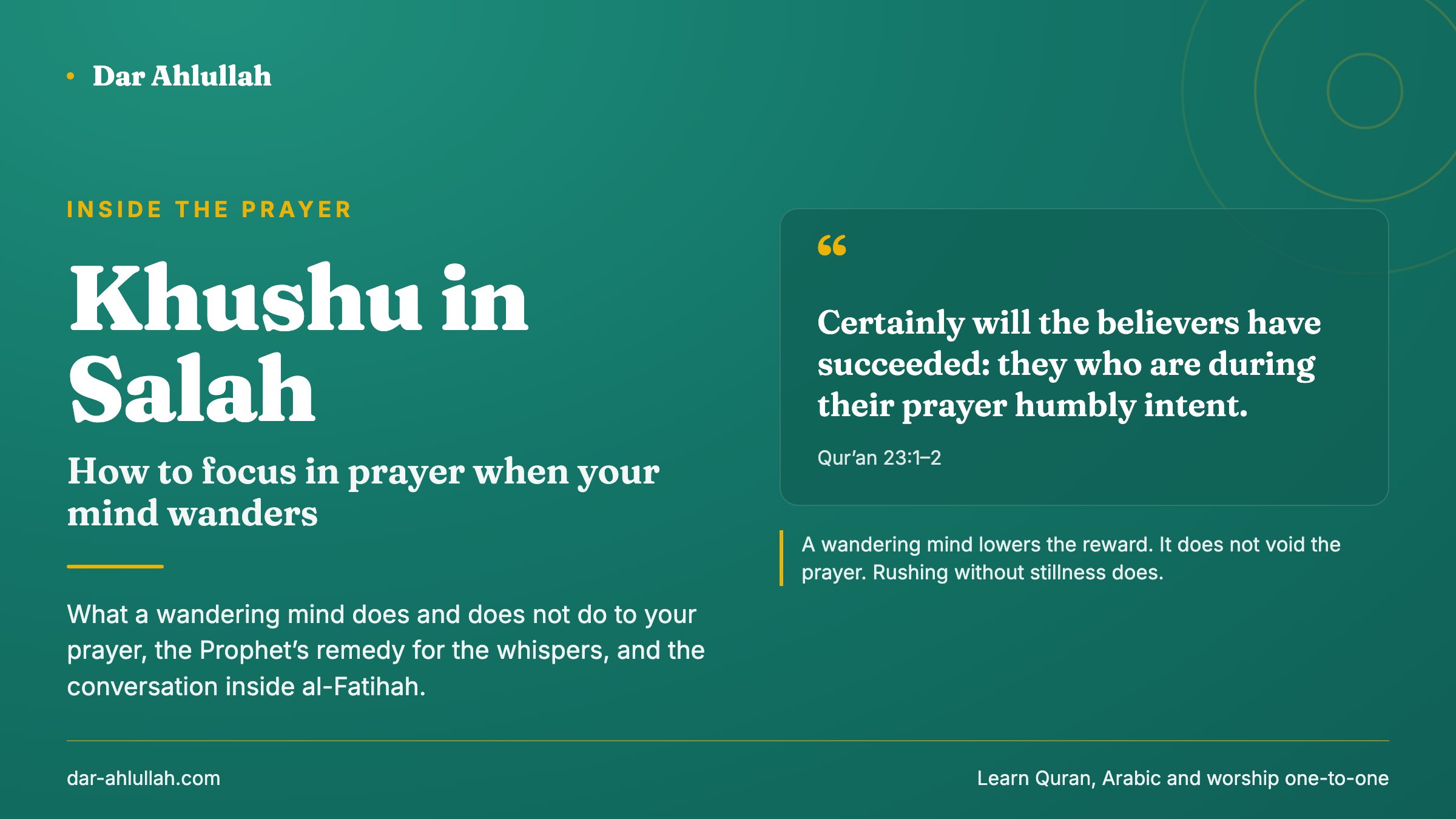
khushu in salah
Khushu in Salah: How to Focus in Prayer When Your Mind Wanders
Khushu is stillness of the body and presence of the heart in prayer. What a wandering mind does and does not do to your salah, what the Sunnah gives you before the takbir, inside the prayer and when the whispers come, and how a non-Arabic speaker learns to mean the words.
26 min read