
what invalidates salah
What Invalidates Salah: The Things That Really Break Your Prayer
Dar Ahlullah team 19 min read
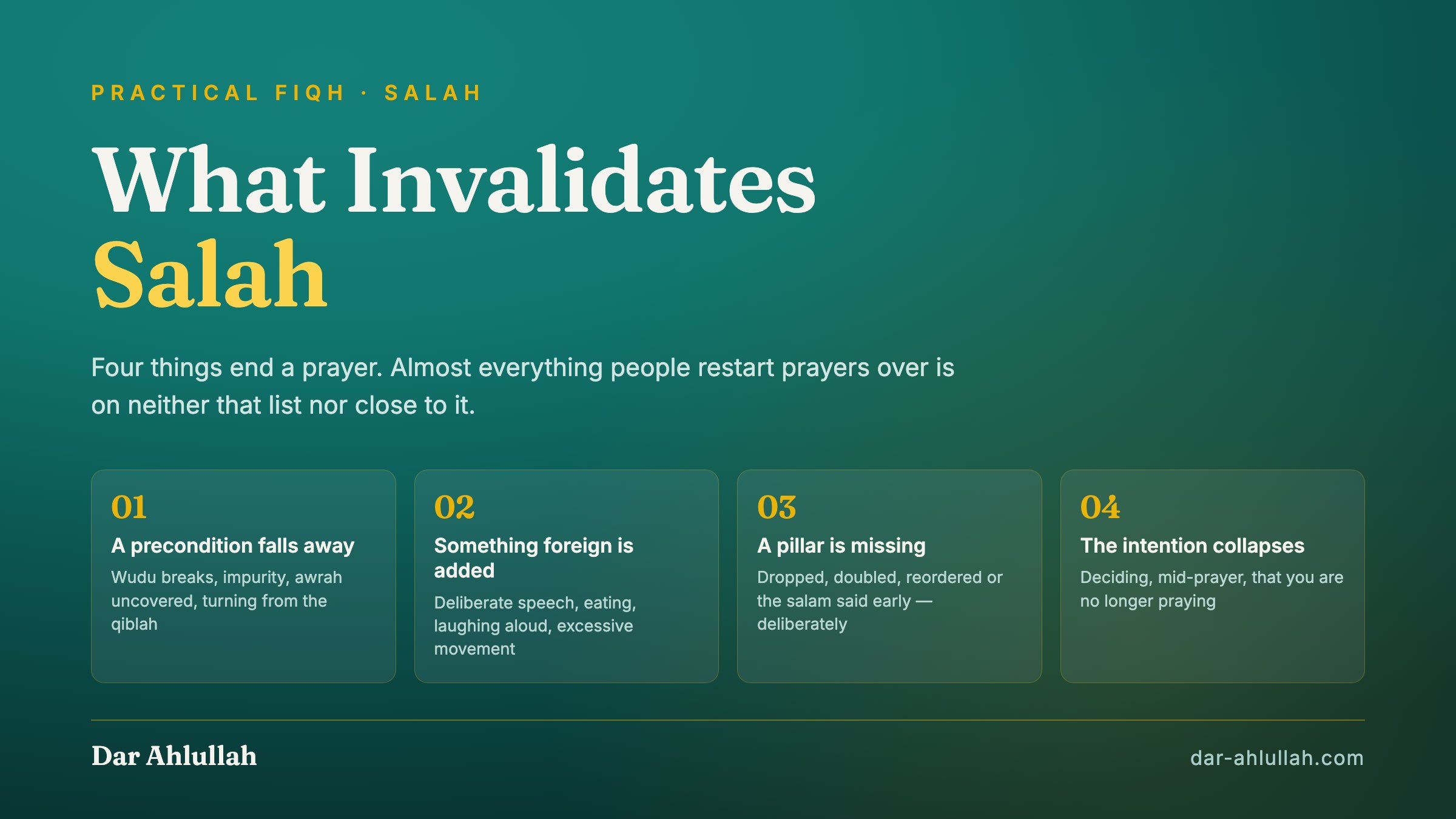
Table of Contents
- Introduction: Did That One Count?
- The Short Answer
- The Three Categories Everyone Mixes Up
- Group One: A Precondition Falls Away
- Group Two: Something Foreign Is Added
- Group Three: Something Is Missing or Out of Order
- Group Four: The Intention Collapses
- The Whole Picture, At a Glance
- Where “Too Much Movement” Actually Starts
- The Word That Changes Every Ruling: Deliberately
- Twelve Things That Do Not Break Your Prayer
- When You Are Allowed to Break It on Purpose
- It Broke. Now What?
- How We Teach This
- Questions People Ask
- Conclusion: A Short List, Not a Minefield
Introduction: Did That One Count?
You are in the third rak’ah when your phone rings in your pocket. Or your toddler climbs onto your back. Or you catch yourself thinking about work for what felt like the whole of Fatihah. Or you say “shh” out loud without meaning to. And the question that arrives is never theological — it is administrative. Do I have to start again?
Most people learn what invalidates salah in the worst possible way: from whichever answer they happened to hear first, usually from someone equally unsure. The result is a folk list that is far longer and far harsher than the actual one. People restart prayers over a sneeze. They repeat an entire Isha because a cat walked past. They quietly avoid praying in situations where an interruption is likely, because they assume the interruption will void it.
The real list is short, and more importantly it is structured. Once you can see why each item is on it, you stop needing to memorise the list at all — you can reason about the situation in front of you. That structure is what this article is for.
One boundary before we start. We teach Quran, Arabic and the practical fiqh of worship; we are not a fatwa body. Where the schools of Islamic law differ we say so plainly and point you to the scholars rather than flattening a real difference into one confident sentence. This article also assumes you can already perform the prayer — if you are still assembling it, our complete guide to salat covers the sequence and our guide to what to say in salah covers the words. And if worship as a whole is still new to you, the order to learn it in is mapped out in our guide to your first 90 days in Islam.
The Short Answer
If you have two minutes rather than twenty, this is the system.
- A precondition fails. Your wudu breaks, impurity is on you or your prayer place, your awrah is uncovered, or you turn away from the qiblah. The prayer had entry requirements; one of them stopped being true.
- Something foreign is added. Deliberate speech, eating or drinking, laughing out loud, or so much unrelated movement that a bystander would say you were no longer praying.
- Something essential is missing or out of order. A pillar dropped, a pillar added, the sequence scrambled, or the salam said early — each of these deliberately.
- The intention collapses. If you decide mid-prayer that you are stopping, it has already ended, even if your body carries on.
- “Deliberately” is doing enormous work in that list. Most of these items, done in genuine forgetfulness or genuine ignorance, are repaired by the prostration of forgetfulness rather than by starting over.
- Almost everything people worry about is not on the list. Wandering thoughts, a sneeze, a yawn, a small scratch, a passing cat, a ringing phone, a child on your back — none of these void a prayer.
The rest of this article is the reasoning, the evidence, and the edge cases.
The Three Categories Everyone Mixes Up
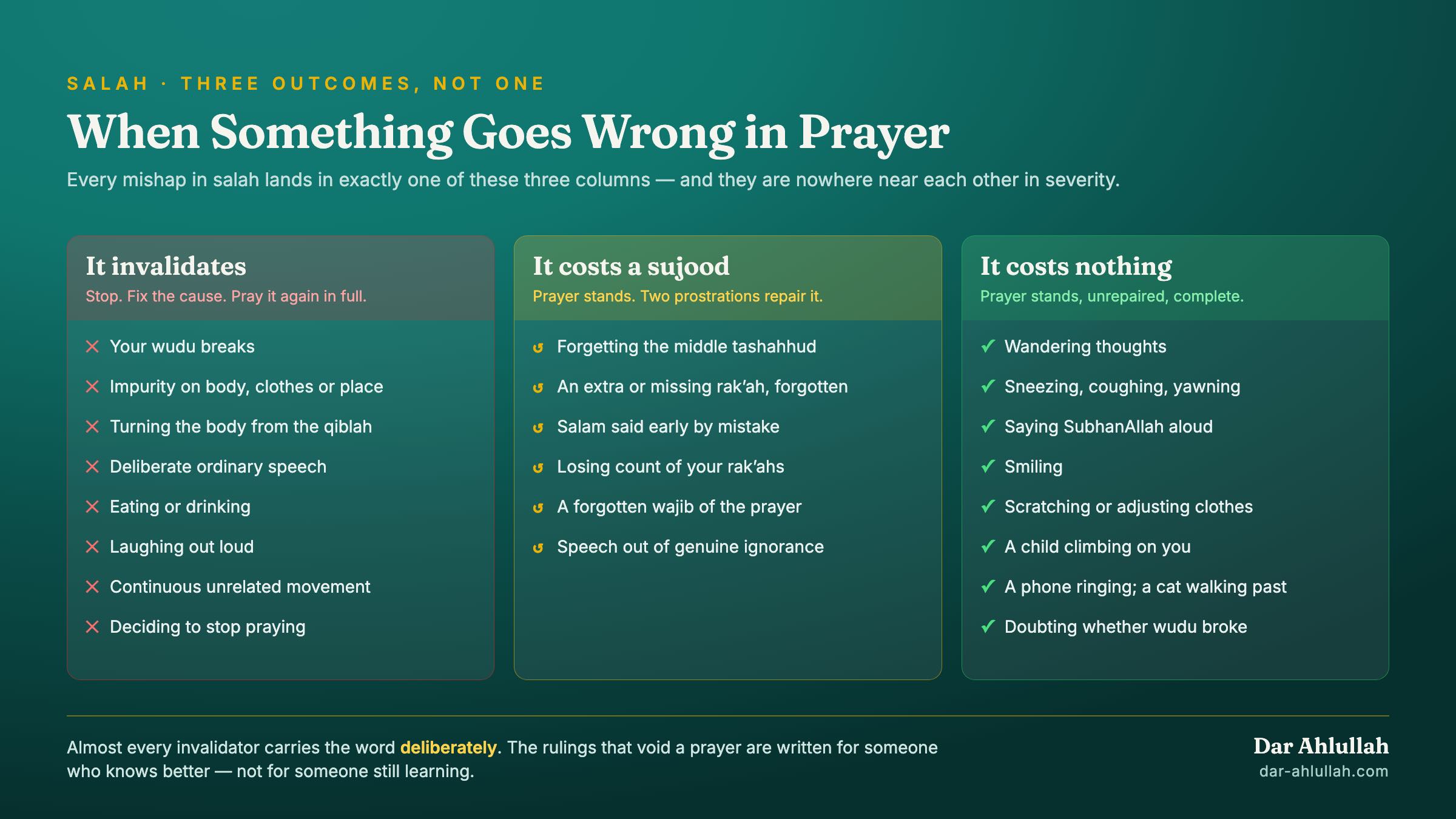
Nearly all the confusion in this topic comes from collapsing three different outcomes into one. When something goes wrong in prayer, exactly one of these three things is true, and they are not close to each other in severity.
- It invalidates the prayer. The prayer is over. You stop, sort out whatever the problem was, and pray it again from the beginning. This is the shortest of the three lists.
- It costs you a prostration of forgetfulness (sujood as-sahw). The prayer stands. You repair it with two extra prostrations and you do not start over. Most genuine slips land here.
- It costs you nothing at all. The prayer stands, unrepaired, complete. This is by far the longest list, and it contains most of what people actually panic about.
Islam Question & Answer’s summary of the difference between the ranks of the prayer is the piece of vocabulary that makes this navigable: a pillar (rukn) cannot be waived, while an obligatory part (wajib) can be compensated for by the prostration of forgetfulness. Drop a pillar and there is nothing to compensate with — the prayer is missing a structural element. Drop a wajib and the repair mechanism exists precisely for that case.
This article is about the first category only. The second one has its own guide: what to do if you make a mistake in prayer walks through the prostration of forgetfulness in detail. If you are reading this because of a slip rather than a rupture, that is probably the article you actually want.
Group One: A Precondition Falls Away
Prayer has conditions you have to satisfy before the takbir, and they have to keep being satisfied all the way to the salam. When one of them stops being true mid-prayer, the prayer stops with it. This group is the least controversial part of the list.
Your wudu breaks
The most common one by a wide margin. Anything that nullifies your ablution — wind, a trip to the bathroom, falling deeply asleep — ends the prayer at the moment it happens. There is no partial credit and no finishing the rak’ah you are in. Islam Question & Answer’s list of what invalidates the prayer opens with exactly this: anything which invalidates wudu.
Note the direction of the rule, because people get it backwards. Breaking wudu ends the prayer. Suspecting that you broke wudu does not. If you are certain you had wudu and merely doubt whether you lost it, you continue — certainty is not removed by doubt. That single principle prevents more unnecessary restarts than any other rule in this topic, and our guide to what breaks wudu sets out the full nullifier list and the doubt rule behind it.
Impurity on your body, clothes or place of prayer
Physical najasah — the substances the law classes as impure — on you, on what you are wearing, or on the ground you are praying on is a condition failure rather than a mistake. If you discover it mid-prayer and can remove it immediately without much action (slipping off a soiled sock, for instance), the prayer can continue. If removing it would require leaving, undressing, or a great deal of movement, the prayer is over.
The much more common version of this in practice is the one people never think about: praying with a nappy-changing accident on your sleeve, or on a carpet a pet has used. Discover it after you have finished and you are not obliged to repeat the prayer if you genuinely did not know at the time.
Your awrah becomes uncovered
Deliberately uncovering the awrah — the part of the body that must be covered in prayer — invalidates it. Accidental exposure that you cover again straight away, such as a shirt riding up in sujood, does not. The distinction is the same one that runs through this entire article: intention.
You turn away from the qiblah
Turning the whole body away from the direction of prayer, without an excuse, ends it. Turning your head to look at something does not — it is disliked, not invalidating. Islam Q&A specifies the threshold as turning away from the qiblah to a large extent, which in practice means your chest, not your gaze.
Group Two: Something Foreign Is Added
The second group is about importing something into the prayer that does not belong in it. This is where the best-known evidence in the topic sits.
Deliberate speech
Ordinary human speech is not compatible with prayer, and the report that establishes it is one of the most humane passages in the hadith literature. Mu’awiyah ibn al-Hakam as-Sulami, newly Muslim, said “yarhamuk Allah” to a man who sneezed during the prayer. The congregation glared at him. Afterwards, rather than rebuking him, the Prophet ﷺ explained: “This prayer of ours is not the place for any of the speech of people; it is only tasbih, takbir and recitation of the Qur’an” (Sahih Muslim 537a).
Two things are established there at once. Speech breaks the prayer — and Mu’awiyah, who spoke out of not knowing, was not told to repeat his. Islam Q&A draws exactly that inference in discussing why he was not ordered to pray again: he did not know the ruling, and ignorance of it excused him. The rule is strict; its application to a person learning is not.
What counts as speech is narrower than people assume. Saying SubhanAllah to alert the imam to a mistake is not foreign speech — it is prescribed. The Prophet ﷺ said “Tasbih is for men and clapping is for women” (Sahih al-Bukhari 1203), which is the sunnah method for signalling during prayer without speaking. Answering the door, telling a child to be quiet, or replying to a question is speech; a word of remembrance is not.
Eating or drinking
Deliberately eating or drinking during the prayer invalidates it. Islam Q&A lists intentional eating and drinking plainly among the invalidators. The practical trap here is chewing gum or a sweet still in the mouth when you start — swallowing it deliberately is eating. Swallowing your own saliva, or the residue of food between your teeth that you did not intend to consume, is not.
Laughing out loud
Audible laughter invalidates the prayer, and this is one of the few points on the whole list where the schools do not differ — Islam Q&A reports scholarly agreement that laughing out loud invalidates the prayer while smiling does not. The reasoning given is that laughter aloud is incompatible with the dignity and humility the prayer requires, which also explains where the line falls: a smile involves no sound and breaks nothing. A suppressed shake of the shoulders that makes no noise is closer to a smile than to laughter.
Excessive, continuous, unrelated movement
The one everybody worries about and nobody can define. It gets its own section below, because the threshold is not where most people assume.
Group Three: Something Is Missing or Out of Order
The third group is structural. The prayer is a specific sequence of specific components, and deliberately breaking that structure breaks the prayer. Islam Q&A’s list covers four versions of this: omitting a pillar, deliberately adding an extra pillar, deliberately performing pillars out of order, and deliberately saying the salam before the prayer is complete.
In real life these almost never happen deliberately, which is why they almost never invalidate anything. Standing up for a fifth rak’ah by mistake, forgetting the middle tashahhud, saying salam a rak’ah early — all of these are the classic sujood as-sahw cases, and each of them has a named prophetic precedent for being repaired rather than restarted. That is the whole subject of our article on repairing a mistake in prayer.
There is one structural failure that is not about forgetting, though, and it is worth naming because it is common: rushing. Stillness in each posture (tuma’ninah) is itself a pillar in the view of the majority, not a refinement. The hadith of the man who prayed badly is the evidence: he prayed, was told “Go back and pray, for you have not prayed” three times over, and was then taught the prayer with the instruction to bow “till you feel at ease” (Sahih al-Bukhari 757). A prayer performed as a rapid sequence of positions with no settling in any of them is the one structural failure people commit on purpose, every day, without ever counting it as one.
Group Four: The Intention Collapses
The last item is the strangest and the most instructive. Islam Q&A lists deciding in the heart to stop praying as an invalidator in its own right. Not doing anything. Deciding.
The prayer is held together by the intention (niyyah) that opened it. Withdraw that intention — genuinely resolve, mid-rak’ah, that you are not praying this prayer any more — and it ends there, even if your body completes every remaining posture perfectly.
This is not a trap for the distracted. Being distracted is not deciding. Realising halfway through Isha that you have no idea which rak’ah you are in is not deciding. Wondering whether you should stop is not deciding. The item describes a deliberate act of the heart, and if you are worried about whether you did it, you did not.
The Whole Picture, At a Glance
Where “Too Much Movement” Actually Starts
“Excessive movement invalidates the prayer” is technically correct and practically useless, because the word doing the work is undefined. Islam Q&A is unusually candid about why: there is no religious text defining the guideline for what counts as too much, so the matter is referred to what people customarily regard as too much — specifically, movement that would make an onlooker judge that this person is not praying.
That reframing is the useful part. The test is not a step count. It is whether the prayer is still recognisable as a prayer from the outside. Which produces three practical rules:
- Movement in the interests of the prayer does not invalidate it, even a lot of it. Stepping forward to fill a gap in the row, moving away from a passing person, adjusting to face the qiblah correctly — all of this serves the prayer.
- Small unrelated movements are disliked, not invalidating. Scratching, adjusting your scarf, shifting your weight, picking up a child who has climbed onto you. Same source: a little movement, or even a lot that is not continuous, does not invalidate the prayer.
- The invalidating case is a great deal of movement, continuous, for no reason. All three conditions at once. Not three separate small fidgets across four rak’ahs.
The Prophet ﷺ prayed while carrying his granddaughter Umamah — putting her down when he prostrated and picking her up when he stood (Sahih al-Bukhari 516). That is a lot of movement by any count, and it did not invalidate anything. Parents who assume their prayer is void every time a child interferes with it are working from a stricter rule than the sunnah supplies.
The Word That Changes Every Ruling: Deliberately
Read the invalidator list again and count how often the word appears. Deliberately uncovering the awrah. Deliberately adding a pillar. Deliberately changing the order. Deliberately saying the salam early. Deliberately omitting an obligatory part. Deliberately speaking. Intentional eating and drinking.
That is not stylistic. Islamic law treats the same physical act under three different headings depending on the state of the person doing it:
- Deliberately, knowing the ruling — the prayer is invalidated.
- Forgetfully — in most of these cases the prostration of forgetfulness repairs it, and the prayer stands.
- Out of genuine ignorance — the case of Mu’awiyah ibn al-Hakam, who spoke in prayer and was taught rather than told to repeat.
For someone who is still learning, this is the single most important sentence in the article: the rulings that void a prayer are written for the person who knows better and does it anyway. A beginner mispronouncing a word, forgetting a posture, or speaking without knowing they must not is not in that category. The learner’s prayers count. They have counted the whole time.
This has a practical implication that runs the other way, too. Repeating prayers “just in case” is not caution — it is a habit that feeds itself, and it is how waswasah (compulsive religious doubt) establishes a foothold. If you find yourself praying Maghrib twice most evenings, the problem to solve is not the prayer.
Twelve Things That Do Not Break Your Prayer
This is the list that actually answers most people’s question, and it is longer than the invalidator list by some distance.
- Wandering thoughts. However far they wander, however long. Distraction costs you focus, not validity.
- Sneezing, coughing, yawning or clearing your throat. None of these are speech.
- Saying SubhanAllah or Alhamdulillah aloud. Remembrance, not conversation. The same applies to reciting aloud by accident in a silent prayer.
- Smiling. Even at something genuinely funny, so long as no sound comes out.
- Crying from fear of Allah. Crying deliberately over a worldly matter is a different case discussed by the scholars; weeping in the prayer itself is not an invalidator.
- Scratching, shifting, or adjusting clothing. Disliked if it becomes constant. Not invalidating.
- A child climbing on you. Established by the sunnah, not merely tolerated by it.
- A phone ringing. Silencing it with a single movement is a small action for a reason. Answering it is speech.
- An animal or a person walking past. A sutrah — a barrier in front of you — is the sunnah remedy, and the whole discussion of who or what passing affects the prayer is a dispute among scholars about specific cases, not a general rule that traffic voids prayers.
- Losing count of your rak’ahs. Build on what you are certain of and prostrate for forgetfulness. The prayer stands.
- Mispronouncing a word while you are still learning. Only an error that distorts the meaning, from someone who knows better, affects validity.
- Doubting whether your wudu broke. Certainty is not removed by doubt. Continue.
When You Are Allowed to Break It on Purpose
A separate question that shares the same search box: not “did my prayer break” but “may I break it?” The default for an obligatory prayer you have started is that you finish it. But that default yields to necessity.
Islam Q&A’s treatment of stopping one’s prayer in cases of necessity gives the governing example: someone in mortal danger — falling into a well, drowning, a fire — whom you are able to save. Saving them takes precedence, and the prayer is repeated afterwards. The same reasoning covers interrupting the prayer during an earthquake or fire when staying put would most likely cause you harm.
Two clarifications that come up constantly:
- A voluntary prayer is different. Interrupting a nafl prayer is permitted even without an excuse, on the position Islam Q&A adopts — so with an excuse it is more clearly permitted.
- A parent calling you is not automatically an emergency. The scholars distinguish the parent who does not know you are praying and needs something urgent from the parent who can simply be answered in a minute. Islam Q&A’s discussion of whether to interrupt a prayer to answer a parent is worth reading before you generalise in either direction.
Note that in every one of these cases, the prayer is owed again once the necessity has passed. Breaking a prayer permissibly is not the same as being excused from it.
It Broke. Now What?
The recovery is undramatic, which is the point.
- Stop. There is no benefit in completing the remaining postures of a prayer that has ended.
- Fix the cause. Renew the wudu, change the clothing, remove the impurity, put down the food.
- Start again from the takbir. The whole prayer, not from where you left off.
- If you are in congregation and your wudu breaks, leave quietly. This is a normal occurrence and it needs no announcement. Rejoin the congregation if there is time; pray alone if there is not.
- If the prayer time has now passed, it becomes a make-up prayer. Not a lost one — our guide to making up missed prayers covers the order and the method.
What you should not do is decide that the day is a write-off. A prayer that had to be restarted is a prayer that was being taken seriously.
How We Teach This
At Dar Ahlullah this material sits in the practical worship track rather than being treated as advanced fiqh, because a learner who cannot tell an invalidated prayer from a repaired one will eventually start repeating prayers defensively — and that habit is much harder to undo than it is to prevent. Lessons are one-to-one and live with a certified mentor, which matters here specifically: the useful version of this topic is not the list, it is the answer to your situation, and the situations people need answered are the ones they will not raise in a group. If you want to see how the subject is structured, our course overview sets out the Islamic Studies track alongside the Quran and Arabic ones, and every new learner starts with a free 30-minute assessment — no card required — so the starting point is set by a conversation rather than a guess.
Questions People Ask
Does laughing break your prayer?
Laughing out loud does, by scholarly agreement. Smiling does not. The criterion is audible sound, not amusement — a silent smile at something funny leaves the prayer intact.
Does talking break your prayer?
Deliberate ordinary speech does. Saying SubhanAllah to alert the imam does not, because it is remembrance rather than conversation. Speaking out of genuine ignorance of the ruling is the case of Mu’awiyah ibn al-Hakam, who was taught rather than told to repeat his prayer.
Does my prayer break if my mind wanders?
No. Distraction is universal and it costs you the reward of presence, not the validity of the prayer. If it is happening constantly, treat it as a training issue rather than a legal one.
Does a child touching me or climbing on me break my prayer?
No. The Prophet ﷺ prayed while carrying his granddaughter Umamah (Sahih al-Bukhari 516), setting her down for sujood and lifting her when he stood. Handling a child during prayer is movement in a category the sunnah explicitly accommodates.
Does passing wind during prayer break it?
Yes — it breaks the wudu, which is a precondition, so the prayer ends with it. Leave, renew your wudu, and pray it again from the beginning.
If I doubt whether I broke my wudu mid-prayer, do I stop?
No. Certainty is not removed by doubt. If you know you had wudu and are merely unsure whether you lost it, the prayer continues and is valid.
Does moving or fidgeting break your prayer?
Only movement that is substantial, continuous and unrelated to the prayer — all three at once. There is no fixed number of movements in the texts; the criterion is whether an onlooker would say the person is no longer praying.
Does a phone ringing break your prayer?
No. Silencing it with a single motion is a minor movement. Answering it is speech, and that does invalidate the prayer.
Can I break my prayer on purpose?
For an obligatory prayer, only for a legitimate necessity — most clearly to save someone from serious danger, or to escape a fire or an earthquake. A voluntary prayer may be interrupted more readily. In every case the obligatory prayer is then prayed again.
If my prayer was invalidated, do I repeat only the rak’ah I was in?
No. An invalidated prayer is repeated in full from the opening takbir. Partial repetition applies to the repair mechanism — sujood as-sahw — not to a prayer that has ended.
Does praying too fast invalidate the prayer?
It can. Stillness in each posture is a pillar in the majority view, and the hadith of the man who prayed badly has him ordered back three times before being taught to bow until he felt at ease. A prayer with no settling in any position is the structural failure people commit most often.
I found impurity on my clothes after finishing. Do I repeat the prayer?
If you genuinely did not know it was there while you were praying, the prayer is not repeated. Remove it before the next one.
Conclusion: A Short List, Not a Minefield
Four things end a prayer: a precondition falling away, something foreign being added, a structural component being deliberately dropped or scrambled, and the intention being withdrawn. Everything else that goes wrong is either repaired by two prostrations or costs nothing at all.
The reason the folk version of this topic is so much harsher than the real one is that fear travels faster than fiqh. Someone hears that talking breaks the prayer and generalises it to sneezing. Someone hears that movement breaks it and generalises it to scratching. The corrective is not more rules — it is the structure, which lets you place a new situation without having heard about it in advance.
And keep the modifier in view. Almost every item on the list says deliberately. The law that voids a prayer is written for someone who knows the ruling and disregards it, not for someone still learning where their hands go. If you are the second person, your prayers have been counting all along.
If purity and prayer are the part of your practice you want on firm ground, that is teachable — one real question at a time, with someone who will answer the specific version of the question you actually have, rather than the general one. That is what the first ninety days are for.
Related articles
khushu in salah
Khushu in Salah: How to Focus in Prayer When Your Mind Wanders
Khushu is stillness of the body and presence of the heart in prayer. What a wandering mind does and does not do to your salah, what the Sunnah gives you before the takbir, inside the prayer and when the whispers come, and how a non-Arabic speaker learns to mean the words.
26 min read
sutrah
Sutrah in Prayer: What It Is and Who May Walk Past You
A sutrah is the barrier you pray behind. What counts as one, how close to stand, where you may walk past someone praying, who carries the sin when there is no way round, and what each school says about the hadith of the woman, the donkey and the black dog.
27 min read
how to perform tayammum
How to Perform Tayammum: Dry Ablution When You Cannot Use Water
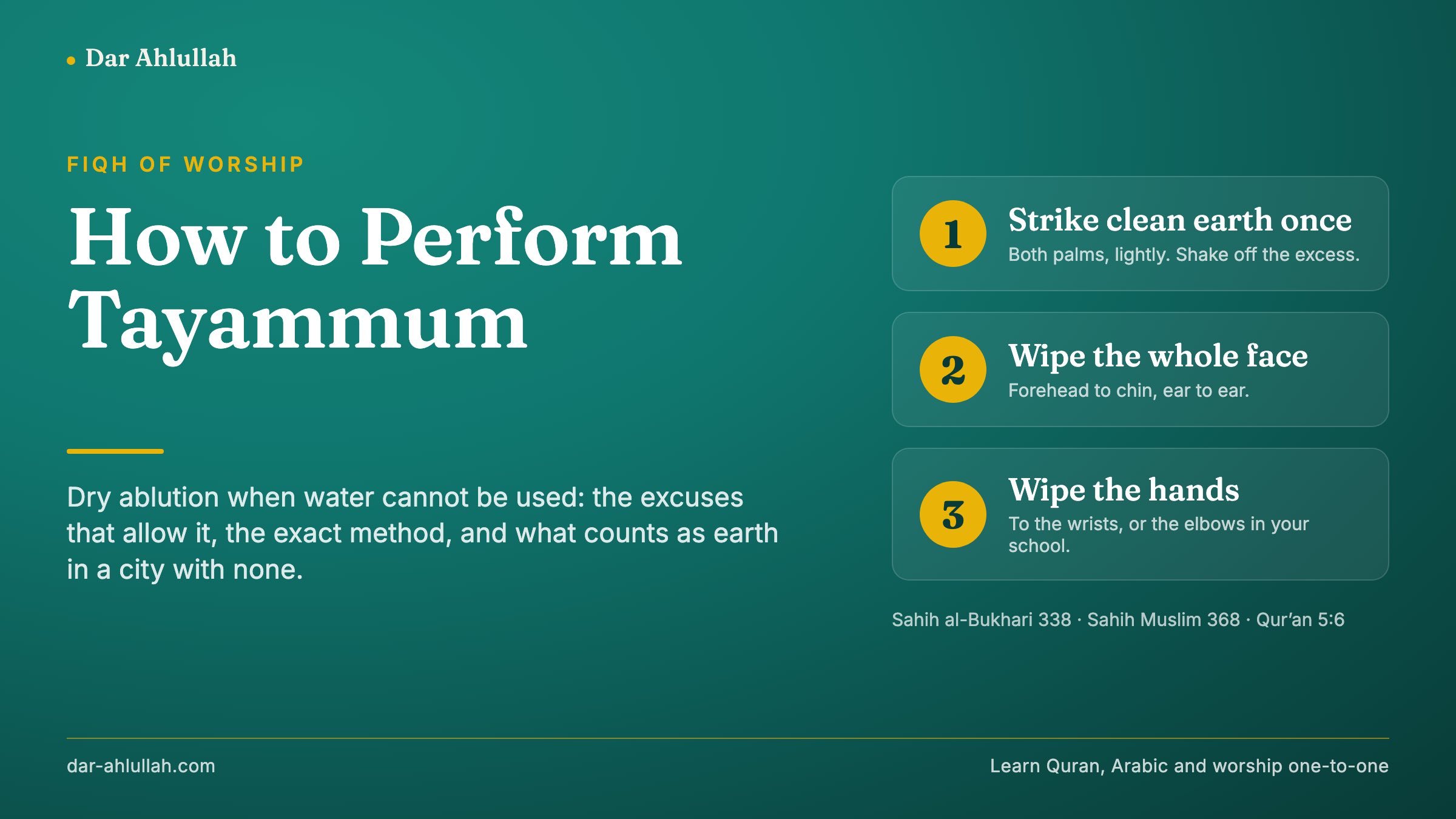
Tayammum is the purification you make with earth when water cannot be used. The rule is short: strike clean earth, wipe your face, wipe your hands. The difficulty for a Muslim in Europe or America is everything around the rule: what counts as a real excuse, what counts as earth in a building with none, how long it lasts, and what you do on a plane or in a hospital bed when there is neither water nor dust.
28 min read