
sutrah
Sutrah in Prayer: What It Is and Who May Walk Past You
Dar Ahlullah team 27 min read
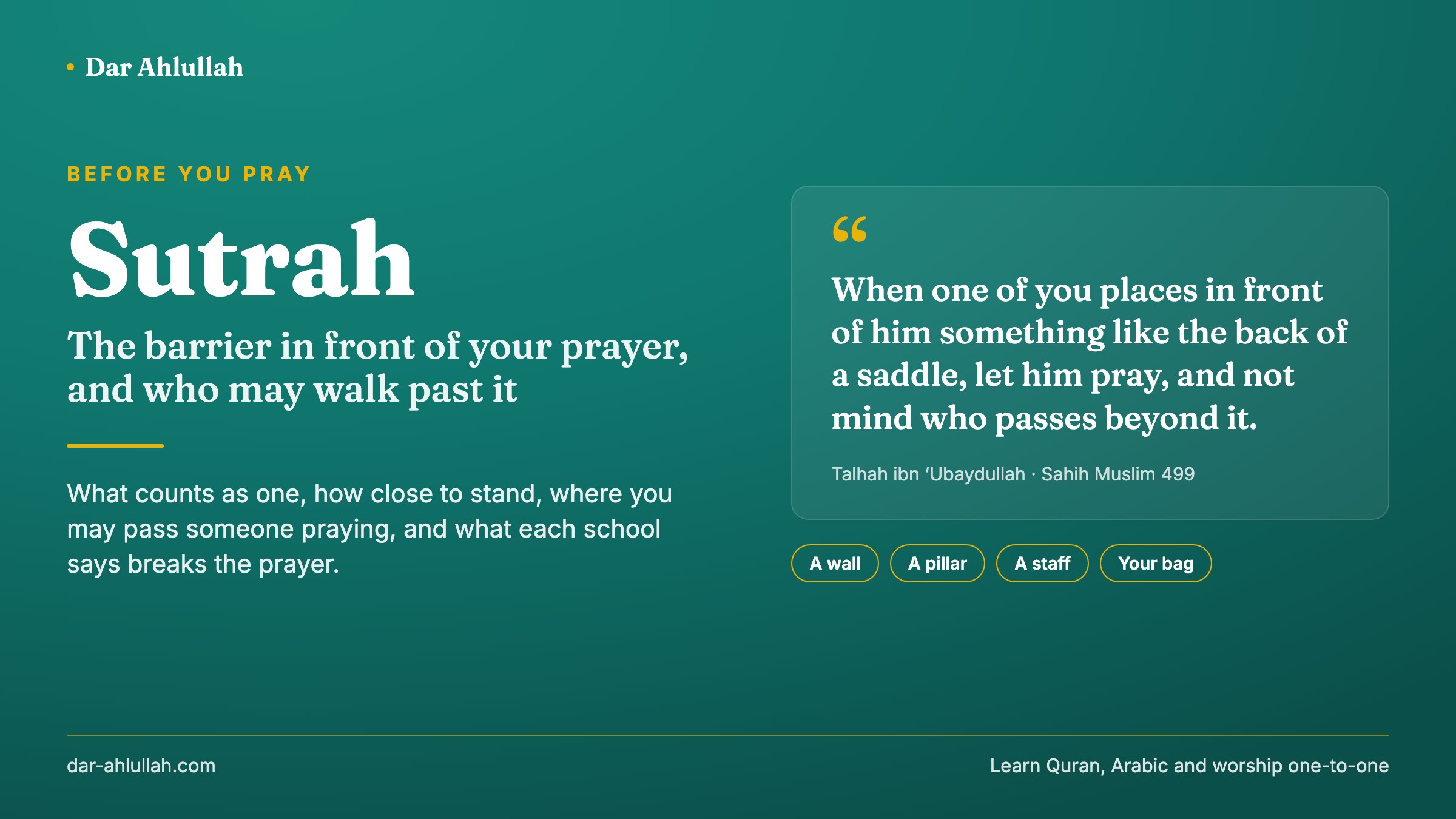
Table of Contents
- Introduction: The Only Door Is Behind Him
- The Short Answer
- What a Sutrah Is, and Where It Comes From
- Sunnah or Obligation?
- What Counts as a Sutrah
- How Close to Stand
- Walking Past Someone Who Is Praying
- Who Carries the Sin?
- When Someone Walks in Front of You
- Does It Break Your Prayer? The Woman, the Donkey and the Black Dog
- In Congregation: The Imam’s Sutrah Covers the Rows
- Masjid al-Haram and Very Crowded Places
- Where You Actually Pray
- Six Mistakes People Make
- How We Teach This
- Questions People Ask
- Conclusion: What Abu Sa‘id Did on a Friday
Introduction: The Only Door Is Behind Him
You finish Zuhr in the prayer room at work. Behind you, a colleague who came in a minute later is still praying on his own. The door is on the far side of him, your next meeting starts in four minutes, and the only way out is straight across the space where he will put his forehead. Do you wait? Do you step past quickly? Did he do something wrong by praying in the middle of the room? And if you walk across, does his prayer still count?
Every one of those questions has an answer, and the answers come from one small object and one short hadith. The object is the sutrah, the barrier a worshipper places in front of himself. The hadith is the warning that someone who walks in front of a person praying would, if he knew what he was taking on, rather stand and wait forty than do it.
This guide covers the sutrah in prayer from both sides. For the person praying: what it is, whether it is required, what counts as one, and how close to stand. For everyone else in the room: where you may and may not walk, who carries the blame when there is no way round, and what to do when you are the one praying and someone crosses. Then the hard part, the hadith about a woman, a donkey and a black dog, with each school’s reading of it. If the prayer itself is still new to you, start with our step-by-step guide to how to pray in Islam; this article sits in its salah library with the other preparations for prayer.
One boundary before we begin. We teach Quran, Arabic and the practical fiqh of worship; we are not a fatwa body. Several questions below are real differences between the schools of Islamic law, and we set the positions side by side rather than pick one and call it consensus. The right answer for you is the one your school or your teacher follows.
The Short Answer
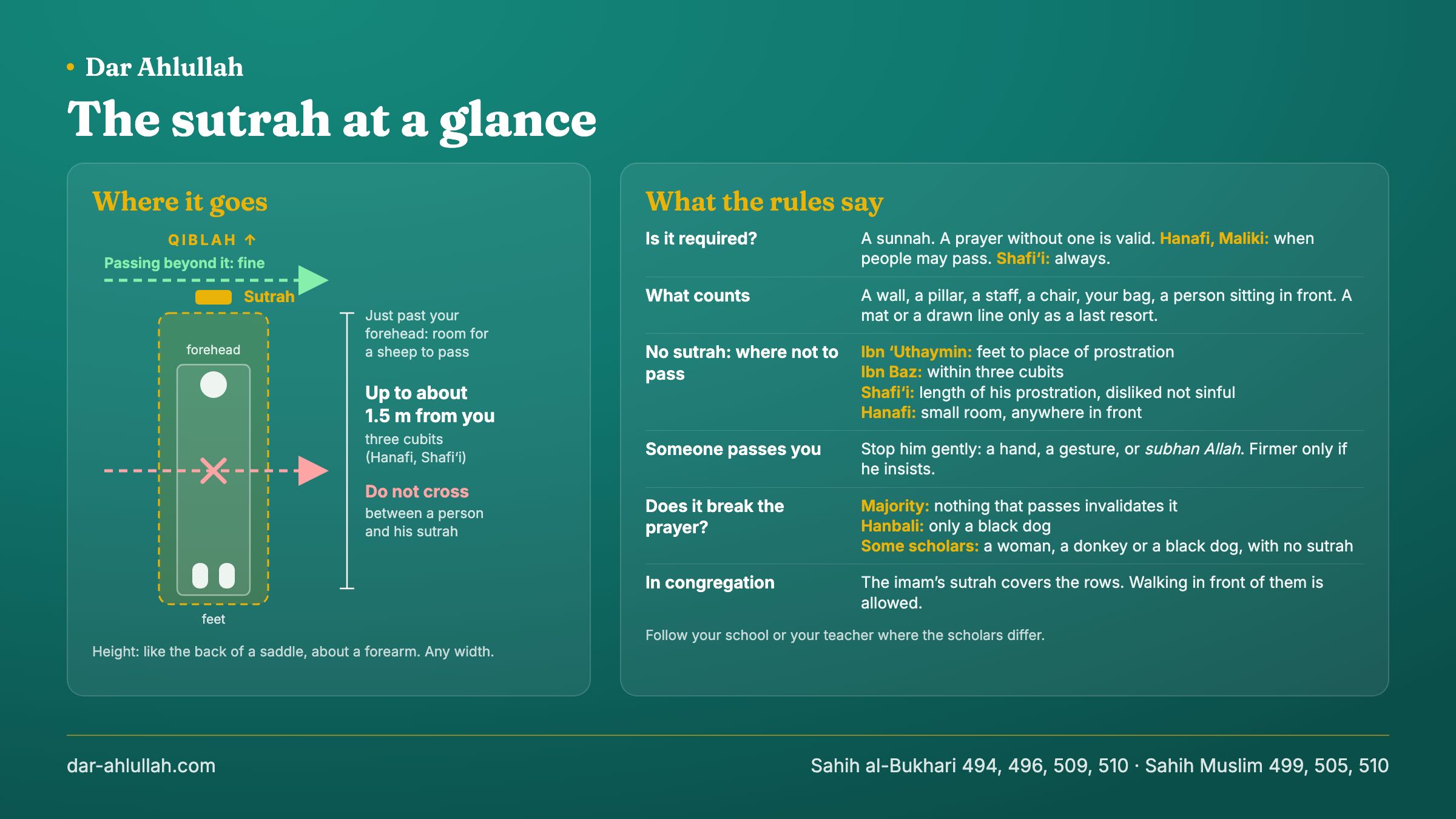
- A sutrah is a barrier you pray behind: a wall, a pillar, a stick, a bag, anything roughly the height of a forearm set just in front of your place of prostration. The Prophet ﷺ prayed behind a spear planted in the ground, behind his camel, and behind the wall of his mosque.
- It is a sunnah, not an obligation. Your prayer is valid without one. The Hanafi and Maliki schools recommend it when you expect people to pass; others recommend it in general.
- Stand close to it. The Prophet’s place of prayer left room for a sheep to pass before the wall. The Hanafi and Shafi‘i texts put the outer limit at about a metre and a half.
- Do not walk between a person and his sutrah, or, if he has none, across the space he is using to pray. Beyond the sutrah, or beyond that space, is fine. In congregation the imam’s sutrah covers everyone behind him, so walking in front of the rows is allowed.
- If someone walks in front of you, stop him gently: a hand, a gesture, or subhan Allah. On the view of the majority, nothing that passes invalidates your prayer; it reduces it. The Hanbali school makes an exception for a black dog, and some scholars for all three things named in the hadith.
What a Sutrah Is, and Where It Comes From
Sutrah is Arabic for a screen or a cover. In the fiqh of prayer it means an object you place in front of yourself so that your prayer has a boundary: people pass beyond it, and your eyes and attention stay inside it. It is not something you pray to. You face the qiblah as always; the sutrah simply marks where your space ends.
The practice is recorded again and again in the two Sahihs. Ibn ‘Umar reported that when the Prophet ﷺ went out on the day of ‘Eid, he ordered a short spear to be planted in front of him and prayed facing it with the people behind him, and that he did the same on journeys (Sahih al-Bukhari 494, Sahih Muslim 501a). Abu Juhayfah saw him lead Zuhr and ‘Asr at al-Batha’ with a staff planted in front of him, “while women and donkeys were passing beyond it” (Sahih al-Bukhari 499). Ibn ‘Umar saw him pray facing his camel, and when the camel would not stay still, facing its saddle (Sahih al-Bukhari 507).
The instruction itself comes in several narrations. Abu Sa‘id al-Khudri reported: “When anyone of you performs prayer, let him pray facing towards a sutrah, and let him get close to it, and not let anyone pass in front of him” (Sunan Ibn Majah 954, graded hasan sahih by al-Albani; also Sunan Abi Dawud 698). And Talhah ibn ‘Ubaydullah reported the size of it: “When one of you places in front of him something like the back of a saddle, let him pray, and not mind who passes beyond it” (Sahih Muslim 499a). When ‘A’ishah reported that the Prophet ﷺ was asked about the worshipper’s sutrah, the answer was the same measure: “Like the back of a saddle” (Sahih Muslim 500a).
The reason is given in one line. Sahl ibn Abi Hathmah reported: “When one of you prays facing a sutrah he should keep close to it, and not let the devil interrupt his prayer” (Sunan Abi Dawud 695, graded sahih by al-Albani). The sutrah protects two things: the prayer, from people cutting across it, and the person praying, from the distraction of movement right in front of his eyes.
Sunnah or Obligation?
A sunnah. IslamQA describes it as a confirmed sunnah, sunnah mu’akkadah, and gives the reason it is not obligatory: on some occasions the Prophet ﷺ prayed without one (IslamQA 118153). One such occasion is in al-Bukhari: Ibn ‘Abbas rode a donkey past part of the row at Mina while the Prophet ﷺ was leading the prayer “with no wall in front of him” (Sahih al-Bukhari 493).
The schools differ on when it is recommended. The Hanafi and Maliki scholars hold that you should place a sutrah only if you expect someone to pass in front of you; if nobody is likely to, it is not required, based on a report that the Prophet ﷺ prayed in open country with nothing in front of him (as summarised in Sayyid Sabiq’s Fiqh us-Sunnah, volume 2). The Hanafi manual Maraqi al-Falah puts it the same way: if a person about to pray thinks someone will pass by, it is recommended for him to put a sutrah in front of himself (Shaykh Ilyas Patel, quoting Hashiyat al-Tahtawi). The Shafi‘i school, in the text of al-Nawawi’s Minhaj, recommends it whenever you pray (Shaykh Irshaad Sedick at SeekersGuidance).
What nobody holds is that a prayer without a sutrah has to be repeated. If you have already prayed a hundred prayers in the middle of a room, every one of them stands.
What Counts as a Sutrah
Height: the back of a saddle
The measure in the hadith is the back of a camel saddle. The Successor ‘Ata’ explained it as about a cubit or more (Sunan Abi Dawud 686), a cubit being the length from the elbow to the fingertips. IslamQA puts the back of a saddle at about two-thirds of a cubit, calls that the best height, and adds that if the sutrah is lower than that it does not matter (IslamQA 145200). In the Shafi‘i school the minimum is about 32 centimetres. In practice: aim for something about as high as your forearm is long, and do not skip the sutrah because what you have is a little shorter.
Thickness: none required
There is no minimum width. The Hanafi texts say the size of the back of a saddle is enough “even if it is thin as a hair”, and IslamQA accepts an arrow or a stick. A walking stick, a tall umbrella propped upright, or the leg of a table will do.
What you can use
- A wall or a pillar. The simplest and most common sutrah. The Prophet ﷺ prayed facing the wall of his mosque.
- Furniture. A chair, the end of a bed, a bookshelf. ‘A’ishah describes the Prophet ﷺ praying at night while she lay across the bed between him and the qiblah (Sahih al-Bukhari 515).
- Your bag. A rucksack or a briefcase standing upright is, on the measure above, a sutrah. On a journey this is usually the easiest thing you have.
- A person. IslamWeb: it is permissible to take someone praying in front of you, or the back of someone sitting, as your sutrah; some jurists disliked using a person who is talking, because he would distract you (IslamWeb fatwa 106812).
- A prayer mat, in the Shafi‘i school. Where there is no object, the Minhaj allows you to spread out a mat, which then marks your space.
- A line on the ground, as a last resort. This one needs a note on its evidence, below.
The drawn line and its hadith
Many guides say that if you have nothing else, you may draw a line in front of you. The source is a hadith of Abu Hurayrah: put something in front of you; if you find nothing, set up your staff; if you have no staff, draw a line; then what passes in front of you will not harm you (Sunan Abi Dawud 689, Sunan Ibn Majah 943). Its grading is disputed, and you should know that before relying on it. Fiqh us-Sunnah reports that Ibn Hibban, Ahmad and Ibn al-Madini graded it sahih. Al-Albani, Shu‘ayb al-Arna’ut and Zubair ‘Ali Za’i all graded it da‘if, and Abu Dawud records the narrator Sufyan saying he found nothing to strengthen it (Sunan Abi Dawud 690). The Hanafi and Shafi‘i texts quoted above both accept the line where nothing else is available. It is the weakest option on the list, so use a real object when you have one.
Setting it slightly to one side
You may have been taught to place the sutrah a little to the right or left of centre rather than dead ahead. That comes from a report of al-Miqdad ibn al-Aswad (Sunan Abi Dawud 693), which al-Albani, al-Arna’ut and Zubair ‘Ali Za’i all graded da‘if. Straight ahead is fine.
How Close to Stand
The instruction is to get close. Two reports give the distance. Sahl ibn Sa‘d: “The distance between the place where the Messenger of Allah ﷺ prayed and the wall was just enough for a sheep to pass” (Sahih al-Bukhari 496, Sahih Muslim 508). And inside the Ka‘bah, Bilal showed Ibn ‘Umar where the Prophet ﷺ had prayed, and Ibn ‘Umar would stand where about three cubits were left between him and the wall (Sahih al-Bukhari 506).
IslamQA reconciles the two: three cubits is measured from your feet while you stand, and the sheep’s passage is what is left in front of your forehead when you prostrate (IslamQA 145200). The schools convert this into a working figure. The Hanafi texts, quoting Ibn Amir Hajj, say about a metre and a half between the sutrah and the person praying; the Shafi‘i Minhaj says about a metre and a half or less, and treats a sutrah further away than that as if there were none.
The practical rule: place it just beyond where your forehead will go. If you pray on a mat, the top edge of the mat or a little past it is the right spot. A sutrah on the other side of a large room is not doing anything.
Walking Past Someone Who Is Praying
This is the half of the topic that applies to everyone, including people who never use a sutrah themselves. Abu Juhaym reported that the Messenger of Allah ﷺ said: “If the person who passes in front of another person in prayer knew the magnitude of his sin, he would prefer to wait for forty rather than pass in front of him.” The narrator added that he did not remember whether it was forty days, months or years (Sahih al-Bukhari 510, Sahih Muslim 507a).
So walking in front of someone praying is forbidden. The question every guide then has to answer is: in front of him how far? That depends on whether he has a sutrah.
If he has a sutrah
Do not pass between him and it. Passing beyond it is fine: that is what Abu Juhayfah saw at al-Batha’, women and donkeys passing beyond the Prophet’s staff while he prayed. The Shafi‘i text makes it strict: passing between a person and a valid sutrah is unlawful “even when there is no other way to pass”.
If he has no sutrah
This is where the schools give different measures:
| View | Where you may not pass | Source |
|---|---|---|
| Ibn ‘Uthaymin | Between his feet and the place where he prostrates. | IslamQA 26182 |
| Ibn Baz | Within three cubits of him. Further away than that does not matter. | IslamQA 147415 |
| Shafi‘i | Within the length of his prostration. With no valid sutrah, passing there is disliked but not sinful. | SeekersGuidance (Shafi‘i) |
| Hanafi | In a large mosque, the area he would see in his peripheral vision while looking at his place of prostration. In a small mosque or any other room, anywhere in front of him. | SeekersGuidance (Hanafi) |
They converge on something simple. In a big hall, pass wide, well beyond where his forehead goes. In a small room, go behind him or wait. And if you can see that someone is about to start praying in a spot you will need to cross, the kindest thing is to hand him a sutrah, or to say you are about to leave.
Two Hanafi solutions for a tight room
The Hanafi manual ‘Umdat al-Fiqh, quoted in the islamqa.org Hanafi answer above, adds two practical points that almost nobody is taught. First, if you were already sitting in front of someone when he began to pray, you may stand up and leave; that is not passing in front of him. Second, if two people need to get past, one of them stands with his back to the person praying, which makes him a sutrah, and the other walks past behind him. Then they swap.
Who Carries the Sin?
The hadith of the forty speaks to the passer. But someone who chooses to pray in a doorway, a corridor or the only route to the wudu area has also made a choice, and the Hanafi scholars assign the blame accordingly. The first three rows below are from ‘Umdat al-Fiqh, as quoted in the islamqa.org Hanafi answer; the fourth follows from the exemption SeekersGuidance gives from Radd al-Muhtar and Maraqi al-Falah, that someone with no alternative but to walk past is acting out of need and is not sinful:
| The person praying | The person passing | Who is sinful |
|---|---|---|
| Had nowhere else to pray | Had another way round | The passer |
| Chose a walkway when other space was free | Had no other way out | The person praying |
| Chose a walkway when other space was free | Had another way round | Both |
| Had nowhere else to pray | Had no other way out | Neither |
The islamqa.org answer adds that someone who passes without meaning to is excused. This table is the Hanafi school’s. The other schools do not lay it out in these four lines, but the obligation to stand close to a sutrah, and to avoid praying where people have to walk, is the same idea from the other side.
When Someone Walks in Front of You
The Prophet ﷺ told the person praying to stop the passer. Abu Sa‘id al-Khudri reported: “When one of you is praying, let him not allow anyone to pass in front of him; let him repel him as much as he can, and if he refuses, let him fight him, for he is only a devil” (Sahih Muslim 505a, Sunan Abi Dawud 697).
“Fight” is the word, and it is worth reading what the scholars made of it rather than taking it at face value. The Shafi‘i text describes it as a scale: push him back gently first, and if he persists, as firmly as is needed. The Hanafi texts go further in the direction of gentleness: it is actually better not to push, and to stop him with a gesture of the head or the eyes, or by saying subhan Allah; a man may say it aloud, and a woman gestures instead, by striking the fingers of her right hand on her left hand. Doing both, the gesture and the words, at once is disliked. And the Prophet’s own practice was to block rather than strike: when a young goat tried to cross in front of him he kept stopping it, and edged forward until his stomach was near the wall and it passed behind him (Sunan Abi Dawud 708, 709).
Two limits matter. First, in the Shafi‘i school the right to push back belongs to someone with a valid sutrah: with no sutrah, or one more than about a metre and a half away, the person praying “is not entitled to push him back”. Second, all of this is for someone praying alone. In congregation, as the sections below explain, the followers do not need to repel anyone.
Children at home
For many parents this is the real question: a toddler running back and forth in front of the prayer mat. Stretch out a hand to stop them, as the sunnah describes, without turning the prayer into a chase. The Prophet ﷺ prayed carrying his granddaughter Umamah, setting her down when he prostrated and lifting her when he stood (Sahih al-Bukhari 516), and on the view of the scholars who hold that a woman passing invalidates the prayer, the ruling is about an adult woman, not a small child. Our guide to what invalidates salah covers the rest of the interruptions that do not break a prayer.
Does It Break Your Prayer? The Woman, the Donkey and the Black Dog
Here is the hadith that raises the hardest questions on this topic, and it deserves to be read carefully rather than quoted in half. Abu Dharr reported that the Messenger of Allah ﷺ said that when one of you stands to pray and has in front of him something like the back of a saddle, it screens him; and if he does not, his prayer is cut off by a donkey, a woman and a black dog. Asked why a black dog rather than a red or a yellow one, Abu Dharr said he had asked the same question and was told that the black dog is a devil (Sahih Muslim 510a). Abu Hurayrah narrated it more briefly: a woman, a donkey and a dog cut off the prayer, and something like the back of a saddle guards against that (Sahih Muslim 511).
The first objection came from ‘A’ishah. When the things that cut off the prayer were listed in front of her, she said, “You have compared us women to donkeys and dogs. By Allah, I saw the Prophet ﷺ praying while I lay on the bed between him and the qiblah” (Sahih al-Bukhari 514, 511).
The scholars read these reports in three ways:
| View | Who holds it | What “cut off” means |
|---|---|---|
| Nothing that passes invalidates the prayer | The majority: ‘Ali, ‘Uthman, Ibn al-Musayyab, al-Sha‘bi, Malik, al-Shafi‘i, Sufyan al-Thawri and the Hanafi scholars | It damages the prayer’s concentration and reward, not its validity. Many of them held the hadith superseded by ‘A’ishah’s report. |
| Only a black dog invalidates it | The Hanbali school | Taken literally for the black dog, but not for the woman or the donkey. |
| All three invalidate it, if they cross with no sutrah | A group of the early scholars, al-Hasan al-Basri among them; IslamQA | Taken literally for all three. The ruling is about an adult woman crossing, not one lying or sitting in front. |
Sources: Fiqh us-Sunnah for the list of names in the majority view; IslamWeb fatwa 89471 for the three positions and the Hanbali view; IslamQA 118153 for the third; Ustadh Tabraze Azam at SeekersGuidance for the Hanafi reading, citing al-Kasani and al-Nawawi. IslamWeb, in a separate fatwa, states that most scholars regard the hadith as abrogated by ‘A’ishah’s and that this is the correct opinion (IslamWeb fatwa 83554).
The majority also cite a hadith that says it outright: “Nothing interrupts prayer, but repel as much as you can anyone who passes in front of you” (Sunan Abi Dawud 719). Its grading is split: al-Albani graded it da‘if and Zubair ‘Ali Za’i hasan. The majority view does not rest on it alone.
Is the hadith comparing women to animals?
That was exactly ‘A’ishah’s objection, and it is a fair one to ask. The answer the scholars give, set out at length by IslamQA 214748, is that the three are grouped by one shared effect on a person praying, the distraction of something crossing directly in front of him, and not by any shared worth. The same hadith that names them says that something the height of a saddle’s back removes the whole issue, which tells you where its attention is: on the worshipper’s concentration, not on the dignity of the one passing. And on the view of the majority, the question of validity does not arise: nothing that crosses in front of you voids your prayer.
What this means for you
- On the majority view, if anyone or anything crosses in front of you, carry on. Your prayer is valid; stop the passer if you can and re-gather your attention.
- On the Hanbali view, a black dog crossing between you and your sutrah, or close in front of you with none, breaks the prayer. Outside a park, that is rare.
- On the third view, an adult woman, a donkey or a black dog crossing that space breaks it, and you pray again. A sutrah removes the question entirely, which is the strongest argument for using one.
- On every view, it only concerns someone praying alone. Behind an imam it does not arise at all.
In Congregation: The Imam’s Sutrah Covers the Rows
In a congregation the followers do not need a sutrah of their own. The imam’s sutrah is the sutrah of everyone behind him. IslamQA reports that it is not recommended for a follower to use one, by consensus (IslamQA 117758). The evidence is Ibn ‘Abbas’s ride at Mina: he passed in front of part of the row on a donkey, dismounted, let it graze, joined the row, “and nobody objected” (Sahih al-Bukhari 76, Sahih Muslim 504a).
That gives three practical rules:
- Walking in front of the rows is allowed, as long as you are not crossing between the imam and his sutrah. If you are late and the only gap is in the row ahead, go to it; the Shafi‘i text explicitly allows passing in front of others to fill a gap.
- Someone crossing in front of your row does not affect your prayer, even on the stricter views. IslamQA answers exactly this case: a woman walked in front of a row praying in congregation, and the followers’ prayer was unaffected (IslamQA 3404).
- Followers do not need to push anyone back. IslamQA 3404 says so directly: someone praying behind the imam does not have to push away anyone who passes in front of him.
When the imam finishes and you still have rak’ahs to make up
If you joined late, the imam’s salam ends his sutrah over you, and you stand to complete your prayer alone in the middle of a room where everyone is getting up to leave. IslamWeb notes that the jurists allow the latecomer to walk forward one, two or even three rows to reach a sutrah, such as a pillar or someone still praying (IslamWeb fatwa 106812). If nothing is close, stay where you are and stop anyone crossing close in front. Our guide to joining the prayer late covers how to make up the rak’ahs themselves.
The same thing happens to everyone after Jumu‘ah, when half the hall stands for the sunnah and the other half heads for the door. Abu Sa‘id’s story below happened on a Friday. If you pray the sunnah there, pray it against a wall or a pillar, and if you are leaving, go along the sides. Our guide to how to pray Jumu’ah covers the rest of the Friday prayer.
Masjid al-Haram and Very Crowded Places
Pilgrims regularly hear that the rules of the sutrah do not apply in the Sacred Mosque. That is one view, not a settled fact:
- Makkah is different. Ibn Qudamah held that there is nothing wrong with praying in Makkah without a sutrah, and quoted Imam Ahmad: Makkah is not like anywhere else. The report they rely on, of the Prophet ﷺ praying near the tawaf area with people passing in front of him, is graded da‘if by al-Albani and others (Sunan Abi Dawud 2016), though IslamQA notes it is supported by other reports (IslamQA 96912).
- Makkah is the same, but crowding excuses you. Ibn ‘Uthaymin held that the general wording of the hadith includes Makkah (IslamQA 26182). But he, and Ibn Baz, both excused what cannot be avoided: Ibn Baz said what happens in al-Masjid al-Haram is excused because the crowding makes it impossible to avoid, especially during Hajj, and Ibn ‘Uthaymin that someone who can find nowhere to pray except where people walk is excused by necessity (both in IslamQA 96912).
In practice both views arrive at the same place for a pilgrim: in the crush of the Haram, pray and do not worry about people passing. When it is not crowded, use a pillar like anywhere else, and do not cut in front of someone praying just because you are in Makkah.
Where You Actually Pray
Most of the questions people ask about the sutrah are really about places the classical texts never pictured. Applying the rules above:
| Where you are | What to use | What to watch |
|---|---|---|
| A mosque | A wall or pillar; in congregation, nothing | After Jumu‘ah and after the fard, pray the sunnah against a pillar, and do not cut across people praying on your way out |
| A prayer room at work or university | The wall, a chair, or your bag | Do not start in the middle of a small room if you can take a spot by the wall. In a small room the Hanafi texts forbid passing anywhere in front of someone praying |
| An airport gate, a corridor, a car park | Your cabin bag or rucksack, stood upright | Pick a spot beside the flow of people, not across it, and keep the bag at the top of your mat |
| A park or open ground | A bag, a bench, a tree, a stick pushed into the grass | Dogs are most likely here, which matters on the Hanbali view |
| At home | A wall, a sofa, the end of a bed | Pray close to a wall rather than in the middle of the room, so children and family are not forced to cross in front of you |
| Travelling | Whatever you are carrying | The Prophet ﷺ took the spear with him on journeys (Sahih al-Bukhari 494). Our guide to praying while travelling covers shortening and combining |
Back to the prayer room
A question very like the one this article opened with was put to SeekersGuidance: someone in a workplace prayer room needed to leave while a person behind him was still praying alone, with no sutrah. The Shafi‘i answer was that passing in front of someone without a sutrah is disliked, not a sin, and that it is limited to the length of his prostration anyway, with a gentle reminder that “Islam brings Mercy, not trepidation”. On the Hanafi table above, if the door was the only way out, you carry no sin. The better fix is to prevent the question in the first place: whoever prays second should take the spot by the wall, or put a bag in front of him.
Six Mistakes People Make
- Thinking a prayer without a sutrah is invalid. It is a sunnah. Every prayer you have prayed without one stands.
- Placing the sutrah across the room. It should be just beyond where your forehead goes, within about a metre and a half of your feet. Further than that, the Shafi‘i text treats it as no sutrah at all.
- Walking in front of someone because “he has no sutrah”. Without a sutrah, the space he is praying in is still to be avoided on every view. Only the measure differs, and in the Shafi‘i school how serious it is.
- Refusing to let anyone past the rows of a congregation. The imam’s sutrah covers the followers; passing in front of the rows is allowed, and followers do not repel anyone.
- Shoving someone at the first step. The sunnah is a scale that starts with a hand, a gesture or subhan Allah. The Hanafi texts prefer not to push at all.
- Quoting half the hadith of the three. Either as proof that a woman walking by ruins every prayer, or as proof that the hadith is not authentic. It is in Sahih Muslim; the majority of scholars hold that nothing passing invalidates the prayer; and a sutrah removes the question on every view.
How We Teach This
The sutrah takes five minutes to learn and one bag to practise. What takes longer is the prayer it protects: al-Fatihah recited correctly, the positions held long enough, and enough Arabic to know what you are saying in them. Fiqh basics, the prayer among them, are part of our Islamic Studies course, and the Quran and Arabic courses build the recitation and the understanding that go into it, one-to-one.
Dar Ahlullah runs one-to-one live sessions with certified teachers, scheduled in your own timezone. Teaching is charged at $9 per teaching hour, with monthly plans at $36, $70 and $102 depending on how many hours you want, and a 20% discount for siblings. You can pause, upgrade or switch plans at any time, and if a teacher is not the right fit we rematch you with another certified mentor at no extra cost. If you would like to see where your prayer and recitation stand before committing to anything, the 30-minute assessment is free and does not ask for a card. The details are on our pricing page.
Questions People Ask
What is a sutrah in prayer?
An object placed in front of someone praying to mark the boundary of his prayer space, so that people pass beyond it. The Prophet ﷺ used a spear, a staff, his camel and the wall of his mosque (Sahih al-Bukhari 494, 499, 507).
Is a sutrah obligatory?
No. It is a sunnah, and a prayer without one is valid. The Hanafi and Maliki schools recommend it when you expect people to pass; the Shafi‘i school and IslamQA recommend it in general.
How high should a sutrah be?
Like the back of a camel saddle (Sahih Muslim 499a, 500a): about a forearm. The Successor ‘Ata’ put it at a cubit or more, and the Shafi‘i minimum is about 32 centimetres. It can be as thin as you like.
How far in front of me should the sutrah be?
Close: just beyond your place of prostration. The Prophet’s place of prayer left room for a sheep to pass before the wall (Sahih al-Bukhari 496). The outer limit most texts give is three cubits, about a metre and a half, from your feet.
Can I use my bag, a chair or my prayer mat as a sutrah?
A bag or chair standing about a forearm high, yes. A prayer mat counts in the Shafi‘i school where nothing else is available. A drawn line is accepted by the Hanafi and Shafi‘i texts as a last resort, though its hadith is disputed (Sunan Abi Dawud 689).
Is it a sin to walk in front of someone who is praying?
Yes, within his prayer space; the Prophet ﷺ said the passer would rather wait forty than do it (Sahih al-Bukhari 510). Beyond his sutrah, or beyond the space he uses if he has none, it is fine. In the Shafi‘i school, passing someone with no sutrah is disliked rather than sinful.
What if there is no other way past?
In the Hanafi school, someone with no alternative but to walk past is not sinful; if the person praying chose a walkway when he had space elsewhere, the sin is his. If you were already sitting in front of him when he started, you may simply stand up and leave.
Does a woman walking in front of me break my prayer?
On the view of the majority, Malik, al-Shafi‘i and the Hanafi scholars among them, no: nothing that passes invalidates the prayer. The Hanbali school limits it to a black dog. Some scholars, and IslamQA, hold that an adult woman, a donkey or a black dog crossing with no sutrah does invalidate it. Behind an imam, it does not arise.
Can I walk in front of people praying in congregation?
Yes, in front of the rows, because the imam’s sutrah covers them (Sahih al-Bukhari 76). Do not cross between the imam and his sutrah.
Do the rules apply in Masjid al-Haram?
Ibn Qudamah and Imam Ahmad held that Makkah is an exception; Ibn ‘Uthaymin held that it is not. Both he and Ibn Baz excused what cannot be avoided in the crowds, so a pilgrim in the crush of the Haram should pray and not worry.
Conclusion: What Abu Sa‘id Did on a Friday
Abu Salih al-Samman watched Abu Sa‘id al-Khudri praying on a Friday behind something he was using as a sutrah. A young man tried to pass in front of him, and Abu Sa‘id pushed him back. He tried again and was pushed harder. The young man complained to Marwan, and Abu Sa‘id followed him in and explained: he had heard the Prophet ﷺ say that if someone praying behind a sutrah is crossed, he should repel the passer, and if the passer refuses, use force, “for he is a devil” (Sahih al-Bukhari 509).
Notice what made the difference in that story: Abu Sa‘id had a sutrah. Everything in this guide follows from that one habit. Put something in front of you, stand close to it, and your prayer has a boundary that others can see and respect. When you are the one walking, look for that boundary, go round it, and remember the forty. If you want the rest of the prayer in the same detail, the salah library links every guide we have written on it, including tahiyyat al-masjid, the two rak’ahs you pray on walking into a mosque, and what to say in salah, position by position.
Related articles
joining the prayer late
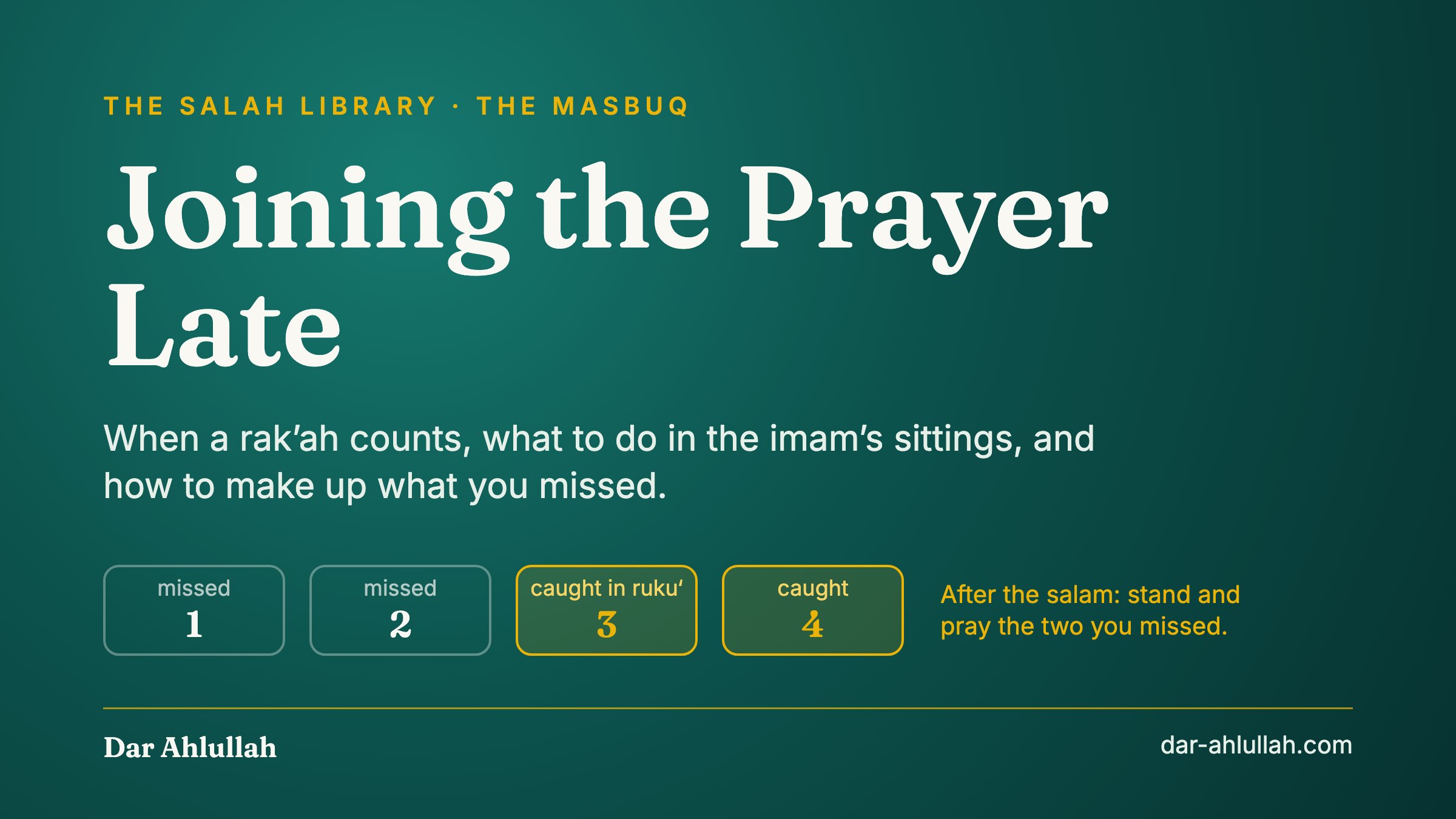
Joining the Prayer Late: How to Make Up Missed Rak’ahs
Joining the prayer late has a short, exact procedure: say the takbir standing, join the imam wherever he is, count the rak'ah only if you reached ruku' before he rose, and complete what you missed after his salam. This guide works through every prayer and arrival point, and explains why the person beside you may make up the same rak'ahs with a different recitation.
20 min read
what invalidates salah
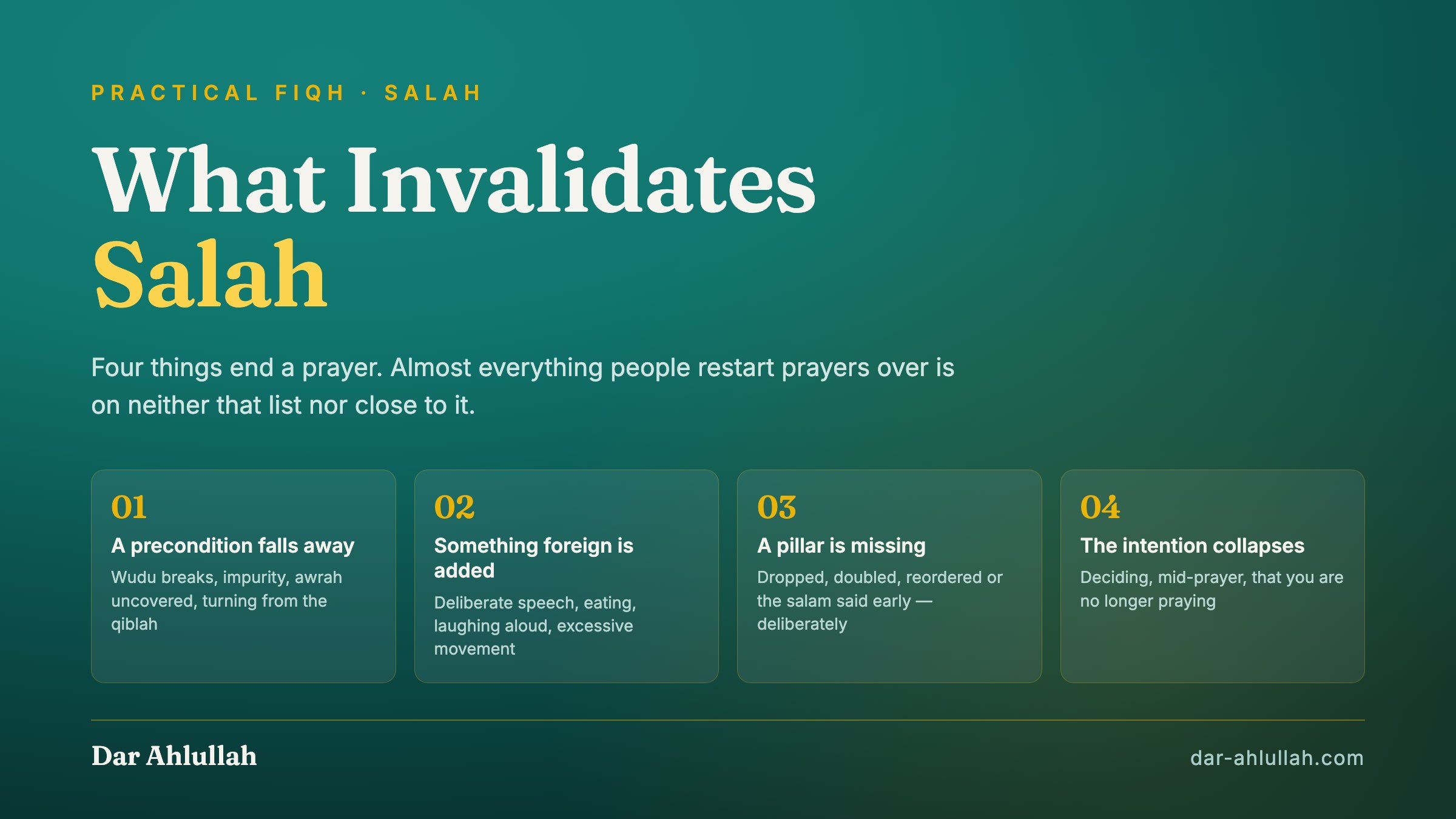
What Invalidates Salah: The Things That Really Break Your Prayer
Four things end a prayer: a precondition falls away, something foreign is added, a structural part is deliberately dropped, or the intention is withdrawn. Almost everything else people restart prayers over is on neither that list nor close to it.
19 min read
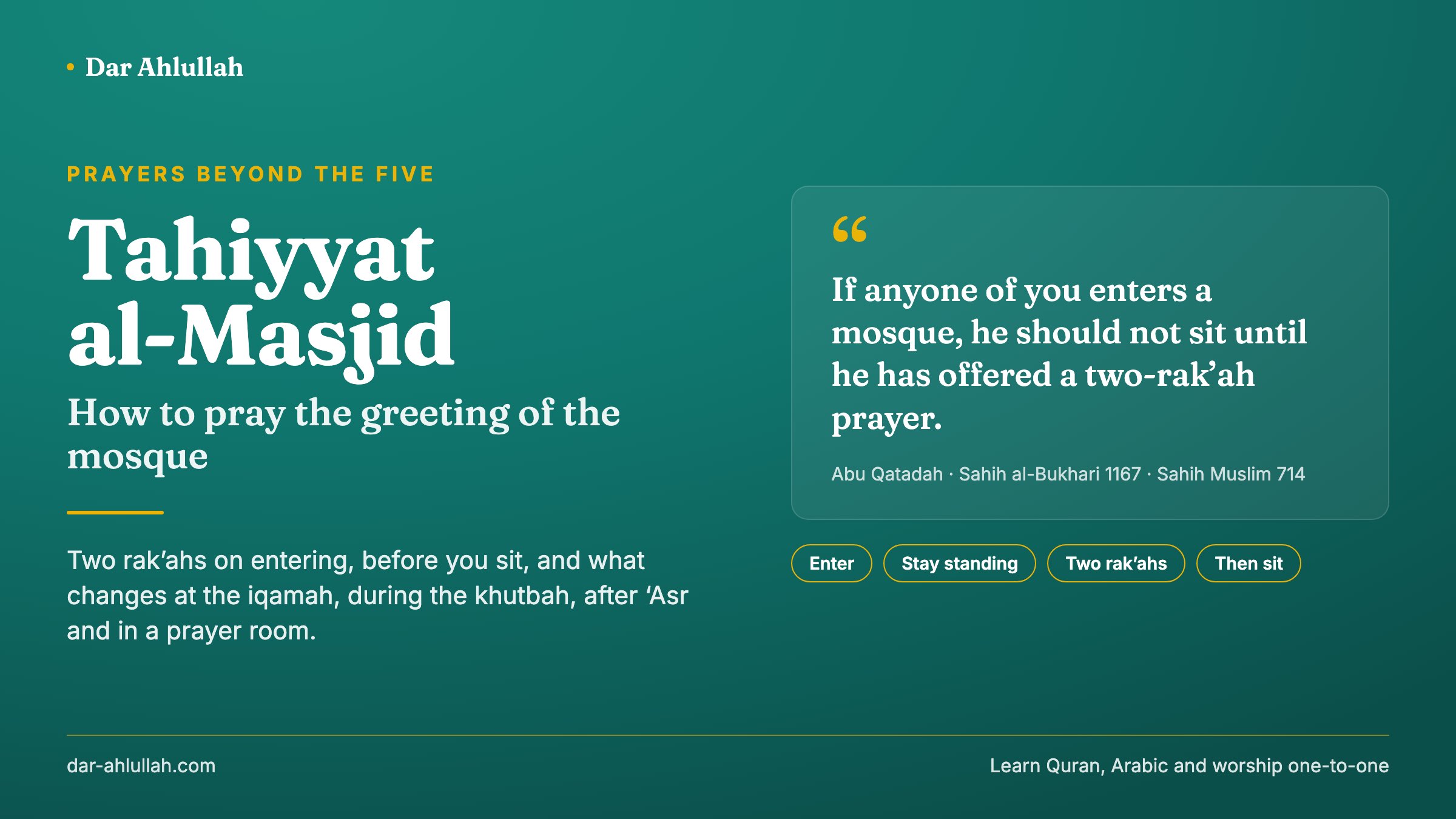
tahiyyat al-masjid
Tahiyyat al-Masjid: How to Pray the Greeting of the Mosque
Tahiyyat al-masjid is two rak'ahs prayed on entering a mosque, before sitting. The method, the prayers that fulfil it for you, what to do if you already sat, the iqamah, the Friday khutbah and forbidden times by school, and whether a prayer room counts.
24 min read