
how to perform tayammum
How to Perform Tayammum: Dry Ablution When You Cannot Use Water
Dar Ahlullah team 28 min read
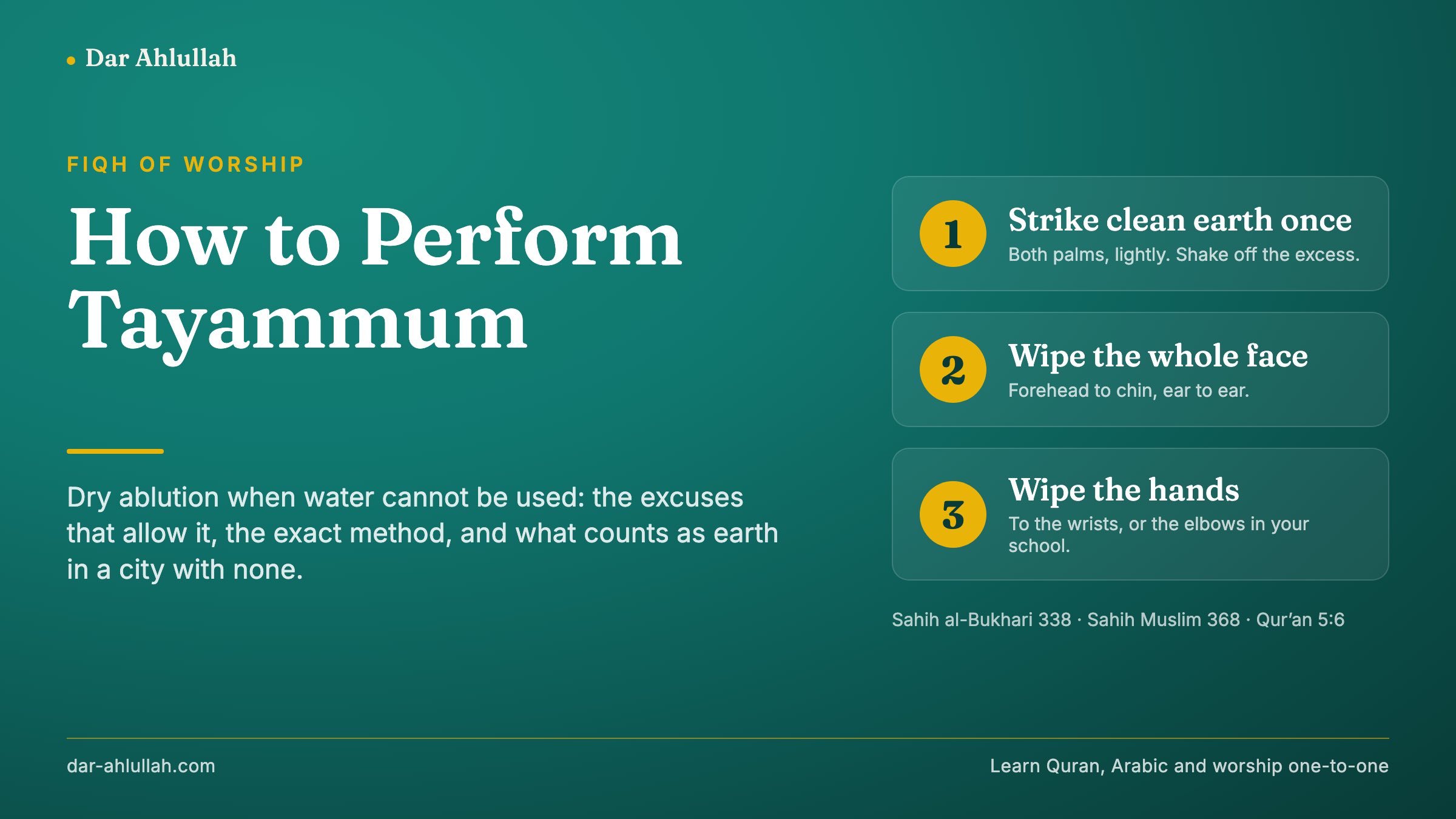
Table of Contents
- Introduction: The Prayer Is Due and There Is No Water
- The Short Answer
- What Tayammum Is, and Where It Comes From
- The Excuses That Allow It
- The Excuses That Do Not
- Running Out of Time: The Case Everyone Gets Backwards
- The Method, Step by Step
- One Strike or Two, Wrists or Elbows
- What Counts as Earth in a City
- Tayammum in Place of Ghusl
- How Long It Lasts, and What Ends It
- You Did Tayammum, Then Found Water
- Neither Water nor Earth
- Wounds, Dressings and Casts
- Six Situations, Worked Through
- Seven Mistakes People Keep Making
- How We Teach This
- Questions People Ask
- Conclusion: The Earth Was Made a Purifier
Introduction: The Prayer Is Due and There Is No Water
It is hour seven of a long-haul flight and Dhuhr has come in somewhere over the Atlantic. Or it is a hospital bed with a cannula in the back of your hand and a nurse who has asked you not to get it wet. Or it is a night in a tent, or a broken-down car on a motorway in January, and the only water is a half-empty bottle you are going to need to drink. The prayer is due. You know that wudu needs water, and you have a vague memory that there is something you can do with sand instead.
That vague memory is tayammum, and it is one of the most generous concessions in the whole of worship: when water cannot be used, clean earth takes its place, and the prayer goes ahead on time. The rule itself is short enough to learn in a minute. What is not short is everything around it, and that is where most people go wrong — in both directions. Some use tayammum when they should not, because the bathroom is far or the water is cold. Others never use it when they should, and skip the prayer or pray with a bad conscience, because they were taught the rule in a place where bare earth was always underfoot and nobody explained what to do in a carpeted building, a plastic aeroplane seat or a hospital ward.
This guide is written for that second problem, which is the problem of a Muslim in Europe or North America. It covers how to perform tayammum: the excuses that permit it and the ones that do not, the exact method and the two sound ways of doing it, what counts as earth when there is no earth, how long one tayammum lasts, what to do when you find water afterwards, and what to do when there is neither water nor earth at all. It assumes you already make wudu correctly. If you do not yet, start with our step-by-step guide to wudu, because tayammum is a substitute for something, and you need to know the something first. If the prayer itself is still new to you, our step-by-step guide to how to pray in Islam is the place to start, and this article sits in its salah library beside the other concessions.
One boundary before we begin. We teach Quran, Arabic and the practical fiqh of worship; we are not a fatwa body. Where the schools genuinely differ we will set the positions side by side rather than pick one and call it consensus, and where a situation needs a scholar who can hear its details, we will say so.
The Short Answer
- Tayammum replaces wudu and ghusl when water cannot be used — because there is none within reach, or because using it would harm you. It is not for inconvenience, cold, or being in a hurry.
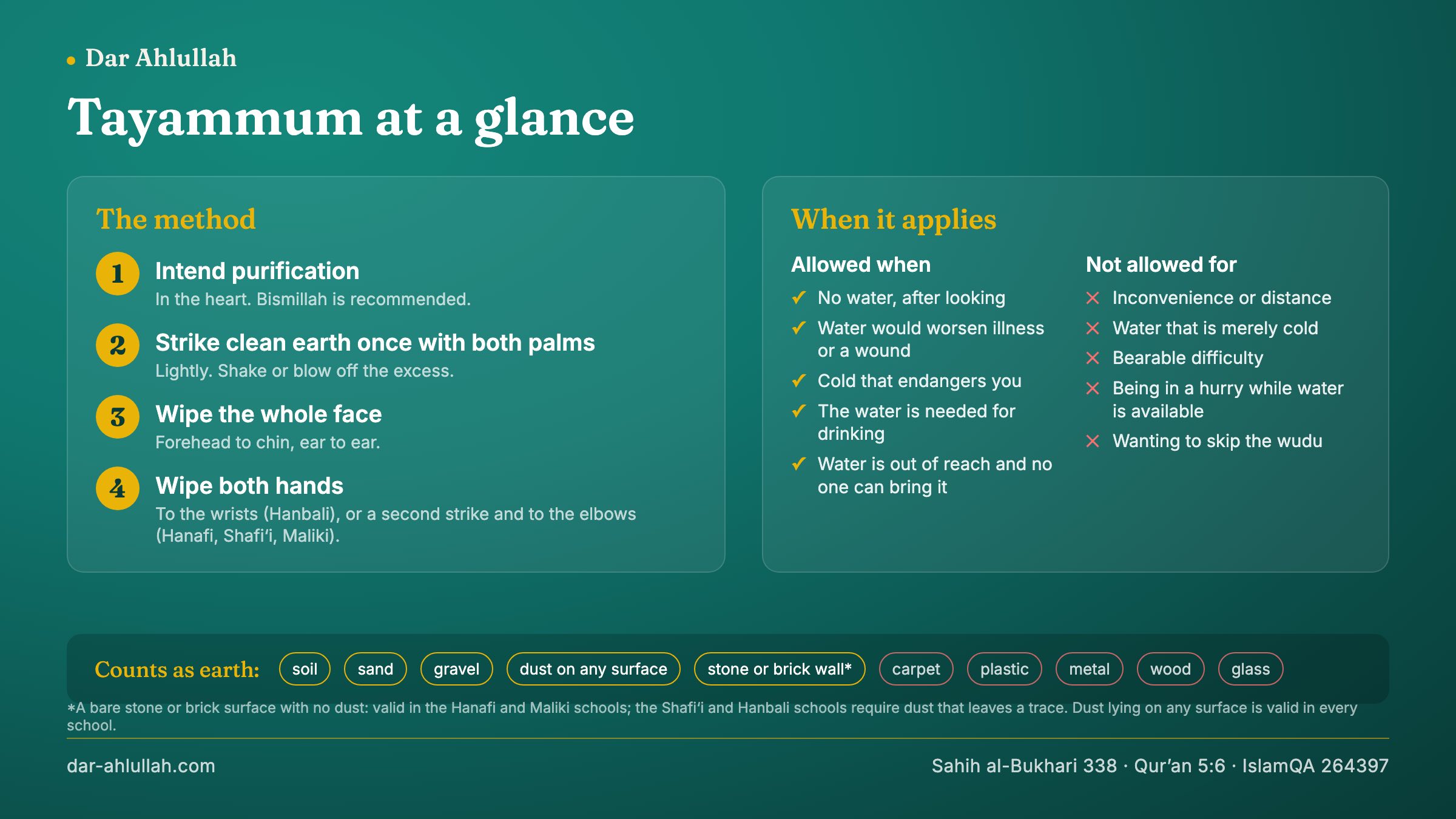
- The method is three moves. Intend purification, strike clean earth once with both palms and shake off the excess, wipe your whole face, then wipe your hands. That is the method the Prophet ﷺ taught with his own hands (Sahih al-Bukhari 338).
- “Earth” means soil, sand, stone and the like — not carpet, plastic, metal or cloth. Dust lying on any surface counts, because the dust is earth. Two schools also accept a bare stone or brick wall with no dust; two do not.
- It ends when anything that breaks wudu happens, or when water becomes usable. Whether one tayammum covers several prayers is a school question: yes in the Hanafi school, one obligatory prayer per tayammum in the Shafi‘i and Maliki schools.
- If there is neither water nor earth, pray as you are, on time, and do not repeat it. The prayer is never dropped because purification became impossible.
What Tayammum Is, and Where It Comes From
The word comes from a root meaning to aim at or head for something (Wikipedia: Tayammum); in the fiqh it means heading for clean earth, with the intention of purification, and wiping the face and hands with it. It is legislated in the Qur’an twice, in almost the same words. The fuller of the two comes at the end of the verse of wudu:
“And if you are ill, on a journey, or have relieved yourselves, or have been intimate with your wives and cannot find water, then purify yourselves with clean earth by wiping your faces and hands. It is not Allah’s Will to burden you, but to purify you and complete His favour upon you, so perhaps you will be grateful.” (Qur’an 5:6; see also 4:43)
The verse was revealed on a journey. ‘A’ishah’s necklace broke and was lost at a halt where there was no water; the Prophet ﷺ stopped the caravan to look for it, and the people, who had no water with them, complained to Abu Bakr about his daughter (Sahih al-Bukhari 334). Fajr came in with nobody able to make wudu, and the verse of tayammum came down. The concession, in other words, was born of exactly the situation this article is about: ordinary people, on the move, with the prayer due and no water anywhere.
The Prophet ﷺ counted it among the things given to his community and to no one before it: “The earth has been made for me a place for praying and a means of purification, therefore anyone of my followers can pray wherever the time of a prayer is due” (Sahih al-Bukhari 335; Sahih Muslim 521). And he set no limit on how long the substitute may stand in for the original: “Clean earth is a means of purification for a Muslim, even for ten years; but when you find water, make it touch your skin, for that is better” (Sunan Abi Dawud 332, graded sahih by al-Albani; also Jami‘ at-Tirmidhi 124 and Sunan an-Nasa’i 322).
Two things follow from that hadith and run through everything below. First, tayammum is a full substitute: a person who has made it is pure for prayer, for touching the mushaf, and for anything else that requires purity, for as long as the excuse lasts. Second, it is only a substitute. The moment water can be used, it must be.
The Excuses That Allow It
The Qur’an names two situations, illness and travel, and one condition, not finding water. The jurists read those together as a single principle — water cannot be used — and list the cases that fall under it (Fiqh us-Sunnah, Tayammum). Five matter in practice.
1. There is no water, after looking for it
The base case. You are somewhere without water — a road, a hillside, an aircraft — and you have made a reasonable search of what is around you. The search matters: the verse says “cannot find,” and finding presupposes looking. A man who came to ‘Umar saying he had become junub and had no water was told, on the Prophet’s own authority, to use the earth (Sahih al-Bukhari 338).
2. Using water would harm you
Illness or injury where water would make the condition worse, delay recovery or cause serious pain. The ruling is stated plainly: “if the sick person cannot do wudu with water because he is unable to or because he is afraid that it will make his sickness worse or delay his recovery, then he should do tayammum” (IslamQA 105356). This is the excuse that hospital patients, people with burns and dressings, and people with skin conditions that react to water fall under. If illness has also changed how you can stand and sit, our guide to how to pray when sick covers that side of it; the two concessions stack.
3. The cold would harm you
Not cold water as such, but cold that endangers. ‘Amr ibn al-‘As became junub on a freezing night on campaign, feared that a full bath would kill him, made tayammum and led his companions in Fajr. When the Prophet ﷺ asked him about it, he cited the verse “Do not kill yourselves, verily Allah is merciful to you,” and the Prophet laughed and said nothing (Sunan Abi Dawud 334, graded sahih by al-Albani). The excuse is the danger, not the discomfort. Cold water that can be warmed, or endured, is water.
4. The water is needed for something more urgent
You have water, but it is what you and the people with you will drink. Fiqh us-Sunnah lists preserving water for drinking, cooking or another necessity as a valid reason, and likewise fear for your life, family or property if you go to fetch it. The half-bottle in the broken-down car is for drinking; the prayer is made with tayammum.
5. The water is out of reach
Water exists but you cannot get to it: it is dangerously far, it is behind a locked door, you are immobile and there is nobody to bring it. The Standing Committee’s ruling on a hospital patient turns on exactly this point — and on its limit. If you could have asked a nurse or a visitor to bring water and did not, the excuse fails and the prayer is repeated (IslamQA 104172).
The Excuses That Do Not
The other half of the subject is shorter and matters more, because tayammum is much more often misused than missed.
- Inconvenience. The bathroom is on another floor; the tap is in a shared kitchen; you would have to take your socks off. None of these is inability. Ibn Baz called making tayammum when water is available “a great evil for which he must be rebuked,” and the principle is simply that water is obligatory “no matter where he is, so long as he is able to use it” (IslamQA 13618).
- Bearable difficulty. A patient who can make wudu with effort must make it: “if you are able to do wudu, even with some difficulty, but it is a normal level of difficulty that you can put up with … then you must use water and do wudu” (IslamQA 223543). The same answer points to the better concession for someone for whom wudu is hard but possible: combining two prayers on one wudu, which our guide to praying when ill explains.
- Cold that is merely unpleasant. Ibn Mas‘ud, at first, would not allow tayammum even for the junub person, for precisely this fear: “If we allowed it then they would probably perform tayammum with clean earth even if water were available but cold” (Sahih al-Bukhari 347). Abu Musa answered him with ‘Ammar’s hadith, and the concession stood — but Ibn Mas‘ud’s fear was about the abuse, and it was well founded.
- Being in a hurry. This one has a real exception inside it, and it needs its own section.
Running Out of Time: The Case Everyone Gets Backwards
Two situations look alike and are ruled opposite ways. The line between them is whether water is present.
Water is here, but wudu or ghusl would take you past the end of the time. You woke junub with a few minutes of Fajr left; the shower will take longer than that. The majority of scholars — ash-Shafi‘i, Abu Thawr, Ibn al-Mundhir and the Hanafis are named — hold that shortage of time is not an excuse for tayammum when water is available; you make ghusl and pray, even if the time has ended by then, and only al-Awza‘i and ath-Thawri permitted tayammum here (IslamQA 94311). The reasoning is that the time for a sleeper begins when he wakes: “there is no negligence when one is sleeping, rather there is negligence when one is awake.” The Maliki school is generally recorded as allowing tayammum for fear of the time running out (Wikipedia: Tayammum), so if that is your school, ask a Maliki teacher rather than settling it from here.
Water is not here, and by the time you could reach it the time will have ended. This is the opposite case and the ruling flips. Ibn Taymiyyah’s principle is that “the Muslim is enjoined to pray on time in whatever manner is possible,” and Ibn ‘Uthaymin’s that “it is not permissible to delay the prayer from its time at all. If someone is afraid that the time will end, he should pray according to his situation” (IslamQA 331783). On the plane, on the hillside, in the car: tayammum, and pray in the time. Do not sit on the prayer waiting for water that is an hour away.
Put the two together and the rule is: time pressure never makes available water unavailable, and it never makes an unavailable-water prayer wait.
The Method, Step by Step
The method comes from one incident. ‘Ammar ibn Yasir had become junub on an errand with no water, and, reasoning that a bath is to wudu what rolling is to wiping, he rolled in the dust like an animal and prayed. When he told the Prophet ﷺ, he was shown how little was actually needed: “It would have been sufficient for you to do like this.” Then the Prophet “stroked lightly the earth with his hands and then blew off the dust and passed his hands over his face and hands” (Sahih al-Bukhari 338; Sahih Muslim 368, where the wording is “he struck the ground with his hands once”).
That is the whole of it. In order:
- Intend to purify yourself for prayer. Intention is in the heart; nothing is said aloud. Saying bismillah at the start, as for wudu, is recommended.
- Strike clean earth once with both palms — a light tap, not a slap — then shake or blow off the excess so that you are not wiping mud onto your face.
- Wipe your whole face with both hands, forehead to chin, ear to ear.
- Wipe your hands. With the left palm over the back and sides of the right hand to the wrist, then the right over the left. Rings and watches come off or are moved so the wiping reaches the skin beneath.
The face is wiped before the hands, in the order of the verse. There is no wiping of the head, the arms above the point your school sets, or the feet, and no washing anywhere: tayammum is a wiping of two places and nothing else. It takes about ten seconds.
One Strike or Two, Wrists or Elbows
If you learned tayammum from a teacher and it looked longer than the four steps above, you learned the second sound way of doing it. There are two, resting on two hadiths.
The first is ‘Ammar’s hadith above: one strike, face, hands to the wrists. The second is a hadith in Sunan ad-Daraqutni, “Tayammum is two strikes: one strike for the face and one strike for the hands up to the elbows” (Utrujj: How to do tayammum), read alongside the fact that the same word, hands, in the verse of wudu means the arms to the elbows. The schools divide accordingly (Wikipedia: Tayammum):
| School | Strikes | How far the hands are wiped |
|---|---|---|
| Hanafi | Two: one for the face, one for the arms | To and including the elbows |
| Shafi‘i | Two | To and including the elbows |
| Maliki | Two; the first obligatory, the second recommended | Wrists obligatory; to the elbows recommended (the school records disagreement) |
| Hanbali | One, as in ‘Ammar’s hadith | To the wrists |
All four agree that the whole face is wiped and that the face comes first. If you follow a school, follow it. If you do not, the one-strike method is what the Prophet ﷺ demonstrated in the two Sahihs, and two strikes to the elbows is valid on every view and is what you will most often see in a mosque. Neither endangers the prayer.
What Counts as Earth in a City
This is the section that a guide written in a country with a courtyard of sand behind every house does not need, and it is the section that decides whether you can actually make tayammum in your flat, your office or seat 34C.
The verse says sa‘idan tayyiban, clean earth, and the jurists split on how far “earth” extends (IslamQA 264397):
- Hanafi and Maliki: anything that is of the earth’s substance — soil, sand, stone, rock, uncooked gypsum — whether or not it carries dust. Al-Kasani: “It is permissible to do tayammum using anything that is part of the earth’s surface.” A smooth stone with no dust is valid. One Hanafi authority, Muhammad ibn al-Hasan, required that particles actually stick to the hand, so even within the school there is a stricter reading.
- Shafi‘i and Hanbali: dust, meaning earth that leaves a trace on the hands. A bare polished stone is not enough.
- Ibn Taymiyyah allowed the other earth-materials when dust cannot be found, and Ibn ‘Uthaymin held the broadest view, “everything that is on the surface of the earth.” When dust is available, use dust: every school accepts it.
What every school excludes is anything that is not earth at all. The Hanafi ruling on a car interior puts it in one sentence: “Tayammum cannot be made with metal, cloth, rubber, etc. Tayammum can only be made with earth or anything that is from the species of the earth, e.g. soil, rock, stone” (IslamQA.org, Hanafi). The same source counts fired brick and clay in, and the test it gives is whether the thing burns to ash or melts: wood, plastic and glass do; earth does not.
Now the built environment, item by item:
| Surface | Does it count? |
|---|---|
| Bare soil, a garden bed, a sandy path, a gravel verge | Yes, in every school. Look for it first. |
| A bag or pot of clean soil or sand kept for the purpose | Yes, in every school. The Standing Committee tells hospital patients to keep earth “in a vessel or bag to use for tayammum” (IslamQA 104172). |
| Dust lying on any surface — a windowsill, a ledge, the top of a wardrobe, a car’s dashboard, an aircraft seat | Yes, in every school, because what you are striking is the dust, not the surface. On an aircraft the passenger “should do tayammum using the chairs of the airplane, if there is dust there” (IslamQA 10798) — and cabins are cleaned, so often there is not (IslamWeb 35636). |
| A bare stone, brick or unplastered concrete wall; a stone step; a paving slab; unglazed clay | Yes in the Hanafi and Maliki schools even without dust; in the Shafi‘i and Hanbali schools only if it carries dust. |
| Carpet, laminate, a plastic seat, a metal rail, a wooden table, glass, a painted or papered wall | No, in every school. Nothing here is earth. |
The practical upshot for a Muslim in a Western city is one habit: if your circumstances make tayammum a real possibility — a chronic condition, a long commute, frequent flights, a hospital stay coming up — keep a small bag of clean, dry soil or sand where you will have it. It weighs nothing, it is valid in every school, and it removes the whole search-for-a-surface problem before it starts.
Tayammum in Place of Ghusl
Tayammum stands in for the full bath exactly as it stands in for wudu, and the method is identical: one act of face and hands, not a rolling in the dust. That is the entire point of ‘Ammar’s story, and it is why the Prophet ﷺ showed him the method rather than telling him he had been right.
It came up again on a journey when a man stood apart from the congregation at Fajr. Asked why he had not prayed, he said he was junub and had no water; the Prophet ﷺ told him to use clean earth, and he made tayammum and prayed (Sahih al-Bukhari 344; Sahih Muslim 682). Abu Dharr, sent out with the camels and away from water for days at a time in a state of janabah, was given the “ten years” hadith as his answer, and its second half is the rule for what happens afterwards: “when you find water, make it touch your skin” (Sunan Abi Dawud 332). The ghusl is owed when water returns; the prayers made with tayammum in the meantime are not.
The one thing to be clear about is that tayammum for janabah is a substitute for the ghusl, not a substitute for wudu on top of it. You make one tayammum and you are pure for prayer.
How Long It Lasts, and What Ends It
Three things end a tayammum (SeekersPath, Hanafi; Fiqh us-Sunnah):
- Anything that breaks wudu. Tayammum is not more durable than the thing it replaces. Our guide to what breaks wudu is the list, and it applies unchanged.
- Water becoming usable. Finding it, if you had none; or becoming able to use it, if you were ill. The Hanafi text is blunt: “it is also nullified by sighting water.”
- The excuse ending for any other reason — the cold night is over, the wound has healed, you have landed.
Then the school question that catches people out. Does one tayammum cover several prayers?
- Hanafi school, and one of the narrations from Ahmad: yes. A tayammum stands until one of the three things above happens, like a wudu, and you may pray with it “as many obligatory and optional prayers as desired.”
- Shafi‘i and Maliki schools: one obligatory prayer per tayammum. “Only one obligatory prayer may be offered with one dry ablution”; a fresh one is made before each fard, with any number of voluntary prayers on it in between. An-Nawawi records this as the view of several Companions, among them ‘Ali, Ibn ‘Abbas and Ibn ‘Umar (SeekersGuidance, Shafi‘i fiqh).
Both views have their evidence and both are followed by large parts of the community. What matters in practice is that you know which you are following, so that a Shafi‘i does not carry a Fajr tayammum through to Dhuhr, and a Hanafi does not think a valid prayer was invalid because he did not renew it. Renewing it is ten seconds and is valid on every view.
You Did Tayammum, Then Found Water
Three timings, three answers.
Before you have prayed. The tayammum is finished; make wudu and pray. Water usable is the end of the excuse, and Dar al-Ifta records this as the position of all four schools (Dar al-Ifta 23955).
After you have prayed, still inside the time. The prayer stands and is not repeated. Two men on a journey made tayammum and prayed, then found water within the time; one repeated the prayer with wudu and the other did not. The Prophet ﷺ told the one who did not repeat, “You followed the sunnah and your prayer was enough for you,” and the one who did, “For you there is the double reward” (Sunan Abi Dawud 338, graded sahih by al-Albani; Abu Dawud notes a question over one link of its chain). Repeating is permitted and rewarded; not repeating is the sunnah. If the tayammum stood in for ghusl, the ghusl is now owed for the prayers ahead, not the one behind.
During the prayer. The rulings above all concern water found before or after the prayer. On water found in the middle of it, the schools differ over whether the prayer is completed or broken and begun again with wudu, and the difference is real. This is a question for a teacher who knows your school, not for a guess; nothing you have already prayed is affected either way.
Neither Water nor Earth
The clean aircraft seat. The hospital bed with a drip in your hand, a painted wall, and nobody to ask. A carpeted room with a locked door. There is no water and there is nothing that counts as earth. What now?
You pray, as you are, on time, and you do not repeat it. This is the position of ash-Shafi‘i, Ahmad and the majority; Ibn Qudamah gives the reason — purification “is one of the conditions of prayer which is waived when one is unable to do it … and he did what he was obliged to do as best he could, so he does not have to repeat it” — and Ibn al-Qayyim the principle, that Allah does not burden a soul beyond its scope (IslamQA 5430). The aircraft ruling applies it directly: with no water and no dust, “he should pray even if he is not tahir, because he is unable to purify himself” (IslamQA 10798).
Two guards on it. First, the inability has to be real: the hospital ruling repeats the prayer of a patient who could have asked for help and did not (IslamQA 104172). Second, it is a last resort, and the same aircraft ruling gives the resort before it: if the plane lands within the time of a prayer that can be combined with the one that is due, delay Dhuhr to pray it with ‘Asr on the ground, with water. Combining on a journey is explained in our guide to how to pray while traveling. If you cannot combine and cannot purify, pray. The prayer is never the thing that is dropped.
Wounds, Dressings and Casts
A wound is the case that tayammum was, in one famous incident, misapplied in the other direction. A man on a journey took a stone to the head, then became junub. He asked his companions whether there was a concession for him to make tayammum; they said there was none while he could use water. He bathed, and died. The Prophet ﷺ said: “They killed him, may Allah kill them! Could they not ask when they did not know? The cure for ignorance is inquiry. It was enough for him to perform tayammum and to pour some drops of water or bind a bandage over the wound, then wipe over it and wash the rest of his body” (Sunan Abi Dawud 336; also Sunan Ibn Majah 572). The grades printed on this report are split: al-Albani graded both hasan, while Shu‘ayb al-Arna’ut and Zubair ‘Ali Za’i graded the Abu Dawud chain da‘if. The schools nonetheless agree on the ruling it describes, and the line “the cure for ignorance is inquiry” is the best one-sentence summary of this whole subject.
The practical rule for an injured limb is a ladder (IslamQA 69796): wash it if washing does no harm; wipe it with a wet hand if washing harms but wiping does not; make tayammum for that part if even wiping harms. If the wound is under a dressing, plaster or cast, wash the rest of the body normally, then wet your hand and wipe over the dressing, and no tayammum is needed on top of it. Do not take a dressing off to make wudu. A cast over a specific part of a specific limb is a detail question; put it to a scholar who can see it.
Six Situations, Worked Through
The long-haul flight
Dhuhr comes in mid-flight. The galley has water, and if you can wash in the lavatory, that is wudu, and there is no tayammum question at all. If the lavatory is out of use or the seatbelt sign will not lift, check whether you land within the time of ‘Asr: if so, combine on the ground with water. If not, look for dust — the seat, the window ledge, the floor — and make tayammum on it. If there is none, pray seated in your place, as you are, and do not repeat.
The hospital ward
You cannot get out of bed and cannot get the cannula wet. Ask: for a bowl of water and a hand to help, or for a relative to bring a bag of soil, which the Standing Committee tells patients to keep by them. Tayammum on the soil, wipe over the dressing, and pray in whatever position you can. If you asked and nobody could help, pray as you are. If you did not ask, the prayer is repeated.
The winter breakdown
Isha, a motorway hard shoulder, one bottle of water and a two-hour wait. The water is for drinking; the verge is gravel and soil. Tayammum on the verge and pray by the car. When you get home, wudu as normal for whatever comes next; nothing is owed for Isha.
The office on the fourth floor
‘Asr is in; the only sink is a shared kitchen two floors down and it is awkward to wash your feet there. This is inconvenience, not inability. Go down, make wudu, and if wiping over socks is available to you on your school’s conditions, use it. Tayammum here would be the “great evil” of Ibn Baz’s answer.
Waking late and junub
Ten minutes of Fajr left, and you need ghusl. On the majority view, make the ghusl and pray, even if the sun rises during it; your time began when you woke. On the Maliki view, tayammum may be made to catch the time. Know which you follow before the morning it happens.
The burn on the hand
A dressing on the right hand that must stay dry for a week. Wudu is made with water on everything else; the dressing is wiped over with a wet hand; no tayammum. If the hand cannot be wiped either, tayammum for that hand and water for the rest. The prayers are prayed on time throughout.
Seven Mistakes People Keep Making
- Rolling in it. ‘Ammar’s mistake, corrected by the Prophet ﷺ himself. Face and hands; nothing else.
- Using it for convenience. Cold, distance, an awkward sink, a hurry: none is an excuse while water is usable.
- Never using it. Skipping the prayer, or carrying a bad conscience through it, in a situation the Qur’an itself named. The concession exists to be used.
- Making it on carpet or plastic. Earth means earth. Find dust, find a stone, or carry soil.
- Waiting for water and losing the time. If water cannot be reached inside the time, tayammum and pray. The time is not negotiable; the water is.
- Assuming your school’s rule on duration is everyone’s. One tayammum per fard is the Shafi‘i and Maliki rule, not the Hanafi one, and the reverse. Neither side is doing it wrong.
- Not asking. The travellers who told the wounded man there was no concession did not know, and did not ask. Every situation in this article that turned on a detail — a cast, a school, a mid-prayer discovery of water — is one where a two-minute question to a teacher is worth more than an hour of guessing.
How We Teach This
Tayammum is a page of fiqh and, once understood, rarely needs a teacher again. What does need one is the layer underneath: knowing which school’s method and duration rule you follow and why, so that the plane, the ward or the January hard shoulder is not the first time you think about it. In our fiqh-of-worship lessons it is taught alongside wudu and the prayer itself, with the situations above worked through as you would actually meet them in a European or American city.
Dar Ahlullah runs one-to-one live sessions with certified teachers, scheduled in your own timezone. Teaching is charged at $9 per teaching hour, with monthly plans at $36, $70 and $102 depending on how many hours you want, and a 20% discount for siblings. You can pause, upgrade or switch plans at any time, and if a teacher is not the right fit we rematch you with another certified mentor at no extra cost. If you would like to see where your wudu and prayer stand before committing to anything, the 30-minute assessment is free and does not ask for a card — the details are on our pricing page.
Questions People Ask
What is tayammum?
Purification with clean earth in place of wudu or ghusl, when water cannot be used. You intend, strike clean earth once with both hands, wipe your face, and wipe your hands. It makes you pure for prayer and for everything else that requires purity, for as long as the excuse lasts.
Can I do tayammum if the water is just very cold?
Not unless the cold would genuinely harm you and the water cannot be warmed. ‘Amr ibn al-‘As’s excuse was fear of death, not discomfort. Cold that can be endured is water that can be used.
Can I make tayammum on a wall, a carpet or a car seat?
On a bare stone, brick or concrete wall, yes in the Hanafi and Maliki schools, and in the other two if it carries dust. On carpet, cloth, plastic, metal, wood or glass, no, in any school. Dust lying on any of those surfaces counts, because the dust is earth.
Does one tayammum cover several prayers?
In the Hanafi school, yes, until something breaks it or water becomes usable. In the Shafi‘i and Maliki schools, one obligatory prayer per tayammum, with any number of voluntary prayers on it. Renewing it costs ten seconds and is valid on every view.
Can tayammum replace ghusl?
Yes, with exactly the same method: one act of face and hands. When water becomes available the ghusl is then made, but the prayers already prayed with tayammum are not repeated.
I did tayammum and prayed, then found water. Do I repeat the prayer?
No. The Prophet ﷺ told the man who did not repeat that he had followed the sunnah and his prayer sufficed him (Sunan Abi Dawud 338). Repeating is permitted and was called a double reward, but it is not required.
Can I do tayammum because I am late for work and wudu takes too long?
No. Shortage of time is not an excuse while water is available. The only time-based case is the opposite one: water cannot be reached before the prayer’s time ends, in which case tayammum is made so that the prayer is not delayed.
Can I touch the mushaf or pray sunnah prayers with tayammum?
Yes. A valid tayammum permits everything a wudu permits, for as long as it stands. The only school-dependent limit is on how many obligatory prayers one tayammum covers.
What if there is no water and nothing that counts as earth?
Pray as you are, on time, and do not repeat it, provided the inability was real and you could not get help. If the situation will end inside the time of a prayer that can be combined with the one that is due, delay to combine with water; if not, pray.
Conclusion: The Earth Was Made a Purifier
The fiqh of tayammum is one verse and one demonstration. When water cannot be used, clean earth takes its place; and when ‘Ammar rolled in the dust to be sure, the Prophet ﷺ showed him that a light touch of the palms, a wipe of the face and a wipe of the hands was all that was ever asked. Everything else in this guide is the boundary of that concession — real inability on one side, real availability on the other, the prayer’s time held fixed in the middle — and the answers to the questions a city puts to it, where the earth is under concrete and the dust has been vacuumed away.
Keep the three moves in your hands, a bag of soil in your drawer if your life calls for it, and the rule in your head that the prayer is never the thing that is dropped. Then the next time Dhuhr comes in over the Atlantic, you will know exactly what to do. If you want the rest of the prayer in the same detail, the salah library links every guide we have written on it.
Related articles
how to pray when sick
How to Pray When Sick: Sitting, Lying Down, and Praying by Gesture
Illness does not remove the prayer or shorten it. It moves you down a fixed ladder of positions — stand, sit, lie on your side — and the whole subject is knowing which rung your body is actually on today.
24 min read
what invalidates salah
What Invalidates Salah: The Things That Really Break Your Prayer
Four things end a prayer: a precondition falls away, something foreign is added, a structural part is deliberately dropped, or the intention is withdrawn. Almost everything else people restart prayers over is on neither that list nor close to it.
19 min read
what breaks wudu
What Breaks Wudu? The Agreed List and the Disputed
Three things break wudu by the agreement of all four schools. Four more are genuinely disputed, and your answer depends on which school you follow. Almost everything else people worry about — food, dirt, a nosebleed, a doubt — does not break it at all.
19 min read