
how to pray istikhara
How to Pray Istikhara: The Prayer Before a Decision
Dar Ahlullah team 23 min read
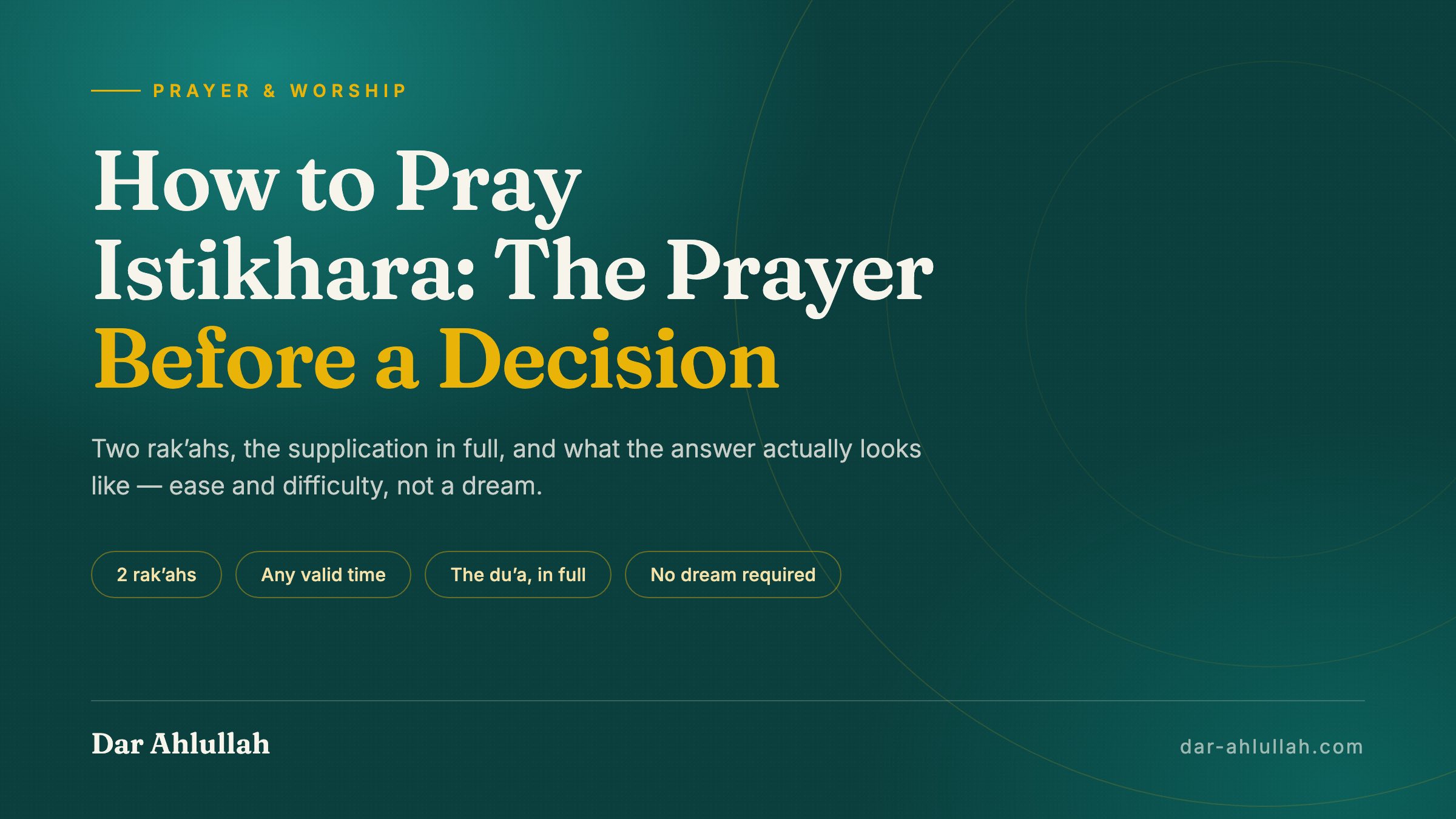
Table of Contents
- Introduction: The Decision Nobody Can Make For You
- The Short Answer
- What Istikhara Actually Is
- What Istikhara Is Not For
- How to Pray Istikhara, Step by Step
- The Du’a, in Full
- Do You Have to Recite Specific Surahs?
- When You Can Pray It
- When You Cannot Pray At All
- The Half Everyone Skips: Asking People
- What the Answer Actually Looks Like
- The Dream Question, Settled
- When Nothing Becomes Clear
- Praying It More Than Once
- Nobody Can Do It For You
- Istikhara Against a Deadline
- Doing This Without Arabic
- What Istikhara Does Not Change
- Seven Mistakes People Keep Making
- How We Teach This
- Questions People Ask
- Conclusion: Pray, Ask, Then Move
Introduction: The Decision Nobody Can Make For You
The offer letter has a reply-by date on it. Taking it means a different city, a different masjid, a school run you have not tested, and a salary that is better in a way you are not certain justifies any of the rest. You have made the list of pros and cons twice and it comes out level both times, which is the specific kind of level that means the list was never going to decide it.
Someone tells you to pray Istikhara. So you look it up, and within four search results you have been told that you must recite two particular surahs, that you should pray it just before sleeping, that the answer arrives as a dream, that seeing white or green means yes and black means no, and that if you are unsure you can pay a shaykh online to perform it on your behalf. One of those five statements is a scholarly recommendation. The rest range from unfounded to something you should close the tab on.
This article sets out how to pray Istikhara the way the hadith actually teaches it: two rak’ahs, a supplication whose full text is below, and a matter you name out loud. Then it deals with the part the hadith pairs it with and almost every guide drops — going and asking people who know — and with the problems that come specifically with making a decision as a Muslim in Britain, Germany or the United States, where the pool of people qualified to advise you may be exactly nobody within an hour’s drive.
One boundary first. We teach Quran, Arabic and the practical fiqh of worship; we are not a fatwa body, and we do not resolve anyone’s actual decision. Where the schools differ we say so. If the five daily prayers are still new to you, our complete guide to salat covers the obligatory sequence, and Istikhara is prayed on top of that rather than in place of it. If you are early in your practice generally, the first ninety days guide puts the voluntary prayers in a sensible order of priority.
The Short Answer
- What it is: two rak’ahs of voluntary prayer followed by a specific supplication, asking Allah to choose for you between options you cannot decide between.
- The evidence: a single well-known hadith of Jabir ibn ‘Abdullah, in which the Prophet ﷺ taught Istikhara for all matters “as he taught us the surahs of the Qur’an”.
- When: any time the prayer itself is valid. It does not belong to the night, and there is no requirement to pray it before sleeping.
- What you say: the du’a below, after the salam, naming the actual matter.
- What the answer is: ease and difficulty in how things then unfold, plus your own inclination after you have done the research. Not a dream, and not a colour.
- What you do next: consult people who know, check the facts, and then act. Istikhara does not remove the obligation to think.
- The one real trap: treating it as a fortune-telling mechanism that will save you from deciding. It is a prayer of entrusting a decision, not of outsourcing one.
What Istikhara Actually Is
The word comes from a root meaning to seek what is good — khayr. Istikhara is asking Allah to select the better of two courses, not asking Him to reveal the future.
The whole practice rests on one hadith, which is unusually clean as fiqh evidence goes. Jabir ibn ‘Abdullah reported that the Prophet ﷺ used to teach the Companions Istikhara in all matters as he taught them the surahs of the Qur’an, and then gave them the words (Sahih al-Bukhari 1166). Two details in that sentence are worth pausing on. In all matters — not only the enormous ones. And as he taught the surahs — that is, as a fixed text to be learned by heart, not as a general idea to be improvised.
The category is voluntary. Nothing is owed if you never pray it, and no decision is invalid for having been made without it. What it does is change the posture you take into a decision. The Qur’an is blunt about how little any of us can see from where we stand: “Perhaps you hate a thing and it is good for you; and perhaps you love a thing and it is bad for you. And Allah knows, while you know not” (2:216). Istikhara is that verse turned into an action. You are conceding, in words, that your ranking of the options may be exactly backwards, and asking the One whose ranking is not.
Notice also what the supplication does not ask for. It never asks to be told which option is better. It asks for the better one to be brought about and the worse one taken away. That is a request for a change in your circumstances, not for a message. Almost every misunderstanding of Istikhara starts by getting this one thing the wrong way round.
What Istikhara Is Not For
Ibn Abi Jamrah, commenting on the hadith, drew the boundary that most later scholars use: Istikhara belongs to permissible matters, and to choosing between two things that are both encouraged. There is no need for it in an obligation, and none in something forbidden or disliked, because the answer in those cases is already known (cited in IslamQA 2217).
That rules out more than people expect:
- Obligations. You do not pray Istikhara about whether to pray Fajr, whether to fast Ramadan, or whether to be honest in a contract. Praying about a settled obligation is not piety; it is hesitation dressed up.
- Forbidden things. There is no Istikhara for whether to take an interest-bearing loan or enter a haram relationship. A prayer cannot be used to seek permission for what has already been refused.
- Trivia. The hadith says all matters, and scholars have read that generously, but the practice is aimed at a decision you genuinely cannot resolve. Praying two rak’ahs over which of two identical kettles to buy is not the Sunnah being taken seriously.
- Decisions you have already made. If you know what you are going to do and want the prayer to bless it retroactively, what you want is du’a, and du’a is available to you at any moment without ceremony.
What it is for: a job offer, a marriage proposal, a move, a course of study, a medical option, a business decision, which of two schools to enrol a child in, whether to take the mortgage the scholars in your country have differed over. Real forks, both roads permissible, neither obviously better.
How to Pray Istikhara, Step by Step
The mechanics are short. If you can pray two rak’ahs of any voluntary prayer, you already know almost all of this.
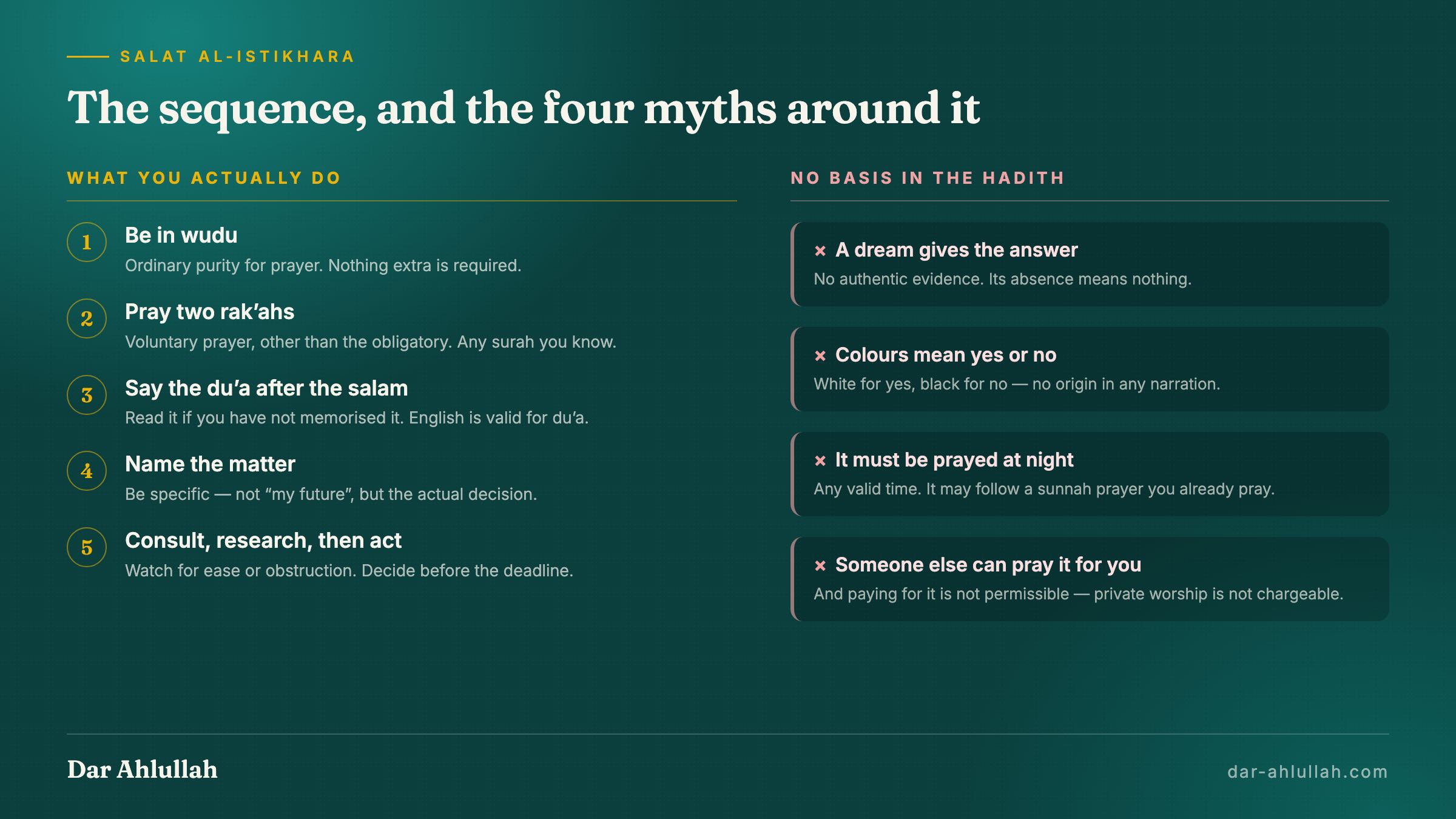
- Be in wudu. Ordinary purity for prayer, nothing additional. If you are unsure whether yours is still valid, our guide to what breaks wudu lists the nullifiers.
- Have the matter clear in your mind. One matter. If you are weighing three options, the cleanest approach is to narrow to a specific question you can name in a sentence.
- Intend two rak’ahs of voluntary prayer. The intention is in the heart; there is nothing to say aloud. The hadith says two rak’ahs “other than the obligatory prayer”.
- Pray them normally. Al-Fatihah in each rak’ah, then whatever else you know. Same postures, same recitations, same closing as any two-rak’ah prayer — the sequence is in our guide to what is said in salah if you need the words in order.
- Say the salam. The supplication comes after the prayer has ended, not inside it.
- Recite the du’a. The full text is below. Raise your hands if you wish; this is ordinary supplication and the ordinary etiquette applies.
- Name the matter. At the point in the du’a where it says “this matter”, say what it actually is — the narration ends with the instruction that he should mention his need. Out loud or silently, in Arabic or in your own language. Be specific: not “my future”, but “taking the position in Leeds”.
- Then get up and do the work. Research, ask, check. The next section on consultation is not an optional extra; it is the other half of the Sunnah.
The Du’a, in Full
Here is the supplication as it appears in the hadith of Jabir. Learn it if you can — it was taught to be memorised — but reading it from a page or a phone screen is entirely acceptable and always has been.
Allahumma inni astakhiruka bi-‘ilmika, wa astaqdiruka bi-qudratika, wa as’aluka min fadlika al-‘azim. Fa-innaka taqdiru wa la aqdiru, wa ta‘lamu wa la a‘lamu, wa anta ‘allamu-l-ghuyub.
Allahumma in kunta ta‘lamu anna hadha-l-amra khayrun li fi dini wa ma‘ashi wa ‘aqibati amri, faqdurhu li wa yassirhu li thumma barik li fih.
Wa in kunta ta‘lamu anna hadha-l-amra sharrun li fi dini wa ma‘ashi wa ‘aqibati amri, fasrifhu ‘anni wasrifni ‘anhu, waqdur liya-l-khayra haythu kana thumma ardini bih.
In English:
O Allah, I seek Your guidance by Your knowledge, and I seek ability by Your power, and I ask You of Your immense bounty. For You have power and I have none, and You know and I do not know, and You are the Knower of the unseen.
O Allah, if You know that this matter is good for me in my religion, my livelihood and the outcome of my affair, then decree it for me, make it easy for me, and bless me in it.
And if You know that this matter is bad for me in my religion, my livelihood and the outcome of my affair, then turn it away from me and turn me away from it, and decree for me what is good wherever it may be, and then make me content with it.
Three things in that text repay a second reading.
First, the criteria. Good is defined as good for your religion, your livelihood and the outcome of your affair. Not good for your comfort, your standing or your five-year plan. You are asking to be given what serves your faith and your end, and those are not always the option that looks better on paper.
Second, the symmetry. If the thing is bad, you ask not only that it be turned away from you but that you be turned away from it. That is a request to have your own wanting changed — which is why a shift in how you feel about an option, days later and for reasons you cannot fully articulate, is not a coincidence to be argued with.
Third, the last clause: then make me content with it. The prayer ends by asking for contentment with an outcome you have not seen yet and did not choose. Nobody prays that sentence honestly and still expects the prayer to function as a prediction.
Do You Have to Recite Specific Surahs?
You will read almost everywhere that you should recite Surah al-Kafirun in the first rak’ah and Surah al-Ikhlas in the second. Here is the accurate position: that is a recommendation from scholars, considered mustahabb by many of them for the thematic fit — renouncing every other object of reliance, then affirming the oneness of the One you are relying on — but it is not part of the hadith of Jabir, and no particular surah is specified there. Any surah you know is valid.
This matters practically. A new Muslim four months into learning to read, or an adult who has al-Fatihah and three short surahs, sometimes delays praying Istikhara at all because they think they need to have memorised something first. They do not. Pray with what you have. If you would like to add those two surahs later because scholars have recommended them, that is a good thing to work towards, and it is a small memorisation project — six verses and four.
When You Can Pray It
Istikhara is not a night prayer. There is no basis for the widespread idea that it must be prayed just before sleeping, and that idea only survives because it is attached to the belief that the answer arrives as a dream, which we deal with below.
You may pray it whenever voluntary prayer is valid. The one general restriction is the three times at which the Prophet ﷺ forbade praying — ‘Uqbah ibn ‘Amir reported them as the moments when the sun is rising until it is fully up, when it stands at its height at midday until it passes the meridian, and when it draws near to setting until it has set (Sahih Muslim 831). Those windows are short, and the schools differ on how strictly they apply to a prayer prayed for a reason. If your decision is urgent, this is not the obstacle it looks like.
There is also a convenience most people never hear about. Al-Nawawi held that a person may pray the Istikhara supplication after two rak’ahs of a regular sunnah prayer — the two before Zuhr, for instance — or after any voluntary prayer, rather than setting aside a separate one (IslamQA 2217). For anyone whose day is broken into fragments, that is worth knowing: the sunnah rak’ahs you already pray can carry it.
If you live far enough north that Isha and Fajr are calculated rather than observed for part of the year, the prohibited windows around sunrise and sunset shift with everything else, and in high summer they can compress oddly. Our guide to prayer times at high latitude explains how those timings are derived where the sun does not behave.
When You Cannot Pray At All
A woman who is menstruating cannot pray the two rak’ahs. She does not have to postpone the decision until she can. Al-Nawawi’s position is that if a person is unable to pray, they may still recite the supplication of Istikhara, and Ibn Baz gave the same ruling explicitly for menstruation and for urgent matters: the du’a is made without the prayer, and there is nothing wrong with that (IslamQA 408677).
The same latitude covers the other cases that come up in ordinary Western life. You are in the meeting and the answer is needed in ten minutes. You are on a ward. You are in a car park with no clean place to pray and a phone call to return. Make the du’a. The prayer is the preferred form; the supplication is the substance, and it is not withheld from anyone who cannot get to a prayer mat.
The Half Everyone Skips: Asking People
Istikhara has a twin, and the twin is istisharah — consultation. They are meant to be done together, and the guides that reduce Istikhara to a ritual you perform alone at midnight have quietly deleted half of it.
Al-Nawawi’s recommendation is that before praying Istikhara, a person should consult someone they know to be sincere, caring and experienced (IslamQA 11981). Note the order. Ask first, then pray. The prayer is not a substitute for the enquiry; it is what you do having made the enquiry and still found the matter unresolved.
The Qur’an is emphatic about the same pairing. The Prophet ﷺ himself was instructed to “consult them in the matter” and then, “when you have decided, rely upon Allah” (3:159). Consultation, decision, reliance — in that sequence. And among the qualities of the believing community: “whose affair is determined by consultation among themselves” (42:38). Deciding alone is not the Islamic default; it is what we have drifted into.
Which raises the problem this article exists to address. If you are one of a handful of practising Muslim families in a northern English town or a Midwestern suburb, “consult someone sincere, caring and experienced” is easy to write and hard to do. There may be no imam who knows you personally, no elder who has done the thing you are about to do, and a family who converted after you did or has not converted at all.
Some practical substance for that situation:
- Split the question by expertise, not by piety. The fiqh part of a decision — is this contract permissible, does this arrangement count as riba — goes to a qualified scholar, and it can go by email or a reputable fatwa service. The worldly part — is this a good school, is this employer decent — goes to whoever actually knows, and their religion is irrelevant to that question.
- Sincere and caring outranks credentialled. Al-Nawawi’s three conditions are about character and experience, not titles. A colleague who has made the same move and has no reason to flatter you is a legitimate counsellor.
- Ask people who will tell you no. The value of consultation is entirely in its capacity to change your mind. Assembling a panel that agrees with you is theatre.
- Distance counts. A teacher who knows you well over a year of weekly video calls knows you better than an imam who has seen you at Jumu’ah for a year without a conversation. Use the relationships you actually have.
What the Answer Actually Looks Like
Go back to the wording of the du’a. You asked for the good thing to be decreed and made easy, and for the bad thing to be turned away. It follows that the response, when it comes, shows up in circumstances rather than in signals.
That is precisely how the scholars describe it. Ibn Taymiyyah’s formulation is quoted widely: if a person makes Istikhara, then whatever Allah makes him feel content with and makes easy for him is what has been chosen for him. Ease after the prayer is the indication to proceed; obstacles and difficulty are an indication of being pushed away from it (IslamQA 5882).
In practice that looks disappointingly ordinary. The flat you were unsure about is let to someone else before you call back. The employer answers the awkward question straightforwardly and the discomfort you could not name resolves. Or the opposite: three separate things go wrong in a fortnight, each individually explicable, and collectively they read as a road closing.
Two cautions, because this is where people over-read.
First, difficulty is not automatically a no. Everything worth doing has friction in it, and a hard marriage negotiation or a stressful house purchase is not a verdict. What the scholars describe is a pattern over time, not the first inconvenience.
Second, ease is not automatically a yes. Haram things are often extremely easy. The criteria in the du’a are religion, livelihood and outcome, in that order, and a smooth path towards something that damages your religion has not answered the prayer you actually made.
The Dream Question, Settled
The most persistent belief about Istikhara is that you pray it, go to sleep, and are shown the answer. Some versions add a colour code: white or green for yes, black or red for no.
There is no authentic evidence for any of it. IslamQA states the position directly, naming the dream requirement as one of the myths widespread among people, and adds that the Prophet ﷺ told us to pray Istikhara and consult others, not to rely on what is seen in dreams (IslamQA 72255). The colour scheme has no origin in any hadith at all.
It is worth being clear about why this matters, because “it is just a harmless extra belief” is the usual defence. It is not harmless. It produces three failures reliably:
- Paralysis. People who dream nothing conclude they were not answered, and pray again, and again, and let the decision drift past its deadline while waiting for a sign that was never promised.
- Self-deception. A person who badly wants an outcome will find it in almost any dream. A mechanism this elastic can ratify anything, which means it decides nothing.
- Exploitation. The dream belief is the entire commercial basis of the paid Istikhara industry, which we come to in a moment.
None of this means a true dream is impossible. Righteous dreams are part of the tradition. But a dream is not the promised mechanism, its absence is not a failure, and no decision should be waiting on one.
When Nothing Becomes Clear
This is the situation almost nobody prepares people for, and it is by far the most common. You prayed, you asked, you researched, and a week later the two options are still level.
The ruling is more freeing than most people expect. If a person has prayed Istikhara and done his best to find out what is best — consulting people, examining the issue, asking those with experience — and then goes ahead and does it, it is hoped that this will be what is best for him, even if he does not feel at ease in his heart at the beginning (IslamQA 72255).
Read that again if you have been stuck. The absence of certainty is not a bar to acting. You are not required to feel peaceful. You are required to seek guidance, do your due diligence, and then choose — and the choosing is yours. Istikhara was never a device for removing the responsibility of a decision from the person who has to live with it. It is the means by which that responsibility is carried out under Allah’s knowledge rather than only your own.
“And whoever relies upon Allah — then He is sufficient for him” (65:3). Reliance is what happens after the decision, not instead of it.
Praying It More Than Once
You may. There is no fixed number and no set period; it is recommended to repeat the prayer and the supplication until the matter becomes clear (IslamQA 5882).
You will also hear that it should be repeated seven times. That specific number rests on a narration which hadith scholars have graded weak, and it is best treated as a pious custom rather than a Sunnah with an established basis. Repeating Istikhara is good. Repeating it exactly seven times is not a requirement, and failing to reach seven has not invalidated anything.
The practical caution runs the other way. Repetition becomes a problem when it is a way of not deciding — praying a ninth time in the hope of a different feeling, while the deadline approaches. If you have prayed, consulted and researched, and you are now repeating mainly to postpone, the ruling in the previous section applies: act.
Nobody Can Do It For You
Search for Istikhara in English and you will find services offering to perform it on your behalf, sometimes for a fee, often with a promised turnaround and a dream-based reading at the end. Some are decorated with the vocabulary of spiritual healing; some come with a WhatsApp number and a price list.
Two points, in order of importance.
First, the fee. Scholars are clear that private acts of worship — prayer, supplication — cannot be charged for. That alone disposes of the paid model regardless of what one holds about the underlying question.
Second, the practice itself. The stronger position among scholars is that Istikhara is not performed on behalf of another person: there is nothing from the Prophet ﷺ or the Companions indicating that anyone asked someone else to do it for them, and the hadith addresses the person facing the matter directly — when one of you is concerned about a matter (IslamQA 134612). Some scholars have permitted a relative or a person of insight making the du’a for someone, but even on the permissive view the person’s own Istikhara is what is called for.
The reasoning is not merely technical. The du’a asks for the matter to be made easy for me, and for me to be made content with the outcome. It is addressed in the first person because the person praying it is the one who will live inside the consequences. Somebody paid to say those words on your behalf is not the referent of a single one of them.
If you cannot pray the two rak’ahs right now, the ruling in the earlier section applies: say the du’a. What is not available is having someone else do it while you wait for their verdict.
Istikhara Against a Deadline
Real decisions come with dates. The offer expires Friday. The property goes to sealed bids on Monday. The family expects an answer after Jumu’ah. And the Istikhara advice circulating online is built around an unhurried timeline nobody actually has.
A sequence that fits a real week:
- Day one, before anything else, gather facts. Most decisions that feel unresolvable are actually under-researched. Establish what you do not yet know and go and find it out.
- Day one or two, consult. Two or three people, chosen for knowledge of the specific question rather than general standing, at least one of whom is likely to disagree with you.
- Then pray Istikhara. Attached to a sunnah prayer you are already praying, if that is what fits — al-Nawawi permitted it, and the version you actually pray beats the more elaborate one you postpone.
- Watch what happens, for as long as you have. If that is four days, it is four days. Look for things opening or closing, not for signals.
- Decide before the deadline, and decide deliberately. Letting the date pass is itself a choice, made badly. If nothing has become clear, choose the option your research favours and proceed.
- Then stop re-opening it. The final clause of the du’a asked for contentment with the outcome. Having asked for that, revisiting the decision nightly for a month is arguing with the answer.
Doing This Without Arabic
A recurring worry among adult learners and new Muslims: the du’a is long, the transliteration is intimidating, and mispronouncing it feels like a risk.
Three things settle it.
The two rak’ahs are prayer, and prayer requires Arabic at least for al-Fatihah — but that is the same Arabic you already use five times a day, and nothing extra is imposed by Istikhara.
The supplication is du’a, and du’a is not restricted by language. If you cannot yet manage the Arabic, say it in English, meaning every clause. Nothing about your Istikhara is deficient. Working towards the Arabic afterwards is worth doing, because it was taught as a text to be learned, but the door is not closed while you learn.
And you may read it. There is no requirement to have it memorised, and holding a phone with the words on it after the salam invalidates nothing. The most common practical failure here is not mispronunciation; it is people postponing the prayer for weeks because they are waiting to have it perfect, while the decision is made for them by the calendar.
If pronunciation is the specific barrier, that is a solvable problem rather than a permanent one. It is the sort of thing a teacher fixes in two sessions of listening — the sounds Arabic has that English does not are a short list, and our introduction to tajweed rules covers the ones that most often go wrong.
What Istikhara Does Not Change
Because it is prayed at a charged moment, people assume it carries special rules. It does not.
- The prayer is an ordinary prayer. Two rak’ahs, ordinary conditions, ordinary invalidators — the list in our guide to what invalidates salah applies here exactly as it would to any other voluntary prayer.
- Errors are repaired the same way. Lose count, and sujood as-sahw is the remedy as usual.
- It is not a night prayer. If you want the voluntary prayer that does belong to the night, that is Tahajjud, and it is a different practice with a different purpose.
- It replaces nothing. Not an obligatory prayer, not research, not consultation, and not your own judgement.
Seven Mistakes People Keep Making
- Waiting for a dream. Not the promised mechanism. Its absence means nothing.
- Skipping the consultation. Al-Nawawi put it before the prayer. Half the Sunnah is asking people who know.
- Praying it about something already forbidden or already obligatory. The answer in those cases is not pending.
- Insisting on midnight. Any valid time. The sunnah rak’ahs before Zuhr will carry it.
- Paying someone to do it. Private worship is not chargeable, and the du’a is written in the first person for a reason.
- Reading every inconvenience as a verdict. The scholars describe a pattern of ease or obstruction, not a single bad phone call.
- Refusing to decide until certainty arrives. Having prayed and researched, act — even without ease in the heart at the start.
How We Teach This
Most of what is above is reading. The parts that are not — whether your two rak’ahs are actually sound, whether the du’a is coming out as words rather than sounds — need somebody listening.
Dar Ahlullah runs one-to-one live sessions with certified teachers, scheduled in your own timezone. Teaching is charged at $9 per teaching hour, with monthly plans at $36, $70 and $102 depending on how many hours you want, and a 20% discount for siblings. You can pause, upgrade or switch plans at any time, and if a teacher is not the right fit we rematch you with another certified mentor at no extra cost. If you want to know where your recitation currently stands before committing to anything, the 30-minute assessment is free and does not ask for a card — the details are on our pricing page.
Questions People Ask
How many rak’ahs is Istikhara?
Two, of voluntary prayer, followed by the supplication after the salam. The hadith specifies two rak’ahs other than the obligatory prayer.
When is the best time to pray Istikhara?
Whenever voluntary prayer is valid, avoiding the three prohibited windows around sunrise, midday and sunset. There is no basis for the claim that it must be prayed at night or before sleeping.
Do I have to see a dream after Istikhara?
No. There is no authentic evidence that a dream is the sign, and the colour schemes attached to it have no origin in the hadith. The indication described by scholars is ease or difficulty in how the matter then unfolds.
What if I feel nothing at all after praying Istikhara?
Consult people who know, check the facts, and then act. It is hoped that this will be what is best for you even if your heart is not at ease at the beginning.
Can I pray Istikhara in English?
The two rak’ahs are a prayer and require Arabic for al-Fatihah as any prayer does. The supplication is du’a and may be said in English, and it may be read from a page or a screen rather than recited from memory.
Can I pray Istikhara during my period?
You cannot pray the two rak’ahs, but you can make the supplication. Al-Nawawi held that someone unable to pray may still recite the du’a of Istikhara, and Ibn Baz gave that ruling for menstruation specifically.
Can someone else pray Istikhara for me?
The stronger position is no, and paying anyone to do so is not permissible, since private acts of worship cannot be charged for. The supplication is worded in the first person for the person who will live with the outcome.
How many times should I repeat Istikhara?
As many as you need until the matter becomes clear; there is no fixed number. The commonly cited figure of seven rests on a narration graded weak and is a custom rather than an established Sunnah.
Which surahs should I recite in the two rak’ahs?
Any that you know. Al-Kafirun then al-Ikhlas is a scholarly recommendation for its fit with the meaning, not a specification in the hadith of Jabir.
Is Istikhara only for marriage?
No. The hadith says all matters. Marriage is simply the decision people most often reach for it over. A job, a move, a course of study or a medical choice are all within it.
Conclusion: Pray, Ask, Then Move
The fiqh of Istikhara took a few hundred words. Two rak’ahs, a du’a after the salam, the matter named, any valid time of day. Learning that was never what stood between anybody and their decision.
What stands in the way is an expectation the Sunnah never created: that after the prayer something will arrive — a dream, a certainty, a sense of peace — that removes the burden of choosing. When it does not arrive, people pray again, and wait, and let the date pass, and end up with the decision made by default rather than by them.
The hadith is doing something quieter and considerably more useful. It gives you words for what you actually know at that moment: that you cannot see the outcome, that Allah can, and that you would rather have what is genuinely good for your religion, your livelihood and your end than the thing you currently happen to want. Then it sends you back out to ask people, weigh the facts, and choose — carrying the choice as a person who has entrusted it rather than as one who is guessing alone.
Two rak’ahs, the du’a, and then the phone calls you have been putting off. That is the whole practice, and it fits inside an ordinary afternoon.
Related articles
how to pray salat al-hajah
How to Pray Salat al-Hajah: The Prayer of Need
Salat al-hajah is two rak'ahs prayed when you need something, then asking Allah for it. The four reports behind it and their grades, the method step by step, du'as with sound chains, asking in English inside the prayer by school, and what to do when the answer is slow.
25 min read
how to pray salat al-istisqa
How to Pray Salat al-Istisqa: The Prayer for Rain
Salat al-istisqa is how Muslims ask Allah for rain in a drought: two rak'ahs in open ground, a khutbah of istighfar, raised hands and a turned cloak. The three forms, the method, where the four schools differ, the du'as with their grades, and what to say when the rain comes.
26 min read
how to pray salat al-tasbih
How to Pray Salat al-Tasbih: The Prayer of Glorification
Salat al-tasbih is four rak'ahs with one phrase of praise said 300 times, 75 in each rak'ah. The reports behind it and their grades, the scholars on both sides, the method position by position, the two reported orders of the counts, and what to do if you lose count.
22 min read