
joining the prayer late
Joining the Prayer Late: How to Make Up Missed Rak’ahs
Dar Ahlullah team 20 min read
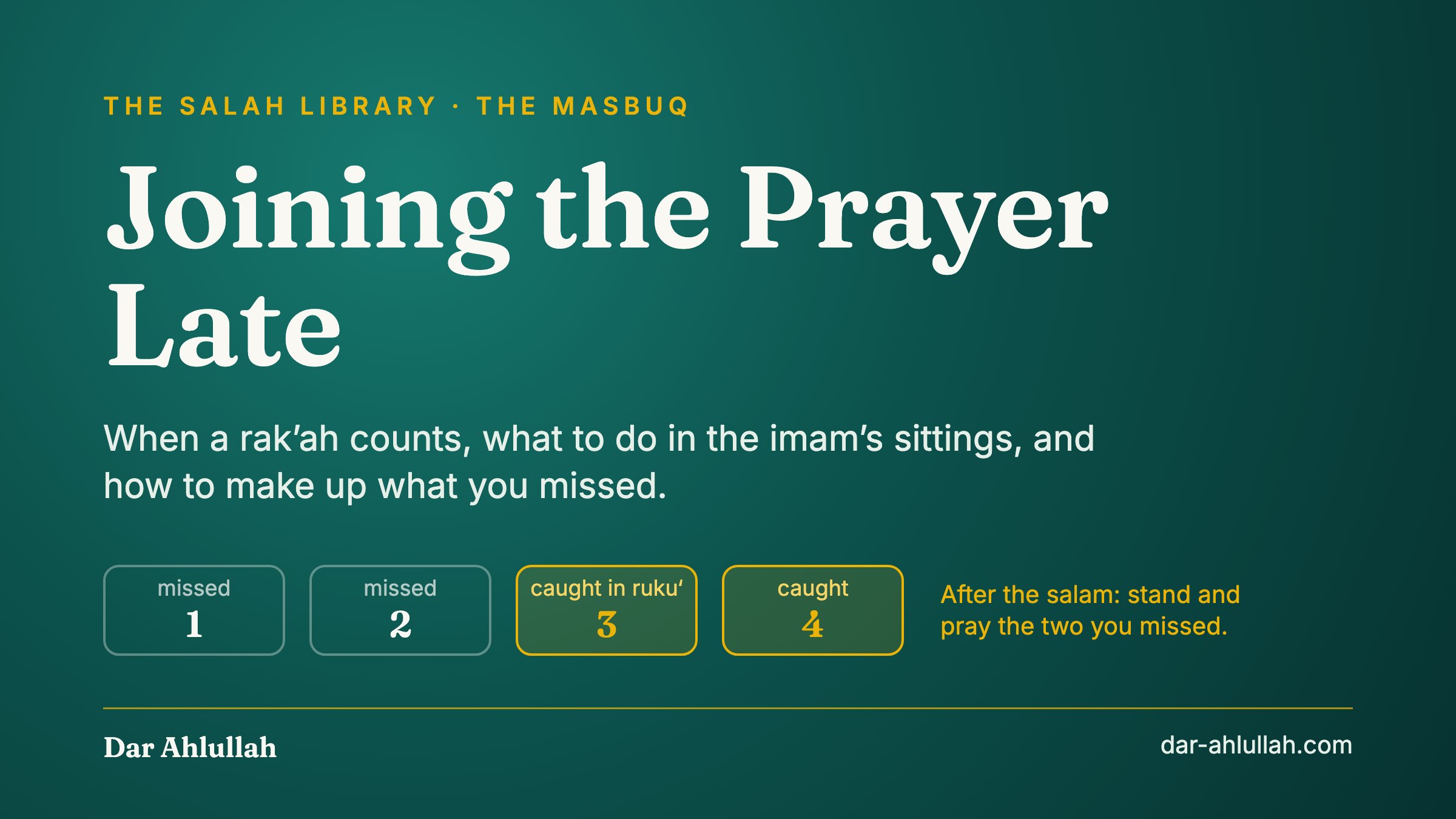
Table of Contents
- Introduction: The Row Is Already Bowing
- The Short Answer
- Walk, Do Not Run
- Joining: The Takbir and the Position You Find
- When a Rak’ah Counts and When It Does Not
- The Prophet ﷺ Was Once the Latecomer
- While You Are Still Behind the Imam
- When the Imam Says the Salam
- Completing What You Missed: Two Readings of One Word
- Every Case, Prayer by Prayer
- Arriving in the Final Tashahhud
- Situations That Change the Answer
- Seven Mistakes People Keep Making
- How We Teach This
- Questions People Ask
- Conclusion: Late Is Not Lost
Introduction: The Row Is Already Bowing
The meeting overran by four minutes, or the lift was slow, or the car park was full. You walk into the prayer hall and the row is already in ruku‘. In the half-second before you do anything, three questions arrive together: do I start now or wait for them to stand up again, does this rak’ah count if I get down in time, and when the imam says the salam, what exactly am I supposed to do about the part I missed?
Everyone who prays in congregation is late some of the time, and the fiqh has a name for the person in that position: the masbuq, from an Arabic root meaning to be gone ahead of — someone the imam has preceded by one or more rak’ahs (Wikipedia: Masbuq). The rules for the masbuq are short, and almost all of them grow out of a single sentence the Prophet ﷺ said to people who had run to catch the prayer. What makes them confusing is not the rules. It is that they are usually taught as one school’s list of steps, with no warning that the person next to you in the row may have learned a different, equally sound way to fill in the missing rak’ahs — and will do something visibly different from you when you both stand up.
This guide covers joining the prayer late for the five daily prayers: how to join, exactly when a rak’ah is caught, what you do in sittings that belong to the imam’s count rather than yours, how to complete what you missed under both of the main readings, and every combination of prayer and arrival point worked out in a table. It assumes you already know the positions of the prayer and what is said in them. If you do not yet, start with our step-by-step guide to how to pray in Islam and come back.
The Short Answer
- Walk calmly. Do not run for the prayer, even if you can hear the imam going into ruku‘.
- Say the opening takbir standing, then join the imam in whatever position he is in — standing, bowing, prostrating or sitting. Do not wait for him to rise.
- You have caught a rak’ah if you reach ruku‘ before the imam rises from it. If you join after that point you still follow him, but that rak’ah does not count for you.
- When the imam says the salam, do not say it with him. Stand, pray the rak’ahs you missed, sit for the tashahhud and give your own salam.
- How many rak’ahs you make up, and where you sit, is the same in every school. What differs is only whether a made-up rak’ah carries a second surah after al-Fatihah. Follow your school; both are sound.
Walk, Do Not Run
The whole of the latecomer’s fiqh starts from one incident. The Prophet ﷺ was leading a prayer and heard the noise of people behind him. When he finished he asked what it was, and they told him they had been hurrying to catch the prayer. He said: “Do not make haste for the prayer, and whenever you come for the prayer, you should come with calmness, and pray whatever you get and complete the rest which you have missed” (Sahih al-Bukhari 635).
He repeated it as a standing instruction: “When you hear the iqamah, proceed to offer the prayer with calmness and solemnity and do not make haste. And pray whatever you are able to pray and complete whatever you have missed” (Sahih al-Bukhari 636; also narrated in Sahih Muslim 602, and a version for the Friday prayer is Bukhari 908).
Two things are in that sentence, and the rest of this article is only their detail. First, the manner of arriving: calm, even at the cost of a rak’ah. Nobody is blamed for missing a rak’ah by walking; the people who were corrected were the ones who ran. Second, the method: pray what you catch, and complete what you missed. There is no special prayer for latecomers and nothing to be made up in a separate sitting. You slot into the congregation where it is, and you finish the prayer yourself when it ends.
Joining: The Takbir and the Position You Find
The opening takbir is said standing
However far along the imam is, your prayer begins the way every prayer begins: the opening takbir, Allahu akbar, said while you are standing upright. This matters most when the imam is bowing. The common mistake is to say the takbir on the way down, which means the one pillar that has to be performed standing was performed half-bent. Stand, say it, then go into ruku‘ (IslamQA 246225).
Do you then say a second takbir for the bowing? IslamQA reports Shaykh Ibn Baz’s view that saying both — the opening takbir and then the takbir for ruku‘ — is preferable and more prudent, but that if you fear the imam will rise before you bow, the opening takbir alone is enough, on the more correct of the two scholarly opinions (IslamQA 246225).
Then join him wherever he is
If the imam is prostrating, you prostrate. If he is sitting, you sit. You do not stand at the back waiting for him to come up for the next rak’ah. Two reports say this directly:
- “When one of you comes to the prayer and the imam is in a position, let him do as the imam is doing” (Jami‘ at-Tirmidhi 591). Graded sahih by Ahmad Shakir and al-Albani; Zubair Ali Za’i graded it da‘if.
- “When you come to pray while we are prostrating, prostrate, and do not count it as anything” (Sunan Abi Dawud 893). Graded hasan by al-Albani; Shu‘ayb al-Arna’ut graded it da‘if.
Neither report is in Bukhari or Muslim, and each has a scholar who weakened its chain, so it is worth being precise about what rests on them. The instruction to join straight away also follows from the Bukhari wording above — “pray whatever you get” — and nothing is gained by standing at the back: the prostration you would have joined is not counted either way, but by waiting you forfeit it as worship.
Say the takbir in the row, not while you walk
Abu Bakrah reached the masjid while the Prophet ﷺ was bowing, and to catch the rak’ah he bowed before he had reached the row, then shuffled forward into it. When he mentioned it afterwards, the Prophet ﷺ said: “May Allah increase your love for the good. But do not repeat it” (Sahih al-Bukhari 783). The eagerness was praised; the method was not. Walk to the row, stand in it, then say your takbir.
When a Rak’ah Counts and When It Does Not
The dividing line is the ruku‘. A rak’ah is caught by catching the bowing; join the imam before he rises from ruku‘ and that rak’ah is yours, even though you missed its recitation (IslamQA 246225). The Shafi‘i texts put the condition precisely: you must reach the bowing while the imam is still in it, before he has risen from the minimum of the bow. If you join after that, the rak’ah is not counted for you, though you must still follow the imam through it (SeekersGuidance, citing al-Nawawi’s Rawdat al-Talibin).
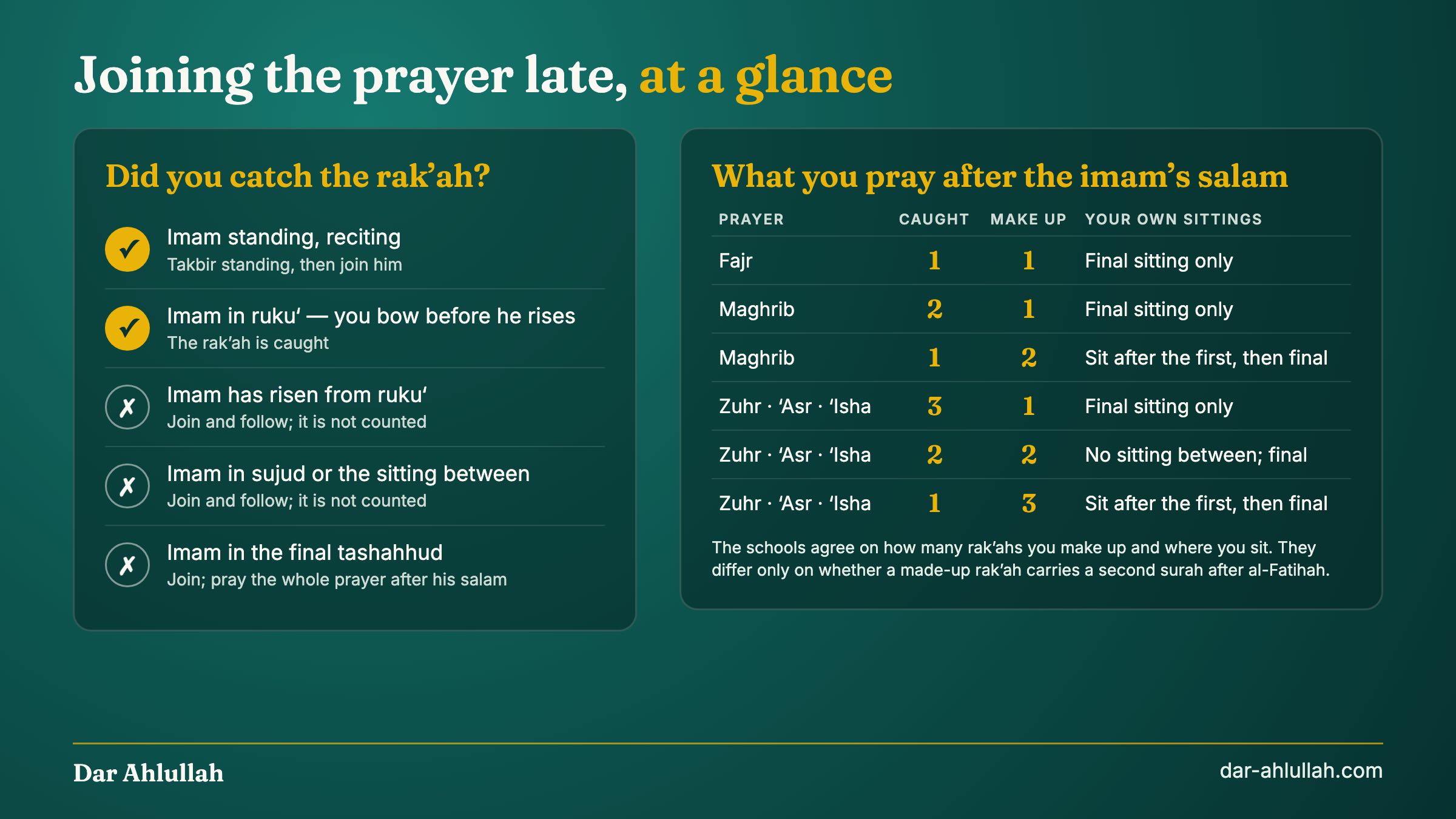
| Where the imam is when you join | Is that rak’ah counted? | What you do |
|---|---|---|
| Standing, before ruku‘ | Yes | Takbir, fold your hands, listen or recite as your school directs |
| In ruku‘, and you bow before he rises | Yes | Takbir standing, then bow |
| Rising from ruku‘, or standing after it | No | Join and follow him; make the rak’ah up later |
| In either prostration, or the sitting between | No | Join and prostrate with him; do not count it (Abu Dawud 893) |
| In the middle tashahhud | No — that rak’ah is finished | Join, sit with him, stand with him for the next |
| In the final tashahhud | No rak’ah caught | Join, sit with him, and pray the whole prayer after his salam |
Notice what the table implies for a prayer you joined in sujud. You prostrated twice with the congregation and those prostrations count for nothing towards your rak’ah total. That is not a loss. They were worship offered in congregation, and the rak’ah itself will be prayed in full afterwards.
The Prophet ﷺ Was Once the Latecomer
If being late to the row feels like a small failure, there is a report worth knowing. On the expedition to Tabuk, the Prophet ﷺ stepped away before Fajr to relieve himself and make wudu, with al-Mughirah ibn Shu‘bah pouring the water. By the time they caught up with the army, the people had already started the prayer behind ‘Abd al-Rahman ibn ‘Awf. The Prophet ﷺ joined the row and prayed the second rak’ah behind him. When ‘Abd al-Rahman gave the salam, the Prophet ﷺ stood and prayed the rak’ah he had missed. The people were alarmed that they had prayed ahead of him, and when he finished he told them: “You were right,” or “you did well” (Sunan Abi Dawud 149, graded sahih by al-Albani).
The Messenger of Allah ﷺ prayed as a masbuq, behind one of his own Companions, and completed his prayer after the salam exactly as described below. The latecomer’s procedure is not a patch for people who got something wrong. It is the Sunnah, and he performed it himself.
While You Are Still Behind the Imam
From the moment you join, you follow the imam in every movement until his salam — including movements that do not fit your own count. This is the part that feels strange at first.
Say you join a four-rak’ah prayer in the imam’s second rak’ah. When he sits for the middle tashahhud, you have prayed only one rak’ah. You sit anyway. When he sits for the final tashahhud, you have prayed three, and you sit again. Neither of those sittings is in the right place for your own prayer, and neither of them breaks it: following the imam is the obligation while he is leading you.
What you recite in a sitting that is not your own final sitting is described differently in different manuals. In the Shafi‘i school, in a sitting that is your first, you recite the tashahhud as far as the blessings on the Prophet ﷺ; in the imam’s final sitting you recite the full tashahhud and the salawat; and if that sitting is not your last — in Fajr, for example — you recite them again in your own final sitting after making up the missed rak’ah (SeekersGuidance, citing al-Nawawi’s Minhaj al-Talibin). Other schools’ manuals phrase the imam’s final sitting differently. None of them treats the choice as affecting the validity of the prayer; learn the version your teacher gives you and do not worry about the row.
What all of them agree on: you do not stand up early. Whatever you recite, you stay seated until the imam has given the salam.
When the Imam Says the Salam
This is the moment the latecomer’s prayer separates from the congregation’s. The imam turns his head to the right and says as-salamu ‘alaykum wa rahmatullah. You do not say it with him, because your prayer is not finished. You stand and complete it.
When exactly do you stand? In the Hanafi method as Mufti Taqi Usmani sets it out, you rise as soon as the imam completes his first salam (Albalagh via IslamQA.org). In the Shafi‘i school it is recommended to wait until he has completed both salams, though standing after the first is still valid (SeekersGuidance). In practice, if you wait until his head has turned to the left, you have satisfied both.
From the moment you stand, you are praying alone for the rest of the prayer. Every normal rule of individual prayer applies: you recite for yourself, you perform every pillar, and if you make a mistake in this portion it is yours to repair, not the imam’s to carry. That last point is covered in detail in our guide to what to do if you make a mistake in prayer.
Completing What You Missed: Two Readings of One Word
Here is where the neighbour in the row may do something different. The disagreement is real, it is old, and it comes down to a single word in the hadith.
Most narrators of the report above have the Prophet ﷺ say of the missed part: complete it. One narrator, Sufyan ibn ‘Uyaynah, transmitted it as: make it up. Abu Dawud recorded the difference in his collection and listed which narrators have which wording (Sunan Abi Dawud 572, graded hasan sahih by al-Albani). The two words produce two pictures of what the latecomer is doing.
Reading one: what you caught is the start of your prayer
If you complete the missed part, then what you prayed with the imam was the beginning of your own prayer and what you pray after his salam is its end. This is the position of al-Shafi‘i, and al-Nawawi explained it from exactly that word: you complete something whose first part is already done. IslamQA reports the same view from the Standing Committee, and names Sa‘id ibn al-Musayyib, al-Hasan al-Basri, ‘Ata’, al-Zuhri, al-Awza‘i and Ishaq among those who held it (IslamQA 49037; see also SeekersGuidance, Shafi‘i and IslamWeb 83220).
On this reading, a made-up rak’ah takes the recitation of the position it fills. If it is your own second rak’ah, it has al-Fatihah and a surah. If it is your third or fourth, it has al-Fatihah alone.
Reading two: what you missed is the start of your prayer
If you make up the missed part, then what you missed was the beginning, and that is what you are now praying. This is the Hanafi reading. It applies to recitation: because the opening rak’ahs of a prayer carry the extra surah, the made-up rak’ahs carry it too. For the sittings, though, the Hanafis count the total rak’ahs you have actually prayed, with the imam and alone together, and sit after every second (SeekersGuidance, Hanafi, citing Ibn ‘Abidin and al-Kasani; Mufti Taqi Usmani).
What actually differs
Work the two readings through and something reassuring falls out. The number of rak’ahs you make up is identical. The place your sittings fall is identical: on the first reading because the made-up rak’ahs fill your own later positions, on the second because the sittings are counted by total. The only visible difference is the second surah. In some cases one reading has you recite a surah after al-Fatihah in a made-up rak’ah where the other has al-Fatihah alone.
A surah after al-Fatihah is not a pillar of the prayer in any school. Neither reading is a shortcut and neither risks your prayer. If you follow a school, follow it. If you do not, pick one of the two from the table below and use it consistently.
Every Case, Prayer by Prayer
Each row assumes you caught the rak’ahs listed by joining before the imam rose from their ruku‘. “F” means al-Fatihah alone; “F + S” means al-Fatihah and a surah.
| Prayer | Caught | Make up | Your sittings after the salam | Reading one (Shafi‘i and others) | Reading two (Hanafi) |
|---|---|---|---|---|---|
| Fajr (2) | 1 | 1 | Final sitting | F + S | F + S |
| Maghrib (3) | 2 | 1 | Final sitting | F | F + S |
| Maghrib (3) | 1 | 2 | After the first, then final | F + S, then F | F + S, then F + S |
| Zuhr, ‘Asr, ‘Isha (4) | 3 | 1 | Final sitting | F | F + S |
| Zuhr, ‘Asr, ‘Isha (4) | 2 | 2 | No sitting between; final | F, then F | F + S, then F + S |
| Zuhr, ‘Asr, ‘Isha (4) | 1 | 3 | After the first, then final | F + S, then F, then F | F + S, then F + S, then F |
| Any | 0 (joined after the last ruku‘) | All | As a normal prayer | As normal | As normal |
The Maghrib row where you caught one rak’ah is the one people most often ask about, and IslamQA walks through it on the first reading: after the imam’s salam, pray a rak’ah with al-Fatihah and a surah, sit for the tashahhud, then pray the last rak’ah with al-Fatihah alone and sit for the final tashahhud and salam (IslamQA 49037). The four-rak’ah case where you caught only the last is the same shape with one more rak’ah of al-Fatihah alone before the end (IslamWeb 83220). The Hanafi column for the same case — surah, sit; surah, no sitting; al-Fatihah alone, final sitting — is Mufti Taqi Usmani’s own worked example (Albalagh).
A practical tip for the moment you stand up: count the rak’ahs you still owe before the imam’s salam, while you are sitting with nothing else to do. The masbuq who loses count is almost always one who started counting after standing.
Arriving in the Final Tashahhud
You walk in and the congregation is sitting for the last time. There is no rak’ah left to catch. Should you still join?
Join. Egypt’s Dar al-Ifta states that, according to the majority of jurists, the congregational prayer is attained by joining the imam in any part of it, even at the end of the final tashahhud before the salam (Dar al-Ifta 6468). Al-Nawawi adds the honest qualification: you earn the reward of praying in congregation, but not the same reward as the person who joined from the start (quoted in IslamWeb 367378). After the salam, you stand and pray the whole prayer as normal.
There is one real alternative. In a large masjid where people are clearly gathering for a second congregation, the same IslamWeb fatwa reports that the Shafi‘is, and Ibn Taymiyyah as his preferred view, hold it better to wait and pray the whole prayer in that new congregation. What you should not do is start the prayer behind the imam and then abandon it to join the new group: once an obligatory prayer is begun, it is not broken off without a valid reason (IslamWeb 367378).
Situations That Change the Answer
The imam performs sujud as-sahw
If the imam prostrates for forgetfulness before his salam, you prostrate with him, because you are still following him. If he does it after his salam, you have already stood up to complete your prayer and you do not go back to join it (IslamQA 246225). The follow-on question — whether you then owe the prostrations yourself at the end — is answered in our guide to sujud as-sahw, along with what to do if you make your own mistake in the portion you pray alone.
You forgot and gave the salam with the imam
It happens most often to people who caught nearly all of the prayer. If you remember straight away, stand immediately, pray the rak’ah you owe, and perform sujud as-sahw at the end. If a long time has passed before you remember, IslamWeb’s ruling is that the whole prayer is repeated from the beginning (IslamWeb 116217).
The prayer is Jumu’ah
The Friday prayer has its own threshold. Catch the ruku‘ of the second rak’ah and you have caught Jumu’ah, adding one rak’ah after the salam. Join after that and, on the majority position, you stand after the salam and pray four rak’ahs of Dhuhr. The details, and the minority view, are in our guide to how to pray Jumu’ah.
The prayer is a janazah
The funeral prayer has no ruku‘ and no sujud, so there is no rak’ah to catch. You join at the imam’s next takbir and complete the takbirs you missed after his salam; see how to pray salat al-janazah.
You are a traveller and the imam is not
Behind a resident imam, a traveller prays the full four, and if you arrive late you complete what you missed as the imam prayed it — the shortening does not apply to that prayer. The rest of the travel concessions are in how to pray while traveling.
The iqamah is called while you are about to pray the sunnah
Leave the sunnah and join the row; the Prophet ﷺ said that once the iqamah is called there is no prayer except the obligatory one (Sahih Muslim 710). The Hanafi exception for the two sunnah rak’ahs of Fajr, and how to make the sunnah up afterwards, are covered in the sunnah rawatib.
The prayer is recited aloud
If you are completing rak’ahs of Maghrib, ‘Isha or Fajr on your own, the Hanafi texts note that you are praying as an individual for that portion and may raise your voice, but should stay aware of the people around you (SeekersGuidance, Hanafi). In a hall where other latecomers are completing their own prayers beside you, quiet is the courteous choice.
Seven Mistakes People Keep Making
- Running for the ruku‘. The instruction is to walk calmly and accept the rak’ah you lose (Bukhari 635, 636).
- Saying the opening takbir while bending. It is said standing. Then bow.
- Bowing before reaching the row. Abu Bakrah did this and was told not to repeat it (Bukhari 783).
- Waiting at the back for the imam to stand up. Join him in sujud or in the sitting. It does not count as a rak’ah, but it counts as worship.
- Counting a rak’ah you joined after the ruku‘. If the imam had risen from the bow, that rak’ah is still owed.
- Standing up before the imam’s salam, or giving the salam with him out of habit. Stay seated until he has turned; then stand without a salam of your own.
- Assuming the person beside you is wrong. If they recite a surah where you recite al-Fatihah alone, they are very likely following the other reading. Both are sound.
How We Teach This
The rules above fit on a page, and once learned they rarely need a teacher. What does need one is the part underneath them: a latecomer who stands up after the salam is suddenly praying alone, reciting al-Fatihah and a surah with nobody to follow, and for many adult learners that is the first time their own recitation carries the prayer. If it is shaky, the masbuq’s rak’ahs are where it shows.
Dar Ahlullah runs one-to-one live sessions with certified teachers, scheduled in your own timezone. Teaching is charged at $9 per teaching hour, with monthly plans at $36, $70 and $102 depending on how many hours you want, and a 20% discount for siblings. You can pause, upgrade or switch plans at any time, and if a teacher is not the right fit we rematch you with another certified mentor at no extra cost. If you want to know where your recitation stands before committing to anything, the 30-minute assessment is free and does not ask for a card — the details are on our pricing page.
Questions People Ask
What is a masbuq?
A person who joins a congregational prayer after the imam has already completed one or more rak’ahs. The word means someone who has been gone ahead of. The masbuq follows the imam until his salam and then completes the missed rak’ahs alone.
If I join the imam in ruku‘, do I get the rak’ah?
Yes, provided you say the opening takbir standing and reach the bowing before the imam rises from it. If he has already risen, the rak’ah is not counted and you make it up after his salam.
If I join in sujud, does that rak’ah count?
No. Join and prostrate with the imam, but do not count it; the rak’ah is prayed in full after the salam. Sunan Abi Dawud 893 says this directly: “prostrate, and do not count it as anything.”
Do I say the salam with the imam?
No. When the imam gives the salam, stand up without giving one and complete the rak’ahs you missed. Your own salam comes at the end of your own prayer.
Do I recite a surah in the rak’ahs I make up?
It depends on the reading you follow. On the Shafi‘i reading, a made-up rak’ah takes the recitation of the position it fills in your own prayer. On the Hanafi reading, the made-up rak’ahs are treated as the opening of the prayer for recitation and carry a surah. The surah is not a pillar in either school, so neither choice endangers the prayer.
Where do I sit for the tashahhud when making up rak’ahs?
After your own second rak’ah counted in total (with the imam and alone together) and at the end. In practice: if you caught one rak’ah of Maghrib or of a four-rak’ah prayer, sit after the first rak’ah you make up. In every other case, the only sitting after the salam is your final one.
I arrived during the final tashahhud. Should I join?
Yes. The majority of jurists hold that you gain the congregational prayer by joining at any point before the salam, though the reward is less than for someone who joined from the start. After the salam, pray the whole prayer.
What if I forget and give the salam with the imam?
If you remember immediately, stand, pray what you owe and perform sujud as-sahw at the end. If a long time has passed, the prayer is repeated.
Does being late mean my prayer is less valid?
No. A masbuq’s prayer is complete and valid. The Prophet ﷺ himself prayed as a latecomer behind ‘Abd al-Rahman ibn ‘Awf and completed his missed rak’ah after the salam (Sunan Abi Dawud 149).
Conclusion: Late Is Not Lost
The fiqh of joining the prayer late is one sentence with its detail filled in. Come calmly. Say the takbir standing and join the imam wherever he is. Count the rak’ah only if you reached the ruku‘ before he rose from it. Stay with him to his salam, then stand and complete what you missed — the same number of rak’ahs and the same sittings in every school, with a surah in the made-up rak’ahs or without one depending on which of two sound readings of a single word you follow.
The rest is reassurance. The prostrations you joined without catching the rak’ah were not wasted. The person next to you reciting differently is not wrong. And the procedure you are following is one the Prophet ﷺ followed himself, one morning on the way back from Tabuk, standing up alone after a Companion’s salam to pray the rak’ah he had missed. If you want the rest of the prayer in the same detail, the salah library links every guide we have written on it.
Related articles
sujood ash-shukr
Sujood ash-Shukr: The Prostration of Gratitude
Sujood ash-shukr is the single prostration a Muslim makes when good news arrives or a harm is lifted. What actually triggers it, why the four schools do not agree on its status, whether you need wudu, how to perform it, what to say, and the answers for an exam result, a hospital corridor and an office desk.
25 min read
how to pray salat al-janazah
How to Pray Salat al-Janazah: The Funeral Prayer
Salat al-Janazah is four takbirs said standing, with no bowing and no prostration. What you recite after each one, the full supplication for the deceased, what changes for a child, and what to do when you arrive late or missed it entirely.
21 min read
how to pray Jumuah
How to Pray Jumu'ah: The Friday Prayer, Start to Finish
Jumu'ah replaces Dhuhr, not adds to it: two rak'ahs, a khutbah you sit silent through, and a congregation. Who it is owed by, what still counts if you walk in late, and what to do when the sermon is in a language you do not speak.
18 min read