
how to pray tahajjud
How to Pray Tahajjud: The Night Prayer, Step by Step
Dar Ahlullah team 21 min read
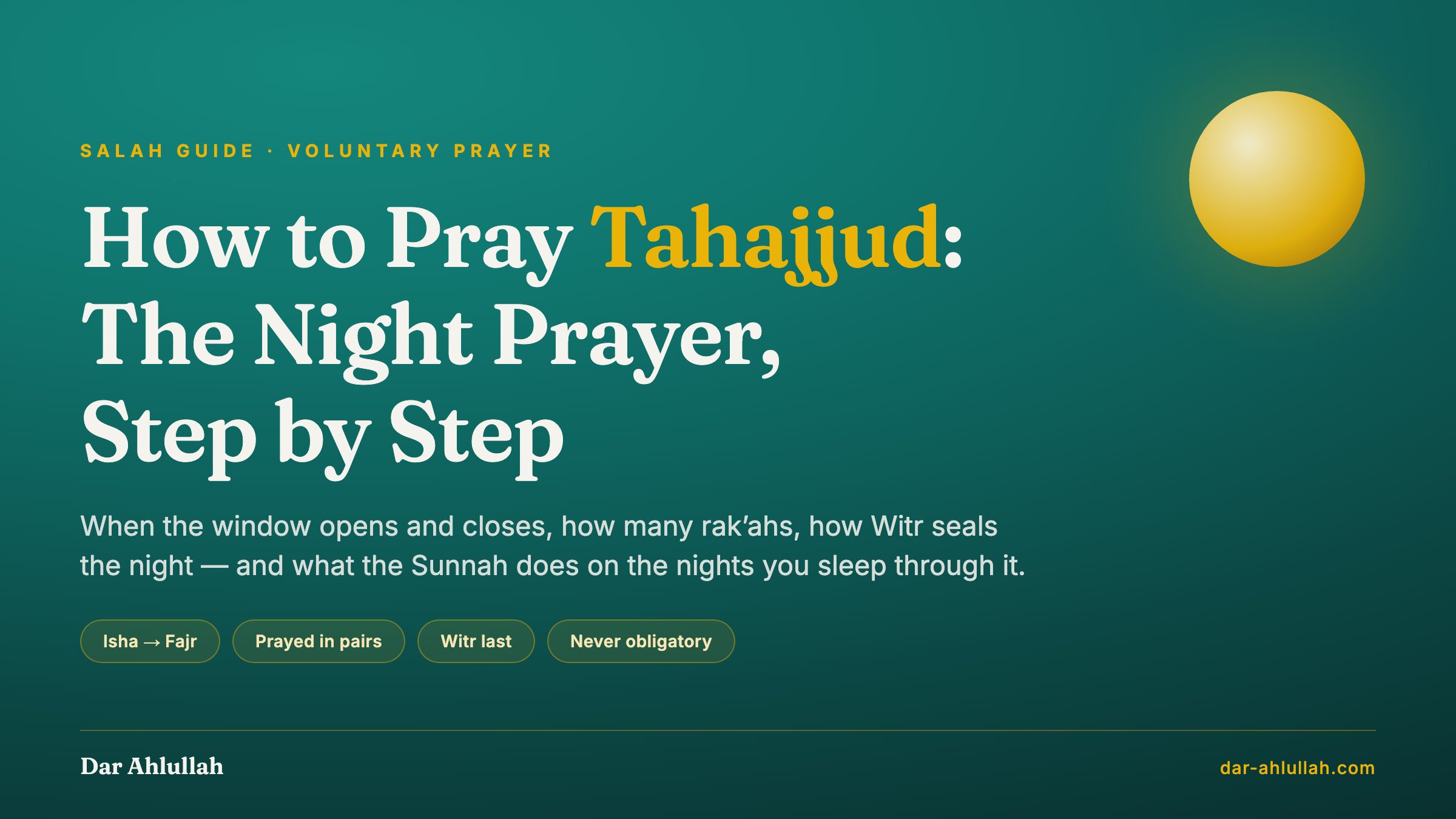
Table of Contents
- Introduction: The Alarm You Set and Did Not Answer
- The Short Answer
- What Tahajjud Actually Is
- Four Words People Mix Up
- The Window: From Isha to Fajr
- Does It Have to Be After Sleep?
- How Many Rak’ahs
- How to Pray It, Step by Step
- Witr: How the Night Closes
- What to Recite When You Do Not Know Much Yet
- Finding the Last Third Where You Live
- When the Night Barely Exists
- Actually Waking Up
- The Night You Sleep Through It
- Tahajjud and a Full-Time Job
- What Tahajjud Does Not Change
- Seven Mistakes People Keep Making
- How We Teach This
- Questions People Ask
- Conclusion: Two Rak’ahs, Tonight
Introduction: The Alarm You Set and Did Not Answer
You set it for 3:40. You had read something about the last third of the night, and it moved you, and you went to bed intending to be one of those people. At 3:40 your hand found the phone before your mind did. You woke properly at 6:50, remembered, and felt the specific flatness of having wanted something at night that you could not reach in the morning.
Almost nobody describes that part. The guides go straight to rak’ah counts. But for a Muslim living in Manchester or Rotterdam or New Jersey — no household already awake, no neighbour’s masjid lit up at 4am, no one who will notice either way — the fiqh of how to pray Tahajjud was never the hard part. The fiqh is genuinely short. The hard parts are the window, the waking, and what you are supposed to do with yourself the next morning.
So this article does all three. It sets out the ruling with the evidence underneath it: when the window opens and closes, how many rak’ahs, how Witr closes the night, what to recite if you have four short surahs to your name. Then it deals with the parts a guide written for a Muslim-majority city never has to answer — how to find the last third when your night runs from 22:15 to 03:05, what happens to Tahajjud in a Northern European June when there is barely a night at all, and how to want this without quietly trading Fajr for it.
One boundary first. We teach Quran, Arabic and the practical fiqh of worship; we are not a fatwa body. On several points below the four schools genuinely differ, and where they do we say so rather than present one position as the only one. If the five daily prayers are still new, our complete guide to salat covers the obligatory sequence first — Tahajjud is built on top of that, never instead of it. And if you are early in your practice generally, the first ninety days guide puts the voluntary prayers in their proper order of priority.
The Short Answer
- What it is: a voluntary (nafl) prayer offered at night, after Isha and before Fajr. It is not one of the five, and nothing is owed if you never pray it.
- When: any time after you have prayed Isha until true dawn enters. The last third of the night is the best portion, not a condition of validity.
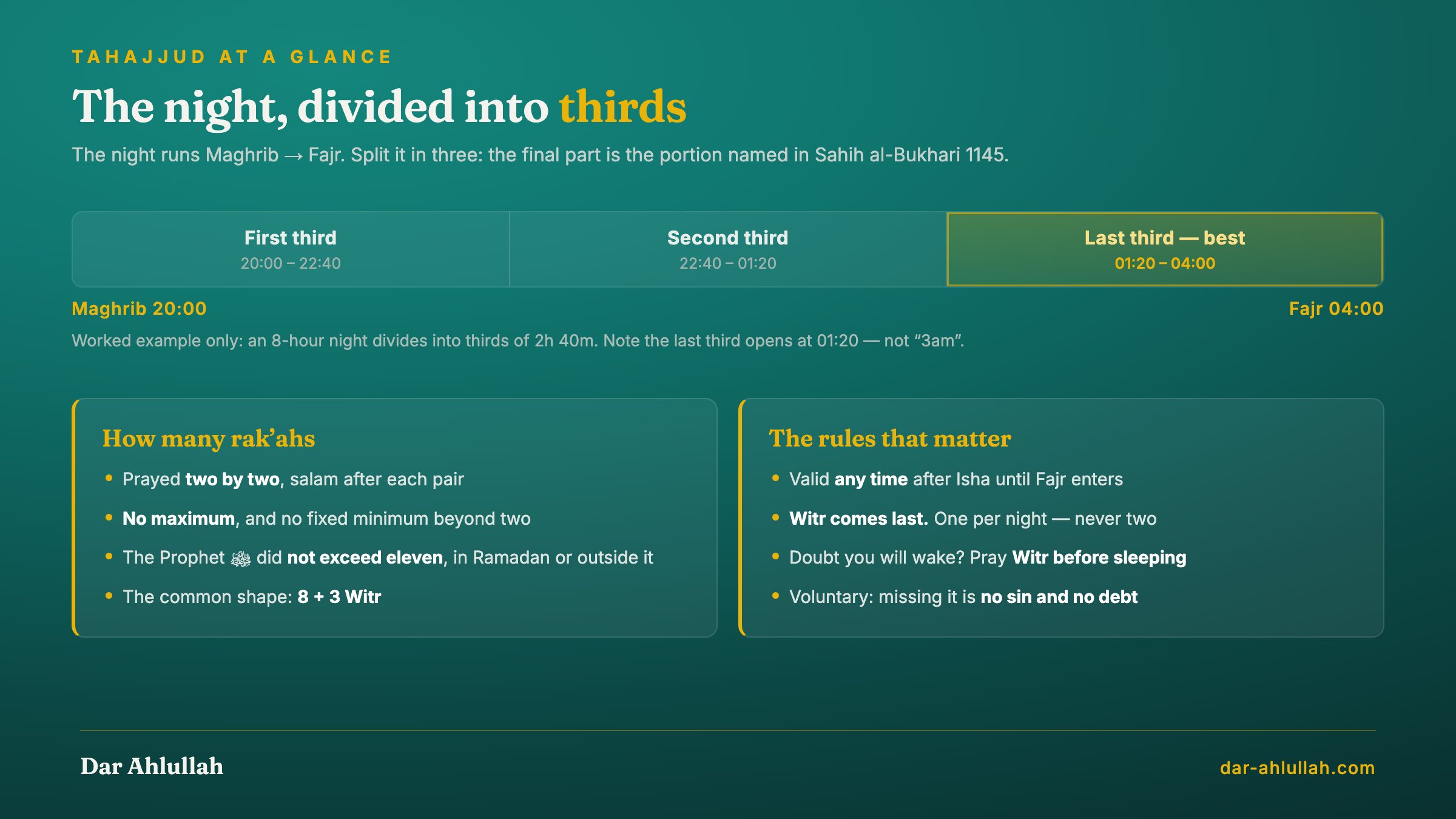
- How many: in pairs — two rak’ahs, salam, two more, as many as you want. There is no maximum. The practical minimum is two.
- How it ends: with Witr, an odd number of rak’ahs, prayed as the last prayer of your night.
- The Prophet’s own habit: eleven rak’ahs including Witr — and he did not exceed that in Ramadan or outside it.
- If you sleep through it: nothing is owed. There is no sin. There is, however, a Sunnah-shaped response, and it is not self-reproach.
- The one real trap: a Tahajjud habit that starts costing you Fajr has traded an obligation for a voluntary act. Fix the bedtime, not the ambition.
What Tahajjud Actually Is
Tahajjud is a voluntary prayer performed at night. The word comes from a root that carries both sleeping and rousing oneself from sleep, which is why the classical definition so often attaches it to waking rather than merely to the hour.
The Qur’an names it directly. In Surah Al-Isra 17:79: “And from [part of] the night, pray with it as additional worship for you; it is expected that your Lord will resurrect you to a praised station.” The word rendered “additional” is nafilah — a surplus, something over and above what was already required. That single word settles the category. Tahajjud sits on top of the five; it never substitutes for any of them.
Its rank among voluntary prayers is unusually high. Abu Hurayrah reported that the Prophet ﷺ said the most excellent prayer after the prescribed ones is the prayer of the night (Sahih Muslim 1163a). Of everything optional a Muslim can pray, this is the one the Sunnah ranks first.
The Qur’an also keeps returning to it as a portrait rather than a rule. Of the conscientious it says they “used to sleep but little of the night, and in the hours before dawn they would ask forgiveness” (51:17–18). Elsewhere: “Their sides part from their beds; they supplicate their Lord in fear and aspiration” (32:16). And among the servants of the Most Merciful are “those who spend part of the night to their Lord prostrating and standing” (25:64). Notice what these verses describe: not a quota, but a person whose night has a shape.
Four Words People Mix Up
A great deal of confusion about night prayer is really confusion about vocabulary. Four terms circulate and they are not synonyms.
| Term | What it refers to | When |
|---|---|---|
| Qiyam al-layl | The broad category: standing in prayer at night. Every term below except the rawatib falls inside it. | Any night, after Isha |
| Tahajjud | Night prayer, in most classical definitions specifically after having slept. | Any night, typically after waking |
| Witr | The odd-numbered prayer that closes the night. Not optional in the Hanafi school. | Every night, last thing |
| Taraweeh | The congregational night prayer specific to Ramadan, usually prayed in the masjid after Isha. | Ramadan nights only |
Two clarifications follow from the table. First, Taraweeh is a Ramadan matter with its own etiquette and its own disputes about rak’ah counts, and it is outside the scope of this article. Second, the rawatib — the regular sunnah rak’ahs attached to each of the five prayers, such as the two after Maghrib — are a different category again. They belong to their prayer, not to the night.
The Window: From Isha to Fajr
The window opens once you have prayed Isha and closes when Fajr enters — true dawn, the same moment that opens the obligatory Fajr prayer. Once dawn has entered, the night is over and the night prayer with it.
That is the whole rule on timing. Everything else people say about the hour is about preference, not validity. A prayer offered at 23:30 is a valid night prayer. So is one at 02:00 and one at 04:40, assuming Fajr has not entered.
The preference has a well-known basis. Abu Hurayrah reported that the Prophet ﷺ said that our Lord descends to the nearest heaven when the last third of the night remains, saying: “Is there anyone to invoke Me, so that I may respond to him? Is there anyone to ask Me, so that I may grant him his request?” (Sahih al-Bukhari 1145). This is why the last third carries the weight it does, and why the supplication made in it is emphasised so heavily.
It is worth being precise about what that hadith establishes and what it does not. It establishes that a particular portion of the night is especially favoured. It does not establish that prayer outside that portion is deficient, and it certainly does not establish that someone who cannot reach the last third should not pray at all. Read as a threshold, the hadith stops many people from praying anything. Read as it was meant — as an encouragement toward the best part of a window that is entirely open — it does the opposite.
One clock-based warning. The “last third of the night” is not the same as “after midnight” on your phone. Civil midnight is a timezone convention and has nothing to do with the length of the night where you are standing. In much of Western Europe, particularly under summer time, the astronomical middle of the night falls well after 00:00.
Does It Have to Be After Sleep?
This is the most common genuine question, and it has a real difference of opinion behind it rather than a single answer people have failed to look up.
Because the root of the word carries the sense of rousing oneself from sleep, many jurists define Tahajjud narrowly: voluntary night prayer offered after waking from sleep. On that definition, rak’ahs prayed at 22:00 before you have gone to bed are night prayer — qiyam al-layl — but not Tahajjud in the specific sense. Others use the terms more loosely and treat any voluntary prayer in the window as Tahajjud.
Here is why the dispute matters less in practice than it looks. Both sides agree the prayer is valid, and both agree it is rewarded. What is disputed is which label it earns, not whether Allah accepts it. So for someone weighing a real choice — pray two rak’ahs before bed, or gamble on waking at 3am and quite possibly pray nothing — the answer is not close. Pray them before bed. A prayer offered is not in competition with a prayer imagined.
And if you do intend to wake, praying some before sleeping does not disqualify you from praying more later. The night is not a single sitting.
How Many Rak’ahs
The structural rule comes from Ibn ‘Umar, who reported that the Prophet ﷺ said: “The night prayer is offered as two rak’ahs followed by two rak’ahs and so on, and if anyone is afraid of the approaching dawn he should pray one rak’ah, and this will be Witr for all the rak’ahs he has prayed before” (Sahih al-Bukhari 990).
Three things are established there at once. Night prayer is built in pairs. You end with an odd rak’ah. And the count is left open — the hadith says “and so on” rather than naming a number.
The Prophet’s own practice supplies the reference shape. Abu Salamah asked ‘A’ishah about his prayer in Ramadan, and she answered that he never exceeded eleven rak’ahs in Ramadan or in other months: four — “do not ask me about their beauty and length” — then four, then three (Sahih al-Bukhari 1147). Eight rak’ahs of night prayer followed by three of Witr is, for that reason, the pattern most people follow when they follow one.
Two observations about that report that usually get skipped. The first is the ceiling: eleven was not a minimum he built up from, it was a maximum he did not pass. The second is that ‘A’ishah’s emphasis falls entirely on length and beauty, not on number. The rak’ahs were few and long. Modern practice tends to invert this and chase the count with the shortest surahs available, which is close to the opposite of what she was describing.
For a first month, two rak’ahs is the correct target. Not two as a stepping stone to eight — two, prayed on more nights than you miss. The reason is in the Sunnah rather than in productivity advice: ‘A’ishah reported the Prophet ﷺ saying that the most beloved deed to Allah is the most regular and constant, even if it were little (Sahih al-Bukhari 6464).
How to Pray It, Step by Step
Mechanically, Tahajjud is the plainest prayer in Islam. There is no adhan for it, no iqamah, no congregation required, no special posture and no additional pillar. If you can pray two rak’ahs, you can pray Tahajjud tonight.
- Wake, if you are waking. Sit up before you decide anything. Most abandoned Tahajjud is abandoned lying down.
- Perform wudu. Sleep breaks it, so it has to be renewed. If you are unsure what does and does not nullify it, our complete guide to wudu covers the sequence and the nullifiers.
- Make the intention. Intention is in the heart. There is no formula to pronounce, and nothing is invalidated by not saying anything aloud.
- Pray two rak’ahs. Exactly as you pray any two-rak’ah prayer: takbir, Al-Fatihah and what you can recite after it, ruku’, sujud, the tashahhud, salam. Our guide to what to say in salah gives every recitation by position if you are still learning them.
- Repeat as many times as you wish. Two, then salam. Two more, then salam. Stop whenever you stop.
- Close with Witr. See the next section — this is the part with the school differences.
- Then ask. The descent hadith above is an invitation, not a description. Sit afterwards and make du’a in whatever language you actually think in. There is no fixed text required, and supplication in English is not a lesser supplication.
Two small points of etiquette. Night prayer may be recited aloud, and the Sunnah is a moderate volume — audible to yourself without disturbing a sleeping household. And unlike Jumu’ah, which is congregational by definition, the night prayer is normally prayed alone and at home. If you want the contrast, our guide to how to pray Jumu’ah sets out the prayer that genuinely does require a congregation.
Witr: How the Night Closes
Witr means odd. It is the prayer that seals the night, and the instruction on its placement is explicit: Ibn ‘Umar reported the Prophet ﷺ saying, “Make Witr as your last prayer at night” (Sahih al-Bukhari 998). Its standing is underlined elsewhere — “Allah is Witr and loves Witr” (Sunan Abi Dawud 1416).
Its legal weight is one of the classic differences between the schools, and it is worth knowing which one you are praying behind or reading about.
- Hanafi: Witr is wajib — obligatory in a category just below fard. It is three rak’ahs prayed together with one salam, with qunut recited in the third.
- Maliki, Shafi’i and Hanbali: Witr is a strongly emphasised sunnah. It may be one rak’ah, or three, five, seven or nine, and the pairs may be separated by salam before the final odd rak’ah.
Nobody holds that it may simply be dropped without consequence, and everybody holds that it comes last. Those two points are enough to act on.
That leaves the genuinely practical question, which is what to do about Witr when you intend to wake later and are not certain you will. The classical guidance splits cleanly on confidence:
- If you expect to wake: delay Witr. Pray your pairs when you wake, and let Witr be the final thing you do before Fajr.
- If you doubt you will wake: pray Witr before you sleep. It is done, and the night is sealed.
And if you prayed Witr before bed and then woke anyway — pray pairs. Do not pray a second Witr. The night takes one.
Witr is also the piece of the night that survives disruption. When our guide to praying while traveling covers what a traveller sets down, the rawatib go and Witr stays; it was maintained on journeys and even prayed on a moving mount.
What to Recite When You Do Not Know Much Yet
A specific belief stops more Western Muslims from praying at night than any ruling does: the idea that Tahajjud requires long recitation, and that four short surahs are not enough to show up with.
They are enough. Al-Fatihah is required; what follows it is not restricted by length. A rak’ah with Al-Fatihah and Surah Al-Ikhlas is a complete, valid rak’ah of night prayer, and it does not become more valid when you eventually learn Al-Baqarah.
The Qur’an addresses this directly, and remarkably gently. Surah Al-Muzzammil 73:20 opens by acknowledging those who stand two-thirds of the night, or half, or a third — and then turns: “He has known that you will not be able to do it and has turned to you in forgiveness, so recite what is easy for you of the Qur’an.” The verse goes on to name exactly who the concession is for: the ill, those travelling in the land seeking Allah’s bounty, and those fighting in His cause. Working people, in other words, are named in the verse.
“Recite what is easy” is not a discount offered to weak believers. It is the instruction, given in the same passage that describes the long vigil.
If your repertoire is genuinely thin, this is the moment it becomes worth extending — not out of shame but because a longer night prayer is more enjoyable when you have more to say in it. Our guide to which surahs to memorize first sequences the short chapters sensibly, and if reading Arabic script is still slow, how to read the Quran for beginners is the earlier step.
Finding the Last Third Where You Live
The last third is calculated from the length of the night, not from the clock. The night for this purpose runs from Maghrib — sunset — to the entry of Fajr. Divide that span into three; the final part is the portion named in the hadith.
Worked through with round numbers: if Maghrib is 20:00 and Fajr is 04:00, the night is eight hours long. A third of it is two hours and forty minutes. The final third therefore begins at 01:20 and runs to Fajr. Note how far that is from “3am”, which is where most people assume it starts.
Run the same arithmetic on a short winter night — Maghrib 16:10, Fajr 06:10 — and the night is fourteen hours, the last third begins at 01:30, and you have a four-and-a-half-hour window. Winter is by far the easiest season for this in Northern Europe, which is the reverse of what people expect.
A small honesty note on method: some reckon the night from Isha rather than from Maghrib. The Maghrib-to-Fajr reckoning is the more common one and is what most prayer applications implement when they display a “last third” row. If your app shows one, it has already done this arithmetic for you — but check which convention it uses before treating the number as exact.
When the Night Barely Exists
Everything above assumes a night with room in it. Across much of Northern Europe in June, that assumption fails.
As latitude increases the summer gap between Isha and Fajr compresses sharply, and above roughly 48 degrees the astronomical twilight that defines those two prayers stops completing altogether for part of the year. At that point Isha and Fajr are no longer observed — they are estimated, by one of several recognised methods. Our guide to prayer times at high latitude sets out the rulings and the four estimation approaches in full.
The consequence for Tahajjud is one most articles never mention. If Isha and Fajr are themselves the output of an estimation method, then the “last third of the night” computed from them inherits that estimate. It is a derived figure sitting on top of an approximation, not an observed fact about the sky. Treat it as a good guide, not a precise boundary, and do not build scruples on top of a number that is already an approximation.
Practically, in a summer where the gap between Isha and Fajr is two hours:
- Do not attempt to insert a long vigil into it. There is not room, and the attempt usually costs you Fajr.
- Pray a small number of rak’ahs shortly before Fajr. In a compressed night, almost everything you pray already falls in the later portion.
- Accept the seasonality. Night prayer is markedly easier in a Scandinavian December than a Scandinavian June, and treating the summer as a reduced season rather than a failed one is the honest reading of a concession the Qur’an itself extends to circumstance.
Actually Waking Up
The Sunnah does not treat waking for night prayer as trivially achievable. Abu Hurayrah reported that the Prophet ﷺ described Satan tying three knots at the back of the head of a sleeping person, breathing over each one, “The night is long, so stay asleep” — and then: if he wakes and remembers Allah, one knot is loosened; if he performs wudu, a second; and if he prays, all of them (Sahih al-Bukhari 1142).
That is not a productivity metaphor. But notice its structure, because it is unusually practical: the knots come undone in stages, and the stages are remembering, then washing, then praying. The difficulty is expected. It is also described as resolving through small physical steps rather than through a surge of resolve.
The rest is unglamorous:
- The lever is bedtime, not willpower. Nobody wakes at 3am on six hours of sleep for long. Sleeping earlier is the whole intervention; every other tip is downstream of it.
- Work backwards, not forwards. Start by praying two rak’ahs shortly before Fajr — when you are already close to waking — and move earlier over weeks. Starting at the last third on night one is the reliable way to stop by night four.
- Put the alarm out of arm’s reach. Trite, and it works, because the failure happens in the two seconds before you are conscious enough to have a preference.
- Do not begin during a hard week. A new night habit needs a week you are not already losing.
On the question of how much of the night to give, the Sunnah offers a shape rather than a quota. ‘Abdullah ibn ‘Amr reported the Prophet ﷺ saying that the most beloved prayer to Allah is the prayer of Dawud, who would sleep half the night, pray a third of it, and sleep a sixth (Sahih al-Bukhari 1131). What is being praised there is a sustainable division of a night that still contains a full night’s sleep — not deprivation.
The Night You Sleep Through It
Say it plainly, because a certain kind of guilt does real damage here: you have not sinned. Tahajjud is voluntary. Nothing is owed, no debt is recorded, and there is no make-up obligation.
This is the sharpest distinction in the whole topic, and it is worth holding onto. A missed obligatory prayer is a debt that must be repaid — our guide to making up missed prayers deals with that in full. A missed voluntary prayer is not a debt at all. Applying the emotional weight of the first to the second is a category error, and it is the single most common reason people abandon night prayer entirely after a bad fortnight.
What the Sunnah offers instead is a response with no reproach in it. ‘A’ishah reported that when the Messenger of Allah ﷺ missed his night prayer because of sleep or pain, he prayed twelve rak’ahs during the day (Sahih Muslim 746e). The chapter this appears under in Sahih Muslim is titled, near enough, for the one who sleeps through the night prayer or is ill — the situation was anticipated.
Two things follow. The daytime rak’ahs are a recommended compensation and not an obligation; you have not failed a second time by not praying them. And note what the report normalises: the Prophet ﷺ himself missed nights. To sleep through it is not the end of a practice. It is part of one.
Tahajjud and a Full-Time Job
The Dawud division — sleep half, pray a third, sleep a sixth — assumes a life that does not begin with a 07:00 alarm and a commute. Most people reading this have one. Pretending otherwise produces a fortnight of exhausted enthusiasm followed by nothing.
What actually survives contact with a working week:
- Two rak’ahs, ten minutes, before Fajr. Set the alarm fifteen minutes ahead of Fajr rather than at 3am. You are borrowing fifteen minutes, not restructuring your sleep.
- Move bedtime, not wake time. Thirty minutes earlier at night buys the morning without a deficit.
- Pick your nights. Two or three nights a week, kept, beats seven attempted. This is the constancy principle from Bukhari 6464 applied honestly.
- Use the season. Long winter nights in Europe make this substantially easier for several months of the year.
If you are also carrying a memorisation schedule alongside a job, the same arithmetic of realistic commitments applies, and our guide to memorising the Quran with a full-time job works through it in detail.
And the warning that belongs in bold: if Tahajjud is costing you Fajr, stop praying Tahajjud until it is not. Waking at 3am, praying at length, then sleeping through an obligatory prayer is a straightforward loss. The voluntary exists to support the obligatory. When it starts consuming it, something has gone wrong with the schedule, not with your sincerity.
What Tahajjud Does Not Change
Because it feels like a special prayer, people assume special rules attach to it. They do not.
- Wudu works the same way. Sleeping breaks it. Nothing about the hour alters that; our guide to what breaks wudu covers the nullifiers.
- Errors are repaired the same way. If you lose count of your rak’ahs at 3am — which happens often, because you are half asleep — the ordinary rules apply, and sujood as-sahw is the remedy exactly as it would be at noon.
- Illness concessions apply. Voluntary prayer may be prayed sitting even without an excuse, and a person who cannot stand is not excluded from night prayer. Our guide to praying when sick covers the posture rules.
- It replaces nothing. Not Isha, not Fajr, not the rawatib, not a missed obligatory prayer.
Seven Mistakes People Keep Making
- Treating the last third as a requirement. It is the best portion of an open window. Praying at 23:00 is night prayer.
- Praying Witr twice. Prayed it before bed, woke, prayed it again to “close properly”. The night takes one Witr; after waking, pray pairs.
- Aiming at eleven rak’ahs on night one. Eleven was a ceiling, not an entry requirement, and the reports emphasise length over count.
- Believing short surahs disqualify you. “Recite what is easy for you” is in the same passage as the long vigil.
- Letting Tahajjud cost Fajr. The clearest possible sign the schedule needs fixing.
- Confusing it with Taraweeh. Taraweeh is congregational and specific to Ramadan; Tahajjud is year-round and normally prayed alone at home.
- Carrying guilt for missing it. It is voluntary. The Prophet ﷺ missed nights and made them up in daylight without reproach.
How We Teach This
Most of what is above is reading. The parts that are not — whether your recitation is actually correct, whether your rak’ahs hold together when you are half awake — need somebody listening.
Dar Ahlullah runs one-to-one live sessions with certified teachers, scheduled in your own timezone, which matters more than usual for a subject where the whole question is what time it is where you are. Teaching is charged at $9 per teaching hour, with monthly plans at $36, $70 and $102 depending on how many hours you want, and a 20% discount for siblings. You can pause, upgrade or switch plans at any time, and if a teacher is not the right fit we rematch you with another certified mentor at no extra cost. If you want to see where your recitation currently stands before committing to anything, the 30-minute assessment is free and does not ask for a card — the details are on our pricing page.
Questions People Ask
Is Tahajjud obligatory?
No. It is voluntary for the Muslim community. It was obligatory upon the Prophet ﷺ, and the Qur’an describes it for him as nafilah — additional worship. Nothing is owed if you never pray it.
How many rak’ahs is Tahajjud?
There is no fixed number. It is prayed in pairs with no maximum, closed by an odd Witr. The Prophet’s habit was eleven rak’ahs including Witr, and he did not exceed that.
Can I pray Tahajjud without sleeping first?
You can pray voluntary night prayer at any point after Isha, and it is valid and rewarded. Whether it carries the specific name Tahajjud without prior sleep is a definitional difference among jurists, not a question of validity. If the realistic alternative is praying nothing, pray before you sleep.
Can I pray Tahajjud after Witr?
Yes — if you have already prayed Witr and then wake, pray in pairs. Do not repeat Witr, because the instruction is to make it the last prayer of the night, and one has already been offered.
What do I recite in Tahajjud?
Al-Fatihah in every rak’ah, then whatever you know. Longer recitation is praised at night, but the Qur’an itself instructs reciting what is easy for you. Short surahs are complete and valid.
Is there a specific du’a for Tahajjud?
No fixed text is required. The hadith about the last third describes an invitation to ask, so ask — in Arabic if you have it, in your own language if you do not. Supplication is not restricted by language.
Can I pray Tahajjud sitting down?
Yes. Voluntary prayer may be offered seated, and someone who cannot stand is not excluded from night prayer at all. The posture rules are covered in our guide to praying when sick.
What if there is almost no night where I live?
In high-latitude summers Isha and Fajr are estimated rather than observed, and the last third is derived from those estimates. Pray a small number of rak’ahs before Fajr rather than attempting a long vigil in a two-hour window. The underlying rulings are in our guide to prayer times at high latitude.
Do I have to make up a Tahajjud I slept through?
No. It is not a debt. The Prophet ﷺ prayed twelve rak’ahs in the daytime when sleep or pain kept him from his night prayer, which is a recommended response rather than a required one.
Conclusion: Two Rak’ahs, Tonight
The fiqh took a few hundred words. Pairs, no maximum, Witr last, any time between Isha and dawn, best in the final third. That is the whole of it, and it was never what stood in the way.
What stands in the way is the size of the thing people imagine they are starting: eleven rak’ahs, an hour of standing, an alarm at a time no one in your building is awake, sustained forever from tonight. Set against that, one missed alarm reads as proof of failure and the practice quietly ends.
The Sunnah does not ask for that opening. It ranks the night prayer above every other voluntary prayer, and in the same breath praises the deed that is small and constant over the deed that is large and abandoned. Those two statements are not in tension. They describe how a night habit is actually built — from underneath, in the fifteen minutes before Fajr, on the nights that you can.
Two rak’ahs, tonight, before you sleep if you doubt you will wake. That is a night prayer. Everything else is what it grows into.
Related articles
prayer times at high latitude
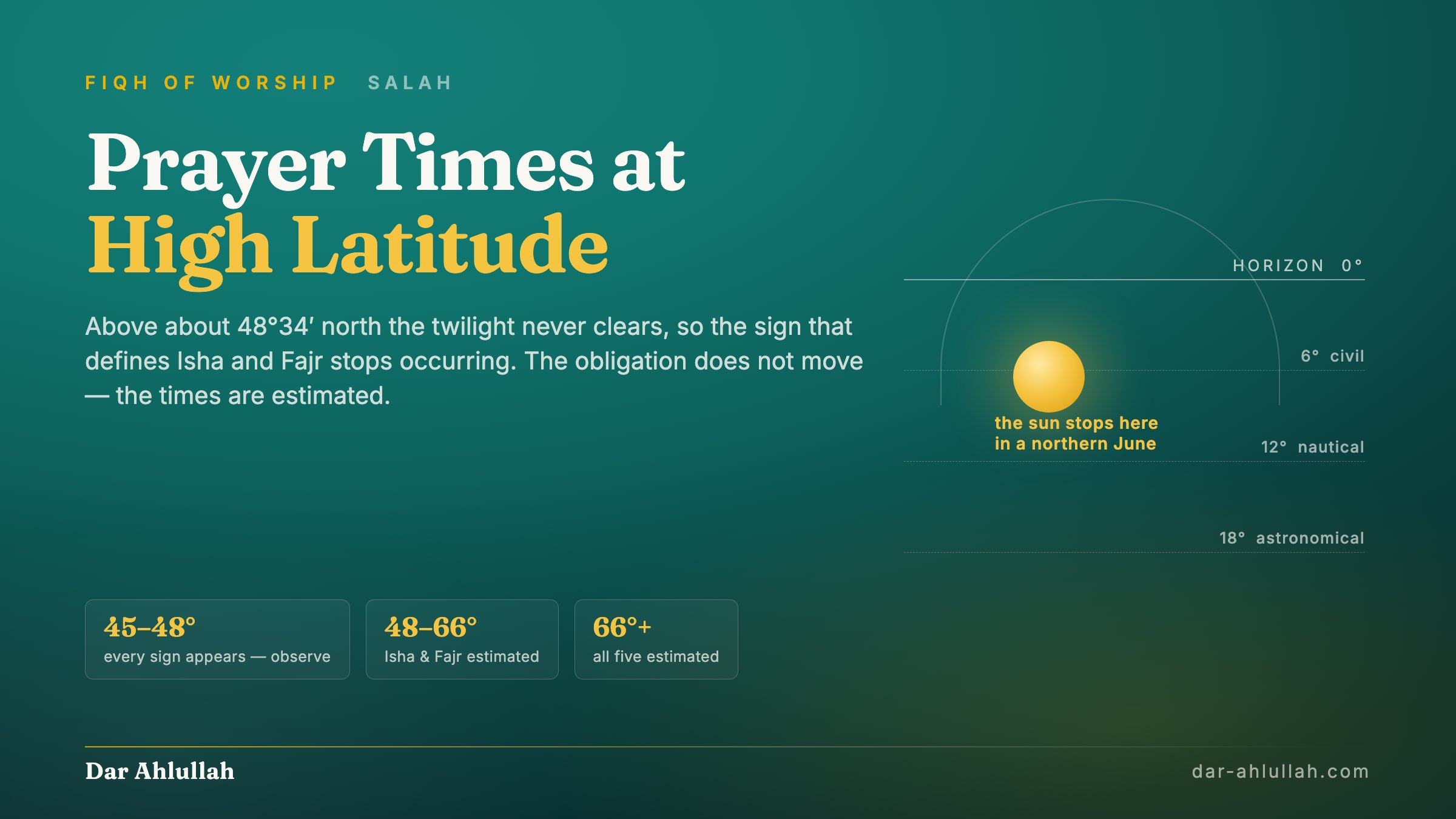
Prayer Times at High Latitude: Isha and Fajr in the Northern Summer
Above roughly 48 degrees north the twilight never clears in June, so the sign that defines Isha and Fajr stops occurring. The obligation does not move — the times are estimated, by one of four recognised methods, and your prayer app has already picked one.
20 min read
morning and evening adhkar
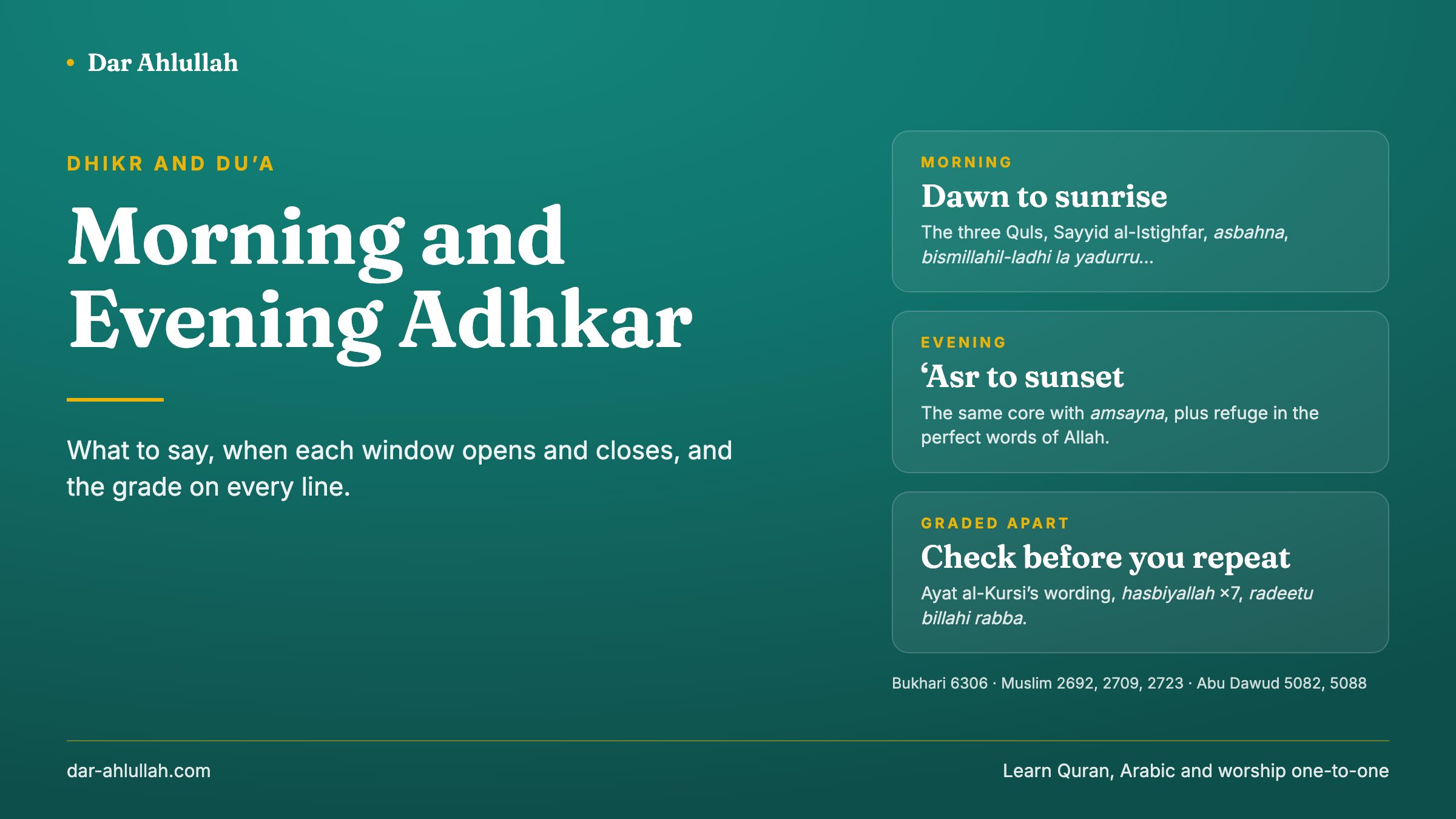
Morning and Evening Adhkar: What to Say and When
Morning and evening adhkar from the sound reports: the windows from dawn to sunrise and from 'Asr to sunset, the core set with the source and count of each line, and the grade printed on the popular additions the hadith scholars dispute, from Ayat al-Kursi to hasbiyallah seven times.
29 min read
how to respond to the adhan
How to Respond to the Adhan: What to Say and the Dua After
How to respond to the adhan: repeat each phrase after the muezzin, say la hawla wa la quwwata illa billah at the two hayya lines, then send salawat and say the du'a after the adhan. This guide sets out every step from the sound reports, prints the grade on the additions people argue about, and lays out the two scholarly answers on the adhan from a phone app.
29 min read