
how to perform ghusl
How to Perform Ghusl: The Full Ritual Bath, Step by Step
Dar Ahlullah team 24 min read
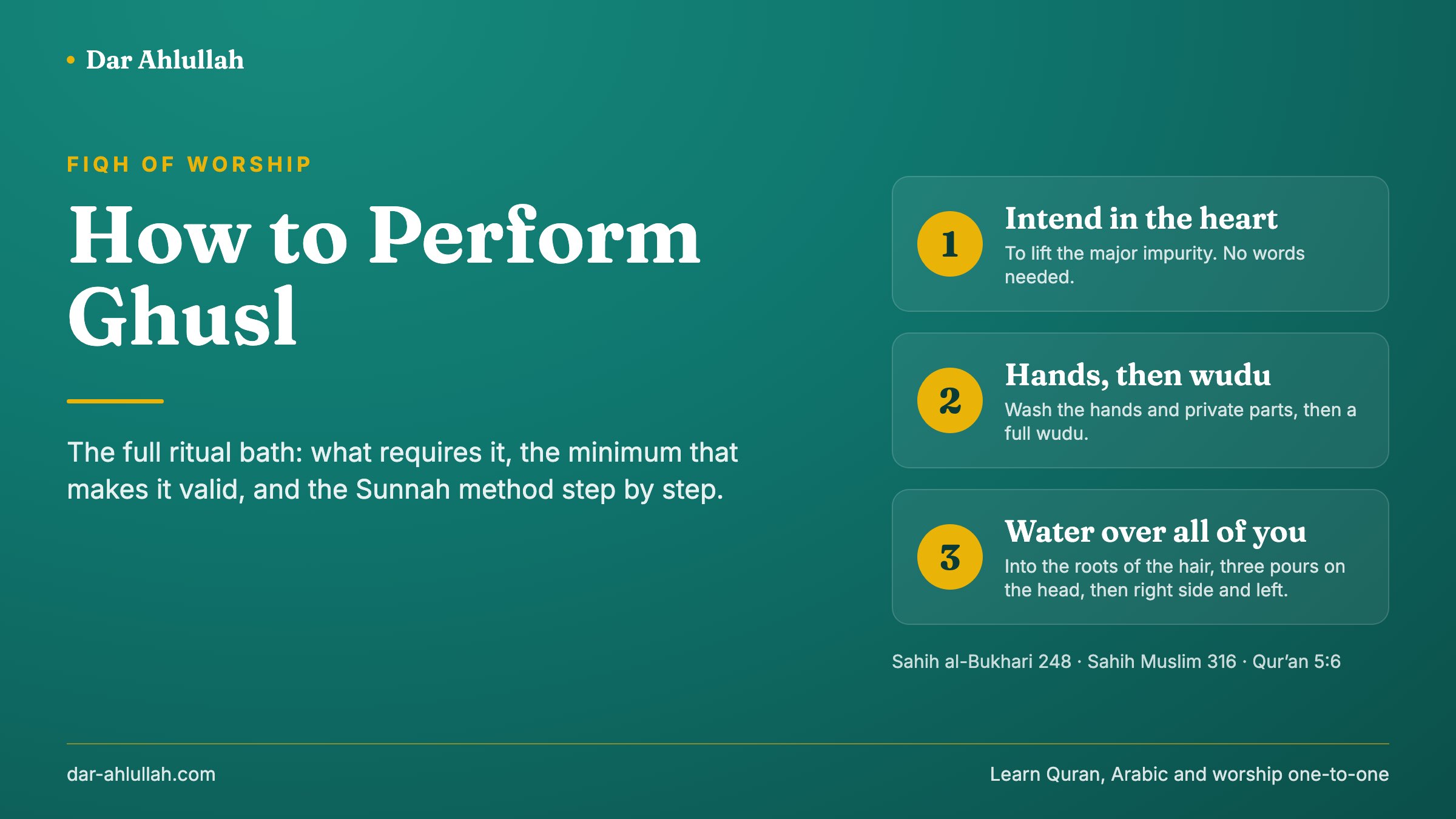
Table of Contents
- Introduction: The Bath Nobody Taught You
- The Short Answer
- What Ghusl Is, and Where It Comes From
- When Ghusl Is Required, and When Wudu Is Enough
- What Waits Until You Have Bathed, and What Does Not
- The Minimum: What Makes a Ghusl Valid
- Where the Four Schools Differ
- The Full Sunnah Method, Step by Step
- Hair, Braids and the Places Water Misses
- Nail Polish, Glue and Other Barriers
- Ghusl After Menstruation and Postnatal Bleeding
- Does Your Ordinary Shower Count?
- Do You Need Wudu After Ghusl?
- When You Cannot Bathe
- Recommended Baths: Friday, Embracing Islam and Others
- Six Situations, Worked Through
- Seven Mistakes People Keep Making
- How We Teach This
- Questions People Ask
- Conclusion: A Bath, Not an Ordeal
Introduction: The Bath Nobody Taught You
Wudu is taught in public. Children learn it at the mosque tap, converts are walked through it on their first Friday, and every guide to the prayer starts with it. Ghusl is taught almost nowhere, because the situations that require it are private, and nobody wants to explain them across a classroom. So a great many Muslims — born into the faith or new to it — reach adulthood with a rough idea that “you have to shower after certain things,” and no clear idea of what makes that shower count.
The gap matters, because ghusl is not optional hygiene. When it is owed, the prayer cannot be prayed without it, and a ghusl that misses its few real requirements is not a ghusl. At the same time, the real requirements are far fewer than most people fear. People undo braids they never needed to undo, repeat wudu they never needed to repeat, and stand under the water for twenty minutes worrying about a square centimetre of skin, while the things that actually decide validity — the intention, water reaching the whole body, and in two of the four schools the inside of the mouth and nose — go unmentioned.
This guide covers how to perform ghusl from start to finish: what requires it and what needs only wudu, what you may and may not do before you bathe, the minimum that makes a ghusl valid, where the four schools differ, the full method the Prophet ﷺ used, braids, nail polish, the bath after menstruation, and the question most guides skip: whether the shower you take every morning can be your ghusl. It assumes you already know wudu, because the Sunnah method contains a complete wudu. If you do not yet, start with our step-by-step guide to wudu. If the prayer itself is new to you, our guide to how to pray in Islam is the place to begin, and this article sits in its salah library beside the other purity guides.
One boundary before we begin. We teach Quran, Arabic and the practical fiqh of worship; we are not a fatwa body. Where the schools differ, we set their positions side by side and say which school holds which, rather than picking one and calling it the only view.
The Short Answer
- Ghusl is owed after sexual intercourse, after any emission of sexual fluid (awake or in a dream), and at the end of menstruation and postnatal bleeding. Until it is done, you cannot pray, perform tawaf or touch the mushaf.
- The minimum is two things: the intention to lift the major impurity, and water reaching every part of the body. The Hanafi and Hanbali schools add the inside of the mouth and nose; the Maliki school adds rubbing the body and not pausing too long.
- The Sunnah method is: wash the hands, wash the private parts, make a full wudu, work water into the roots of the hair, pour water over the head three times, then over the whole body, right side first (Sahih al-Bukhari 248 and 265).
- You do not need to undo braids for the bath after intercourse, in any of the four schools (Sahih Muslim 330). Anything that stops water reaching the skin, such as ordinary nail polish, must come off.
- An obligatory ghusl done properly counts as wudu. You can pray straight after it. A shower taken only to get clean does not count, unless it carries the intention.
What Ghusl Is, and Where It Comes From
Ghusl is the full ritual bath: washing the whole body with water, with the intention of purification. It lifts what the jurists call the major state of impurity (al-hadath al-akbar), in the same way that wudu lifts the minor one. The state left by intercourse or emission is called janabah, and a person in it is junub.
The command is in the same verse that commands wudu: “And if you are in a state of janabah, then purify yourselves” (Quran 5:6). Another verse ties it to the prayer directly: do not approach the prayer while junub “until you have washed yourselves” (Quran 4:43). And the verse on menstruation says that once women have become pure and “have purified themselves,” the restrictions of that period end (Quran 2:222).
The Quran gives the command; the Sunnah gives the method. Two wives of the Prophet ﷺ, ‘A’ishah and Maymunah, each described exactly how he bathed, and their two descriptions are the backbone of every ghusl guide, including this one. They are set out step by step below.
When Ghusl Is Required, and When Wudu Is Enough
Most of the confusion around ghusl is about whether it is owed at all. These are the cases, with the evidence for each.
1. Sexual intercourse, even without ejaculation
The Prophet ﷺ said that when a man sits between a woman’s four limbs and has intercourse with her, the bath becomes obligatory (Sahih al-Bukhari 291). In Sahih Muslim, the same ruling settles a dispute between the Muhajirun and the Ansar: the Ansar held that the bath was owed only if there was an emission, the Muhajirun that intercourse alone required it, and ‘A’ishah, when asked, reported the Prophet’s ﷺ ruling that the bath is owed once the two private parts meet (Sahih Muslim 349). Both spouses owe the bath.
2. Emission of sexual fluid, awake or asleep
Any emission of mani — the fluid released at climax — requires ghusl, for men and for women. When Umm Sulaym asked whether a woman must bathe after a wet dream, the Prophet ﷺ answered: “Yes, if she sees the fluid” (Sahih al-Bukhari 282). That condition matters both ways. Asked about a man who wakes to find wetness but remembers no dream, he said that man must bathe; asked about one who remembers a dream but finds no wetness, he said no bath is due (Sunan Abi Dawud 236, graded hasan by al-Albani; also Jami‘ at-Tirmidhi 113).
3. The end of menstruation or postnatal bleeding
When the bleeding stops, ghusl is owed before the prayer can be resumed. The bath itself is the same as any other, with two additions from the Sunnah covered in the section on menstruation below.
4. Embracing Islam
When Qays ibn ‘Asim became Muslim, the Prophet ﷺ told him to bathe with water and lote-tree leaves (Sunan Abi Dawud 355; Sunan an-Nasa’i 188). Whether that bath is obligatory or recommended is a real difference of opinion, set out in the section on recommended baths.
What needs only wudu
Madhy, the thin, clear fluid that can come with arousal and without climax, does not require ghusl. ‘Ali, who experienced it often, had the question put to the Prophet ﷺ, who said to wash the private part and make wudu (Sahih al-Bukhari 269; also 132). Everything else that breaks wudu — using the toilet, wind, deep sleep — is covered in what breaks wudu, and what does not.
| What happened | What it requires | Source |
|---|---|---|
| Intercourse, with or without ejaculation | Ghusl, for both spouses | Bukhari 291, Muslim 349 |
| Emission of sexual fluid while awake | Ghusl | Bukhari 282 |
| Woke up and found fluid, whether or not you remember a dream | Ghusl | Abu Dawud 236 |
| Remember a dream, but found no fluid | Nothing | Abu Dawud 236 |
| End of menstruation or postnatal bleeding | Ghusl | Quran 2:222 |
| Madhy (clear fluid with arousal, no climax) | Wash the area and make wudu | Bukhari 269 |
What Waits Until You Have Bathed, and What Does Not
While you are junub, a short list of acts is closed to you until you bathe:
- The prayer, obligatory or voluntary. This is the verse itself: do not approach the prayer while junub “until you have washed yourselves” (Quran 4:43).
- Touching the mushaf. This is the position of all four schools, and Ibn ‘Abd al-Barr reported the agreement of the jurists of the major cities on it (Dorar, al-Mawsu‘ah al-Fiqhiyyah).
- Reciting the Quran. All four schools prohibit it for the junub; at-Tirmidhi records that most scholars permitted no more than part of a verse, while permitting tasbih and tahlil (Dorar). Dhikr and du‘a remain open.
- Staying in the mosque. All four schools prohibit remaining in a mosque while junub. The Shafi‘i and Hanbali schools allow passing through, reading the verse’s “except one passing through” that way, and the Hanbali school allows staying if the person has made wudu (Dorar).
- Tawaf around the Ka‘bah.
Just as important is what does not wait. Abu Hurayrah once slipped away from the Prophet ﷺ because he was junub and did not want to sit with him in that state. When he came back, the Prophet ﷺ said: “Subhan Allah! A believer never becomes impure” (Sahih al-Bukhari 283). Janabah is a ritual state, not dirt. You can hold your children, cook, eat, talk and work.
Nor does the bath have to be immediate. ‘Umar asked whether one of them could sleep while junub, and the Prophet ﷺ said yes, if he makes wudu first (Sahih al-Bukhari 287). The Prophet ﷺ sometimes woke at dawn in Ramadan in a state of janabah, then bathed and fasted (Sahih al-Bukhari 1925). Al-Nawawi recorded that the bath becomes pressing only when a prayer is due, and that this is the consensus of the Muslims (Dorar). The one thing you cannot do is let the time of a prayer run out while you wait.
The Minimum: What Makes a Ghusl Valid
Strip ghusl to what decides its validity and two things remain:
- The intention to lift the major impurity. It is made in the heart and needs no words.
- Water reaching the entire outer body: every part of the skin and the hair on it, including the scalp, behind the ears, the navel, the folds of the skin, between the fingers and toes, and under the arms.
IslamWeb’s fatwa centre describes the sufficient ghusl in exactly these terms: the intention to remove the major impurity, and washing the entire body with water (IslamWeb 475267). Unlike wudu, ghusl has no required order. The jurists treat the body as one limb, and Ibn ‘Abd al-Barr reported agreement that no order between its parts is required (Dorar). Wash the back before the head, or the legs before the arms, and the ghusl still stands.
That is the floor on every view. The schools then add to it in different places, and that is where most guides quietly pick one school without telling you.
Where the Four Schools Differ
Four questions divide the schools. None of them is obscure; each one changes what you must do in the shower.
| Question | Hanafi | Maliki | Shafi‘i | Hanbali |
|---|---|---|---|---|
| Is the intention a condition of validity? | No (needed for the reward) | Yes | Yes | Yes |
| Must water enter the mouth and nose? | Yes, obligatory | No, sunnah | No, sunnah | Yes, obligatory |
| Must you rub the body (dalk)? | No, sunnah | Yes, obligatory | No, sunnah | No, sunnah |
| Must you wash without long pauses (muwalat)? | No, sunnah | Yes, when you remember and are able | No, sunnah | No, sunnah |
The intention. The Maliki, Shafi‘i and Hanbali schools count the intention among the obligatory acts of ghusl, on the basis of “actions are only by intentions” (Dorar). In the Hanafi school, as Shaykh Yusuf Weltch puts it for SeekersGuidance, “the intention is not a condition for validity – even though it is a condition in order to attain the reward of the actions” (SeekersGuidance via IslamQA.org).
Mouth and nose. The Hanafi and Hanbali schools treat the inside of the mouth and nose as part of the body that must be washed; the Maliki and Shafi‘i schools require only the outside of the body (IslamWeb 351553, citing the Kuwaiti Encyclopedia of Fiqh). Ibn Baz and Ibn ‘Uthaymin both held them obligatory; Ibn ‘Uthaymin said ghusl is not valid without them (Dorar). For a Hanafi or Hanbali, a ghusl that skips them is not a ghusl.
Rubbing. In the Maliki school, pouring water without passing the hand over the body is not called washing at all; al-Nafrawi says that without rubbing, when one is able to rub, it is only “immersion.” The rub can be done with the hand, another limb or a cloth (IslamWeb 447118, in Arabic). The other three schools hold rubbing to be sunnah, because it is how you make sure the water has actually reached the skin (Dorar).
Continuity. The Maliki school requires washing without a pause long enough for the washed parts to dry, when you remember and are able; Khalil lists it with the intention in his Mukhtasar. The majority hold it sunnah, so on their view a spot you forgot can simply be washed later and the ghusl is complete (IslamWeb 365470, in Arabic; Dorar).
The practical upshot is easy to remember: if you rinse your mouth and nose, rub as the water goes on, and keep going without long breaks, your ghusl is valid on every one of the four views. Follow your own school where it is lighter if you have one; but if you do not yet know which school you follow, doing the full set costs you perhaps a minute.
The Full Sunnah Method, Step by Step
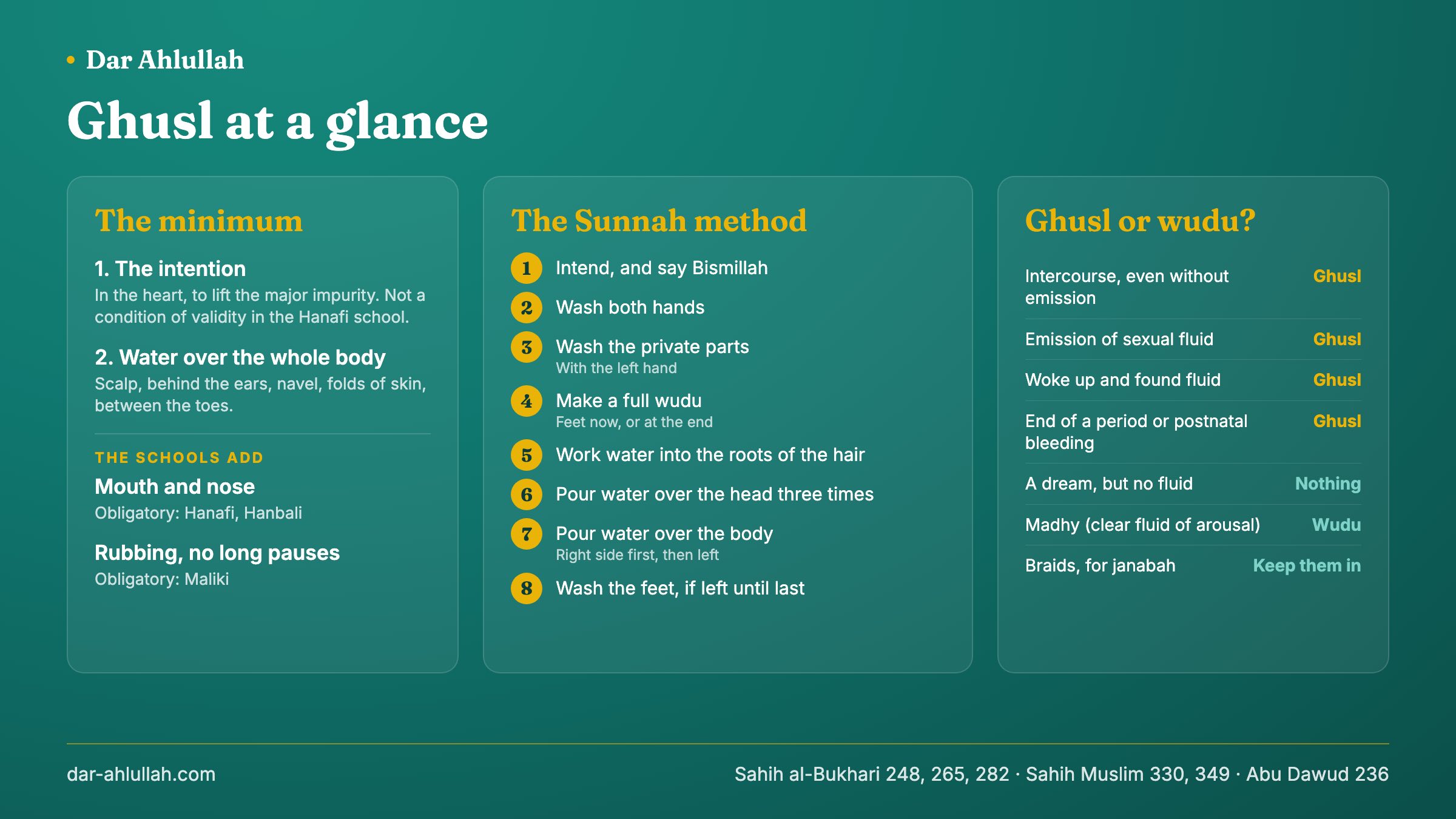
‘A’ishah described the Prophet’s ﷺ bath after janabah: he began by washing his hands, then made wudu as for the prayer, then put his fingers in water and worked them through the roots of his hair, then poured three handfuls of water over his head, then poured water over his whole body (Sahih al-Bukhari 248; Sahih Muslim 316). Maymunah, who set out the water for him, adds detail: he washed his private parts with his left hand, rubbed that hand on the ground, rinsed his mouth and nose, and washed his feet last, after stepping aside from where he had bathed (Sahih al-Bukhari 265, 274). Put together, the method runs like this:
- Intend in your heart to lift the major impurity. Saying Bismillah is sunnah.
- Wash both hands, two or three times.
- Wash the private parts and anything on the body from the impurity, using the left hand. The Prophet ﷺ then rubbed that hand on the ground or a wall (Bukhari 274); soap does that job today.
- Make a full wudu, as for the prayer, including rinsing the mouth and nose. You may wash the feet now, or leave them to the end as in Maymunah’s report.
- Work water into the roots of your hair with wet fingers until the scalp is wet.
- Pour water over your head three times.
- Pour water over the whole body, starting with the right side and then the left, passing your hands over it so the water reaches every fold.
- Wash your feet, if you left them, after moving from where you stood.
Two details from these reports are worth noticing. The first is how little water it took: the Prophet ﷺ bathed with one sa‘ of water, up to five mudd, and made wudu with a single mudd (Sahih al-Bukhari 201). A ghusl is not a test of how long you can stand under a shower. The second is that he was screened while he bathed: Umm Hani’ found him bathing while Fatimah held a screen for him (Sahih al-Bukhari 280). Covering yourself from other people’s eyes while bathing is obligatory (Dorar); in a private bathroom it takes care of itself.
Hair, Braids and the Places Water Misses
Umm Salamah asked the Prophet ﷺ whether she had to undo her tightly plaited hair for the bath after janabah. He said: “No, it is enough for you to throw three handfuls of water on your head and then pour water over yourself, and you shall be purified” (Sahih Muslim 330). When ‘A’ishah heard that ‘Abdullah ibn ‘Amr was telling women to undo their plaits, she asked why he did not just tell them to shave their heads, since she bathed with the Prophet ﷺ and did no more than pour three handfuls over her head (Sahih Muslim 331). All four schools agree that braids do not have to be undone for the bath after janabah (Dorar). What has to happen is that water reaches the scalp.
A hadith often quoted here — “under every hair there is janabah, so wash the hair and cleanse the skin” — is weak. Abu Dawud himself called its narrator weak and the report munkar, and al-Albani graded it da‘if (Sunan Abi Dawud 248; Ibn Majah 597). The rule that water must reach the roots of the hair does not need it; ‘A’ishah’s description of the Prophet’s ﷺ fingers working through his hair is enough.
The places a quick shower tends to miss are the ones the jurists list: behind and inside the folds of the ears, the navel, under the arms, the backs of the knees, between the toes, folds of skin in a heavier body, and under a long beard. Pass a wet hand over them. That is what rubbing is for.
Nail Polish, Glue and Other Barriers
Anything that sits on the skin and stops water reaching it must be removed before ghusl, and the skin beneath it washed. IslamWeb’s fatwa on the question says plainly that the obstacle must be removed and the body under it washed “so that your Ghusl will be valid” (IslamWeb 461020). In practice that means ordinary nail polish, waterproof layers of make-up, glue, paint and anything else that forms a film. Henna dye is different: it colours the skin without forming a layer, so it does not affect ghusl (IslamQA 261).
What if you find the barrier afterwards — a fleck of paint discovered at ‘Asr? On the majority view, which does not require continuity, you remove it and wash that spot with the intention of completing your ghusl, and the bath is then complete. The prayers you prayed in between are repeated on the majority view; Ibn Taymiyyah held that they need not be (IslamWeb 461020; IslamWeb 365470, in Arabic). If the missed spot was part of the limbs of wudu and you had washed it in a later wudu, that wudu already covered it.
Ghusl After Menstruation and Postnatal Bleeding
The bath at the end of a period is the same bath, with two additions from the Sunnah. When Asma’ bint Shakal asked about it, the Prophet ﷺ told her to pour water on her head and rub it hard until it reached the roots of the hair, then pour water over herself, and then take a piece of cotton or cloth scented with musk and use it to clean herself. ‘A’ishah explained the part that embarrassed the questioner: “Rub the place soiled with blood with it” (Sahih Muslim 332; Sahih al-Bukhari 314).
Braids do not have to be undone for this bath either in the Hanafi, Maliki and Shafi‘i schools (Dorar), though the instruction to rub the head hard shows that the scalp must genuinely be wet.
One point causes needless worry. A woman does not make up the prayers she missed during her period. When the bleeding stops she bathes and prays the prayer whose time she is in. Which prayers are and are not owed is worked through in our guide to making up missed prayers.
Does Your Ordinary Shower Count?
This is the question most guides skip, and the one that matters most to someone who showers every morning anyway. The answer depends on the intention.
A shower taken simply to get clean or to cool down is, in Ibn ‘Uthaymin’s words, “not an act of worship, rather it is just an ordinary action,” and it does not lift an impurity (IslamQA 68854). So a junub person who showers out of habit, without intending ghusl, has on the Maliki, Shafi‘i and Hanbali view still not bathed. On the Hanafi view, where the intention is not a condition, that shower lifts the janabah as long as water reached the whole body and the mouth and nose.
The fix costs nothing. Your morning shower is your ghusl, on every view, if you do four things:
- Intend ghusl before the water touches you.
- Rinse your mouth and nose.
- Pass your hands over your body as the water runs, including the places listed above.
- Keep going without stopping long enough for the washed parts to dry.
Shampoo, soap and shower gel do no harm. Clean water mixed with soap is still water reaching your skin.
Do You Need Wudu After Ghusl?
No, not after an obligatory ghusl. ‘A’ishah reported that the Prophet ﷺ did not make wudu after his ghusl (Jami‘ at-Tirmidhi 107; Sunan Abi Dawud 250; both graded sahih by al-Albani). IslamQA sets out the distinction: a ghusl that lifts janabah, menstruation or postnatal bleeding is sufficient for the prayer with no further wudu, while a recommended ghusl, such as the Friday bath, or a shower to cool down does not replace wudu (IslamQA 99543).
The wudu inside the Sunnah method is not wasted either. It is part of the ghusl, so when you finish you are already in wudu, unless something that breaks wudu happens before you pray.
When You Cannot Bathe
If water cannot be used — there is none, or it would harm you — tayammum takes the place of ghusl, with exactly the same strike of clean earth and wipe of the face and hands as it takes for wudu. When water becomes usable, you bathe, but the prayers you prayed on the tayammum are not repeated. The excuses that allow it, the ones that do not, and the case of a junub person who wakes with too little time before the prayer ends are all covered in how to perform tayammum.
A cast or dressing that cannot be removed is not a reason to skip the bath. You wash everything else and wipe over or make tayammum for the covered part; the same guide sets out how.
Recommended Baths: Friday, Embracing Islam and Others
Some baths are not owed but are rewarded. The best known is the Friday bath before Jumu‘ah. The Prophet ﷺ said the bath on Friday is wajib on every adult (Sahih al-Bukhari 879), and whether that word means obligatory or strongly recommended is discussed in our guide to how to pray Jumu‘ah. Remember that a recommended bath does not count as wudu.
Embracing Islam. The Hanbali school holds the bath obligatory for someone who becomes Muslim, on the strength of the Qays ibn ‘Asim hadith above. The Hanafi and Shafi‘i schools hold it recommended, because many people became Muslim in the Prophet’s ﷺ time without being told to bathe (IslamQA 81949; Dorar). The two sources we checked report the Maliki position differently. Either way, a new Muslim who had any cause of ghusl before accepting Islam should bathe, and most will simply bathe as their first act of worship. Our guide to your first 90 days as a new Muslim puts it in the order of everything else there is to learn.
Waking from unconsciousness. The Shafi‘i and Hanbali schools recommend a bath for someone who recovers from fainting or unconsciousness, with no sign of janabah (Dorar).
Six Situations, Worked Through
- You wake at 6:40, Fajr ends at 6:55, and you find you had a wet dream. Ghusl is owed, and the prayer is owed on time. A focused ghusl takes a few minutes: intention, mouth and nose, water over the head and body with your hands moving. Do that and pray.
- A married couple had intercourse but there was no ejaculation. Ghusl is owed by both of them (Bukhari 291; Muslim 349). The view that the bath depends on emission is exactly the one ‘A’ishah’s report settled.
- You notice nail polish on one nail at ‘Asr, after bathing that morning. Remove it and wash the nail with the intention of completing your ghusl. On the majority view you repeat the prayers prayed since the bath; Ibn Taymiyyah held that you need not (IslamWeb 461020).
- It is Ramadan, you are junub, and the dawn adhan is about to go. Eat your suhur, start the fast, and bathe in time for Fajr. The Prophet ﷺ did exactly this (Bukhari 1925).
- Your period ends late at night and your hair is in braids. You do not need to undo them. Rub water into your scalp until it is wet at the roots, pour water over your head and body, and pray ‘Isha if its time has not ended.
- You have just taken your shahadah. Bathe, whether your school calls it obligatory or recommended, with the intention of ghusl, and learn wudu next: it is the purification you will use five times a day.
Seven Mistakes People Keep Making
- Missing Fajr to bathe “properly” later. A complete ghusl can be done in a few minutes. Letting the prayer’s time run out is the one thing that is not allowed.
- Skipping the mouth and nose. For Hanafis and Hanbalis this invalidates the ghusl. For everyone else it is sunnah. Do it.
- Showering out of habit and assuming it counts. Without the intention it does not count in three of the four schools. Decide before the water starts.
- Undoing elaborate braids every time. The Prophet ﷺ told Umm Salamah she did not have to (Muslim 330). Wet the roots.
- Making wudu again straight after an obligatory ghusl. It is not required (Tirmidhi 107). Pray.
- Treating madhy like mani. The clear fluid of arousal needs wudu, not ghusl (Bukhari 269). Over-bathing out of doubt is its own problem.
- Avoiding family, food or work until the bath. “A believer never becomes impure” (Bukhari 283). Janabah closes the prayer, the mushaf and the mosque, not the rest of life.
How We Teach This
Ghusl is a page of fiqh and, once understood, rarely needs a teacher again. What does need a teacher is the layer underneath: knowing which school you follow and where its requirements sit, so that you are not deciding in the shower at 6:40 whether your mouth and nose count. In our fiqh-of-worship lessons it is taught alongside wudu, tayammum and the prayer itself, with the questions people are too embarrassed to ask in a mosque answered one to one.
Dar Ahlullah runs one-to-one live sessions with certified teachers, scheduled in your own timezone. Teaching is charged at $9 per teaching hour, with monthly plans at $36, $70 and $102 depending on how many hours you want, and a 20% discount for siblings. You can pause, upgrade or switch plans at any time, and if a teacher is not the right fit we rematch you with another certified mentor at no extra cost. If you would like to see where your purification and prayer stand before committing to anything, the 30-minute assessment is free and does not ask for a card — the details are on our pricing page.
Questions People Ask
What are the obligatory parts of ghusl?
On every view: the intention (except that the Hanafi school does not make it a condition of validity) and water reaching the whole body. The Hanafi and Hanbali schools add rinsing the mouth and nose; the Maliki school adds rubbing and washing without long pauses.
How long does ghusl take?
A few minutes. The Prophet ﷺ bathed with around one sa‘ of water (Bukhari 201). A ghusl is complete once the requirements are met, not after a set time.
Do I have to say the intention out loud?
No. The intention is a decision in the heart. Saying Bismillah at the start is sunnah; there is no required formula.
Can I perform ghusl in a shower, or do I need a bucket?
A shower is fine. The Sunnah method describes pouring water; a shower pours it for you. The requirement is that water reaches the whole body.
Can I read the Quran on my phone while junub?
Touching a phone is not touching the mushaf, but the recitation itself is the issue: all four schools prohibit reciting the Quran while junub. Dhikr and du‘a are open. Bathe, then recite.
Can I sleep before doing ghusl?
Yes. The Prophet ﷺ told ‘Umar that a junub person may sleep if he makes wudu first (Bukhari 287). Bathe before the next prayer is due.
Do I need to do ghusl after a wet dream if I see nothing?
No. The bath is owed when there is fluid, whether or not you remember the dream; a dream with no fluid requires nothing (Abu Dawud 236; Bukhari 282).
Does one ghusl cover several causes, such as janabah and the end of a period?
Yes. Ibn Qudamah records that one ghusl intended for both causes suffices for both, and that this is the view of most scholars (IslamWeb 239635).
Conclusion: A Bath, Not an Ordeal
The fiqh of ghusl fits on an index card. Intend it; get water to every part of the body; rinse your mouth and nose, rub as you go and do not stop halfway, and you are covered on every view. The Sunnah adds a beautiful order to it — hands, private parts, wudu, the roots of the hair, three pours over the head, the right side and then the left — and ‘A’ishah, Maymunah and Umm Salamah preserved it in enough detail that nothing about it has to be guessed.
What the Sunnah also preserved is how light it was meant to be: a little water, braids left in, no wudu repeated, no family avoided, and no prayer missed for the sake of a bath that takes minutes. Learn it once and it stops being a source of worry. If you want the rest of purification and the prayer in the same detail, the salah library links every guide we have written on it.
Related articles
what breaks wudu
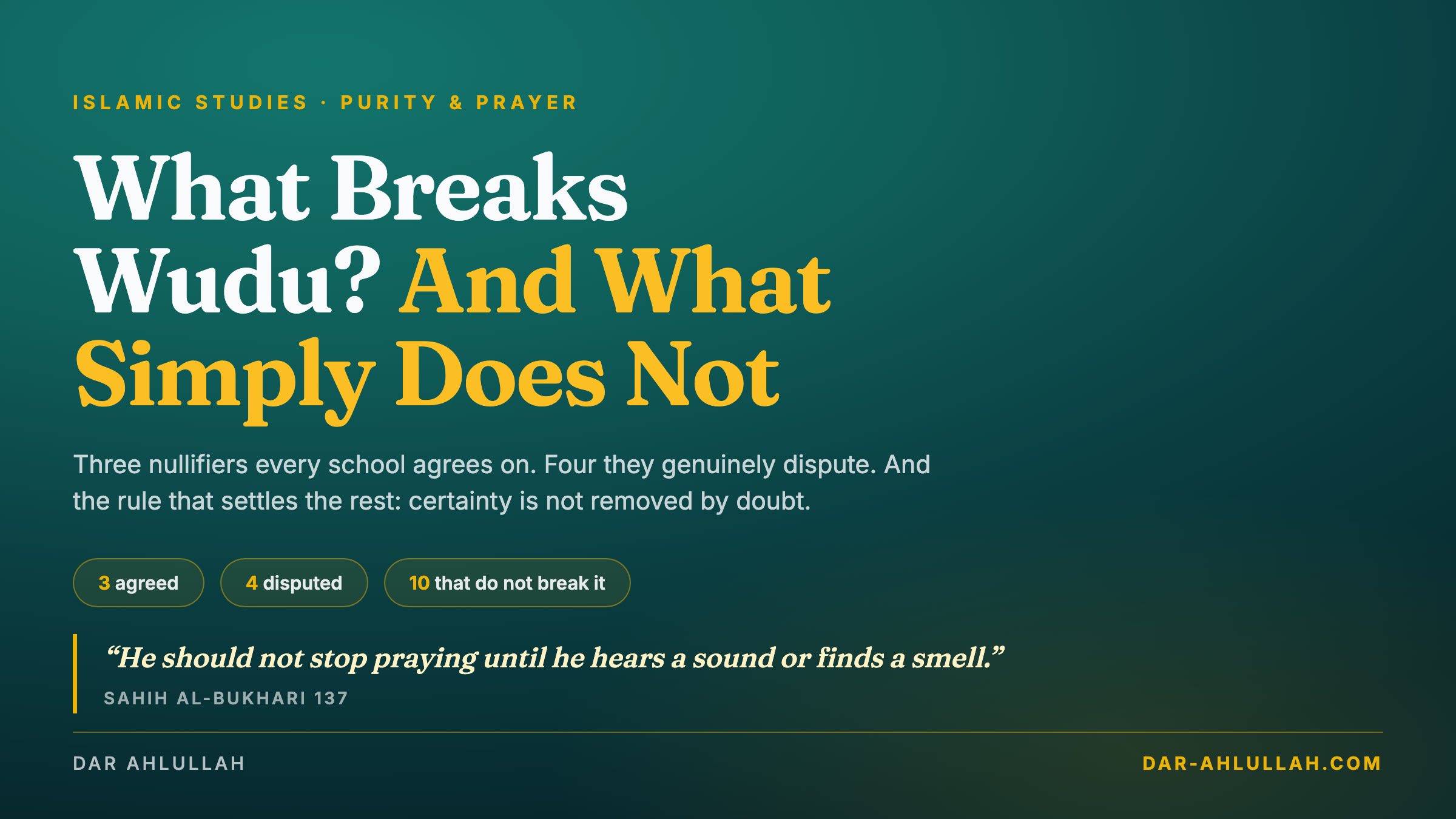
What Breaks Wudu? The Agreed List and the Disputed
Three things break wudu by the agreement of all four schools. Four more are genuinely disputed, and your answer depends on which school you follow. Almost everything else people worry about — food, dirt, a nosebleed, a doubt — does not break it at all.
19 min read
how to perform tayammum
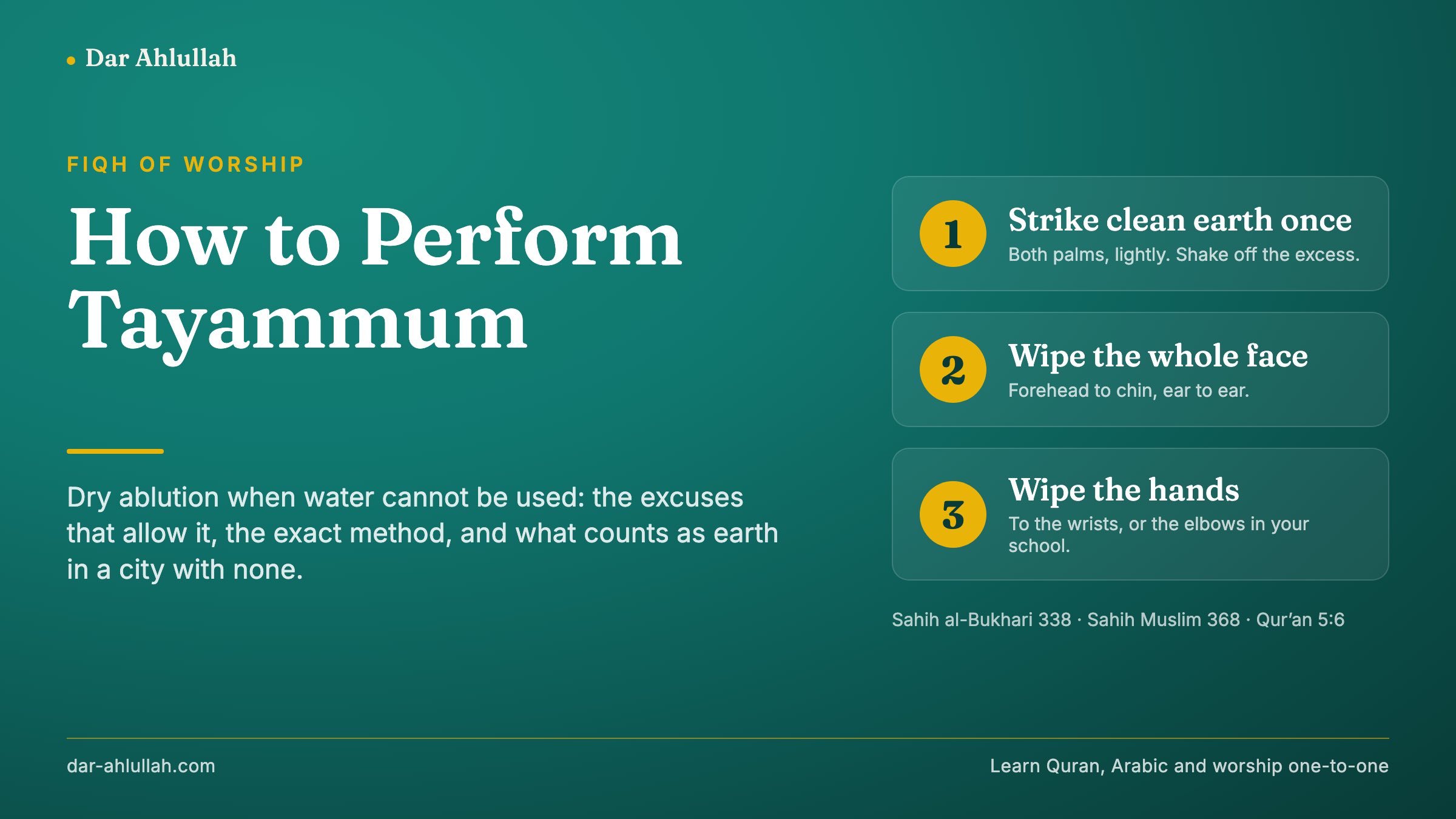
How to Perform Tayammum: Dry Ablution When You Cannot Use Water
Tayammum is the purification you make with earth when water cannot be used. The rule is short: strike clean earth, wipe your face, wipe your hands. The difficulty for a Muslim in Europe or America is everything around the rule: what counts as a real excuse, what counts as earth in a building with none, how long it lasts, and what you do on a plane or in a hospital bed when there is neither water nor dust.
28 min read
Learn wudu
Learn Wudu: Your Complete Guide to Purification for Prayer with Dar Ahlullah
Learn wudu step-by-step with Dar Ahlullah. This complete guide provides all the essential instructions for purification before prayer. Master wudu today!
32 min read