
sunnah rawatib
The Sunnah Rawatib: The Twelve Rak’ahs Around the Five Prayers
Dar Ahlullah team 27 min read

Table of Contents
- Introduction: The Prayers Everyone Around You Assumed You Knew
- The Short Answer
- What the Rawatib Are, and What They Are Not
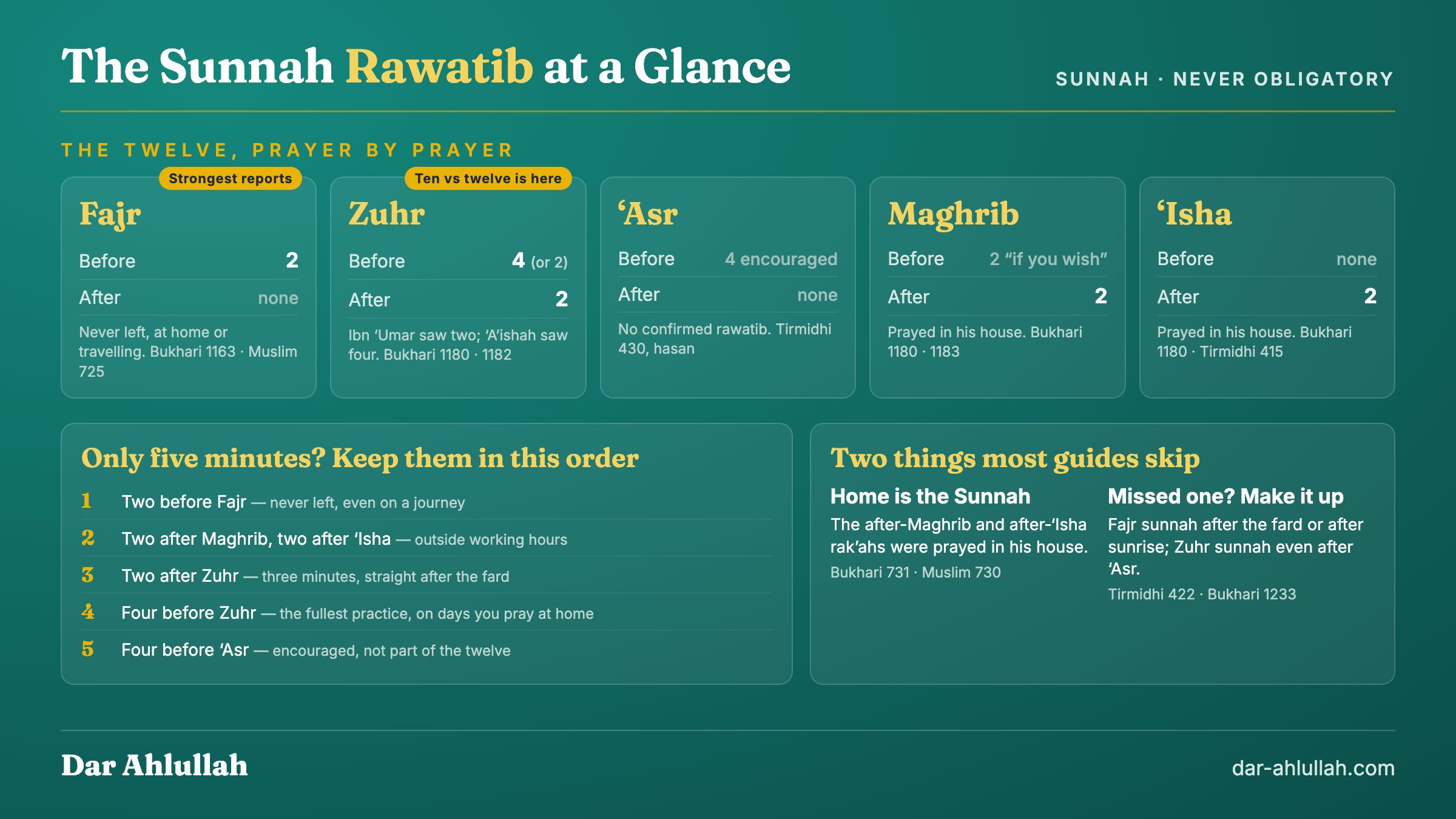
- The Twelve, Prayer by Prayer
- Ten or Twelve? The Two Reports Side by Side
- What the Four Schools Say
- The Two Before Fajr: The One He Never Left
- Before and After, When Nobody Calls the Adhan
- Two by Two, or Four at Once
- Where to Pray Them: The Case for Your Living Room
- When You Miss One
- On a Journey
- When You Only Have Five Minutes: Which to Keep
- The House in Paradise: Every Day, or Once?
- Seven Mistakes People Keep Making
- How We Teach This
- Questions People Ask
- Conclusion: The Prayers Around the Prayers
Introduction: The Prayers Everyone Around You Assumed You Knew
There is a moment most converts and many second-generation Muslims recognise. You have learned the five prayers. You know the sequence, you can get through al-Fatihah, you are proud of it. Then you pray Maghrib next to someone at the masjid, give the salam, and stand up to leave — and they are still there, already back on their feet, praying something else. Nobody told you about the something else. Ask, and the answer comes back as a single word that explains nothing: sunnah.
The something else is the sunnah rawatib — the regular voluntary rak’ahs the Prophet ﷺ attached to each of the five prayers, some before the obligatory prayer and some after. They are the most-prayed voluntary prayers in Islam by a wide margin, prayed more often than Tahajjud, Duha or Witr, and they are also the least explained, because in a Muslim-majority country nobody has to explain them. You absorb them from the people around you before you can read.
In Manchester or Frankfurt or New Jersey there is nobody to absorb them from, and the English-language material has two problems. One page says there are ten of them and the next says twelve, and neither says why. And almost all of it is written on the assumption of a masjid next door and an adhan you can hear, so it tells you to pray the “before” rak’ahs between the adhan and the iqamah, which is no instruction at all if you pray Zuhr alone in a stairwell at work.
This article sets out the rawatib from the sound reports: what they are, how many there are and where each one goes, why ten and twelve are both correct answers, and what each of the four schools makes of them. Then it does the things a guide written for Cairo does not need to do: where the “before” prayers go when no adhan is called, why praying them in your living room is the Sunnah itself rather than a concession, how to make one up, and — for the working day — which ones to keep when there is only time for some.
One boundary first. We teach Quran, Arabic and the practical fiqh of worship; we are not a fatwa body, and where the schools differ we say so rather than picking for you. If the five obligatory prayers are still new, our complete guide to salat covers the sequence every one of these rak’ahs is prayed with, and the first ninety days guide puts the voluntary prayers into a sensible order of priority. The rawatib sit near the top of that order, which is why they get an article of their own.
The Short Answer
- What they are: the regular voluntary rak’ahs attached to the five daily prayers. Ratibah means fixed or regular; rawatib is its plural.
- The ruling: sunnah — strongly encouraged, never obligatory, and nothing is owed if one is missed. The Bedouin who asked whether anything beyond the five was owed was told: “No, unless you do so voluntarily.”
- The fullest count, twelve: two before Fajr, four before Zuhr and two after, two after Maghrib, two after ‘Isha.
- The other count, ten: the same list with two before Zuhr instead of four. Both come from sound reports, and the difference is explained below.
- ‘Asr: no confirmed rawatib. Four before it are encouraged on a hasan report, and are not part of the twelve.
- The most confirmed of all: the two before Fajr, which the Prophet ﷺ kept at home and on journeys, and described as better than the world and everything in it.
- Where: the reports say he prayed the after-Maghrib and after-‘Isha rak’ahs in his house. Home is the Sunnah for the rawatib, not a fallback.
- If you miss one: it may be made up — the Fajr sunnah after the fard or after sunrise, the Zuhr sunnah even after ‘Asr — and it is encouraged, not owed.
What the Rawatib Are, and What They Are Not
Start with the word. Ratibah in Arabic means something fixed, regular, in its settled place; a ratib salary is one paid on schedule. The sunnah rawatib are the voluntary prayers with a settled place — attached to a specific obligatory prayer, prayed either just before it (qabliyyah) or just after it (ba‘diyyah). That is what separates them from the rest of the voluntary prayers. Tahajjud has a window, Duha has a window, but neither is attached to one of the five. The rawatib are.
They are sunnah, not fard, and it is worth being precise about that because the word does a lot of work here. When a man from Najd asked the Prophet ﷺ what Islam required of him, he was told five prayers in the day and night. He asked whether he owed any more, and the answer was: “No, but if you want to offer the nawafil prayers you can” (Sahih al-Bukhari 46, and the same exchange in Sahih Muslim 11). Nothing in the rawatib is owed, and nothing is sinful if left. What they are is the practice of the Prophet ﷺ held to so consistently that his Companions could recite the list from memory, which is exactly how we have it.
The clearest statement of what they are for is a report about the Day of Judgement. The first thing a person is called to account for is the prayer. If it is complete, he is saved. If it is deficient, the Lord says: “Look! Are there any voluntary prayers for My servant?” — and the deficiency in the obligatory is made good from the voluntary (Jami‘ at-Tirmidhi 413, graded sahih by al-Albani; the fuller version is Sunan Abi Dawud 864). Read that against the honest state of your own Fajr — the one prayed half-awake, the one where the mind left in the second rak’ah — and the rawatib stop looking like an optional extra. They are the patch. Two rak’ahs prayed on a working morning with full attention cover for the obligatory ones prayed without it.
Two things they are not. They are not Witr, which is a separate night prayer with its own rulings, covered in our article on how to pray Tahajjud. And they are not the general category of nafl, which is any voluntary prayer at any permitted time. The rawatib are the specific, named, placed ones.
The Twelve, Prayer by Prayer
The fullest list comes from Umm Habibah, the wife of the Prophet ﷺ. She reported him as saying: “Whoever prays twelve rak’ahs in a day and night, a house will be built for him in Paradise: four rak’ahs before Zuhr, two after it, two after Maghrib, two after ‘Isha, and two before the Fajr prayer” (Jami‘ at-Tirmidhi 415, which at-Tirmidhi himself grades hasan sahih). The shorter form of the same report, without the breakdown, is in Sahih Muslim 728, where Umm Habibah adds that she never left them after hearing it — and the narrator after her says the same, and the one after him.
| Prayer | Before | After | Source |
|---|---|---|---|
| Fajr | 2 | none (prayer is discouraged after Fajr until the sun is up) | Tirmidhi 415; Bukhari 1180; Bukhari 1163 |
| Zuhr | 4 (or 2 — see below) | 2 | Tirmidhi 415; Bukhari 1182; Muslim 730 |
| ‘Asr | none confirmed; 4 encouraged | none (prayer is discouraged after ‘Asr) | Tirmidhi 430 (hasan) |
| Maghrib | none confirmed; 2 permitted “for whoever wishes” | 2 | Tirmidhi 415; Bukhari 1180; Bukhari 1183 |
| ‘Isha | none confirmed | 2 | Tirmidhi 415; Bukhari 1180 |
A few notes on the table. There is nothing after Fajr and nothing after ‘Asr because those are two of the windows in which voluntary prayer is discouraged, and the rawatib respect them. ‘Asr has no confirmed rawatib at all; the four before it rest on a single report — “May Allah have mercy upon a man who prays four before ‘Asr” (Jami‘ at-Tirmidhi 430, graded hasan) — which is encouragement, not a fixed sunnah, and the count is not part of the twelve.
The two before Maghrib are a special case. The Prophet ﷺ said “Pray before the Maghrib prayer” twice, and the third time added “for whoever wishes” — and al-Bukhari’s narrator explains why: he did not want people to take it as a fixed practice (Sahih al-Bukhari 1183). So they are permitted and good, and deliberately not made regular. If you pray them, pray them quickly; the Maghrib window is short.
What the Zuhr “four before” is doing in brackets is the subject of the next section.
Ten or Twelve? The Two Reports Side by Side
Search for the rawatib and you will find pages that say ten and pages that say twelve with equal confidence, and if you have no teacher this is genuinely unsettling: it looks like somebody is wrong about a basic fact. Nobody is. The two numbers come from two Companions reporting what they saw, and they saw different amounts of the same thing.
The ten come from Ibn ‘Umar: “I remember ten rak’ahs of nawafil from the Prophet: two rak’ahs before the Zuhr prayer and two after it; two rak’ahs after Maghrib prayer in his house, and two rak’ahs after ‘Isha prayer in his house, and two rak’ahs before the Fajr prayer, and at that time nobody would enter the house of the Prophet” (Sahih al-Bukhari 1180). Every item on Ibn ‘Umar’s list is on Umm Habibah’s. The only difference is Zuhr: two before, not four.
The four come from inside the house. ‘A’ishah said the Prophet ﷺ “never missed four rak’ahs before the Zuhr prayer and two rak’ahs before the Fajr prayer” (Sahih al-Bukhari 1182), and when ‘Abdullah ibn Shaqiq asked her about his voluntary prayers she described the day in order: “Before the noon prayer he used to pray four rak’ahs in my house; then would go out and lead the people in prayer; then come in and pray two rak’ahs” (Sahih Muslim 730). Ibn ‘Umar was a young man who prayed in the masjid and could see what happened there and in the house he had access to. ‘A’ishah and Umm Habibah were in the house where the four were prayed. The rule the scholars apply is that a narrator who saw more is not contradicted by one who saw less; the reconciliation IslamQA gives is simply that the two before Zuhr are the confirmed core and the four are established by those who witnessed them (IslamQA 175137).
So in practice: two before Zuhr is a rawatib on every reading, four is the fuller practice on the sound reports, and a person who prays two has not fallen short of the list, only of its fullest form. The schools then formalise this in slightly different ways, which is why you meet both numbers in print.
What the Four Schools Say
If you were raised in one tradition you can skip this. If you are a convert working out why two friends, two apps and two masjids give you two different lists, this is the table you need.
| School | The confirmed rawatib | The rest |
|---|---|---|
| Hanafi | Twelve: 2 before Fajr; 4 before Zuhr (as one prayer, one salam) and 2 after; 2 after Maghrib; 2 after ‘Isha | Non-confirmed: 4 before ‘Asr; 2 before ‘Isha; 4 after ‘Isha; 6 after Maghrib (awwabin). No pre-Maghrib sunnah in the school; the two before Maghrib are discouraged by some Hanafi authorities and recommended by others. |
| Shafi‘i | Ten: 2 before Fajr; 2 before Zuhr and 2 after; 2 after Maghrib; 2 after ‘Isha | Non-confirmed, twelve more: 2 further before Zuhr and 2 after; 4 before ‘Asr; 2 before Maghrib; 2 before ‘Isha — 22 in all. Al-Nawawi ranks the Fajr two highest of the rawatib. |
| Maliki | The Fajr two are in a category of their own, raghibah — “below a sunnah but higher than a nafilah”. Witr is the only daily confirmed sunnah. | The rest are nafilah mu’akkadah: 4 before and 4 after Zuhr, 4 before ‘Asr, 2 (ideally 6) after Maghrib. |
| Hanbali | Ten on the school’s primary position, with 2 before Zuhr | A secondary position in the school, and the position of Ibn Taymiyyah, Ibn Baz and Ibn ‘Uthaymin, takes the twelve of Umm Habibah’s report. Most fatwa sites you will meet in English teach twelve. |
Sources for the table: the Hanafi list is from SeekersGuidance’s summary of the confirmed and non-confirmed sunnahs in the Hanafi school, with the pre-Maghrib split noted by Hanafi scholars answering on IslamQA.org; the Shafi‘i count and al-Nawawi’s ranking from the order of sunnah prayers in the Shafi‘i school; the Maliki categories from the summary of the non-obligatory prayers in the Maliki school; and the Hanbali primary and secondary positions from Mohammad Zahid’s survey of the rawatib, which names the scholars who hold each.
Notice what the table does not contain: disagreement about whether to pray them. Every school holds the Fajr two in the highest regard of anything attached to the five, every school has the two after Maghrib and ‘Isha, every school has something before and after Zuhr. The differences are about labels and about whether the fourth and fifth items are “confirmed” or merely “good”. If you are new, take the twelve of Umm Habibah’s report as your target and do not lose sleep over the classification. If you belong to a school, follow it.
The Two Before Fajr: The One He Never Left
If the rest of this article is forgotten, keep this section. Of all the voluntary prayers, the two rak’ahs before Fajr have the strongest reports, the shortest form, and the most direct instruction about how to pray them — which makes them the natural first rawatib for anyone building the habit from nothing.
‘A’ishah said the Prophet ﷺ “was never more regular and particular in offering any nawafil than the two rak’ahs of the Fajr prayer” (Sahih al-Bukhari 1163), and reported him as saying: “The two rak’ahs at dawn are better than this world and what it contains” (Sahih Muslim 725). Ibn al-Qayyim summarised his practice on journeys as praying only the obligatory prayers — apart from Witr and the sunnah of Fajr, which he never omitted whether travelling or not (IslamQA 21467).
And they are short. Deliberately short. ‘A’ishah again: he “used to make the two rak’ahs before the Fajr prayer so light that I would wonder whether he recited al-Fatihah” (Sahih al-Bukhari 1165). The recitation reported for them is exactly the recitation a beginner already has. Abu Hurayrah reported that he recited in them “Say: O disbelievers” and “Say: He is Allah, the One” — Surah al-Kafirun and Surah al-Ikhlas (Sahih Muslim 726). Ibn ‘Abbas reported another pairing, 2:136 in the first and 3:64 in the second (Sahih Muslim 727). Both are sound; the first is the one everyone can do in their first month. If the only two surahs you know after al-Fatihah are al-Kafirun and al-Ikhlas, you are not making do. You are following the report.
When: after dawn has broken and the adhan is called, before the obligatory prayer. Hafsah reported that he “used to offer two rak’ahs after the call-maker had made the adhan and the day had dawned” (Sahih al-Bukhari 1180). Then, if you are at home, there is one more Sunnah nobody tells you: he used to lie down on his right side afterwards, before the obligatory prayer (Sahih al-Bukhari 1160). A brief pause, on the right side, between the sunnah and the fard. The scholars differ on whether that lying-down is recommended for everyone or was particular to him; nobody says it is required.
Before and After, When Nobody Calls the Adhan
Every classical description of the “before” rawatib assumes a sound you can hear. “There is a prayer between the two adhans” — the adhan and the iqamah — the Prophet ﷺ said, and added the third time, “for the one who wants to” (Sahih al-Bukhari 627). In a masjid the window is obvious: adhan, then the sunnah, then iqamah, then the fard. Praying Zuhr alone in a meeting room in Leeds, you have neither.
The translation is simpler than it looks. The adhan marks the entry of the prayer time. The iqamah marks the start of the obligatory prayer. So the “before” rawatib go anywhere between the moment the time comes in — the notification on your app is your adhan — and the moment you say the opening takbir of the fard. For someone praying alone the sequence is: time comes in, pray the sunnah, then pray the fard, then the sunnah after. The gap between them can be a breath or half an hour. What you cannot do is pray the “before” rak’ahs before the time has entered; a sunnah attached to Zuhr has no existence until Zuhr does.
The “after” rawatib are easier still. After the salam, they follow — ideally after a moment’s separation, whether by speaking, by the adhkar after prayer, or by moving to a different spot. And they follow the prayer they belong to. Two after Maghrib means after Maghrib, in Maghrib’s window; they are not carried to the end of the day.
One rule for when you do pray in congregation. “When the prayer commences, there is no prayer but the obligatory prayer” (Sahih Muslim 710). If you walk into the masjid and the iqamah has been called, you join the row; you do not start the sunnah and catch up. The majority apply that to Fajr like everything else. The Hanafi school makes a single exception for the Fajr two, on the strength of their status: a person may still pray them if he is confident of catching the congregation, at least one rak’ah with the imam, and should do it away from the rows rather than inside the prayer hall (IslamWeb 220702). Follow your school. If you have none, join the row and make the sunnah up afterwards, as the next section describes.
Two by Two, or Four at Once
The four before Zuhr raise a question the two-rak’ah sets do not: one prayer or two? The answer depends on where you learned to pray.
In the Shafi‘i and Hanbali view, the four are prayed as two separate prayers of two rak’ahs each, each with its own salam — IslamQA states this as the position of ash-Shafi‘i and Ahmad, with the four before Zuhr “two at a time” (IslamQA 1048). The Hanafi view prays them as one prayer of four with a single salam, reciting al-Fatihah and a surah in every rak’ah and sitting for the tashahhud alone after the second (SeekersGuidance, how to pray a four-rak’ah sunnah). Both are valid ways to pray four voluntary rak’ahs. Neither changes the count.
For a beginner who has to choose, two by two has a practical advantage: it is the form you already know, and a four-rak’ah prayer with a surah in every unit is something a Hanafi child learns by watching, not by reading. If you later settle into a school, adopt its form. What you recite inside any of these rak’ahs is no different from the obligatory prayer — our article on what to say in salah lays out the words by position — and there is no fixed surah for any of the rawatib except the two reported pairings for the Fajr sunnah above.
Where to Pray Them: The Case for Your Living Room
Here is the part most useful to a Muslim who lives an hour from the nearest masjid, and it runs opposite to what most people assume.
Ibn ‘Umar’s list is specific about location. Two after Maghrib “in his house”, two after ‘Isha “in his house”, and the two before Fajr at an hour when nobody entered the house at all (Sahih al-Bukhari 1180; the same detail in Sahih al-Bukhari 1172). ‘A’ishah’s account has him praying the four before Zuhr “in my house”, then going out to lead the people, then coming back in for the two after (Sahih Muslim 730). The pattern is the obligatory prayer in public and the rawatib at home. And there is a general instruction behind the pattern. When his Companions began gathering behind him for his night prayer in Ramadan, he stopped, and told them: “You should pray in your houses, for the best prayer of a person is that which he prays in his house, except the compulsory prayers” (Sahih al-Bukhari 731).
So the Muslim who prays Maghrib alone in a flat in Vienna and then two more rak’ahs on the same rug is not doing a lesser version of what the masjid crowd does. For the rawatib specifically, the rug is the Sunnah. The masjid is for the fard. That reversal matters, because a great deal of quiet discouragement in the West comes from feeling that everything you pray is a second-best version of something happening properly somewhere else. For these twelve rak’ahs it is not true, and the reports say so in as many words.
It also answers a question people are embarrassed to ask: whether the rawatib can be prayed in a different room from the fard, or after walking home. Yes. The Prophet ﷺ prayed the fard in the masjid and walked to his house for the sunnah after it. The attachment is to the prayer, not to the spot.
When You Miss One
Because the rawatib are not owed, missing one is not a debt in the sense that a missed obligatory prayer is — our article on how to make up missed prayers covers that separate obligation, and states plainly that it concerns the five, not the sunnah. But the rawatib can be made up, and the Prophet ﷺ did make them up, in two reports that settle most of the cases you will meet.
The Fajr sunnah, missed before the fard. Qays ibn ‘Amr prayed Fajr with the Prophet ﷺ, then stood to pray two more rak’ahs. The Prophet ﷺ asked, “Easy, Qays — two prayers together?” Qays said he had not prayed the two before Fajr. In Abu Dawud’s version the Prophet ﷺ kept silent, which is approval; in at-Tirmidhi’s he said, “Then there is no harm” (Jami‘ at-Tirmidhi 422 and Sunan Abi Dawud 1267, both graded sahih by al-Albani). So: straight after the fard is permitted. The alternative is to wait until the sun is up: “Whoever did not pray the two rak’ahs before Fajr, let him pray them after the sun has risen” (Jami‘ at-Tirmidhi 423, which al-Albani grades sahih and Zubair ‘Ali Za’i grades da‘if — the disagreement is on the chain, and the practice of praying them after sunrise is accepted either way). IslamQA sets both options out, with the after-fard route to be used before sunrise (IslamQA 65746).
The Zuhr sunnah, missed for a reason. Umm Salamah saw the Prophet ﷺ pray two rak’ahs immediately after ‘Asr — a time when he had forbidden voluntary prayer — and sent a servant to ask. His answer: “The people of ‘Abd al-Qays came to me and made me busy, and I could not offer the two rak’ahs after the Zuhr prayer. These are for those” (Sahih al-Bukhari 1233). Two things follow. A rawatib missed because something genuinely got in the way — a delegation, a meeting that overran, a child — is made up. And it may be made up even in a discouraged time, because a prayer with a specific cause is treated differently from one begun at random in that window. IslamQA’s summary is that making up the regular sunnah prayers, if missed for an excuse such as sleep, forgetting or being kept busy, is mustahabb on the correct scholarly view (IslamQA 114233).
The rest. Missed with no excuse at all — you simply did not bother — the scholars still permit making it up, but the thing to fix is the next one, not the last one. And a rawatib missed for weeks is not a backlog. There is no ledger of sunnah prayers waiting to be cleared, and treating there as if there were is how people give up on the whole practice. Start again tomorrow with the Fajr two.
On a Journey
Ibn ‘Umar, watching people pray sunnah on the road, said: “I accompanied the Messenger of Allah on a journey and he did not offer more than two rak’ahs” — and quoted the verse about the Prophet ﷺ as the example to follow (Sahih Muslim 689; the same in Sahih al-Bukhari 1101). The general reading is that the rawatib attached to Zuhr, Maghrib and ‘Isha are set down on a journey, in the same spirit as the shortening of the prayers themselves. Two things are kept: Witr and the two before Fajr, which is why the Fajr section above quoted Ibn al-Qayyim on exactly that point. What counts as a journey, how far, and for how long is a separate subject, and our article on how to pray while traveling takes it school by school.
Setting them down is a concession, not a prohibition. If you are on a long-haul flight with nothing to do but sit, praying the rawatib is good. The point is that you owe nothing if you do not, and the Sunnah on the road was to travel light.
When You Only Have Five Minutes: Which to Keep
This is the section a guide written for Riyadh does not need, and it is probably the reason you are here. Zuhr and ‘Asr fall inside the working day in every European and American timezone for most of the year. A twelve-minute prayer break covers the fard with some margin; it does not comfortably cover four before, the fard, and two after. So which rawatib do you keep, and which do you let go without guilt?
The reports themselves give the order. It is not a ruling; it is what the emphasis in the sources looks like when laid end to end.
- The two before Fajr. Never left, at home or travelling; better than the world and what is in it; the ones al-Nawawi ranks above every other rawatib. They also fall before the working day begins, so time is rarely the real obstacle here. If you keep one set, keep this one.
- The two after Maghrib and the two after ‘Isha. Both are in Ibn ‘Umar’s ten and Umm Habibah’s twelve, both were prayed at home, and both fall outside working hours for most people. There is no time reason to skip them.
- The two after Zuhr. Two rak’ahs prayed lightly take about three minutes. If your break is the problem, this is the one to keep at work, because it goes straight after the fard with no need to wait for anything.
- The four before Zuhr. The fullest practice on the sound reports and the one with the largest reported reward: “Whoever maintains four rak’ahs before Zuhr and four after it, Allah makes him prohibited for the Fire” (Jami‘ at-Tirmidhi 428, graded sahih; also Sunan Abi Dawud 1269). It is also the set that needs the most time. Keep it on the days you pray Zuhr at home, and let it go on the days you cannot, without treating that as failure.
- Four before ‘Asr. Encouraged on a hasan report and not part of the twelve. The last thing to add and the first to drop.
Two practical notes. On Friday, Jumu‘ah replaces Zuhr, and its sunnah prayers have their own pattern — two or four after it depending on the school — which our article on how to pray Jumu‘ah sets out. And if the pressure is on the fard itself rather than the sunnah — if you are reading this because the twelve-minute break does not exist at all — the rawatib are the wrong thing to be solving. Fix the obligatory prayer first.
The House in Paradise: Every Day, or Once?
Umm Habibah’s report promises a house in Paradise for twelve rak’ahs “in a day and night”. Unlike the reward hadith attached to some other voluntary prayers, this one is in Sahih Muslim and there is no grading problem with it (Sahih Muslim 728). The question people ask is whether it means once or always.
The scholars read it both ways. Ibn ‘Uthaymin took the wording at face value: a person who prays them on one day has a house built for that day, and each further day another. Ibn Baz held that the promise belongs to the one who is consistent, which is how the version in at-Tirmidhi — “whoever persists” — frames it, and IslamQA prefers that reading on the principle that the more specific narration explains the more general one (IslamQA 142662). Notice that Umm Habibah herself, having heard it, never left them again, and neither did the two narrators after her. That is the reading the chain itself models: this is a daily practice, and its reward is attached to the practice.
For a beginner the practical takeaway is not to fixate on twelve. Two before Fajr, kept every day for a month, is a better foundation than twelve prayed once in a burst of resolve and abandoned.
Seven Mistakes People Keep Making
- Treating a missed rawatib as a sin. Nothing is owed. The Bedouin was told so directly, and the “first thing accounted for” hadith puts the sunnah in the role of patching the fard, not adding to the debt.
- Praying the “before” rak’ahs before the time comes in. A sunnah attached to Zuhr does not exist until Zuhr does. Wait for the time, then pray the sunnah, then the fard.
- Starting the sunnah when the iqamah has been called. Join the row. The Hanafi exception for the Fajr two applies only if you will still catch the congregation, and away from the prayer hall.
- Thinking the masjid is the proper place for them. The reports say the opposite: the Prophet ﷺ prayed the after-Maghrib and after-‘Isha rak’ahs at home, and said the best prayer other than the obligatory is in the house.
- Treating ten versus twelve as a contradiction. Ibn ‘Umar saw two before Zuhr; ‘A’ishah and Umm Habibah, inside the house, saw four. Both are sound, and the difference is at Zuhr alone.
- Making the Fajr sunnah long. It was prayed so lightly that ‘A’ishah wondered whether al-Fatihah had been recited, with al-Kafirun and al-Ikhlas after it. A ten-minute Fajr sunnah on a working morning is a habit that will not survive; a two-minute one will.
- Keeping a backlog. Missed for an excuse, make it up. Missed for weeks, start again tomorrow. There is no ledger.
How We Teach This
Most of what is above is reading, and reading is enough for it. The part that is not — whether the twelve rak’ahs you are now praying are actually sound, whether your al-Fatihah and your al-Kafirun are coming out as words rather than approximations of words — needs somebody listening.
Dar Ahlullah runs one-to-one live sessions with certified teachers, scheduled in your own timezone. Teaching is charged at $9 per teaching hour, with monthly plans at $36, $70 and $102 depending on how many hours you want, and a 20% discount for siblings. You can pause, upgrade or switch plans at any time, and if a teacher is not the right fit we rematch you with another certified mentor at no extra cost. If you want to know where your recitation currently stands before committing to anything, the 30-minute assessment is free and does not ask for a card — the details are on our pricing page.
Questions People Ask
What are the sunnah rawatib?
The regular voluntary rak’ahs attached to the five daily prayers, prayed just before or just after the obligatory prayer. On the fullest count they are twelve: two before Fajr, four before Zuhr and two after, two after Maghrib, two after ‘Isha.
Are the sunnah prayers obligatory?
No. They are sunnah — the consistent practice of the Prophet ﷺ, strongly encouraged, and nothing is owed if one is missed. The man who asked whether anything beyond the five was required was told no, unless he chose to pray voluntarily.
Is it ten rak’ahs or twelve?
Both are reported soundly and differ only at Zuhr. Ibn ‘Umar counted two before Zuhr, giving ten; Umm Habibah and ‘A’ishah, in the house, reported four, giving twelve. The Hanafi school and most English-language fatwa sites teach twelve; the relied-upon Shafi‘i and Hanbali counts are ten, with the extra two as a non-confirmed sunnah.
Is there a sunnah before ‘Asr?
Not a confirmed one. Four rak’ahs before ‘Asr are encouraged on a report graded hasan, and they are not part of the twelve.
Is there a sunnah before Maghrib?
Two rak’ahs are permitted “for whoever wishes”, in the Prophet’s own words, and were deliberately not made a fixed practice. They are not part of the twelve. The Hanafi school does not count a pre-Maghrib sunnah at all.
Can I pray the Fajr sunnah after the Fajr prayer?
Yes, if you missed it before. The Prophet ﷺ approved of Qays ibn ‘Amr doing exactly that. The other option is to wait until the sun has risen and pray it then.
Can I make up a missed sunnah prayer?
Yes, and it is encouraged when the sunnah was missed for an excuse. The Prophet ﷺ made up the two after Zuhr after ‘Asr when a delegation had kept him busy. It is not a debt, and there is no backlog to clear.
Should I pray the sunnah at home or in the masjid?
At home is the Sunnah for these. The reports specify that the after-Maghrib and after-‘Isha rak’ahs were prayed in the Prophet’s house, and he said the best prayer other than the obligatory is in the house.
What do I recite in the sunnah prayers?
Al-Fatihah and whatever you know, as in any prayer. For the two before Fajr, the reported recitation is al-Kafirun in the first rak’ah and al-Ikhlas in the second, which is why they are the ideal first rawatib for a beginner.
Do I pray the sunnah prayers when travelling?
The rawatib attached to Zuhr, Maghrib and ‘Isha are set down on a journey. The two before Fajr and Witr are kept. Praying the others is permitted, not required.
Conclusion: The Prayers Around the Prayers
The fiqh of the rawatib is short once the noise is stripped out. Twelve rak’ahs, or ten, arranged around the five in fixed places; none of them owed; the two before Fajr first among them; the after-prayers prayed at home, which is where you were going to pray them anyway; a missed one made up if there was a reason and let go if there was not.
What the rest of this article was for is mostly protective. So that ten and twelve do not look like a contradiction when you meet them on the same evening. So that “between the two adhans” translates into something you can do in a building where no adhan is called. So that you know that the rug in your flat is not the second-best place for these prayers but the reported one. And so that the working day, which does not stop for Zuhr, does not become the reason you keep none of them when you could have kept most.
The Companions who passed Umm Habibah’s report along each added the same line: having heard it, I never left them. It is a habit that was designed to be kept by ordinary people with ordinary days. Two rak’ahs before Fajr tomorrow is where it starts.
Related articles
adhkar after salah
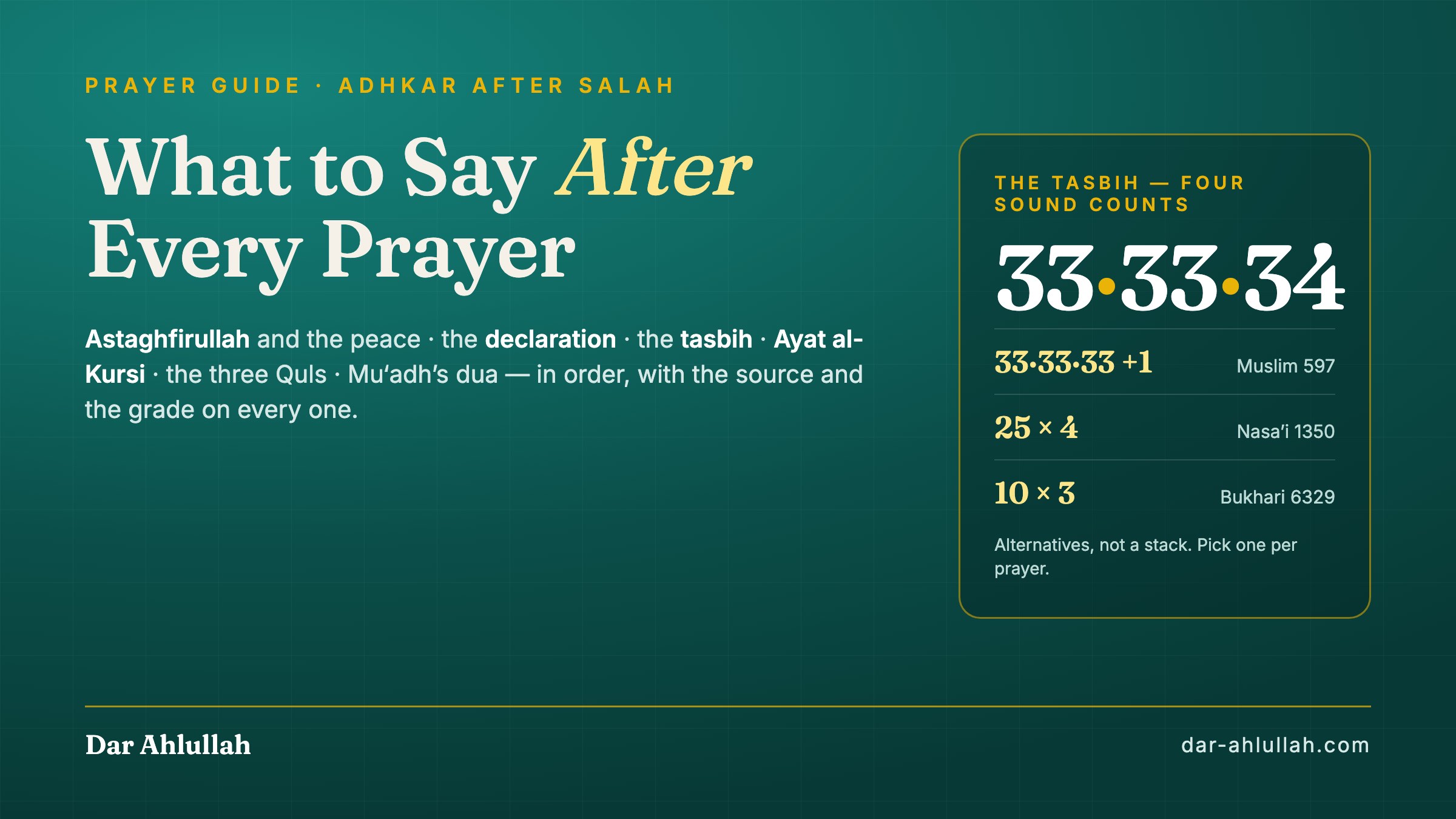
Adhkar After Salah: What to Say After Every Prayer
The adhkar after salah are the remembrances said in the minutes after the salam. This guide gives them in order with their sources, sets the 33-33-34, 33-33-33, 25-by-four and 10-by-three reports side by side so the counts stop looking like a contradiction, prints the grade on every famous reward, and works out which to keep when you pray Zuhr in a stairwell at work.
34 min read
how to pray duha
How to Pray Duha: The Prayer Between Sunrise and Noon
Duha is a voluntary prayer of the forenoon: two rak'ahs or more, any time between the end of sunrise and just before midday. The window and how to compute it where you live, the rak'ah counts, the contradiction in the hadith resolved, and the grade on every reward you have been quoted.
22 min read
how to pray istikhara
How to Pray Istikhara: The Prayer Before a Decision
Istikhara is two rak'ahs and a supplication, prayed at any valid time about a real fork in the road. The full du'a, what the answer actually looks like, why the dream is a myth, and what to do when nothing becomes clear.
23 min read