
adhkar after salah
Adhkar After Salah: What to Say After Every Prayer
Dar Ahlullah team 34 min read
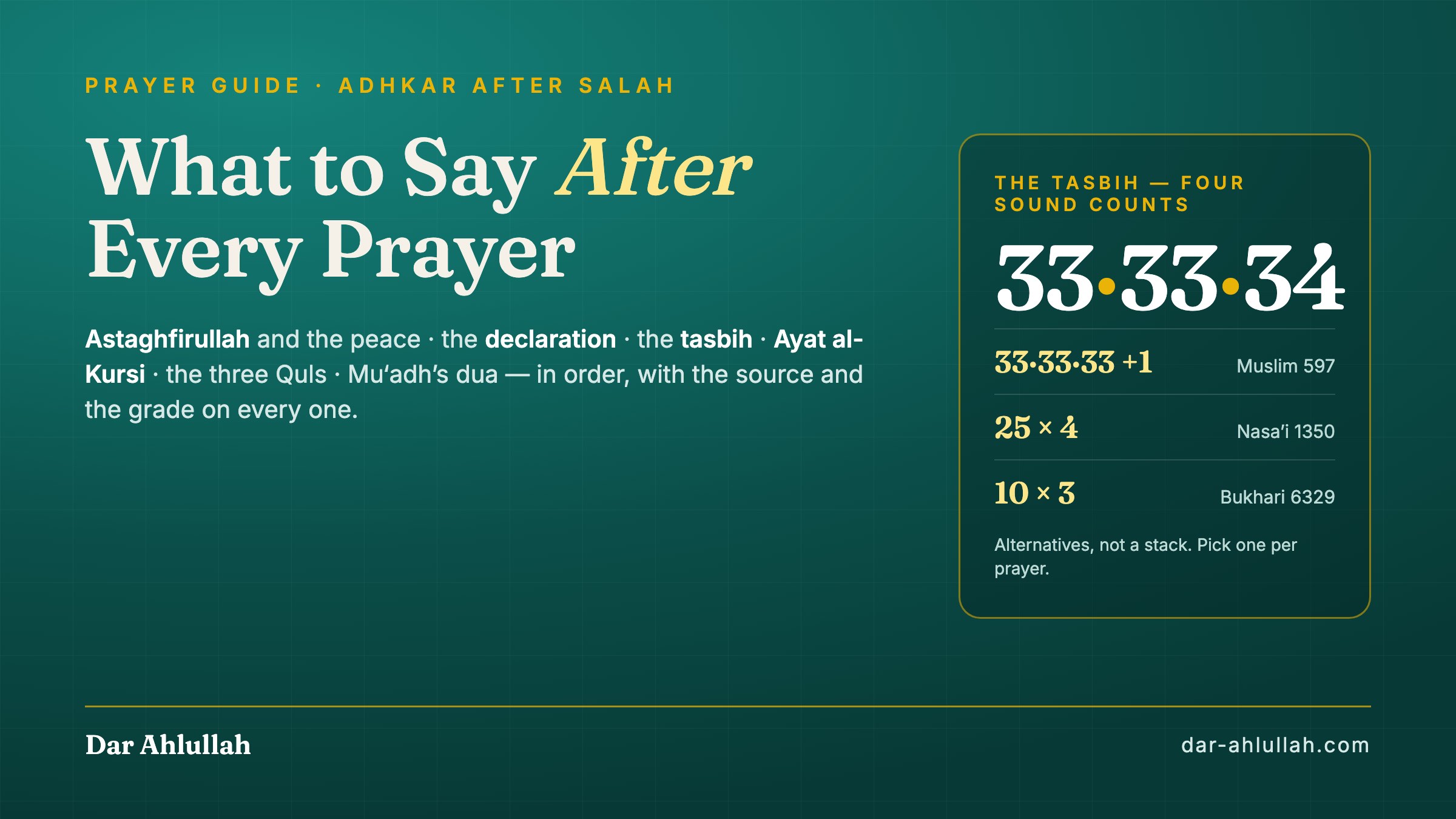
Table of Contents
- Introduction: The Two Minutes After the Salam
- The Short Answer
- Why the Dhikr After Prayer Is Its Own Act
- What He Said First: Astaghfirullah and the Peace
- The Declaration: La Ilaha Illallah Wahdahu
- The Tasbih: 33, 34, 25 or 10 — The Reports Side by Side
- The Poor Emigrants: Why This Dhikr Exists
- Ayat al-Kursi and the Three Quls
- The Supplications Attached to the Prayer
- Is There a Fixed Order?
- Before or After the Sunnah Rak’ahs?
- Aloud, Quietly, or Together: What the Schools Say
- Fingers, Beads and Counters
- When You Only Have One Minute: Which to Keep
- At Work, on a Train, in a Stairwell
- What You Are Actually Saying
- Seven Mistakes People Keep Making
- How We Teach This
- Questions People Ask
- Conclusion: The Prayer Does Not End at the Salam
Introduction: The Two Minutes After the Salam
Watch a row of people finish a congregational prayer and you will see the same thing every time. The salam is given, and then nobody moves. Lips move, fingers move, one or two people have a string of beads out, and roughly two minutes later the row breaks up and the sunnah prayers begin. If you learned to pray as an adult, or learned it from a book, this is the part nobody taught you. You know the prayer ends with as-salamu ‘alaykum wa rahmatullah to the right and the left. What the people around you are doing after that is a mystery, and asking produces the same one-word answer that explains nothing: dhikr.
The something they are doing is the adhkar after salah — the remembrances the Prophet ﷺ said in the minutes after the salam, so regularly that his Companions could list them, and in some cases could tell from a distance that his prayer had ended by the sound of them. They are not part of the prayer. Nothing is invalid if they are left out, and nothing is owed. But they carry some of the most specific promises in the whole of the Sunnah — forgiveness for sins “even if they are like the foam of the sea” is attached to one of them — and they are repeated as often as the prayer itself: five times, every day, for life.
The English-language material on them has two problems, and they are the same two problems the sunnah prayers have. One page says the tasbih is thirty-three, thirty-three and thirty-four; the next says thirty-three of each and a closing line; a third says twenty-five of four things; a fourth says ten. Each of them is quoting a sound hadith, and none of them tells you that the others exist, so the counts look like a contradiction when in fact they are a choice. And almost all of it assumes a masjid, a congregation and an unhurried quarter of an hour, so it says nothing to the person who has just prayed Zuhr alone in a stairwell at work and has ninety seconds before someone comes looking for them.
This article sets the adhkar out in order from the sound reports, with the source and the grade printed on every one, because the difference between a hadith in Sahih Muslim and a hadith al-Albani graded weak is exactly the difference between what you should build a habit on and what you may add if you like. It puts the four counts side by side and explains why they are alternatives. It answers the three practical questions the schools actually differ on — whether the dhikr comes before or after the sunnah rak’ahs, whether it is said aloud or quietly, and whether a congregation says it together — without picking a school for you. Then it does what a guide written for Cairo does not need to do: it works out what to keep when there is only a minute.
One boundary first. We teach Quran, Arabic and the practical fiqh of worship; we are not a fatwa body. If the prayer itself is still new, our complete guide to salat covers the sequence these adhkar follow, and the first ninety days guide puts them in a sensible order of priority next to everything else a new Muslim is learning. The words said inside the prayer, position by position, have their own article — what to say in salah — and this one starts precisely where that one stops.
The Short Answer
- What they are: the remembrances the Prophet ﷺ said after the salam of the obligatory prayers. Dhikr means remembrance; adhkar is its plural.
- The ruling: sunnah — recommended, never obligatory, nothing owed if missed. The prayer is complete at the salam.
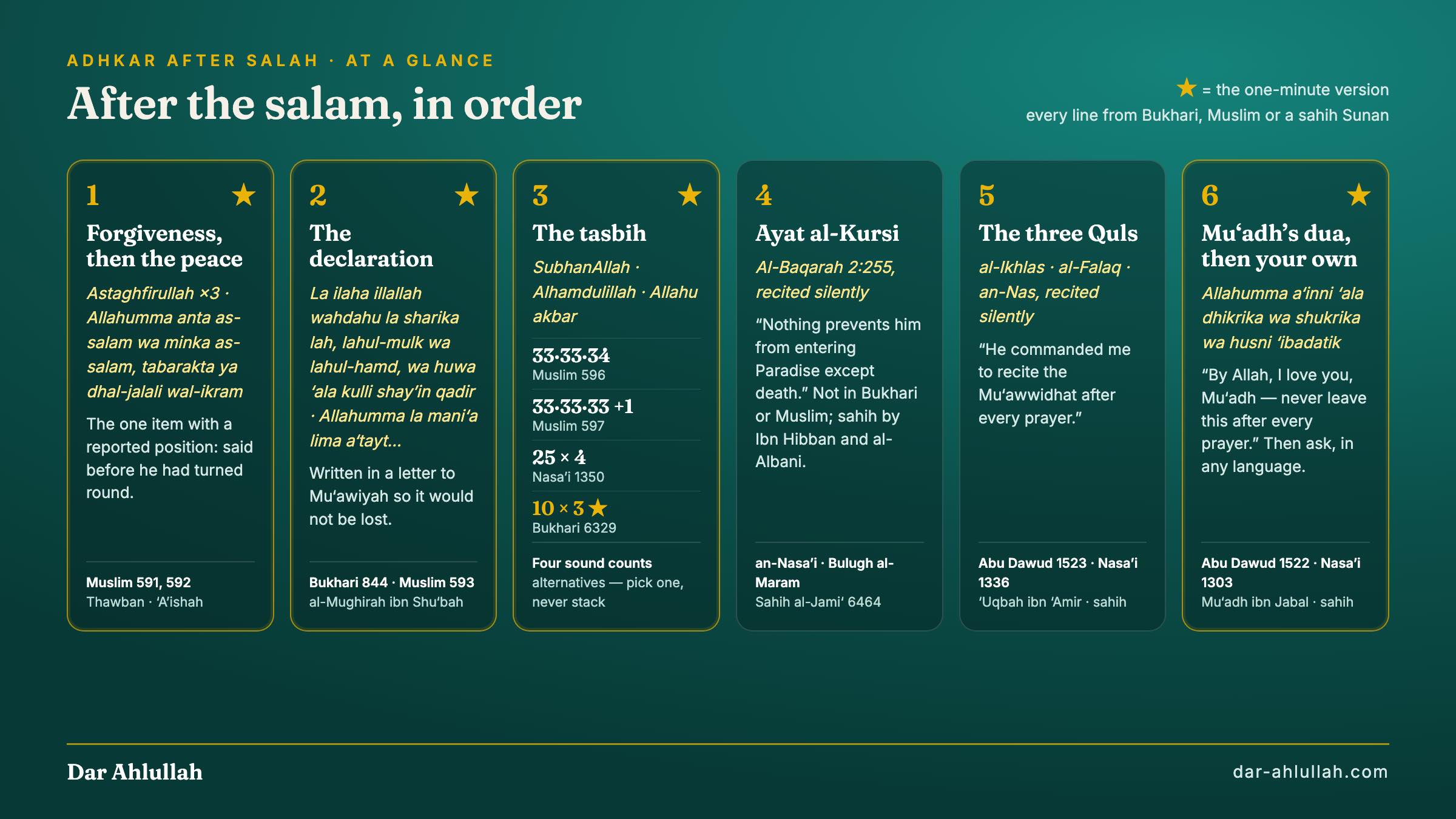
- What comes first: Astaghfirullah three times, then Allahumma anta as-salam wa minka as-salam, tabarakta ya dhal-jalali wal-ikram. This is the one item with a reported position: the Prophet ﷺ said it before he had even turned round.
- The declaration: La ilaha illallah wahdahu la sharika lah, lahul-mulk wa lahul-hamd, wa huwa ‘ala kulli shay’in qadir, with its continuation.
- The tasbih: SubhanAllah, Alhamdulillah, Allahu akbar. Four sound counts exist — 33/33/34; 33/33/33 with a closing tahlil to make one hundred; 25 each of four phrases; and 10 each of three. They are alternatives, not a stack.
- Then: Ayat al-Kursi, and the three short surahs of refuge.
- Plus the supplications the Prophet ﷺ asked specific Companions never to leave, above all Mu‘adh’s: Allahumma a‘inni ‘ala dhikrika wa shukrika wa husni ‘ibadatik.
- If you have one minute: the istighfar and the peace, the declaration, and ten of each tasbih. Every item on that list is from Bukhari or Muslim.
Why the Dhikr After Prayer Is Its Own Act
Start with the Qur’an, because the instruction is there before it is anywhere else. Surah an-Nisa’ 4:103 says: “When you have finished the prayer, remember Allah standing, sitting and lying on your sides.” The verse names the moment — when you have finished — and then names every posture a body can be in, which is a way of saying that the remembrance is not tied to the prayer mat. Surah al-Jumu‘ah 62:10 does the same for the Friday prayer: when it is finished, disperse, seek Allah’s bounty, “and remember Allah much.” The prayer ends; the remembrance is what you carry out of it.
The Sunnah then makes the moment specific. Asked which supplication is most likely to be answered, the Prophet ﷺ said: “In the last part of the night, and after the obligatory prayers” (Jami‘ at-Tirmidhi 3499, graded hasan by al-Albani; Zubair ‘Ali Za’i grades it weak, which is worth knowing because it is the report most often quoted on this subject). The stronger evidence is not any single saying but the pattern: the number of separate, sound reports from separate Companions describing what he said in those minutes, which is what the rest of this article is built from.
And there is the report that shows how public the practice was. Ibn ‘Abbas said that raising the voice in dhikr when people finished the obligatory prayer was the custom in the Prophet’s time, and added: “I used to know that they had finished by hearing it” (Sahih al-Bukhari 841; Sahih Muslim 583). He was a boy at the time, and he could tell from the sound. What that report means for the volume of your own dhikr is one of the three questions the schools differ on, and it is taken up below. What it means for the existence of the practice is not in dispute by anyone.
One more distinction before the list. These are the adhkar of the obligatory prayers. Almost every report says so in its wording — “after every prescribed prayer”, dubura kulli salatin maktubah — and the specific promises attached to them are tied to that. Nobody is prevented from remembering Allah after a voluntary prayer, and nothing is wrong with doing so. But the set described here, with its counts and its rewards, belongs to the five.
What He Said First: Astaghfirullah and the Peace
Thawban, the freed servant of the Prophet ﷺ, reported that when the Messenger of Allah finished his prayer he sought forgiveness three times and then said: “O Allah, You are Peace and from You is peace. Blessed are You, O Possessor of majesty and honour” (Sahih Muslim 591). The narrator al-Walid asked al-Awza‘i how the seeking of forgiveness went, and was told: you say astaghfirullah, astaghfirullah. So the first thing on the list is:
- Astaghfirullah — three times. I seek Allah’s forgiveness.
- Allahumma anta as-salam, wa minka as-salam, tabarakta ya dhal-jalali wal-ikram. O Allah, You are Peace, and from You is peace. Blessed are You, O Possessor of majesty and honour.
This is the one item on the whole list with a reported position. ‘A’ishah said that when the Prophet ﷺ gave the salam he did not remain sitting longer than it took to say Allahumma anta as-salam wa minka as-salam, tabarakta ya dhal-jalali wal-ikram (Sahih Muslim 592). Then he moved. Samurah ibn Jundub said that when the Prophet ﷺ finished a prayer he would turn to face the congregation (Sahih al-Bukhari 845), and al-Bara’ said that when they prayed behind him they liked to be on his right, so that his face would turn towards them (Sahih Muslim 709). So the shape of the minutes after the salam, as the Companions describe it, is: a brief pause facing the qiblah for the istighfar and the peace, then a turn, and the rest of the dhikr facing the people. If you are praying alone there is nothing to turn towards, and nothing to do about it.
Notice what the first word is. The prayer you have just finished was the best thing you did in the last few hours, and the first thing said after it is I seek forgiveness — three times. The scholars read this as forgiveness for whatever was deficient in the prayer itself: the wandering mind in the second rak‘ah, the recitation that was rushed. It sets the tone for everything after it. The dhikr is not a victory lap.
The Declaration: La Ilaha Illallah Wahdahu
Al-Mughirah ibn Shu‘bah dictated a letter to Mu‘awiyah recording what the Prophet ﷺ used to say after every obligatory prayer. The letter survives in both Sahihs (Sahih al-Bukhari 844; Sahih Muslim 593):
La ilaha illallah, wahdahu la sharika lah, lahul-mulku wa lahul-hamd, wa huwa ‘ala kulli shay’in qadir. Allahumma la mani‘a lima a‘tayt, wa la mu‘tiya lima mana‘t, wa la yanfa‘u dhal-jaddi minkal-jadd.
There is no god but Allah, alone, without partner. His is the dominion and His is the praise, and He has power over all things. O Allah, none can withhold what You give, and none can give what You withhold, and the fortune of the fortunate is of no use to him against You.
Ibn az-Zubayr reported a longer form, which he said the Prophet ﷺ used to say after the salam of every prayer (Sahih Muslim 594). It opens with the same declaration and continues: la hawla wa la quwwata illa billah; la ilaha illallah wa la na‘budu illa iyyah; lahun-ni‘matu wa lahul-fadlu wa lahuth-thana’ul-hasan; la ilaha illallahu mukhlisina lahud-dina wa law karihal-kafirun — there is no power and no strength except with Allah; there is no god but Allah and we worship none but Him; His is the favour and His the grace and His the good praise; there is no god but Allah, sincere to Him in religion though the disbelievers hate it.
The two forms are not in competition. Al-Mughirah’s is the core; Ibn az-Zubayr’s is the core with more. Learn the first and you have what both Sahihs record in the letter; add the second when it comes. The phrase la ilaha illallah wahdahu la sharika lah, lahul-mulk wa lahul-hamd, wa huwa ‘ala kulli shay’in qadir is worth learning perfectly, because it comes back in the next section as the line that completes the hundred.
The Tasbih: 33, 34, 25 or 10 — The Reports Side by Side
This is the section that untangles the counts. The tasbih after prayer is three phrases — SubhanAllah (glory be to Allah), Alhamdulillah (praise be to Allah), Allahu akbar (Allah is greatest) — and the disagreement you will meet on every website is about how many times to say each. Here are the reports, each one sound, each one giving a different count.
| Count | Report | Source and grade | The promise attached |
|---|---|---|---|
| 33 + 33 + 33, then one line to make 100 | Abu Hurayrah: “Whoever glorifies Allah after every prayer thirty-three times, praises Him thirty-three times and magnifies Him thirty-three times — that is ninety-nine — and says to complete the hundred: la ilaha illallah wahdahu la sharika lah, lahul-mulk wa lahul-hamd, wa huwa ‘ala kulli shay’in qadir” | Sahih Muslim 597 | “His sins are forgiven even if they are like the foam of the sea.” |
| 33 + 33 + 34 | Ka‘b ibn ‘Ujrah: “There are words that follow the prayer whose sayer, or doer, after every prescribed prayer will not be disappointed: thirty-three tasbih, thirty-three tahmid, thirty-four takbir” | Sahih Muslim 596 | “Will not be disappointed.” The takbir’s thirty-fourth makes the hundred. |
| 25 + 25 + 25 + 25 | Zayd ibn Thabit: they were told to say the tasbih 33, the tahmid 33 and the takbir 34 after every prayer. A man of the Ansar was then told in a dream to make each twenty-five and add the tahlil (la ilaha illallah) as a fourth. He told the Prophet ﷺ the next morning, who said: “Do that” | Sunan an-Nasa’i 1350, graded sahih by al-Albani; Jami‘ at-Tirmidhi 3413 | Approved by the Prophet ﷺ in person. Also one hundred. |
| 10 + 10 + 10 | ‘Abdullah ibn ‘Amr: “Two qualities which no Muslim keeps except that he enters Paradise. They are easy, and those who act on them are few: glorify Allah after every prayer ten times, praise Him ten times, magnify Him ten times” — and the same report, in the wording of Abu Hurayrah, in Bukhari | Jami‘ at-Tirmidhi 3410 and Sunan Abi Dawud 5065, both graded sahih by al-Albani; Sahih al-Bukhari 6329 | “That is one hundred and fifty on the tongue and one thousand five hundred on the scale.” |
Read the table and the contradiction disappears. These are not four scholars disagreeing about one hadith. They are four sound reports of what the Prophet ﷺ taught on different occasions to different people, and every one of them is a valid way to do it. The point was made inside one of the reports itself. In the Bukhari version of the poor emigrants’ story, the narrator says: “We differed among ourselves, and some of us said thirty-three, thirty-three and thirty-four. So I went back to the Prophet ﷺ, who said: say SubhanAllah, Alhamdulillah and Allahu akbar until each of them is thirty-three” (Sahih al-Bukhari 843). The Companions themselves noticed the two counts, asked, and were given an answer that did not cancel the other.
What the scholars draw from this is that the counts are alternatives, and that the sensible practice is to vary them rather than to invent a hybrid. What you should not do is stack them — thirty-three of each and then twenty-five of each — because no report describes that, and the hundred is the hundred. Pick one. The 33-33-33-plus-one form in Sahih Muslim 597 carries the most quoted promise, the foam of the sea, and is the one most people learn first. The 10-10-10 form is the one to keep in your pocket for the day the report itself describes: easy, and few do it, because — the same hadith continues — Shaytan comes to a person in his prayer and reminds him of something that needs doing, so that he leaves before he has said them.
A note on the “hundred”. In the 33-33-33 form the hundredth is the declaration you learned in the last section, said once. In the 33-33-34 form the thirty-fourth takbir is the hundredth. In the 25-by-four form the four phrases are said in turn, twenty-five each, and the tahlil is la ilaha illallah on its own. That is all the arithmetic there is.
The Poor Emigrants: Why This Dhikr Exists
The tasbih after prayer has an origin story, and it is worth knowing because it tells you what the dhikr is for. The poor among the Muhajirun — the emigrants from Makkah who had arrived in Madinah with nothing — came to the Prophet ﷺ and said: the people of wealth have taken the high ranks and the lasting bliss. He asked how. They said: they pray as we pray and fast as we fast, but they give in charity and we cannot, and they free slaves and we cannot. He said: “Shall I not teach you something by which you will catch up with those ahead of you and go ahead of those behind you, and no one will be better than you except one who does the same?” They said yes. He said: “Glorify Allah, magnify Him and praise Him thirty-three times after every prayer” (Sahih Muslim 595; Sahih al-Bukhari 843).
The story has a second half. The poor emigrants came back and said: our brothers with property have heard what we do, and they have done the same. The Prophet ﷺ said: “That is the bounty of Allah, which He gives to whom He wills.”
Two things follow. The first is that this dhikr was given as the great equaliser — the deed that costs nothing, needs no money, no property, no slaves to free, and is worth more than all of them. It was addressed to people who had lost everything and felt they were falling behind in the one race that mattered. If you are new to Islam and feel that the people around you are twenty years ahead of you, this hadith was addressed to you. The second is the answer to the emigrants’ complaint at the end: the rich did it too, and the door did not close. Nobody is locked out of it.
Ayat al-Kursi and the Three Quls
After the tasbih, the reports add recitation. Two items, with a sourcing note on each.
Ayat al-Kursi, the Throne Verse, al-Baqarah 2:255. Abu Umamah reported the Prophet ﷺ as saying: “Whoever recites Ayat al-Kursi after every prescribed prayer, nothing prevents him from entering Paradise except death.” This is the post-prayer hadith you will meet most often, and it is worth knowing where it comes from, because it is not in Bukhari or Muslim. Ibn Hajar records it in Bulugh al-Maram with the note that an-Nasa’i reported it and Ibn Hibban graded it sahih; al-Albani also graded it sahih in Sahih al-Jami‘ (no. 6464), and IslamQA’s summary of the adhkar after prayer lists it among them on that basis. So: sound, but by the grading of later scholars rather than by the two Sahihs. That is a real distinction and this article prints it wherever it applies. It is not a reason to drop the verse. It is a reason to know which promises you are standing on.
The three Quls — al-Ikhlas, al-Falaq and an-Nas. ‘Uqbah ibn ‘Amir said: “The Messenger of Allah ﷺ commanded me to recite the Mu‘awwidhat after every prayer” (Sunan Abi Dawud 1523 and Sunan an-Nasa’i 1336, both graded sahih by al-Albani). The word mu‘awwidhatan in the dual means the two surahs of refuge, al-Falaq and an-Nas; the plural form in the Nasa’i wording is read by the scholars as including al-Ikhlas, which is how the practice of all three came to be standard, and how IslamQA lists it. If you have learned al-Ikhlas and the two surahs of refuge for your prayer — and they are the first three most people learn — you already have this item.
The recitation is silent. Ayat al-Kursi and the three surahs are Qur’an, and the question of raising the voice, taken up below, is about the tasbih and the takbir, not about reciting Qur’an over the heads of people who are still praying.
The Supplications Attached to the Prayer
Beyond the fixed adhkar are supplications the Prophet ﷺ taught individual Companions to say after the prayer, and the Companions passed them on with the instruction attached. They are not a second list to get through. They are what you say when the fixed adhkar are done and there is a moment left. In order of how strongly they are attested:
- Mu‘adh’s supplication. The Prophet ﷺ took Mu‘adh ibn Jabal by the hand and said: “By Allah, I love you, Mu‘adh. I advise you: never leave saying after every prayer, Allahumma a‘inni ‘ala dhikrika wa shukrika wa husni ‘ibadatik” — O Allah, help me to remember You, to thank You, and to worship You well (Sunan Abi Dawud 1522, graded sahih by al-Albani; Sunan an-Nasa’i 1303). Mu‘adh bequeathed it to the man who narrated it from him, and he to the next. It is nine words, it was given with “I love you”, and it is the one to learn if you learn only one.
- Sa‘d’s refuge. Sa‘d ibn Abi Waqqas taught his sons, as a teacher teaches children to write, the words the Prophet ﷺ used to seek refuge with at the end of every prayer: Allahumma inni a‘udhu bika minal-jubn, wa a‘udhu bika an uradda ila ardhalil-‘umur, wa a‘udhu bika min fitnatid-dunya, wa a‘udhu bika min ‘adhabil-qabr — O Allah, I seek refuge with You from cowardice, from being returned to the most feeble stage of life, from the trials of this world, and from the punishment of the grave (Sahih al-Bukhari 2822).
- Al-Bara’s line. When the Prophet ﷺ turned to face them after the prayer, al-Bara’ heard him say: Rabbi qini ‘adhabaka yawma tab‘athu ‘ibadak — my Lord, protect me from Your punishment on the day You raise Your servants (Sahih Muslim 709).
- After Fajr specifically. Umm Salamah reported that when the Prophet ﷺ gave the salam of the morning prayer he would say: Allahumma inni as’aluka ‘ilman nafi‘an, wa rizqan tayyiban, wa ‘amalan mutaqabbalan — O Allah, I ask You for beneficial knowledge, good provision and accepted deeds (Sunan Ibn Majah 925, graded sahih by al-Albani).
- The ten-fold tahlil after Fajr — with a grading warning. Abu Dharr reported: “Whoever says after the Fajr prayer, with his legs still folded, before speaking, la ilaha illallah wahdahu la sharika lah, lahul-mulk wa lahul-hamd, yuhyi wa yumit, wa huwa ‘ala kulli shay’in qadir ten times, ten good deeds are written for him, ten sins erased, he is raised ten degrees, and he is protected that day from every disliked thing and from Shaytan” (Jami‘ at-Tirmidhi 3474). Bashar ‘Awwad Ma‘ruf grades it hasan sahih and Zubair ‘Ali Za’i hasan, but al-Albani graded it weak. You will find this promise on posters in every masjid. Say it if you like; know that the grading is split, and do not build your understanding of the day’s protection on it when the Mu‘awwidhat, which are sahih, are right there.
After the reported supplications, ask for what you need, in whatever language you have. Nothing in the reports restricts the dua after prayer to Arabic, and a person who has learned the fixed adhkar in Arabic and then asks for a job, a spouse or a parent’s health in English has done exactly what the Companions did in the language they had.
Is There a Fixed Order?
Only partly, and it is worth being honest about which part. The istighfar and Allahumma anta as-salam have a reported position: first, before the Prophet ﷺ had turned round (Sahih Muslim 592). After that, the reports describe individual items — the declaration, the tasbih, the verse, the surahs, the supplications — each “after every prayer”, and none of them says “then”. The sequence you see in every printed adhkar booklet is the scholars’ sensible arrangement of independent reports, and the most common one is the order this article uses:
- Astaghfirullah ×3; Allahumma anta as-salam wa minka as-salam, tabarakta ya dhal-jalali wal-ikram.
- La ilaha illallah wahdahu la sharika lah… with Allahumma la mani‘a lima a‘tayt… (and the Ibn az-Zubayr continuation if you know it).
- The tasbih, in whichever of the four sound counts you are using that prayer.
- Ayat al-Kursi.
- Al-Ikhlas, al-Falaq, an-Nas.
- Mu‘adh’s supplication, then any other reported supplication, then your own.
If you do the tasbih before the declaration, nothing is lost. If you recite Ayat al-Kursi first because it is what came to mind, nothing is lost. The order is a good habit, not a condition. What you should not do is treat a booklet’s order as a text, and then feel that the dhikr “did not count” because you did item four before item three. There is no such rule, and the anxiety is heavier than the worship.
Before or After the Sunnah Rak’ahs?
This is the first of the three questions the schools genuinely differ on, and it only arises after four of the five prayers — Zuhr, Maghrib and ‘Isha have sunnah rawatib prayed after them, and Fajr and ‘Asr do not. The question is whether the dhikr comes between the obligatory prayer and those rak’ahs, or after both.
The Shafi‘i position is that the dhikr comes first: the invocations are recommended to precede the post-prayer sunnah prayers, and al-Shafi‘i said he preferred that the imam and the follower remember Allah after the salam, quietly. The Hanafi position has more than one strand. The transmitted one, in ash-Shurunbulali’s Maraqi al-Falah and at-Tahtawi’s commentary on it, is to stand for the sunnah immediately after the obligatory prayer without a separation, except for the length of Allahumma anta as-salam, and to say the tasbih and the supplications after the sunnah rak’ahs. Other Hanafi scholars allow the full adhkar first, and SeekersGuidance’s Hanafi answer sets out the positions and describes the difference as one about what is best, not about what is permitted. The practice you will see in masjids following the Salafi approach is the Shafi‘i shape: the full adhkar immediately after the salam, then the sunnah.
Two practical readings. First, every position keeps Allahumma anta as-salam straight after the salam, before anything else, including the sunnah; the three-fold istighfar that Sahih Muslim 591 places before it takes three seconds. Second, the Hanafi “short dhikr, sunnah, then the rest” shape is worth knowing even if you do not follow the school, because it is what makes the two habits fit into a working lunch break — you have not left the adhkar; you have moved them to after the two rak’ahs.
And if you pray in a masjid that does it one way while you were taught the other: do it their way that day and yours at home. This is not a question anyone is meant to fall out over.
Aloud, Quietly, or Together: What the Schools Say
The second question is volume, and the third is whether a congregation says the dhikr together as one voice. They are separate, and it helps to keep them separate.
Aloud or quietly. The evidence for raising the voice is the Ibn ‘Abbas report already quoted — a boy could tell from outside the row that the prayer had ended. IslamQA’s survey of the question attributes the view that raising the voice is good, or recommended, to at-Tabari, Ibn Hazm, Ibn Taymiyyah and, among the modern scholars, Ibn ‘Uthaymin, and attributes to al-Shafi‘i and the majority the view that the raised voice in the Prophet’s time was for teaching: al-Shafi‘i said the imam and the follower should remember Allah quietly, unless the imam is someone to be learned from, in which case he raises his voice until he judges it has been learned and then goes quiet. Egypt’s Dar al-Ifta states that there is consensus on the permissibility of dhikr after the prayer, that the scholars differ only on whether audible or silent is better, and that silent is better where one fears showing off or disturbing others. Every position agrees on the boundary: not so loud that it troubles someone still praying. What is at stake between them is whether a moderate voice is the Sunnah or a concession, and you are free to follow either.
Together, in unison. This is a different question from volume. In some masjids the congregation says the tasbih and the dua as one voice, led by the imam; in others each person says their own adhkar at their own pace, whether aloud or not. IslamQA’s view, stated in its summary of the adhkar after prayer, is that reciting in unison has no basis and each person should recite to himself without attending to anyone else’s voice; in many masjids of the Shafi‘i and Hanafi traditions it is done as a matter of course, and Egypt’s Dar al-Ifta, asked about audible dhikr after congregational prayers, answered that it is permitted and recommended where it disturbs no one. We are not going to settle that for you. What we will say is what every scholar on both sides says: it is not a matter to argue about in the row, and a visitor who does not join a congregation’s collective dhikr, or who does, has done nothing wrong either way.
The person praying alone at home or at work is not touched by any of this. Say the adhkar at whatever volume lets you hear yourself, which is the volume the majority of scholars recommend for everyone anyway.
Fingers, Beads and Counters
The reported practice is fingers. ‘Abdullah ibn ‘Amr said: “I saw the Messenger of Allah ﷺ counting the tasbih on his hand” — and in one version, “on his right hand” (Sunan Abi Dawud 1502, graded sahih by al-Albani; Jami‘ at-Tirmidhi 3411). And the Prophet ﷺ told the women of the Muhajirun, through Yusayrah, to hold to the tasbih, the tahlil and the taqdis and to “count them on the fingers, for they will be questioned and made to speak” (Sunan Abi Dawud 1501, graded hasan by al-Albani; Jami‘ at-Tirmidhi 3583). That is the Sunnah, it is free, and it is the method to learn.
The way it is usually done: touch the thumb to each finger-joint of the right hand in turn. Three joints on each of four fingers is twelve; go round nearly three times for thirty-three. Some people count each finger as one and go round the hand for tens; some count on both hands. None of this is prescribed. What is prescribed is that fingers are the instrument.
Beads (misbahah, tasbih) and the click-counters and phone apps that have replaced them are a matter of some difference. There is a report that Sa‘d ibn Abi Waqqas saw a woman with date-stones or pebbles in front of her, counting her tasbih with them, and that the Prophet ﷺ did not forbid it but taught her a shorter formula that was “easier, or better” (Sunan Abi Dawud 1500) — but that report is graded weak by al-Albani and hasan by others, so it will not carry a ruling on its own. Scholars who permit beads point to it and to the absence of any prohibition; scholars who discourage them point to the fingers hadith and to the risk of the beads becoming a display. The one thing both sides agree on: if a counter is what stands between you and dropping the tasbih on a busy day, it is not the thing to give up first. Use it at home while you learn the finger method, and let the fingers take over.
When You Only Have One Minute: Which to Keep
This section is the one a guide written for a Muslim-majority country does not need. The full adhkar, said unhurriedly, take somewhere between five and ten minutes. Five times a day, that is a real cost, and on a working day in Manchester or New Jersey at least one of the five prayers is going to be prayed with somebody waiting. The honest answer is not “make the time”. The honest answer is a triage, and the reports themselves supply it.
- Never drop: Astaghfirullah three times and Allahumma anta as-salam. Ten seconds. It is the one item with a reported position, and the Prophet ﷺ said it before he had moved (Sahih Muslim 591 and 592).
- Next: the declaration — la ilaha illallah wahdahu la sharika lah… through …dhal-jaddi minkal-jadd. Fifteen seconds. It is in both Sahihs from a letter written to preserve exactly this (Bukhari 844, Muslim 593).
- Then the tasbih, in the ten-by-three count. Thirty seconds. This is not a shortcut you are inventing. It is the count of Sahih al-Bukhari 6329 and Jami‘ at-Tirmidhi 3410, described by the Prophet ﷺ as easy, and it is the count he attached to the warning that Shaytan reminds a person of an errand before it is said. The errand is the thing waiting for you outside the stairwell. Ten of each, and you have beaten it.
- Then Mu‘adh’s supplication. Five seconds. Allahumma a‘inni ‘ala dhikrika wa shukrika wa husni ‘ibadatik.
That is about one minute, and every line of it is from Bukhari, Muslim or a sahih-graded Sunan. The full tasbih, Ayat al-Kursi, the three surahs and the rest of the supplications are what you add back at Maghrib and ‘Isha, when you are home. Nobody who does the one-minute version at Zuhr and the full version at night has “skipped the adhkar”. They have kept them, which is what the reports about the few who act on them were about.
At Work, on a Train, in a Stairwell
Three practical cases that the classical books did not have to address.
You have to stand up straight away. The reported practice is that the Prophet ﷺ said the adhkar in his place, sitting and then turned towards the people. But nothing in the reports makes the spot a condition. The anchor in every wording is the time — after the prayer — not the posture or the place, and the verse that commands the remembrance names standing, sitting and lying down as all acceptable (4:103). If you must fold the mat and walk, say the adhkar as you walk. That is not the ideal, and it is a great deal better than the alternative, which is nothing.
You have prayed in a shared space and someone is watching. Say them quietly, which the majority of scholars recommend in any case. Moving lips and a hand counting in a pocket is not a spectacle. What people notice is a person sitting still for a minute after finishing something, which in an office reads as thinking.
You have combined two prayers — as a traveller, or in the other cases where the schools allow joining, covered in our guide to praying while travelling. The adhkar belong to each obligatory prayer. When Zuhr and ‘Asr are joined, a short dhikr between the two — the istighfar and the peace — and the full adhkar after the second is the arrangement that keeps the two prayers together, which is the point of joining them. If you are combining because time is short, the one-minute version after the second prayer is the whole of what is being asked of you.
What You Are Actually Saying
Every phrase in the adhkar is Arabic, and a person who has learned them by sound alone is saying, five times a day, words whose meaning they know only in outline. That is the condition most non-Arabic-speaking Muslims live in for years, and it is fixable in an afternoon, because the adhkar reuse a very small vocabulary. Here is the whole of it.
| The phrase | Word by word | What it says |
|---|---|---|
| Astaghfirullah | astaghfiru I seek forgiveness · Allah | I seek Allah’s forgiveness. |
| Allahumma anta as-salam wa minka as-salam | Allahumma O Allah · anta You (are) · as-salam the Peace · wa minka and from You · as-salam peace | You are Peace itself; every peace comes from You. |
| Tabarakta ya dhal-jalali wal-ikram | tabarakta blessed are You · ya O · dha possessor of · al-jalal majesty · wa and · al-ikram honour | Blessed are You, O Possessor of majesty and honour. |
| SubhanAllah | subhana glory / far above any flaw · Allah | Glory be to Allah — He is above every imperfection. |
| Alhamdulillah | al-hamdu the praise · li-llah belongs to Allah | All praise belongs to Allah. |
| Allahu akbar | Allah · akbar greater / greatest | Allah is greater than everything. |
| La ilaha illallah | la no · ilaha god · illa except · Allah | There is no god but Allah. |
| Wahdahu la sharika lah | wahdahu alone · la sharika no partner · lahu to Him | Alone, with no partner. |
| Lahul-mulku wa lahul-hamd | lahu to Him · al-mulk the dominion · wa lahu and to Him · al-hamd the praise | His is the kingdom and His is the praise. |
| Wa huwa ‘ala kulli shay’in qadir | wa huwa and He · ‘ala over · kulli every · shay’in thing · qadir able | And He has power over all things. |
| Allahumma a‘inni ‘ala dhikrika wa shukrika wa husni ‘ibadatik | a‘inni help me · ‘ala to · dhikrika remembering You · shukrika thanking You · husni ‘ibadatik worshipping You well | O Allah, help me to remember You, thank You, and worship You well. |
Count the distinct words and it is about thirty. Lahu, wa, la, illa, kulli, shay’ — these are also among the most common words in the Qur’an, and a person who learns them here meets them in every surah they read afterwards. That is the argument for learning the adhkar as words rather than as sounds: the vocabulary is tiny and it is the Qur’an’s own. Our guide to the most common words in the Qur’an starts from exactly this kind of high-frequency list.
Seven Mistakes People Keep Making
- Treating the counts as a contradiction. Thirty-three, thirty-four, twenty-five and ten are all sound. Pick one per prayer. The only wrong answer is a hybrid nobody reported.
- Stacking the counts. Thirty-three of each and then a hundred and then ten more is not more reward; it is a made-up form. The hundred is the hundred.
- Reciting the tasbih at speed until the words disappear. SubhanAllah said thirty-three times as a hum is not thirty-three tasbihs. The reports are about saying words. Slower and fewer beats faster and more, which is what the ten-count is for.
- Building the habit on the weak report and skipping the sahih one. The ten-fold tahlil after Fajr, with its day-long protection, is graded weak by al-Albani; the three Quls, with no poster made of them, are sahih. Learn the sahih items first.
- Dropping everything because there is no time for everything. The one-minute version exists and is entirely from the Sahihs. Nothing in the reports says all or nothing.
- Doing the adhkar after the sunnah prayers and thinking the istighfar can wait too. Whatever your school says about the tasbih, every position puts Allahumma anta as-salam straight after the salam, and the istighfar before it takes three seconds.
- Arguing in the row. Loud or quiet, together or alone, beads or fingers — each of these has scholars on both sides. The Sunnah after the prayer is remembrance, not correction of the person beside you.
How We Teach This
Most of what is above is reading, and reading is enough for it. The part that is not — whether the phrases you are now saying five times a day are coming out as the words in the reports rather than approximations of them, and whether your Ayat al-Kursi and your three surahs are sound — needs somebody listening. The adhkar are where a learner’s Arabic gets its first daily workout, and small errors in them set hard, because nothing repeated five times a day for a year is easy to unlearn.
Dar Ahlullah runs one-to-one live sessions with certified teachers, scheduled in your own timezone. Teaching is charged at $9 per teaching hour, with monthly plans at $36, $70 and $102 depending on how many hours you want, and a 20% discount for siblings. You can pause, upgrade or switch plans at any time, and if a teacher is not the right fit we rematch you with another certified mentor at no extra cost. If you want to know where your recitation currently stands before committing to anything, the 30-minute assessment is free and does not ask for a card — the details are on our pricing page.
Questions People Ask
What are the adhkar after salah?
The remembrances the Prophet ﷺ said after the salam of the obligatory prayers: seeking forgiveness three times and Allahumma anta as-salam, the declaration la ilaha illallah wahdahu la sharika lah, the tasbih (SubhanAllah, Alhamdulillah, Allahu akbar), Ayat al-Kursi, the three short surahs, and the supplications he taught individual Companions. They are sunnah, not obligatory.
Is dhikr after prayer obligatory?
No. The prayer is complete at the salam and nothing is owed after it. The adhkar are recommended, with specific rewards reported for them, and nothing is invalid if they are left.
Is it 33 times or 34 times?
Both, from different sound reports. Sahih Muslim 597 has thirty-three of each and a closing la ilaha illallah wahdahu… to make one hundred; Sahih Muslim 596 has thirty-three, thirty-three and thirty-four. Two more sound counts exist: twenty-five each of four phrases (Nasa’i 1350) and ten each of three (Bukhari 6329). Use any one of them; do not combine them.
What is the first thing to say after salam?
Astaghfirullah three times, then Allahumma anta as-salam wa minka as-salam, tabarakta ya dhal-jalali wal-ikram (Sahih Muslim 591). ‘A’ishah reported that the Prophet ﷺ stayed sitting only long enough to say it before turning round (Sahih Muslim 592).
Do I say the adhkar before or after the sunnah prayers?
The schools differ. The Shafi‘i position, and the practice in Salafi-influenced masjids, is the full adhkar first, then the sunnah rak’ahs. The transmitted Hanafi position is Allahumma anta as-salam, then the sunnah at once, then the tasbih and supplications. Every position puts the peace first.
Should the dhikr be said aloud or silently?
Al-Shafi‘i and the majority: quietly, with the raised voice in the Prophet’s time explained as teaching. Ibn Hazm, Ibn Taymiyyah and Ibn ‘Uthaymin: a moderate raised voice is the Sunnah, on the Ibn ‘Abbas report. All agree it must not disturb someone still praying, and Qur’an recitation (Ayat al-Kursi, the three surahs) is silent.
Can I use tasbih beads or a counter?
Counting on the fingers of the right hand is the reported practice and the method to learn. Beads and counters are permitted by some scholars and discouraged by others; there is no sound report of the Prophet ﷺ using them. If a counter is what keeps the tasbih in your day, use it while you learn the finger method.
Do I say the adhkar after sunnah or nafl prayers too?
The reports specify the obligatory prayers — “after every prescribed prayer” — and the promised rewards are tied to them. Remembering Allah after a voluntary prayer is good and unrestricted, but the set with its counts belongs to the five.
Can I say the adhkar while walking away?
The reported practice is to say them in your place. But the reports anchor the adhkar to the time, after the prayer, not to the spot, and the Qur’an names standing, sitting and lying down as postures for remembrance after prayer (4:103). If you must move, say them as you go rather than leave them.
What is the shortest sound version?
Astaghfirullah ×3 and Allahumma anta as-salam; the declaration; ten each of SubhanAllah, Alhamdulillah and Allahu akbar; and Allahumma a‘inni ‘ala dhikrika wa shukrika wa husni ‘ibadatik. About one minute, every line from Bukhari, Muslim or a sahih-graded Sunan.
Is the Ayat al-Kursi hadith authentic?
It is not in Bukhari or Muslim. It is reported by an-Nasa’i, graded sahih by Ibn Hibban (as Ibn Hajar notes in Bulugh al-Maram) and by al-Albani (Sahih al-Jami‘ 6464). Sound, on the grading of later scholars.
Conclusion: The Prayer Does Not End at the Salam
The fiqh of the adhkar after salah is short once the noise is removed. Forgiveness first, three times, and the peace. The declaration of Allah’s oneness in the words a Companion wrote down in a letter so they would not be lost. The tasbih in one of four sound counts, all of which are a hundred or a shortcut to it. A verse and three surahs. A handful of supplications the Prophet ﷺ gave to named people with the instruction never to leave them. None of it owed, all of it kept, five times a day, by people who had nothing else to give.
What the rest of this article was for is mostly protective. So that four different counts on four different websites do not look like a contradiction. So that you know which of the famous promises stand on the two Sahihs and which on later grading. So that the three questions the schools differ on are recognised as differences and not as tests you might be failing. And so that the working day, which does not stop for Zuhr, does not become the reason you keep none of the adhkar when you could have kept most.
The emigrants who were taught the tasbih had lost their homes, their trade and their families, and were told that three phrases after every prayer would carry them past people with everything. That is a promise made to people in a hurry with very little. Ten of each, after the next prayer, is where it starts.
Related articles
sunnah rawatib
The Sunnah Rawatib: The Twelve Rak’ahs Around the Five Prayers
The sunnah rawatib are the regular voluntary rak’ahs attached to the five daily prayers: twelve in a day on the fullest count, ten on the other. Which goes before and which after, why the two counts differ, what each school holds, where to pray them, how to make one up, and which to keep when you only have five minutes.
27 min read
what to say in salah
What to Say in Salah: Every Word of the Prayer, in Order
Most guides to prayer teach the postures and only name the words. This one teaches the words: what you say at every position, what it means, where it comes from, and which parts are pillars, which are obligatory, and which are simply recommended.
19 min read
how to perform tayammum
How to Perform Tayammum: Dry Ablution When You Cannot Use Water
Tayammum is the purification you make with earth when water cannot be used. The rule is short: strike clean earth, wipe your face, wipe your hands. The difficulty for a Muslim in Europe or America is everything around the rule: what counts as a real excuse, what counts as earth in a building with none, how long it lasts, and what you do on a plane or in a hospital bed when there is neither water nor dust.
28 min read