
what to say in salah
What to Say in Salah: Every Word of the Prayer, in Order
Dar Ahlullah team 19 min read
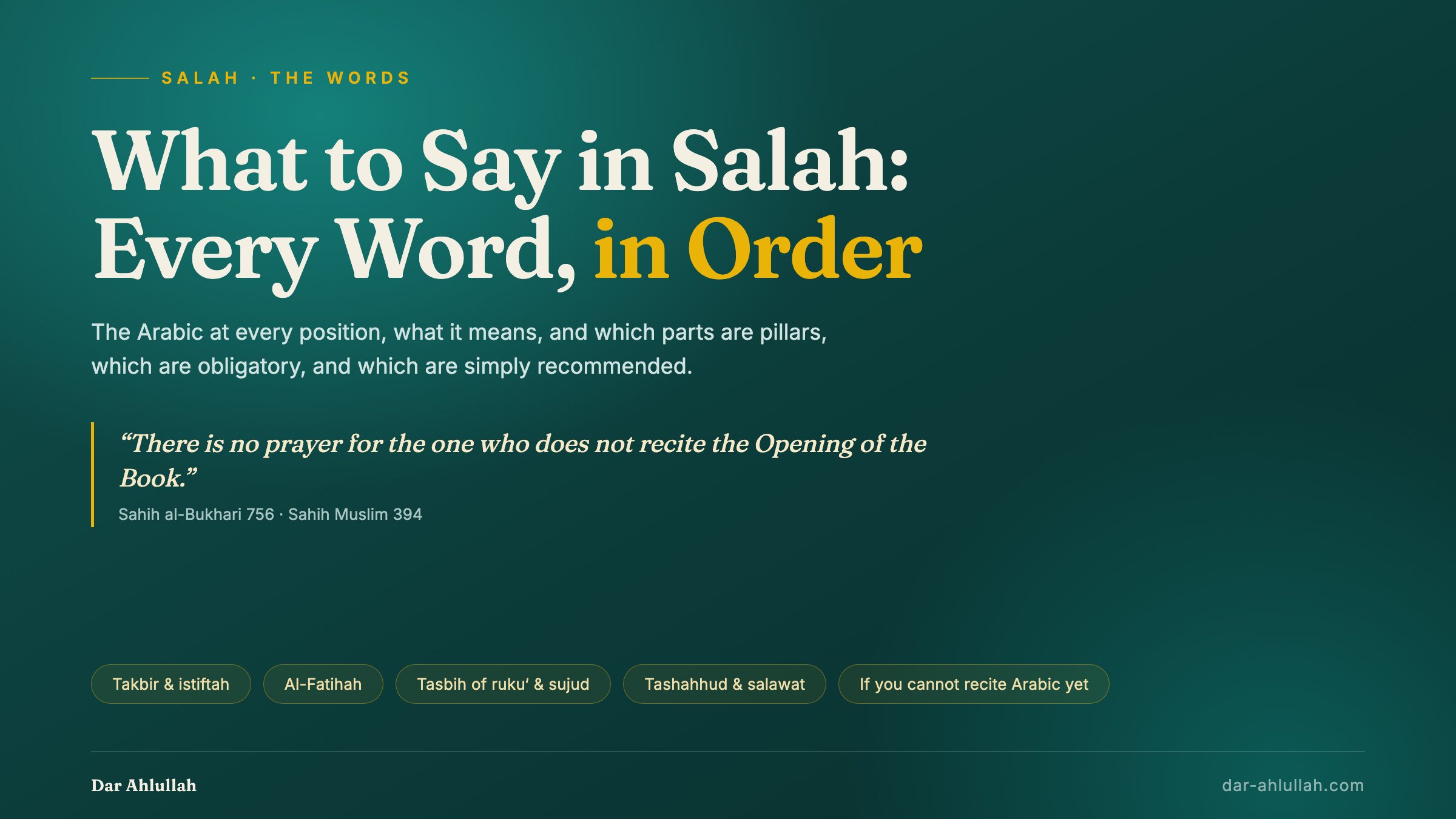
Table of Contents
- Introduction: The Gap Between Knowing the Steps and Knowing the Words
- The Short Answer
- Required, Obligatory, Recommended: Three Different Things
- Standing: From the Takbir to the Recitation
- Al-Fatihah and the Surah After It
- Bowing, Rising, Prostrating, Sitting
- Every Position and Its Words, At a Glance
- The Final Sitting: Tashahhud to Taslim
- If You Cannot Recite Arabic Yet
- What Changes Between the Rak’ahs
- Aloud or Silent: Which Words, Which Prayers
- Five Mistakes Non-Arabic Speakers Make
- How to Actually Get These Into Memory
- How We Teach This
- Questions People Ask
- Conclusion: A Short List, Learned Once
Introduction: The Gap Between Knowing the Steps and Knowing the Words
There is a particular stage in learning to pray that almost nobody writes about. You know the shape of the prayer. You know you stand, then bow, then stand again, then prostrate twice, then sit. You have watched it enough times to follow along in a congregation without embarrassing yourself. And yet, when you stand alone on a prayer mat at home, you realise you do not actually know what to say in salah — not with confidence, not in order, not knowing which parts you are obliged to say and which parts you have merely heard other people saying.
That gap is real and it is specific. Most guides to prayer are organised around the body: here is how to stand, here is how to place your hands, here is how far to bow. The words get mentioned in passing, named rather than taught. You are told to “recite the tashahhud” without ever being given the tashahhud. So you learn the choreography first and spend months mumbling through the parts you never properly received.
This guide is organised the other way round. It goes through the prayer position by position and gives you the actual words at each one: the Arabic in transliteration, what it means, where it comes from, and — the part that matters most for peace of mind — whether leaving it out breaks your prayer, costs you a prostration of forgetfulness, or costs you nothing at all. If you want the physical sequence instead, our complete guide to salat covers the postures; this article is the companion that fills in the speech.
One boundary before we start. We teach Quran, Arabic and the practical fiqh of worship; we are not a fatwa body. The classifications below follow the Hanbali arrangement because it is the one that sorts the spoken parts most clearly, and we say so wherever it matters, rather than presenting one school’s categories as though every scholar shared them.
The Short Answer
If you have three minutes and want the floor rather than the ceiling, here is the whole prayer reduced to the words you cannot skip:
- Allahu akbar to enter the prayer, and again at each change of position.
- Surah al-Fatihah, standing, in every single rak’ah.
- Subhana Rabbiy al-‘adheem while bowing.
- Sami‘a Allahu liman hamidah as you rise, then Rabbana wa laka’l-hamd once you are upright.
- Subhana Rabbiy al-a‘la while prostrating.
- Rabb ighfir li sitting between the two prostrations.
- The tashahhud in the sitting, and the blessings on the Prophet in the final one.
- As-salamu ‘alaykum wa rahmatullah to leave the prayer.
That is it. Everything else in this article — the opening supplication, seeking refuge, the basmalah, saying ameen, the extra surah, the du‘a before the salam — is recommended rather than required. Beautiful, rewarded, and worth learning, but your prayer is valid without it. Knowing that distinction is what stops the anxiety, because the thing most beginners fear is having prayed for years incorrectly, and the honest answer is that if you said the eight items above, you did not. If prayer is one piece of a practice you are assembling from the beginning, our guide to your first ninety days in Islam places it in sequence with wudu and Quran reading.
Required, Obligatory, Recommended: Three Different Things
Islamic law does not sort the parts of prayer into “must” and “nice to have.” It uses three tiers, and confusing them is the source of most of the worry people carry about their prayer.
A pillar (rukn) cannot be dropped under any circumstance. Forget it, skip it, or omit it out of ignorance, and it still has to be done — the prayer is not complete without it. An obligatory part (wajib) is binding, but if you genuinely forget it, the prostration of forgetfulness repairs the prayer and you do not start over. A sunnah is recommended: leaving it out, even deliberately, does not invalidate anything. Islam Q&A sets out the distinction, noting that a pillar cannot be waived while an obligatory part can be compensated for by sujood as-sahw.
Applied to the spoken parts specifically, and following the Hanbali summary Daleel al-Talib that Islam Q&A works from in its breakdown of the obligatory and sunnah acts of prayer, the sorting comes out like this. Only one spoken element is a pillar: reciting al-Fatihah. The obligatory tier holds the takbirs other than the opening one, sami‘a Allahu liman hamidah, rabbana wa laka’l-hamd, the tasbih of bowing and prostrating, rabb ighfir li between the prostrations, and the first tashahhud. Everything else you will read below — and there are around a dozen items — is sunnah.
Two practical consequences follow. First, if you are new and can only hold a few phrases in memory, you now know exactly which few to prioritise. Second, if you have been praying for a while and suddenly discover a phrase you never knew about, you can check which tier it belongs to before deciding whether anything needs repairing. In the overwhelming majority of cases the answer is that it does not. If you do reach the point where a repair is genuinely needed, our guide to what to do when you make a mistake in prayer walks through the prostration of forgetfulness and when it applies.
Standing: From the Takbir to the Recitation
The opening takbir
You raise your hands and say Allahu akbar — “Allah is the greatest.” This one is called takbirat al-ihram, the takbir of consecration, because it is the door: before it you are a person standing on a mat, after it you are in prayer and the ordinary permissions of speech and movement no longer apply. It is a pillar. No other formula substitutes for it.
The opening supplication (du‘a al-istiftah)
After the takbir and before you begin reciting, there is a short silence that the Prophet (peace be upon him) filled with supplication. Two versions are well established and you may use either.
The first, reported by Abu Hurayrah and narrated in Sahih al-Bukhari 744 and Sahih Muslim 598:
Allahumma ba‘id bayni wa bayna khatayaya kama ba‘adta bayna’l-mashriqi wa’l-maghrib. Allahumma naqqini min al-khataya kama yunaqqa’th-thawb al-abyad min ad-danas. Allahumma ighsil khatayaya bi’l-ma’i wa’th-thalji wa’l-barad.
“O Allah, put a great distance between me and my sins, as great as the distance You have made between the East and the West. O Allah, cleanse me of sin as a white garment is cleansed from filth. O Allah, wash away my sins with water and snow and hail.”
The second, reported from ‘A’ishah and narrated in Sunan Abi Dawud 776 and Jami‘ at-Tirmidhi 243, is shorter and is usually the one taught first for that reason:
Subhanaka Allahumma wa bi hamdika, wa tabaraka smuka, wa ta‘ala jadduka, wa la ilaha ghayruk.
“Glory and praise be to You, O Allah. Blessed is Your name, exalted is Your majesty, and there is no god but You.”
Islam Q&A gathers both in its answer on the opening supplication in prayer. Both are sunnah. You say one, not both, and you say it only in the first rak’ah — this is the single most common place where people over-perform, repeating the istiftah at the start of every rak’ah because nobody ever told them it belongs to the opening alone.
Seeking refuge and the basmalah
Before reciting, you seek refuge: A‘udhu billahi min ash-shaytan ir-rajim — “I seek refuge with Allah from the accursed Shaytan.” Then Bismillah ir-Rahman ir-Rahim — “In the name of Allah, the Most Gracious, the Most Merciful.” Both are sunnah, both said quietly even in the prayers recited aloud.
Al-Fatihah and the Surah After It
This is the one spoken pillar of the prayer. The Prophet (peace be upon him) said: “There is no prayer for the one who does not recite the Opening of the Book” — narrated in Sahih al-Bukhari 756 and Sahih Muslim 394. Not the first rak’ah only. Every rak’ah, of every prayer, obligatory and voluntary alike.
Al-Fatihah is seven verses. You can read them, with the Arabic alongside a translation, at Surah al-Fatihah on Quran.com. If you are learning the Arabic script from the beginning so that you can read it rather than recite from memory, our guide to reading the Quran for beginners is the place to start, and the Arabic alphabet guide comes before even that.
After al-Fatihah you say ameen — aloud in the prayers recited aloud, quietly otherwise. It is sunnah.
Then, in the first two rak’ahs only, you add a further passage of Quran. This too is sunnah rather than obligatory, which surprises people. Islam Q&A addresses it directly in its answer on whether it is obligatory to recite a surah after al-Fatihah. Any passage will do, of any length. The short surahs at the end of the Quran are the traditional starting set precisely because they are short, and if you are deciding what to commit to memory first, we have written separately on which surahs to memorise first.
Bowing, Rising, Prostrating, Sitting
From here the words come in short, repeating units, which is good news: the remaining vocabulary of the prayer is genuinely small.
In ruku‘ (bowing)
You say Allahu akbar as you go down, and once settled in the bow: Subhana Rabbiy al-‘adheem — “Glory be to my Lord, the Most Great.” Saying it once is obligatory; three times is the customary sunnah, and more is permitted.
Rising from ruku‘
As you straighten up you say Sami‘a Allahu liman hamidah — “Allah hears the one who praises Him.” Then, standing fully upright: Rabbana wa laka’l-hamd — “Our Lord, and to You belongs all praise.” Both are obligatory for someone praying alone. Note that the phrase here is not Allahu akbar; this is the one transition in the prayer that has its own formula, and mixing it up is common.
In sujud (prostration)
Down with Allahu akbar, then: Subhana Rabbiy al-a‘la — “Glory be to my Lord, the Most High.” Once is obligatory, three times customary. This is also the position where personal supplication is most encouraged, in whatever language you have, after the required tasbih.
Sitting between the two prostrations
Up with Allahu akbar, and in the brief sitting: Rabb ighfir li — “My Lord, forgive me.” Then down again with another Allahu akbar for the second prostration.
Notice the pattern that has now emerged. Every change of position is announced by Allahu akbar except the rise from bowing, and each stationary position has exactly one short phrase attached to it. Learn six phrases and you have covered the entire body of the prayer between the opening and the final sitting.
Every Position and Its Words, At a Glance
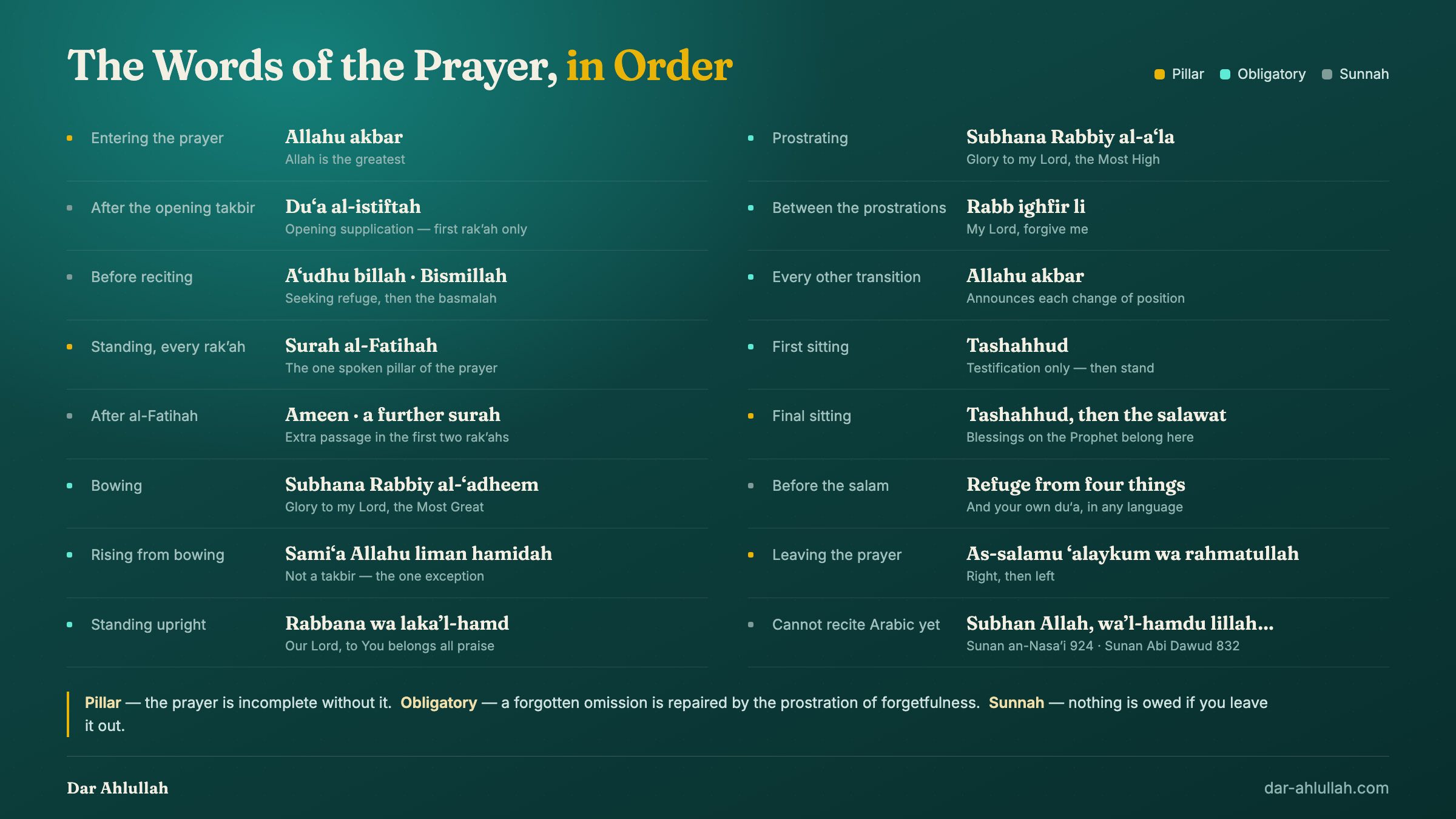
The table below is the same information in a form you can scan while you are learning. “Pillar” means the prayer is incomplete without it. “Obligatory” means a forgotten omission is repaired by the prostration of forgetfulness. “Sunnah” means nothing is owed if you leave it.
| Position | What you say | Meaning | Tier |
|---|---|---|---|
| Entering the prayer | Allahu akbar | Allah is the greatest | Pillar |
| After the opening takbir | Du‘a al-istiftah | Opening supplication | Sunnah |
| Before reciting | A‘udhu billah · Bismillah | Seeking refuge · In the name of Allah | Sunnah |
| Standing, every rak’ah | Surah al-Fatihah | The Opening of the Book | Pillar |
| After al-Fatihah | Ameen | Answer our prayer | Sunnah |
| First two rak’ahs | A further passage of Quran | — | Sunnah |
| Bowing | Subhana Rabbiy al-‘adheem | Glory to my Lord, the Most Great | Obligatory |
| Rising from bowing | Sami‘a Allahu liman hamidah | Allah hears the one who praises Him | Obligatory |
| Standing upright | Rabbana wa laka’l-hamd | Our Lord, to You belongs all praise | Obligatory |
| Prostrating | Subhana Rabbiy al-a‘la | Glory to my Lord, the Most High | Obligatory |
| Between the prostrations | Rabb ighfir li | My Lord, forgive me | Obligatory |
| Every other transition | Allahu akbar | Allah is the greatest | Obligatory |
| First sitting | Tashahhud | The testification | Obligatory |
| Final sitting | Tashahhud, then the salawat | Testification, then blessings on the Prophet | Pillar (final tashahhud) |
| Before the salam | Du‘a seeking refuge from four | — | Sunnah |
| Leaving the prayer | As-salamu ‘alaykum wa rahmatullah | Peace and mercy of Allah be upon you | Pillar |
The Final Sitting: Tashahhud to Taslim
The tashahhud
This is the longest thing you will memorise for the prayer, and the one most often left half-learned. Ibn Mas‘ud said the Prophet (peace be upon him) taught it to him with his hand between his hands, the way he would teach a surah of the Quran. It is narrated in Sahih al-Bukhari 831 and Sahih Muslim 402, and Islam Q&A gives the full wording in its answer on what to say in the tashahhud:
At-tahiyyatu lillahi wa’s-salawatu wa’t-tayyibat. As-salamu ‘alayka ayyuha’n-Nabiyyu wa rahmatullahi wa barakatuh. As-salamu ‘alayna wa ‘ala ‘ibadillahi’s-salihin. Ashhadu an la ilaha illa’llah, wa ashhadu anna Muhammadan ‘abduhu wa rasuluh.
“All compliments, prayers and pure words are due to Allah. Peace be upon you, O Prophet, and the mercy of Allah and His blessings. Peace be upon us and upon the righteous slaves of Allah. I bear witness that there is no god but Allah, and I bear witness that Muhammad is His slave and His Messenger.”
Learn it in the four segments the punctuation marks out rather than as one block. Each segment is a complete thought, which is why it holds in memory far better broken up than run together.
The blessings on the Prophet (salawat ibrahimiyyah)
In the final sitting only, the tashahhud is followed by the salawat, narrated in Sahih al-Bukhari 3370:
Allahumma salli ‘ala Muhammadin wa ‘ala ali Muhammad, kama sallayta ‘ala Ibrahima wa ‘ala ali Ibrahim, innaka hamidun majid. Allahumma barik ‘ala Muhammadin wa ‘ala ali Muhammad, kama barakta ‘ala Ibrahima wa ‘ala ali Ibrahim, innaka hamidun majid.
“O Allah, send prayers upon Muhammad and upon the family of Muhammad, as You sent prayers upon Ibrahim and upon the family of Ibrahim; You are indeed Worthy of Praise, Full of Glory. O Allah, send blessings upon Muhammad and upon the family of Muhammad, as You sent blessings upon Ibrahim and upon the family of Ibrahim; You are indeed Worthy of Praise, Full of Glory.”
The two halves are near-identical — only salli/sallayta becomes barik/barakta. Learning the first half properly gets you most of the second for free.
The supplication before the salam
The Prophet (peace be upon him) said that when you have finished the final tashahhud you should seek refuge with Allah from four things — narrated in Sahih al-Bukhari 1311 and Sahih Muslim 588:
Allahumma inni a‘udhu bika min ‘adhabi jahannam, wa min ‘adhabi’l-qabr, wa min fitnati’l-mahya wa’l-mamat, wa min sharri fitnati’l-masih id-dajjal.
“O Allah, I seek refuge with You from the torment of Hell, from the torment of the grave, from the trials of life and death, and from the evil of the trial of the false messiah.”
This is the point in the prayer where you may also make your own du‘a, in Arabic or in your own language, for whatever you need. Many people who have prayed for years never realised there was a designated slot for that. There is, and it is here.
The taslim
You turn your face to the right and say As-salamu ‘alaykum wa rahmatullah, then to the left and repeat it. The first is a pillar — it is how you leave the prayer, and until you have said it you are still inside it.
If You Cannot Recite Arabic Yet
This is the question our students ask more than any other, and the honest answer is more generous than most people expect — but it is not a blanket permission, and the distinction it draws is worth understanding properly.
The scholars separate two categories. For the adhkar — the takbir, the tasbih of bowing and prostrating, the tashahhud, the supplications — the majority position is that someone who cannot speak Arabic may say them in their own language until they learn, because remembrance of Allah is not tied to one tongue. For the Quranic recitation, meaning al-Fatihah, the majority hold that a translation is not the Quran but an interpretation of it, and so cannot substitute. Islam Q&A sets both halves out in its answer on what a non-Arab should do for the adhkar in salah.
So what does someone genuinely do in the meantime? There is a specific, well-attested provision. ‘Abd-Allah ibn Abi Awfa reported that a man came to the Prophet (peace be upon him) and said he could not learn anything of the Quran, and asked to be taught something to say instead. He was told to say:
Subhan Allah, wa’l-hamdu lillah, wa la ilaha illa’llah, wa Allahu akbar, wa la hawla wa la quwwata illa billah.
“Glory be to Allah, praise be to Allah, there is no god but Allah, Allah is the greatest, and there is no power and no strength except with Allah.”
The report is narrated in Sunan an-Nasa’i 924 and Sunan Abi Dawud 832, and Islam Q&A applies it directly to this case in its answer on what to do if you cannot read al-Fatihah in prayer. That answer adds two further points that matter. If you can recite part of al-Fatihah, you recite what you have and repeat it to make up seven verses. And the obligation to learn does not disappear — the provision is a bridge, not a destination.
The last point in that answer is the one worth carrying with you. Not every mispronunciation invalidates a prayer. Only an error that distorts the meaning, made by someone who knows better, affects validity. The mistakes of a person genuinely trying to learn do not break their prayer. This follows the principle stated in Surah al-Baqarah 2:286 — that Allah does not burden a soul beyond its capacity — and it is the reason nobody should stop praying while they are still learning to pronounce.
What Changes Between the Rak’ahs
The words are not identical in every unit, and the differences are simple enough to state in a paragraph each.
The first rak’ah carries the opening takbir and the opening supplication. No other rak’ah does.
The first two rak’ahs carry al-Fatihah plus a further passage of Quran. In a three- or four-rak’ah prayer, the third and fourth carry al-Fatihah alone.
The first sitting, which occurs after the second rak’ah of a three- or four-rak’ah prayer, carries the tashahhud only. You do not add the salawat there, and you stand back up.
The final sitting carries the tashahhud, then the salawat, then the supplication before the salam, then the taslim.
Which means a two-rak’ah prayer such as Fajr has only one sitting, and it is the final one. A four-rak’ah prayer such as Dhuhr has two, and only the second gets the salawat. Combine that with the timings and rak’ah counts covered in our guide to salat and you have the full map. If a prayer’s window has already closed and you are working out what you owe, that is a separate question with a separate answer — see how to make up missed prayers.
Aloud or Silent: Which Words, Which Prayers
The rule is narrower than people assume. Only the Quranic recitation of the first two rak’ahs changes volume, and only in three prayers.
Fajr, and the first two rak’ahs of Maghrib and Isha, are recited aloud. Dhuhr, Asr, the third rak’ah of Maghrib and the last two of Isha are recited silently. Everything else in the prayer — every takbir, every tasbih, the tashahhud, the salawat, the supplications — is said quietly in all five prayers, audible to yourself but not intended for anyone else. The one exception people notice is ameen, which follows the recitation: aloud where the recitation is aloud.
“Quietly” here does not mean silently in your head. The words should be formed with the tongue, at a level you could hear if the room were still. A prayer performed entirely in thought, with no movement of the tongue at all, has not met the requirement.
Five Mistakes Non-Arabic Speakers Make
These come up constantly, and every one of them is a matter of learning rather than a matter of sin.
Repeating the opening supplication in every rak’ah. It belongs to the first rak’ah only. Harmless, but it means you have been carrying a longer prayer than you needed to.
Saying Allahu akbar when rising from ruku‘. That single transition takes sami‘a Allahu liman hamidah instead. This is the most frequent slip on the list.
Adding the salawat to the first tashahhud. The blessings on the Prophet belong to the final sitting. In the middle sitting you say the tashahhud and stand.
Stopping the prayer to restart when a word comes out wrong. Unless the error distorts meaning and you knew better, there is nothing to restart. Continue.
Letting long vowels collapse. This is the pronunciation issue that actually matters, because Arabic distinguishes meaning by vowel length, and it is the one thing that genuinely benefits from a teacher listening rather than an app. Our introduction to tajweed rules for beginners covers the mechanics; if you want to understand what the words are saying while you say them, the most common words in the Quran is a fast way in, since the vocabulary of the prayer overlaps heavily with it.
How to Actually Get These Into Memory
The full set of spoken material in the prayer is roughly a hundred and fifty words of Arabic. That is less than a page. People struggle with it not because it is long but because they try to absorb it as one undifferentiated block of sound.
Learn it position by position instead, and in the order the prayer uses. Take the bowing phrase on its own until it is automatic, then the two rising phrases, then the prostration phrase, then the sitting phrase. Those five carry you through every rak’ah of every prayer for the rest of your life, and each is four or five words long. Only then start on the tashahhud, in its four segments, and only after that the salawat — which, as noted above, is largely the same sentence twice.
Two things accelerate this more than repetition does. The first is meaning: a phrase you understand is a phrase you can reconstruct when memory slips, whereas a phrase held as pure sound is gone the moment one syllable goes. The second is correction out loud. Silent practice locks in whatever you happened to guess about pronunciation, and the longer it goes uncorrected the harder it is to unlearn. The general principles here are the same ones we set out in our guide to revising Quran memorisation, applied to a much smaller body of text.
How We Teach This
The words of the prayer are the first thing we cover with anyone who comes to us new to practice, and we cover them out loud, one to one, because that is the only way to catch a pronunciation error before it sets. A teacher hearing you say Subhana Rabbiy al-a‘la can correct the vowel in the second syllable in three seconds; a recording cannot, and neither can an app.
That work sits inside our Islamic Studies programme, which covers aqeedah, fiqh, seerah and manners alongside the practical mechanics of worship, and it runs in parallel with Quran reading for people who are learning the script at the same time. Every course is taught one to one and paced to the individual. If you want to know where you actually stand before committing to anything, there is a free thirty-minute assessment where a mentor listens to your recitation and recommends a starting point — no card required. You can see the full range on our courses page.
If prayer is the part of practice you are building from zero, the wider sequence is laid out in our first ninety days guide, which puts wudu, prayer and Quran reading in the order that actually works rather than the order they appear in a textbook.
Questions People Ask
Can I say the prayer in English?
The adhkar — takbir, tasbih, tashahhud, supplications — may be said in your own language by someone who cannot yet manage the Arabic, according to the majority position. Al-Fatihah is the exception: a translation is understood as interpretation rather than Quran, so it does not substitute. If you cannot recite al-Fatihah yet, the substitute formula from the hadith of Ibn Abi Awfa takes its place while you learn.
What if I forget the tashahhud?
If you forget the first tashahhud and have already stood up, continue and perform the prostration of forgetfulness. The first tashahhud is obligatory rather than a pillar, which is exactly why it can be repaired that way. The final tashahhud cannot be skipped.
Do I have to say all three repetitions in ruku‘ and sujud?
No. Once is obligatory. Three is the customary sunnah and there is nothing wrong with more, but a prayer with one is a valid prayer.
Which opening supplication should I use?
Either. Both are authentically narrated and neither is required. The shorter Subhanaka Allahumma is usually taught first simply because it is easier to hold in memory.
What do I say in the third and fourth rak’ahs?
Al-Fatihah alone, then the ordinary words of bowing, rising, prostrating and sitting. No opening supplication, and no additional surah.
Is it enough to say the words in my head?
No. The tongue should move and form the words, at a volume you could hear yourself in a quiet room. Recitation held purely in thought does not count as recitation.
I have been praying wrong for years. Do I owe those prayers?
Almost certainly not. If you were saying the pillars — the opening takbir, al-Fatihah, the final tashahhud and the salam — your prayers were valid, and missing sunnah items costs nothing. If you have a specific case you are worried about, put it to a scholar rather than to a search engine, since the answer depends on details a general article cannot see.
Does my wudu need to be renewed if I take a long time learning?
Only if something has actually broken it. Time by itself does not. We covered the list separately in what breaks wudu.
Conclusion: A Short List, Learned Once
The whole spoken content of the prayer comes to about a hundred and fifty words of Arabic, and only one of them — al-Fatihah — is a pillar you cannot substitute. Six short phrases cover every bow, rise, prostration and sitting in every rak’ah you will ever pray. The tashahhud and the salawat are the longest items, and both are built from repeating parts. Everything else is recommended.
Most people carry this topic as a low-grade anxiety for years, convinced they are getting it wrong in some way they cannot identify. The fix is not more worry, it is a single pass through the list with someone listening — after which the words stop being a source of doubt and become what they were meant to be, which is the part of the day you look forward to.
Related articles
khushu in salah
Khushu in Salah: How to Focus in Prayer When Your Mind Wanders
Khushu is stillness of the body and presence of the heart in prayer. What a wandering mind does and does not do to your salah, what the Sunnah gives you before the takbir, inside the prayer and when the whispers come, and how a non-Arabic speaker learns to mean the words.
26 min read
how to pray salat al-tasbih
How to Pray Salat al-Tasbih: The Prayer of Glorification
Salat al-tasbih is four rak'ahs with one phrase of praise said 300 times, 75 in each rak'ah. The reports behind it and their grades, the scholars on both sides, the method position by position, the two reported orders of the counts, and what to do if you lose count.
22 min read
adhkar after salah
Adhkar After Salah: What to Say After Every Prayer
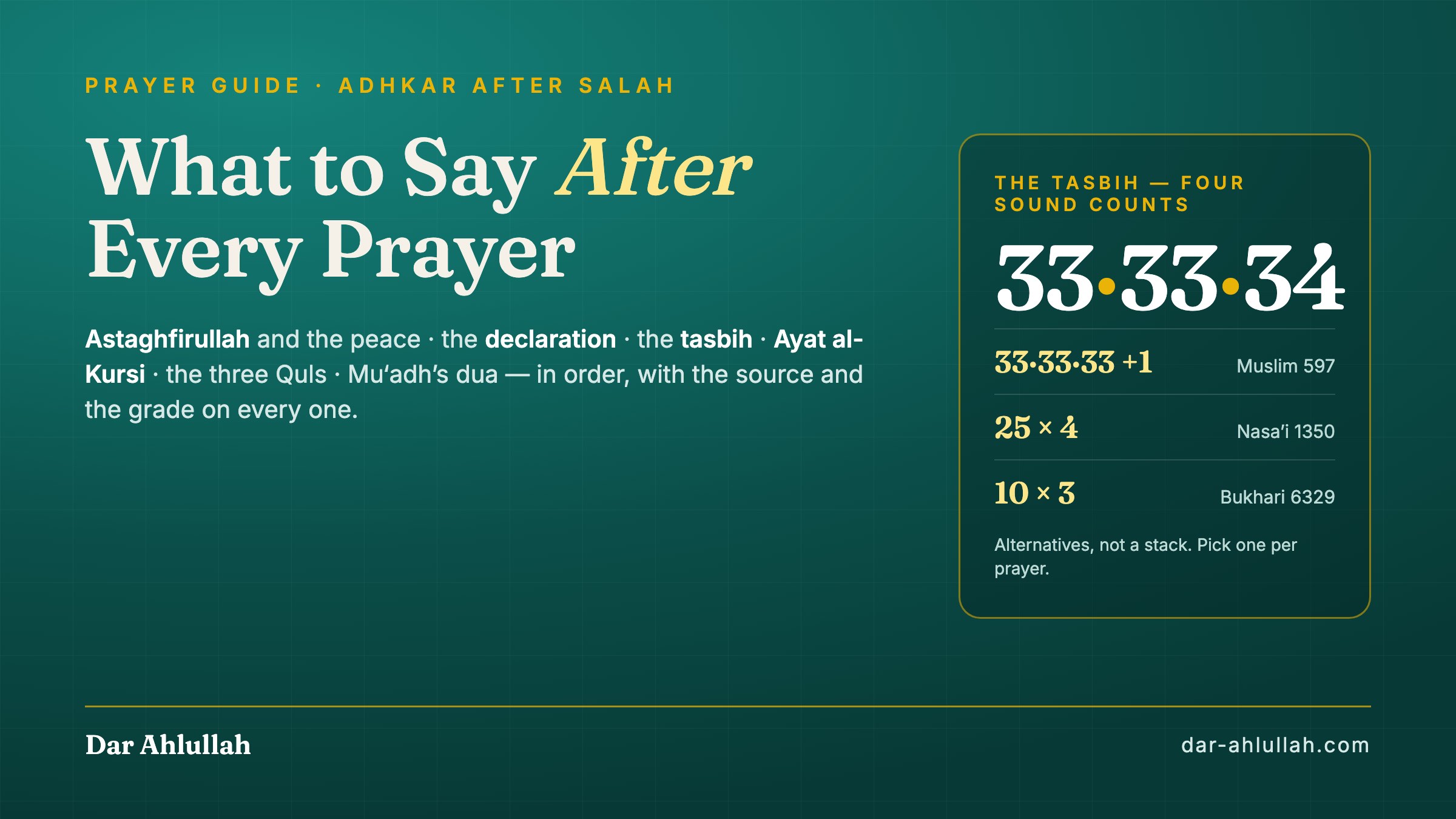
The adhkar after salah are the remembrances said in the minutes after the salam. This guide gives them in order with their sources, sets the 33-33-34, 33-33-33, 25-by-four and 10-by-three reports side by side so the counts stop looking like a contradiction, prints the grade on every famous reward, and works out which to keep when you pray Zuhr in a stairwell at work.
34 min read