
how to pray while traveling
How to Pray While Traveling: Shortening, Combining, and Praying on the Move
Dar Ahlullah team 23 min read
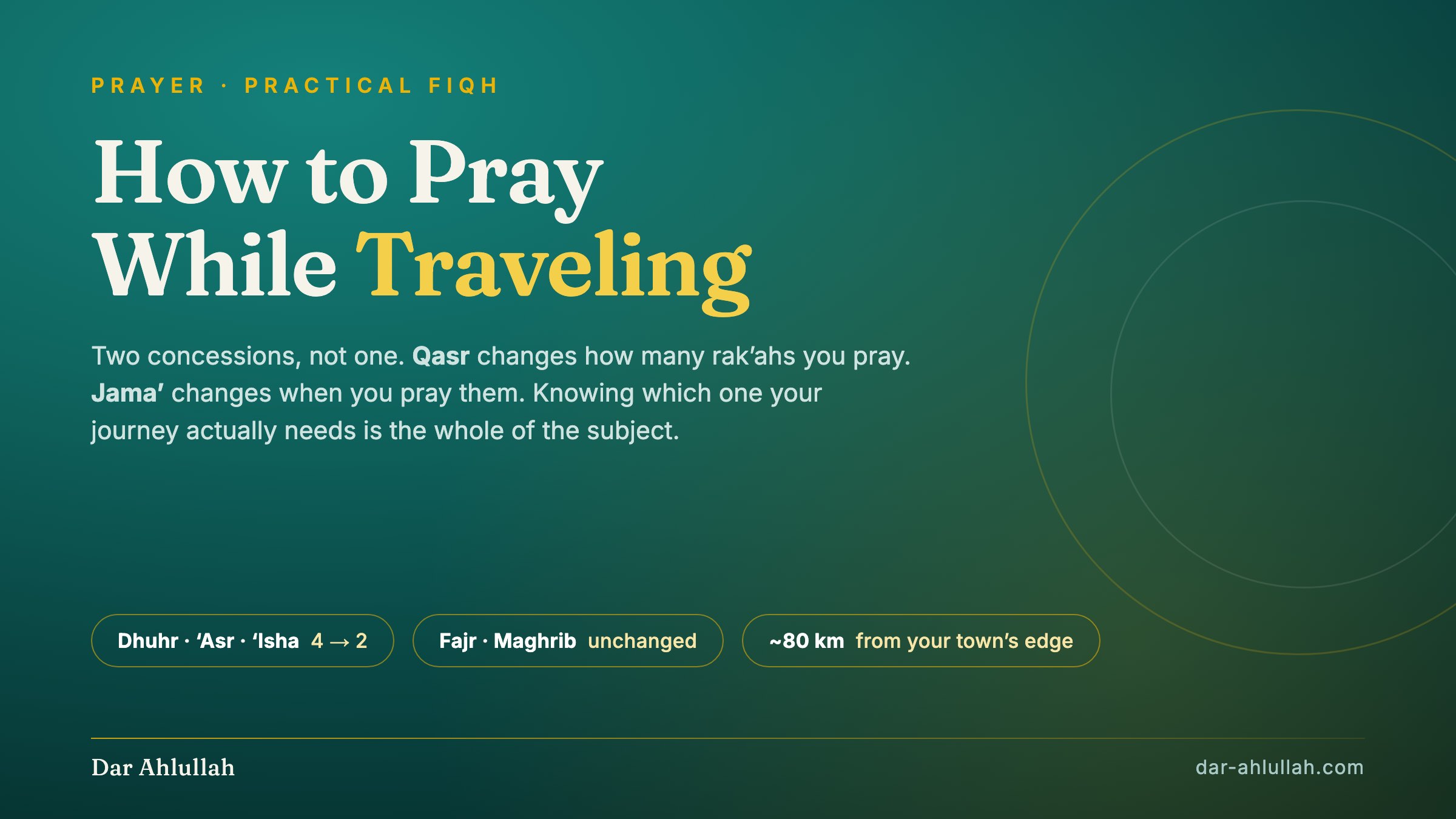
Table of Contents
- Introduction: The Prayer That Falls at 35,000 Feet
- The Short Answer
- Two Concessions, Not One
- Are You Actually a Traveller Yet?
- How Long You Stay a Traveller
- Qasr: Exactly What Changes
- Jama’: The Two Ways to Combine
- What Happens to the Sunnah Prayers
- Praying on the Vehicle Itself
- Long-Haul Flights and the Time-Zone Problem
- What Does Not Change on a Journey
- Four Journeys, Worked Through
- Six Mistakes Travellers Keep Making
- How We Teach This
- Questions People Ask
- Conclusion: A Concession, Not a Loophole
Introduction: The Prayer That Falls at 35,000 Feet
The seatbelt sign is on. The window shade two rows up is open and the sky outside has gone the colour of a Maghrib you are fairly sure started forty minutes ago somewhere below you. You have no idea which way the qiblah is, whether you are allowed to pray sitting down, whether you were supposed to have prayed this on the ground before boarding, or whether the four rak’ahs you are about to attempt in a seat with 78 centimetres of pitch are even four rak’ahs any more.
Almost every Muslim living in Europe or North America meets this moment several times a year, and most of us improvise our way through it. The improvisation is the problem. Knowing how to pray while traveling is not a matter of finding one flexible ruling to lean on — it is a matter of understanding two separate concessions that do two different jobs, and then knowing which of them your particular journey has actually switched on.
Those two concessions are qasr (shortening) and jama’ (combining). Most articles on this topic run them together into a single blur called “travel prayer.” They are not the same thing, they are not triggered by exactly the same reasoning, and you can very easily be entitled to one and not want the other. Separate them and the whole subject becomes navigable.
One boundary before we start. We teach Quran, Arabic and the practical fiqh of worship; we are not a fatwa body. On this topic the schools of Islamic law differ on two specific numbers — how far and how long — and we will name the differences rather than pick one and present it as consensus. If you are still assembling the prayer itself, our complete guide to salat covers the sequence first; and if worship as a whole is new to you, the order to learn it in is mapped out in our guide to your first 90 days in Islam.
The Short Answer
If you have two minutes rather than twenty, this is the system.
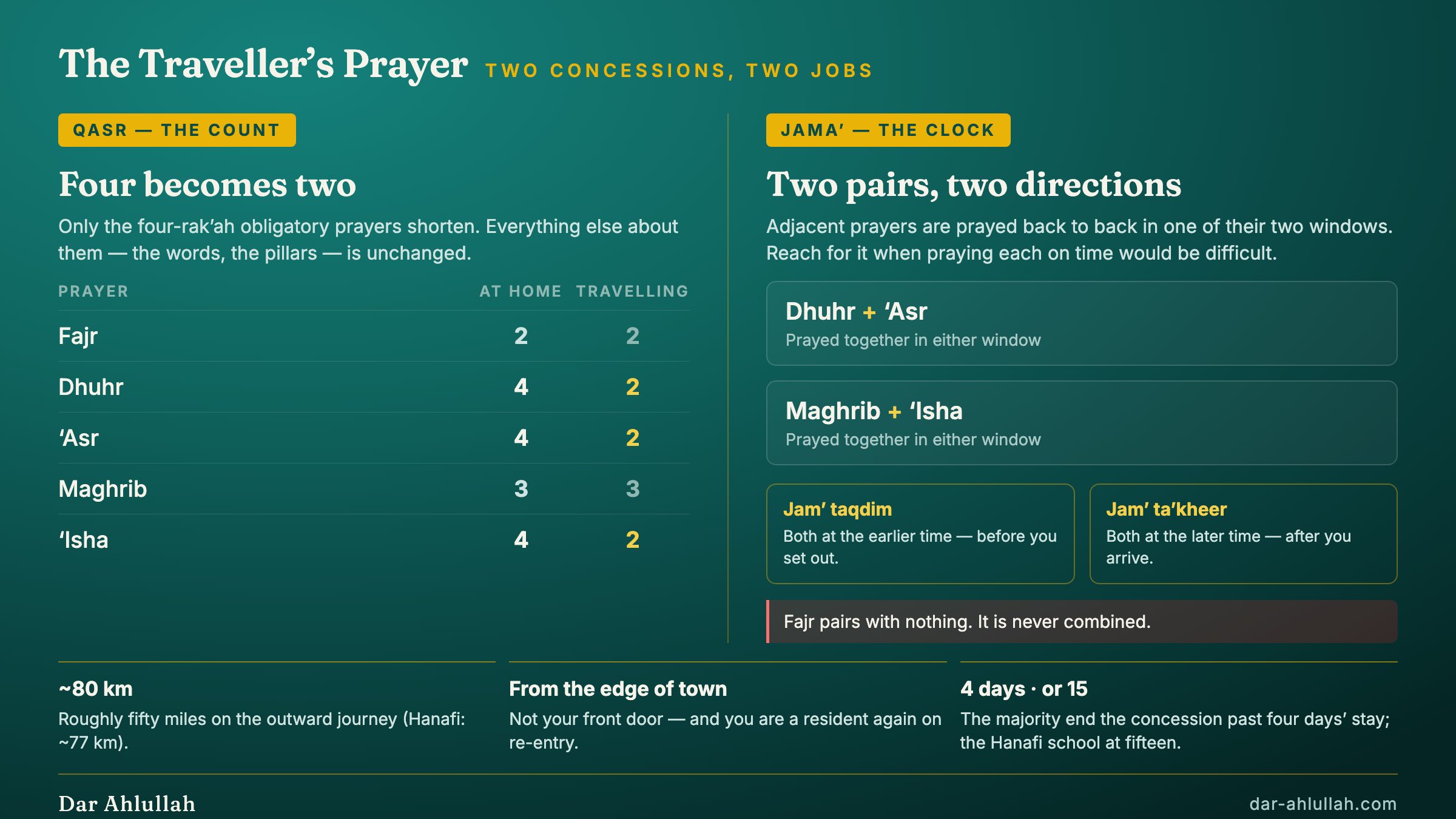
- Travel switches on two separate permissions. Qasr changes how many rak’ahs you pray. Jama’ changes when you pray them. They are independent: you may shorten without combining, and combine without shortening.
- Qasr turns the four-rak’ah prayers into two. Dhuhr, ‘Asr and ‘Isha become two rak’ahs each. Fajr stays at two and Maghrib stays at three. Nothing else about them changes.
- Jama’ lets you pair Dhuhr with ‘Asr and Maghrib with ‘Isha, either at the time of the earlier one or at the time of the later one. Fajr never joins anything.
- You become a traveller when you leave the built-up edge of your town on a journey of roughly eighty kilometres or more — not when you leave your front door, and not for a long drive that stays inside your own city.
- You stop being one when you settle. The majority of scholars put the line at intending to stay more than four days; the Hanafi school puts it at fifteen. This is the single biggest live difference in the topic and you should know which one your community follows.
- The concession is a gift, not a compromise. ‘Umar ibn al-Khattab asked the Prophet ﷺ about shortening in a time of safety and was told: “It is an act of charity which Allah has done to you, so accept His charity” (Sahih Muslim 686a).
The rest of this article is the reasoning, the evidence, and the awkward cases — the layover, the eastbound red-eye, the weekly commute to a client site.
Two Concessions, Not One
Start here, because almost every confusion downstream comes from collapsing these two.
Qasr is about quantity. A four-rak’ah obligatory prayer is prayed as two. That is the whole of it. The Qur’an introduces it directly: “And when you travel throughout the land, there is no blame upon you for shortening the prayer” (Surah an-Nisa 4:101). ‘A’ishah described the history behind it plainly — “When the prayers were first enjoined they were of two rak’ahs each. Later the prayer in a journey was kept as it was but the prayers for non-travellers were completed” (Sahih al-Bukhari 1090). On that reading, the shortened prayer is not a reduced version of the real prayer. It is the older form, left standing.
Jama’ is about timing. Two prayers whose windows sit next to each other are prayed back to back in one of the two windows. Mu’adh ibn Jabal reported of the Tabuk expedition: “We set out with the Messenger of Allah ﷺ on the Tabuk expedition, and he observed the noon and afternoon prayers together and the sunset and ‘Isha’ prayers together” (Sahih Muslim 706a).
Why insist on the distinction? Because they answer different problems. Qasr answers I am unsettled and cannot pray at length. Jama’ answers I will be somewhere impossible when that window opens. A four-hour train journey may need neither. A day of connecting flights may need both. A long meeting in a city ninety kilometres away may need only the second. Once you can name which problem you actually have, you stop reaching for a blanket permission and start making a decision.
There is also a difference in emphasis worth knowing. Shortening on a journey was the Prophet’s constant practice — Ibn ‘Umar said, “I accompanied Allah’s Apostle and he never offered more than two rak’ahs during the journey. Abu Bakr, ‘Umar and ‘Uthman used to do the same” (Sahih al-Bukhari 1102). Combining was not: it appears on hard marches and pressing days rather than on every trip. Islam Question & Answer’s summary of the traveller’s prayer reflects that, treating joining as the option you reach for when praying each prayer in its own time would be difficult. If you are sitting comfortably in a hotel room with the whole afternoon free, shorten — but there is no particular virtue in combining just because you can.
Are You Actually a Traveller Yet?
Two questions decide this: how far, and from where.
How far
The classical scholars expressed the threshold in units nobody uses any more — burud and manzil, measured in days of loaded camel travel — and the modern conversions land close together. Islam Question & Answer reports the majority position as approximately eighty kilometres on the outward journey. The Hanafi conversion, given as three manzils, comes out at roughly 77 kilometres. For practical purposes those are the same number.
So: about fifty miles. Below that you are not a traveller in the technical sense, however tiring the day is. A ninety-minute crawl across your own metropolitan area in traffic is not a journey; a clean sixty-kilometre run to the next town and back is not a journey either. This disappoints people, and it should not. The concession is tied to a distance, not to how inconvenient your day feels.
From where
The measurement does not start at your front door. It starts at the edge of the place you live. Al-Bukhari titles the relevant chapter exactly this way — “When a traveller leaves his original place, he can shorten his salat” — and the practical effect is that you pray in full until the built-up area of your town is behind you, and you go back to praying in full the moment you re-enter it on the way home.
Two consequences people miss. First, the drive to the airport is usually still resident territory; the shortening begins after departure, not in the taxi. Second, arriving home late at night does not entitle you to a shortened ‘Isha because you have “been travelling all day.” You are home. Pray four.
The intention matters as much as the map
A journey is something you set out on deliberately. A courier who criss-crosses a region all day without ever aiming at a destination eighty kilometres out has not started a journey; someone who books a flight to another country has, from the moment they leave town. The Hanafi formulation makes the role of intention explicit — you become a traveller by setting out with the intention of eventually travelling three manzils — and the same logic runs through the other schools.
How Long You Stay a Traveller
This is where the schools genuinely part company, and where most confident internet answers quietly pick a side without telling you.
The majority of scholars — the position attributed to Malik, al-Shafi’i and Ahmad — hold that a traveller keeps the concessions so long as he is not staying in the place he has gone to for four or more days. Intend a longer stay and you pray in full from arrival. The Hanafi school sets the line at a firm intention to remain fifteen days or more in one place.
Both sides are reasoning from the same reports, which describe stays that ran on without a settled plan. Ibn ‘Abbas said, “The Prophet once stayed for nineteen days and prayed shortened prayers” (Sahih al-Bukhari 1080). Anas ibn Malik described the journey to Makkah: “We travelled with the Prophet from Medina to Mecca and offered two rak’ahs till we returned to Medina” — and when asked how long they were in Makkah, “We stayed in Mecca for ten days” (Sahih al-Bukhari 1081). The interpretive question is whether those stays were open-ended, waiting on events, or whether they set a general ceiling.
What this means for you in practice:
- A weekend away, a three-night conference, a short Umrah trip. Inside the concession on every school. Shorten with confidence.
- A week to ten days — the classic family visit. This is the contested zone. A Hanafi traveller shortens throughout; a Shafi’i, Maliki or Hanbali traveller who arrived intending to stay that long prays in full. Follow the position your teacher or local scholars work with, and do not let a stranger online talk you out of it.
- A month-long posting, a semester abroad, a relocation. Everyone agrees: you are a resident there. Pray in full.
- The weekly commute to a client site two hundred kilometres away. Each trip is its own journey. You are a traveller on the road and for a short stay — and a resident again the moment you are back inside your own town. This case attracts a lot of bad advice; it is worth asking a scholar about your specific pattern rather than generalising from someone else’s.
Notice what is not a factor: comfort. Staying in a hotel with a prayer mat and a qiblah arrow on the ceiling does not end your traveller status, and sleeping badly in an airport does not extend it. The ruling tracks distance, intention and duration — nothing else.
Qasr: Exactly What Changes
Shortening is narrower than people assume. Here is the whole of it, prayer by prayer.
| Prayer | At home | Travelling | Notes |
|---|---|---|---|
| Fajr | 2 rak’ahs | 2 rak’ahs | Unchanged. There is nothing to shorten. |
| Dhuhr | 4 rak’ahs | 2 rak’ahs | Shortened. |
| ‘Asr | 4 rak’ahs | 2 rak’ahs | Shortened. |
| Maghrib | 3 rak’ahs | 3 rak’ahs | Unchanged. Maghrib is never shortened. |
| ‘Isha | 4 rak’ahs | 2 rak’ahs | Shortened. |
Everything else stays as it is. You still open with the takbir, still recite al-Fatihah in both rak’ahs, still perform a full ruku’ and two full prostrations, still sit for the tashahhud, still give the salam. The words are identical to the words you say at home — if you are still learning them, our guide to what to say in salah lays them out by position. A shortened prayer is a complete prayer with fewer units, not a rushed or simplified one.
Two practical points.
Praying behind a resident imam. If you join a congregation whose imam is praying the full four, you follow him to four. The concession does not survive contact with the congregation; you complete what the imam completes. If you arrive late and catch part of the prayer, you finish what you missed as the imam prayed it.
Leading as a traveller. If you lead a mixed congregation and pray two, the residents behind you stand and complete their remaining two after your salam. Announcing it before you begin — “I am a traveller, please complete your prayer” — saves an entire back row from confusion.
And if it is a shortened prayer you missed rather than one you are praying now, the rules for making it up are their own subject; our guide to making up missed prayers covers what changes and what does not.
Jama’: The Two Ways to Combine
Combining pairs two prayers into one sitting. There are exactly two pairs, and exactly two directions.
- The pairs. Dhuhr with ‘Asr. Maghrib with ‘Isha. Fajr pairs with nothing — it stands alone at both ends.
- Jam’ taqdim (combining early). Both prayers are prayed in the earlier window: ‘Asr pulled forward into Dhuhr’s time, or ‘Isha pulled forward into Maghrib’s.
- Jam’ ta’kheer (combining late). Both are prayed in the later window: Dhuhr delayed into ‘Asr’s time, or Maghrib delayed into ‘Isha’s.
Which direction you choose is a scheduling decision, and the Sunnah models exactly that reasoning. Anas ibn Malik described the Prophet ﷺ reading the day before he set out: “Whenever the Prophet started the journey before noon, he used to delay the Dhuhr prayer till the time for the ‘Asr prayer and then he would dismount and pray them together; and whenever the sun declined before he started the journey he used to offer the Dhuhr prayer and then ride” (Sahih al-Bukhari 1112). Departing early means delaying. Departing after the window has already opened means praying first and travelling after. The principle is simply: put the prayers where you will actually be able to pray them properly.
Order matters within the pair — you pray the earlier prayer first, then the later one, with the second following the first rather than being scattered across the evening. And you may combine while shortening, so a combined and shortened Dhuhr and ‘Asr is four rak’ahs in total: two, salam, two.
What combining is not: a licence to sleep through Fajr and pray it with Dhuhr, or to bank a whole day’s prayers into one evening session. Fajr is not combinable, and the pairing is strictly adjacent. A prayer moved outside its pair has not been combined — it has been missed, and it becomes a make-up prayer instead.
What Happens to the Sunnah Prayers
Here is where travellers most often carry unnecessary weight. Ibn ‘Umar’s report is the anchor: “I accompanied Allah’s Apostle and he never offered more than two rak’ahs during the journey”, and the first three caliphs did the same (Sahih al-Bukhari 1102). Al-Bukhari files it under a chapter heading that says the quiet part out loud: whoever did not offer the nawafil before and after the obligatory prayer during a journey.
The general reading is that the regular sunnah prayers attached to Dhuhr, Maghrib and ‘Isha — the rawatib — are set down on a journey. Not forbidden, and not sinful to pray. Simply lifted, in the same spirit as the shortening itself.
Two things were kept. The night prayer and witr continued on journeys, and could even be prayed on the moving mount. Sa’id ibn Yasar described dismounting on the road to Makkah to pray witr on solid ground, and being told by ‘Abdullah ibn ‘Umar: “Isn’t it sufficient for you to follow the good example of Allah’s Apostle?” (Sahih al-Bukhari 999). The two rak’ahs before Fajr were likewise maintained.
The practical upshot for a long travel day: pray the obligatory prayers, keep witr, and let the rawatib go without guilt. Then, when you are settled again, pick them back up. Treating a journey as a personal failure of consistency is exactly the frame the concession was given to dissolve.
Praying on the Vehicle Itself
Voluntary and obligatory prayers are treated very differently here, and mixing them up is the single most common error in the air.
Voluntary prayer: relaxed
Nafl prayer on a moving vehicle has explicit precedent, including on the direction question. ‘Abdullah ibn ‘Amir reported from his father: “I saw the Prophet ﷺ offering the prayer on his mount whatever direction it took” (Sahih al-Bukhari 1093). Seated, facing however the vehicle happens to be pointing, with head movements in place of full bowing and prostration — a voluntary prayer prayed that way on a plane, a train or in a passenger seat is a real prayer.
Obligatory prayer: strict, then merciful
The obligatory prayer keeps its pillars for as long as you can keep them: standing, facing the qiblah, a genuine bow, a genuine prostration. Islam Question & Answer’s treatment of praying on a plane sets the order plainly — when the time comes and the flight continues, you offer the prayer as best you are able, bowing, prostrating and facing the qiblah if you can, asking the crew for the direction if the aircraft does not display it.
That produces a straightforward order of preference:
- Pray it on the ground. Use combining deliberately: shift the prayer into a window where you will be at a gate, in a terminal prayer room, or in your seat before push-back rather than at cruising altitude.
- If you must pray in the air, pray it properly if there is space. A galley or a clear area near the rear doors, with the crew’s permission and outside meal service, allows a full prayer.
- If there is genuinely no space, pray seated, facing the qiblah at the outset if you can determine it, and making your bow and prostration as motions of the head with the prostration lower than the bow.
- Never let both windows of a combinable pair close. A deficient prayer prayed on time is a prayer; a perfect prayer prayed after the window has gone is a make-up.
Cars deserve their own line, because the excuse is so available. If you are the passenger and the driver can pull into a service area, the obligatory prayer is prayed on the ground. Praying seated in a moving car when stopping was possible is not a concession anyone granted.
Two related conditions travel with you. Purity is one of them — airport wudu is awkward but not optional, and the list of things that actually break it is shorter than most people think, which our guide to what breaks wudu works through. The other is that the prayer must not be invalidated by what you do inside it; our guide to what invalidates salah is worth reading before you pray in a place full of interruptions.
Long-Haul Flights and the Time-Zone Problem
This is the part almost no guide addresses, and it is the part that actually confuses people flying between Europe or North America and the Muslim world.
Prayer times are astronomical, not administrative. They are set by where the sun is relative to you, right now — not by the clock in the city you took off from, and not by the timetable saved on your phone last week. On an aircraft you are moving through those times rather than waiting for them, and the direction of travel changes everything:
- Flying east — London to Dubai, New York to Casablanca — you race towards the sun. The remaining daylight collapses. Prayer windows arrive faster than the cabin clock suggests, and a flight that looks like “one prayer” can carry two.
- Flying west — Istanbul to Chicago, Cairo to Toronto — you chase the sun. The afternoon stretches out. A single window can stay open for hours, and Maghrib may not arrive until long after your body insists it should have.
- Flying north at high latitude in summer, the twilight may never resolve properly. This is the same problem northern Europe faces on the ground every June, and it has its own scholarly discussion — if your route runs over the Arctic in summer, ask before you fly rather than improvising at 40,000 feet.
A workable procedure for an ordinary long-haul flight:
- Before boarding, clear the deck. Pray what is due. If the next prayer’s window will open while you are airborne and it is combinable with the current one, use jam’ taqdim in the terminal and board with nothing outstanding.
- In the air, judge by the sky and the map, not by the departure city. The seat-back moving map gives you position and local time along the route; the window gives you the sun. Between them you can tell whether a window has opened.
- On landing, close the deck. Use jam’ ta’kheer for whatever became due late in the flight, praying at the arrival airport before you go anywhere else.
- If a window genuinely passed while you were unable to pray, pray it as soon as you are able on the ground. Do not let it slide into a general debt — our guide to making up missed prayers explains why immediacy matters and what the make-up looks like.
The honest caveat: “unable” means unable. A full cabin during a meal service is a real constraint. Not wanting to be seen praying is not one, and it is worth deciding in advance which of the two you are dealing with, because you will not decide it well at the moment.
What Does Not Change on a Journey
The list of things travel does not alter is longer than the list of concessions, and knowing it prevents the slide from “I am travelling” to “the rules are suspended.”
- The prayer is still obligatory. Every one of the five, every day, on a journey of any length.
- Wudu is still required, on the same terms. Where water is genuinely unavailable, tayammum is the legislated substitute — our complete guide to wudu covers when it applies.
- The qiblah is still the qiblah for obligatory prayer wherever you can determine and face it.
- The words are unchanged. Nothing in the recitation is abbreviated because the rak’ahs are.
- Congregation is still preferred. Islam Question & Answer states it directly: “Prayer in congregation is obligatory for travellers as well as others”. If there is a masjid or a musalla in the terminal, that is where you pray.
- Cleanliness of place and clothing still applies. An airport carpet is not a purity problem; a visibly soiled one is.
None of these are new obligations for the traveller. They are the ordinary conditions of prayer, still in force. If the ordinary conditions themselves are unfamiliar, the underlying framework is worth building deliberately — our introduction to fiqh for beginners lays out the structure these rulings sit inside.
Four Journeys, Worked Through
The rules are easier to hold once you have seen them applied to a day that looks like your own.
1. Manchester to Birmingham and back, one day
Roughly 140 kilometres each way. You leave the built-up area at eight in the morning and are back by nine at night. You are a traveller from the edge of Manchester until you re-enter it. Dhuhr and ‘Asr are two rak’ahs each and may be combined if the meeting schedule demands it; Maghrib on the motorway is three. If you are home before ‘Isha, ‘Isha is four — you are a resident again.
2. A weekend visit to family, three nights
Well over eighty kilometres, and a stay comfortably inside four days. You shorten for the whole visit on every school. Rawatib set down; witr kept. When you pray the shortened prayers behind the local imam at the neighbourhood masjid, you follow him to four.
3. New York to Jeddah, overnight eastbound
You pray Maghrib and ‘Isha combined and shortened in the terminal before boarding — jam’ taqdim, four rak’ahs in total. Fajr will arrive early and abruptly somewhere over the Atlantic as you close on the sun; it is two rak’ahs, it cannot be combined, and you pray it in the air, standing in the galley if the crew allow it and seated if they do not. Dhuhr will likely fall after you land, so it waits.
4. A three-week work posting abroad
The journey out is a journey: shorten on the day of travel. But arriving with the intention of staying three weeks makes you a resident at the destination on every school. Pray in full for the whole posting. Weekend excursions from there start the analysis over again from your temporary base.
Six Mistakes Travellers Keep Making
- Shortening Maghrib. It is three, at home and away. There is no two-rak’ah Maghrib.
- Combining Fajr with something. Fajr has no adjacent pair. Sleeping through it and praying it with Dhuhr is a missed prayer being described in flattering language.
- Starting too early. Praying a shortened Dhuhr in the departure lounge of your own city’s airport, before you have left the built-up area, is praying it short as a resident.
- Carrying the concession home. The moment you are back inside your town, you are a resident, however long the day was.
- Praying seated when standing was possible. The concession for posture is tied to inability, not to preference — in a car that could have pulled over, or a cabin with an empty galley, the excuse is not there.
- Treating “travelling” as a mood. Distance, intention and duration decide it. Tiredness, unfamiliarity and disruption do not.
How We Teach This
Travel fiqh is the point where a lot of students discover that they learned the prayer as a sequence of movements rather than as a structure they can reason about. Someone who memorised “Dhuhr is four” without knowing why is left guessing the moment the four becomes two. Someone who understands rak’ah, window and pillar as separate ideas can work out the answer on an aeroplane without a signal.
That is how we sequence it in our one-to-one sessions: the mechanics first, then the reasoning underneath them, then the situations — travel, illness, interruption — where the reasoning has to carry the weight. Because sessions are one-to-one, they are also scheduled around your life rather than against it, which matters more than usual for students whose work puts them in a different time zone every few weeks.
Every new student starts with a free 30-minute assessment, with no card required, so a teacher can see where your prayer actually stands before recommending anything. If the fit is not right, you can be matched with another certified mentor at no extra cost, and you can pause, upgrade or switch plans at any time. You can see the full range of programmes on our courses page.
Questions People Ask
Do I have to shorten, or is it optional?
The schools differ on how strongly it is recommended, and some hold it close to obligatory for the traveller. What is agreed is that it is the Prophet’s consistent practice on a journey — Ibn ‘Umar reported that he never prayed more than two rak’ahs while travelling (Sahih al-Bukhari 1102). Praying in full is not sinful on the majority view, but shortening is the Sunnah and the better choice.
Can I combine without shortening, or shorten without combining?
Yes to both. They are separate concessions answering separate problems. Shortening without combining is the most common pattern for a traveller with a relaxed schedule; combining without shortening happens when you are a resident somewhere but face a genuine obstacle to praying on time.
What if I am travelling for something sinful?
A number of scholars hold that the concessions do not attach to a journey undertaken for a sinful purpose. This is a live difference of opinion and the sort of question to put to a scholar with the specifics, rather than to settle from an article.
How do I find the qiblah on a plane?
Many aircraft display it on the seat-back system; where they do not, ask the cabin crew, who often have it. Face it as you begin, and do not restart the prayer because the aircraft has since turned — you faced it as far as you were able, which is the standard the situation asks for.
Does the traveller pray Jumu’ah?
The obligation of Friday prayer on a traveller is its own discussion with a real difference of opinion behind it. If you find yourself near a masjid at the time, praying with the congregation is uncontroversially good; the question of obligation is one to take to a scholar.
My flight lands two minutes before Fajr ends. What now?
Pray it. A prayer begun inside its window before the sun rises is a prayer prayed on time. If the window closes while you are still on the airbridge, pray it immediately on landing as a make-up and do not let it drift.
Am I a traveller if I drive 200 km but come home the same night?
Yes, on the outward journey and during the stay. The distance and the deliberate journey are what matter, not whether you sleep away from home. You revert to praying in full once you are back inside your own town.
Which position on the four-versus-fifteen-day question should I follow?
The one your teacher or local scholars work with. Both are long-established positions held by major schools, and the sound approach is consistency with a school rather than picking whichever answer is more convenient on a given trip.
Conclusion: A Concession, Not a Loophole
Reduce the whole subject and two questions are left. Am I a traveller? — decided by distance from the edge of your town, the intention behind the journey, and how long you plan to stay. And which concession does this journey actually need? — qasr for the rak’ahs, jama’ for the timing, either, both, or neither.
Everything else follows from those two. The shortened prayer is complete. The combined pair is on time. The rawatib can wait. The prayer that mattered most on that flight was the one you actually prayed, in the state you could manage, inside its window.
And when the reduced version feels like a lesser offering, it is worth returning to what ‘Umar was told when he raised exactly that discomfort: “It is an act of charity which Allah has done to you, so accept His charity” (Sahih Muslim 686a). The concession is not a discount on your worship. It is part of it.
Related articles
morning and evening adhkar
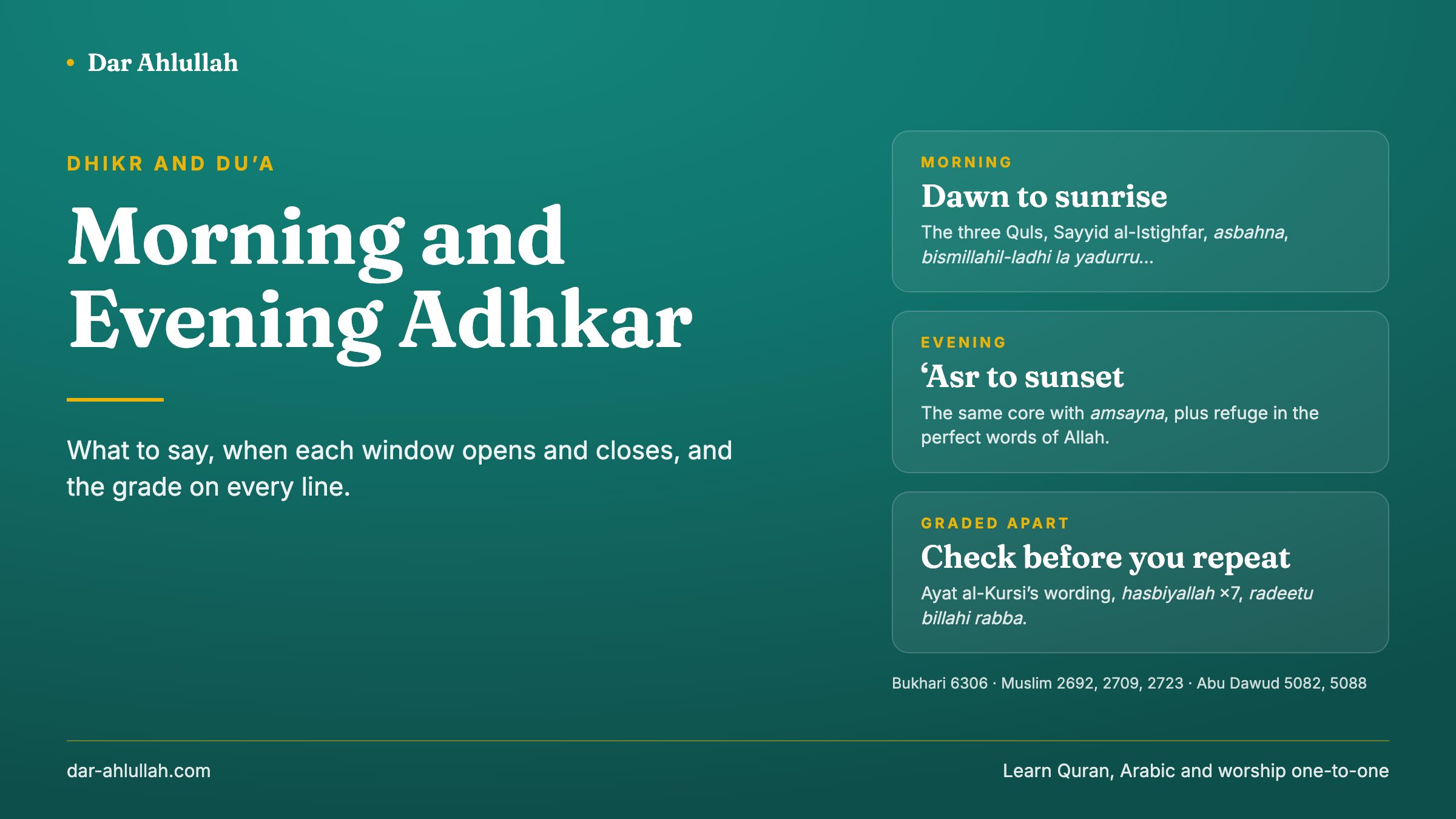
Morning and Evening Adhkar: What to Say and When
Morning and evening adhkar from the sound reports: the windows from dawn to sunrise and from 'Asr to sunset, the core set with the source and count of each line, and the grade printed on the popular additions the hadith scholars dispute, from Ayat al-Kursi to hasbiyallah seven times.
29 min read
how to respond to the adhan
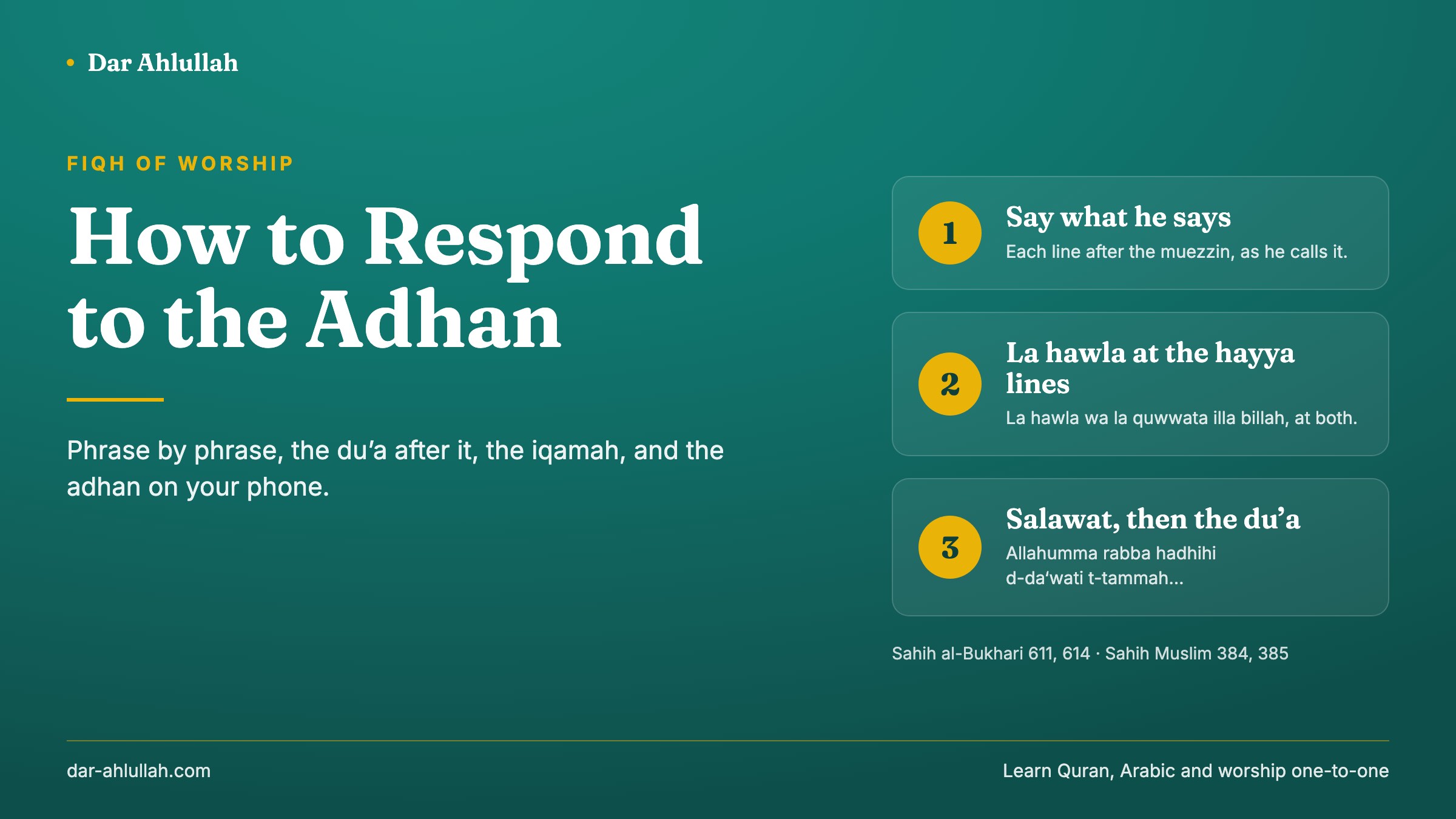
How to Respond to the Adhan: What to Say and the Dua After
How to respond to the adhan: repeat each phrase after the muezzin, say la hawla wa la quwwata illa billah at the two hayya lines, then send salawat and say the du'a after the adhan. This guide sets out every step from the sound reports, prints the grade on the additions people argue about, and lays out the two scholarly answers on the adhan from a phone app.
29 min read
khushu in salah
Khushu in Salah: How to Focus in Prayer When Your Mind Wanders
Khushu is stillness of the body and presence of the heart in prayer. What a wandering mind does and does not do to your salah, what the Sunnah gives you before the takbir, inside the prayer and when the whispers come, and how a non-Arabic speaker learns to mean the words.
26 min read