
how to pray when sick
How to Pray When Sick: Sitting, Lying Down, and Praying by Gesture
Dar Ahlullah team 24 min read
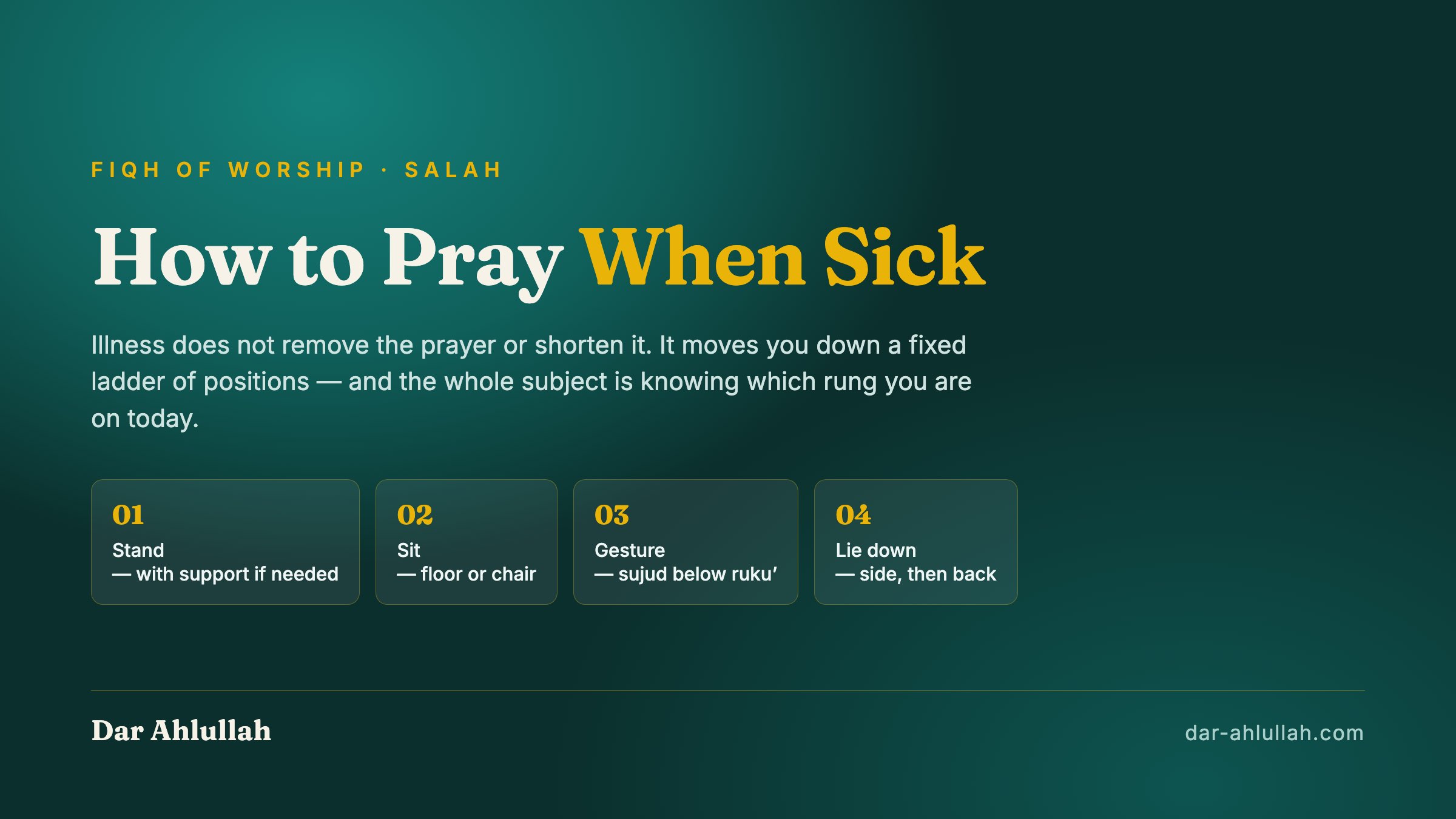
Table of Contents
- Introduction: The Prayer You Are Not Sure You Are Allowed to Sit Down For
- The Short Answer
- The Ladder: One Rule, Several Rungs
- What “Cannot” Actually Means
- Praying Seated: Exactly What Changes
- Praying on a Chair
- When You Can Stand but Cannot Prostrate
- Praying Lying Down
- The Half-Reward Hadith, and Why It Is Not About You
- Purification When You Are Ill
- What Illness Does Not Change
- Illness, Timing, and the Prayers You Lost
- Four Situations, Worked Through
- Six Mistakes People Keep Making
- How We Teach This
- Questions People Ask
- Conclusion: Capacity Is the Standard
Introduction: The Prayer You Are Not Sure You Are Allowed to Sit Down For
It is the third day of something viral, or the second week after surgery, or a Tuesday in a back that has decided to stop cooperating. Dhuhr is in. You stand up, and about four seconds into al-Fatihah you understand that you are not going to make it through this the way you normally would.
So you sit. And then, almost immediately, the doubt starts. Was that allowed, or did you just take a shortcut you had not earned? Does the prayer still count? Is it worth half now? Should you have pushed through? Should you make it up later when you are better?
That doubt is the actual problem, and it is worse than the illness. It is what makes people either force themselves into a standing prayer that costs them their concentration entirely, or quietly skip prayers for a week and plan to deal with it afterwards. Both are avoidable, and both come from the same gap: knowing how to pray when sick is not a matter of finding permission to relax. It is a matter of knowing precisely which rung of a fixed ladder your body is on today, and praying the complete prayer of that rung.
Because that is the shape of this subject. There is no separate, lesser “sick prayer.” There is the prayer, performed at the level of capacity you actually have, and the rule for finding that level is one of the most explicit in the whole of worship.
One boundary before we start. We teach Quran, Arabic and the practical fiqh of worship; we are not a fatwa body, and a body is a specific thing in a way a general article is not. Where a real difference of opinion exists, we will name it rather than pick one and present it as consensus, and where a situation needs a scholar who can hear the details, we will say so. If you are still assembling the prayer itself, our complete guide to salat covers the sequence in full; and if worship as a whole is new to you, the order to learn it in is mapped out in our guide to your first 90 days in Islam.
The Short Answer
If you have two minutes rather than twenty, this is the system.
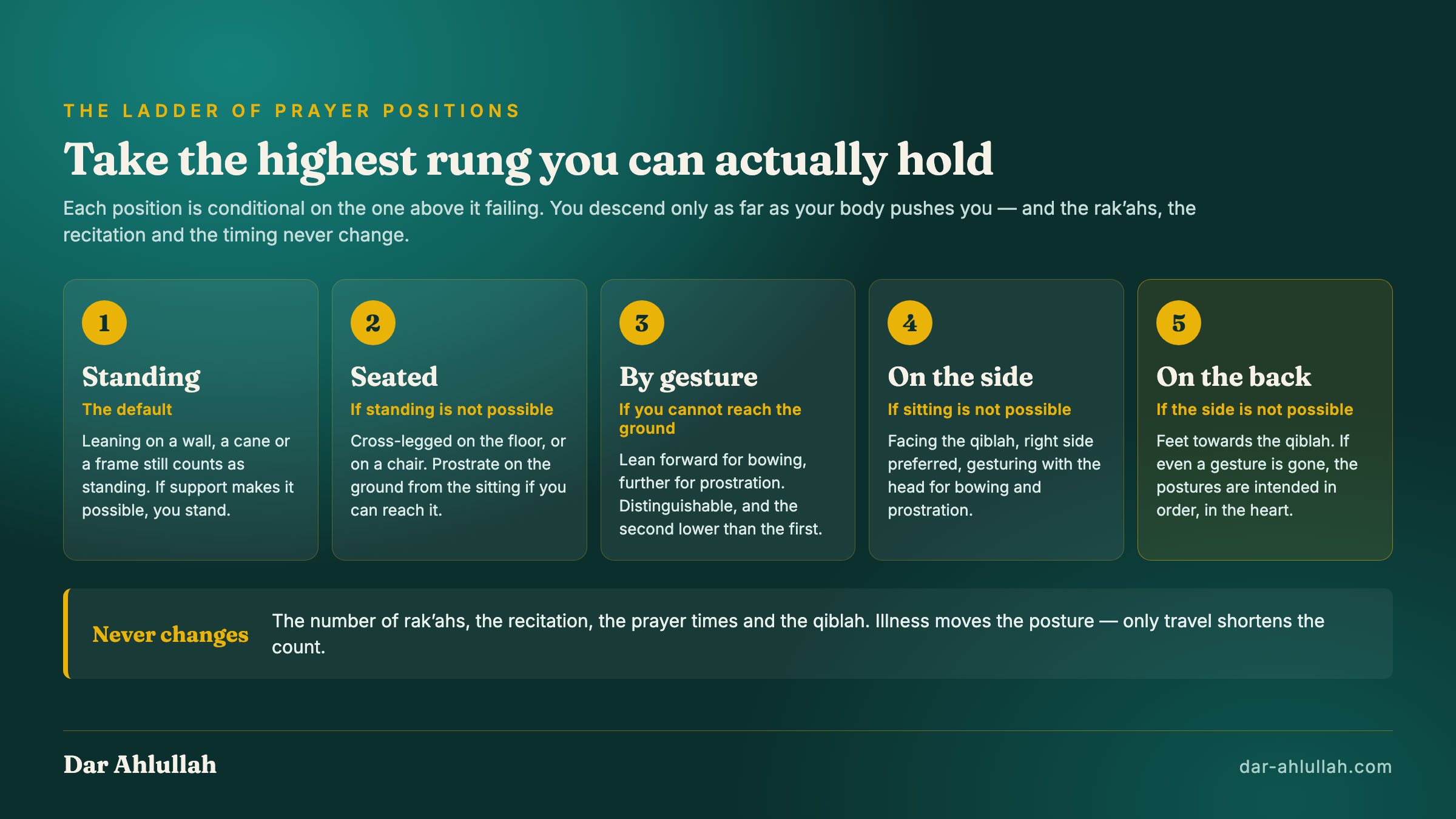
- You never stop praying. Illness moves the prayer down a ladder of positions. It does not remove it, postpone it, or reduce the number of rak’ahs.
- The ladder is explicit. Stand; if you cannot, sit; if you cannot, lie on your side. That order is stated in a single hadith and everything else in this article is a detail hanging off it.
- You take the highest rung you can hold. Not the highest you could survive, and not the most comfortable one available. If you can stand leaning on a wall or a stick, you stand.
- You can be on different rungs within one prayer. Standing for the recitation and seated for the prostration is a normal, valid combination, not a compromise.
- When you cannot bow or prostrate, you gesture, leaning forward as far as you can, and making the gesture for prostration lower than the gesture for bowing.
- The rak’ahs do not change. Dhuhr is still four. Only travel shortens the count, and illness is a different concession entirely.
- The half-reward hadith is not about you. Sitting with a valid excuse is not the case that hadith is describing, and there is a separate hadith about what is written for the person who is ill.
Everything below is that system with the edges filled in.
The Ladder: One Rule, Several Rungs
‘Imran ibn Husayn had haemorrhoids, and he asked the Prophet how he should pray. The answer he received is the entire framework: “Pray while standing and if you can’t, pray while sitting and if you cannot do even that, then pray lying on your side” (Sahih al-Bukhari 1117).
Three things are worth noticing about that answer, because they are the reason this subject is simpler than it looks.
First, it is a sequence, not a menu. Each rung is conditional on the failure of the one above it. You do not choose the position that suits you; you descend only as far as you are pushed.
Second, the man asking was not dying. He had a painful, chronic, undramatic complaint — the sort of thing people today talk themselves out of counting as a real excuse. It counted.
Third, the answer never once suggests postponing or omitting anything. The question was how, and the answer was how. That is the note the whole topic is written in.
Later jurists extended the same logic one rung further for the person who cannot manage even lying on their side: praying on the back, with the feet towards the qiblah. The reasoning is not a new principle, only the same one applied again — and the same principle appears in general form elsewhere in the Sunnah: “if I order you to do something, then do of it as much as you can” (Sahih al-Bukhari 7288). The command is not waived by partial inability. It is scaled to what is left.
And the ladder rests on something stated even earlier, in the Qur’an’s closing verse of Surah al-Baqarah: “Allah does not require of any soul more than what it can afford” (Qur’an 2:286). Capacity is not a loophole inside the law. Capacity is the measure the law is written against.
What “Cannot” Actually Means
This is where nearly all the real confusion lives, because “I cannot stand” sounds like it should mean total physical impossibility, and almost nobody who needs this article is in that state. They are in pain, or dizzy, or exhausted, or afraid of making something worse.
The threshold is lower than most people assume, and it has three separate triggers. Standing is waived when you are genuinely unable to stand, or when standing is severely difficult, or when you are ill and there is a real fear that standing will worsen the illness or delay recovery. As one detailed treatment of the question puts it, “it is not permissible for anyone to pray sitting unless he is unable to stand, or standing is very difficult for him, or he is sick and there is the fear that his sickness may become worse.”
Read that carefully in both directions, because it cuts both ways.
It is permissive in a way people do not expect. Post-operative recovery where standing pulls at stitches, a fever that makes the room tilt, a back injury that turns standing into a countdown, advanced pregnancy complications, chemotherapy fatigue, a dialysis afternoon — none of these require you to be immobile before you may sit. Fear of worsening the condition is itself listed as sufficient. You do not have to prove incapacity to a court. You have to assess your own state honestly.
It is also restrictive in a way people do not expect. Ordinary tiredness is not on the list. A long day, a bad night, or simple reluctance does not move you down a rung in the obligatory prayer. The same discussion offers a usable rule of thumb for the grey zone: the difficulty is real when it is severe enough to take away your khushu’ — when holding yourself upright consumes so much of you that you cannot stay present through the recitation at all.
That test is worth keeping, because it converts an unanswerable question (“is my pain bad enough?”) into an answerable one (“can I actually be in this prayer while standing in it?”). If the standing is eating the prayer, sit down and pray a prayer.
Two practical notes follow from the threshold. Support counts as standing: leaning on a wall, a cane, a walking frame or another person keeps you on the top rung, and if that is what makes standing possible then that is what you do. And the assessment is per prayer, not per illness. Fajr on a bad night and Maghrib after the medication has worked are two different capacities, and you are not locked into the worse one for the duration.
Praying Seated: Exactly What Changes
Here is the part that reassures most people: almost nothing changes.
The number of rak’ahs is untouched. Dhuhr is four, Maghrib is three, Fajr is two. Illness is not travel — the shortening concession belongs to the journey, not to the sickbed, which is why the two are governed by different rules and why our guide to praying while travelling is a separate subject from this one. If you are ill and travelling, the travel rules apply because of the travel, and this ladder applies because of the illness. They stack; neither borrows from the other.
The recitation is untouched. Al-Fatihah, the surah after it, the tasbih of bowing and prostration, the tashahhud — all of it stays exactly as it is. If you are still building that vocabulary, our breakdown of what to say in salah sorts it by obligation tier. Nothing on that list is dropped because you are seated.
The intention, the takbir, the qiblah and the timing are untouched.
What changes is only the geometry. Sitting on the ground, the recommended posture during what would be the standing portion is cross-legged, occupying the place where you would otherwise have stood. For bowing you lean forward from the waist with your hands towards your knees. For prostration, if you can put your forehead to the ground, you do — being seated does not exempt you from actual prostration if actual prostration is available to you. Many people who cannot stand can still prostrate perfectly well, and they should.
If you cannot reach the ground, you gesture, and the one rule that governs the gesture is that the prostration must be lower than the bowing. That distinction is the whole point: it is what keeps two different pillars from collapsing into one identical nod. The instruction given for exactly this case is to lean forward as far as you can for both, and to make the sujud lower than the ruku’.
Between the two prostrations you sit as you would; the sitting is already there. And the tashahhud is entirely unaffected, because you were seated for it anyway.
Praying on a Chair
Chairs are now a normal fixture at the back of most masjids in Europe and North America, and they generate their own small crop of questions.
The first is whether the chair is a step down from sitting on the floor. In principle, floor-sitting cross-legged is the described posture, and it is preferred where it is available. But the whole reason a person is on a chair is usually that getting down to and up from the floor is the very thing they cannot do — and in that case the chair is simply how sitting is achieved. It is not a lesser version of the concession. It is the concession, in the form your knees allow.
The second is where the chair goes in the congregation. The guidance turns on which part of the prayer you are performing in it. If you will be seated for the whole prayer, the seat itself should line up with the row. If you can stand for the standing portions and only use the chair for bowing and prostration, then your standing position is what lines up with the row, because “what matters here is the standing position.” Practically, this is why chairs are often set slightly back with the front legs at the line — and it is also why nobody should be reorganising a row over it mid-prayer.
The third question is the important one, and it is asked far too rarely: should you be sitting for the whole prayer at all? If you can stand, you stand, and you use the chair only for what you genuinely cannot do standing. The rule is unglamorous and consistent: whatever you can do, you are obliged to do; whatever you cannot, is waived. The chair is a tool for the parts that are waived, not a seat you settle into for the duration because it is there.
On the chair itself, the mechanics are the same as floor-sitting. Hands to the knees for bowing. For prostration, hands to the ground if you can reach it, and if not, to your knees, with the lean for prostration deeper than the lean for bowing.
When You Can Stand but Cannot Prostrate
This is the case people most often get wrong, and they get it wrong in the direction of doing less than they are able.
Somebody who can stand without difficulty but cannot get down to the floor — a knee replacement, a spinal condition, late pregnancy, a cast — will very often sit for the entire prayer, on the reasoning that they cannot prostrate so they may as well be seated throughout. That is a rung too far down.
Standing is a pillar of the obligatory prayer in its own right. Inability to prostrate does not waive it. The correct form is to stand for the standing portion and recite standing, then take the seated position for the bowing and the prostration, gesturing for each, with the gesture for prostration lower. The parts you can perform are still owed.
The general principle underneath this is the one already quoted — do of it as much as you can — and it disposes of a surprising number of individual questions. Can you say the takbir but not raise your hands? Say the takbir. Can you recite but not aloud? Recite. Can you prostrate on a cushion but not the floor? Prostrate on the cushion. Inability in one component is not a licence to drop the components either side of it.
At the far end of this, for someone who cannot manage even a gesture — immobilised, in traction, unable to move the head — the prayer still does not lapse. The takbir is said, the recitation is made, and the postures are intended in sequence in the heart: standing, bowing, rising, prostrating, sitting, prostrating again, each in its order, with its words. It is the last rung, and it is still the prayer.
Praying Lying Down
Below sitting comes lying on the side, and this is the rung named explicitly in the hadith of ‘Imran ibn Husayn.
The described position is lying on the side facing the qiblah, with the right side preferred. The prayer is then performed by gesture — the same rule again, prostration lower than bowing — with all the recitation said as normal.
If lying on the side is not possible, the position becomes lying on the back with the feet towards the qiblah, gesturing with the head. Anyone who has been on a hospital ward with a drip in one arm and a monitor on the other has met this case, and it is worth knowing before you meet it, not during.
Two things people worry about here turn out not to be problems. The first is dignity: praying flat on your back in a hospital bed with a nurse walking past feels exposed in a way that praying in a masjid does not, and it is worth naming that the feeling is normal and the prayer is not diminished by it. The second is precision: people ask exactly how far the head should tilt for bowing versus prostration, as if there is a measured angle. There is not. The requirement is that the two are distinguishable and that the second is lower. Do that, and you have done it.
What you do not do is wait. A common and entirely understandable instinct in hospital is to postpone the prayer until you can perform it properly — after the drip is out, after the physiotherapist has been, after you can sit up. But the prayer of the lying position is proper. The window closing while you wait for a better version is a real loss; the gestured prayer inside its time is not.
The Half-Reward Hadith, and Why It Is Not About You
Almost everyone who searches this topic eventually runs into a hadith that stops them cold, and it deserves to be dealt with directly rather than left to do quiet damage.
The same companion, ‘Imran ibn Husayn, also reported: “If he prays while standing it is better and he who prays while sitting gets half the reward of that who prays standing; and whoever prays while lying gets half the reward of that who prays while sitting” (Sahih al-Bukhari 1115).
Read cold, that lands like a penalty on the sick, and it is why some people force themselves through a standing prayer they cannot hold, or come away from a seated prayer feeling they short-changed it.
That is not what the scholarly reading of it says. The case being described is the person praying seated without an excuse — which is permitted in voluntary prayer, where one may sit without excuse but receives half the reward compared to standing. It is not a description of the excused person, for the straightforward reason that the excused person is doing exactly what they were commanded to do. The two hadiths come from the same companion; one is the instruction to sit when you cannot stand, and the other cannot sensibly be read as a fine for obeying it.
And there is a separate, explicit report about what is written for the person who is ill: “When a slave falls ill or travels, then he will get reward similar to that he gets for good deeds practiced at home when in good health” (Sahih al-Bukhari 2996).
Which is the answer to the anxiety underneath the whole question. What you could do when you were well is what is recorded while you are not. The seated prayer of someone who cannot stand is not a reduced prayer. It is the prayer.
Purification When You Are Ill
Wudu is where illness produces the most improvised, invented rulings, usually in the direction of skipping the prayer entirely because the purification looks impossible.
It is not impossible, and there are three separate cases.
You cannot use water. If you are unable to perform wudu with water, or you have a genuine fear that using it will worsen your condition or delay recovery, tayammum replaces it. The ruling is stated plainly: “if the sick person cannot do wudu with water because he is unable to or because he is afraid that it will make his sickness worse or delay his recovery, then he should do tayammum.” It is performed by striking the hands on clean earth and wiping the face and hands, and it remains valid until water becomes usable again.
You have a continuing nullifier. Ongoing incontinence, a permanent leak, chronic bleeding — the class of conditions that would otherwise make wudu impossible to hold long enough to pray. The provision here is that you clean yourself and perform wudu for each prayer after its time has begun, take reasonable measures to contain the problem, and are then excused for what continues during the prayer. The condition does not stop the prayer; it changes the timing of the wudu.
You are bandaged or splinted. Where a limb is covered by a dressing or cast that cannot be removed, the general approach is wiping over the covering in place of washing what is underneath. The details vary between the schools, and a cast over a specific part of a specific limb is precisely the sort of question worth putting to a scholar who can see the situation rather than settling from an article.
Underneath all three is the same principle running through this whole subject, and it produces one hard conclusion: prayer is not abandoned because purification became complicated. The purification is adapted, and the prayer happens. If the ordinary nullifiers themselves are unfamiliar territory, our guide to what breaks wudu sets out the baseline these concessions are departures from.
What Illness Does Not Change
It is as useful to be clear about what stays fixed, because a concession that is allowed to spread turns into a habit that has to be unpicked later.
Illness does not change the number of rak’ahs. It does not change the recitation. It does not remove the obligation to face the qiblah where you are able to be turned towards it. It does not change the prayer times, and it does not create a general permission to combine prayers — the combining concession has its own conditions and its own scholarly discussion, and while a number of scholars do extend it to genuine illness and hardship, that is a specific ruling to seek on your specific situation, not a default that switches on with a temperature.
It also does not change what invalidates a prayer. Speaking mid-prayer, eating, deliberately leaving a pillar — these break a seated prayer exactly as they break a standing one, and our guide to what invalidates salah applies unchanged. The one adjustment worth naming is that tuma’ninah, stillness in each posture, is easy to lose when everything is a gesture. A nod that runs straight into the next nod is not two postures. Pause in each.
And it does not change what to do about mistakes. If you lose count of rak’ahs while unwell — which happens constantly, because medication and fever are not friendly to concentration — the repair is the ordinary one, set out in our guide to what to do if you make a mistake in prayer. The prostrations of forgetfulness are performed by gesture too, on whatever rung you are on.
Illness, Timing, and the Prayers You Lost
Two timing questions come up often enough to deserve their own answers.
The first is sleep and medication. Painkillers, anaesthesia and simple exhaustion will take prayers from you, and the response is the plain one: pray it when you wake, as soon as you are aware of it. A prayer that passed while you were genuinely unconscious is not a sin you incurred; leaving it once you are conscious is a different matter. Where illness has cost you not one prayer but a stretch of them, the method for working through a backlog without either despairing or inventing a number is set out in our guide to making up missed prayers.
The second is prolonged unconsciousness — a coma, a long anaesthetic, a period of genuine absence of awareness. The schools of law diverge here on how much is owed and from what point, and that divergence is real and long-standing rather than a matter of one correct answer that people have failed to look up. If this describes your situation, or a family member’s, that is a question for a scholar with the actual timeline in front of them.
What is worth saying about both is that the anxiety they generate is usually larger than the ruling. People carry the weight of a hospital fortnight for years, having never asked anyone what was actually owed. Asking is short. Carrying it is long.
Four Situations, Worked Through
Recovering from abdominal surgery at home, week one. Standing is possible but pulls; prostration is out of the question. You stand for the recitation, holding the wall if that helps. You sit for the bowing and the prostration, gesturing, prostration lower than bowing. Four rak’ahs for Dhuhr, all of it recited as normal. If wudu is manageable, wudu; if the dressing cannot get wet, wiping over it or tayammum as the case requires. As the days improve, you climb back up the ladder — prostrating on a cushion before prostrating on the floor, and so on.
Influenza, day three, at home. You can stand, but four seconds in the room moves. Test it honestly against the khushu’ question: if standing takes the prayer away from you entirely, sit and pray cross-legged, prostrating on the ground, which you can very likely still do. Full rak’ahs, full recitation. By day five you will probably be standing again, and you should be.
On a hospital ward, cannula in one arm, told not to sit up. Lying on your right side facing the qiblah if you can be positioned that way; on your back with feet towards the qiblah if not. Gesture for bowing and prostration, prostration lower. Recite quietly. Tayammum on a clean surface if water is not reachable, and ask the nursing staff — the request is more ordinary to them than it feels to you. Do not wait for a better version.
Chronic condition, good days and bad days. The assessment is per prayer. Standing on Tuesday morning and seated on Tuesday evening is not inconsistency; it is the rule working correctly. The failure mode here is settling permanently onto the rung that fits your worst day, because it is simpler than reassessing. Reassess.
Six Mistakes People Keep Making
- Skipping prayers to make up later. The single most common one, and the most costly. There is a valid way to pray in almost every state a conscious person can be in. Delay is not one of the concessions.
- Sitting for the whole prayer when only the prostration is the problem. Standing is owed separately. If you can stand, stand for the standing part.
- Forcing a standing prayer out of guilt. The opposite failure. If standing has taken the prayer away from you, you have not gained anything by remaining upright inside it.
- Making bowing and prostration the same gesture. They are two pillars. Distinguish them, prostration lower.
- Reducing the rak’ahs. A conflation with the traveller’s concession. Illness does not shorten anything.
- Staying on the low rung after recovery. A chair that was necessary in March is a habit by June. The assessment is meant to be repeated.
How We Teach This
At Dar Ahlullah we teach Quran, Arabic and the practical fiqh of worship one-to-one and live, and this topic is one of the clearest arguments for why one-to-one matters. A general article can lay out the ladder; it cannot tell you which rung your particular back, or your particular recovery, puts you on this week. That is a conversation, and it is the sort of conversation people are often reluctant to have in a group.
What we do in sessions is the mechanics first, then the reasoning underneath them, then the situations — illness, travel, interruption — where the reasoning has to carry the weight on its own. Every learner starts with a free 30-minute assessment session, with no card required, so a teacher can see where your prayer actually stands before recommending anything. If the fit is not right, you can be matched with another certified mentor at no extra cost, and you can pause, upgrade or switch plans at any time. You can see the full range of programmes on our courses page.
Questions People Ask
Do I have to make up a prayer I prayed sitting down, once I recover?
No. A prayer performed correctly at the level of capacity you had is a complete prayer. There is nothing outstanding to repeat.
Can I pray sitting because I am simply exhausted?
Not for an obligatory prayer. Ordinary tiredness is not one of the three triggers — inability, severe difficulty, or fear of worsening an illness. Voluntary prayers are a different matter, and may be prayed seated without an excuse.
Is a chair worse than sitting on the floor?
Floor-sitting is the described posture where it is available, but for most people using a chair, getting to and from the floor is precisely the thing they cannot do. In that case the chair is how sitting is achieved, and there is nothing deficient about it.
How low should I lean for bowing and prostration?
As far as you comfortably can, with one requirement: the prostration lower than the bowing. There is no prescribed angle. Being distinguishable is the point.
What if I cannot face the qiblah in a hospital bed?
Face it if you can be positioned towards it, and ask the staff if repositioning is possible. If it genuinely is not, you face what you are able to face. The same principle governs the whole subject — what is beyond your capacity is not required of you.
Can I combine prayers because I am ill?
This is a separate concession with its own conditions and a genuine difference of opinion behind it. A number of scholars extend it to real illness and hardship, but it is not automatic and it is worth asking about your specific case rather than assuming it.
My child is unwell. Should they still pray?
The same ladder applies to anyone praying, at any age. For a child, the more useful thing is usually to teach the ladder itself while they are well, so that being ill does not feel like a reason to stop.
Does prostrating on a cushion or a raised object count?
Prostrating on a raised object is generally treated as a step above gesturing, and if you can reach it, it is preferable to gesturing. The order remains: floor if you can, raised surface if you cannot, gesture if you cannot manage that.
I am ill and travelling. Which set of rules applies?
Both, for their own reasons. The travel concessions apply because you are travelling; this ladder applies because you are ill. They do not cancel or extend one another.
Conclusion: Capacity Is the Standard
Reduce the whole subject and one question is left: what can I actually do right now? Not what you could manage last month, not what you can just barely survive if you grit your teeth, and not the least you could get away with. What you can hold.
Answer that honestly and the ladder does the rest. Stand if you can, with support if support is what makes it possible. Sit if you cannot, and prostrate from the sitting if the ground is reachable. Gesture if it is not, prostration lower than bowing. Lie on your side if sitting is gone, and on your back if the side is gone. Recite the whole of it, every rak’ah of it, inside its window.
The instinct that makes people uneasy about all this — that a reduced posture must mean a reduced offering — is answered directly by the report about the one who falls ill: what was written when they were well is written still. The prayer you can perform is not a smaller version of the one you would rather have offered. On the days your body has taken the choice away, it is the whole of it.
Related articles
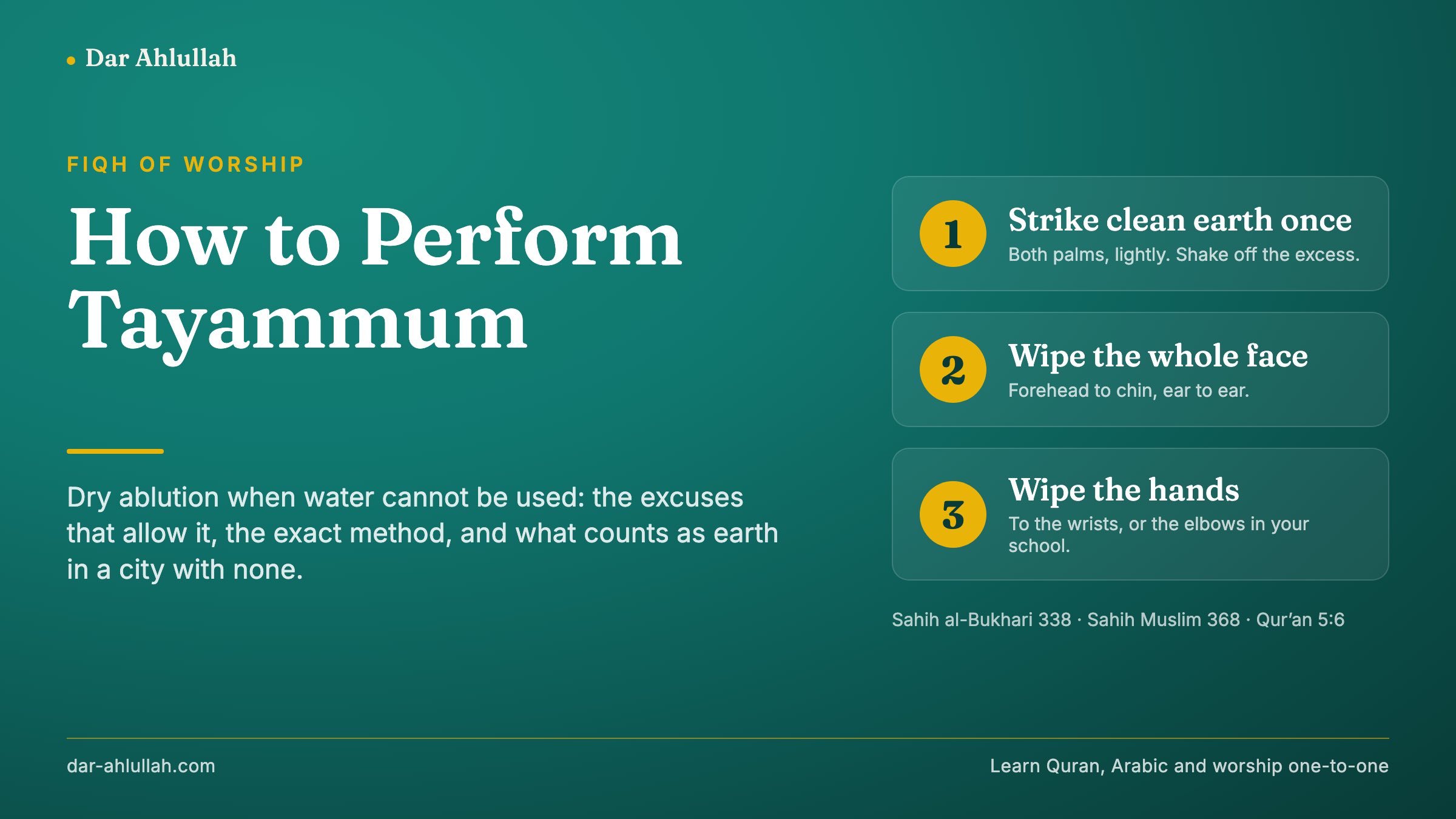
how to perform tayammum
How to Perform Tayammum: Dry Ablution When You Cannot Use Water
Tayammum is the purification you make with earth when water cannot be used. The rule is short: strike clean earth, wipe your face, wipe your hands. The difficulty for a Muslim in Europe or America is everything around the rule: what counts as a real excuse, what counts as earth in a building with none, how long it lasts, and what you do on a plane or in a hospital bed when there is neither water nor dust.
28 min read
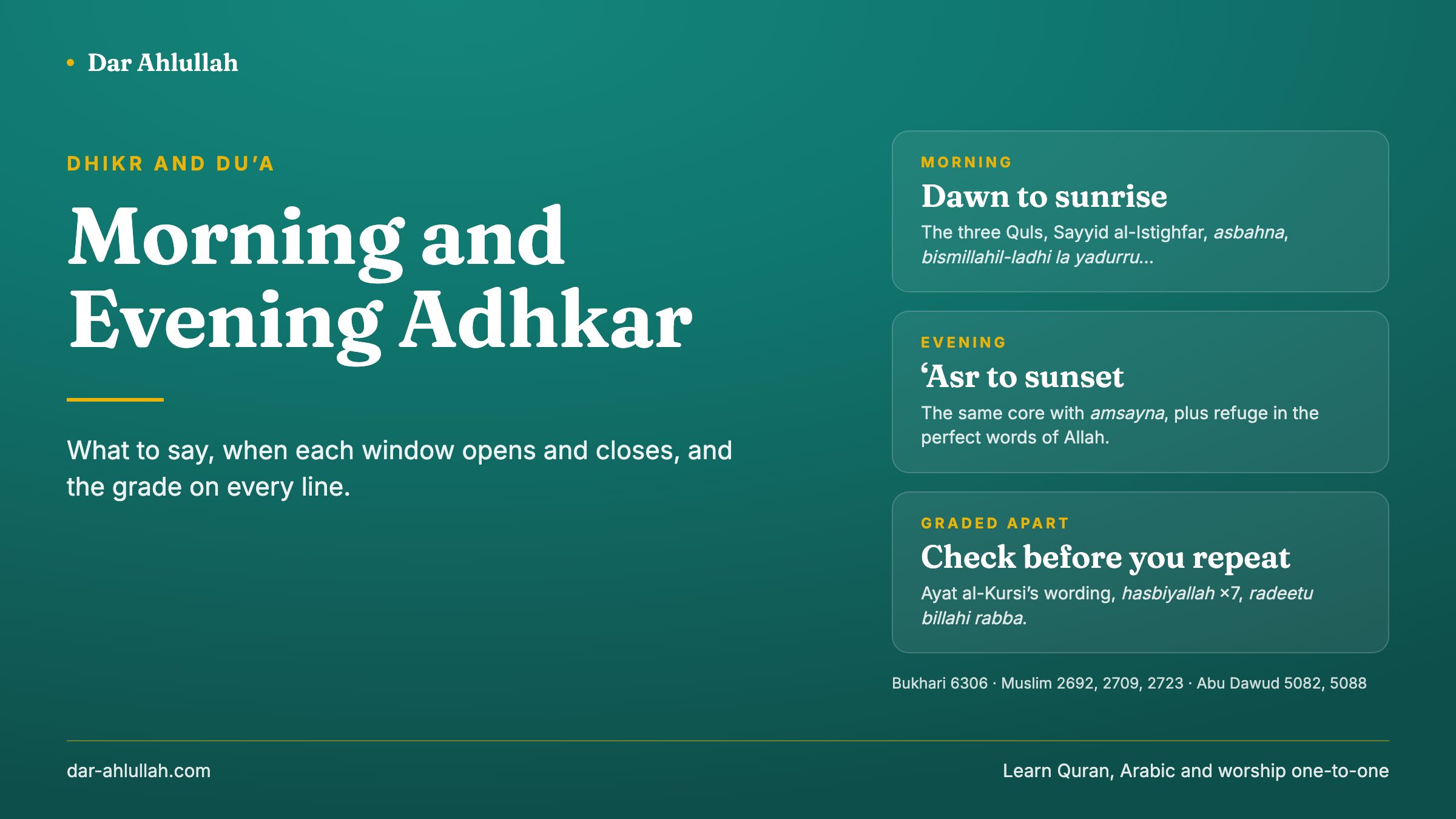
morning and evening adhkar
Morning and Evening Adhkar: What to Say and When
Morning and evening adhkar from the sound reports: the windows from dawn to sunrise and from 'Asr to sunset, the core set with the source and count of each line, and the grade printed on the popular additions the hadith scholars dispute, from Ayat al-Kursi to hasbiyallah seven times.
29 min read
how to respond to the adhan
How to Respond to the Adhan: What to Say and the Dua After
How to respond to the adhan: repeat each phrase after the muezzin, say la hawla wa la quwwata illa billah at the two hayya lines, then send salawat and say the du'a after the adhan. This guide sets out every step from the sound reports, prints the grade on the additions people argue about, and lays out the two scholarly answers on the adhan from a phone app.
29 min read