
how to pray salat al-istisqa
How to Pray Salat al-Istisqa: The Prayer for Rain
Dar Ahlullah team 26 min read
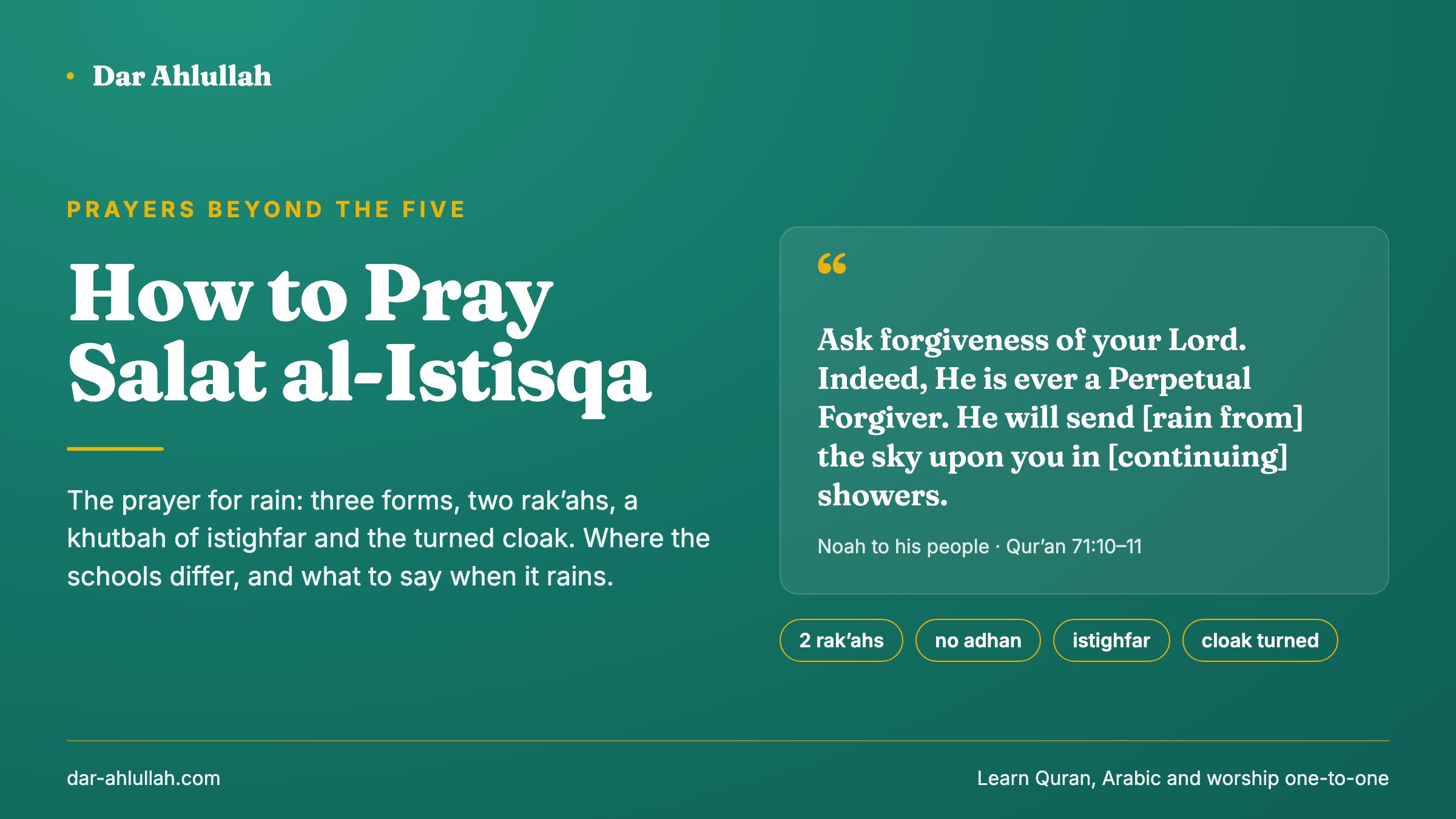
Table of Contents
- Introduction: When Moses Asked for Water
- The Short Answer
- What Istisqa Is, and When It Is Prayed
- Three Ways the Prophet ﷺ Asked for Rain
- Before the Day: Repentance, Charity and Fasting
- How to Pray Salat al-Istisqa, Step by Step
- Where the Four Schools Differ
- The Khutbah: Before the Prayer or After It?
- Turning the Cloak
- The Du‘as for Rain
- When the Rain Comes, and When It Will Not Stop
- Istisqa Where You Live
- Not to Be Confused With
- Six Mistakes People Make
- How We Teach This
- Questions People Ask
- Conclusion: Ask, Then Turn
Introduction: When Moses Asked for Water
The word is older than the prayer. When the Qur’an describes Moses asking Allah for water for the Children of Israel, the verb it uses is istasqa: “And [recall] when Moses prayed for water for his people” (Qur’an 2:60). Salat al-istisqa, the prayer for rain, comes from the same root. It is what a Muslim community does when the rain stops coming: it goes out together, humbled, asks forgiveness, prays two rak’ahs, and asks Allah for water.
Most people who search for it have never seen it prayed. It has no fixed day and no adhan, and it is held only when a drought calls for it, so a Muslim can live for years in a community that never holds one. When a mosque does announce it, the questions come quickly. Is it like the Eid prayer? Does the khutbah come before the prayer or after it? What is everyone doing with their jackets at the end? And if nothing is being organised near you, is there anything you can do on your own?
This guide answers those questions from the hadith and the four schools. It covers the three ways the Prophet ﷺ asked for rain, the full prayer step by step, the points on which the Hanafi, Maliki, Shafi‘i and Hanbali schools differ, the du‘as with their sources and grades, and what the Sunnah says to do when the rain arrives, including when there is too much of it. If you are new to the prayer itself, start with our step-by-step guide to how to pray in Islam; this article sits in its salah library beside the other prayers beyond the five.
One boundary before we begin. We teach Quran, Arabic and the practical fiqh of worship; we are not a fatwa body. Where the scholars differ, as they do on several points here, we set the positions side by side rather than pick one and call it consensus. If your mosque holds an istisqa, follow its imam.
The Short Answer
- Istisqa means asking Allah for water. It is prescribed when rain fails or water sources dry up. The Maliki, Shafi‘i and Hanbali schools call the prayer a confirmed sunnah, and the relied-upon Hanafi position is that it is recommended.
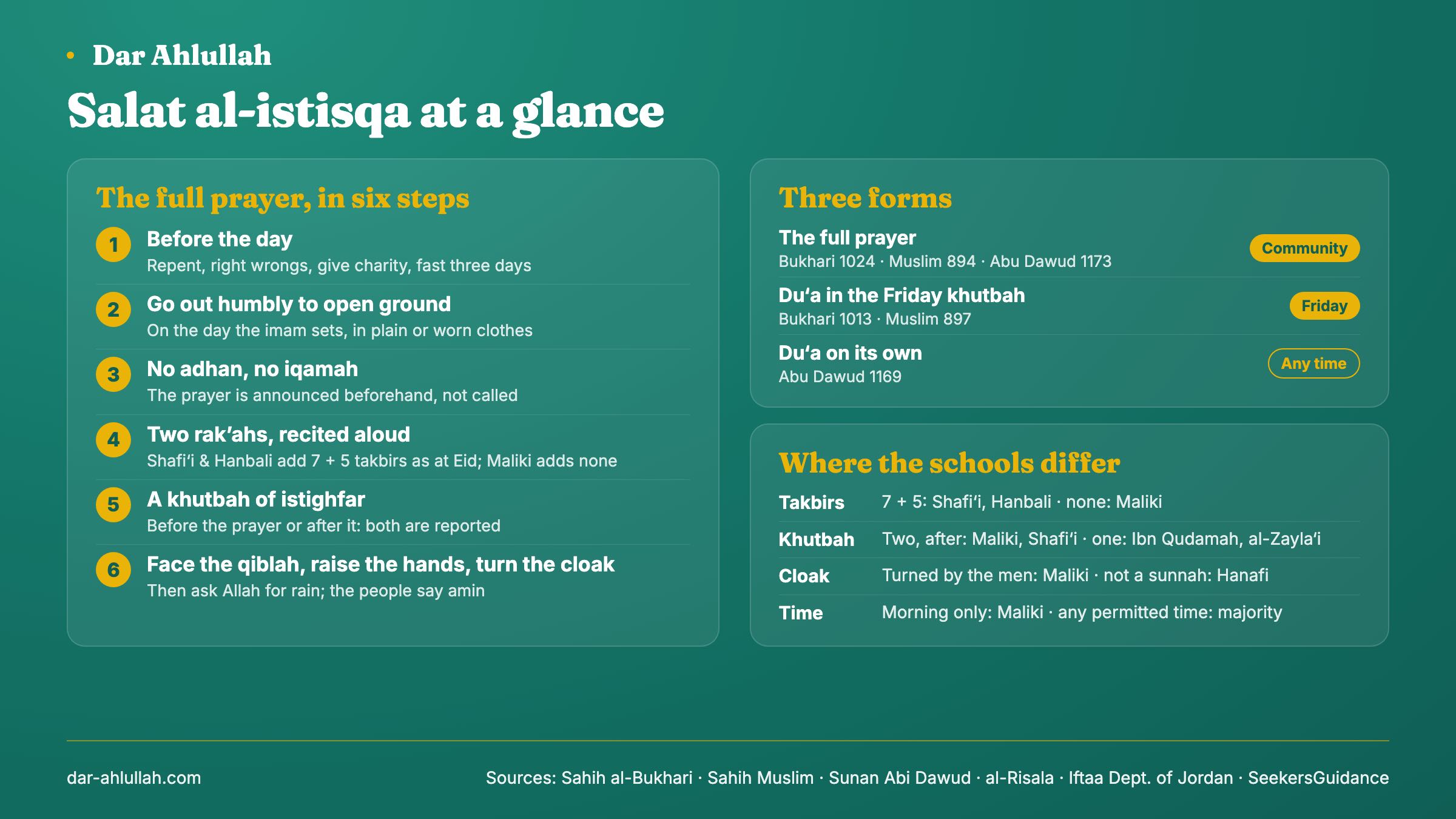
- There are three forms: the full prayer in open ground, a du‘a for rain inside the Friday khutbah, and du‘a on its own at any time. The Prophet ﷺ is reported using all three.
- The prayer is two rak’ahs, recited aloud, with no adhan and no iqamah, prayed in congregation, ideally outside town. The Shafi‘i and Hanbali schools add the seven and five extra takbirs of the Eid prayer; the Maliki school adds none.
- A khutbah built on istighfar goes with it, and the imam faces the qiblah, raises his hands high, turns his cloak inside out and asks for rain. The reports place the khutbah both before and after the prayer, and the schools differ on the order.
- When it rains, say sayyiban nafi‘an, “a beneficial downpour” (Sahih al-Bukhari 1032). When it will not stop, say Allahumma hawalayna wa la ‘alayna, “around us and not upon us” (Sahih al-Bukhari 1014).
What Istisqa Is, and When It Is Prayed
Istisqa is asking Allah for water. The Iftaa Department of Jordan defines it as “seeking water (rain) from Allah (the Most High) during drought and times of low rainfall” and calls it a confirmed sunnah (Iftaa Department of Jordan). A SeekersGuidance answer, citing the Shafi‘i manual al-Fiqh al-Manhaji, gives its cause as “a lack of rain or the drying up of water sources” (SeekersGuidance). It is prayed for a need, not on a calendar.
At its centre is a promise the Qur’an gives in the words of two prophets. Noah told his people: “Ask forgiveness of your Lord. Indeed, He is ever a Perpetual Forgiver. He will send [rain from] the sky upon you in [continuing] showers” (Qur’an 71:10-12). Hud said the same: “ask forgiveness of your Lord and then repent to Him. He will send [rain from] the sky upon you in showers” (Qur’an 11:52). That is why the Maliki Risala replaces the takbir of the Eid sermon with istighfar, why the Shafi‘i imam asks forgiveness nine times in the first sermon and seven in the second, and why the schools tell people to repent before they go out. The founder of the Hanafi school went further and held that istisqa is du‘a and istighfar, with Noah’s words as its basis.
The prayer is also humble in a way no other congregational prayer is. Ibn ‘Abbas, asked how the Prophet ﷺ prayed for rain, said he went out “wearing old clothes in a humble and lowly manner”, ascended the pulpit at the prayer-place but “did not deliver the sermon as you deliver”, stayed in supplication, humility and takbir, and then prayed two rak’ahs “as done on the ‘Id” (Sunan Abi Dawud 1165, hasan per al-Albani; also Jami‘ at-Tirmidhi 558). The Eid prayer is a celebration. This one, in the same place and nearly the same shape, is an appeal.
Three Ways the Prophet ﷺ Asked for Rain
The prayer is only one of the ways. Fiqh us-Sunnah lists three, and the hadith show the Prophet ﷺ using each of them (Fiqh us-Sunnah, Salatul Istisqa).
| Form | What happens | When | The report |
|---|---|---|---|
| The full prayer | The community goes out to open ground. Two rak’ahs, a khutbah, du‘a facing the qiblah with raised hands, and the cloak turned | Any time prayer is permitted, on the majority view; the Maliki school confines it to the morning | Sahih al-Bukhari 1024, Sahih Muslim 894, Sunan Abi Dawud 1173 |
| Du‘a in the Friday khutbah | The imam asks for rain during the Jumu‘ah sermon with his hands raised, and the congregation says amin | Friday | Sahih al-Bukhari 1013, Sahih Muslim 897 |
| Du‘a on its own | Anyone asks Allah for rain, with no prayer attached | Any time | Sunan Abi Dawud 1169 |
The Friday form is the most vivid report in the chapter. Anas describes a man walking into the mosque during the khutbah and saying that the livestock were dying and the roads were cut off. The Prophet ﷺ raised both hands and said three times, Allahumma-sqina, “O Allah, give us rain.” Anas swore there was not a trace of cloud in the sky; then a cloud “like a shield” rose from behind the hill of Sal‘, spread, and rained, and “we could not see the sun for a week” (Sahih al-Bukhari 1013). The du‘a-only form is in the report of Jabir: people came to the Prophet ﷺ weeping from the drought, and he supplicated for rain on the spot (Sunan Abi Dawud 1169, sahih per al-Albani).
IslamQA sets out the practical consequence: “If praying for rain is done by offering supplication (du‘a’) only, it is permissible at any time” (IslamQA 114841). A Hanafi answer on the question puts it the same way from the other side: the Prophet ﷺ “did not always perform the Istisqa’ prayer when seeking rain. He would sometimes only make du‘a for rain (during the khutbah, or after salah, or specifically going outside to do so), while at other times he did perform the salah” (Qibla, via islamqa.org). That sentence is the key to the Hanafi position below, and to what one person can do when no prayer is being held.
Before the Day: Repentance, Charity and Fasting
The preparation is part of the worship. The Hanafi, Maliki and Shafi‘i texts we cite set out much the same programme:
- Repentance, and putting wrongs right. The Jordanian fatwa lists repentance, seeking forgiveness, repaying injustices and reconciling people in dispute. Ibn Abi Zayd’s Maliki Risala has the imam command the people to repent and give up injustice before they go out, “because sins are a cause for misfortunes”, citing Qur’an 42:30 (al-Risala, ch. 19, English commentary). A hadith names one sin in particular: people “do not withhold the Zakah of their wealth, but rain will be withheld from the sky” (Sunan Ibn Majah 4019, hasan per al-Albani).
- Charity. The Risala: “He commanded them to give sadaqa and charity.” The Hanafi answer from SeekersGuidance has the people give charity every day before setting out (SeekersGuidance, Hanafi).
- Fasting. In the Shafi‘i school the people fast for three consecutive days and go out on the fourth while still fasting, “because supplication is more likely to be answered while in that state” (Iftaa Department of Jordan). The Hanafi answer gives the same three days with the fourth for going out, and has them go out on three consecutive days. The Risala: “It is recommended to fast three days before the rain prayer.”
- How you go out. In plain or worn clothes, walking humbly: the Prophet ﷺ went out “wearing old clothes in a humble and lowly manner” (Sunan Abi Dawud 1165). The Hanafi answer adds lowered heads and “reverent fear of their Lord”.
- Who goes. The Hanafi answer recommends that the whole community go out, “the elderly and children” with them, and even the animals. The Risala names the adult Muslims, women who normally go out, and children old enough to understand.
How to Pray Salat al-Istisqa, Step by Step
This is the full prayer as a mosque or community would hold it. Where the schools diverge, the step says so, and the table after this section sets the differences out together.
1. Gather in open ground, on a day the imam has set
The Prophet ﷺ “went to the place of prayer and prayed for rain” (Sahih Muslim 894), the open prayer-ground used for Eid, not his mosque. ‘A’ishah says that when people complained of the drought he had a pulpit set up there and “fixed a day for the people on which they should come out”, and came out himself “when the rim of the sun appeared” (Sunan Abi Dawud 1173, hasan per al-Albani). Shaykh Ibn Baz: the prayer is offered “in the desert (i.e., outside the city) if that is possible, or else in the mosques” (IslamQA 9364). Where a community already prays Eid in a park or a field, that is the natural place; otherwise, the mosque.
2. No adhan and no iqamah
The prayer is announced in advance instead of being called. The Risala: “There is no adhan or iqama for the rain prayer.” When the imam stands, the rows form and he begins.
3. Two rak’ahs, recited aloud
“He faced the Qibla invoking Allah. He turned over his cloak (inside out) and then offered two rak‘at and recited the Qur’an aloud in them” (Sahih al-Bukhari 1024). SeekersGuidance reports no known disagreement, among those who affirm the prayer, that it is two rak’ahs, and that “the various schools of thought agree that the recitation ... should be done aloud, and one may recite any Quranic chapters.” The surahs usually named are al-A‘la in the first rak’ah and al-Ghashiyah in the second, as in the Eid prayer (Fiqh us-Sunnah); the Maliki Risala gives al-A‘la and ash-Shams; SeekersGuidance also mentions Qaf with Nuh, the surah that contains Noah’s promise of rain. Each rak’ah has one bowing and two prostrations like any other prayer, and the prayer ends with the tashahhud and the salam.
4. The extra takbirs, if your school has them
In the Shafi‘i and Hanbali schools the imam adds the takbirs of Eid: seven in the first rak’ah after the opening takbir, and five in the second “apart from the one he says while standing up from the prostration” (Iftaa Department of Jordan; SeekersGuidance, citing Ibn Qudamah’s al-Mughni and al-Nawawi’s al-Majmu‘). Their evidence is Ibn ‘Abbas’s “as done on the ‘Id” and a report from Ja‘far ibn Muhammad from his father that the Prophet ﷺ, Abu Bakr and ‘Umar said seven and five. The Maliki school adds none: “There are no special takbirs in this prayer or in the eclipse prayer” (Risala), because ‘Abdullah ibn Zayd’s report of the two rak’ahs mentions none. Behind an imam, do what he does.
5. The khutbah
The imam addresses the people, and the content is repentance and asking. In the Maliki Risala, “Takbir is replaced with asking forgiveness”, and the imam repeats Noah’s words from Surah Nuh; in the Shafi‘i description he asks forgiveness nine times in the first sermon and seven in the second, and asks for forgiveness and sends blessings on the Prophet ﷺ throughout both. Whether it comes before the prayer or after, and whether it is one sermon or two, is the most visible difference between mosques, and has its own section below.
6. Face the qiblah, raise your hands, turn the cloak, and ask
‘Abdullah ibn Zayd saw the Prophet ﷺ on that day: “He turned his back towards the people and faced the Qibla and asked Allah for rain. Then he turned his cloak inside out” (Sahih al-Bukhari 1025). He raised his hands higher than in any other du‘a, “so much that the whiteness of his armpits became visible” (Sahih al-Bukhari 1031), and Anas reports that he “prayed for rain pointing the back of his hands to the sky” (Sahih Muslim 895b). The congregation stays seated facing the qiblah and says amin to the imam’s du‘a (SeekersGuidance, Hanafi; Risala). Then everyone leaves.
Where the Four Schools Differ
| Question | Positions | Where it is stated |
|---|---|---|
| Is the congregational prayer a sunnah? | Yes, a confirmed sunnah: Maliki, Shafi‘i, Hanbali. Abu Hanifa, in the main transmitted narrations: istisqa is du‘a and istighfar, and the congregational prayer is not a sunnah. His companions Abu Yusuf and Muhammad: two rak’ahs in congregation, followed by a khutbah. The relied-upon Hanafi position, per Ibn ‘Abidin: the prayer is recommended | Risala; Iftaa Department of Jordan; Ibn Qudamah in IslamQA 182416; SeekersGuidance, Hanafi; Qibla |
| Extra takbirs as in Eid? | Seven and five: Shafi‘i, Hanbali. None, like any voluntary prayer: Maliki | SeekersGuidance; Iftaa Department of Jordan; Risala |
| How many khutbahs, and where? | Two, after the prayer, as at Eid: Maliki, Shafi‘i. One khutbah: the reading of Shams al-Din Ibn Qudamah (Hanbali) and al-Zayla‘i (Hanafi), as reported by Muhammadiyah’s fatwa council, which places it after the prayer and allows it before on the basis of ‘A’ishah’s report | Risala; Iftaa Department of Jordan; Muhammadiyah Tarjih |
| Is the cloak turned? | Yes, by the imam standing and the men seated, not the women: Maliki. Not a sunnah for the imam or the followers: Hanafi | Risala; SeekersGuidance, Hanafi |
| What time? | Morning until the sun passes its height, and no other time: Maliki. Any time except the times when prayer is disliked, best at the time of the Eid prayer: Ibn Qudamah (Hanbali). Any time, even the disliked times, because it is a prayer with a reason: Mughni al-Muhtaj (Shafi‘i), though al-Nawawi records two views on the disliked times | Risala; IslamQA 114841, quoting al-Mughni, al-Majmu‘ and al-Mawsu‘ah al-Fiqhiyyah; Iftaa Department of Jordan |
Abu Hanifa’s position is the one most often misreported, sometimes as a refusal of the Sunnah. The Hanafi texts say something narrower. Istisqa, in his view, is du‘a and asking forgiveness, based on Noah’s words in Qur’an 71:10-11 and on the Friday report in which the Prophet ﷺ asked for rain with no prayer at all (SeekersGuidance, citing al-Quduri and al-Kasani). The Hanafi scholars then differed over what he meant. Ibn al-Humam suggested the hadith of the prayer had not reached him; al-Quduri wrote that he did not endorse a group prayer but allowed an individual one; al-Marghinani, author of al-Hidayah, read him as saying that the congregational prayer is not an emphasised sunnah while still being permitted or even recommended. Ibn ‘Abidin concluded that it is recommended, and the Qibla answer calls that “the relied-upon conclusion in the Hanafi madhhab”. A Hanafi mosque that holds the two rak’ahs is following its own school.
On time, the prohibited windows are the same ones that apply to every voluntary prayer: after Fajr until the sun has risen, when the sun is at its height, and after ‘Asr until it sets. The general question of whether a prayer with a reason may be prayed in them is set out school by school in our guide to tahiyyat al-masjid. For istisqa it rarely matters in practice: a community that sets a day usually chooses a morning, as the Prophet ﷺ did when he came out “when the rim of the sun appeared”.
The Khutbah: Before the Prayer or After It?
Different mosques will do this differently, and both can point to a report. Here are the reports and what order each gives.
| Report | Order | Where it is, and its grade |
|---|---|---|
| ‘Abdullah ibn Zayd: he faced the qiblah asking Allah for rain, turned his cloak, “and then offered two rak‘at” | Du‘a first, then the prayer | Sahih al-Bukhari 1024, 1025 |
| Ibn ‘Abbas: he ascended the pulpit, gave no sermon “as you deliver” but supplicated, humbled himself and said takbir, then prayed two rak’ahs | Du‘a first, then the prayer | Sunan Abi Dawud 1165, hasan per al-Albani; Jami‘ at-Tirmidhi 558, hasan per al-Albani and Ahmad Shakir |
| ‘A’ishah: he sat on the pulpit, praised Allah, spoke of the drought, made du‘a with his hands raised, turned his back and his cloak, “then faced the people, descended and prayed two rak’ahs” | Khutbah first, then the prayer | Sunan Abi Dawud 1173, hasan per al-Albani and al-Arna’ut; Abu Dawud called it gharib with a sound chain |
| Abu Hurayrah: he prayed two rak’ahs without adhan or iqamah, “then he addressed us and supplicated”, faced the qiblah and turned his cloak | The prayer first, then the khutbah | Sunan Ibn Majah 1268, da‘if per al-Albani, Muhammad Fu’ad ‘Abd al-Baqi and Zubair ‘Ali Za’i |
Other versions of ‘Abdullah ibn Zayd’s report list the prayer and the turning of the cloak joined by a plain “and”, which does not settle the order (Sahih al-Bukhari 1027). The Maliki and Shafi‘i schools place two khutbahs after the prayer, modelled on Eid; the Muhammadiyah council holds one khutbah after the prayer and allows it before, on ‘A’ishah’s report. The one report that explicitly puts the prayer first and the sermon after is graded weak. If you are organising an istisqa, follow the order your scholars teach. If you are attending one, the order is the imam’s call, and each order has a report behind it.
Turning the Cloak
This is the part people remember, and the part that looks strangest to someone seeing it for the first time. The imam, facing the qiblah, takes the upper garment he is wearing, the rida’, and turns it so that what was on the right is now on the left. In one narrator’s wording of ‘Abdullah ibn Zayd’s report, the Prophet ﷺ “put the right side of his cloak on his left side” (Sahih al-Bukhari 1027); Sahih Muslim has him turning it “while facing the Qibla” (Sahih Muslim 894).
Why. The Risala’s commentary says it is done “to indicate the change of their state from hardship to ease”: the garment turned over as a hope that Allah will turn the drought over.
When. At the moment the imam does it, not before. Shaykh Ibn Baz: the cloak “should be worn as normal, and it should be turned inside out during the khutbah when the imam turns his rida’ inside out. With regard to turning the rida’ or ‘abayah inside out before that, the more correct view is that this is not prescribed and is contrary to the Sunnah” (IslamQA 26108).
How. Right to left and left to right, not upside down. The Risala: “He does not turn it upside down”, because that is not reported from the Prophet ﷺ or anyone after him. In the Maliki description the imam turns his standing and the congregation turns theirs sitting.
Who. In the Maliki school, the men do what the imam does, “if they have cloaks”; the women do not. In the Hanafi school it is not a sunnah for anyone. If you are wearing nothing that corresponds to a cloak, the Maliki text’s “if they have cloaks” already covers you.
The Du‘as for Rain
You may ask for rain in your own words, in any language, outside the prayer. These are the words reported from the Prophet ﷺ, with the grade of each.
| The words | Meaning | Source and grade |
|---|---|---|
| Allahumma-sqina, Allahumma-sqina, Allahumma-sqina | O Allah, give us rain (three times) | Sahih al-Bukhari 1013, in the Friday khutbah |
| Allahumma-sqina ghaythan mughithan, mari’an, muri‘an, nafi‘an ghayra darr, ‘ajilan ghayra ajil | O Allah, give us rain that rescues us, wholesome and fertile, beneficial and not harmful, now and not later | Sunan Abi Dawud 1169: sahih per al-Albani, hasan per al-Arna’ut |
| Allahumma anta Allahu la ilaha illa ant, al-ghaniyyu wa nahnu al-fuqara’. Anzil ‘alayna al-ghayth, waj‘al ma anzalta lana quwwatan wa balaghan ila hin | O Allah, You are Allah, there is no god but You, the Rich, and we are the poor. Send down the rain upon us, and make what You send down a strength for us and a provision for a time | Sunan Abi Dawud 1173: hasan per al-Albani and al-Arna’ut. It follows praise taken from al-Fatihah |
| Allahumma-sqi ‘ibadaka wa baha’imaka, wanshur rahmataka, wa ahyi baladaka al-mayyit | O Allah, give water to Your servants and Your animals, spread Your mercy, and give life to Your dead land | Sunan Abi Dawud 1176: hasan per al-Albani; da‘if per al-Arna’ut and Zubair ‘Ali Za’i |
The last one is widely quoted, and the Maliki Risala cites it among the imam’s du‘as; its grading is split, so it is printed here with both. Raise your hands for these, high, and if you want to follow Anas’s report exactly, with the backs of the hands toward the sky.
When the Rain Comes, and When It Will Not Stop
The Sunnah does not end when the prayer does. It has words for the rain itself.
- When you see it raining: sayyiban nafi‘an, “a beneficial downpour” (Sahih al-Bukhari 1032). Another version has Allahumma sayyiban hani’an, “O Allah, a wholesome downpour”, and adds that when he saw clouds forming he would leave what he was doing, even a prayer, and seek refuge in Allah from their harm (Sunan Abi Dawud 5099, sahih per al-Albani).
- Let some of it fall on you. Anas: it rained, and the Prophet ﷺ uncovered part of his body until the rain fell on it. Asked why, he said: “It is because it has just come from the Exalted Lord” (Sahih Muslim 898).
- Ask while it falls. A hadith of Sahl ibn Sa‘d names two du‘as that are not rejected, “du‘a at the time of the call to prayer and du‘a at the time of rain”; IslamQA gives it from al-Hakim’s Mustadrak and notes al-Albani’s sahih grading (IslamQA 195085).
- When there is too much. The next Friday a man came in during the khutbah again (Anas did not know whether it was the same one) and asked the Prophet ﷺ to pray for the rain to be held back; in another version, “The houses have collapsed and the livestock are drowned” (Sahih al-Bukhari 1033). The Prophet ﷺ raised his hands again and said: Allahumma hawalayna wa la ‘alayna. Allahumma ‘ala al-akami wa al-zirabi wa butuni al-awdiyati wa manabiti al-shajar, “O Allah, around us and not upon us. O Allah, on the plateaus, the hills, the valleys and the places where trees grow.” “The rain stopped and we came out, walking in the sun” (Sahih al-Bukhari 1014). He did not ask for the rain to end, only for it to fall where it would do good. Nothing in the report adds a prayer for this; it is a du‘a.
- Thunder. IslamQA knows of no du‘a for thunder or lightning from the Prophet ﷺ himself. From his Companion ‘Abdullah ibn al-Zubayr it is reported that on hearing thunder he would stop speaking and say: Subhan alladhi yusabbihu ar-ra‘du bi-hamdihi wal-mala’ikatu min khifatih, “Glory be to the One whom the thunder glorifies with His praise, and the angels too, in awe of Him”, echoing Qur’an 13:13 (al-Bukhari’s al-Adab al-Mufrad 723 and Malik’s Muwatta’, isnad sahih per al-Nawawi and al-Albani, via IslamQA 195085).
- Who gave it. After a night of rain at al-Hudaybiyah the Prophet ﷺ told the Companions that Allah had said: some of My servants woke as believers and some as disbelievers. “Whoever said that the rain was due to the Blessings and the Mercy of Allah had belief in Me ... and whoever said that it rained because of a particular star had no belief in Me” (Sahih al-Bukhari 846).
Istisqa Where You Live
Most of the classical texts assume a ruler who calls the people out. Muslims in Europe, North America or Australia do not have one, and the prayer can still be held. Shaykh Ibn Baz: “If the people of a city are not ordered by their ruler to offer the Eid prayers or prayers for rain, then it is prescribed for them to offer the Eid prayer and prayers for rain in the desert (i.e., outside the city) if that is possible, or else in the mosques” (IslamQA 9364). In practice that means the mosque organises it.
- If your mosque announces an istisqa, go, fasting if the announcement asks for it, in plain clothes, having given some charity. Follow the imam on the takbirs, the order of the khutbah and the cloak; those are the points on which his school and yours may differ, and you have seen above that each is defensible.
- If nothing is organised, the du‘a is open to you at any time, in your own words or in the words above. The Hanafi scholar al-Quduri, as the Qibla answer reports, read Abu Hanifa as allowing an individual prayer for rain even while he did not endorse the group one.
- On a Friday, the second form is available: the imam can ask for rain in the khutbah with the congregation saying amin, exactly as in Sahih al-Bukhari 1013. If there is a drought where you live, that is a reasonable thing to ask your imam to do.
Checking the forecast does not conflict with any of this. Asked whether weather forecasting counts as astrology or claiming knowledge of the unseen, IslamQA quotes the Standing Committee: forecasting “is based on knowledge of the natural laws of Allaah”, made “on the basis of likelihood, not certain knowledge”, and Shaykh Ibn ‘Uthaymin that predicting what can be calculated is not fortune-telling (IslamQA 83837). The Hudaybiyah hadith is about who is credited for the rain, not about knowing that it is coming.
Not to Be Confused With
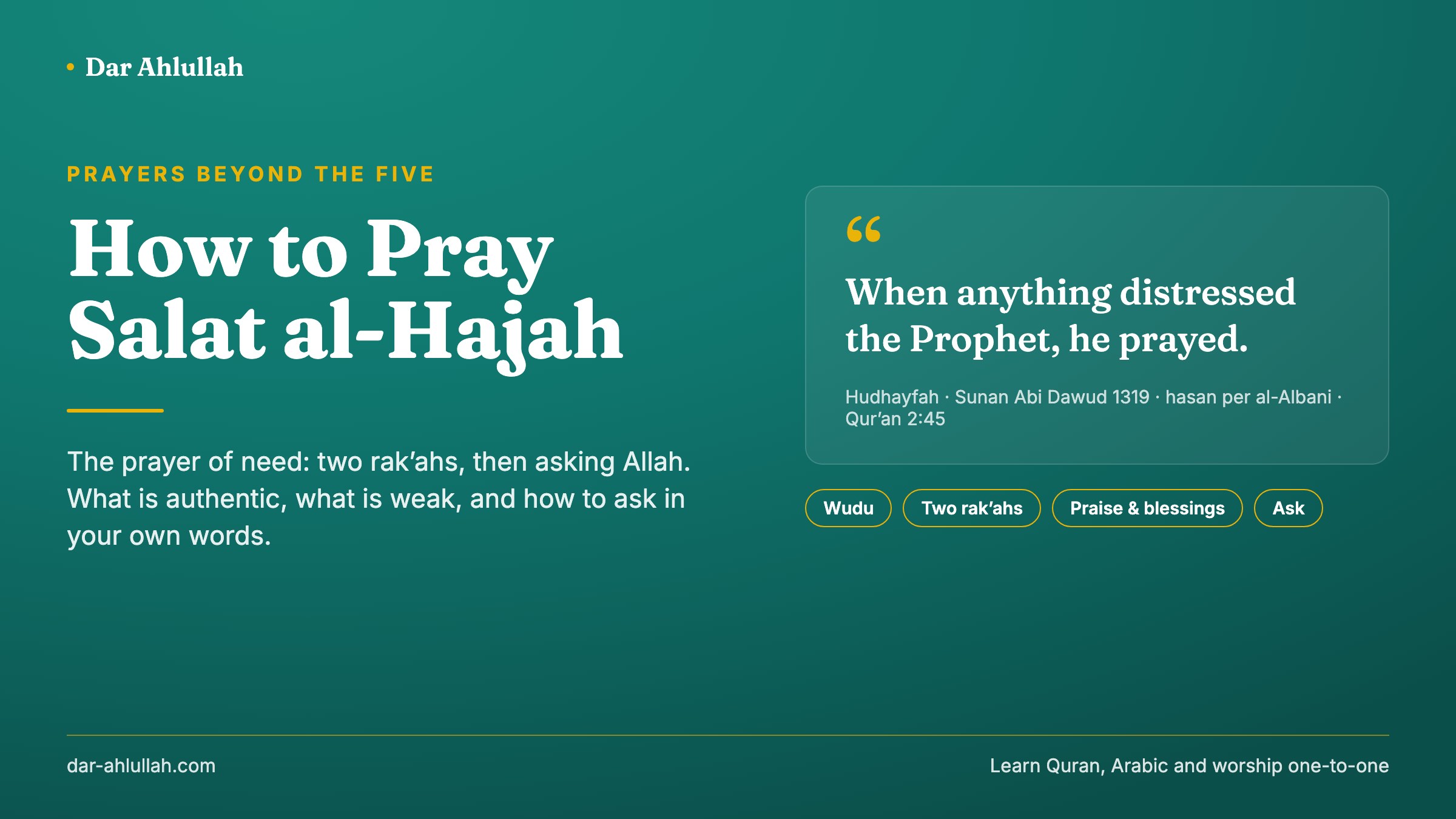
- Salat al-hajah. The prayer of need is one person’s prayer, two rak’ahs and then your own du‘a, for whatever you need. Istisqa is a community’s prayer for one need. See our guide to how to pray salat al-hajah, which also sets out why its main hadith is disputed.
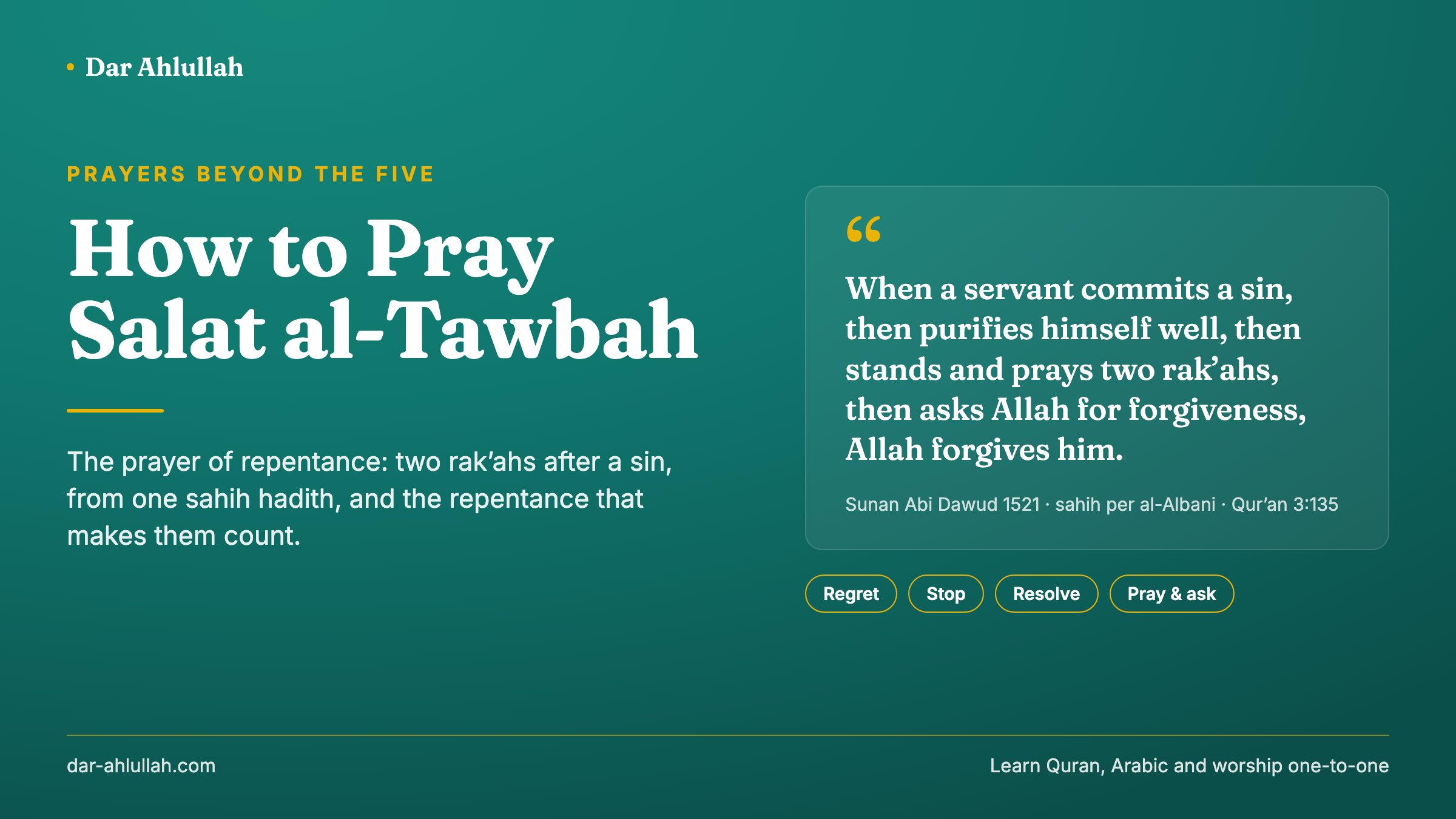
- Salat al-tawbah. The prayer of repentance is prayed after a sin. Istisqa carries repentance inside it, because Noah’s promise ties rain to istighfar, but it is prayed for rain. See how to pray salat al-tawbah.
- The Eid prayer. Same prayer-ground, and in the Shafi‘i and Hanbali description the same two rak’ahs with seven and five takbirs. Ibn Qudamah says istisqa “resembles the Eid prayer in the place and manner in which it is done” (IslamQA 114841). But Eid is a celebration on a fixed day, and istisqa is an appeal on a day the imam sets, in worn clothes.
- The eclipse prayer. Also a congregational prayer for something happening in the sky, but each of its rak’ahs has two bowings and two long standings (Sahih al-Bukhari 1044). The Risala notes that istisqa has one bowing in each rak’ah “to avoid being like the eclipse prayer”.
- Salat al-janazah. The other communal prayer outside the five that most people meet only occasionally. It is prayed standing, with no bowing and no prostration; istisqa is an ordinary two rak’ahs. See how to pray salat al-janazah.
Six Mistakes People Make
- Thinking the prayer is the only way to ask for rain. The Prophet ﷺ also asked for rain in the Friday khutbah and with du‘a alone. If no prayer is being held, the du‘a is still yours, at any time.
- Turning the cloak early. The cloak is worn normally and turned when the imam turns his. Ibn Baz: turning it before that “is not prescribed and is contrary to the Sunnah.”
- Turning it upside down. The turn is right to left, as in Sahih al-Bukhari 1027. The Risala says outright that it is not turned upside down.
- Calling the adhan or the iqamah. There is none. The day and time are announced beforehand.
- Saying the Hanafis “do not believe in it”. Abu Hanifa held that istisqa is du‘a and istighfar, on the basis of the Qur’an and an authentic hadith, and the relied-upon position of his school is that the congregational prayer is recommended.
- Crediting the rain to anything but Allah. Check the forecast by all means. When the rain comes, say what the Companions were taught to say: it fell by the bounty and mercy of Allah.
How We Teach This
Salat al-istisqa is rare enough that you can pray five times a day for years without standing in one, which is exactly why a clear picture of it beforehand matters. It asks for the same things as every prayer: a solid knowledge of the rak’ah itself, recitation clear enough to be read aloud, and enough Arabic to mean the du‘as rather than just pronounce them. Fiqh basics, the prayer among them, are part of our Islamic Studies course for children and teens, and the Quran and Arabic courses build the recitation and understanding behind every du‘a in this article, one-to-one.
Dar Ahlullah runs one-to-one live sessions with certified teachers, at times that work in your timezone. Teaching is charged at $9 per teaching hour, with monthly plans at $36, $70 and $102 depending on how many hours you want, and a 20% discount for siblings. You can pause, upgrade or switch plans at any time, and if a teacher is not the right fit we rematch you with another certified mentor at no extra cost. If you would like to see where your prayer and recitation stand before committing to anything, the 30-minute assessment is free and does not ask for a card. The details are on our pricing page.
Questions People Ask
What is salat al-istisqa?
The prayer for rain: two rak’ahs prayed in congregation, usually in open ground, with a khutbah of istighfar and du‘a, when rain fails or water sources dry up. The Prophet ﷺ prayed it at the prayer-ground with his cloak turned and his hands raised (Sahih al-Bukhari 1027, 1031).
How many rak’ahs is the rain prayer?
Two, recited aloud. The Shafi‘i and Hanbali schools add seven takbirs in the first and five in the second, as at Eid; the Maliki school adds none.
Is there an adhan or iqamah for salat al-istisqa?
No. The day is announced in advance, and the imam begins when the rows are formed.
Is the khutbah before or after the prayer?
Both are reported. ‘A’ishah’s report (Sunan Abi Dawud 1173, hasan) puts the khutbah first; the Maliki and Shafi‘i schools put two khutbahs after the prayer, as at Eid. Follow your imam.
What time is salat al-istisqa prayed?
On the majority view, any time outside the prohibited windows, best in the morning like the Eid prayer. The Maliki school limits it to the morning, until the sun passes its height. The du‘a for rain, without the prayer, has no time limit at all.
Can I pray salat al-istisqa alone?
The reports describe a congregational prayer. On your own you can always make the du‘a for rain, and al-Quduri reports that Abu Hanifa allowed an individual prayer for it.
Do women turn their cloaks?
In the Maliki school, no: the men turn theirs, seated, if they have cloaks. In the Hanafi school nobody does, because it is not a sunnah there for the imam or the followers.
What is the du‘a for rain?
Allahumma-sqina ghaythan mughithan, mari’an, muri‘an, nafi‘an ghayra darr, ‘ajilan ghayra ajil: “O Allah, give us rain that rescues us, wholesome and fertile, beneficial and not harmful, now and not later” (Sunan Abi Dawud 1169, sahih per al-Albani).
What do I say when it starts raining?
Sayyiban nafi‘an, “a beneficial downpour” (Sahih al-Bukhari 1032). It is also a time to make du‘a, and the Prophet ﷺ let some of the rain fall on him (Sahih Muslim 898).
What is the du‘a to stop heavy rain?
Allahumma hawalayna wa la ‘alayna, “O Allah, around us and not upon us”, followed by the places where rain does good: the plateaus, hills, valleys and places where trees grow (Sahih al-Bukhari 1014).
Is istisqa only for a drought?
Its cause is a lack of rain or the drying up of water sources, which is how the Shafi‘i manual cited by SeekersGuidance defines it. It is not prayed on a schedule or for rain in general.
Conclusion: Ask, Then Turn
Take away the questions of order and the prayer is simple enough to carry in your head. Repent first, and put right what you can. Go out plainly dressed. Pray two rak’ahs aloud. Listen to a khutbah of istighfar and du‘a. Then face the qiblah with your hands raised higher than you raise them for anything else, turn your cloak when the imam turns his, and ask Allah for water with the Prophet’s words or your own.
The schools differ on the takbirs, the sermon and the cloak, and each can point to a report. What none of them differs on is the promise in Surah Nuh: ask forgiveness, and He will send the rain. If you want the rest of the prayer in the same detail, the salah library links every guide we have written on it, including the other prayers with a cause, such as salat al-hajah and istikhara.
Related articles
how to pray salat al-hajah
How to Pray Salat al-Hajah: The Prayer of Need
Salat al-hajah is two rak'ahs prayed when you need something, then asking Allah for it. The four reports behind it and their grades, the method step by step, du'as with sound chains, asking in English inside the prayer by school, and what to do when the answer is slow.
25 min read
how to pray salat al-tawbah
How to Pray Salat al-Tawbah: The Prayer of Repentance
Salat al-tawbah is two rak'ahs after a sin, taught in one sahih hadith. The method, what to say in sujud and after the salam, the forbidden-times question by school, praying it again after a relapse, sins against people, and what a new Muslim owes for the past.
25 min read
how to pray salat al-tasbih
How to Pray Salat al-Tasbih: The Prayer of Glorification
Salat al-tasbih is four rak'ahs with one phrase of praise said 300 times, 75 in each rak'ah. The reports behind it and their grades, the scholars on both sides, the method position by position, the two reported orders of the counts, and what to do if you lose count.
22 min read