
prayer times at high latitude
Prayer Times at High Latitude: Isha and Fajr in the Northern Summer
Dar Ahlullah team 20 min read
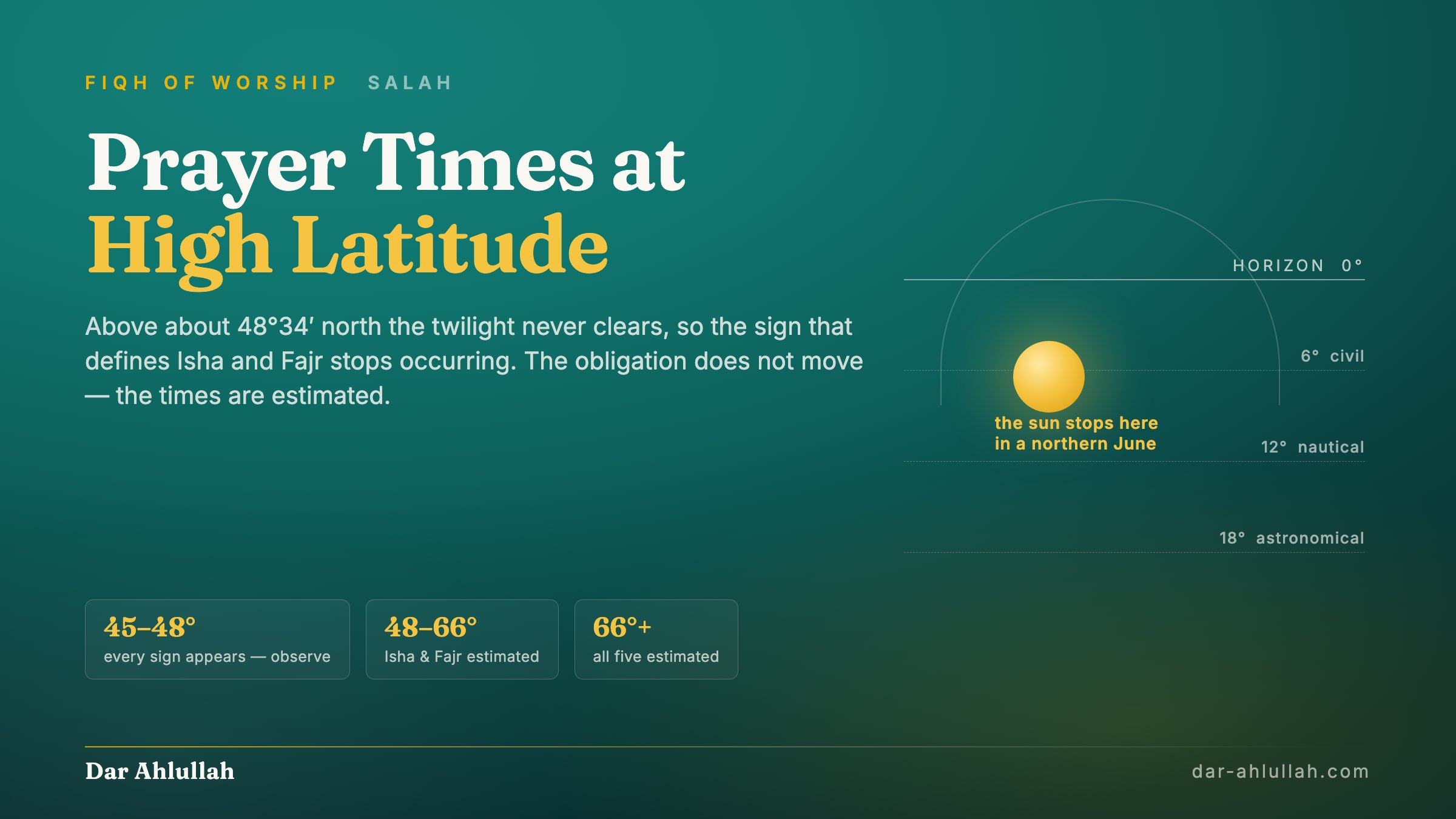
Table of Contents
- Introduction: The Night That Never Gets Dark
- The Short Answer
- Why It Happens: The Astronomy in Four Lines
- Who This Actually Affects
- The Rule That Does Not Move: Five, Every Twenty-Four Hours
- The Three Bands: The 1986 Ruling
- The Four Methods of Estimation
- Your Prayer App Already Chose for You
- Which Method Should You Follow?
- Winter: The Same Problem Upside Down
- What This Does Not Change
- Four Situations, Worked Through
- Six Mistakes People Keep Making
- How We Teach This
- Questions People Ask
- Conclusion: The Sign Moved, the Obligation Did Not
Introduction: The Night That Never Gets Dark
It is the third week of June. The sun went down over Manchester at ten past ten, and at half past eleven the sky is still the colour of weak tea. You open the prayer app for Isha and it gives you 00:52. Your brother’s app, on the same sofa, says 23:10. The mosque two streets away has announced Isha at 23:00 all month. In the WhatsApp group somebody has posted a screenshot of a fatwa and somebody else has posted a different one.
None of these people is being careless. The disagreement is real, it is old, and it is not really about the app. At your latitude, for several weeks a year, the sky sign that defines the start of Isha and the start of Fajr does not occur. Not “is hard to see through the light pollution” — does not occur. The sun does not go far enough down. And when the sign a ruling is attached to stops appearing, jurists have to say what to do instead, which is exactly what they did, in writing, decades ago.
This article is about that. What is astronomically happening, what the fiqh says about it, what the four recognised estimation methods actually are, why your phone silently picked one of them for you, and how to stop the June argument from recurring every year.
One boundary before we start. We teach Quran, Arabic and the practical fiqh of worship; we are not a fatwa body, and this is a subject where a genuine, respectable difference of opinion produces clock times more than an hour apart. Where that happens we will name the disagreement rather than pick a side and dress it up as consensus. If you are still assembling the prayer itself, our complete guide to salat covers the sequence and the timings in the ordinary case; and if worship as a whole is new to you, the order to learn it in is mapped out in our guide to your first 90 days in Islam.
The Short Answer
- Five prayers in every twenty-four hours. Always. The count never collapses, however strange the sky gets. This is the one fixed point in the whole subject.
- Where the sign still appears, you use it — no matter how long or short the day is. A nineteen-hour day is not a problem to be solved. It is just a long day.
- Above roughly 48°34′ north, the sign for Isha disappears for part of the summer, and Fajr with it. Those two times then have to be estimated, and there are four recognised ways of doing the estimating.
- Above the Arctic Circle, at 66°34′, the sun itself stops setting for weeks. Then everything is estimated, from the times at a moderate latitude.
- The method is a community decision, not a personal preference. Follow what your local mosque follows.
- Your prayer app has already made this decision on your behalf, in a settings menu you have probably never opened.
Why It Happens: The Astronomy in Four Lines
Maghrib is easy. The sun crosses the horizon; you can see it happen; the time is unambiguous anywhere on earth where the sun sets at all. Dhuhr and Asr are shadow-based and equally well behaved. The trouble is entirely with the two prayers at the edges of the night, because Fajr and Isha are not defined by where the sun is on the horizon. They are defined by how far it has gone below it — by twilight.
Astronomers slice twilight into three bands, and the numbers matter here. Civil twilight runs while the sun is between the horizon and 6° below it; nautical twilight from 6° to 12° below; astronomical twilight from 12° to 18° below. Past 18°, the sky is as dark as it is going to get.
The prayer-time conventions used around the world sit inside that range. The Muslim World League places Fajr at 18° and Isha at 17°; the Islamic Society of North America uses 15° for both; the Egyptian General Authority of Survey uses 19.5° and 17.5°; Karachi uses 18° and 18°; Umm al-Qura uses 18.5° for Fajr and a fixed 90 minutes after Maghrib for Isha. Different bodies, different angles, all of them somewhere in the twilight band.
Now the geometry. Around the summer solstice the sun’s path is tilted such that, above a certain latitude, it simply never descends 18° below the horizon at any point in the night. That latitude is approximately 48°34′ north or south, and above it, astronomical twilight lasts from sunset to sunrise. Go further north and even the 12° mark stops being reached: between about 54°34′ and 60°34′, nautical twilight persists all night. Further still, at the Arctic Circle, the sun stops setting altogether.
So there are not one but three progressively worse versions of this problem, and — this is the useful part — the fiqh answers them with three progressively different rulings.
Who This Actually Affects
The line at 48°34′ runs closer to ordinary European life than most people assume. It is not an Arctic curiosity.
Above the line, in the persistent-twilight band: Paris (48.9°N), Stuttgart (48.8°N), Brussels (50.8°N), London (51.5°N), Berlin (52.5°N), Amsterdam (52.4°N), Dublin (53.3°N), Manchester (53.5°N). Every one of these loses the Isha sign for a stretch of the summer.
Just below it: Vienna (48.2°N) and Munich (48.1°N) sit a few dozen kilometres under the threshold, which tells you how fine the margin is. A family in Munich and a family in Stuttgart are ninety minutes apart by train and in two different fiqh situations for six weeks of the year.
In the nautical band, where the nights are lighter still: Newcastle (55.0°N), Glasgow (55.9°N), Copenhagen (55.7°N), Stockholm (59.3°N), Oslo (59.9°N), Helsinki (60.2°N).
Above the Arctic Circle: Kiruna (67.9°N), Tromsø (69.7°N), Murmansk (69.0°N) — the midnight sun proper.
And a note for readers in the United States, because the answer is not symmetrical: the 49th parallel forms most of the northern border, so almost the entire lower 48 sits below the threshold. Seattle is at 47.6°N. New York is at 40.7°N. Only a thin strip along the Canadian border crosses the line at all, and Alaska is a different matter entirely. This is, overwhelmingly, a European and Canadian question. If you have moved from Chicago to Stockholm, nobody in your old community will have warned you, because it never came up.
The Rule That Does Not Move: Five, Every Twenty-Four Hours
Before any of the methods, fix the thing that none of them touch. The Qur’an ties the prayer to time as a defining property of it: “Indeed, prayer has been decreed upon the believers a decree of specified times” (Qur’an 4:103). The obligation is five, and it is timed.
The obvious question — what happens when the times themselves misbehave — was asked directly, and answered directly, in a context far more extreme than a Swedish June. Describing the days of the Dajjal, the Prophet said that among them would be a day like a year, a day like a month and a day like a week. The Companions asked whether one day’s prayers would suffice for the day that was like a year. “No,” he said, “but you must make an estimate of time” (Sahih Muslim 2937a).
That single exchange is the foundation of this entire discipline, and it establishes two things at once. First, the count does not collapse: an abnormal sky does not reduce five prayers to one. Second, estimation is not a workaround invented by uncomfortable modern Muslims — it is the instruction given for precisely the case where observation fails.
Contemporary fatwa applies it in exactly those terms. Addressing regions where day or night runs continuously, one detailed treatment states that “the day which is like a year is not regarded as one day in which only five prayers will be sufficient, rather we are obliged to offer five prayers in each twenty-four hour period”, with the times estimated from the nearest country in which the signs can be distinguished.
Everything that follows is a disagreement about how to estimate. Nothing that follows is a disagreement about whether you pray.
The Three Bands: The 1986 Ruling
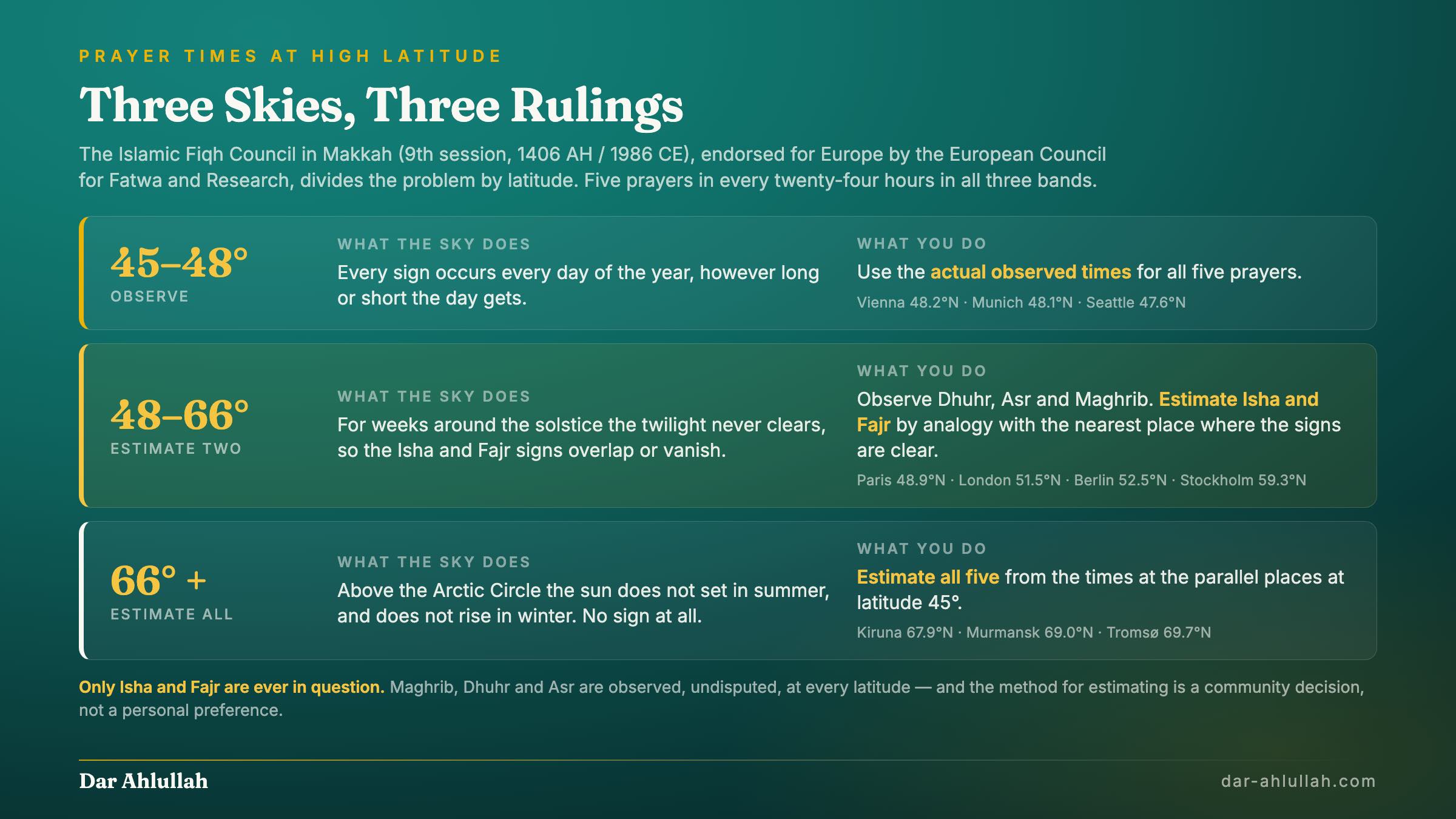
The clearest institutional statement of the framework came from the Islamic Fiqh Council in Makkah, in its ninth session (1406 AH / 1986 CE), and was subsequently endorsed for European conditions by the European Council for Fatwa and Research. It divides the world into three zones by latitude, and gives each a different instruction.
| Latitude band | What the sky does | What you do |
|---|---|---|
| Up to about 45–48° | All five signs occur every day of the year, though days get very long and very short. | Observe the actual times. “Certain areas between latitudes 45–48 degrees north and south have clear marks for prayer times throughout the day (24 hours). People living in these areas are required to observe these clear times.” |
| 48° to 66° | For part of the year the twilight never clears, so the Isha and Fajr signs overlap or vanish. | Estimate those two prayers “on the basis of analogy with the times of these prayers at the nearest place where prayer times are clearly marked.” The other three are observed normally. |
| Above 66° | The sun does not set in summer or does not rise in winter. No sign is available at all. | Estimate all of them: these areas “should estimate prayer times on the basis of the times at the parallel places at latitude 45 degrees.” |
Read the middle row again, because it is the row almost every European Muslim is actually in, and it contains a detail people miss constantly: only Isha and Fajr are affected. Maghrib, Dhuhr and Asr are observed exactly as they occur, and they are never in dispute. If your summer confusion has spread to all five prayers, you have imported a problem that does not exist.
The Saudi Board of Grand Scholars reached the same practical conclusion, ruling that Muslims living at extreme latitudes should estimate prayer times in accordance with the nearest moderate-latitude area.
The Four Methods of Estimation
“Estimate by analogy with the nearest place” is a principle, not an algorithm, and jurists have operationalised it in more than one way. Four approaches are in circulation. All four are held by recognised scholars; all four are defensible; and they produce different times.
| Method | How it works | Effect in a British June |
|---|---|---|
| Aqrab al-bilad (nearest land) |
Take the times from the nearest place where the sign does appear — in practice, a city on a lower parallel, often 45° or 48°. | Isha lands relatively early and moves little across the season. |
| Aqrab al-ayyam (nearest day) |
Take the last local date on which the sign was still detectable, and hold that clock time until the sign returns. “The last time on which the legal sign is detectable is the reference time. This time should be adopted throughout the period of persistent twilight.” | Isha freezes very late — for London, past midnight — and stays there for weeks. |
| Nisf al-layl (dividing the night) |
Divide the interval from sunset to sunrise into parts and place the prayers proportionally. In the common software form, “the period from sunset to sunrise is divided into two halves,” with Isha and Fajr set around the midpoint; some scholars instead place Isha at the end of the first third. | Isha in the late evening, around 22:45 to 23:30 depending on the variant. |
| Sub’ al-layl (one-seventh) |
“The period between sunset and sunrise is divided into seven parts. Isha begins after the first one-seventh part, and Fajr is at the beginning of the seventh part.” Attributed to an interpretation among Shafi’i scholars. | Isha earlier than the halving method, Fajr correspondingly later. |
Prayer-time software adds a fifth, purely computational variant: the angle-based method, in which the night is divided in proportion to the convention’s twilight angle divided by sixty, so that a 15° Isha angle puts Isha at the quarter-night mark. It is not a separate fiqh position so much as a smoother way of implementing the same proportional logic.
Notice the spread. On the same night, in the same city, the nearest-day method and the halving method can be more than an hour and a half apart. Neither is a bug. That gap is the difference of opinion, rendered as a number on a lock screen.
Your Prayer App Already Chose for You
Here is the practical consequence almost nobody is told. Every prayer-time app contains two separate settings that decide your Isha and Fajr, and it shipped with defaults.
The first is usually called Calculation Method, and it selects the twilight angles: Muslim World League, ISNA, Egyptian, Umm al-Qura, Karachi, and so on. The second is usually called High Latitude Adjustment or Higher Latitudes, and its options are recognisably the methods above: None, Middle of the Night, One Seventh, Angle Based.
| Convention | Fajr angle | Isha angle |
|---|---|---|
| Muslim World League | 18° | 17° |
| ISNA | 15° | 15° |
| Egyptian General Authority of Survey | 19.5° | 17.5° |
| University of Islamic Sciences, Karachi | 18° | 18° |
| Umm al-Qura, Makkah | 18.5° | 90 minutes after Maghrib |
Two people sitting in the same room, both with prayer apps, both sincere, will get different Isha times if one is on ISNA + Angle Based and the other is on MWL + One Seventh. Neither phone is broken. Each has silently adopted a different scholarly position, chosen by a developer’s default rather than by either user.
So the first practical step in this entire article is unglamorous: open the settings, find out which two options your app is on, and find out which method your mosque announces its timetable from. If they disagree, change the app, not the mosque.
Which Method Should You Follow?
The honest answer is that this is not a question you should be answering privately from a search engine, and the sources themselves say so. The recurring instruction across the fatwas is to check what the Muslim community in your area is doing and act accordingly — not because your reasoning is worthless, but because prayer times are a congregational institution. A timetable that only you are on is a timetable that quietly removes you from the jama’ah for two months a year.
Three principles that hold regardless of which position your community takes:
- Pick a recognised method and stay on it for the season. The single worst practice here is choosing a different method each night depending on which one lets you sleep — that is selecting by convenience rather than by evidence, and it means you have no position at all.
- Prefer your local mosque’s timetable where one exists, even if you find another method more persuasive on paper. Congregational coherence is itself a legitimate consideration, and it is one your family will feel every night.
- Where there is no mosque — and in northern Scandinavia and rural Canada there often is not — put the question to a scholar who knows your specific latitude, adopt what they give you, and stop reopening it. The general fiqh of worship, including this, is the sort of thing that is much better learned once, properly, than reassembled every June from forum posts. Our overview of fiqh for beginners sets out how the practical rules are structured and which questions genuinely need a teacher.
Winter: The Same Problem Upside Down
The summer version gets all the attention, but the same latitude produces the inverse problem in December, and it catches people who have only prepared for June.
In the 48°–66° band, the winter difficulty is compression rather than absence. In Stockholm in late December the sun rises around nine and sets around three. Dhuhr, Asr and Maghrib land inside a six-hour window, most of which is a working day, and Fajr and Isha crowd the ends of it. The signs are all there and all observable — so this is not a fiqh problem at all. It is a scheduling problem, and it is solved by a conversation with an employer or a school about a fifteen-minute break, not by a fatwa.
Above the Arctic Circle the winter is the true mirror image: the sun does not rise for weeks, and the polar night is governed by the same third-band instruction as the midnight sun, estimating from a moderate latitude. The important thing is that the same estimation applies whether the anomaly is too much light or too little. It is one rule, not two.
One practical consequence worth planning for: if the compressed winter days mean prayers are being missed at work rather than merely being awkward, that is a backlog forming, and backlogs are much easier to deal with early. The method for working through one without either despairing or inventing a number is set out in our guide to making up missed prayers.
What This Does Not Change
A surprising amount of the confusion in this subject comes from people assuming that if the times move, everything else moves with them. It does not.
The number of rak’ahs is untouched. Isha at 00:50 is still four rak’ahs. Fajr is still two. Living at 60°N is not a state of travel, and it carries no shortening concession — qasr belongs to the journey. If you want the actual boundaries of that concession, and how it differs from what is described here, our guide to praying while travelling covers it. The two situations can coexist, but neither borrows from the other.
The recitation is untouched. Al-Fatihah, the surah, the tasbih of ruku and sujud, the tashahhud — all of it stays exactly as it is at any latitude. If you are still building that vocabulary, our breakdown of what to say in salah sorts it by obligation tier.
Purification is untouched. Nothing about a bright night changes what breaks wudu or what is required for it.
The repairs are untouched. Lose count of rak’ahs in a very late Isha — which happens, because a prayer at one in the morning is a tired prayer — and the fix is the ordinary one.
And physical capacity is a separate axis entirely. If you are ill as well, the posture ladder in our guide to praying when sick applies on top of this, independently. Latitude decides when; capacity decides how.
Four Situations, Worked Through
1. Manchester, late June. Your app says Isha 01:20; the mosque says 23:00.
Both are outputs of legitimate methods: 01:20 is roughly what the nearest-day method produces for that latitude, and 23:00 is roughly what dividing the night produces. There is no third source that will adjudicate this for you. Follow the mosque, and set your app’s High Latitude Adjustment to whichever option brings it closest to the mosque’s timetable, so that the phone stops arguing with the community every night.
2. Stockholm. Fajr is at 01:30 and you start work at seven.
First, check the method — at 59°N a 01:30 Fajr is very likely an unadjusted calculation the app should not be attempting at all, and a community-endorsed method will usually give something more workable. Second, once the time is settled, treat it as a sleep-architecture question rather than a willpower question: sleeping early, praying Fajr, and returning to sleep is a normal arrangement in northern communities and not a compromise. What is not an option is deciding that Fajr does not exist for two months.
3. Tromsø in June. The sun does not set at all.
You are in the third band, above 66°. All five times are estimated from a moderate latitude, conventionally 45°. Practically, this means using a timetable produced for that purpose — usually one your local Islamic centre publishes for the season. This is the one case where you should not be improvising from an app’s defaults, because the app has to make an assumption that no observation can correct.
4. You are flying Doha to Reykjavík in July.
Two rulings stack, and it is worth separating them. Being a traveller gives you qasr and the possibility of combining, which is about the count and the grouping. Arriving above 48°34′ is about the timing. Clear what is due before you board, use the combination the journey permits, and once you land, adopt the local timetable of the community you have arrived in rather than the one from the city you left.
Six Mistakes People Keep Making
- Praying four prayers because “Isha had no time today.” The Dajjal hadith exists precisely to close this door. An absent sign obliges estimation, not omission.
- Turning jam’ into a summer habit. Permanently attaching Isha to Maghrib because Isha is inconvenient is not what the concession is for; combining is discussed for travel and for genuine need, and treating a whole season as a standing need is a claim worth putting to a scholar rather than assuming.
- Method-shopping nightly. Halving the night when you want to sleep, nearest-day when you want a late window. Consistency is part of the ruling, not an optional extra.
- Assuming the app is neutral. It is not. It has a fiqh position, chosen by default, sitting in a dropdown.
- Applying the confusion to all five prayers. In the 48°–66° band only Isha and Fajr are in question. Dhuhr, Asr and Maghrib are observed, undisputed, all year.
- Deciding alone when a mosque exists. Your household running a private timetable is a real cost, paid nightly, for a position that is not more correct than the one down the road.
How We Teach This
Questions like this one are the reason we teach the fiqh of worship alongside recitation rather than after it. A learner who can recite beautifully but does not know that only two prayers are in question above 48° will spend every June anxious about something that was settled in 1986.
What we do in sessions is the mechanics first, then the reasoning underneath them, then the situations — latitude, travel, illness, interruption — where the reasoning has to carry the weight on its own. Every learner starts with a free 30-minute assessment session, with no card required, so a teacher can see where you actually stand before recommending anything. If the fit is not right, you can be matched with another certified mentor at no extra cost, and you can pause, upgrade or switch plans at any time. You can see the full range of programmes on our courses page.
Questions People Ask
Is it true that Isha simply drops in the far north?
No. The obligation to pray five in each twenty-four hours is stated explicitly in the fatwa literature for exactly these regions, and the Dajjal hadith is cited as its basis. What changes is that the time is estimated rather than observed. A minority view historically discussed the question differently, but the position acted on by the Fiqh Council, the European Council for Fatwa and Research and the mainstream fatwa bodies is that the five remain.
At what latitude does the problem actually start?
Astronomically, around 48°34′ north or south, which is where the sun stops descending 18° below the horizon near the solstice. The Fiqh Council’s framework uses 48° as the practical boundary, and treats 66° as the second boundary.
Why do two prayer apps give me different Isha times?
Because they are on different calculation conventions, different high-latitude adjustments, or both. The angle conventions alone differ by up to 4.5° between bodies, and the high-latitude adjustment can move Isha by well over an hour. Both settings are usually editable.
My mosque’s timetable is much earlier than my app. Who is wrong?
Probably neither. An early mosque time usually reflects one of the dividing-the-night methods; a late app time usually reflects the nearest-day method or an unadjusted calculation. Follow the mosque and reconfigure the app to match it.
Can I just follow Makkah’s timings?
It has been proposed — the argument being that the times of moderate latitudes where the rulings were revealed should be the reference. It is a minority position; the mainstream institutional rulings direct you to the nearest place with distinguishable signs, or to the 45° parallel, rather than to Makkah. Do not adopt it unilaterally because it is convenient.
Does any of this apply to fasting?
The same three-band logic is applied to Ramadan, and where the day is extremely long but the signs are still present, the ruling is that you fast the actual day, with the ordinary concessions for genuine hardship and making up the days later. It is a related question with its own detail, and worth putting to a scholar rather than inferring from this article.
What about the southern hemisphere?
The same thresholds apply as south latitudes, six months out of phase. In practice very few people live above 48°34′S — southern Chile, southern Argentina and parts of New Zealand’s South Island approach it — which is why the discussion is overwhelmingly framed as a northern one.
Conclusion: The Sign Moved, the Obligation Did Not
The reason this question feels destabilising the first time you meet it is that it looks like the law has run out. The sky stops producing the thing the ruling points at, and for a moment it seems as if nobody planned for that.
Somebody did. The instruction to estimate was given in the clearest possible terms, in a case far more extreme than anything Scandinavia produces, and the jurists who inherited it built a three-band framework and four methods for carrying it out. What you are looking at in a June argument is not a gap in the religion. It is the ordinary, healthy business of applying a fixed principle to a variable sky, and there are people whose job it is to have already done that work for your city.
Your part is smaller than it feels: find out what your community follows, set your phone to agree with it, and pray the five. The sign moved. The obligation did not.
Related articles
how to pray tahajjud
How to Pray Tahajjud: The Night Prayer, Step by Step
Tahajjud is voluntary, prayed in pairs between Isha and Fajr and closed with Witr. When the window opens, how many rak'ahs, what to recite when you know only short surahs, and what the Sunnah does on the nights you sleep through it.
21 min read
morning and evening adhkar
Morning and Evening Adhkar: What to Say and When
Morning and evening adhkar from the sound reports: the windows from dawn to sunrise and from 'Asr to sunset, the core set with the source and count of each line, and the grade printed on the popular additions the hadith scholars dispute, from Ayat al-Kursi to hasbiyallah seven times.
29 min read
how to respond to the adhan
How to Respond to the Adhan: What to Say and the Dua After
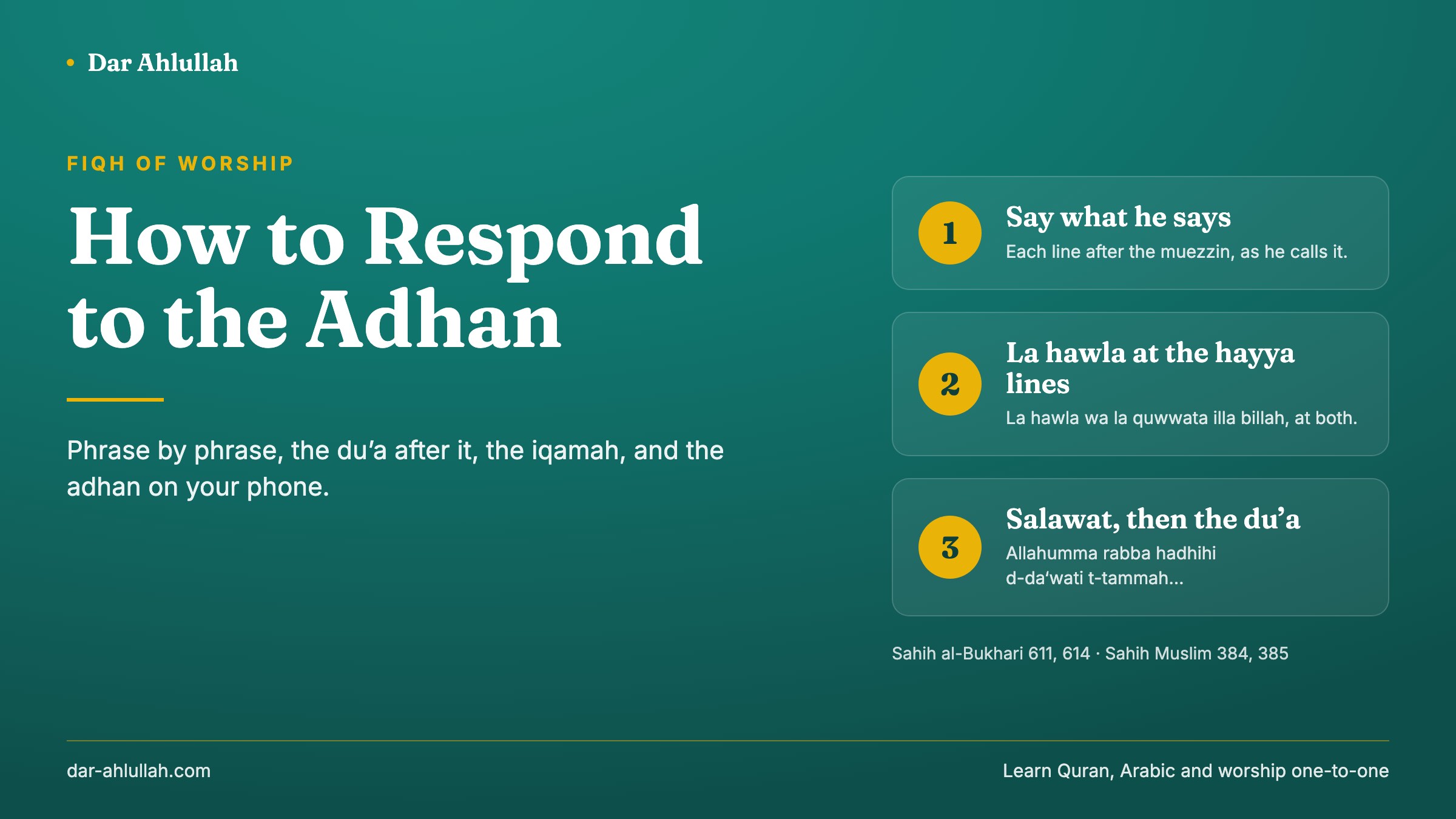
How to respond to the adhan: repeat each phrase after the muezzin, say la hawla wa la quwwata illa billah at the two hayya lines, then send salawat and say the du'a after the adhan. This guide sets out every step from the sound reports, prints the grade on the additions people argue about, and lays out the two scholarly answers on the adhan from a phone app.
29 min read