
how to pray Jumuah
How to Pray Jumu'ah: The Friday Prayer, Start to Finish
Dar Ahlullah team 18 min read
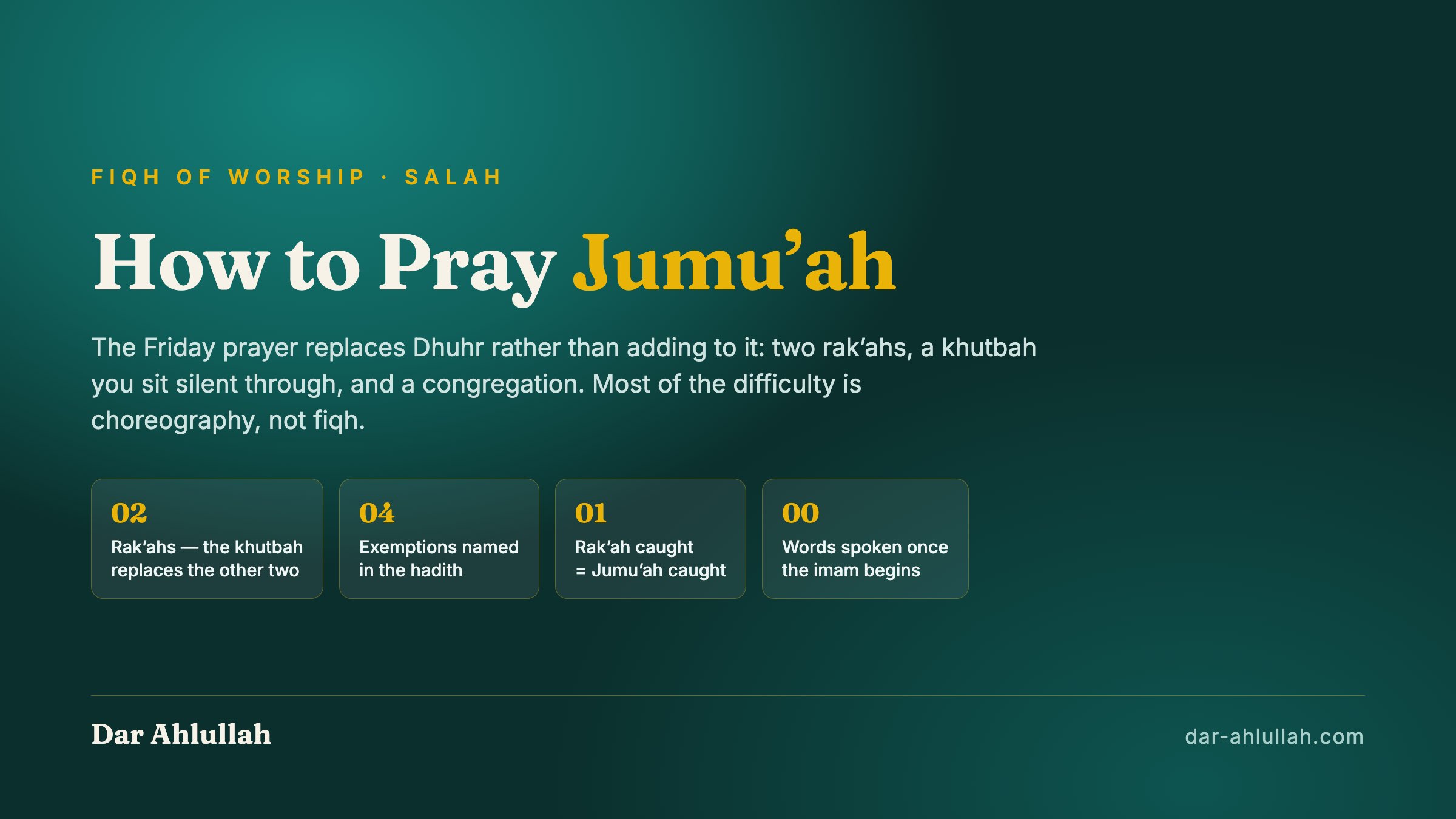
Table of Contents
- Introduction: Your First Friday in a New City
- The Short Answer
- What Jumu’ah Actually Is
- Who It Is Obligatory On — and the Four Exemptions
- Before You Leave the House
- During the Khutbah: The Silence Rule
- The Khutbah You Cannot Understand
- The Prayer Itself, Step by Step
- Arriving Late: Exactly What You Have Caught
- Jumu’ah and Work
- When You Pray Dhuhr Instead
- Missing It, and the Weight the Sunnah Puts on That
- Seven Mistakes People Keep Making
- What Jumu’ah Does Not Change
- How We Teach This
- Questions People Ask
- Conclusion: One Hour, Once a Week
Introduction: Your First Friday in a New City
You have found the masjid. You have worked out that the prayer is at 13:30, or 13:15, or — because there are three congregations and you did not know that — possibly all three. You arrive, and the room is already full, and a man is speaking from the minbar in a language you do not have. Somebody is still praying two rak’ahs in the corner and you cannot tell whether you are supposed to do that too, or whether you have missed the moment for it. Then everyone stands, and it is over in about four minutes, and you are not entirely sure whether what you just prayed counted.
Almost every Muslim in Europe or North America who did not grow up going has had a version of that Friday. And the awkwardness is not really about the fiqh, which is short. It is about the choreography — the fifteen small things everyone else in the room appears to have known since they were seven.
So this article does both. It sets out the ruling on how to pray Jumu’ah properly, with the evidence underneath it, and it also sets out the practical shape of the hour: what to do before you go, what the silence during the khutbah actually forbids, what happens if you walk in late, what to do when the sermon is in a language you do not speak, and when Friday prayer is not owed of you at all.
One boundary first. We teach Quran, Arabic and the practical fiqh of worship; we are not a fatwa body. On several points below the four schools genuinely differ, and where they do we will say so rather than present one position as the only one. If the five daily prayers are still new, our complete guide to salat covers the sequence first, and if worship as a whole is new to you, the order to learn it in is mapped out in our guide to your first 90 days in Islam.
The Short Answer
If you have two minutes rather than twenty-five, this is the whole thing.
- Jumu’ah replaces Dhuhr on a Friday. It is not an extra prayer. You do not pray both.
- It is two rak’ahs, prayed aloud, in congregation. The khutbah stands in place of the other two, which is why the sermon is part of the prayer rather than a preamble to it.
- It is obligatory on adult male Muslims who are resident and able. Four categories are exempted by name: a slave, a woman, a child, and someone who is ill.
- Exempt does not mean excluded. A woman who attends and prays Jumu’ah has prayed Jumu’ah, and it counts for her Dhuhr.
- Once the khutbah begins, you stop talking. Completely. Even telling someone else to be quiet is named in the hadith as the wrong thing to do.
- Catch one rak’ah and you have caught Jumu’ah, adding the second after the imam finishes. Arrive after that and you pray Dhuhr instead — four rak’ahs.
- Come early. The reward described in the Sunnah is graded by how early you arrive, and it drops steeply.
Everything below is that, with the edges filled in.
What Jumu’ah Actually Is
The command is explicit in the Qur’an. “O believers! When the call to prayer is made on Friday, then proceed diligently to the remembrance of Allah and leave off your business” (Qur’an 62:9). The next verse releases you again: “Once the prayer is over, disperse throughout the land and seek the bounty of Allah” (62:10). An hour is claimed, and then the day is handed back.
Three structural facts follow, and getting them straight removes most of the confusion.
It substitutes for Dhuhr rather than adding to it. On a Friday there are still five prayers. Jumu’ah occupies the Dhuhr slot. Praying Jumu’ah and then praying Dhuhr afterwards is a duplication, not extra caution.
It is two rak’ahs, not four, and the imam recites aloud. The two rak’ahs that would otherwise be there are replaced by the khutbah — which is why the sermon is not optional and why the silence during it is treated as strictly as behaviour inside a prayer.
It requires a congregation. You cannot pray Jumu’ah alone. The scholars differ on the minimum number and on whether a permanent mosque is required, with positions ranging from three or four people upwards, but the principle is agreed: Jumu’ah is a gathering, and where there is no gathering there is Dhuhr.
Its time is the time of Dhuhr — after the sun passes its zenith, lasting until Asr begins. That is the majority position, and it is why a masjid in a city with a large Muslim population may run two or three consecutive congregations inside the same window rather than one.
Who It Is Obligatory On — and the Four Exemptions
The narration that fixes this is short and worth having in full: “The Friday prayer in congregation is a necessary duty for every Muslim, with four exceptions: a slave, a woman, a boy, and a sick person” (Sunan Abi Dawud 1067).
Beyond those four, the jurists add the traveller and, more generally, anyone prevented by a genuine excuse — the same class of excuse that would exempt someone from congregational prayer at all.
Two things about that list are constantly misread.
“Exempt” means not obliged, not barred. A woman who comes to Jumu’ah has performed Jumu’ah, and it takes the place of her Dhuhr exactly as it does for anyone else. She is not doing something supererogatory on top of an obligation she still owes. The exemption removes a burden; it does not remove a permission, and there is no basis for treating a woman’s presence at Friday prayer as unusual.
“Sick” is not a high bar, but it is a real one. The category covers genuine illness and, by extension, the conditions the jurists treat alongside it — being a carer whose absence would leave someone at risk, or a level of difficulty that would prevent attending any congregation. It does not cover ordinary tiredness or a preference for staying in. If you are well enough to go to work on a Friday, the honest reading is that you are well enough for Jumu’ah. If illness is your actual situation, the ladder of what you can still perform is set out in our guide on how to pray when sick.
Before You Leave the House
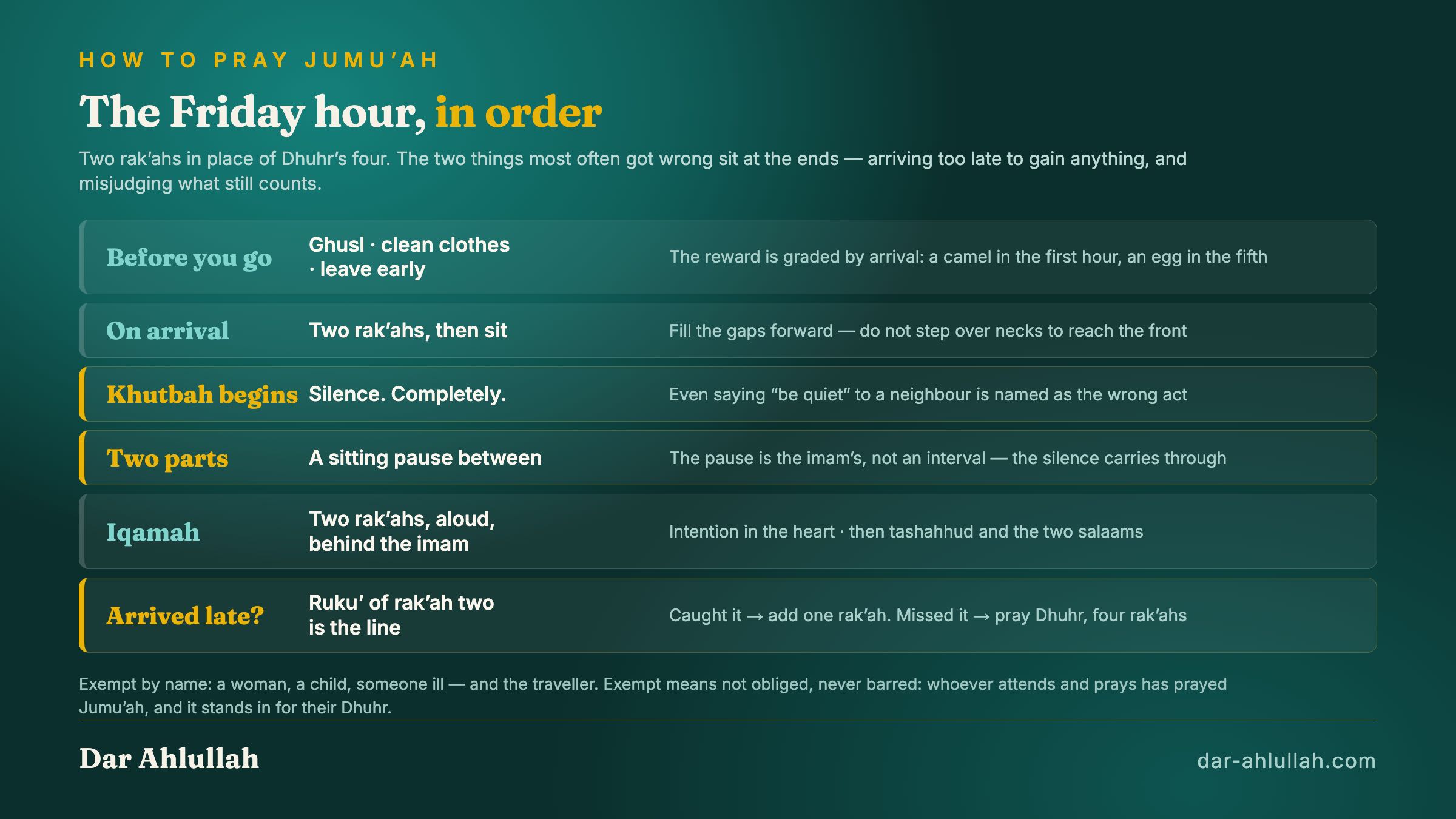
Friday has an etiquette attached to it, and unusually for a set of recommended acts, the Sunnah attaches an explicit scale of reward to one of them.
Read that as a curve rather than a list. It does not descend gently; it falls off a cliff. A camel to an egg in five steps is a deliberate image, and the point it makes is that turning up as the imam sits down is a fundamentally different act from arriving with time to sit, read and settle.
The practical checklist, in order:
- Ghusl. Strongly emphasised, and named in the hadith above as the thing the reward is conditional on. If you are unsure of the procedure, our guide to purification covers both ghusl and wudu.
- Clean clothes and scent. Established Friday etiquette. In a shared prayer hall this is also a courtesy to the person whose forehead will be where your feet are.
- Go early. The single highest-value item on the list, by the explicit terms of the hadith.
- Pray the greeting of the mosque when you arrive. Two rak’ahs on entering, before sitting — and if the khutbah has already started, the majority position is that you still pray two brief rak’ahs rather than sitting straight down.
- Sit close and fill the gaps. Stepping over people’s necks to reach a space at the front once the khutbah is under way is specifically discouraged. Arriving early is what makes this a non-issue.
During the Khutbah: The Silence Rule
This is the section that most repays reading, because the standard is stricter than almost anyone assumes, and the hadith proves it with an example nobody would have guessed.
“When the Imam is delivering the Khutba, and you ask your companion to keep quiet and listen, then no doubt you have done an evil act” (Sahih al-Bukhari 934).
Look at who is being corrected there. It is not the person chatting. It is the person who noticed the chatting, leaned across in defence of the khutbah itself, and said the most pious sentence available — be quiet. Even that, on the Prophet’s own terms, is laghw: idle speech that costs you the full reward of your Friday.
The rule that falls out of it is unusually clean. From the moment the imam begins, you do not speak. Not to correct, not to greet, not to answer a question, not to whisper. If somebody near you is talking, you leave it; the responsibility for their Friday is theirs, and intervening spends your own.
In practice that also means:
- Phone silenced before the khutbah, not during it. Reaching for a buzzing phone mid-sermon is the most common breach in a European masjid, and it is entirely preventable in the car park.
- Do not return salaam, and do not initiate it. The greeting is good; its timing here is not.
- Do not read Qur’an or make your own dhikr during the sermon. The khutbah is what you are there to listen to.
- Children are a different case. A quiet word to settle a small child is not what the hadith is aimed at, and most scholars treat necessity as an exception. Habitual conversation is not necessity.
The khutbah comes in two parts with a brief sitting pause between them. That pause is the imam’s, not an interval; the silence continues through it.
The Khutbah You Cannot Understand
Here is the question that a general article on Jumu’ah written for a Muslim-majority country never has to address, and which for our readers is often the whole of the experience: the khutbah is in Arabic, or Urdu, or Turkish, or Bengali, and I understand none of it. Am I doing anything at all?
Two separate answers, and it helps to keep them apart.
Your prayer is valid. Whatever the language, if the khutbah was delivered and you listened and prayed the two rak’ahs behind the imam, you have prayed Jumu’ah. Comprehension is not a condition of validity for the listener. Nothing is owed again and nothing needs repeating.
Whether the khutbah itself must be in Arabic is a real difference of opinion, and the schools do not line up neatly:
- Hanafi: Arabic is not a condition of validity. Abū Ḥanīfa’s position is that a khutbah delivered entirely in another language is sound.
- Shāfi‘ī: Arabic is a condition for one who is able — but with an explicit carve-out where none of the listeners know Arabic, in which case the khutbah is given in their language.
- Ḥanbalī: Arabic if the preacher knows it; otherwise whatever language he commands.
- Mālikī: most hold that it should be in Arabic.
The contemporary practice in Western mosques — a sermon in the local language, with the formal Arabic portions retained — sits comfortably inside that spread rather than outside it. These positions are set out at length in IslamQA’s treatment of the Friday khutbah in languages other than Arabic and in IslamOnline’s fiqh discussion of the same question.
What to actually do about it, if you are sitting through forty minutes a week that you cannot follow:
- Find out whether your masjid runs an English congregation. Many large mosques run two or three, and one of them is often in the local language. People sit through years of an incomprehensible khutbah without ever asking.
- Do not treat the hour as wasted. Being present, silent and attentive in the gathering is itself the act being asked of you, and it is worth exactly what it is worth regardless of your vocabulary.
- Or make it the reason to learn. A khutbah is, linguistically, a very tractable target: it is formulaic, it repeats, and it recycles a fairly small stock of Qur’anic phrases week after week. Learners are often surprised how quickly the shape of it opens up once the high-frequency vocabulary is in place — our guide to learning Quranic Arabic sets out where to start.
The Prayer Itself, Step by Step
The prayer is the least complicated part of the hour, which surprises people who have been anxious about it.
- The first adhan and the khutbah. You are seated, silent, facing the minbar.
- The imam finishes and sits; the iqamah is called. Stand and straighten the rows, shoulder to shoulder, filling gaps forward.
- Make the intention for Jumu’ah. In the heart. Nothing is said aloud.
- Two rak’ahs behind the imam, recited aloud. You listen; you do not recite along, beyond what your school directs for al-Fātiḥah. Your part is the responses, the postures, and following the imam without preceding him.
- Tashahhud and the two salaams, exactly as in any prayer. If you are unsure of the words of any position, what to say in salah sets them out in order.
- The sunnah prayers afterwards. Two or four rak’ahs, and the schools describe the pattern differently — four is the common Hanafi practice, two is common elsewhere, and some pray two at the masjid and two at home. These are recommended, not obligatory, and the variation you see around you is not people getting it wrong.
That is the entire prayer: about four minutes, once you are in the row.
Arriving Late: Exactly What You Have Caught
This is the question people are too embarrassed to ask, and the answer is precise.
“Whoever catches one rak’ah of Friday prayer or other than it, then he has caught the prayer” (Sunan Ibn Mājah 1123). So:
- You joined before the imam rose from the bowing of the second rak’ah. You have caught that rak’ah, and therefore Jumu’ah. When the imam gives salaam, stand and complete one more rak’ah on your own. Your Friday prayer is complete and valid.
- You joined after that — in the sitting, or in the tashahhud. The majority position is that you have not caught Jumu’ah. You join the imam for the reward of the congregation, and when he finishes you stand and pray Dhuhr: four rak’ahs. This is not a punishment or a lesser substitute; it is simply the prayer that was owed once Jumu’ah was out of reach.
There is a minority view holding that catching any part of the prayer suffices for Jumu’ah, and it is discussed in the treatment of catching up with the Friday prayer. The majority position — one full rak’ah — is the safer and more widely held one, and it is what most Western mosques will tell you if you ask.
The thing not to do is guess in the moment and then carry the uncertainty for a week. Learn the rule once: ruku’ of the second rak’ah is the line.
Jumu’ah and Work
For most Muslims in Europe and North America this is the actual obstacle, and it deserves treating as a practical problem rather than a spiritual failing.
Friday is an ordinary working day, the prayer falls in the early afternoon, and the nearest masjid may be twenty-five minutes away. The result is that a large number of people who fully intend to attend end up not attending, week after week, and eventually stop trying.
What tends to work:
- Ask, specifically and once. A standing request for a shifted lunch break on Fridays is a small and normal accommodation, and in much of Europe and North America it is protected in some form. Most people never ask because they are braced for a conversation that usually turns out to be brief.
- Find the nearest congregation, not the nicest one. A prayer room in an office block, a university musalla, a community centre. Travel time is what actually kills attendance.
- Use the later congregation. Large mosques often run a second or third Jumu’ah precisely because of working hours, and people frequently do not know it exists.
- If it is genuinely impossible, pray Dhuhr — and keep the file open. An obligation you cannot currently meet is a different thing from one you have abandoned. Circumstances change; jobs change.
What does not work is deciding privately that your situation is permanently exempt without ever having tested it.
When You Pray Dhuhr Instead
Four common cases, and in every one of them the answer is the same: four rak’ahs of Dhuhr, at the ordinary Dhuhr time.
You are travelling. The traveller is not obliged to attend Jumu’ah. If you happen to be near a masjid at the time, praying with the congregation is uncontroversially good; if not, you pray Dhuhr, shortened to two rak’ahs under the travel concession. Our guide to praying while travelling covers when that shortening applies.
You are ill, or caring for someone who is. Named in the hadith. Pray Dhuhr.
There is no congregation you can reach. Jumu’ah cannot be prayed alone, and it cannot be prayed at home by yourself. In a small town with no masjid and no gathering, Dhuhr is what is owed — not a deficient version of Friday, simply the prayer that applies.
You arrived after the imam rose from the second bowing. As above. Dhuhr, four rak’ahs.
In none of these cases is anything made up later. Dhuhr, prayed in its time, discharges the obligation completely.
Missing It, and the Weight the Sunnah Puts on That
The warning is stark, and it is worth reading carefully because its condition is doing a great deal of work: whoever abandons three Friday prayers out of negligence, Allah places a seal on his heart (Sunan Abi Dawud 1052).
Two observations.
The condition is negligence, not absence. The traveller, the ill person, the one with no congregation within reach — none of them are inside this warning at all. It is aimed at a specific thing: the person for whom attending is possible and who does not, repeatedly, out of indifference.
The described consequence is a hardening, not a tally. A seal on the heart is a description of what habitual neglect does to a person — each week it becomes fractionally easier not to go, until the question stops arising. That is the actual mechanism, and it is why the number given is three rather than thirty.
If you are reading that with a run of missed Fridays behind you, the useful response is neither despair nor a ledger. Go this week. And if there is a wider backlog of prayers behind the Fridays, our guide to making up missed prayers deals with that as a fixable matter rather than a permanent status.
Seven Mistakes People Keep Making
- Praying Dhuhr after Jumu’ah. Jumu’ah is your Dhuhr. Adding four rak’ahs of Dhuhr afterwards is a duplication.
- Arriving as the imam sits down. Valid, and almost entirely outside the reward the hadith describes. The gap between the first hour and the fifth is a camel and an egg.
- Shushing the person next to you. The one hadith on this subject singles out precisely that act.
- Assuming a woman’s Jumu’ah does not count. It counts, and it replaces her Dhuhr.
- Guessing at what you caught when you arrive late. One rule: if you made the bowing of the second rak’ah with the imam, it is Jumu’ah plus one rak’ah. Otherwise it is Dhuhr, four.
- Treating an incomprehensible khutbah as an invalid one. Your prayer is sound. The question of the khutbah’s language is the imam’s, and the schools differ on it.
- Never asking work. The most common reason people miss Jumu’ah in the West is a conversation they have not had.
What Jumu’ah Does Not Change
- The other four prayers. Fajr, Asr, Maghrib and Isha are exactly as they are on any other day.
- The conditions of prayer. Purity, covering, facing the qiblah, the time — all unchanged. The things that would invalidate any prayer invalidate this one too.
- The number owed. Five prayers on a Friday, as on every day. Jumu’ah occupies one of the five slots; it does not add a sixth.
- The obligation on those exempt to pray Dhuhr. An exemption from Jumu’ah is never an exemption from the Dhuhr it replaces.
How We Teach This
At Dar Ahlullah we teach Quran, Arabic and the practical fiqh of worship one-to-one and live, to students across Europe and North America. Jumu’ah comes up constantly with our adult learners, and almost never as a question about rak’ahs. It comes up as the language question — forty minutes a week of a sermon somebody cannot follow — and as the confidence question, which is really about not knowing the choreography of a room.
Both are the sort of thing one-to-one teaching handles well and a group class handles badly, because nobody wants to raise their hand and say they are not sure what they just prayed. Lessons are booked in the student’s own timezone rather than ours, and evening slots after work are normal. Every learner starts with a free 30-minute assessment session, with no card required, so a teacher can see where things actually stand before recommending anything — you can book that assessment here.
Questions People Ask
Can I pray Jumu’ah at home with my family?
The majority position is no — Jumu’ah requires a congregation of the kind the jurists describe, and most schools attach further conditions about the place and the number present. A household praying together is generally not held to meet them. Where a valid Jumu’ah is out of reach, Dhuhr is what is owed, and it discharges the obligation fully.
How many rak’ahs is Jumu’ah in total?
The obligatory part is two, prayed behind the imam. The sunnah prayers before and after vary by school — commonly four before and four after in the Hanafi practice, two after in others. Only the two are required.
I got there and the prayer had already finished. What do I do?
Pray Dhuhr, four rak’ahs, in its time. You have missed Jumu’ah; you have not missed the obligation, because Dhuhr is the obligation in that case.
Is ghusl on Friday obligatory?
The majority hold it to be strongly recommended rather than obligatory, and a minority have held it obligatory. Given the emphasis it carries in the Sunnah and its explicit place in the reward hadith, treat it as something to do rather than something to weigh.
Can I speak between the two parts of the khutbah?
The safer and more common position is no — the sitting between the two parts is a pause in the sermon rather than an interval outside it, and the silence carries through.
Do I have to listen if the khutbah is political or I disagree with it?
The instruction to listen silently is not conditional on agreeing. If a particular masjid’s sermons are consistently a problem for you, the answer is another congregation, not a conversation during this one.
My workplace has a prayer room and a few of us gather. Is that a valid Jumu’ah?
It may well be, and it depends on which school your community follows — they differ on the minimum number and on whether a permanent mosque is required. This is exactly the question to put to a local scholar or imam rather than settle from an article, because the answer is specific to your school and your circumstances.
Should my young son come with me?
He is not obliged, and bringing him is a well-established practice. The realistic advice is to sit near the back the first few times, come early enough to explain what is about to happen, and treat a restless Friday as normal rather than a failure.
Is there something particular to read on Fridays?
Reciting Surah al-Kahf on Friday and sending abundant salawat upon the Prophet are both widely practised, on narrations whose gradings are discussed by the scholars. Neither is obligatory, and both are worth asking your local teacher about rather than taking from a list.
Conclusion: One Hour, Once a Week
Strip away the anxiety and Jumu’ah is one of the least complicated obligations in the whole of worship. Two rak’ahs. A sermon you sit still for. Once a week, in place of a prayer you were praying anyway.
What makes it feel hard is not the fiqh but the room — the sense that everyone else knows the choreography and you are guessing. So learn the four things that actually settle it: come early, stay silent from the moment the imam begins, know that one rak’ah with the congregation means you have caught it, and know that if you could not get there, Dhuhr is not a consolation prize but the prayer that was owed.
The verse that commands it also releases you from it in the very next line — disperse through the land, seek what you were seeking. An hour is claimed, once a week, and then the day is given back. Held that way, it is a small thing to organise a Friday around, and it is the one weekly appointment that puts you in a room with the people you share this with.
Related articles
tahiyyat al-masjid
Tahiyyat al-Masjid: How to Pray the Greeting of the Mosque
Tahiyyat al-masjid is two rak'ahs prayed on entering a mosque, before sitting. The method, the prayers that fulfil it for you, what to do if you already sat, the iqamah, the Friday khutbah and forbidden times by school, and whether a prayer room counts.
24 min read
joining the prayer late
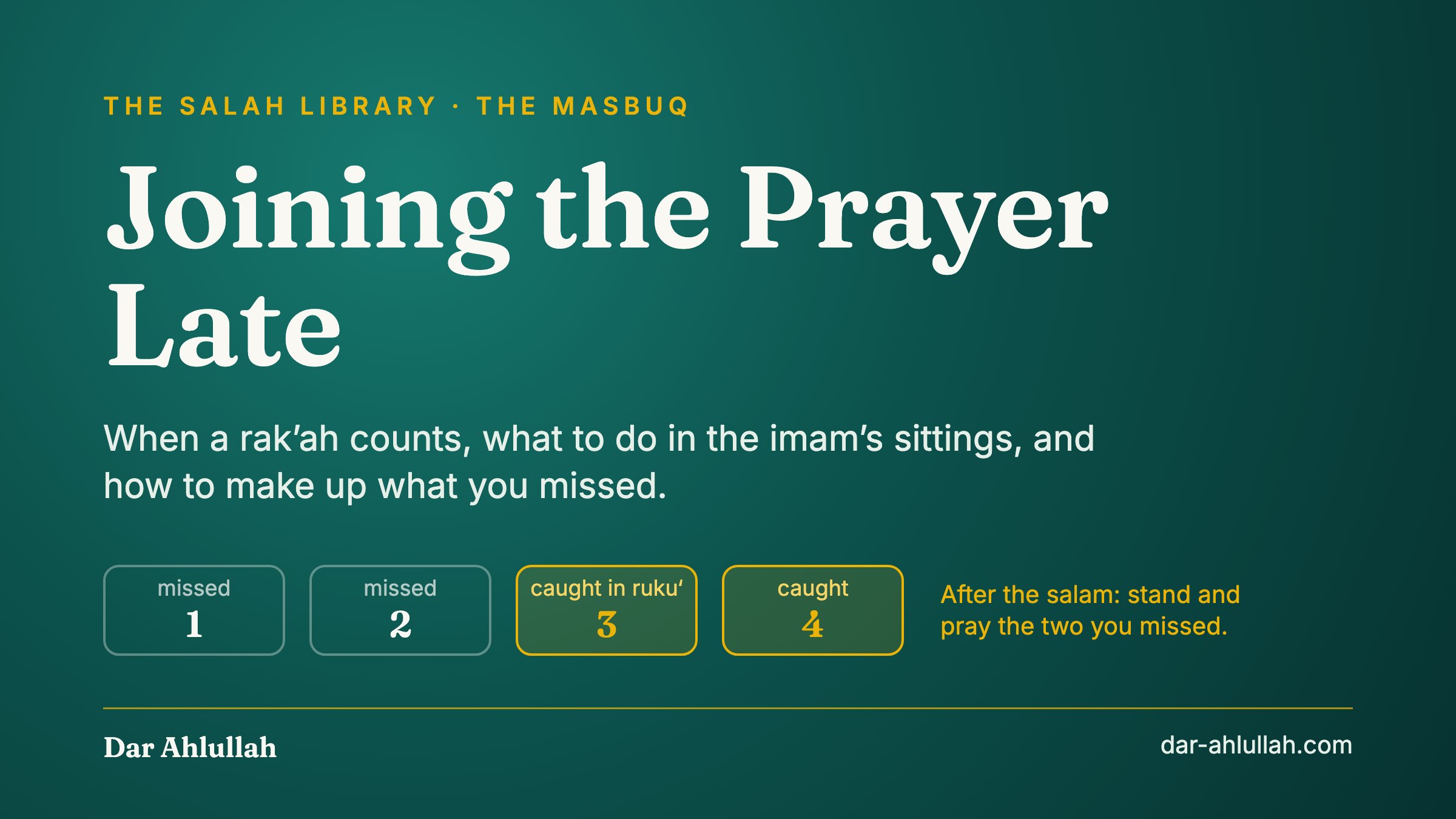
Joining the Prayer Late: How to Make Up Missed Rak’ahs
Joining the prayer late has a short, exact procedure: say the takbir standing, join the imam wherever he is, count the rak'ah only if you reached ruku' before he rose, and complete what you missed after his salam. This guide works through every prayer and arrival point, and explains why the person beside you may make up the same rak'ahs with a different recitation.
20 min read
morning and evening adhkar
Morning and Evening Adhkar: What to Say and When
Morning and evening adhkar from the sound reports: the windows from dawn to sunrise and from 'Asr to sunset, the core set with the source and count of each line, and the grade printed on the popular additions the hadith scholars dispute, from Ayat al-Kursi to hasbiyallah seven times.
29 min read