
morning and evening adhkar
Morning and Evening Adhkar: What to Say and When
Dar Ahlullah team 29 min read
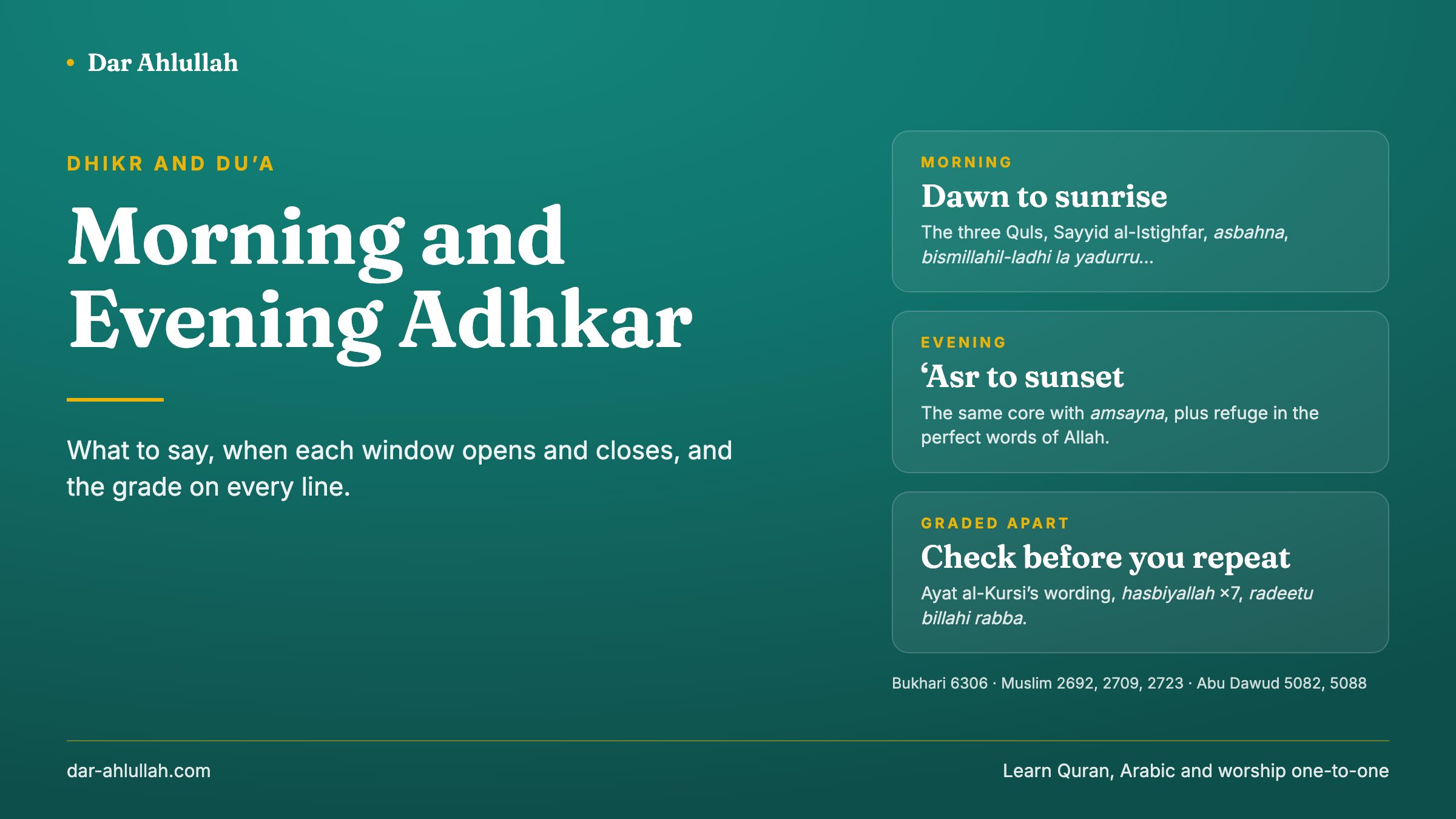
Table of Contents
- Introduction: Two Windows in Every Day
- The Short Answer
- When Does “Morning” Begin, and When Does “Evening” End?
- The Sound Core: Each Dhikr, Its Count and Its Grade
- The Morning Adhkar, One by One
- In the Evening: What Changes
- Ayat al-Kursi: Morning and Evening, or Bedtime?
- The Counted Adhkar: Ten and One Hundred
- Popular Adhkar the Hadith Scholars Grade Apart
- Not to Be Confused With: After Fajr, and Bedtime
- Saying Them: Aloud, From a Phone, in English
- Reading Them During a Period
- If You Miss Them
- A Short Version, Every Line Sound
- How We Teach This
- Questions People Ask
- Conclusion: The Same Words, Twice a Day
Introduction: Two Windows in Every Day
The Qur’an returns to two times of day again and again. “O you who have believed, remember Allah with much remembrance, and exalt Him morning and afternoon” (Qur’an 33:41–42). “Exalt [Allah] with praise of your Lord before the rising of the sun and before its setting” (50:39). “In the evening and the morning” (40:55). “Remember your Lord within yourself… in the mornings and the evenings, and do not be among the heedless” (7:205).
The Sunnah fills those two windows with words. Some the Prophet ﷺ said himself every morning and evening; some he taught to a Companion who asked for something to say; some come with a promise attached — protection until the evening, sufficiency against everything, Paradise for the one who dies that day. Taken together they are what Muslims call the adhkar al-sabah wal-masa’, the morning and evening remembrances.
They are also one of the most copied sets of words in the Muslim world, and copying has not been kind to them. The lists in apps, on posters and in printed booklets mix reports that al-Bukhari and Muslim recorded with reports that the hadith scholars graded weak, give counts that are not in the narrations, and almost never tell the reader which is which. One famous line, said seven times in many morning lists, is graded mawdu’ — fabricated — by al-Albani in the collection it comes from. Another, Ayat al-Kursi, appears in nearly every list on the strength of a report that two hadith scholars graded good and a third judged to have an anomalous wording.
This article sets out the morning and evening adhkar with the source and the grade printed on each one. It separates the core that the graders agree is sound from the items they grade apart, explains when each window opens and closes and what the scholars say if you miss it, and answers the practical questions people ask most — reading from a phone, saying them in English, and reading them during a period. Nothing here is a ruling of ours. Where scholars differ, both views are given with their sources.
The Short Answer
- What they are: remembrances and supplications the Prophet ﷺ said or taught for the morning and the evening. Each is a separate report with its own promise; there is no single fixed “set” in any one hadith.
- The morning window: from dawn (the start of Fajr) to sunrise is the time Ibn al-Qayyim gives, and the best time on every view quoted here.
- The evening window: from ‘Asr to sunset on Ibn al-Qayyim’s view; other scholars said it begins at sunset or runs until a third of the night has passed (IslamQA 22765).
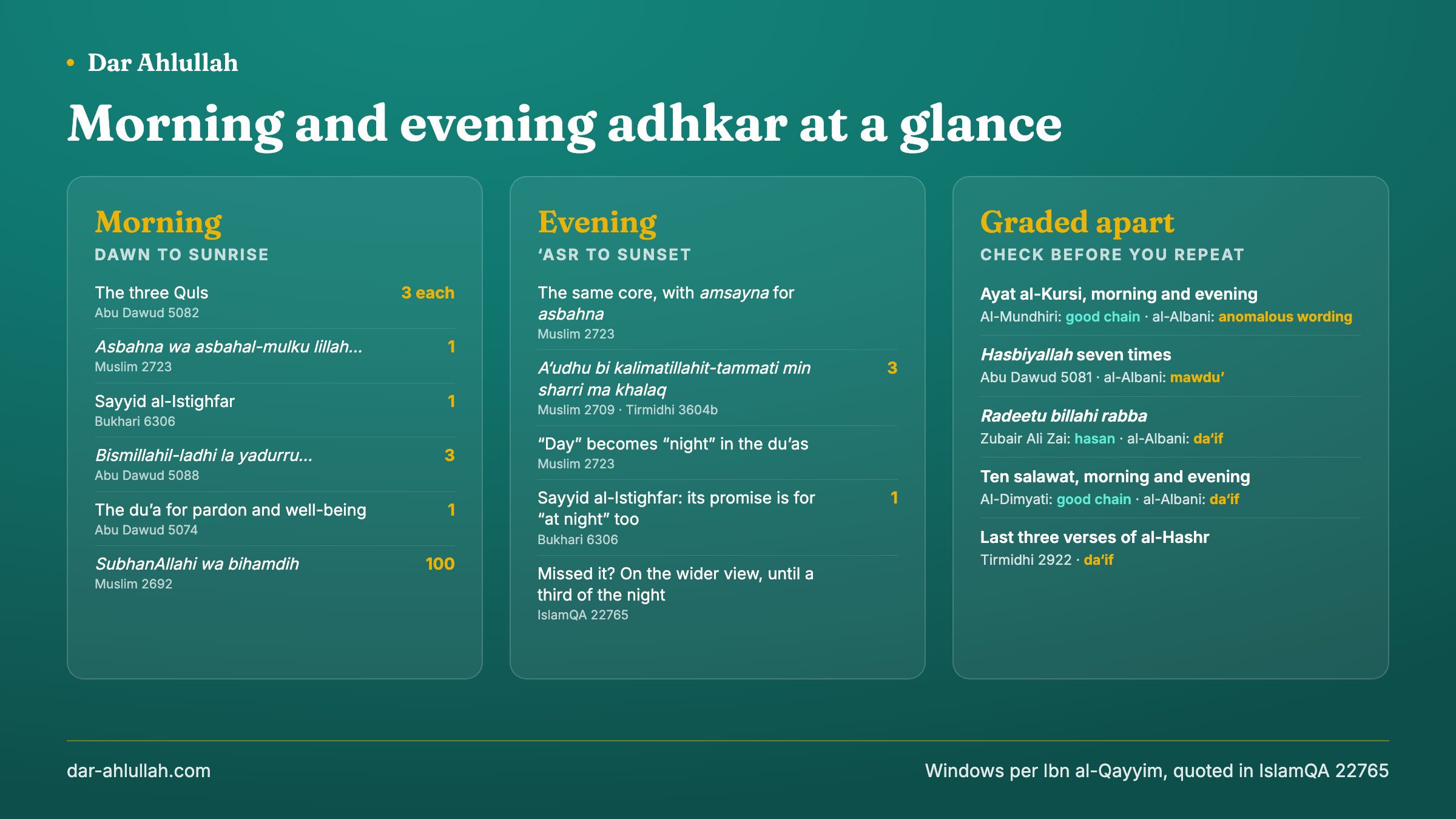
- The core, all sound: the three Quls three times each; Sayyid al-Istighfar; asbahna wa asbahal-mulku lillah; Allahumma bika asbahna; Allahumma ‘alimal-ghaybi wash-shahadah; bismillahil-ladhi la yadurru three times; the du’a for pardon and well-being; and in the evening, a‘udhu bi kalimatillahit-tammat.
- Graded apart: Ayat al-Kursi for the morning and evening, radeetu billahi rabba, ten salawat, and Allahumma ‘afini fi badani have graders on both sides.
- Graded weak or worse: hasbiyallahu la ilaha illa huwa seven times (al-Albani: mawdu’ in Abu Dawud 5081), the last three verses of Surat al-Hashr (Tirmidhi 2922), and several others set out in a table below.
- Missed them? Ibn ‘Uthaymin: “I hope that he will be rewarded” for making them up.
- Say them, do not only hear them: the adhkar have to be spoken with the tongue to count (IslamQA 70577).
When Does “Morning” Begin, and When Does “Evening” End?
Almost every report in this article opens with a time: “whoever says in the morning…”, “when he reaches the evening…”. IslamQA’s answer on the question takes this to make the time part of the Sunnah: “the correct view is that there is a set time”. Where the scholars differ is on where each window starts and stops. The views, as IslamQA sets them out in its answer on the question, are these:
| Window | Earliest | Ideal | Latest, on the wider views |
|---|---|---|---|
| Morning | Dawn, the beginning of Fajr time | Between dawn and sunrise | The end of the forenoon (duha), “shortly before the time for Zuhr prayer” |
| Evening | ‘Asr; some scholars said sunset | Between ‘Asr and Maghrib | When a third of the night has passed |
The basis for the ideal windows is Ibn al-Qayyim’s reading of the two verses above. Quoted in IslamQA 22765 from al-Wabil al-Sayyib, he said that “before the rising of the sun and before its setting” is the interpretation of the hadiths that say “in the morning… and in the evening”, so that “the time for that is between dawn and sunrise, and between ‘Asr and Maghrib”. Ibkar is the first part of the day and ‘ashiy the latter part. IslamQA’s own conclusion is to aim for those windows and, if they are missed, to say the morning adhkar before the forenoon ends and the evening adhkar before a third of the night has gone.
The Hanafi answers say much the same. Shaykh Yusuf Shabbir gives “between dawn (Fajr beginning time) and sunrise” for the morning and “between ‘Asr and sunset” for the evening, citing al-Nawawi, Ibn al-Qayyim and Ibn Taymiyyah, adds that if that time is missed the adhkar “can be read after sunrise and sunset respectively”, and makes one refinement: where a hadith names the night or the time after sunset for a particular dhikr, that dhikr is better said after sunset. His examples are the last two verses of Surat al-Baqarah and bismillahil-ladhi la yadurru (islamqa.org 118148). Mawlana Muhammad Abasoomar, asked whether the evening du’as belong after ‘Asr or after Maghrib, answered that they “may ideally be recited after ‘Asr or Maghrib or later”, citing al-Futuhat al-Rabbaniyyah and al-Wabil al-Sayyib (HadithAnswers).
In practice, then: the morning adhkar fit in the gap after you pray Fajr and before the sun is up, and the evening adhkar in the hour or so between ‘Asr and Maghrib. If your day does not allow that, the wider windows are a real scholarly position, not a loophole. Because the windows are defined by dawn, sunrise, ‘Asr and sunset, they move with the seasons; where Fajr itself has to be set by a calculation convention in summer, the same convention sets the start of your morning (see prayer times at high latitude).
The Sound Core: Each Dhikr, Its Count and Its Grade
These are the morning and evening adhkar whose reports are in the Sahihayn or are graded sahih or hasan by the graders cited. The grade column gives the hadith grader’s verdict as printed with the report; “al-Albani” refers to his grading of the Sunan.
| Dhikr | Count | When | Source and grade |
|---|---|---|---|
| Surat al-Ikhlas, al-Falaq and an-Nas: “they will suffice you against everything” | 3 each | Morning and evening | Abu Dawud 5082, Tirmidhi 3575: hasan (al-Albani) |
| Sayyid al-Istighfar, the chief of the prayers for forgiveness | 1 | Day and night | Sahih al-Bukhari 6306 |
| Asbahna wa asbahal-mulku lillah… / Amsayna wa amsal-mulku lillah… | 1 | Morning / evening wording | Sahih Muslim 2723 |
| Allahumma bika asbahna wa bika amsayna… | 1 | Morning / evening wording | Abu Dawud 5068, Tirmidhi 3391, Ibn Majah 3868: sahih (al-Albani) |
| Allahumma ‘alimal-ghaybi wash-shahadah…, taught to Abu Bakr | 1 | Morning, evening and bedtime | Abu Dawud 5067, Tirmidhi 3392: sahih (al-Albani) |
| Bismillahil-ladhi la yadurru ma‘asmihi shay’un… | 3 | Morning and evening | Abu Dawud 5088, Ibn Majah 3869: sahih (al-Albani); Tirmidhi 3388: hasan sahih |
| Allahumma inni as’alukal-‘afwa wal-‘afiyah…, which he “never failed to utter” | 1 | Morning and evening | Abu Dawud 5074, Ibn Majah 3871: sahih (al-Albani) |
| Ya Hayyu ya Qayyum, bi rahmatika astaghith… | 1 | Morning and evening | al-Nasa’i, al-Sunan al-Kubra: hasan (al-Albani, Sahih al-Targhib 661; Shu‘ayb al-Arna’ut), via Dorar |
| Asbahna ‘ala fitratil-Islam… | 1 | Morning | Ahmad 15367: sahih (Shu‘ayb al-Arna’ut); al-‘Iraqi: chain sahih, via Dorar. See the evening note below |
| SubhanAllahi wa bihamdih, ‘adada khalqih… | 3 | After Fajr, in the morning | Sahih Muslim 2726 |
| A‘udhu bi kalimatillahit-tammati min sharri ma khalaq | 3 | Evening | Sahih Muslim 2709; Abu Dawud 3898: sahih (al-Albani); the count of three in Tirmidhi 3604b: sahih (Darussalam) |
| La ilaha illallahu wahdahu la sharika lah… | 1 (or 100 in the day) | Morning and evening | Abu Dawud 5077: sahih (al-Albani); the hundred in Sahih al-Bukhari 3293 |
| SubhanAllahi wa bihamdih | 100 | Morning and evening | Sahih Muslim 2692 |
The Morning Adhkar, One by One
There is no order fixed by any one hadith; these are separate reports, and you may say them in any sequence. The order below is simply a practical one: the protections first, then the declarations, then the counted dhikr, which can run on while you do something else.
1. The three Quls, three times each
‘Abdullah ibn Khubayb went out on a dark, rainy night to find the Prophet ﷺ, who told him three times, “Say,” before telling him what: “Say: ‘Say, He is Allah, One,’ and al-Mu‘awwidhatan three times in the morning and evening; they will serve you for every purpose” (Abu Dawud 5082). In al-Tirmidhi’s wording: “they will suffice you against everything” (Tirmidhi 3575). Recite Qul huwa Allahu ahad (112), Qul a‘udhu bi rabbil-falaq (113) and Qul a‘udhu bi rabbin-nas (114), each three times, including the opening Bismillahir-Rahmanir-Rahim.
2. Asbahna wa asbahal-mulku lillah
‘Abdullah ibn Mas‘ud reported this as what the Prophet ﷺ himself said each evening, adding that “when it was morning he said like this” (Sahih Muslim 2723). The morning form:
Asbahna wa asbahal-mulku lillah, wal-hamdu lillah. La ilaha illallahu wahdahu la sharika lah, lahul-mulku wa lahul-hamdu wa huwa ‘ala kulli shay’in qadir. Rabbi as’aluka khayra ma fi hadhal-yawmi wa khayra ma ba‘dah, wa a‘udhu bika min sharri ma fi hadhal-yawmi wa sharri ma ba‘dah. Rabbi a‘udhu bika minal-kasali wa su’il-kibar. Rabbi a‘udhu bika min ‘adhabin fin-nari wa ‘adhabin fil-qabr.
“We have entered the morning, and the whole dominion of Allah has entered the morning, and praise is due to Allah. There is no god but Allah alone, without partner; His is the dominion and His is the praise, and He has power over all things. My Lord, I ask You for the good of this day and the good of what follows it, and I seek refuge in You from the evil of this day and the evil of what follows it. My Lord, I seek refuge in You from laziness and the misery of old age. My Lord, I seek refuge in You from a punishment in the Fire and a punishment in the grave.”
3. Allahumma bika asbahna
Abu Hurayrah reported that the Prophet ﷺ used to teach his Companions to say on reaching the morning: Allahumma bika asbahna, wa bika amsayna, wa bika nahya, wa bika namut, “O Allah, by You we enter the morning and by You we enter the evening, by You we live and by You we die”, with a closing phrase that the narrations place differently: in al-Tirmidhi’s wording the morning ends wa ilaykal-masir (“and to You is the return”) and the evening wa ilaykan-nushur (“and to You is the resurrection”); Ibn Majah’s gives only the evening ending, wa ilaykal-masir (Tirmidhi 3391, Ibn Majah 3868, Abu Dawud 5068). Both endings appear in narrations graded sahih, which is why printed lists differ on the order.
4. Sayyid al-Istighfar
Allahumma anta rabbi, la ilaha illa ant. Khalaqtani wa ana ‘abduk, wa ana ‘ala ‘ahdika wa wa‘dika mastata‘t. A‘udhu bika min sharri ma sana‘t. Abu’u laka bi ni‘matika ‘alayya, wa abu’u laka bi dhanbi, faghfir li, fa innahu la yaghfirudh-dhunuba illa ant.
“O Allah, You are my Lord; there is no god but You. You created me and I am Your servant, and I hold to Your covenant and Your promise as far as I am able. I seek refuge in You from the evil of what I have done. I acknowledge Your blessing upon me and I acknowledge my sin, so forgive me, for none forgives sins but You.”
The Prophet ﷺ called it the most superior way of asking forgiveness and said: “If somebody recites it during the day with firm faith in it, and dies on the same day before the evening, he will be from the people of Paradise; and if somebody recites it at night with firm faith in it, and dies before the morning, he will be from the people of Paradise” (Sahih al-Bukhari 6306). Note that the promise is for the day and for the night, which is why it belongs to both lists. Our article on salat al-tawbah covers the same words in the setting of repentance.
5. Allahumma ‘alimal-ghaybi wash-shahadah
Abu Bakr asked the Prophet ﷺ for something to say in the morning and the evening, and was told:
Allahumma ‘alimal-ghaybi wash-shahadah, fatiras-samawati wal-ard, rabba kulli shay’in wa malikah. Ash-hadu an la ilaha illa ant. A‘udhu bika min sharri nafsi, wa min sharrish-shaytani wa shirkih.
“O Allah, Knower of the unseen and the seen, Originator of the heavens and the earth, Lord and Owner of everything: I bear witness that there is no god but You. I seek refuge in You from the evil of my own self, and from the evil of Satan and his call to associate partners with You.”
“Say it when you reach morning, and evening, and when you go to bed” (Tirmidhi 3392; Abu Dawud 5067; both sahih per al-Albani).
6. Bismillahil-ladhi la yadurru, three times
Bismillahil-ladhi la yadurru ma‘asmihi shay’un fil-ardi wa la fis-sama’, wa huwas-Sami‘ul-‘Alim.
“In the name of Allah, with whose name nothing on earth or in the heavens can cause harm, and He is the All-Hearing, the All-Knowing.”
‘Uthman ibn ‘Affan reported that whoever says it three times in the morning “will not suffer sudden affliction till the evening”, and in the evening, till the morning (Abu Dawud 5088). The report carries its own human footnote: the narrator, Aban, had been struck by partial paralysis, and when a listener stared at him he said that the hadith was true, “but that day when I was afflicted by it, I became angry and forgot to say them.”
7. The du’a for pardon and well-being
Ibn ‘Umar said the Prophet ﷺ “never failed to utter these supplications in the evening and in the morning” (Abu Dawud 5074; Ibn Majah 3871; sahih per al-Albani):
Allahumma inni as’alukal-‘afwa wal-‘afiyata fid-dunya wal-akhirah. Allahumma inni as’alukal-‘afwa wal-‘afiyata fi dini wa dunyaya wa ahli wa mali. Allahummastur ‘awrati, wa amin raw‘ati. Allahummahfazni min bayni yadayya, wa min khalfi, wa ‘an yamini, wa ‘an shimali, wa min fawqi, wa a‘udhu bi ‘azamatika an ughtala min tahti.
“O Allah, I ask You for pardon and well-being in this world and the next. O Allah, I ask You for pardon and well-being in my religion and my worldly affairs, my family and my property. O Allah, cover my faults and calm my fears. O Allah, guard me from in front of me and behind me, from my right and my left, and from above me, and I seek refuge in Your greatness from being taken unawares from beneath me.”
8. Ya Hayyu ya Qayyum
Anas reported that the Prophet ﷺ told his daughter Fatimah: “What prevents you from listening to what I advise you? That you say in the morning and the evening: Ya Hayyu ya Qayyum, bi rahmatika astaghith, aslih li sha’ni kullah, wa la takilni ila nafsi tarfata ‘ayn” — “O Ever-Living, O Sustainer of all, in Your mercy I seek help: set right all my affairs, and do not leave me to myself for the blink of an eye.” Al-Nasa’i recorded it in al-Sunan al-Kubra, and al-Albani (Sahih al-Targhib 661) and Shu‘ayb al-Arna’ut both graded it hasan (the gradings are collected on Dorar).
9. Asbahna ‘ala fitratil-Islam, in the morning
‘Abd al-Rahman ibn Abza reported that on reaching the morning the Prophet ﷺ said: Asbahna ‘ala fitratil-Islam, wa ‘ala kalimatil-ikhlas, wa ‘ala dini nabiyyina Muhammad ﷺ, wa ‘ala millati abina Ibrahim, hanifan musliman wa ma kana minal-mushrikin — “We have entered the morning upon the natural way of Islam, upon the word of sincere devotion, upon the religion of our Prophet Muhammad, and upon the way of our father Ibrahim, who was upright, a Muslim, and not one of those who associate partners with Allah.” Imam Ahmad recorded it (15367); Shu‘ayb al-Arna’ut graded it sahih and al-‘Iraqi called its chain sahih.
10. SubhanAllahi wa bihamdih, ‘adada khalqih, three times
Juwayriyah, the Prophet’s wife, was still sitting in her place of prayer from Fajr when he came back in the forenoon. He told her he had said four phrases three times since leaving her that would outweigh everything she had said since the morning: SubhanAllahi wa bihamdih, ‘adada khalqih, wa rida nafsih, wa zinata ‘arshih, wa midada kalimatih — “Glory and praise be to Allah, as many times as the number of His creation, as much as pleases Him, as heavy as the weight of His Throne, and as much as the ink of His words” (Sahih Muslim 2726). It is a morning dhikr by its setting, and a lesson in itself: a few words said with weight can stand beside hours.
In the Evening: What Changes
Most of the core is said again in the evening with the words turned around. Four changes matter.
“Morning” becomes “evening”, and “day” becomes “night”. Ibn Mas‘ud’s report is actually given in its evening form first: Amsayna wa amsal-mulku lillah… Rabbi as’aluka khayra ma fi hadhihil-laylati wa khayra ma ba‘daha, wa a‘udhu bika min sharri ma fi hadhihil-laylati wa sharri ma ba‘daha… (Sahih Muslim 2723). Allahumma bika amsayna, wa bika asbahna… reverses the order of morning and evening.
One evening-only refuge. A man came to the Prophet ﷺ having been stung by a scorpion in the night and was told: “Had you recited these words in the evening, ‘I seek refuge in the perfect words of Allah from the evil of what He created,’ it would not have done any harm to you” (Sahih Muslim 2709; Abu Dawud 3898, sahih per al-Albani). Al-Tirmidhi’s narration gives the count: “Whoever says three times when he reaches the evening…” (Tirmidhi 3604b). A‘udhu bi kalimatillahit-tammati min sharri ma khalaq. The same words, said on stopping at any place, protect the traveller until he leaves it (Tirmidhi 3437).
The fitrah declaration stays a morning dhikr. Some lists include an evening version, amsayna ‘ala fitratil-Islam. Al-Albani judged the words “and in the evening” in that report anomalous (shadhdh) and not established (al-Silsilah al-Sahihah 6/1230, on Dorar), and the version that al-‘Iraqi and al-Arna’ut graded sound gives only the morning.
Night-specific items may wait for sunset. On Shaykh Yusuf Shabbir’s refinement, a dhikr whose report speaks of the night is better said after Maghrib; his own example from this list is bismillahil-ladhi la yadurru, which al-Tirmidhi’s narration ties to “the evening of every night” (Tirmidhi 3388). Sayyid al-Istighfar’s promise is likewise worded for “at night”. Saying the whole set between ‘Asr and Maghrib is also within the windows the scholars above describe.
Ayat al-Kursi: Morning and Evening, or Bedtime?
Ayat al-Kursi (2:255) appears at the head of nearly every morning and evening list. Its place there rests on a single report, and the hadith scholars graded that report differently.
The report is Ubayy ibn Ka‘b’s. He found something stealing from his store of dates at night, caught it, and it turned out to be a jinn. Asked what protects people from them, it answered: “This verse in Surat al-Baqarah: Allahu la ilaha illa Huwal-Hayyul-Qayyum. Whoever says it in the evening is protected from us until the morning, and whoever says it in the morning is protected from us until the evening.” In the morning Ubayy told the Prophet ﷺ, who said: “The wicked one spoke the truth.” Al-Nasa’i recorded it in al-Sunan al-Kubra (10730), along with Ibn Hibban and al-Tabarani.
| Grader | Verdict | Where |
|---|---|---|
| Al-Mundhiri | “Its chain is good” (isnaduhu jayyid) | al-Targhib wal-Tarhib 1/313 |
| Al-Dimyati | “Its chain is sahih” | al-Matjar al-Rabih 222 |
| Al-Albani | The morning-and-evening wording is “an anomalous addition” (ziyadah shadhdhah), not established | al-Silsilah al-Sahihah 7/743 |
All three verdicts are collected on Dorar’s hadith encyclopedia. So Ayat al-Kursi in the morning and evening has a report that two classical hadith scholars accepted and a modern one rejected in that wording — a genuine difference, not a settled question either way.
What is not in dispute is Ayat al-Kursi at bedtime. In Abu Hurayrah’s story of the man caught taking from the Ramadan charity, the thief teaches him to recite it whenever he goes to bed: “Allah will appoint a guard for you who will stay with you and no satan will come near you till morning”; and the Prophet ﷺ says, “He really spoke the truth, although he is an absolute liar” (Sahih al-Bukhari 2311). And after the prescribed prayers it has its own report, covered in our article on adhkar after salah. Whatever you conclude about the morning and evening wording, a person who recites it after Fajr, after ‘Asr and at bedtime is reciting it at times with reports behind them.
The Counted Adhkar: Ten and One Hundred
Two short phrases carry counts and some of the largest promises in the whole subject.
SubhanAllahi wa bihamdih, a hundred times morning and evening. “He who recites in the morning and in the evening ‘Glory be to Allah, and praise be to Him’ one hundred times, no one will bring on the Day of Resurrection anything better than this, except one who says the same or more” (Sahih Muslim 2692; also Abu Dawud 5091). A separate report, without the morning and evening, promises that whoever says it a hundred times in a day “will be forgiven all his sins even if they were as much as the foam of the sea” (Sahih al-Bukhari 6405).
La ilaha illallahu wahdahu la sharika lah, lahul-mulku wa lahul-hamdu wa huwa ‘ala kulli shay’in qadir. Said in the morning — the report gives no count — it carries the reward of freeing a slave from the descendants of Isma‘il, ten good deeds recorded, ten bad deeds removed, ten degrees raised, and protection from the Devil until the evening, and the same in the evening until the morning (Abu Dawud 5077, sahih per al-Albani). Said a hundred times in a day, it equals freeing ten slaves, with a hundred good deeds written, a hundred bad deeds erased, “and on that day he will be protected from the morning till evening from Satan” (Sahih al-Bukhari 3293; Sahih Muslim 2691).
The hundreds are where most people stall, because they take time. They are also the part that does not need you to sit still. They can be said walking to the station, on the school run or doing the dishes, counted on the fingers, provided they are actually spoken (see below).
Popular Adhkar the Hadith Scholars Grade Apart
Every item in this table is in common morning and evening lists. The grades are as printed with the reports. Where graders disagree, both are given.
| Dhikr, as commonly listed | Source | Graded sound by | Graded weak by |
|---|---|---|---|
| Hasbiyallahu la ilaha illa huwa, ‘alayhi tawakkaltu wa huwa rabbul-‘arshil-‘azim, seven times | Abu Dawud 5081, where it is Abu al-Darda’s own saying | Zubair Ali Zai: chain hasan | Al-Albani: mawdu’ (fabricated) |
| Radeetu billahi rabba, wa bil-Islami dina, wa bi Muhammadin nabiyya | Abu Dawud 5072, Tirmidhi 3389, Ibn Majah 3870 | Zubair Ali Zai and Bashar ‘Awwad Ma‘ruf: hasan | Al-Albani and Ahmad Shakir: da‘if |
| Ten salawat on the Prophet ﷺ morning and evening, “my intercession will reach him” | Al-Tabarani | Al-Dimyati: chain good | Al-Albani: da‘if (Da‘if al-Targhib 396); al-‘Iraqi: a break in the chain (both via Dorar) |
| Allahumma ‘afini fi badani…, three times | Abu Dawud 5090 | Al-Albani: chain hasan | Zubair Ali Zai: da‘if |
| Allahumma inni asbahtu ush-hiduka wa ush-hidu hamalata ‘arshik…, four times | Abu Dawud 5069, 5078 | Zubair Ali Zai (both) and Shu‘ayb al-Arna’ut (5078): hasan | Al-Albani: da‘if |
| Allahumma ajirni minan-nar, seven times after Maghrib and Fajr | Abu Dawud 5079 | Zubair Ali Zai: hasan | Al-Albani and al-Arna’ut: da‘if |
| Allahumma ma asbaha bi min ni‘matin… | Abu Dawud 5073 | — | Al-Albani, al-Arna’ut and Zubair Ali Zai: da‘if |
| Asbahna wa asbahal-mulku lillahi rabbil-‘alamin… fathahu wa nasrahu wa nurahu… | Abu Dawud 5084 | — | Al-Albani and Zubair Ali Zai: da‘if |
| A‘udhu billahis-Sami‘il-‘Alimi minash-shaytanir-rajim three times, then the last three verses of Surat al-Hashr | Tirmidhi 2922 | — | Ahmad Shakir, al-Albani and Zubair Ali Zai: da‘if |
| Fa subhanallahi hina tumsuna wa hina tusbihun… (30:17–19) in the morning, to make up what the day missed | Abu Dawud 5076 | — | Al-Albani: very weak |
Two things follow from this, and they pull in different directions.
First, a weak grade is not a verdict on the words. Radeetu billahi rabba is a sound phrase in its own right: the same declaration is in the sahih report on responding to the adhan (see how to respond to the adhan). Hasbiyallah is close to the wording of a Qur’anic verse (9:129). What a weak grade affects is the attachment: the count, the timing and the promise cannot be quoted as the Prophet’s ﷺ with confidence.
Second, the scholars differ on acting on weak reports in matters of virtue at all. IslamQA summarises Ibn Hajar’s three conditions for those who allow it — the report must not be very weak, it must concern a deed that has a basis in the Shari‘ah, and the person must not believe it to be established — and quotes Ibn Taymiyyah that the practice means hoping for a reward for a deed already known to be prescribed, not establishing a new one (IslamQA 44877). Under those conditions, a report graded mawdu’ or very weak is excluded on every view. The practical course is the one the adhkar after salah article recommends too: learn the sound core first, then decide about the rest with your teacher.
Not to Be Confused With: After Fajr, and Bedtime
Three other sets of remembrance sit right next to the morning and evening adhkar and are often merged with them.
- The adhkar after the prayer. Astaghfirullah three times, Allahumma antas-salam, the tasbih counts, and the items tied specifically to the end of Fajr and Maghrib belong to the prayer, not to the time of day. They are said after the salam, before or after the sunnah rak‘ahs depending on the school. They have their own article: adhkar after salah. In a busy morning the two run together — you finish the after-prayer adhkar of Fajr and carry straight on into the morning adhkar — but they are different reports with different promises.
- The bedtime adhkar. Al-Bara’ ibn ‘Azib’s du’a before sleeping, Allahumma aslamtu wajhi ilayk…, with the instruction to make it the last thing said (Sahih al-Bukhari 247), and Ayat al-Kursi at bedtime, belong to the night’s end, not to the evening.
- The forenoon prayer. The ideal morning window closes at sunrise, shortly before the time for salat ad-duha opens. Juwayriyah, sitting in remembrance from Fajr into the forenoon, is the bridge between the two.
Saying Them: Aloud, From a Phone, in English
They must be spoken, not only thought. IslamQA, asked whether the morning adhkar can be said in the mind, answered: “With regard to the Adhkar which are spoken on the tongue, such as reciting Quran, saying Tasbih, Tahmid, and Tahlil, and the Dhikrs to be recited in the morning and evening… it is essential to move the tongue, and a person is not regarded as having said them if he does not move his tongue” (IslamQA 70577). The Shafi‘i position, from al-Nawawi, is that legislated dhikr “is not counted or deemed valid unless expressed with the tongue such that the person can hear himself, if sound of hearing” (SeekersGuidance, via islamqa.org 169135). That does not mean loud. It means your lips move and the words are actually said.
Listening to a recording does not replace saying them. IslamWeb answered a questioner who could not read Arabic and wanted to listen instead: listening “does not substitute for reciting them because reciting Dhikr is a verbal act of worship”, but “whoever cannot read them because he cannot speak Arabic, there is nothing wrong with listening to the Adhkar and repeating after the reciter”, until he can say them himself (IslamWeb 456184). So a recording is a fine teacher, played a line at a time with you repeating after it.
Reading from a phone, a card or a book is how nearly everyone learns them. None of the answers quoted here asks you to have them memorised first; what they ask is that you say them.
In English. SeekersGuidance, asked whether the adhkar in al-Nawawi’s collection may be said in English, answered that “there is no harm in saying the translations… in English, however, the maximal benefit comes from saying them in Arabic”, and pointed to al-Bara’ ibn ‘Azib: when he repeated his bedtime du’a back with “Your Messenger” in place of “Your Prophet”, the Prophet ﷺ corrected him to the original word (SeekersGuidance). The advice it gives is the advice of this article too: memorise the Arabic, learn the meaning beside it, and let the two grow together. Many of these phrases use the most frequent words in the Qur’an (the most common words in the Quran), so a few weeks of adhkar is also a few weeks of vocabulary.
Reading Them During a Period
The adhkar themselves — the du’as, the tasbih, the declarations — are dhikr, and dhikr is not forbidden during menstruation on any view quoted here. The only question is the Qur’anic part: the three Quls, and Ayat al-Kursi if you include it.
- The Hanafi answer. Reciting the Qur’an is not permitted during menstruation or major impurity, but SeekersGuidance, asked about precisely this case — the Mu‘awwidhatayn, Ayat al-Kursi and the morning and evening supplications — answered that “it is permissible for those in a state of major ritual impurity or menstruation to recite the morning and evening supplications with the intention of protection from the devil”, and that Qur’anic verses may be said with the intention of du’a rather than recitation (SeekersGuidance, Shaykh Anas al-Musa).
- The majority’s exception. IslamQA notes that the majority of jurists, who forbid recitation during a period, still make an exception for dhikr and for Qur’anic phrases “not intended as tilawah” (IslamQA 2564).
- The view that permits recitation. The same answer records that Malik, one narration from Ahmad, Ibn Taymiyyah and al-Shawkani held that a menstruating woman may recite the Qur’an, Ibn Taymiyyah observing that women menstruated in the Prophet’s time and he did not forbid them to recite or to remember Allah. On that view the question does not arise. Touching the mushaf is a separate matter, which IslamQA holds forbidden in any state of impurity — one more reason a phone or a printed card of adhkar is the usual way to read them.
If You Miss Them
Life does not always leave the twenty minutes between Fajr and sunrise free. Three answers apply.
- Use the wider window. The morning adhkar before the forenoon ends and the evening adhkar before a third of the night has passed are within the views IslamQA reports (IslamQA 22765).
- Read them late. The Hanafi answer: “If this time is not possible or missed on a particular day, the Adhkar can be read after sunrise and sunset respectively” (islamqa.org 118148).
- Make them up. Ibn ‘Uthaymin: “With regard to making it up if he forgets it, I hope that he will be rewarded for that” (quoted in IslamQA 22765).
These are voluntary acts of remembrance. The reports promise reward and protection to the one who says them and say nothing against the one who does not. Missing a morning is a missed opportunity, not a debt.
A Short Version, Every Line Sound
If the full list feels like too much to start with, this is a set built only from the core table, every line from the Sahihayn or graded sahih or hasan by al-Albani. The first six items take a few minutes at a normal pace.
- The three Quls, three times each (Abu Dawud 5082).
- Asbahna wa asbahal-mulku lillah… in the morning, amsayna… in the evening (Muslim 2723).
- Sayyid al-Istighfar, once (Bukhari 6306).
- Bismillahil-ladhi la yadurru…, three times (Abu Dawud 5088).
- Allahumma inni as’alukal-‘afwa wal-‘afiyah…, once (Abu Dawud 5074).
- In the evening only: A‘udhu bi kalimatillahit-tammati min sharri ma khalaq, three times (Muslim 2709; Tirmidhi 3604b).
- Then, wherever you are, SubhanAllahi wa bihamdih as close to a hundred as the day allows (Muslim 2692).
Add one more item from the core table each week, and in about two months you will have all of it, learned in the right order: the sound reports first.
How We Teach This
Most of the morning and evening adhkar are learned by ear and said in a hurry, and anything said twice a day for years sets hard — mispronunciations included. The three Quls are Qur’an, with the rules of recitation that apply to any Qur’an, and phrases like a‘udhu bi kalimatillahit-tammat carry letters that English speakers commonly flatten. Reading can give you the list. It cannot tell you whether what is coming out of your mouth matches it.
Dar Ahlullah runs one-to-one live sessions with certified teachers, scheduled in your own timezone. Teaching is charged at $9 per teaching hour, with monthly plans at $36, $70 and $102 depending on how many hours you want, and a 20% discount for siblings. You can pause, upgrade or switch plans at any time, and if a teacher is not the right fit we rematch you with another certified mentor at no extra cost. If you want to know where your recitation stands before committing to anything, the 30-minute assessment is free and does not ask for a card — the details are on our pricing page. For the bigger picture of the prayer these adhkar are built around, start with our complete guide to learning salah.
Questions People Ask
What are the morning and evening adhkar?
They are the remembrances and supplications the Prophet ﷺ said or taught for the morning and the evening: the three Quls three times each, Sayyid al-Istighfar, asbahna wa asbahal-mulku lillah, bismillahil-ladhi la yadurru three times, the du’a for pardon and well-being, and others. Each is a separate report with its own promise.
When should I read the morning adhkar?
Ideally between dawn and sunrise, which is Ibn al-Qayyim’s reading of “before the rising of the sun” (50:39). If you miss that, some scholars extend the time to the end of the forenoon, shortly before Zuhr (IslamQA 22765).
Are the evening adhkar read after ‘Asr or after Maghrib?
Both are held. Ibn al-Qayyim and the Hanafi answer of Shaykh Yusuf Shabbir give ‘Asr to sunset; other scholars said the evening starts at sunset, and some extend it to a third of the night. Items whose report mentions the night are better said after sunset on the Hanafi answer’s view.
Do I have to say all of them?
No. They are voluntary, and each report stands alone with its own promise; saying some of them is not invalidated by leaving others. Start with the sound core and build up.
Is Ayat al-Kursi part of the morning and evening adhkar?
It rests on Ubayy ibn Ka‘b’s report, whose chain al-Mundhiri called good and al-Dimyati sahih, while al-Albani judged its morning-and-evening wording anomalous. Ayat al-Kursi at bedtime is in Sahih al-Bukhari (2311) without dispute.
Is hasbiyallahu la ilaha illa huwa seven times authentic?
In Abu Dawud 5081 it is Abu al-Darda’s own saying, and al-Albani graded the report mawdu’ (fabricated); Zubair Ali Zai graded its chain hasan. The words themselves are close to Qur’an 9:129; what is not established is the count and the promise as the Prophet’s ﷺ.
Can I read the adhkar from my phone?
Yes. What is required is that you say them with your tongue, not that you have them memorised; thinking them silently is not counted as saying them (IslamQA 70577).
Can I say them in English?
SeekersGuidance answered that there is no harm in saying the translations, but the fullest benefit is in the Arabic wording, and advised memorising the Arabic and learning the meaning alongside it.
Can I say them during my period?
Yes. The du’as and dhikr are permitted on every view; the Qur’anic parts are said with the intention of du’a and protection on the Hanafi view (SeekersGuidance), fall under the majority’s exception for dhikr (IslamQA 2564), and are not restricted at all on the view of Malik and Ibn Taymiyyah.
What if I miss them?
Say them later in the day. The Hanafi answer says they can be read after sunrise or sunset, and Ibn ‘Uthaymin said of making them up: “I hope that he will be rewarded for that.”
Conclusion: The Same Words, Twice a Day
Strip the morning and evening adhkar back to what the sound reports contain and what remains is short. Three surahs you probably already know, said three times. A declaration that the day belongs to Allah. The chief of the prayers for forgiveness. A name that nothing harms with. A request for pardon and well-being that the Prophet ﷺ never once left. In the evening, a refuge in the perfect words of Allah. Then, as the day allows, a hundred glorifications.
Everything else in the long lists is either sound and worth adding as you go, or graded apart by the hadith scholars, and you now have the grades in front of you rather than having to take a poster’s word for it. That was the point of this article: not to shorten anyone’s worship, but to make sure that what you repeat twice a day for the rest of your life is what was actually said.
Aban ibn ‘Uthman narrated the hadith of bismillahil-ladhi la yadurru and then, on the one day he was angry and forgot it, was struck by paralysis. He did not conclude the hadith was wrong. He concluded that he had forgotten. The adhkar work by being said, morning after morning, evening after evening, on the days when they feel like a formality as much as on the days they do not.
Related articles
how to respond to the adhan
How to Respond to the Adhan: What to Say and the Dua After
How to respond to the adhan: repeat each phrase after the muezzin, say la hawla wa la quwwata illa billah at the two hayya lines, then send salawat and say the du'a after the adhan. This guide sets out every step from the sound reports, prints the grade on the additions people argue about, and lays out the two scholarly answers on the adhan from a phone app.
29 min read
how to pray salat al-tawbah
How to Pray Salat al-Tawbah: The Prayer of Repentance
Salat al-tawbah is two rak'ahs after a sin, taught in one sahih hadith. The method, what to say in sujud and after the salam, the forbidden-times question by school, praying it again after a relapse, sins against people, and what a new Muslim owes for the past.
25 min read
adhkar after salah
Adhkar After Salah: What to Say After Every Prayer
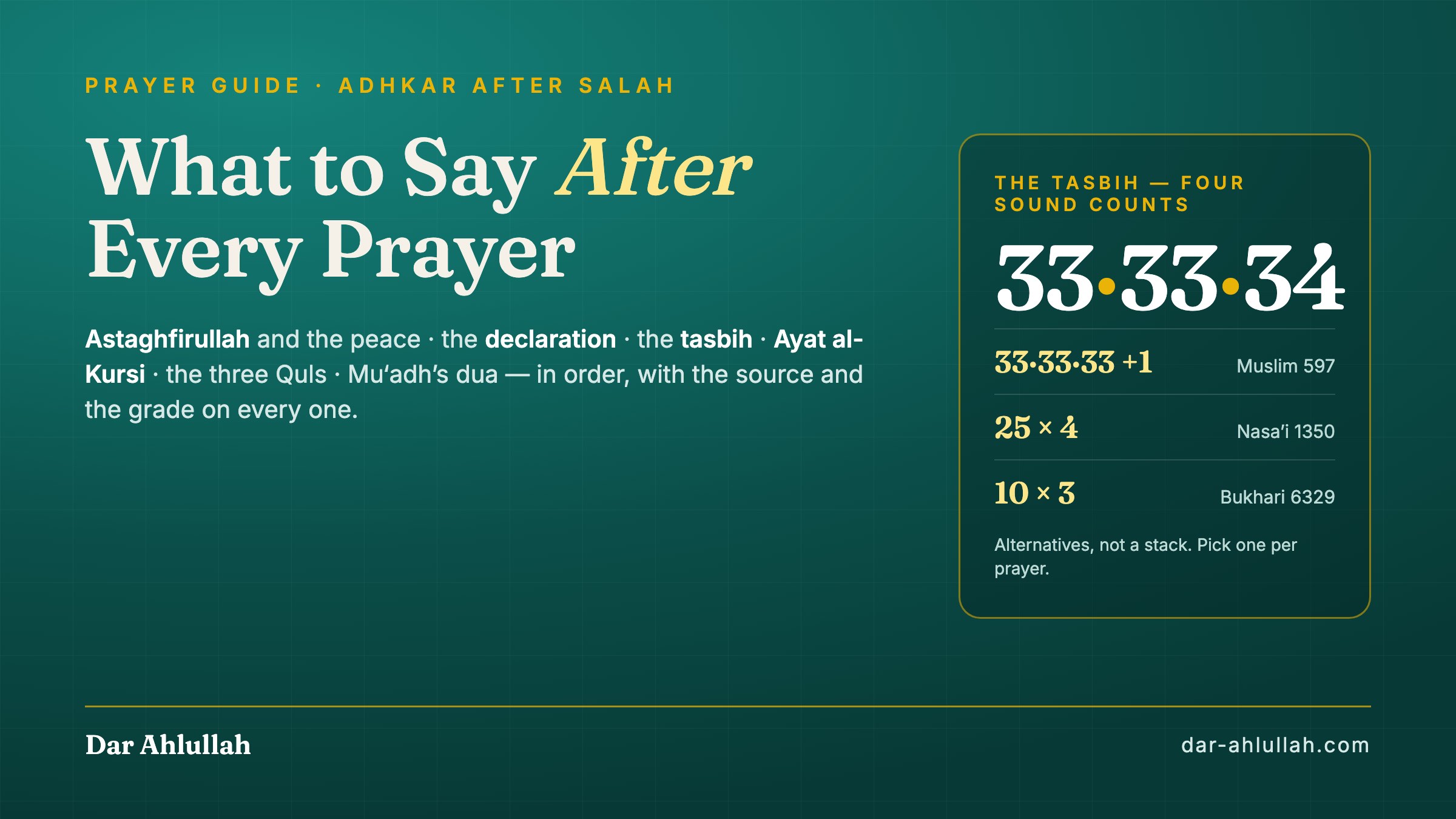
The adhkar after salah are the remembrances said in the minutes after the salam. This guide gives them in order with their sources, sets the 33-33-34, 33-33-33, 25-by-four and 10-by-three reports side by side so the counts stop looking like a contradiction, prints the grade on every famous reward, and works out which to keep when you pray Zuhr in a stairwell at work.
34 min read