
tahiyyat al-masjid
Tahiyyat al-Masjid: How to Pray the Greeting of the Mosque
Dar Ahlullah team 24 min read
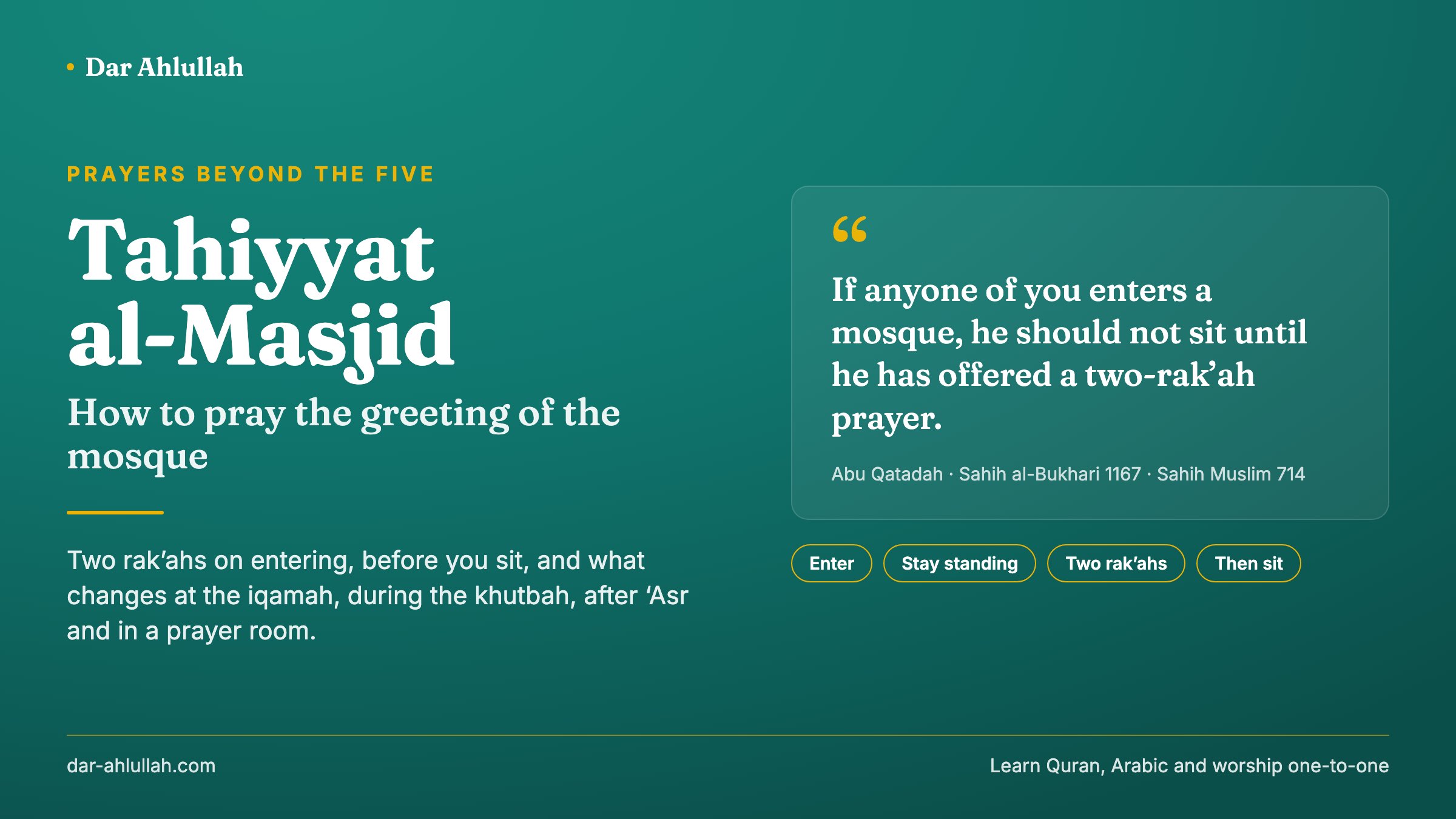
Table of Contents
- Introduction: The Room Was Sitting
- The Short Answer
- Where the Greeting Comes From
- Sunnah or Obligation?
- How to Pray Tahiyyat al-Masjid, Step by Step
- When Another Prayer Does the Job
- If You Have Already Sat Down
- Walking In During the Adhan or the Iqamah
- Arriving During the Friday Khutbah
- After Fajr, After ‘Asr and the Other Forbidden Times
- Prayer Rooms, Rented Halls and Converted Houses
- Masjid al-Haram: Tawaf or Two Rak’ahs?
- When You Cannot Pray It
- Six Situations, Worked Through
- Six Mistakes People Make
- How We Teach This
- Questions People Ask
- Conclusion: What Abu Qatadah Saw
Introduction: The Room Was Sitting
You take your shoes off at the rack, push through the second door, and the prayer hall is half full. People are sitting against the back wall, a few are reading from a mushaf, a group near the front is listening to someone talk. The congregation is not due for another ten minutes. The obvious thing to do is what everybody else is doing, so you find a space and sit down.
That is exactly what one of the Companions did. Abu Qatadah walked into the mosque in Madinah, saw the Prophet ﷺ sitting among people, and sat down with them. The Prophet ﷺ asked him what had stopped him from praying two rak’ahs before sitting. His answer was the honest one: I saw you sitting, and the people sitting. The room was sitting, so he sat. The Prophet ﷺ then gave the instruction that every guide to this prayer quotes: when one of you enters the mosque, let him not sit until he has prayed two rak’ahs.
Those two rak’ahs are known as tahiyyat al-masjid, the greeting of the mosque. They take two or three minutes. The questions come afterwards, and they come in a particular order for anyone who prays in Europe or North America. What if I have already sat down? What if the iqamah is being called as I walk in? What if the khutbah has started? What if it is after ‘Asr? And the one a guide written for Cairo or Karachi never has to answer: is the prayer room on the third floor at work, or the rented hall where we pray Jumu’ah, a mosque at all?
This guide covers how to pray tahiyyat al-masjid: its evidence and status, the method, the prayers that fulfil it without your noticing, and then each of those situations, with the positions of the schools set side by side where they differ. If the prayer itself is still new to you, start with our step-by-step guide to how to pray in Islam; this article sits in its salah library beside the other voluntary prayers.
One boundary before we begin. We teach Quran, Arabic and the practical fiqh of worship; we are not a fatwa body. Where the scholars genuinely differ we show the positions rather than pick one and call it consensus. Two of the questions below, the khutbah and the forbidden times, are real differences between the schools, and the right answer for you is the one your school or your teacher follows.
The Short Answer
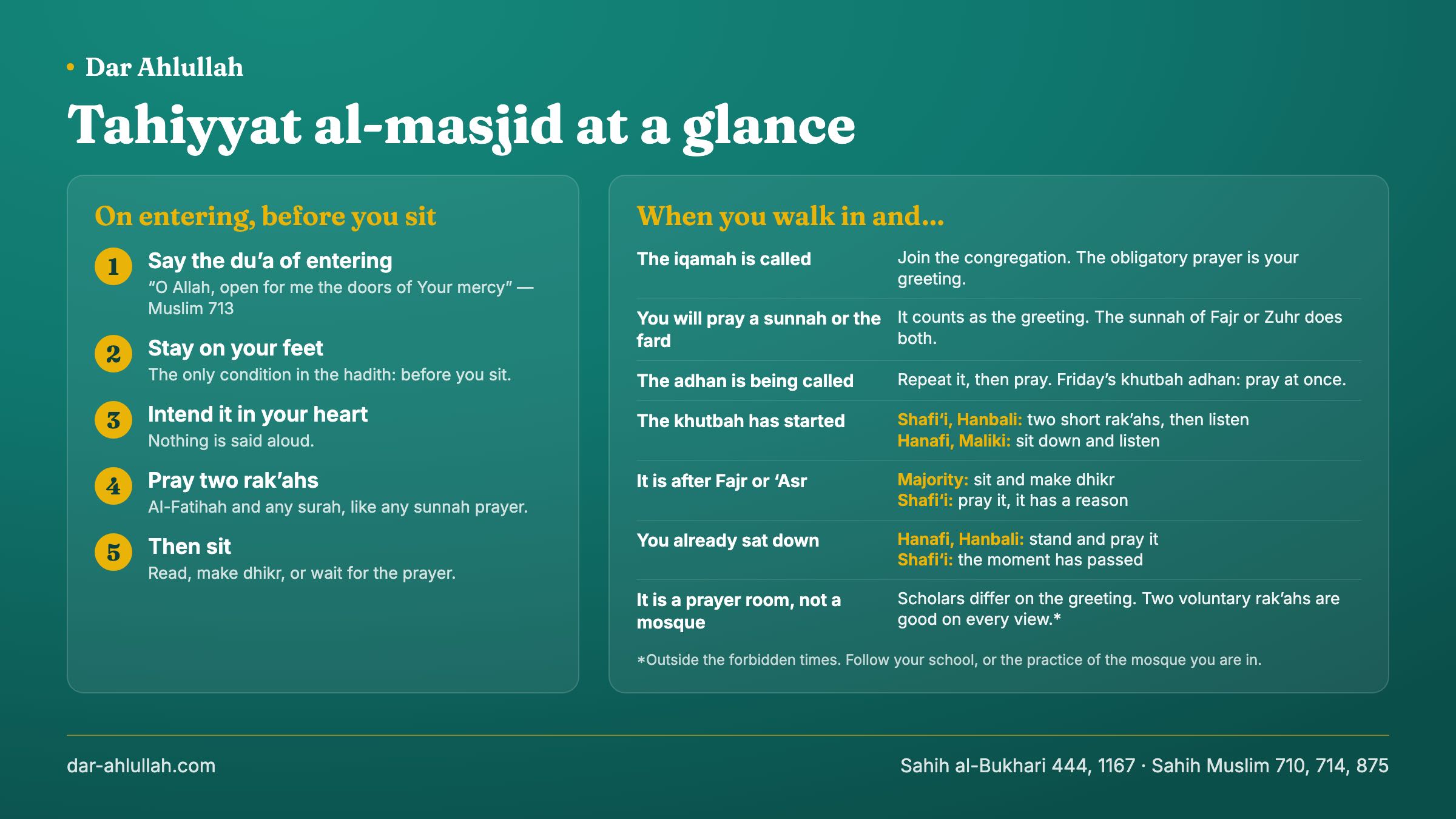
- Tahiyyat al-masjid is two rak’ahs you pray when you enter a mosque, before you sit down. It comes from the hadith of Abu Qatadah in Sahih al-Bukhari and Sahih Muslim, and the scholars agree that it is a sunnah, not an obligation.
- You pray it like any two-rak’ah sunnah prayer. Intend it in your heart, recite al-Fatihah and any surah in each rak’ah, and finish with the salam. There is no special surah, du’a or spoken intention.
- Any prayer you pray on entering counts as the greeting. The obligatory prayer, the sunnah before Fajr or Zuhr, or a make-up prayer all fulfil it. If the iqamah has been called, join the congregation; that is your greeting.
- Two situations divide the schools. During the Friday khutbah, the Shafi‘is and Hanbalis pray two short rak’ahs while the Hanafis and Malikis sit and listen. In the forbidden times after Fajr and ‘Asr, the majority hold the prayer back while the Shafi‘is pray it. Follow your school, or the practice of the mosque you are in.
- It belongs to a mosque. Whether a workplace prayer room or a rented hall counts as one is a real difference among scholars. Two voluntary rak’ahs there, outside the forbidden times, are good on every view.
Where the Greeting Comes From
The instruction itself is short. Abu Qatadah reported that the Messenger of Allah ﷺ said, “If anyone of you enters a mosque, he should pray two rak’ahs before sitting” (Sahih al-Bukhari 444). Another narration gives it as a prohibition on sitting: “he should not sit until he has offered a two-rak’ah prayer” (Sahih al-Bukhari 1167). Muslim has the same wording (Sahih Muslim 714a), and then, immediately after it, the story behind it: Abu Qatadah entering, sitting with the people because they were sitting, and being asked, “What prevented you from offering two rak’ahs before sitting down?” (Sahih Muslim 714b).
The second report that shapes almost every ruling below is about a Friday. Jabir ibn ‘Abdullah narrated that a man came into the mosque while the Prophet ﷺ was delivering the khutbah. The Prophet ﷺ asked him, “Have you prayed?” He said no. “Get up and pray two rak’ahs” (Sahih al-Bukhari 930, 931). Muslim names the man as Sulayk al-Ghatafani, records that he had already sat down, and gives the instruction in full: “Sulayk, stand and pray two rak’ahs, and make them short.” Then the Prophet ﷺ addressed everyone: “When any one of you comes on Friday while the imam is delivering the sermon, he should pray two rak’ahs and make them short” (Sahih Muslim 875g).
Two smaller reports show the same habit in ordinary life. Jabir came to the Prophet ﷺ in the mosque, and the Prophet ﷺ told him to pray two rak’ahs, then repaid a debt he owed him and gave him more than was due (Sahih al-Bukhari 443). And Ka‘b ibn Malik described what the Prophet ﷺ did when he came home from a journey: he went first to the mosque, prayed two rak’ahs in it, and only then sat down (Sahih Muslim 716).
The name comes from the jurists. Tahiyyah means a greeting, and the Hanafi manual Durr al-Mukhtar phrases the sunnah with a small addition that is worth keeping: it is a sunnah to greet the Lord of the mosque with two rak’ahs. The building is not what is being greeted. The Hanafi texts also cite a report in Sahih Ibn Hibban addressed to Abu Dharr: “The mosque has a greeting, and its greeting is two rak’ahs” (both quoted in Shaykh Faraz Rabbani’s answer at SeekersGuidance).
Sunnah or Obligation?
A sunnah. Al-Nawawi recorded that the scholars are unanimously agreed that greeting the mosque is recommended, and that it is disliked to sit down without greeting it when there is no excuse. IslamQA, which quotes him, also quotes Ibn Hajar: Ibn Battal reported from the literalist Zahiri school that it is obligatory, but Ibn Hazm, the best-known Zahiri of all, said it is not. It closes with the verdict of Shaykh Ibn ‘Uthaymin that it is a confirmed sunnah, sunnah mu’akkadah (IslamQA 181099). The Hanafi jurist Ibn ‘Abidin likewise cites consensus on its being a sunnah.
The clearest evidence that it is not owed is a hadith about something else entirely. A man from Najd came to the Prophet ﷺ asking about Islam and was told of the five daily prayers. “Is there any more?” he asked. “No, but if you want to offer the nawafil prayers” (Sahih al-Bukhari 46). Every prayer beyond the five, the greeting of the mosque included, sits in that “if you want to”.
That matters in both directions. Nobody who sits down without praying has sinned, so there is no call to reproach them. And the Prophet ﷺ still asked Abu Qatadah what had stopped him, and interrupted his own khutbah to tell Sulayk to stand, which is not how anyone treats a trivial thing. It is a sunnah he insisted on.
One practical detail for anyone who is in and out of the same mosque all day, a volunteer, a weekend-school teacher, a student in a study circle: the Hanafi texts say that praying the greeting once covers the whole day. It is a confirmed sunnah once a day, and recommended each time after that (Durr al-Mukhtar, quoted in the SeekersGuidance answer above).
How to Pray Tahiyyat al-Masjid, Step by Step
1. Say the du’a of entering
The Prophet ﷺ taught a short du’a for the doorway: Allahumma iftah li abwaba rahmatik, “O Allah, open for me the doors of Your mercy”, and on leaving, Allahumma inni as’aluka min fadlik, “O Allah, I ask You of Your bounty” (Sahih Muslim 713a). It is not part of the prayer, but it is part of arriving, and it takes five seconds.
2. Decide before you sit
The only condition the hadith sets is timing: before you sit down. Put your bag down, find your place, and stay on your feet. This is the moment the room pulls at you, and it is the whole of Abu Qatadah’s story.
3. Check that you are in wudu
The greeting is a prayer, so it needs wudu like any other. If you are unsure whether yours still holds, our guide to what breaks wudu, and what does not settles it, and the step-by-step guide to wudu has the method. Mosques usually have a wudu area near the entrance, so you can renew it before you are in the hall.
4. Intend it in your heart
Know that you are standing to pray two rak’ahs on entering the mosque. That knowing is the intention. Nothing needs to be said aloud, and as the next section shows, even intending them simply as two voluntary rak’ahs fulfils the greeting.
5. Pray two rak’ahs like any sunnah prayer
Opening takbir, al-Fatihah, any surah you know, ruku‘, sujud, the second rak’ah, the sitting and the salam, exactly as in the two sunnah rak’ahs before Fajr. If you need the words of each position, what to say in salah, position by position gives them in order. No particular surah is reported for this prayer; recite what you know.
6. Then sit
That is the whole prayer. Sit, read, make dhikr, or wait for the congregation.
How many rak’ahs?
Two is the number in the hadith, and the minimum. In the Shafi‘i school a single rak’ah prayed with the intention of greeting the mosque does not fulfil it (Tahiyyat al-Masjid, IslamQA Shafi‘i). More is allowed: Ibn ‘Abidin quotes al-Quhustani that it may be prayed as two or four rak’ahs, with four being better. If you are short of time, two is the sunnah.
When Another Prayer Does the Job
This is the part most people are never told, and it removes half the questions. The greeting is not a separate prayer that has to be squeezed in before everything else. It is two rak’ahs before sitting, and whatever you pray in those two rak’ahs counts.
Al-Nawawi put it plainly in al-Majmu‘: the greeting of the mosque is accomplished whenever someone enters and prays any two rak’ahs, whether they intend two voluntary rak’ahs, a vow, the sunnah before or after an obligatory prayer, the obligatory prayer alone, or the obligatory prayer together with the intention of greeting the mosque (quoted by Shaykh Irshaad Sedick at SeekersGuidance). The Hanafi text says the same thing more briefly: the obligatory prayer, or another prayer, takes its place even without having intended it.
- The sunnah of Fajr. The Standing Committee: praying the two rak’ahs of Fajr counts for itself and for the greeting of the mosque, and this is better than praying the greeting and then the sunnah separately (IslamQA 21206).
- The sunnah before Zuhr. IslamWeb: someone who enters can pray the confirmed sunnah before Zuhr, or any obligatory prayer, straight away, and it replaces the greeting, because the point is to pray two rak’ahs before sitting (IslamWeb fatwa 132253). Our guide to the sunnah rawatib covers which prayers have a sunnah before them.
- The obligatory prayer itself. If you walk in and pray the fard, whether with the congregation or alone because you missed it, you have greeted the mosque.
- A make-up prayer. If you owe missed prayers, a make-up prayer on entering fulfils the greeting too. In the Shafi‘i school, SeekersGuidance adds, make-up prayers take precedence over voluntary ones anyway. Our guide on how to make up missed prayers covers the rest.
So the working rule is simple. If you are about to pray something anyway, the greeting is already inside it. You only need the separate two rak’ahs when you walk in with nothing else to pray.
If You Have Already Sat Down
You came in, sat without thinking, and remembered five minutes later. Look at the two hadiths again: Abu Qatadah had sat down when the Prophet ﷺ asked him about the two rak’ahs, and Sulayk had sat down when the Prophet ﷺ told him to stand and pray them. Most scholars read that as showing the greeting survives a sitting. One school reads the condition more strictly.
| Position | Held by | What you do |
|---|---|---|
| Sitting does not cancel it | Hanafi school: “this sunnah is not lifted in our school if one sits down before praying it” (Durr al-Mukhtar) | Stand and pray the two rak’ahs |
| Sitting does not cancel it | Hanbali school: Ibn Qudamah, “if one sits before praying, it is a sunnah to stand up and pray” (al-Mughni) | Stand and pray the two rak’ahs |
| The opportunity passes once you sit | Shafi‘i school, as stated by SeekersGuidance from al-Nawawi’s Minhaj | Pray it before sitting next time |
The Hanafi and Hanbali quotations are both in the SeekersGuidance Hanafi answer cited above. IslamWeb follows the majority: someone who sits down may still stand and pray it, while noting that some jurists held it is not called for after sitting deliberately (IslamWeb fatwa 132253).
Walking In During the Adhan or the Iqamah
The adhan is being called
Shaykh Ibn ‘Uthaymin’s advice is to stay standing, repeat the adhan after the muezzin, and pray the greeting when he has finished. There is one exception: the adhan on Friday that comes just before the khutbah. Then you pray the greeting straight away, without waiting for the adhan to end, so that you are ready to listen when the khutbah begins, because listening to the khutbah is obligatory and responding to the muezzin is not (IslamQA 11960).
The iqamah has been called
Then there is no greeting to pray. The Prophet ﷺ said, “When the prayer commences, there is no prayer except the obligatory prayer” (Sahih Muslim 710a). Join the congregation. The obligatory prayer is your greeting, for the reason given above, and Shaykh Faraz Rabbani notes that when the congregation has started you can simply intend the greeting along with the prayer you are joining. Al-Nawawi, in Kitab at-Tahqiq, lists praying the greeting once the iqamah has been called among the times it is disliked.
If the imam is already in ruku‘ or further, the question is no longer the greeting but how to join and what to make up afterwards. That has its own guide: joining the prayer late.
Arriving During the Friday Khutbah
This is the difference you are most likely to see with your own eyes, because in the same mosque on the same Friday some latecomers will pray two quick rak’ahs and others will sit straight down. Both are following a school.
| Position | Held by | What you do |
|---|---|---|
| Pray two short rak’ahs, then sit and listen | The Shafi‘i and Hanbali schools, and the hadith scholars | Pray two brief rak’ahs before sitting |
| Sit down and listen; do not pray | The Hanafi and Maliki schools | Sit down at once and listen |
The first position takes the hadith of Sulayk at its word. The Prophet ﷺ stopped his khutbah to tell a man who had sat down to stand and pray, and then made it a general instruction for anyone arriving while the imam is speaking (Sahih Muslim 875g). The Shafi‘i texts go as far as calling it disliked to leave the greeting in that situation.
The second position rests on the obligation to listen. The Qur’an says, “So when the Qur’an is recited, then listen to it and pay attention that you may receive mercy” (al-A‘raf 7:204). Shaykh Sohail Hanif sets out the Hanafi reasoning: even telling someone to be quiet during the khutbah is prohibited, and a prayer takes longer than a word; and the Companions and Successors, particularly the people of Madinah, are reported not to have prayed while the khutbah was being given (SeekersGuidance, Hanafi fiqh). A second hadith is cited for sitting: a man was stepping over people’s necks during the khutbah and the Prophet ﷺ said, “Sit down, you have annoyed the people” (Sunan Abi Dawud 1118, sahih per al-Albani).
Egypt’s Dar al-Ifta, setting the positions side by side, calls it a matter of legitimate juristic difference, advises imams not to reprimand those who pray, and suggests following the practice of your local mosque to avoid confusion (Dar al-Ifta al-Missriyyah, fatwa 6797). Whichever you follow, do not correct the person next to you for following the other. For the rest of Friday, the arrival times, the silence and what to do if you miss the prayer, see how to pray Jumu’ah.
After Fajr, After ‘Asr and the Other Forbidden Times
There are windows in which voluntary prayer is prohibited. “There is no prayer after the morning prayer until the sun rises, and there is no prayer after the ‘Asr prayer until the sun sets” (Sahih al-Bukhari 586). And ‘Uqbah ibn ‘Amir named three moments: as the sun rises until it is fully up, when it stands at its height until it passes the meridian, and as it sets until it has set (Sahih Muslim 831).
The question is whether a prayer that has a reason, and entering the mosque is a reason, is held back in those windows like any other voluntary prayer. Shaykh Khalid al-Musleh sets out the two answers, using the greeting of the mosque as the case (al-Musleh on tahiyyat al-masjid in the prohibited times):
| Position | Held by | What you do |
|---|---|---|
| Held back like any voluntary prayer | The majority of Hanafi, Maliki and Hanbali jurists | Sit without praying. The Hanafi texts recommend occupying yourself with tasbih, tahlil and blessings on the Prophet ﷺ instead |
| Prayed, because it has a reason | The Shafi‘i school and a narration within the Hanbali school; al-Musleh and IslamQA 306 take this view | Pray the two rak’ahs |
The permitting side points out that the prohibition already had exceptions, such as making up a missed obligatory prayer, the two rak’ahs after tawaf, and repeating the obligatory prayer with a congregation, and that the Prophet ﷺ commanded the greeting during the Friday khutbah, which is itself a time when prayer is otherwise not offered. The Hanafi position, that no voluntary prayer is offered after Fajr and ‘Asr whatever its reason, is explained by the Islamic Portal, which also quotes al-Nawawi’s Rawdah on a Shafi‘i detail worth knowing: if you entered for a purpose, a lesson, i‘tikaf or waiting for the prayer, the greeting in these times is not disliked, but entering only in order to pray it is.
If your study circle or weekend class meets between ‘Asr and Maghrib, you will meet this question every week, and in a northern European winter that gap can be under two hours. It is the same school split that decides whether salat al-tawbah may be prayed in those windows, and the reasoning is identical: both are prayers with a reason.
Prayer Rooms, Rented Halls and Converted Houses
Most guides assume that you know when you are in a mosque. Muslims in the West often pray in rooms that may not be one: the multi-faith room at the airport, a prayer room at university or in a hospital, a spare office set aside at work, a community centre hired for Jumu’ah. The greeting belongs to a mosque, so the question is real.
In fiqh, a mosque in the full sense is a place permanently dedicated to Allah for prayer, recitation and His remembrance. A musalla, a prayer place, is a place where people gather to pray that has not been made a permanent endowment or is not yet intended to become a permanent mosque. That is how Shaykh Abdur Rahman ibn Yusuf draws the line (Fiqh of Masjid and Musalla, IslamQA Hanafi). IslamQA applies it to prayer rooms in homes, institutions and businesses: rooms intended only for the people who live or work there, rather than as public mosques open to all Muslims, do not come under the rulings on mosques, and it quotes Ibn Hajar, Ibn Qudamah and al-Mawsu‘ah al-Fiqhiyyah to that effect (IslamQA 136661).
On the greeting itself, the scholars then divide:
- Not prayed as the greeting in a musalla. Asked about places rented for prayer, Shaykh Ibn ‘Uthaymin said the rulings on mosques do not apply, that praying the greeting there is not necessary, and that people should pray the usual sunnah prayers (IslamQA 4399).
- May be prayed in a musalla. The Hanafi answer above: one can also perform tahiyyat al-masjid in a musalla.
- A hall the community intends as its mosque is one. Some teachers treat a rented space that a congregation has set up as its mosque, and where the prayers are held regularly, as taking the ruling of a mosque (for example, Shaykh Abu Ishaaq al-Qaysee).
| Where you are | Usually treated as |
|---|---|
| A purpose-built or endowed mosque | A mosque. Pray the greeting. |
| A converted house or unit that has been dedicated as a mosque | A mosque, once it has been dedicated as one. The mosque committee can tell you its status. |
| A hall rented for Jumu’ah, tarawih or a weekend school | Disputed: a musalla on Ibn ‘Uthaymin’s view, a mosque on the view that the congregation’s intention decides. |
| A prayer room at work, university, a hospital or an airport | A musalla: set aside for the people there, not endowed as a public mosque. |
| A prayer corner in your home | Not a mosque (Ibn Hajar and Ibn Qudamah, quoted in IslamQA 136661). |
Keep the stakes in proportion. Outside the forbidden times, two voluntary rak’ahs on walking into any clean prayer space are a good deed on every view. What the scholars differ on is only whether those rak’ahs carry the name and the specific sunnah of greeting a mosque. So in a prayer room, pray them if your school allows it, or pray the sunnah of the prayer you have come for, which is what Ibn ‘Uthaymin advised, and you have lost nothing either way.
Masjid al-Haram: Tawaf or Two Rak’ahs?
If you are going for ‘umrah or hajj, there is one mosque with a different greeting. Shaykh Ibn ‘Uthaymin explains that someone who enters Masjid al-Haram in order to perform tawaf begins with the tawaf, which replaces the two rak’ahs of greeting, since two rak’ahs are prayed after the tawaf anyway. Someone who enters it to pray, to listen to a lesson or for any other reason prays two rak’ahs, as in any other mosque (IslamQA 106318). Ibn ‘Abidin gives the Hanafi statement of the same exception: the greeting of the Haram of Makkah is tawaf.
When You Cannot Pray It
Al-Nawawi’s wording was that it is disliked to sit without greeting the mosque when there is no excuse. Sometimes there is one.
- You are not in wudu. Renew it if there is a wudu area and time, then pray before sitting. If you cannot, sit. The Hanafi texts recommend that someone unable to pray the greeting say the four phrases of tasbih four times: Subhan Allah, al-hamdu lillah, la ilaha illa Allah, Allahu akbar (Durr al-Mukhtar, quoted in the SeekersGuidance answer above).
- It is a forbidden time and you follow the majority. Sit, and fill the time with tasbih, tahlil and blessings on the Prophet ﷺ, as the Hanafi texts recommend.
- The iqamah is being called. You are about to pray the obligatory prayer, which is the greeting.
- The khutbah is under way and you follow the Hanafi or Maliki school. Sit and listen.
Six Situations, Worked Through
Dropping your child at weekend school
You walk your daughter into the Saturday class and step into the prayer hall to wait for an hour. Pray two rak’ahs before you sit. If you are in and out of the building several times that day, on the Hanafi position once covers the day, and each time after that is extra reward rather than a debt.
The Zuhr adhan starts as you walk in
Stand and repeat the adhan after the muezzin, as Ibn ‘Uthaymin advised. Then pray the sunnah before Zuhr. Those rak’ahs are your greeting, so there is nothing else to fit in before the iqamah.
Friday, and the khutbah has started
If you follow the Shafi‘i or Hanbali school, pray two short rak’ahs, then sit and listen. If you follow the Hanafi or Maliki school, sit down at once and listen. If you have no settled school, follow the practice of the mosque you are in, as Dar al-Ifta advises. Either way, do not step over people to reach the front.
A study circle between ‘Asr and Maghrib
You arrive after praying ‘Asr at work. On the majority view, sit down without praying and make dhikr until the lesson begins. On the Shafi‘i view, you have come for a purpose, the lesson, so pray the two rak’ahs.
The prayer room at the office
It is a musalla on the definitions above, set aside for the staff, not endowed as a mosque. On Ibn ‘Uthaymin’s view there is no greeting to pray: pray Zuhr and its sunnah as normal. The Hanafi answer allows the greeting there. Outside the forbidden times, two voluntary rak’ahs are good whichever view you take.
You sat down without thinking
Five minutes in, you remember. On the Hanafi and Hanbali positions, stand and pray it now. On the Shafi‘i position as SeekersGuidance states it, the moment has passed; pray it before sitting next time.
Six Mistakes People Make
- Sitting because everyone else is sitting. It is exactly what Abu Qatadah did, and exactly what he was asked about. Nobody around you is necessarily skipping it: they may have prayed before you arrived.
- Starting the greeting after the iqamah. Once the prayer has commenced, the only prayer is the obligatory one (Sahih Muslim 710a). Join the row.
- Praying the greeting and then the sunnah when time is short. One prayer does both. The sunnah of Fajr or Zuhr, or the fard itself, is the greeting.
- Correcting someone for the other school’s practice at the khutbah. Whether you pray or sit is a legitimate difference. And telling someone to be quiet while the imam is speaking is itself forbidden (Sahih al-Bukhari 934), so a correction mid-khutbah is doubly wrong.
- Treating it as obligatory. It is a sunnah the Prophet ﷺ insisted on, but it is a sunnah. Nobody who sits without it has sinned.
- Assuming every prayer room is a mosque, or that none is. A dedicated mosque is one; a workplace prayer room usually is not; a rented hall is disputed. Where the status is unclear, ask the people who run it.
How We Teach This
Tahiyyat al-masjid is two rak’ahs, and once understood it rarely needs a teacher again. What does need one is the layer underneath: a two-rak’ah prayer prayed correctly, al-Fatihah recited properly, and enough Arabic to know what you are saying in it. Fiqh basics, the prayer among them, are part of our Islamic Studies course, and the Quran and Arabic courses build the recitation and the understanding that go into it, one-to-one.
Dar Ahlullah runs one-to-one live sessions with certified teachers, scheduled in your own timezone. Teaching is charged at $9 per teaching hour, with monthly plans at $36, $70 and $102 depending on how many hours you want, and a 20% discount for siblings. You can pause, upgrade or switch plans at any time, and if a teacher is not the right fit we rematch you with another certified mentor at no extra cost. If you would like to see where your prayer and recitation stand before committing to anything, the 30-minute assessment is free and does not ask for a card. The details are on our pricing page.
Questions People Ask
What is tahiyyat al-masjid?
The greeting of the mosque: two voluntary rak’ahs prayed on entering a mosque, before sitting down. It comes from the hadith of Abu Qatadah in Sahih al-Bukhari 444 and 1167 and Sahih Muslim 714.
How many rak’ahs is tahiyyat al-masjid?
Two. In the Shafi‘i school one rak’ah does not fulfil it. The Hanafi texts allow four, and consider four better.
Is tahiyyat al-masjid obligatory?
No. It is a sunnah by the agreement of the scholars, and a confirmed one according to Ibn ‘Uthaymin. Ibn Battal reported that some literalists held it obligatory; Ibn Hazm, the leading literalist, said it is not.
What do I recite in tahiyyat al-masjid?
Al-Fatihah and any surah you know, in each rak’ah. No particular surah or du’a is reported for it, and the intention is in the heart.
Does the sunnah of Fajr or Zuhr count as tahiyyat al-masjid?
Yes. Any prayer you pray on entering, including the obligatory prayer and the sunnah before it, fulfils the greeting. The Standing Committee says praying the sunnah of Fajr for both is better than praying them separately.
Can I pray tahiyyat al-masjid after ‘Asr or after Fajr?
The schools differ. The majority of Hanafi, Maliki and Hanbali jurists hold it back until the forbidden window has passed. The Shafi‘i school, a narration in the Hanbali school, and IslamQA allow it, because it is a prayer with a reason.
Should I pray tahiyyat al-masjid during the Friday khutbah?
The Shafi‘i and Hanbali schools say yes, two short rak’ahs, following the hadith of Sulayk in Sahih Muslim 875. The Hanafi and Maliki schools say sit down and listen.
What if I sat down before praying it?
On the Hanafi and Hanbali positions, stand and pray it; sitting does not cancel it. In the Shafi‘i school, as SeekersGuidance states it, the opportunity passes once you sit.
Do I pray tahiyyat al-masjid in a prayer room at work or university?
A prayer room set aside for the people of a workplace or institution is a musalla, not a mosque, on the definitions quoted above. Ibn ‘Uthaymin said the greeting is not needed in such places; the Hanafi answer allows it. Two voluntary rak’ahs outside the forbidden times are good on every view.
What is the greeting of Masjid al-Haram?
For someone entering to perform tawaf, the tawaf replaces it. For someone entering to pray or for any other reason, it is two rak’ahs like any mosque.
Conclusion: What Abu Qatadah Saw
“I saw you sitting, and the people sitting.” That is the whole reason Abu Qatadah gave, and it is the reason most of us would give. The Prophet ﷺ did not scold him. He asked a question, and then gave the instruction that has been prayed in every mosque since: do not sit until you have prayed two rak’ahs.
Everything else in this guide is the edge of that one sentence: the prayer that already fulfils it, the iqamah that replaces it, the khutbah and the forbidden times where the schools part ways, and the prayer room that may not be a mosque at all. The next time you walk into a hall where everyone is sitting, stay on your feet for two minutes first. If you want the rest of the prayer in the same detail, the salah library links every guide we have written on it, including the sunnah rawatib that so often do the greeting’s work, and how to pray Jumu’ah.
Related articles
sunnah rawatib
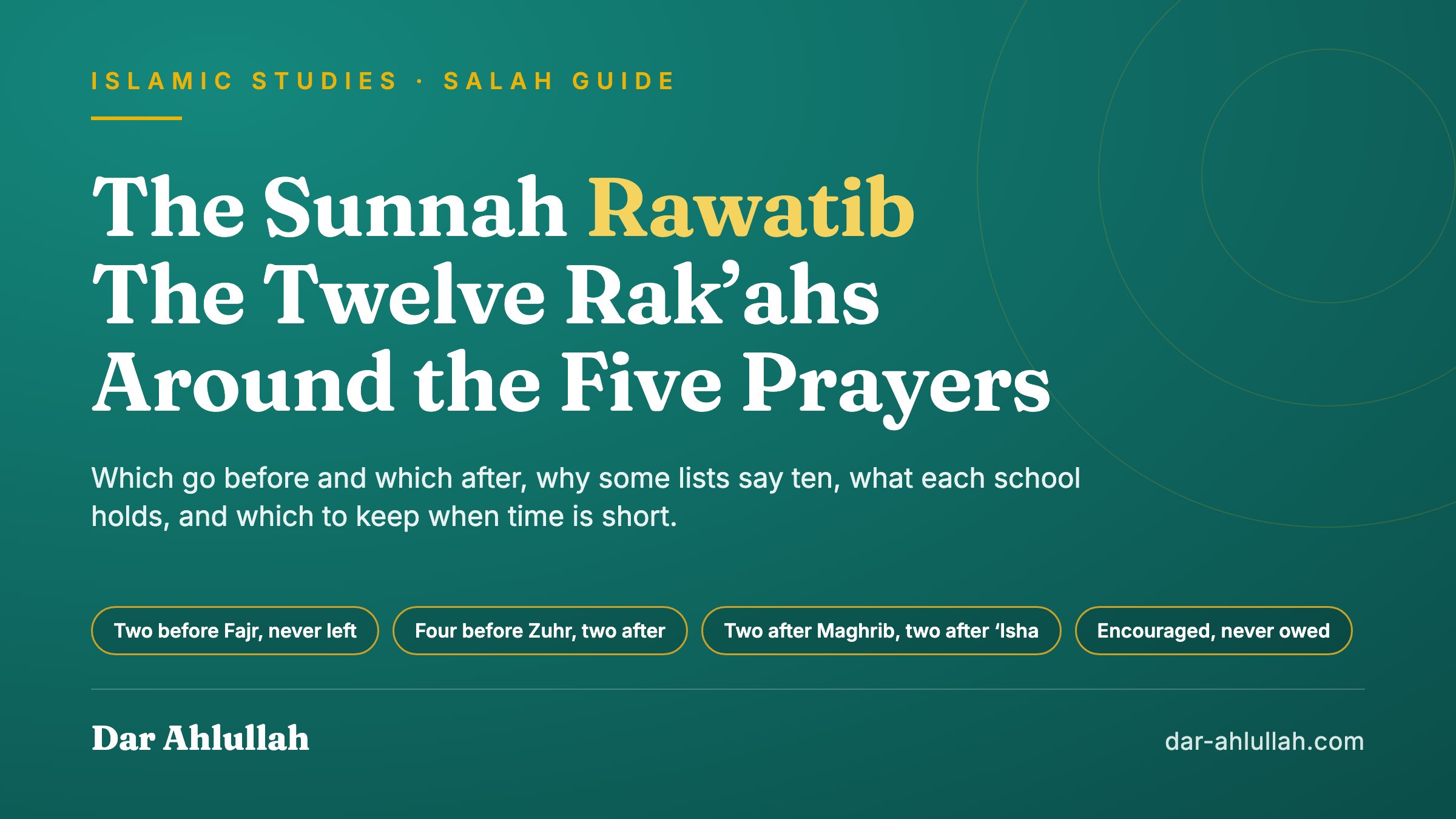
The Sunnah Rawatib: The Twelve Rak’ahs Around the Five Prayers
The sunnah rawatib are the regular voluntary rak’ahs attached to the five daily prayers: twelve in a day on the fullest count, ten on the other. Which goes before and which after, why the two counts differ, what each school holds, where to pray them, how to make one up, and which to keep when you only have five minutes.
27 min read
how to pray Jumuah
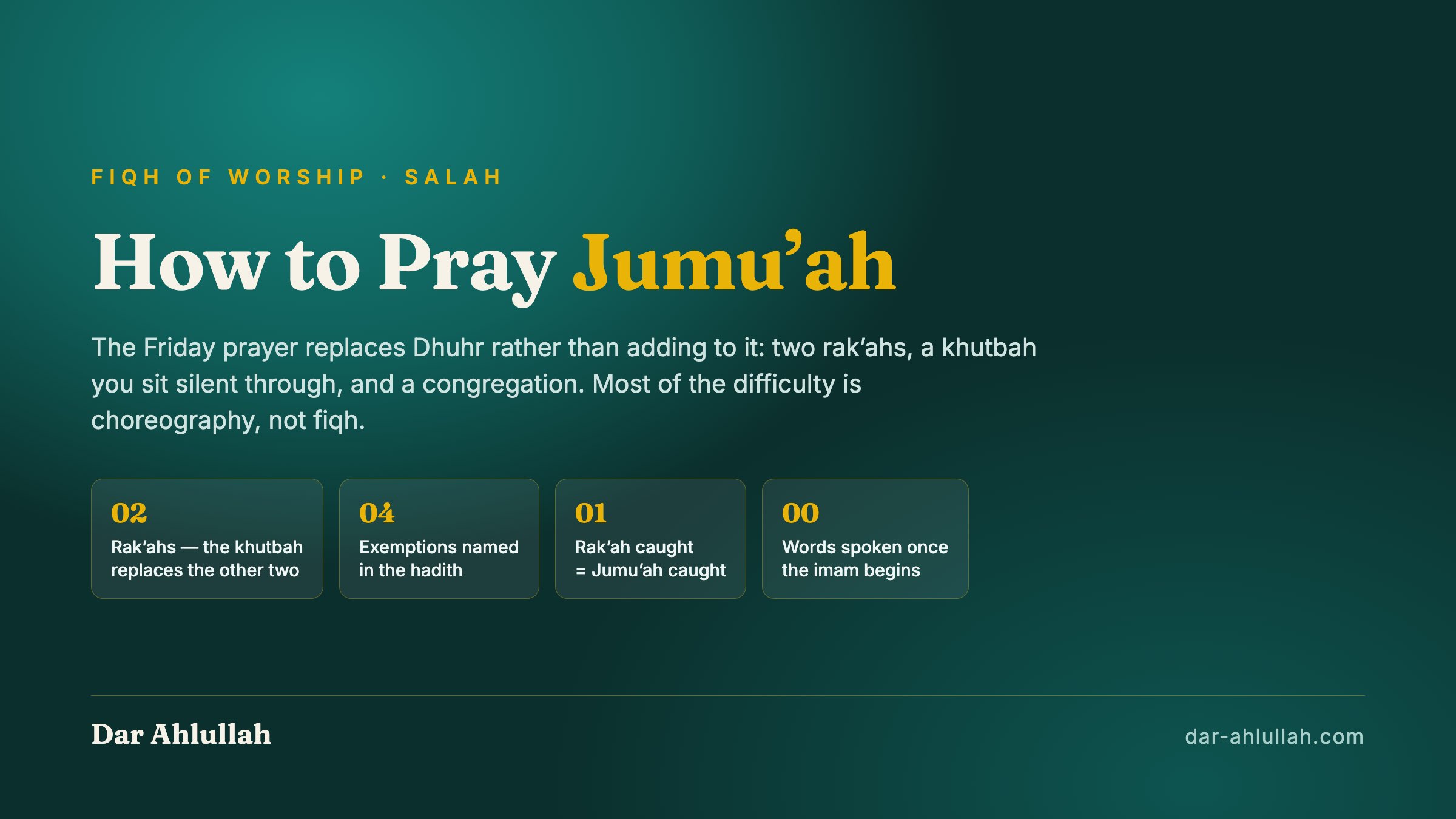
How to Pray Jumu'ah: The Friday Prayer, Start to Finish
Jumu'ah replaces Dhuhr, not adds to it: two rak'ahs, a khutbah you sit silent through, and a congregation. Who it is owed by, what still counts if you walk in late, and what to do when the sermon is in a language you do not speak.
18 min read
how to pray salat al-tawbah
How to Pray Salat al-Tawbah: The Prayer of Repentance
Salat al-tawbah is two rak'ahs after a sin, taught in one sahih hadith. The method, what to say in sujud and after the salam, the forbidden-times question by school, praying it again after a relapse, sins against people, and what a new Muslim owes for the past.
25 min read