
what breaks wudu
What Breaks Wudu? The Agreed List and the Disputed
Dar Ahlullah team 19 min read
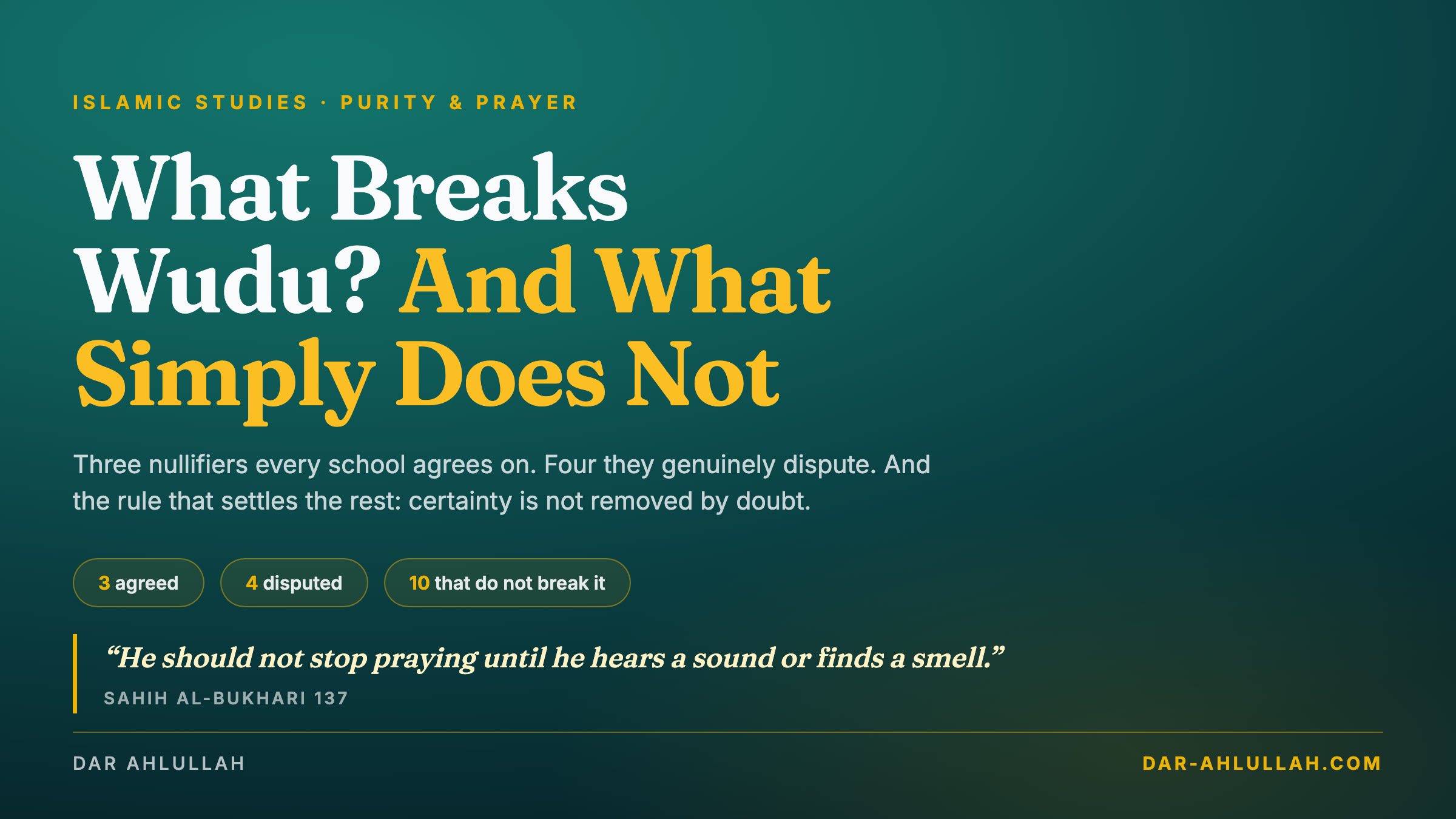
Table of Contents
- Introduction: The Question Behind the Question
- The Short Answer
- What “Breaking” Wudu Actually Means
- The Nullifiers Everyone Agrees On
- The Four Genuine Disagreements
- Agreed and Disputed, At a Glance
- Ten Things That Do Not Break Wudu
- The Rule That Solves Most of This: Doubt Never Breaks Wudu
- If It Breaks While You Are Praying
- Chronic Conditions and the Excused Person
- “Which School Am I Following?”
- How We Teach This
- Questions People Ask
- Conclusion: Fewer Repeats, Not More
Introduction: The Question Behind the Question
Almost nobody searches what breaks wudu out of curiosity. The question arrives attached to a specific moment: you are already in the masjid and you just shook someone’s hand, or you dozed off on the train, or your nose bled, or you touched yourself while changing, and the prayer starts in four minutes. What you want is not a lecture on ritual purity. You want to know whether you have to get up and go to the tap again.
The reason the answer feels slippery is that this topic has three layers, and most of what is written online mixes them together. There is a short list that every school of Islamic law agrees on. There is a shorter list they genuinely disagree about, where two people who both know what they are talking about will give you different answers because they follow different scholars. And there is a long list of things that do not break wudu at all but that people repeat to each other anyway.
This guide separates the three. It also spends time on the single principle that resolves most day-to-day cases — that certainty is not undone by doubt — because that one rule saves more repeated wudu than the whole list of nullifiers combined.
One boundary before we start. We teach Quran, Arabic and the practical fiqh of worship; we are not a fatwa body. Where the schools of law differ, we say so plainly and point you to the scholars rather than flattening a real difference into one confident sentence. If you are still assembling the wudu itself, work through our complete guide to performing wudu first; this article assumes you can already do it and only asks when it stops counting. And if you are newer than that — if wudu and prayer are both still being assembled — the order to learn them in is mapped out in our guide to your first 90 days in Islam.
The Short Answer
If you have two minutes rather than twenty, this is the whole system.
- Anything that exits the front or back passage breaks wudu. Urine, stool, wind, and the other discharges. This is the core of the list and nobody disputes it.
- Losing your awareness breaks wudu. Deep sleep, fainting, intoxication, anaesthesia. Light dozing where you would still notice yourself passing wind does not.
- Anything that requires a full ghusl breaks wudu too, and is not fixed by wudu alone — sexual discharge, the end of menstruation, postnatal bleeding.
- Four cases are genuinely disputed: touching your own private parts, touching a woman, eating camel meat, and blood or vomit. Your answer here depends on which school you follow, and every position has qualified scholars behind it.
- Doubt does not break wudu. If you had it and you are not certain you lost it, you still have it. This is a hard rule with an explicit hadith behind it, not a concession.
- Eating, touching impure things, laughing outside prayer, changing clothes, cutting hair or nails, and bleeding from a scrape do not break wudu by the majority view — and several of them by every view.
The rest of this article is the reasoning, the evidence, and the edge cases.
What “Breaking” Wudu Actually Means
Two pieces of vocabulary make everything downstream easier, and both are worth learning properly rather than guessing at.
Hadath is the state of ritual impurity that stops you praying. It is not dirt. A person can be freshly showered, in clean clothes, and still be in a state of hadath; a person can have dust on their hands and be perfectly pure. It is a legal state, not a physical one, which is exactly why the list of nullifiers looks arbitrary until you stop thinking of it as hygiene.
Hadath comes in two grades:
- Minor (hadath asghar) — removed by wudu. This is what the whole article is about.
- Major (hadath akbar, or janabah) — removed only by a full ritual bath, ghusl. Sexual intercourse or ejaculation, the end of menstruation, and the end of postnatal bleeding put a person in this state. Wudu will not lift it.
The practical consequence: everything on the major list also ends your wudu, but doing wudu will not fix it. This trips people up more often than any of the disputed cases. If a sister finishes her period, no amount of wudu makes her ready to pray — ghusl does. Once you are pure, how to pray in Islam walks through the prayer itself. Once you are in a state of purity, how to pray in Islam covers the prayer itself.
The base text for all of this is the ablution verse, Surah al-Ma’idah 5:6, which sets out the washing itself and then names the situations that require purification again. Much of the disagreement below comes from one word in that verse, which we get to in its place.
The Nullifiers Everyone Agrees On
Start here, because in practice this list covers the overwhelming majority of real cases.
1. Anything Exiting the Front or Back Passage
Urine, stool, wind, and the other bodily discharges from the two passages. This is the primary and least controversial nullifier; the classical scholars list it first and the four schools do not differ on the substance of it. Islam Question & Answer’s summary of the nullifiers puts “any discharge from the front or back passage” at the top of the list, alongside the unusual case of such matter emerging from somewhere other than its normal exit.
The thing worth knowing here is not the rule but its threshold. Feeling something — movement, pressure, an unsettled stomach — is not the same as something having exited. That distinction has a hadith of its own, and it is important enough that it gets its own section below.
2. Loss of Awareness: Sleep, Fainting, Intoxication
Sleep is on the list, but not for the reason most people assume. Sleep does not itself make a person impure. It is on the list because a sleeping person cannot tell whether they broke wudu, so the law treats the loss of awareness as a proxy for the event it hides. That single insight is what makes the sleep rule usable.
Which is why the test is depth, not posture. As Islam Question & Answer puts the criterion: if the sleep is light enough that you would have felt yourself break wudu, your wudu stands, and it makes no difference whether you were lying down, sitting, or leaning on something. If you were far enough under that you would not have noticed, renew it. The companions of the Prophet were described by Anas as waiting for the night prayer until their heads were nodding, then praying without renewing wudu — a report cited across the schools precisely because it draws this line between dozing and real sleep.
Fainting, general anaesthesia, seizure with loss of consciousness, and intoxication all fall under the same heading and are treated more strictly than sleep, since none of them has a “light” version where awareness is preserved.
And if you genuinely cannot tell how deeply you slept? The scholars answer that from the doubt principle: uncertainty about the depth of your sleep does not invalidate your wudu.
3. Whatever Requires Ghusl
Sexual intercourse, ejaculation, the end of a menstrual period, and the end of postnatal bleeding all end wudu and require the full bath, ghusl, rather than wudu alone. There is no disagreement here worth reporting to a beginner.
One clarification that saves confusion: a woman does not owe the prayers she missed during menstruation, and she does not perform wudu “to catch up” when it ends. She performs ghusl and resumes with the current prayer. The related question — which missed prayers are actually owed and which are not — is worked through in our guide to making up missed prayers.
The Four Genuine Disagreements
These are the cases where you will get contradictory answers from people who are both correct within their own school. That is not a failure of the tradition; it is what happens when two sound texts pull in different directions and honest scholars weigh them differently. What follows is the disagreement stated as a disagreement, not resolved for you.
1. Touching Your Own Private Parts
The evidence is a hadith of Busrah bint Safwan, who reported the Prophet saying: “He who touches his penis should perform ablution” — recorded in Sunan Abi Dawud 181 and Jami’ at-Tirmidhi 82, where at-Tirmidhi graded it hasan sahih.
- Shafi’i, Maliki and Hanbali: direct contact with the bare hand breaks wudu, on the plain sense of the hadith.
- Hanafi: it does not, on the strength of a competing report and a reading that treats the instruction as recommended rather than obligatory.
Practical upshot for a beginner: through clothing, no school considers it a nullifier. The dispute concerns bare contact.
2. Touching a Woman
This is the disagreement with the widest daily reach, and it hangs on one word. The ablution verse mentions the state of one who has lamastum an-nisa — touched, or come into contact with, women. The schools split on whether lams here carries its literal sense of skin contact or its well-attested euphemistic sense of intercourse.
- Shafi’i: literal. Skin-to-skin contact between a man and a woman he could in principle marry breaks wudu, desire or no desire.
- Maliki and Hanbali: contact breaks it only when accompanied by desire.
- Hanafi: the word means intercourse; ordinary touch does not break wudu at all. Islam Question & Answer, working from the same reading, states that touching a woman’s body does not break wudu unless something is emitted as a result.
If you have ever seen one man refuse to shake hands in the masjid line and another do it without a thought, this verse is why. Both are following scholarship.
3. Eating Camel Meat
Jabir ibn Samurah reported that a man asked the Prophet whether to perform wudu after eating mutton, and was told he could if he wished; asked about camel meat, the answer was “yes” — Sahih Muslim 360.
- Hanbali, and the position of Ishaq ibn Rahawayh and a number of modern scholars including Ibn Baz, Ibn Uthaymin and al-Albani: it breaks wudu, on the specific and explicit wording of the hadith. Islam Question & Answer adopts this view, noting that a specific text takes precedence over a general one.
- The majority — Hanafi, Maliki, Shafi’i: it does not, holding the instruction to be abrogated by the later general ruling that food touched by fire does not require wudu.
Two things about this one. First, it is the cleanest illustration in the whole topic that these nullifiers are legal categories rather than hygiene rules; no one claims camel meat is unclean. Second, it is far more likely to matter to you in Riyadh or Nouakchott than in Manchester, which is a fair reason not to lose sleep over it — but worth knowing before your first camel-meat meal, not after.
4. Blood and Vomit
The most commonly assumed nullifier on the whole list, and one of the least settled.
- Hanafi and Hanbali (differing on the details): flowing blood and a mouthful of vomit break wudu.
- Shafi’i and Maliki: neither does.
Islam Question & Answer surveys both sides and concludes that bleeding from the body does not invalidate wudu, on the grounds that the hadith usually cited for it concerns non-menstrual vaginal bleeding rather than bleeding generally, and that the vomiting report is graded weak. The default rule they apply — that wudu stands unless clear evidence removes it — is the same principle that governs doubt.
So: a nosebleed, a shaving cut, a blood test. By the majority view your wudu is intact. If you follow a school that says otherwise, follow it; just know the disagreement is real and you are not being lax if you do not repeat.
A Fifth, Narrower Case
The Hanafi school additionally holds that laughing out loud during the prayer breaks both the prayer and the wudu — a position specific to prayer and not shared by the other three. It comes up rarely enough that it belongs as a footnote, but it is a real position and worth recognising if someone cites it. What to do about a prayer that has gone wrong in other ways is covered in our guide to fixing a mistake in prayer.
Agreed and Disputed, At a Glance

Read the table below alongside it. “Agreed” means the four Sunni schools concur; “disputed” means qualified scholars differ and your answer follows your school.
| Case | Status | Note |
|---|---|---|
| Urine, stool, wind | Agreed — breaks | The core of the list |
| Deep sleep, fainting, anaesthesia | Agreed — breaks | Depth is the test, not posture |
| Intercourse, menses, postnatal bleeding | Agreed — requires ghusl | Wudu alone does not lift it |
| Touching own private parts, bare hand | Disputed | Hanafi: no. Other three: yes |
| Touching a woman | Disputed | Shafi’i: yes. Maliki/Hanbali: with desire. Hanafi: no |
| Eating camel meat | Disputed | Hanbali: yes. Majority: no |
| Flowing blood, mouthful of vomit | Disputed | Hanafi/Hanbali: yes. Shafi’i/Maliki: no |
| Laughing aloud inside the prayer | Disputed | Hanafi only |
| Eating, drinking, changing clothes | Agreed — does not break | Camel meat aside |
| Doubt about any of the above | Agreed — does not break | Certainty is not removed by doubt |
Ten Things That Do Not Break Wudu
This list matters more than it looks. Almost everyone carrying anxiety about wudu is carrying it about something on this list rather than something on the real one.
- Eating and drinking. Agreed across all four schools. A full meal, then straight to prayer, no renewal needed — the camel-meat dispute being the single exception.
- Touching something impure. Handling something najis makes the body part dirty and it needs washing; it does not put you into a state of hadath. Wash the hand, keep the wudu.
- Changing your clothes. Including full undress. Nothing about it touches the list.
- Cutting hair or nails, shaving, trimming the beard. None of it breaks wudu. You do not re-wash the head after a haircut.
- Bleeding from a scrape or a nosebleed — by the Shafi’i and Maliki view and the position adopted above. Disputed, not agreed, so know your school.
- Laughing outside the prayer. The Hanafi ruling on laughter is confined to laughter inside the prayer.
- Crying, in prayer or out of it.
- Light dozing where you would have noticed yourself break wudu — on the criterion above.
- Touching your spouse — on the Hanafi reading, and on the Maliki and Hanbali reading where there is no desire involved. Disputed, and the Shafi’i answer differs.
- Anger, backbiting, or sin generally. Sin is a serious matter with its own remedy in repentance, but it does not put you into a state of hadath. Wudu after sin is a recommended act, not a required one.
The Rule That Solves Most of This: Doubt Never Breaks Wudu
If you take one thing from this article, take this. It resolves more real situations than the entire nullifier list.
The principle in the books of Islamic legal maxims is that certainty is not removed by doubt. Applied here: if you know you had wudu, and you are not certain you lost it, you still have it. Not probably. Definitely, as a matter of law.
The hadith behind it is unusually direct. A man asked about someone who imagines he has felt something during prayer, and the Prophet answered that he should not stop praying “until he hears a sound or finds a smell” — Sahih al-Bukhari 137, and Sahih Muslim 361. Islam Question & Answer states the practical form: a person does not have to redo wudu until they are certain enough to swear to it.
Three consequences worth spelling out:
- You do not leave the prayer for a suspicion. The hadith is specifically about that moment. Stay in the prayer.
- You do not owe a repeat of prayers you now suspect you prayed without wudu, if at the time you believed you had it.
- Repeating wudu on doubt makes the doubt worse, not better. The scholars treat persistent waswasah — intrusive whispering about purity — as something to be starved rather than fed, and acting on it is what feeds it. If washing has started taking you ten minutes and three restarts, the problem is not your fiqh, and the answer is not more washing.
If It Breaks While You Are Praying
Occasionally it is not a doubt. You are in the second rak’ah and you know exactly what happened.
The prayer is over at that point — wudu is a condition for it, not a component of it, so there is nothing to repair from the inside. What you do:
- Stop. There is no benefit in finishing.
- Leave quietly. If you are in congregation, walk out without announcement; the people around you are not owed an explanation and covering the matter is itself preferred.
- Perform wudu again.
- Pray again from the beginning. Not from where you stopped — the whole prayer.
- If the congregation is still going, join it. If it has finished, pray alone; you have not missed the prayer, only the congregation.
Note the difference from a lapse of memory or a miscounted rak’ah, which is repaired from inside the prayer with the prostration of forgetfulness rather than by starting over. The two situations look similar and are handled in opposite ways, which is why they are worth learning together — the second is covered in what to do if you make a mistake in prayer.
Chronic Conditions and the Excused Person
Everything above assumes a body that behaves predictably. For a substantial number of people it does not, and the law has a category for exactly that: ma’dhur, the excused person.
The category covers someone with a condition that would otherwise make prayer impossible — urinary incontinence, a wound that will not stop seeping, continual non-menstrual bleeding (istihadah), chronic flatulence. The relief granted is essentially the same in shape across the schools, even where the technical framing differs: such a person performs wudu for the prayer time and prays with it, and the ongoing condition does not invalidate that wudu during the time even though the same thing would invalidate anyone else’s.
Two things to say about this. First, it is a genuine dispensation, not a grudging one, and it exists so that a chronic condition never becomes a reason to stop praying. Second, the details — when the status begins, how it interacts with the prayer times, whether a fresh wudu is needed for each prayer — vary by school and by condition, and this is precisely the sort of question to put to a scholar who can ask you follow-up questions rather than to an article. If this is your situation, that conversation is worth having once, properly, and then not again.
“Which School Am I Following?”
Four of the cases above resolve differently depending on your school, which naturally raises the question for anyone who has never consciously picked one. A few practical notes.
Most Muslims inherit a school without ever choosing it — through family, through the masjid they grew up in, through the region they come from. That is a legitimate way to have one. If you were taught to pray a particular way and have never had reason to question it, you already have an answer to these four questions, whether or not you could name the school.
For new Muslims and for anyone genuinely unattached, the honest guidance is unglamorous: follow the school taught at the masjid you actually attend and by the teacher you actually learn from. The value of consistency here is real. A person who follows one school on all four disputed cases is on solid ground; a person who assembles the most convenient answer from each school on each question has built something no scholar recognises, and will have no coherent position when a fifth question arrives.
What you should not do is treat the disagreement itself as a problem to be solved before you can pray. It is not. Every position listed above has centuries of scholarship behind it, and the agreed list — which covers most of daily life — is agreed. Where this fits into the wider picture of how Islamic law is derived and why the schools exist at all is the subject of our introduction to fiqh for beginners.
How We Teach This
Purity rules are where a lot of otherwise confident learners quietly stall, and the reason is almost always the same: they were taught the list without the framework, so every new situation has to be looked up rather than reasoned out. Someone who understands that sleep is on the list as a proxy for unnoticed events, and that doubt is legally inert, can work out the answer to a case they have never met. Someone holding twenty memorised rules cannot.
So in our Islamic Studies sessions we teach the framework first and the list second, and we teach the disputed cases as disputes — naming the schools, naming the evidence — rather than presenting one school’s answer as the answer. Learners come to us from many backgrounds, and a teacher who flattens that difference is doing them no favours.
Sessions are one-to-one and live, which matters here more than in most subjects, because the questions people actually need answered about purity are personal and they will not ask them in a group. A private session with a certified teacher is a place where they get asked. If you want to see how the subject is structured, our course overview sets out the Islamic Studies track alongside the Quran and Arabic ones, and every new learner starts with a free 30-minute assessment — no card required — so the level is set by a conversation rather than a guess.
Questions People Ask
Does touching a dog break wudu?
No. Touching a dog does not break wudu by any school. The rules concerning dogs relate to the purity of what a dog’s saliva has touched — a separate matter, handled by washing the affected thing. Your wudu is unaffected.
Does bleeding break wudu?
Disputed. Hanafi and Hanbali scholars hold that flowing blood does; Shafi’i and Maliki scholars hold that it does not. Islam Question & Answer adopts the latter, on the basis that the evidence cited for the former does not establish it. A minor cut or nosebleed leaves your wudu intact on that view.
Does sleeping sitting up break wudu?
Posture is not the criterion; depth is. If the sleep was light enough that you would have noticed yourself break wudu, it stands, whether you were sitting, leaning or lying down. If you were under deeply enough that you would not have noticed, renew it. Uncertain which it was? Your wudu stands.
Does eating break wudu?
No, with one disputed exception. Eating and drinking do not break wudu by unanimous agreement. Camel meat specifically is contested: the Hanbali school says renew, the majority says no need.
Does touching my wife break wudu?
It depends on the school. Shafi’i: yes, on skin contact. Maliki and Hanbali: only if accompanied by desire. Hanafi: no, unless something is emitted. All three positions read the same word in the ablution verse differently.
I am not sure if I broke my wudu. Do I redo it?
No. Certainty is not removed by doubt. If you know you had wudu and are not certain you lost it, you still have it — and if this happens to you constantly, repeating the wudu is making it worse rather than better.
Does passing wind while sitting on a chair break wudu?
Yes. The nullifier is the exit of wind, and nothing about position changes that. The chair only enters the discussion in the sleep case, where a firmly seated posture is one reason a person might have stayed light enough to notice.
Do I need a new wudu for every prayer?
No. One wudu covers as many prayers as you like until something on the list breaks it. Renewing it for each prayer is a recommended practice, not an obligation.
Does a woman’s wudu break when her period ends?
Her state requires ghusl rather than wudu — the full bath, not the ablution. Once she has performed it she resumes with the current prayer; the prayers missed during the period are not owed.
Does vomiting break wudu?
Disputed, along the same lines as blood. Hanafi and Hanbali scholars hold that a mouthful does; Shafi’i and Maliki scholars hold that it does not, and note that the report usually cited for it is graded weak.
Conclusion: Fewer Repeats, Not More
The useful summary of this topic is shorter than the topic itself. Three things break wudu by agreement: what exits the two passages, the loss of awareness, and whatever requires a ghusl. Four things are disputed, and your school answers them. Everything else on the popular list — food, dirt, blood by the majority view, haircuts, clothes, laughter outside the prayer, and above all doubt — does not.
Most people who arrive at this question leave it doing wudu more often than they need to, which is exactly backwards. The list is short, the doubt rule is generous, and the tradition is not trying to catch you out. Learn the framework once and you will spend the rest of your life not thinking about it — which is the point.
If purity and prayer are the part of practice you want to put on firm ground, that is teachable, one question at a time, with someone who will answer the specific version of the question you actually have. That is what the first ninety days are for.
Related articles
how to perform ghusl
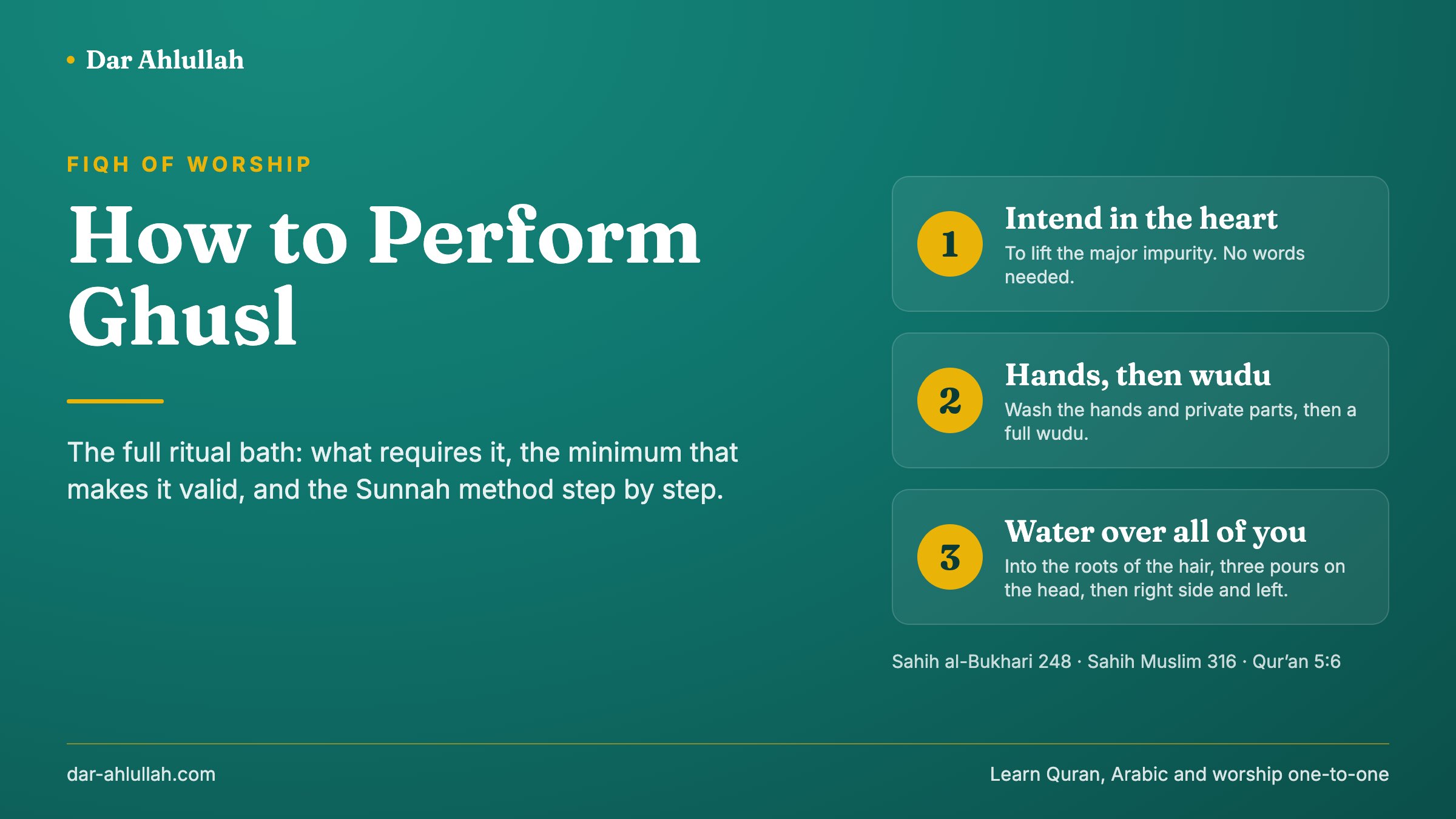
How to Perform Ghusl: The Full Ritual Bath, Step by Step
Ghusl is the full ritual bath, owed after intercourse, after any emission of sexual fluid, and at the end of menstruation and postnatal bleeding. Its real requirements are fewer than most people fear: an intention and water over the whole body, with two schools adding the mouth and nose and one adding rubbing. This guide sets out the minimum, the Sunnah method, where the four schools differ, and whether your morning shower can be your ghusl.
24 min read
how to perform tayammum
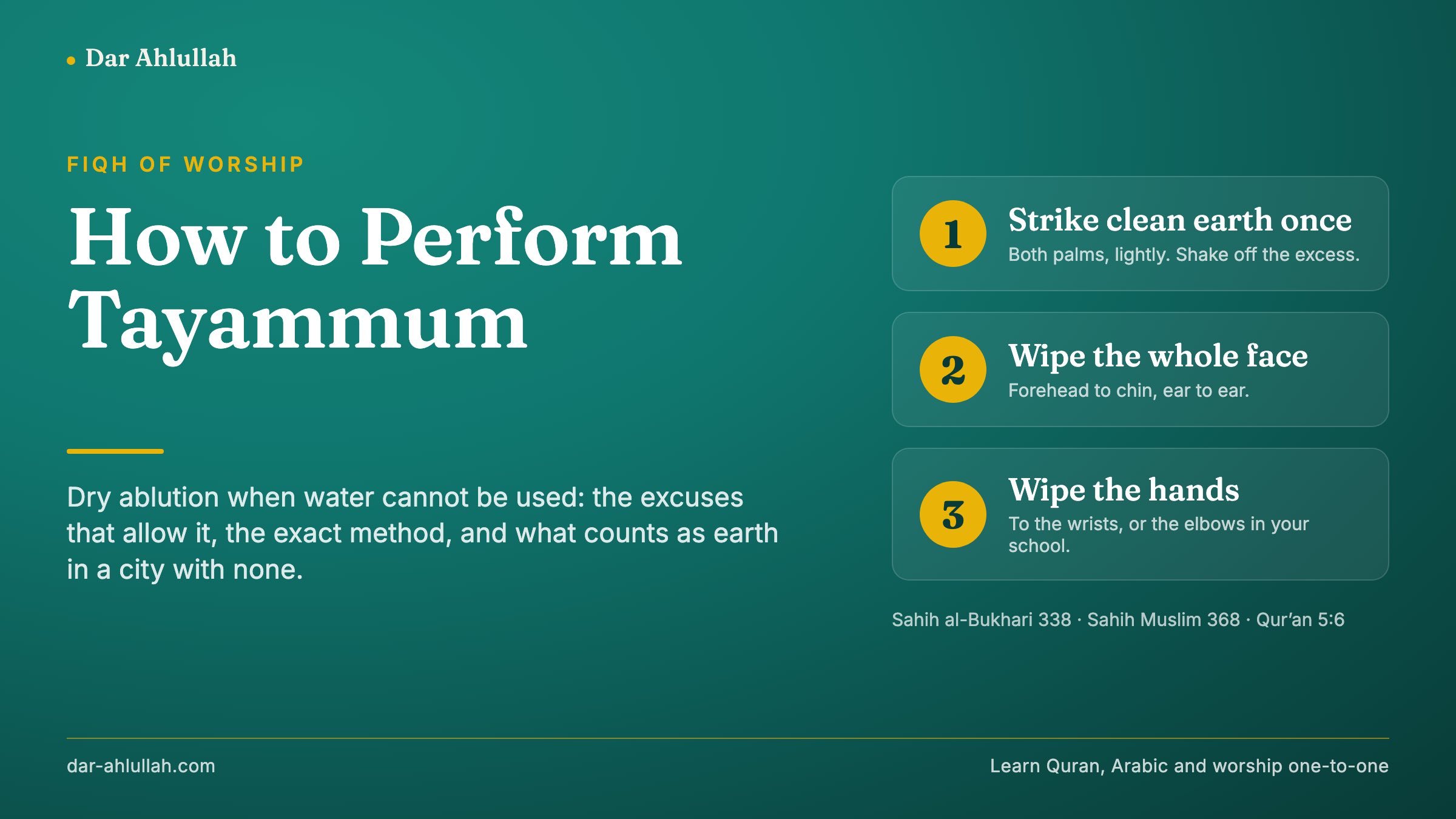
How to Perform Tayammum: Dry Ablution When You Cannot Use Water
Tayammum is the purification you make with earth when water cannot be used. The rule is short: strike clean earth, wipe your face, wipe your hands. The difficulty for a Muslim in Europe or America is everything around the rule: what counts as a real excuse, what counts as earth in a building with none, how long it lasts, and what you do on a plane or in a hospital bed when there is neither water nor dust.
28 min read
khushu in salah
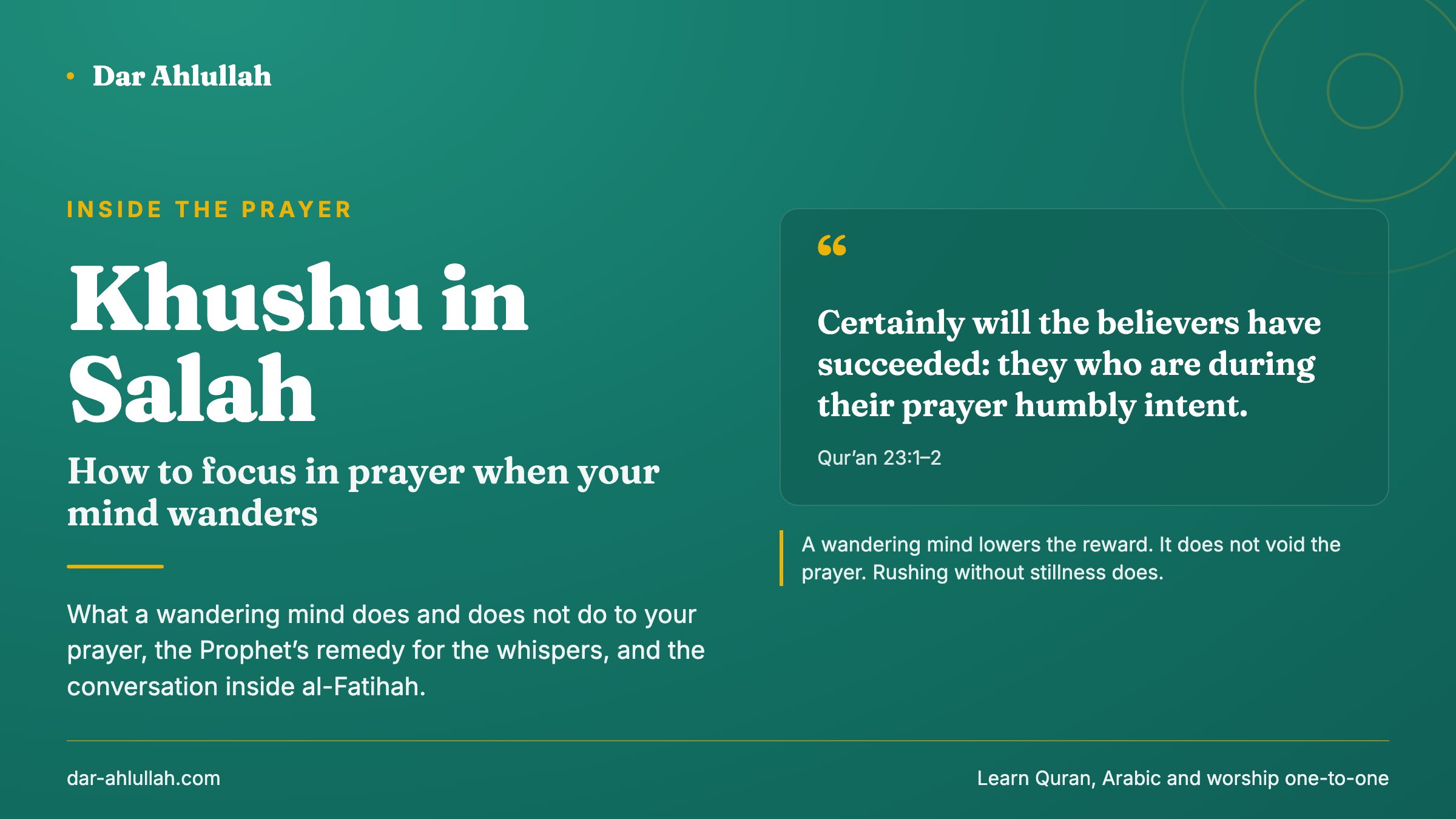
Khushu in Salah: How to Focus in Prayer When Your Mind Wanders
Khushu is stillness of the body and presence of the heart in prayer. What a wandering mind does and does not do to your salah, what the Sunnah gives you before the takbir, inside the prayer and when the whispers come, and how a non-Arabic speaker learns to mean the words.
26 min read