
which surahs to memorize first
Which Surahs to Memorize First: A Practical Order
Dar Ahlullah team 15 min read
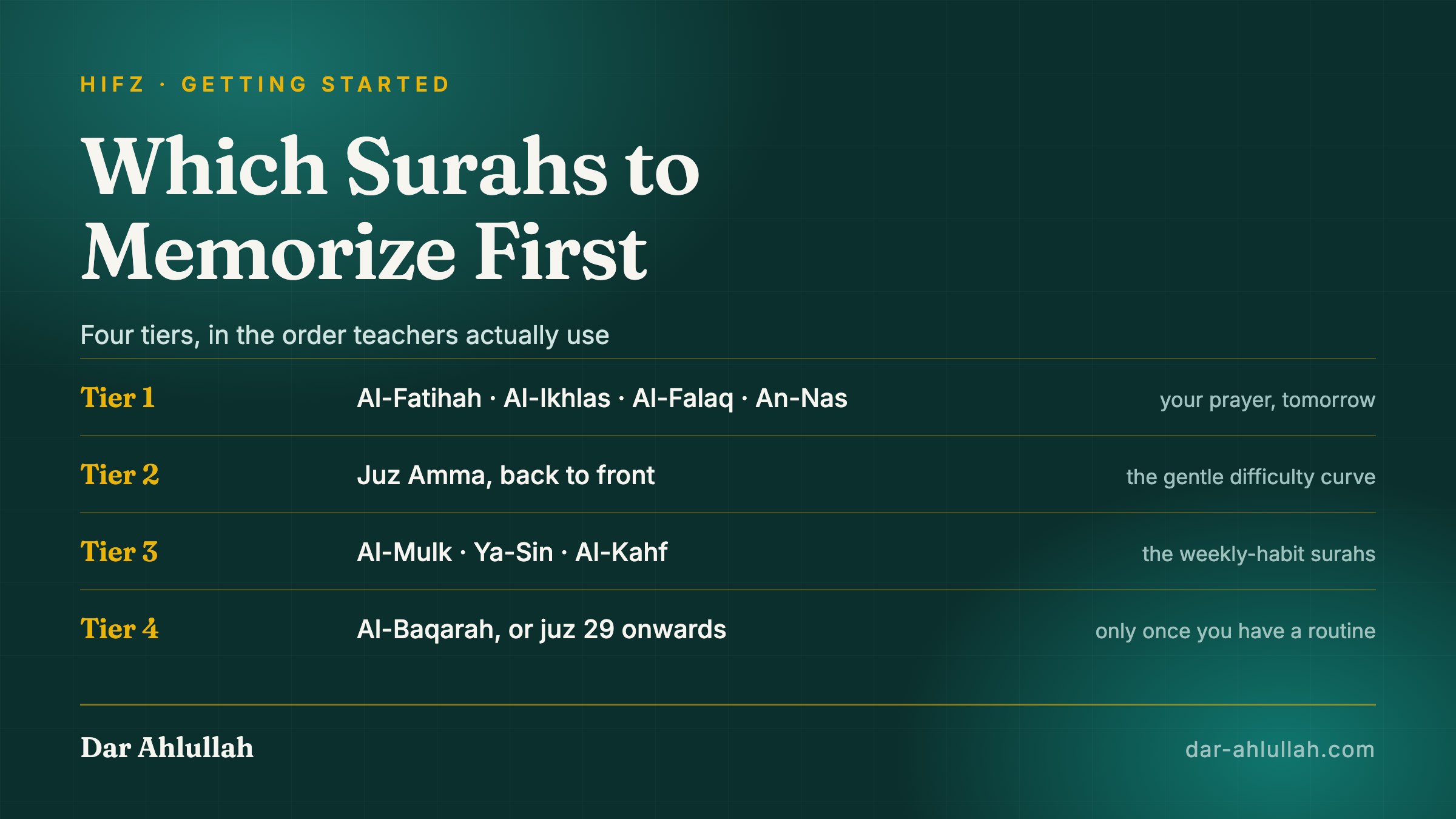
Table of Contents
- Introduction: The Question Under the Question
- The Short Answer: The Order Most Teachers Use
- Why “Shortest First” Is the Wrong Only Rule
- Tier One: The Surahs Your Prayer Needs Tomorrow
- Tier Two: Finishing Juz Amma From the Back Forwards
- Tier Three: The Weekly-Habit Surahs
- Tier Four: The Long Surahs, and When to Turn to Them
- The Three Routes People Actually Take
- A Twelve-Week Plan You Can Start This Week
- The Thing That Decides Your Pace More Than the Surah
- Four Mistakes That Cost People a Year
- Children and Adults Need Different Orders
- How We Sequence It
- Questions People Ask About Where to Start
- Conclusion: Start Where Your Prayer Is
Introduction: The Question Under the Question
Almost nobody asking which surahs to memorize first is really asking about surahs. They are asking something more anxious: where do I start so that six months from now I have not quietly given up? The list matters far less than the fact that the list has an order, that the order has a reason, and that you can tell whether you are on schedule.
So this guide gives you the order, and the reason behind each step. It is the sequence that Quran teachers use almost universally — not because it is prescribed anywhere, but because it survives contact with real students. Along the way you will see verse counts, an honest note on what each tier costs in weeks, and the specific places where beginners lose momentum.
If you are still at the stage of decoding the script rather than committing it to memory, start with our complete guide to learning Quran online instead, and come back here once you can read a page of Juz Amma aloud without guessing.
The Short Answer: The Order Most Teachers Use
If you want the sequence without the reasoning, here it is:
- Al-Fatihah — because every unit of every prayer requires it.
- Al-Ikhlas, Al-Falaq, An-Nas — short, constantly used, and recited together in a fixed habit.
- Al-Kawthar, Al-Asr, An-Nasr, Al-Masad, Al-Fil, Quraysh, Al-Maun, Al-Kafirun — the very short surahs at the end of the mushaf.
- The rest of Juz Amma, working backwards from An-Naba’ towards where you started — the surahs lengthen gradually, so the difficulty curve stays gentle.
- Al-Mulk, then Ya-Sin, then Al-Kahf — the surahs many Muslims keep as a weekly or nightly habit.
- Juz Tabarak (juz 29), then Juz Qad Sami’a (juz 28) — continuing backwards through the mushaf.
- Al-Baqarah onwards, if and when you commit to the whole Quran.
Two things about that list are worth stating plainly. The first four steps are not optional in any sensible plan — they are the surahs you will use in worship every single day, and memorising them repays itself immediately. Everything from step five onwards is genuinely a choice about ambition, and the honest answer to “what comes after Juz Amma” is that it depends on whether you are memorising to enrich your prayer or memorising the entire Quran.
Why “Shortest First” Is the Wrong Only Rule
Search this question and you will get the same answer everywhere: start with the shortest surahs. That is not wrong, but on its own it is a poor rule, and it explains a common failure — the student who has memorised eleven short surahs, cannot use nine of them in any regular context, and has forgotten six of them by spring.
Length is one criterion. There are three others that matter at least as much:
- Frequency of use. A surah you recite daily revises itself. A surah you never recite has to be revised deliberately, forever, from a schedule you have to maintain. Every surah you memorise adds a permanent maintenance cost — unless your prayer already pays it for you.
- Sound familiarity. You have heard the closing surahs of the mushaf hundreds of times in prayer and recitation. Memorising something your ear already half-knows is dramatically faster than memorising unfamiliar text of the same length.
- Difficulty of the words, not the count of them. Verse counts mislead. Al-Kawthar is three short verses; some three-verse passages elsewhere run to several lines each. Judge by lines on the page, not by the number of ayahs.
Put those together and the rule becomes: start with what is short, what you will use every day, and what you have already heard a thousand times. That is exactly why the standard order starts at the back of the mushaf.
Tier One: The Surahs Your Prayer Needs Tomorrow
This tier is small and it is urgent. Until it is done, every prayer you pray is limited by it.
| Surah | Verses | Why it comes first |
|---|---|---|
| Al-Fatihah | 7 | Recited in every unit of every prayer. Nothing else competes for first place. |
| Al-Ikhlas | 4 | Short, extremely familiar, and usable in any prayer from the day you learn it. |
| Al-Falaq | 5 | Paired with An-Nas in a fixed daily habit, so it revises itself. |
| An-Nas | 6 | Same as above — learn the pair together, they are rarely used apart. |
| Al-Kawthar | 3 | The shortest surah in the Quran. A genuine confidence win in a couple of days. |
| Al-Asr | 3 | Three verses, simple structure, and a meaning short enough to learn alongside the words. |
For most adults working with a teacher a couple of times a week, this tier takes somewhere between two and five weeks. If you already pray, you will find that half of it is recall rather than memorisation — you know more of this than you think, you have simply never been asked to produce it from memory on demand.
Learn the meaning of these six as you go. Not a full tafsir — just enough that the words are not noise. Our guide to the most common words in the Quran covers the vocabulary that recurs across this tier and will make the next one measurably easier.
Tier Two: Finishing Juz Amma From the Back Forwards
Juz Amma — the thirtieth and last part of the Quran — contains thirty-seven surahs, and it is where essentially every memorisation journey spends its first year. You work through it backwards, from the last surah towards An-Naba’, for one reason: the surahs get longer as you move forwards through it, so going backwards means your capacity and the difficulty rise together.
A rough map of what that gradient looks like:
- An-Nas back to Al-Fil (surahs 114–105) — three to six verses each, mostly one or two lines on the page. Expect a few days each.
- Al-Humazah back to Ad-Duha (104–93) — up to eleven verses. Still short, but you now have to hold a sequence rather than a phrase.
- Al-Layl back to An-Naziat (92–79) — twenty to forty-six verses. This is where the real work starts and where honest students slow down. A surah a week is good going.
- An-Naba’ (78) — forty verses, and the natural end of the juz.
Two practical notes. First, do not race the last section; the surahs from An-Naziat onwards are several times the size of the ones you started with, and students who kept the same weekly target here are the ones who burn out. Second, from the moment you finish your second surah you need a revision routine, not just a memorisation routine — see our guide to revising Quran memorization, because this is the single most common point of failure in the whole endeavour.
Tier Three: The Weekly-Habit Surahs
After Juz Amma, the standard next step is not the next juz. It is a small set of longer surahs that many Muslims keep as a recurring habit — which means, once again, that your routine pays part of the revision cost for you.
| Surah | Verses | Realistic effort |
|---|---|---|
| Al-Mulk | 30 | Two to six weeks. Widely recited nightly, so it stays fresh with almost no extra revision. |
| Ya-Sin | 83 | Two to five months. Long, but rhythmic and heavily repeated in recitation, so the ear helps. |
| Al-Kahf | 110 | Four to nine months. Commonly recited on Fridays; narrative, which some find easier and some find harder. |
Those ranges are wide on purpose, because at this length the variable is no longer the surah — it is you. How fluently you read, how many minutes a day you actually sit down, and whether your revision is holding. A student memorising half a page a day with solid revision will finish Al-Kahf; a student memorising a page a day with no revision will not, and will lose Juz Amma while trying.
Al-Mulk is the right one to take first of the three. It is the shortest, it has a natural nightly slot in most people’s routine, and finishing a thirty-verse surah is the proof you need that you can handle something beyond Juz Amma.
Tier Four: The Long Surahs, and When to Turn to Them
Here is where you have to be honest with yourself about the goal, because the answer diverges completely.
If your goal is a richer prayer — more variety in what you recite, deeper connection in salah — you have essentially arrived. Juz Amma plus Al-Mulk gives you more than you can use in a week of prayers. What is left is not more surahs but better ones: perfecting tajweed on what you hold, learning the meanings properly, and slowly extending into juz 29.
If your goal is the whole Quran, then after Juz Amma the two defensible routes are:
- Keep going backwards — juz 29 (Tabarak), then juz 28, and so on. The text keeps getting longer but only gradually, and you never face a step change.
- Turn to the front and start Al-Baqarah — 286 verses, the longest surah in the Quran, and roughly two and a half juz on its own. It is the traditional route in many hifz schools, it front-loads the hardest work, and it is where unsupervised adults most often stall.
There is no scholarly requirement either way. Choose backwards if you are self-directed and need visible progress to stay motivated; choose Al-Baqarah if you have a teacher holding you accountable several times a week. On the timeline this all implies, we have a separate honest answer: how long it takes to memorize the Quran.
The Three Routes People Actually Take
Strip away the detail and there are three coherent orders. Pick one deliberately rather than drifting between them.
1. Prayer-first (recommended for most adults)
Tier one, then the short surahs of Juz Amma, then stop and consolidate for a few months before deciding anything else. Every surah you learn goes to work immediately. This is the route with the lowest dropout rate, because the reward arrives before the discipline runs out.
2. Juz Amma back-to-front (the classic)
The same as above but committed through the whole juz without pausing, finishing at An-Naba’. It suits students with a fixed weekly lesson and someone listening to them. Most children in structured programmes follow this.
3. Front-to-back (only with a teacher)
Al-Fatihah, then Al-Baqarah, then straight on. It is the traditional madrasa order and it works — in a madrasa, with daily supervision. Attempted alone, it asks a beginner to spend their first several months on the hardest text in the Quran before they have any technique. If nobody is listening to you daily, do not choose this one.
A Twelve-Week Plan You Can Start This Week
This is a starting plan, not a prescription. It assumes an adult beginner who can already read Arabic script slowly, working roughly twenty minutes a day.
| Weeks | New material | Revision |
|---|---|---|
| 1–2 | Al-Fatihah, with the meaning | Recite it in every prayer, deliberately, from memory |
| 3–4 | Al-Ikhlas, Al-Falaq, An-Nas | All three every night; Al-Fatihah every prayer |
| 5–6 | Al-Kawthar, Al-Asr | Everything so far, once a day, out loud |
| 7–8 | An-Nasr, Al-Kafirun | Rotate: two old surahs per day plus the new one |
| 9–10 | Al-Maun, Quraysh | Use a different memorised surah in each prayer |
| 11–12 | Al-Fil, Al-Humazah | Full recall test: everything, from memory, to a listener |
Twelve weeks, ten surahs, and — more importantly — a revision habit that exists before you have anything large enough to lose. If at week twelve you can recite all ten to another person without prompting, you are ready for the longer surahs of Juz Amma. If you cannot, do not add anything new; the problem is revision, not capacity, and adding material makes it worse.
The Thing That Decides Your Pace More Than the Surah
Two students start Juz Amma on the same day with the same twenty minutes. One finishes in eight months, one is still in it after two years. The difference is almost never talent and almost never the order they chose. It is whether they can read the page fluently before they try to memorise it.
Memorising from a page you decode letter by letter means you are learning two things at once, and the memory you build is fragile — it collapses the moment you are asked to start from an unfamiliar verse in the middle. Memorising from a page you can read aloud smoothly is a single task, and it goes roughly three times faster.
So if your reading is slow, the fastest route to memorisation is a detour: finish decoding properly first. Our guides to reading the Quran for beginners and to the Noorani Qaida cover that stage, and how long it takes to learn to read the Quran sets realistic expectations for it. Three months spent there will save you a year here.
Four Mistakes That Cost People a Year
Memorising what you cannot read
Covered above, and it is the biggest one. If you are reconstructing the surah from the sound of a recitation rather than from the page, you have memorised a recording, not a text — and it will not survive being interrupted.
Starting revision late
The instinct is to revise once you have “enough to revise”. By then you have already lost the earliest material and built the habit of not revising. Revision starts on day two, when you have exactly one surah, and it never stops.
Choosing surahs you will never recite
Every surah outside your daily and weekly routine is a permanent line item in your revision schedule. Ten surahs you use is a lighter load than five you do not. Let your prayer carry as much of the maintenance as it can.
Fixing tajweed afterwards
Whatever pronunciation you memorise with is what you will recite for years, because memory locks in the sound, not the rule. Correcting a mispronounced surah later is significantly harder than learning it correctly the first time — which is why our tajweed rules for beginners guide belongs alongside this one, not after it.
Children and Adults Need Different Orders
The tier list above is written for adults. For children, two adjustments are worth making.
Sound before sense. Young children memorise by ear with startling speed and do not need — and often cannot use — the meaning-first approach that helps adults. A five-year-old can hold Juz Amma comfortably; the same child cannot hold a discussion of what Al-Asr means. Take the speed while it is on offer and add meaning later.
Volume over sequence. With adults, choosing well matters because their time is scarce and their motivation is finite. With children in a consistent programme, quantity of correct repetition matters more than clever ordering. The classic back-to-front route through Juz Amma is usually the right default, and the parent’s job is consistency rather than curriculum design.
On when to begin at all, our guide to what age a child should start learning Quran goes into the readiness signals worth waiting for.
How We Sequence It
At Dar Ahlullah, sequencing is decided in the first session rather than assumed. The complimentary 30-minute assessment exists to establish one thing before anything is planned: whether the student can read the page fluently, or is reconstructing it. Those two students get different starting points, and giving them the same plan wastes months of somebody’s time.
From there, sessions run one-to-one with a certified teacher, which matters more for memorisation than for almost anything else — because the errors that ruin hifz are the ones you cannot hear yourself making. If the pairing is not right, we will rematch you with another certified mentor at no extra cost, and you can pause, upgrade or switch plans at any time. Our rate is about $9 per teaching hour, and you can see how the plans are built on it on the pricing page.
Questions People Ask About Where to Start
Should I memorise Al-Fatihah first?
Yes, without qualification. It is recited in every unit of every prayer, so it is both the most useful surah to hold and the one your daily routine revises for free.
Is it wrong to memorise the Quran out of order?
No. Memorising from the back of the mushaf forwards is the mainstream approach in Quran schools worldwide. The order of memorisation carries no ruling; the order of the mushaf is preserved in recitation, not in the sequence you learn it.
Which surah is the easiest to memorise?
Al-Kawthar, at three short verses, is the shortest complete surah and the usual first win. Al-Asr and Al-Ikhlas are close behind. But easy on the page and easy to retain are different things — retention comes from revision, not from brevity.
How many surahs do I need for my prayer?
Strictly, Al-Fatihah plus one other passage. Practically, five or six short surahs is enough to pray with variety and not repeat yourself within a day. That is a realistic first target and takes most adults a couple of months.
Should I memorise Juz Amma or Al-Baqarah after the short surahs?
Finish Juz Amma first unless you have a teacher listening to you several times a week. Al-Baqarah is the longest surah in the Quran and is the point where self-directed learners most reliably stall.
Do I need to understand the Arabic to memorise it?
No, and millions of people memorise without it. But understanding measurably helps retention, because meaning gives the sequence a logic to hang on rather than leaving it as pure sound. Even a translation read alongside is worth the few minutes it costs — and if you want to go further, learning Quranic Arabic is the long-term answer.
How long should I spend on each surah before moving on?
Until you can recite it twice, from memory, on two different days, without a prompt — not until you have recited it correctly once. The second day is the test that matters, because it is the one that proves the material survived a night.
What if I forget a surah I memorised months ago?
That is expected and it is not failure. Forgetting is what memory does without scheduled review; the fix is a revision cycle rather than more memorisation. Recovering a lapsed surah takes a fraction of the time the first pass did.
Conclusion: Start Where Your Prayer Is
The best first surah is not the shortest one. It is the one you will recite tomorrow, and the day after, and every day after that — because that is the surah whose revision is already paid for.
Start with Al-Fatihah. Add Al-Ikhlas, Al-Falaq and An-Nas. Take Al-Kawthar and Al-Asr for the confidence. Then work backwards through Juz Amma at whatever pace lets you still recite everything behind you. Build the revision habit while it is trivially small, get somebody to listen to you at least weekly, and do not add new material in any week you could not recite the old.
Do that and the question of what to memorise next answers itself, because you will be the kind of student who still remembers what they memorised last.
Related articles
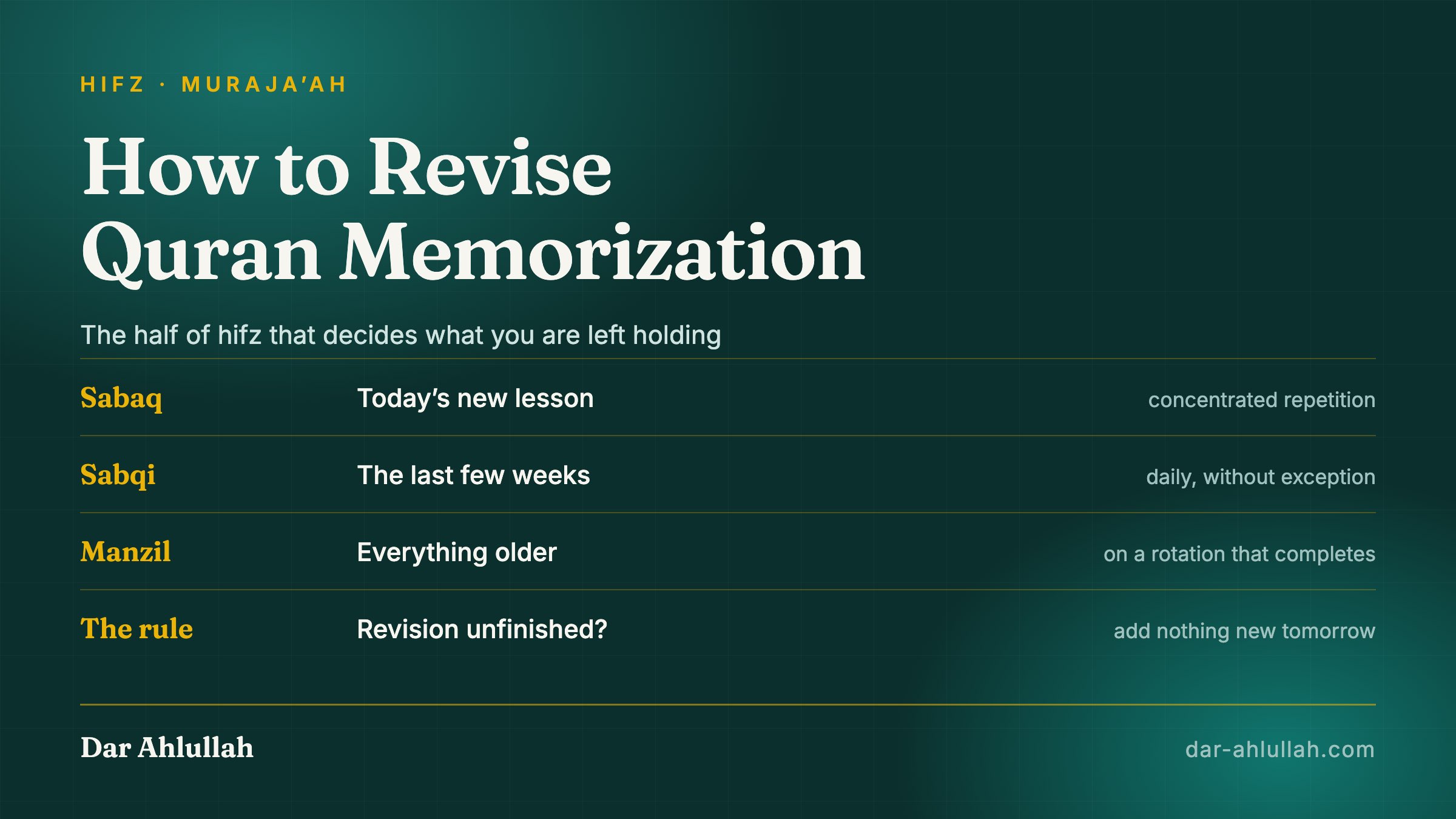
how to revise Quran memorization
What Murajaah Means, and How to Revise Quran Memorization
Every hifz plan is a memorisation plan, and almost every one that fails, fails because nothing in it described what happens to the pages behind you.
15 min read
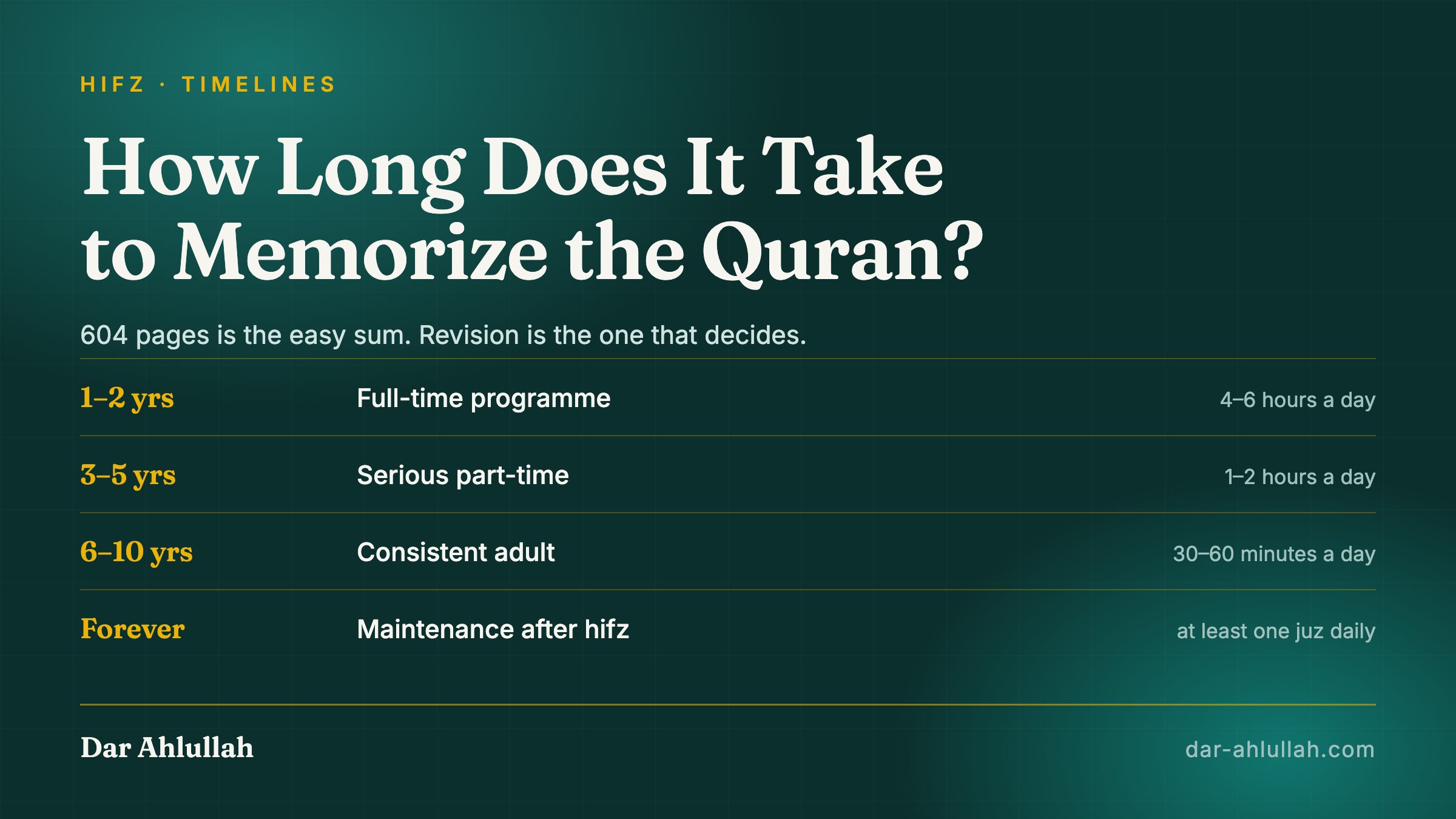
how long does it take to memorize the Quran
How Long Does It Take to Memorize the Quran? An Honest Answer
One to three years, two to five, six months - the published numbers describe how long the memorising takes, and memorising is not the part that decides when you finish.
13 min read
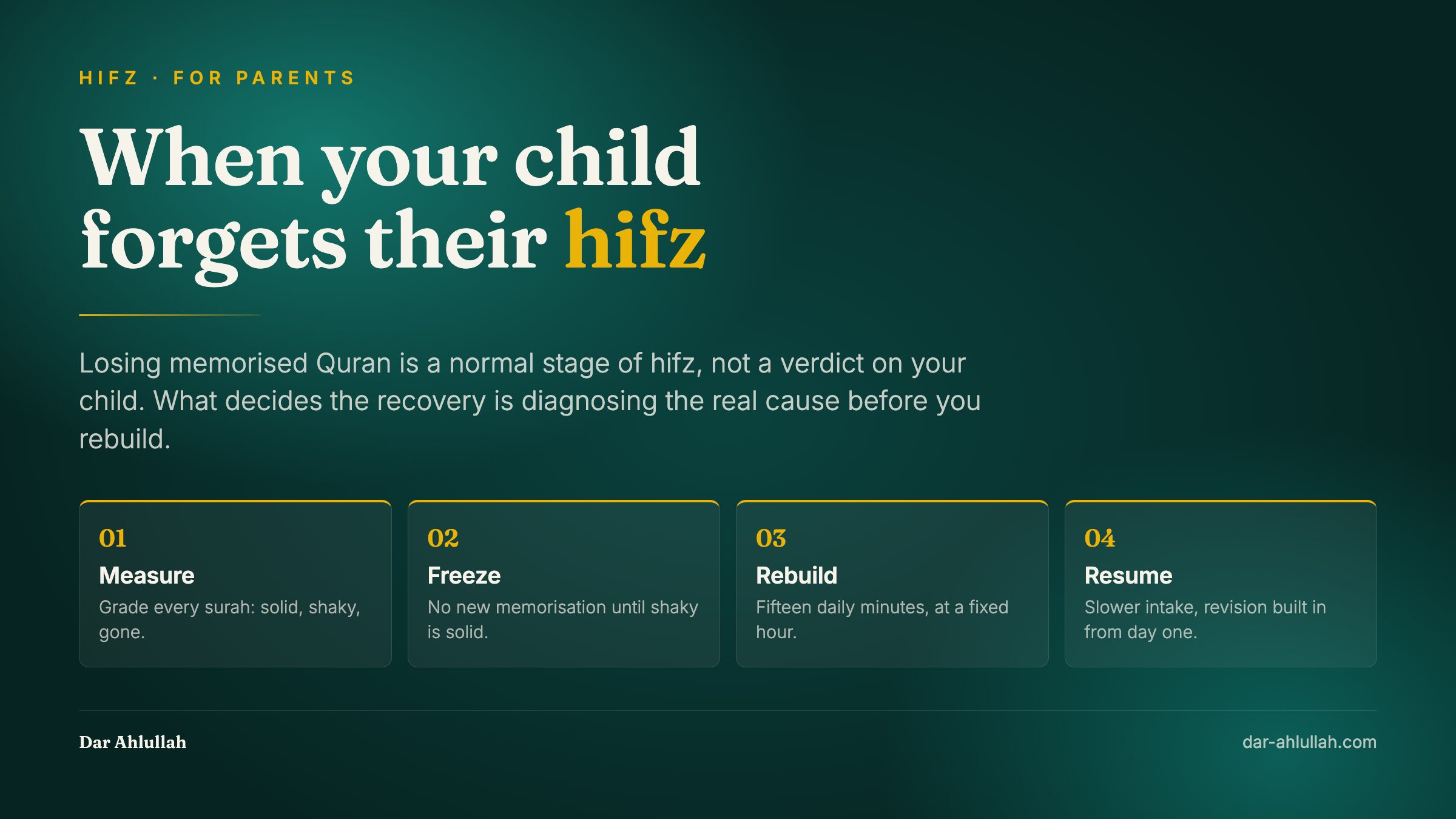
how to help a child who forgot Quran memorization
What to Do When Your Child Forgets Their Quran Memorization
Losing memorised Quran is a normal stage of hifz, not a verdict on your child. What decides the recovery is finding the real cause first, then freezing new material while the old is rebuilt.
22 min read