
new Muslim guide
A New Muslim Guide to Your First 90 Days in Islam
Dar Ahlullah team 14 min read
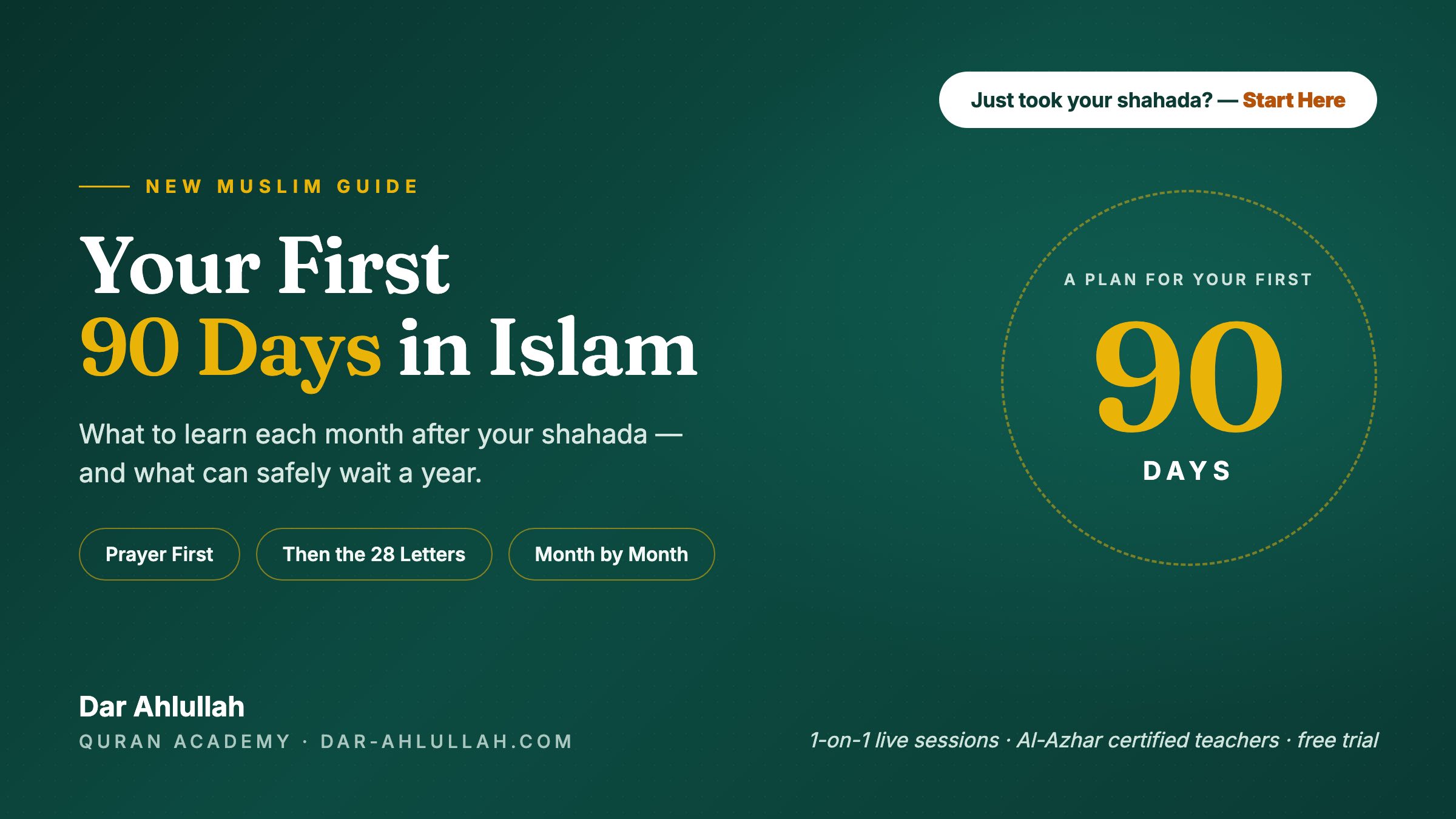
Table of Contents
- Introduction: The Problem Is the Order, Not the Amount
- The Short Answer: Ninety Days in One Paragraph
- Days 1–30: Purification and Prayer
- Days 31–60: The 28 Letters
- Days 61–90: Routine, Meaning, People
- What to Deliberately Postpone
- Learning in English While You Learn the Arabic
- The Five Hardest Parts, and What Helps
- Why One-to-One Lessons Suit New Muslims
- What It Costs and How to Start
- FAQs for New Muslims
- Conclusion: Ninety Days Is Enough
Introduction: The Problem Is the Order, Not the Amount
Within a week of saying the shahada, most new Muslims have been handed more advice than they could act on in a year. A reading list from one brother. A lecture series from another. An app, a translation, a warning about which translation, a debate about schools of law they had never heard of, and somewhere in the middle of it all, the quiet realisation that they cannot yet pray properly.
None of that advice is wrong. It is just unordered, and unordered advice is indistinguishable from noise. What a new Muslim actually needs in the first ninety days is a sequence: what is urgent, what is merely important, and what can safely wait a year without any harm at all.
This new Muslim guide is that sequence. It covers the first three months from the day of your shahada — what to learn each month, in what order, and how much time it honestly takes. It is written for the practical questions, not the theological ones. For rulings specific to your situation, ask a qualified scholar or your local imam; for the learning path, this is what we walk our own revert students through.
The Short Answer: Ninety Days in One Paragraph
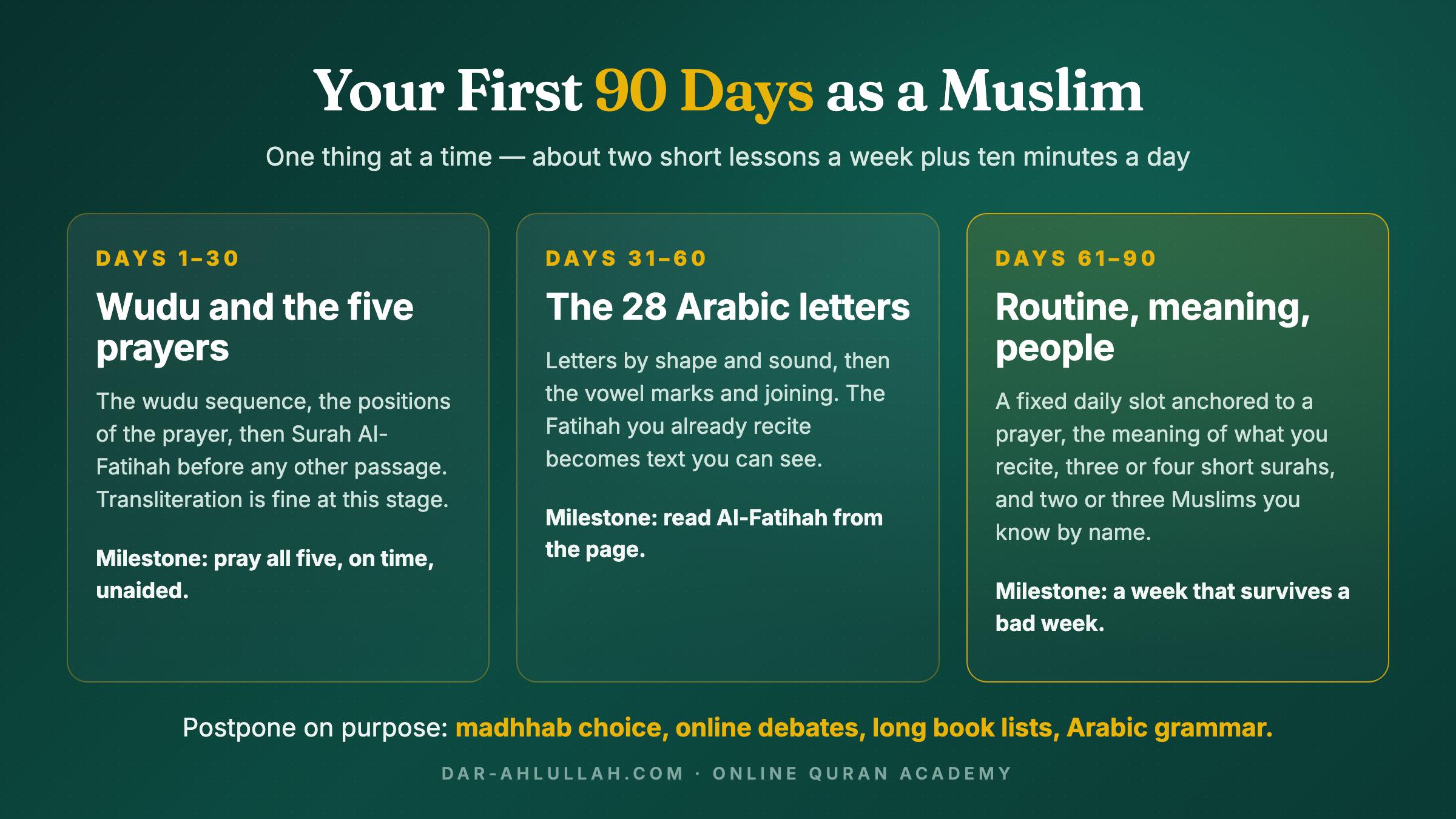
You are already a Muslim. The shahada was the entry, not the exam, and nothing you learn from here changes your standing — it changes your practice. In the first month, learn wudu and the five prayers well enough to pray them on time, using transliteration if you need it. In the second month, start the Arabic letters, so that what you are reciting stops being a sound you copied and becomes text you can read. In the third month, turn both into a routine that survives a bad week, and add meaning: what you are saying in prayer, and why.
That is the whole plan. Three things, in that order:
- Month one — pray. Wudu, the shape of the prayer, and Surah Al-Fatihah. This is the only genuinely urgent item, because prayer is due five times a day starting now.
- Month two — read. The 28 Arabic letters and their vowel marks. Two short lessons a week is enough. This is what stops you from being permanently dependent on transliteration.
- Month three — consolidate. A fixed daily slot, a few short surahs, the meaning of what you already recite, and one or two actual Muslims you know by name.
Everything else — fasting rules, zakat calculations, hajj, the fiqh of things you are not doing yet, the history, the debates — belongs to month four and beyond. Front-loading them is the single most common way a strong start turns into overwhelm.
Days 1–30: Purification and Prayer
The first month has exactly two objectives: be able to make wudu without checking, and be able to pray all five prayers unaided. Nothing else in month one matters as much, and most of it can wait.
The one-time things
Take a full-body ghusl at the start. Scholars differ on whether it is obligatory or strongly recommended for someone entering Islam, so simply do it and the question resolves itself. You do not need to repeat your shahada, register anywhere, or take an Arabic name — a certificate is sometimes issued by a mosque for practical purposes like hajj visas or a Muslim marriage or burial, and that is the only reason to seek one.
Wudu first, because it gates everything
Wudu is a short, fixed sequence, and it is the prerequisite for every prayer, so it is the first thing worth over-learning. Most people have it reliably within a few days of practice. Our step-by-step walkthrough covers the order and the common slips: how to perform wudu correctly.
Then the prayer itself, one prayer at a time
Do not try to learn all five prayers in one sitting. The physical shape is the same in each; only the number of units and a few details change. A workable order for week one:
- Learn the positions and their order — standing, bowing, prostration, sitting — and what is said in each.
- Learn Surah Al-Fatihah before anything else. It is recited in every unit of every prayer; the Prophet (peace be upon him) said that whoever does not recite it in his prayer, his prayer is invalid (Sahih al-Bukhari 756). Nothing else in the prayer carries that weight.
- Add one short surah — Al-Ikhlas is three lines and does the job.
- Start with Fajr, two units, and add the others as the shape becomes familiar. Praying imperfectly and on time beats delaying until you feel ready.
Our full beginner walkthrough of the prayer is here: learning salah step by step, with the positions and the words for each. If you prefer a shorter version to keep on your phone, the prayer basics guide covers the same ground more briefly.
Transliteration is a scaffold, and scaffolds come down
Use transliteration in month one. It gets you praying this week instead of next month, and that is worth far more than purity of method. But treat it as temporary. Transliteration cannot represent several Arabic sounds — the throat letters and the heavy letters have no English equivalent — so a pronunciation learned entirely from Latin script will need correcting later. The correcting is easier the earlier it happens, which is what month two is for.
Days 31–60: The 28 Letters
Month two is where a new Muslim's path forks. One road keeps reciting from memory and transliteration indefinitely, and the Quran stays a closed book in the most literal sense. The other spends about eight weeks on the alphabet and then has access to the text for life.
The second road is much shorter than people expect. Reading the Quran is a decoding skill, not a language skill. Arabic has 28 letters; each changes shape depending on its position in a word, and the short vowels are written as marks above and below the line rather than as letters. Learn those two things and you can pronounce any word in the Mushaf — including words you do not yet understand.
A realistic pace, from what we see with adult beginners:
- Two to four weeks to recognise and pronounce all 28 letters in their isolated and connected forms.
- Two to three months to read simple joined words with vowels, slowly and aloud, with a teacher correcting you.
- Six to twelve months to read a page of the Mushaf unaided at a careful pace with basic tajweed applied.
Those figures assume roughly two half-hour lessons a week plus ten minutes of daily practice out loud. They are not the fastest possible timeline; they are what ordinary consistency produces alongside a job.
The immediate payoff arrives long before fluency. Once you know the letters and vowels, the Al-Fatihah you already recite from memory becomes something you can see, which is the point at which most reverts say the prayer changed for them. Our full walkthrough of that stage — the four stages, the plateau, the mistakes — is here: learning Quran as an adult beginner.
Days 61–90: Routine, Meaning, People
By month three the emergency is over. You can pray, and you can read a little. The work now is making it durable, and that is a different kind of work.
Build the routine around the prayers you already owe
You do not need to invent a study schedule. Five fixed points already exist in your day. Attaching ten minutes of reading practice to one of them — most people pick after Fajr or after Isha — means the habit is anchored to something that is happening anyway. Study slots that float around a calendar are the ones that quietly disappear.
Add meaning to what you already say
Month three is the right time to learn what you have been reciting, and it is deliberately not month one. Understanding Al-Fatihah, the words said in bowing and prostration, and two or three short surahs converts a sequence you perform into something you mean. Take it phrase by phrase rather than as a translation to read once. If understanding the language itself becomes the goal, that is a separate study with its own path: Quranic Arabic for beginners — but start it on top of a reading skill you already have, not instead of one.
Know two or three Muslims by name
This is the item most reading lists leave out, and the one reverts most often say made the difference. Not a community, not a network — two or three people you can text a small question to without it becoming an occasion. A mosque with a new Muslim group, a study circle, a regular teacher. Isolation is the most common reason a strong first month does not become a first year.
A short memorisation goal, if you want one
Three or four short surahs from the end of the Mushaf is a good ninety-day target — enough to vary your prayer, small enough to finish. Formal hifz is a long-term commitment that belongs after reading is secure, not before.
What to Deliberately Postpone
Knowing what to skip is half of this guide. None of the following is unimportant; all of it is better later, and each one has derailed new Muslims who took it on in month one.
| Postpone | Why it can wait |
|---|---|
| Choosing a school of law | You do not need to pick a madhhab to pray correctly. Learn one sound method from one teacher and stay with it. The comparative question is interesting in year two and paralysing in week two. |
| Online debates and sect arguments | The confident voices online are not the qualified ones, and the arguments are addressed to people who already have grounding. A new Muslim gets the anxiety without the context. |
| Long book lists | A classical text read without a teacher usually produces confusion and a sense of failure. One structured course beats ten unfinished books. |
| Arabic grammar | Reading the script and understanding the language are different skills taught in different ways. Grammar before decoding is the most expensive detour in this whole subject. |
| Fiqh for situations you are not in | Rulings on zakat, hajj, and inheritance are worth learning when they apply to you. Learn what applies this month. |
| Announcing it to everyone | Whom to tell, and when, is a judgement call about your own circumstances — not a religious deadline. Many reverts tell family in stages, and there is nothing deficient about that. |
Learning in English While You Learn the Arabic
Two things are happening in parallel in these ninety days, and confusing them causes a lot of unnecessary discouragement.
Understanding Islam happens in your own language, immediately and without limit. Read a good translation of the Quran in English, learn the meaning of the prayer, ask your questions in English. Nothing is gated behind Arabic here, and any teacher who implies otherwise is mistaken.
Reciting the Quran happens in Arabic, because a translation is an explanation of the Quran rather than the Quran itself — which is why the prayer is in Arabic even for those who understand none of it. This is the part that takes months, and it takes them for everybody.
Run both at once. Read meaning in English on the days you are curious, and drill letters in Arabic on the days you are disciplined. Millions of Muslims in Indonesia, Turkey, Nigeria and Pakistan recite with excellent tajweed and no conversational Arabic at all, so the two tracks genuinely are independent.
The Five Hardest Parts, and What Helps
1. Praying at work
Dhuhr and Asr fall in the working day for most of the year in Europe and North America. What works is deciding the logistics once — which room, which fifteen minutes, what you tell a manager if asked — rather than renegotiating it daily. A prayer that has a location and a slot gets prayed.
2. Family reaction
This is usually the heaviest item, and it is not a knowledge problem, so no course fixes it. What reverts consistently report helping: keeping practice visible but undramatic, not arguing theology in the first year, and having someone outside the family who understands the situation.
3. Feeling permanently behind
You will sit near people who memorised juz' as children and recite effortlessly. That comparison is not informative — they had a decade you did not, and most of them cannot explain a rule you learned in a week. Measure against your own last month.
4. The first Ramadan
If Ramadan lands inside your first months, treat it as a month of practice rather than a test to pass. Fasting is required of you as it is of any Muslim, with the ordinary exemptions, but the long night prayers and the reading targets are voluntary. Many reverts overreach in their first Ramadan and start the next one exhausted.
5. Practising without correction
Recordings and apps are excellent for listening and useless for correction. Ten minutes a day repeating a mispronounced letter embeds the error more deeply. This is the argument for a live teacher rather than a course — not the content, the correction.
Why One-to-One Lessons Suit New Muslims
Group classes for beginners are usually built for children, and a class of eight-year-olds is not a comfortable place to be a thirty-five-year-old learning the letter ‘ayn for the first time. Beyond comfort, three things make private lessons the more sensible arrangement in this particular first year.
- Nothing is assumed. A revert's starting point is unlike anyone else's: possibly fluent in the meaning of Islam after months of reading, and simultaneously at zero on the alphabet. A one-to-one teacher diagnoses that in one session; a syllabus cannot.
- Questions stay private. The basic questions are the ones people avoid asking in a group, and they are the ones that matter most in month one.
- The pace is yours. New Muslims often move very fast through the alphabet and slowly through the sounds that do not exist in English, or the reverse. A fixed class pace serves neither.
Whoever you learn with, ask two questions before you commit: how many adult beginners does this teacher currently have, and can I keep the same teacher throughout. Rotating teachers is efficient for an academy and poor for a beginner, because each new one restarts your diagnosis. You can read about our teachers and ask about both in the free assessment.
What It Costs and How to Start
Our rate is about $9 per teaching hour, and it is the same for adults and children because the cost driver is teacher time, not student age. In practice:
- $36 a month — eight 30-minute one-to-one sessions. This is what we recommend to almost every new Muslim: two short lessons a week, which is exactly the cadence the alphabet stage wants.
- $70 a month — eight 60-minute sessions, once you move into tajweed or memorisation.
- $102 a month — twelve 60-minute sessions, for intensive study.
There is no registration fee, and the 30-minute assessment before you commit is free. Our Quran Reading (Nooraniya) course is the alphabet-and-joining track described in month two; prayer and worship basics are covered inside the same sessions for students who need them, so a new Muslim does not have to book two separate things. Full plan details are on the pricing page.
The assessment is worth booking even if you study elsewhere afterwards. Thirty minutes of reading aloud with a teacher tells you your actual starting point, which no article — including this one — can do for you. Sessions are scheduled in your own timezone, evenings and weekends included, which matters more than it sounds when Dhuhr and a work calendar are already competing.
FAQs for New Muslims
What should a new Muslim learn first?
Wudu and the five daily prayers, in that order, because prayer is due five times a day from now and wudu is its prerequisite. Learn Surah Al-Fatihah before any other passage, since it is recited in every unit of every prayer. Everything else — fasting rules, zakat, Arabic, Islamic history — can follow in the months after, without any harm.
How long does it take to learn to pray?
Most new Muslims can perform all five prayers unaided within two to four weeks, using transliteration at first. Praying correctly from the Arabic script, with the pronunciation corrected, usually follows a few months later once the alphabet stage is done. Start praying before you feel ready; correcting a prayer you are already performing is far easier than starting from nothing.
Do I have to learn Arabic to be a Muslim?
No. You need enough Arabic to recite the prayer — roughly Al-Fatihah and a short surah, which is a matter of weeks — and everything else can be understood in your own language. Learning to read the Arabic script is a separate goal worth pursuing, and learning Arabic as a language is a third one. They are commonly confused, and confusing them discourages people unnecessarily.
Do I need to change my name after converting?
No. There is no requirement to change your name unless its meaning is objectionable in Islam. Many reverts keep the name they were given, and doing so is not a sign of weaker practice.
Should I take a certificate of conversion?
Only for practical reasons. Your shahada is valid whether or not anyone documents it, but a certificate from a mosque or Islamic centre can be needed for a hajj or umrah visa, an Islamic marriage, or burial arrangements. It is administrative, not religious.
Is it normal to feel overwhelmed in the first months?
It is close to universal, and it is nearly always a symptom of order rather than volume — too many topics opened at once. Narrow it deliberately: this month, prayer; next month, the letters. Depth in one thing at a time produces more progress in ninety days than breadth across six.
Can I learn all this online, or do I need a mosque?
The learning works well online — recitation is audio-first, so a video call loses very little, and a private session removes the audience most adult beginners are self-conscious about. What online study cannot replace is people. Use online lessons for the teaching and a local mosque or new Muslim group for the company; the two are complements, not alternatives.
What if I said the shahada months ago and have not started?
Then start this week, at day one of this plan, and do not spend energy on the gap. Beginning late is the ordinary case rather than the exception, and the sequence is the same whether you took your shahada last Friday or three years ago.
Conclusion: Ninety Days Is Enough
The first ninety days do not need to cover Islam. They need to leave you able to pray without checking, able to read a little of what you recite, and in contact with two or three Muslims you can ask a small question. That is a complete and sufficient outcome for three months, and it is reachable on about an hour a week of lessons plus ten minutes a day.
The mistake to avoid is the reading list — the twenty open topics, the debates, the grammar book — because breadth in the first months tends to end in a stall, and a stall is much harder to restart than a slow start is to accelerate.
If you want a hand with the first two months, our 30-minute assessment is free and there is no obligation afterwards. Tell the teacher you took your shahada recently and where you are with prayer; they will start you at the right place rather than at the top of a syllabus.
Related articles
fiqh for beginners
Fiqh for Beginners: What to Learn First, and in What Order
Fiqh is the science of what a Muslim does, as distinct from what a Muslim believes. The part you use daily — purification and prayer — is a few weeks of study, and it is taught in a fixed order for a reason.
16 min read
aqeedah for beginners
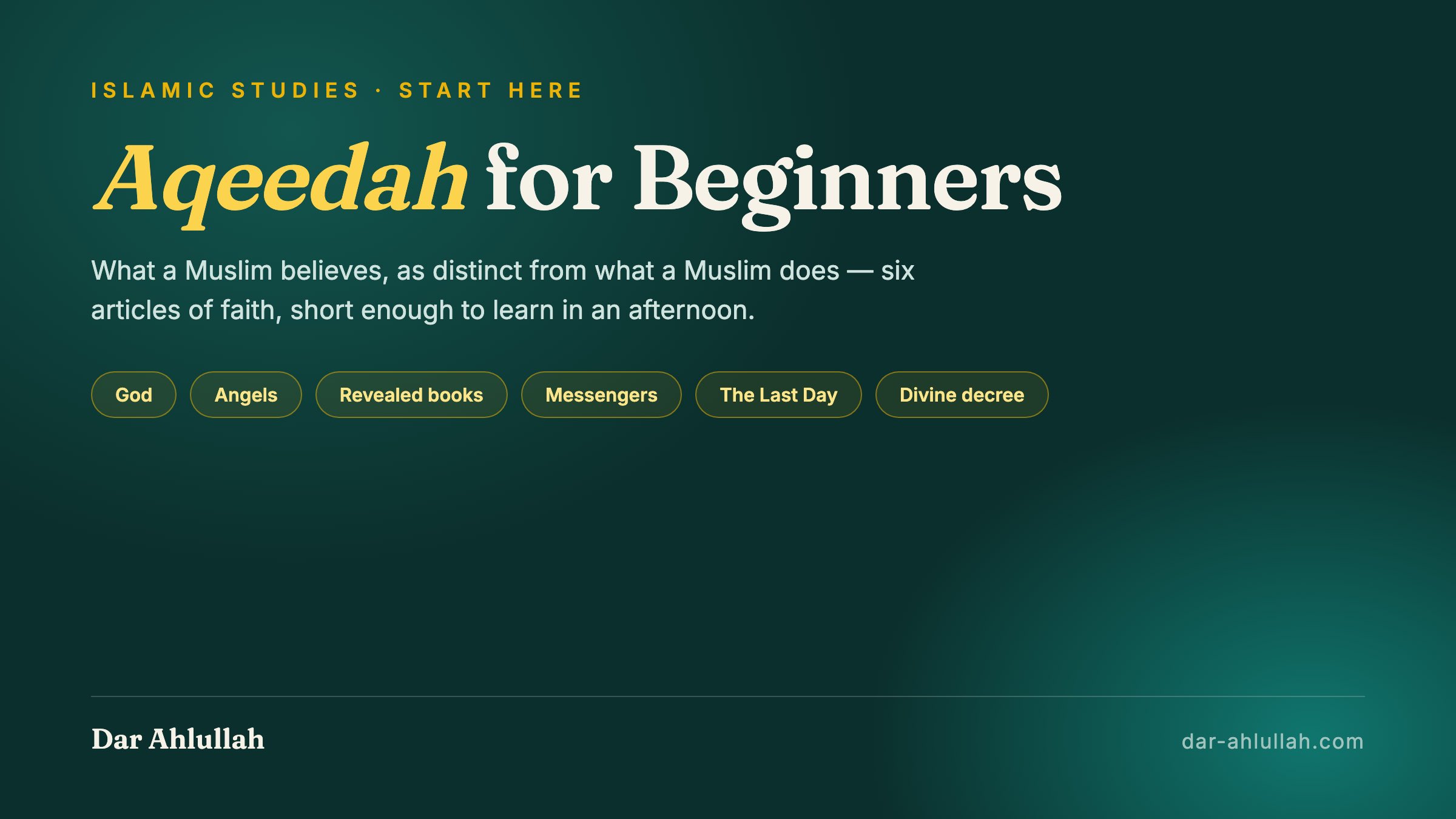
Aqeedah for Beginners: The Six Articles of Faith, Explained Simply
Aqeedah is the subject that answers what a Muslim believes, as distinct from what a Muslim does. The core of it is six articles of faith — short enough to learn in an afternoon, and the foundation everything else rests on.
17 min read
how to study the Seerah
How to Study the Seerah: A Beginner’s Reading Plan
Most people stall in the first four chapters of a Seerah book because they started with the flesh instead of the skeleton. Thirteen years in Mecca, ten in Medina, one book finished properly, and the Quran open beside it.
18 min read