
how to memorize Quran with a full time job
How to Memorize Quran With a Full Time Job: A Schedule That Survives Your Week
Dar Ahlullah team 20 min read
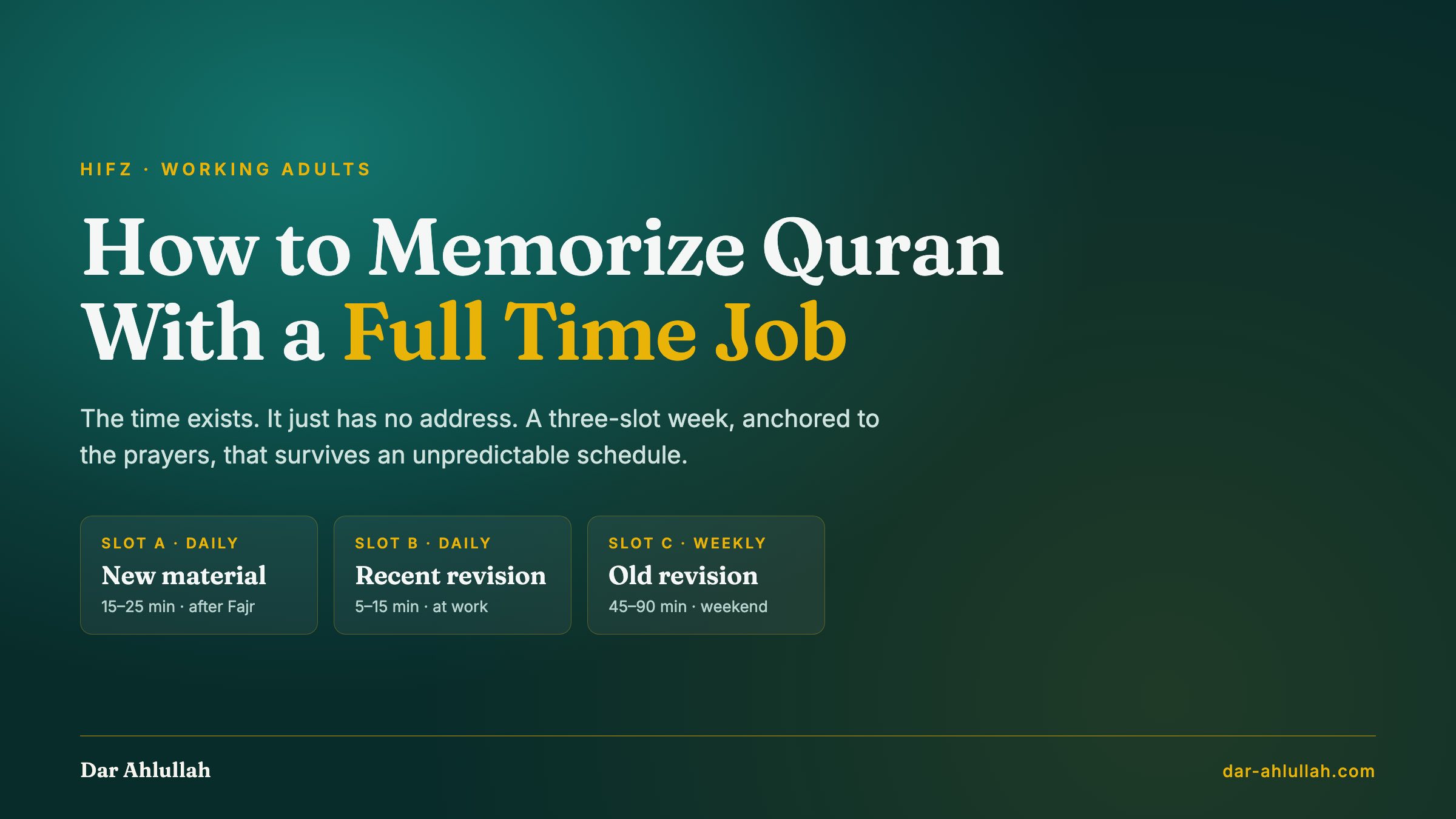
Table of Contents
- Introduction: The Time Exists. It Just Has No Address.
- What Is Actually Being Asked of a Working Person
- Budget the Revision First, Then the Memorising
- Where the Slots Actually Are in a Working Week
- The Three-Slot Week
- Anchor to Salah, Not to the Clock
- Why Small and Daily Beats Long and Weekly
- Dead Time Is Revision Time, Not Memorising Time
- The Minimum Viable Day
- Travel, Shift Work, On-Call and Deadline Season
- Five Ways Working Adults Break Their Own Schedule
- When to Freeze New Material
- The Twenty-Minute Weekly Review
- How We Schedule Hifz Around a Working Week
- Questions Working Adults Ask
- Conclusion: Design the Week, Not the Motivation
Introduction: The Time Exists. It Just Has No Address.
Almost nobody with a full-time job abandons hifz because they genuinely could not find twenty minutes. They abandon it because the twenty minutes never had a fixed address in the week. It floated. It was “in the evening, when things calm down” — and then a fortnight arrived where nothing calmed down, and the habit had nothing to hold on to.
This guide is not about how long the whole Qur’an takes; that is a different question with a different answer, and our guide to how long it takes to memorize the Quran deals with it honestly. This one is about schedule design — the layer that sits underneath the wider online hifz program structure: where in a working week the slots actually go, what anchors them so they survive a bad month, what to protect first when the week collapses, and how to adapt the whole structure for travel, shift work and deadline season.
Learning how to memorize Quran with a full time job is, in practice, an exercise in placement. Get the placement right and the motivation problem mostly dissolves, because you stop having to decide every day.
What Is Actually Being Asked of a Working Person
It is worth starting here, because a lot of working adults carry a quiet assumption that serious hifz belongs to people with empty calendars, and that anything less than a full-time madrasah schedule is a compromise not really worth making.
The Qur’an itself does not frame it that way. In Surah Al-Muzzammil 73:20, after describing the night prayer, the verse turns directly to the practical reality of people’s lives: “He knows that some of you will be sick, some will be travelling throughout the land seeking Allah’s bounty, and some fighting in the cause of Allah. So recite whatever you can from it.” The person travelling in the land seeking Allah’s bounty is the person going to work. The instruction attached to that description is not to wait for a freer season.
The second reference point is the well-known narration recorded in Sahih al-Bukhari 6464, in which the Prophet ﷺ is reported to have said that “the most beloved deed to Allah is the most regular and constant even if it were little.” Read as a scheduling instruction rather than as encouragement, it is unusually specific: regularity is the variable being optimised, and size is explicitly not.
That is convenient, because regularity is also the variable that memory rewards. The rest of this article is essentially an attempt to build a week where the small thing is the thing that happens every day.
Budget the Revision First, Then the Memorising
The single most common structural mistake working adults make is to plan the new memorisation and treat revision as whatever time is left. This is exactly backwards, and it is the reason a lot of promising three-month starts end with a person holding four juz they can no longer recite.
Hifz has two loads, and only one of them grows:
- New material — roughly constant. Whatever you can add in a session today, you can add in a session next year.
- Revision — grows every single week, because everything you have ever memorised needs revisiting forever.
A working adult’s weekly budget is fixed. New material is constant, revision is growing, and a fixed budget minus a growing cost eventually leaves nothing. That is not a motivation failure; it is arithmetic, and it will happen to a disciplined person just as reliably as to an undisciplined one.
The fix is to reverse the order of allocation. Decide the revision load first, protect it absolutely, and let new memorisation take whatever remains — even if that means adding three lines a week instead of a page. The mechanics of the revision itself, including the three streams most teachers separate it into, are covered in our guide to revising Quran memorization. What matters for scheduling is the ordering: revision is the fixed cost, memorising is the discretionary spend.
Where the Slots Actually Are in a Working Week
Before designing anything, it helps to look honestly at what a working week actually contains. Most people searching for extra hours are looking in the wrong place — they are looking for a free block, when what a hifz schedule needs is a free edge: the boundary either side of something that already happens at a fixed time.
These are the edges most working adults actually have:
| Slot | Typical length | Best used for | Fails when |
|---|---|---|---|
| After Fajr, before the day starts | 15–30 min | New material | You go back to sleep; the alarm is negotiable |
| Commute (public transport) | 20–60 min | Listening, recent revision | Treated as memorisation time |
| Commute (driving) | 20–60 min | Listening only | You try to look at a mushaf |
| Lunch break | 10–20 min | Recent revision | Colleagues, no private space |
| After Dhuhr or Asr | 5–10 min | Recent revision | Prayer itself is rushed at work |
| Between Maghrib and Isha | 20–45 min | New material or long revision | Family and dinner arrive first |
| After Isha, before sleep | 10–20 min | Consolidating the day’s new material | You are too tired to retrieve anything |
| One weekend morning | 45–90 min | Old revision, teacher session | Left unscheduled and absorbed by errands |
Two things stand out in that list. First, there is far more available than most people assume — the total across a week is usually several hours. Second, almost every slot on it is defined by something else that already happens: a prayer, a journey, a meal. That is not a coincidence, and it is the basis of everything that follows.
The Three-Slot Week
Here is the structure we would put in front of an adult with a full-time job who wants to memorise seriously and sustainably. It uses three named slots, each with a different job, and it deliberately keeps the daily commitment small enough that a bad day does not break it.
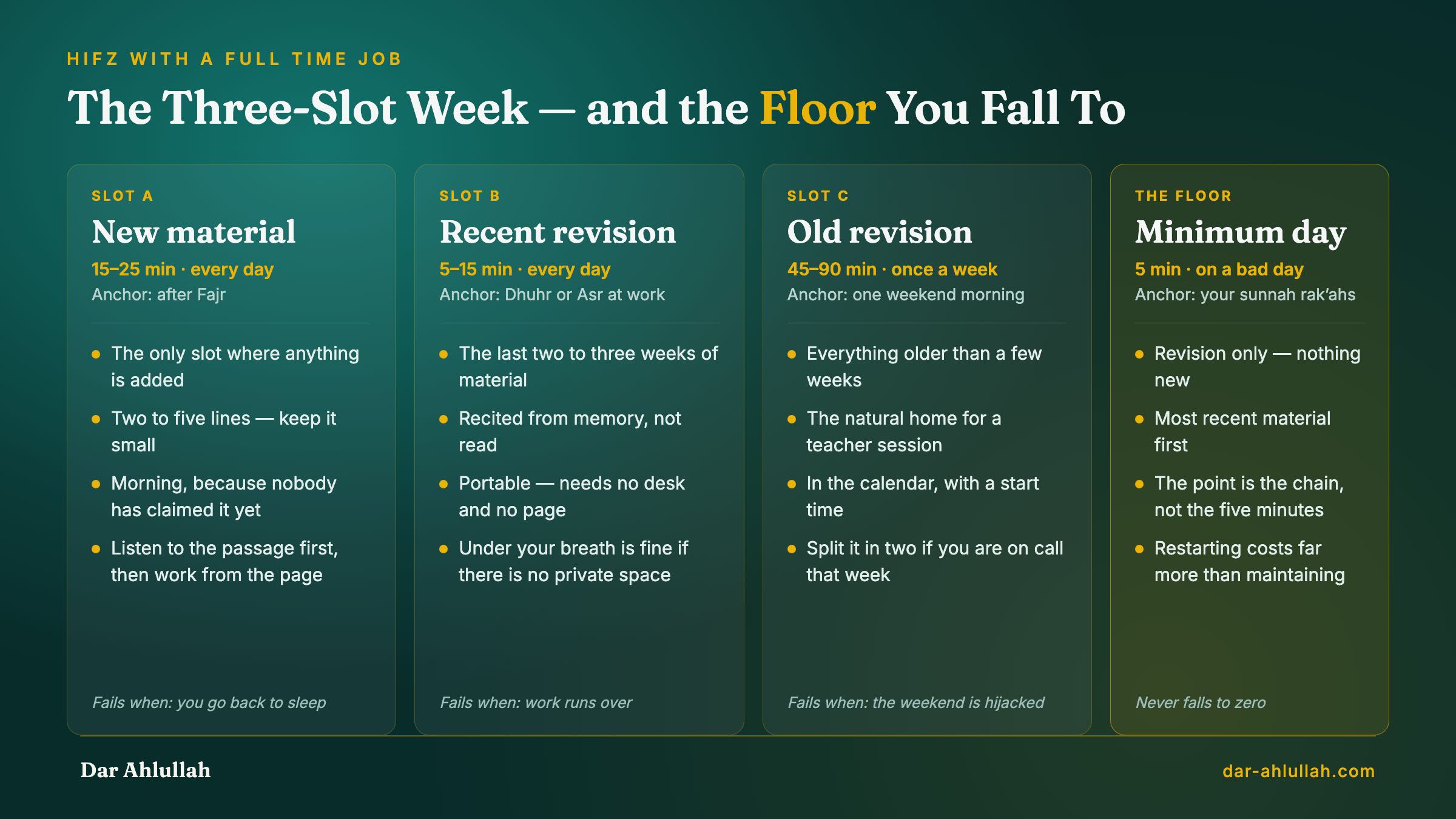
Slot A — New material (daily, 15–25 minutes, morning)
This is the only slot where you add anything. It goes in the morning for two reasons that have nothing to do with virtue and everything to do with reliability: a morning slot is the one part of the day that has not yet been claimed by anyone else, and it is the slot least likely to be cancelled by an overrunning meeting or a child who will not settle.
Keep the target embarrassingly small — two to five lines, depending on your reading fluency. The point of Slot A is not volume. It is that it happens every day.
Slot B — Recent revision (daily, 5–15 minutes, attached to a workday prayer)
Slot B covers what you have memorised in roughly the last two to three weeks: the material that is still fragile and will vanish quickest if left. It is short, it is portable, and it is the slot that goes in the middle of the working day, attached to Dhuhr or Asr or a lunch break.
Recite it from memory, out loud if you have somewhere private, under your breath if you do not. Do not read it. The distinction matters more than it looks, and the next section explains why.
Slot C — Old revision (weekly, 45–90 minutes, one weekend morning)
Slot C is the bulk pass over everything older than a few weeks. Weekdays cannot hold it — it is too long and too easily displaced — so it gets one protected weekend morning, in a calendar, with a start time, like an appointment with another person.
This is also the natural home for a teacher session, because Slot C is the only one long enough to hear a substantial amount of your old material read back and corrected. If the weekend is the only part of your week that reliably holds a lesson, our notes on weekend Quran classes for adults and children cover how that schedule is usually built.
Why three and not one
The three slots are separated because they fail differently. Slot A fails when you oversleep. Slot B fails when work runs over. Slot C fails when the weekend is hijacked. If all three lived in one evening block, one bad evening would take out new material, recent revision and old revision at once — and that is precisely the pattern that turns a missed day into a missed month.
Anchor to Salah, Not to the Clock
A schedule written as clock times — 6:30am, 1:00pm, Saturday 9:00am — is fragile for anyone whose work does not run to a fixed timetable. A schedule written as attachments is far more robust: after Fajr, after Dhuhr, after the Saturday school run.
There are three practical reasons to hang hifz slots off the prayers specifically:
- The anchor is already non-negotiable. You are not adding a new commitment to the day; you are extending one that already survives busy weeks.
- It travels. Prayer times shift with the season and with the country you are in, and a slot defined as “after Fajr” shifts with them automatically. A slot defined as 6:30am does not, which is why so many schedules quietly break in autumn.
- The mushaf is already out. The transition cost — the small friction of stopping one thing and starting another, which is where most habits actually die — is close to zero if you simply do not stand up.
There is a fourth benefit that pays off later. Material revised immediately after prayer tends to end up recited inside prayer, which is by some distance the most efficient revision a working person has access to: it costs no extra minutes at all.
Why Small and Daily Beats Long and Weekly
The three-slot design is not just a convenience. Three findings from the memory literature all point the same way, and together they explain why a person doing twenty minutes a day will usually outperform a person doing two and a half hours on Sunday.
Spacing. The spacing effect is the finding that the same total study time produces substantially more long-term retention when it is distributed across separate sessions rather than massed into one. The advantage is not marginal and it is not controversial; it is one of the most reliably replicated results in the study of memory. For hifz this means the calendar shape of your week is doing real work, independently of how many minutes it contains.
Retrieval. The testing effect is the finding that pulling information out of memory strengthens it more than re-exposing yourself to it does. Re-reading feels productive and produces a strong short-term impression that fades quickly; retrieval feels harder and lasts. This is the entire reason Slot B says recite from memory rather than read through. A revision session done with your eyes on the page is comfortable, fast, and worth a fraction of the same minutes spent reciting with the mushaf closed.
Sleep. Fact-based memory is consolidated substantially during sleep, and particularly during the deep slow-wave sleep concentrated in the early part of the night. The practical consequence for scheduling is that a day boundary is not a neutral gap between sessions — it is part of the process. Seven sessions on seven days genuinely are not the same input as seven sessions crammed into one, and no amount of discipline on Sunday buys back the six nights of consolidation you skipped.
Put together: the schedule that looks least impressive on paper — twenty minutes, every day, forever — is the one the evidence favours. That is a fortunate result for someone with a job.
Dead Time Is Revision Time, Not Memorising Time
Every article on busy-schedule hifz recommends using the commute, and the advice is sound but almost always underspecified. Dead time is genuinely valuable, but only for certain jobs, and using it for the wrong one produces the illusion of progress without the progress.
What dead time is good for:
- Listening to a reciter for material you are about to memorise, which is how you get the rhythm and the stopping points before you ever try to hold the words.
- Reciting old material from memory while driving, walking, cooking, queuing, or on the treadmill. This is real Slot C work, done free.
- Testing yourself on the joins — the end of one page into the start of the next, which is where recitation usually stalls.
What dead time is not good for:
- New memorisation. Attaching words to a page and to a position takes visual attention. Passive listening while doing something else builds familiarity, and familiarity is easily mistaken for memorisation — right up to the moment somebody asks you to recite it and the words are not there.
- Anything requiring correction. If nobody is listening, an error you make while driving is an error you are rehearsing.
That second point deserves emphasis, because it is a specific hazard of self-directed adult hifz. Repetition does not distinguish between right and wrong; it strengthens whichever one you performed. Unsupervised solo revision reliably locks in small pronunciation and wording errors, and the ones that come from confusing two similar passages are the hardest to catch alone — our guide to memorising similar verses covers why those particular errors feel entirely correct from the inside.
The Minimum Viable Day
Every working person’s schedule will collapse sometimes. A newborn, a product launch, a hospital week, a house move. The schedules that survive are not the ones that never get hit; they are the ones that have a defined floor to fall back to instead of falling to zero.
Define yours in advance, in writing, and make it genuinely small:
- Five minutes. Not fifteen. It has to be a number you cannot argue your way out of at 11pm.
- Revision only. No new material on a minimum day. Adding to a pile you are not maintaining is how the arithmetic in the earlier section catches up with you.
- The most recent material first, because that is what decays fastest.
- Inside a prayer if nothing else is possible. Recite this week’s portion in your sunnah rak’ahs and the minimum day is met without a single extra minute in the day.
The purpose of the minimum day is not the five minutes of revision. It is that the chain does not break. Restarting after a six-week gap costs vastly more than maintaining through a bad month, and the psychological cost — the sense of having failed at this before — is worse than the memory cost.
The narration in Sahih al-Bukhari 5033 compares the Qur’an slipping from memory to camels escaping when their tethers are released. It is a precise image for the mechanism: the loss is not gradual and proportional, and a fortnight of nothing costs more than fourteen times one day of nothing.
Travel, Shift Work, On-Call and Deadline Season
The three-slot week assumes a fairly conventional working pattern. Plenty of people do not have one. The structure still applies; what changes is which anchor each slot hangs from.
Frequent travel
Time zones destroy clock-based schedules and leave prayer-based ones intact, which is the single strongest argument for anchoring to salah. Keep Slot A and Slot B exactly as they are — they follow you — and accept that Slot C moves or shrinks on travel weeks. Freeze new material for any trip longer than about four days: revision travels well because it needs no page, and new memorisation needs a stable environment that a hotel and an unfamiliar schedule do not provide.
Shift work
Do not attach slots to times of day at all; attach them to positions in your shift. “First thing after waking, whenever that is” and “before the shift starts” are stable anchors across a rotating rota, where “morning” is not. Expect to hold a smaller daily volume than a nine-to-five worker and plan for it deliberately rather than discovering it. Rotating sleep is a real cost to consolidation, not an excuse.
On-call and interrupt-driven work
Slot A moves as early as it can go, ahead of the first possible interruption — on-call weeks are exactly when the pre-work slot earns its keep. Slot C should be split into two shorter sessions rather than one long one, because a ninety-minute block is a large target for an interruption to destroy while two forty-minute blocks are not.
Deadline season
If your year has a predictable crunch — quarter close, tax season, exams, a shipping deadline — put the freeze in the calendar before it arrives. Plan to stop adding new material for those weeks and to run revision only. A planned freeze is a normal part of a schedule. An unplanned collapse is how people conclude that hifz is not for them.
Five Ways Working Adults Break Their Own Schedule
1. Starting at the volume you wish you could sustain
The first week is always the least representative week you will have. Whatever you can do in a burst of enthusiasm in January is not the number to build the year on. Set the daily target at what you could still do during your worst normal week, and let a good week be a bonus rather than the baseline.
2. Putting the whole thing in the evening
Evening is the most contested part of a working adult’s day and the part where your capacity to retrieve anything is lowest. It is fine for consolidating what you did in the morning; it is a poor place for the load-bearing slot.
3. Measuring progress in pages memorised
Pages added is a flattering metric and a misleading one, because it says nothing about whether you can still recite them. Track pages you can currently recite accurately, unprompted, cold. That number can go down, which is exactly what makes it useful.
4. Doing revision with your eyes open
Covered above, and worth repeating because it is the most common single leak in adult hifz. Reading through what you have memorised is not revision. It is re-reading, it feels good, and it is worth a small fraction of the same time spent reciting blind.
5. Going without a listener
An adult memorising alone has no error detection, and errors that are never detected get rehearsed until they are indistinguishable from the correct version. This is the single largest structural difference between adult self-study and a child in a traditional programme, and it is the part that does not have a solo workaround.
When to Freeze New Material
Freezing — deliberately stopping new memorisation while continuing revision — is a normal tool, not an admission of defeat. Working adults should expect to use it several times a year. The signals that it is time:
- Slot C is regularly overrunning or getting skipped. The revision load has outgrown its container.
- You are making errors in material memorised more than three months ago. Old material should be stable; if it is not, nothing new should be arriving on top of it.
- Your recitable total has stopped rising even though your memorised total is. You are adding at the front and losing at the back.
- A known crunch period is coming. Freeze before it, not during it.
Come out of the freeze when you can complete Slot C comfortably inside its window with everything accurate. The mistake is not freezing too often — it is freezing too late, after a chunk of the back catalogue has already gone. If you are deciding where to resume and what order to take material in, our guide to which surahs to memorize first covers the sequencing question.
The Twenty-Minute Weekly Review
One small addition makes the difference between a schedule you follow and a schedule you occasionally remember. Once a week — the end of Slot C is the natural place — spend twenty minutes on the schedule itself rather than on the Qur’an:
- Count the slots you actually hit. Not how you felt about the week. Seven Slot As out of seven, four Slot Bs out of five.
- Look at the misses for a pattern. One missed morning is noise. Three missed Wednesdays is a standing meeting, and the answer is to move Wednesday’s slot, not to try harder.
- Check next week’s calendar for known collisions and pre-place the affected slots now, while you have a choice about where they go.
- Update the recitable total — what you can currently recite cold, not what you have ever memorised.
- Decide one thing for next week: add, hold, or freeze. One decision, made deliberately, once.
This is the part almost nobody does, and it is the part that turns a fragile arrangement into something that adapts. A schedule that cannot be adjusted in response to evidence will eventually meet a week it cannot absorb.
How We Schedule Hifz Around a Working Week
At Dar Ahlullah, sessions are booked in your own timezone rather than ours, which for a working adult in Europe or North America is the difference between a slot that fits the week and one that fights it. Early-morning and late-evening sessions exist for exactly the two edges this article recommends building around, and weekend slots exist for Slot C.
Lessons are one-to-one with a certified teacher, which is what supplies the missing piece in the mistakes list above: somebody listening to you recite from memory who can catch an error before it is rehearsed into permanence. If the pairing is not right, we will rematch you with another certified mentor at no extra cost.
On frequency: two full-hour sessions a week is the standard shape for an adult building a hifz habit, and three is the shape for someone memorising seriously and wanting weekly correction on both new material and the back catalogue. Both, along with what each costs, are set out on our pricing page — the rate is $9 per teaching hour and plans can be paused, upgraded or switched at any time, which matters more than it sounds when a deadline season arrives and you need to drop to revision only for a month. There is a free 30-minute assessment before you commit, with no card required. The wider structure that these sessions sit inside is described in our online hifz program guide.
Questions Working Adults Ask
How much time a day do I actually need to memorise the Quran while working?
Less than most people assume for the memorising and more than most people assume for the revision. A workable daily floor is 15–25 minutes for new material plus 5–15 minutes of recent revision, with a longer weekly session for older material. The daily figure stays roughly constant; the weekly one grows as you accumulate, and that is the part to plan for.
Is it better to do a little every day or a long session at the weekend?
A little every day, by a wide margin. The same total minutes distributed across the week produce more durable retention than the same minutes massed into one session — that is the spacing effect — and the overnight consolidation between sessions is part of the mechanism, so a weekend-only schedule cannot replicate it however long the session is.
Can I memorise during my commute?
Use the commute for listening and for revising material you already hold, not for taking on anything new. New memorisation needs visual attention on the page, and passive listening while driving builds familiarity that feels like memorisation and disappears the moment you try to recite unprompted.
What do I do when work gets so busy the schedule falls apart?
Fall to a pre-defined minimum day rather than to zero: five minutes, revision only, most recent material first, recited inside your sunnah prayers if there is genuinely no other window. The point is to keep the chain intact, because restarting after a long gap costs far more than maintaining through a bad month.
Should I stop memorising new pages when I get behind on revision?
Yes, and sooner than feels comfortable. If old material is producing errors or your weekly revision session is regularly overrunning, freeze new material until you can complete a full revision pass accurately inside its window. Adding to a back catalogue you are already losing is the most common way adult hifz quietly reverses.
Is morning really better than evening for memorising?
For most working people, yes — but mainly for a scheduling reason rather than a biological one. The morning slot is the part of the day least likely to be taken by someone else, so it is the slot that survives busy weeks. If your circumstances genuinely make evenings more protected, use the evening; reliability matters more than the hour.
Can I memorise the Quran without knowing Arabic?
You can, and many people do, though understanding what you are reciting makes the material noticeably easier to hold and much easier to distinguish when two passages resemble each other. You do not need conversational fluency — enough to know what the words in front of you are doing is a far smaller target.
Do I need a teacher if I am disciplined enough to do this alone?
Discipline is not the gap. Error detection is. Repetition strengthens whatever you actually performed, correct or not, so an unheard mistake becomes a rehearsed mistake, and the errors that come from confusing similar passages are undetectable from the inside by definition. A weekly listener is the part of adult hifz that has no solo substitute.
Conclusion: Design the Week, Not the Motivation
The reason a full-time job makes hifz hard is not that it consumes the hours. It is that it makes the hours unpredictable, and an unscheduled habit cannot survive unpredictability. Everything in this guide is aimed at that one problem: anchor the slots to things that already happen, budget the revision before the memorising, keep the daily commitment small enough to survive a bad week, define the floor you fall to instead of falling to zero, and review the schedule itself once a week so it can adapt before it breaks.
Do that, and the question stops being whether you have the time. Twenty minutes a day, held for a decade, is a considerable amount of Qur’an — and the deed done constantly, even when little, is the one the narration singles out. If you want the wider route into memorisation that this schedule sits inside, our complete guide to learning Qur’an online is the place to start.
Related articles

how to memorize similar verses in the Quran
How to Memorize Similar Verses in the Quran (Mutashabihat)
The places where recitation derails are not the unfamiliar verses. They are the familiar ones — the passages that resemble each other so closely that memory takes the wrong branch.
17 min read
how to revise Quran memorization
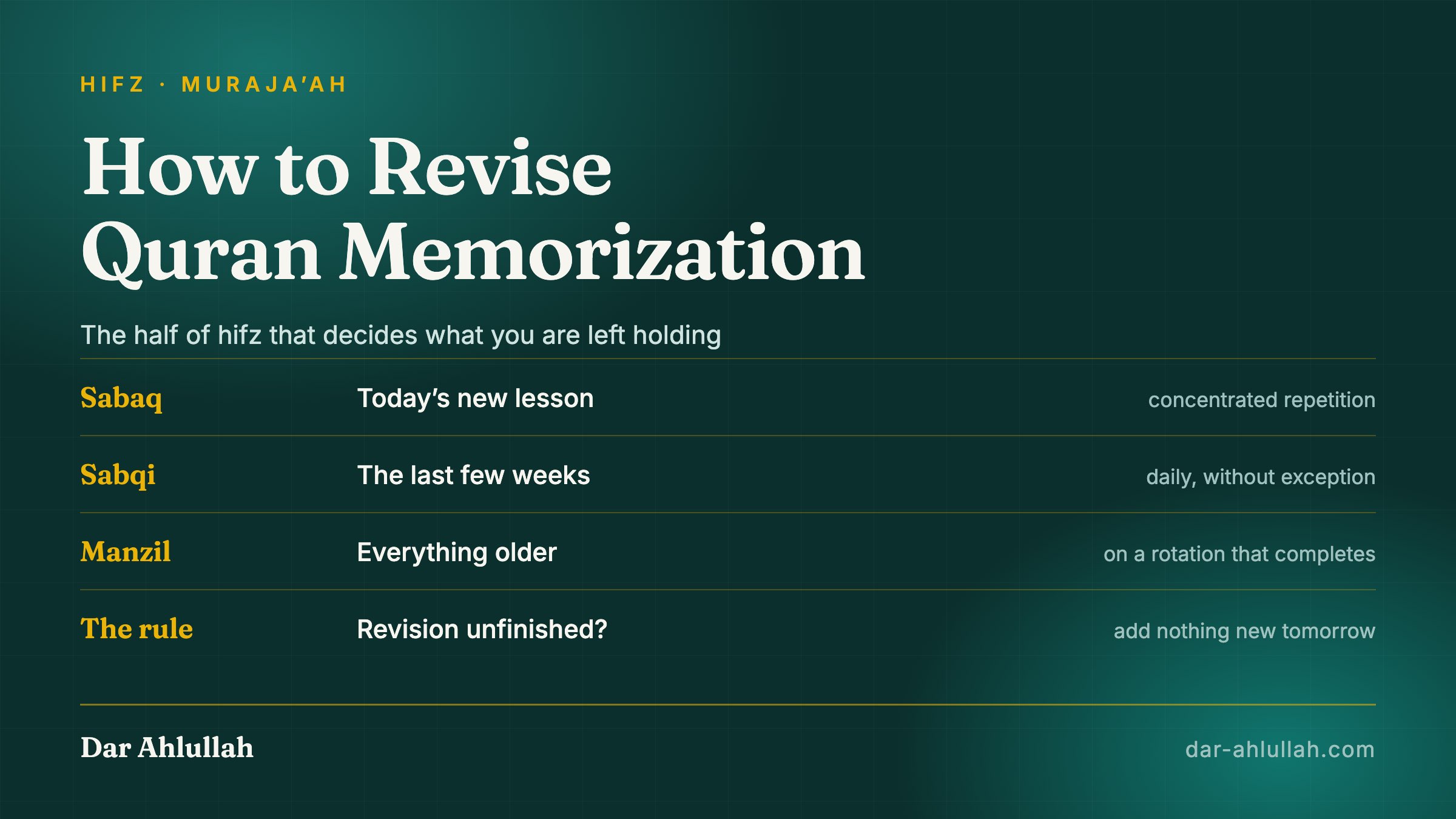
What Murajaah Means, and How to Revise Quran Memorization
Every hifz plan is a memorisation plan, and almost every one that fails, fails because nothing in it described what happens to the pages behind you.
15 min read
how long does it take to memorize the Quran
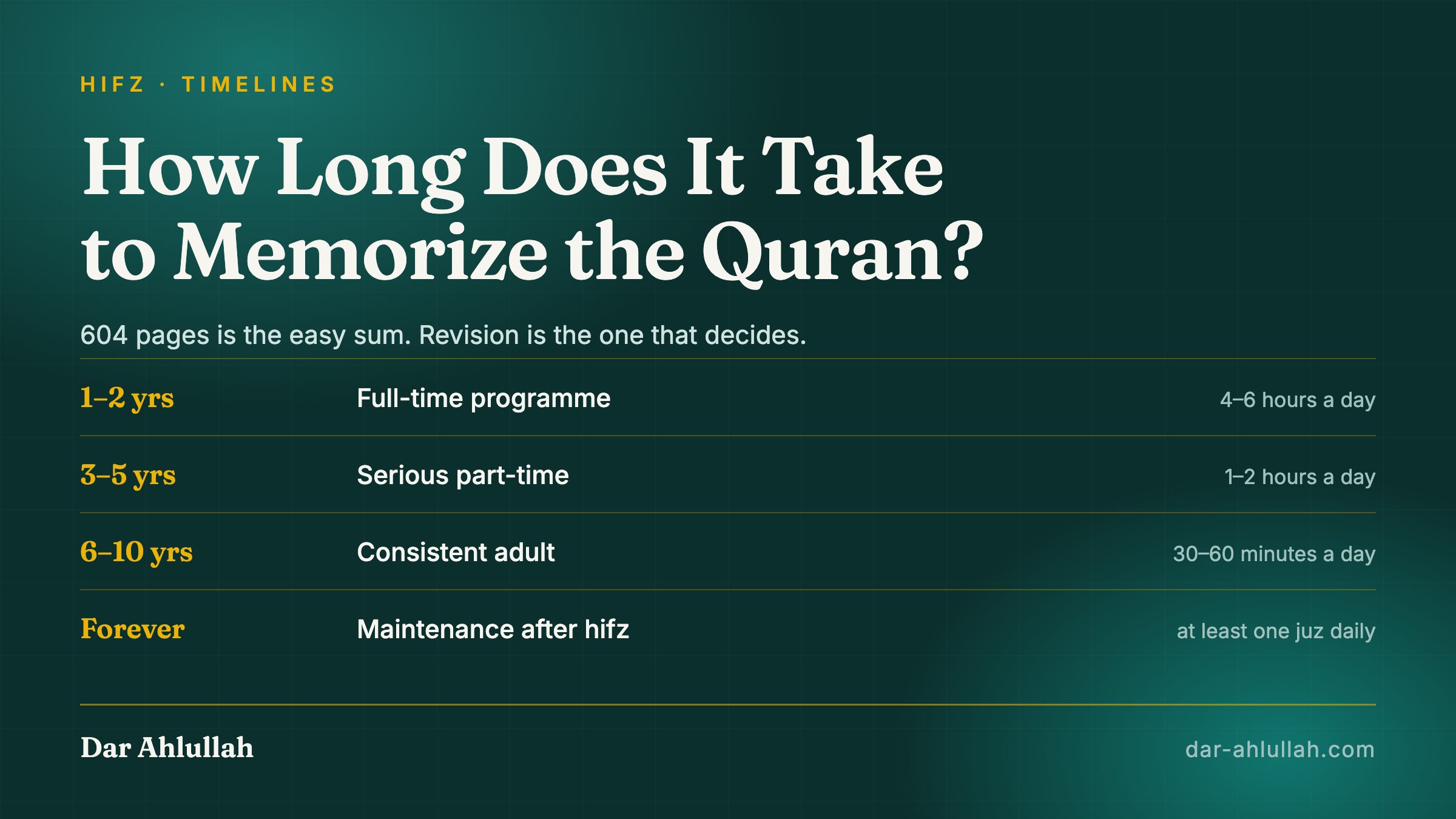
How Long Does It Take to Memorize the Quran? An Honest Answer
One to three years, two to five, six months - the published numbers describe how long the memorising takes, and memorising is not the part that decides when you finish.
13 min read