
how to read the Quran for beginners
How to Read the Quran for Beginners: A Step-by-Step Route
Dar Ahlullah team 20 min read
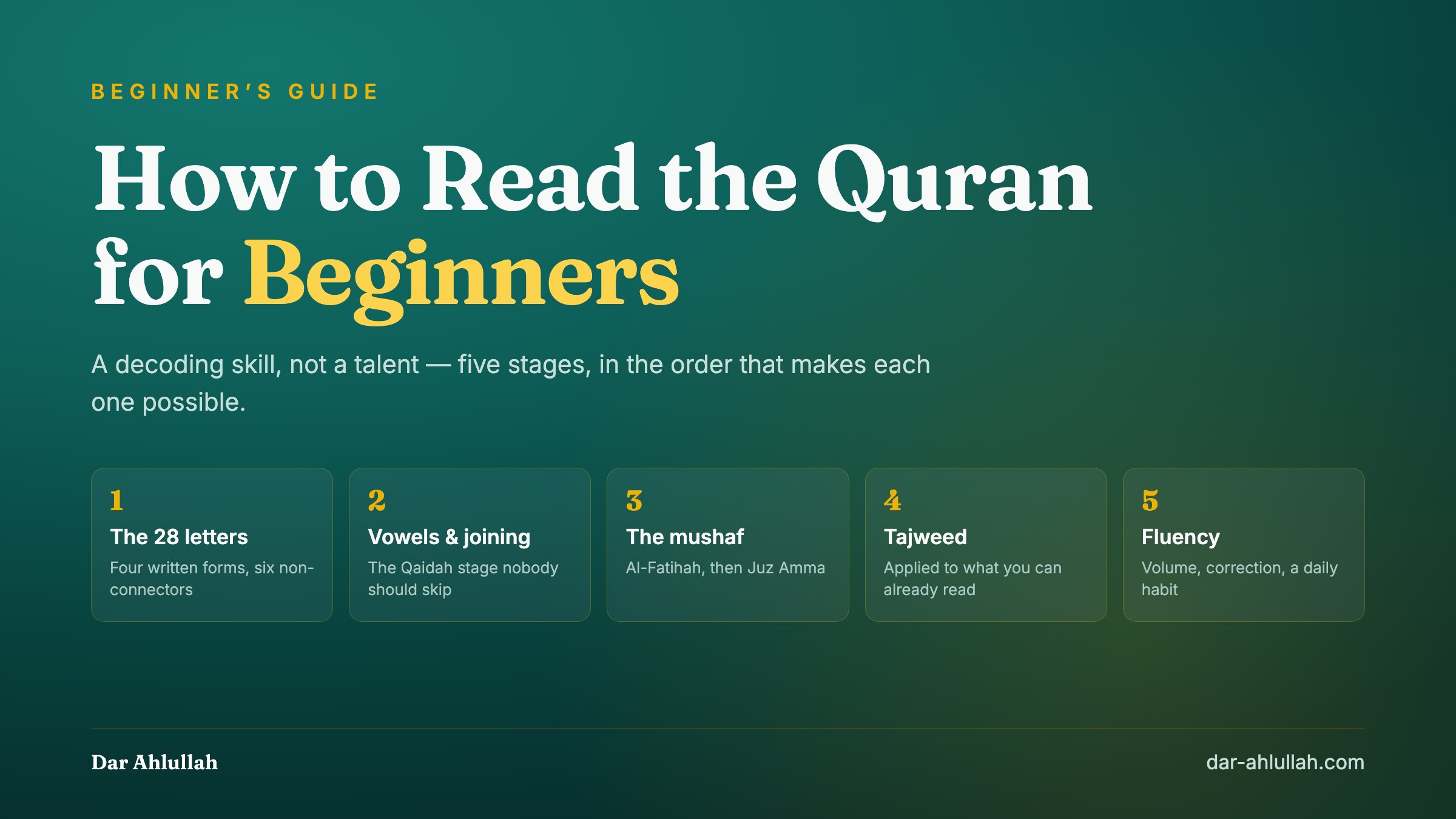
Table of Contents
- Introduction: The Gap Between Wanting To and Being Able To
- The Short Answer: Five Stages, In This Order
- First, Decide What “Reading” Means
- Stage 1: The 28 Letters and Their Four Faces
- Stage 2: Vowels and Joining — the Qaidah Stage
- Stage 3: Your First Pages of the Mushaf
- Stage 4: Tajweed, Applied to What You Can Already Read
- Stage 5: Fluency, and the Habit That Produces It
- Why Transliteration Stalls You
- How Long Each Stage Actually Takes
- A Realistic Weekly Plan
- What Self-Study Can and Cannot Fix
- Six Mistakes That Cost Beginners Months
- How We Run the Beginner Route
- FAQs About Learning to Read the Quran
- Conclusion: Start at Al-Fatihah, Not at Page One
Introduction: The Gap Between Wanting To and Being Able To
Most people who want to read the Quran are not short of motivation. They are short of a route. They open the mushaf, see a page of joined script with small marks above and below it, recognise nothing, and close it again — and the conclusion they draw is that they are not the kind of person who can do this.
That conclusion is wrong, and the reason is worth stating plainly. Reading the Quran is a decoding skill, not a talent. It is the same category of skill as reading English: a finite set of symbols, a finite set of rules for how they combine, and a period of slow, effortful sounding-out that ends when the symbols become automatic. Children do it every year in every language on earth. The only thing that makes Arabic feel different to an adult is that you already know what fluency feels like in your own language, so the beginner stage feels like failure rather than like the beginning.
What actually goes wrong for most beginners is sequencing. They start in the wrong place, skip the stage that makes the next one possible, or try to learn four things at once — letters, vowels, tajweed rules and meaning — and stall on all four. So this guide on how to read the Quran for beginners is arranged as a sequence rather than as a list of tips. Five stages, in order, each with a clear thing that marks its completion, so you always know what you are working on and what comes next.
One thing to carry with you before the work starts. The Prophet ﷺ said that the one who is skilled in reciting the Quran will be with the noble and obedient scribes, and that the one who recites it and stumbles through it, finding it difficult, has two rewards — the hadith is recorded in Sahih Muslim. The halting stage is not a failure state you have to get past before the reward starts. It is explicitly the stage with the double reward.
The Short Answer: Five Stages, In This Order
If you want the whole route in one screen, here it is. Do not reorder them, and do not run two of them at once.
- Letters. Recognise all 28 letters by name and sound, in all four of their written forms. Ends when you can name any letter anywhere on a page.
- Vowels and joining. Add the short vowels, sukun, shadda and tanween, and read joined two- and three-letter syllables. This is the Qaidah stage. Ends when you can sound out an unfamiliar word without being told it.
- The mushaf. Move from the primer into the actual text, starting with Al-Fatihah and the short surahs at the end. Ends when you can read a short surah aloud, slowly, without help.
- Tajweed. Apply the rules of pronunciation to text you can already decode. Ends when the common rules happen without you thinking about them.
- Fluency. Volume and consistency. This one does not end; it is the maintenance phase, and it is where most of the reward accumulates.
Every stage in that list depends on the one above it, which is why the order is not negotiable. Tajweed rules applied to letters you cannot reliably identify are memorised trivia. Meaning studied before decoding produces someone who knows what a verse says and still cannot read it.
First, Decide What “Reading” Means
“I want to read the Quran” hides two different goals, and the fastest way to waste a year is to pursue both at once without noticing.
Recitation is the ability to look at Arabic script and produce the correct sounds. It is a mechanical skill, it is the prerequisite for prayer, and it is what this guide is about. You do not need to understand a single word to do it, which sounds strange until you remember that most of the Muslim world recites this way and that a child memorising Juz Amma is doing exactly this.
Comprehension is understanding the Arabic as language — vocabulary, grammar, the shape of a sentence. It is a separate, longer project, and it runs on its own track. It is worth starting, but not instead of decoding and not at the same time as your first weeks of letters.
The practical rule: get to the end of stage three first, then start comprehension alongside stage four and five. By then reading no longer consumes your whole attention, so there is room for meaning. If you want to see what the comprehension track looks like when you get there, our guide to the most common words in the Quran is the cheapest possible entry point, because a small number of words carry an enormous share of the text.
There is a third thing people sometimes mean — memorisation. That is a separate discipline again, it depends entirely on stage three being finished, and it has its own guide: how online hifz programmes work. Do not begin it before you can read.
Stage 1: The 28 Letters and Their Four Faces
Arabic has 28 letters and reads right to left. That much most beginners know before they start. The part that catches people out is that a letter does not keep one shape: most letters are written differently depending on whether they stand alone, begin a word, sit in the middle, or end it. Four faces, one letter, one sound.
This is why an alphabet chart is not enough on its own. The chart shows you the isolated form — the one that appears least often in a real page — and then the mushaf shows you the other three. A beginner who has memorised the chart and nothing else looks at a line of Quran and genuinely cannot find the letters they know.
Two further details make the first stage much easier if you learn them at the start rather than discovering them by frustration.
Letters come in shape families. A large share of the alphabet is built from a handful of base skeletons distinguished only by dots — one above, two above, three above, one below. Learning the families rather than 28 unrelated pictures cuts the memory load down sharply, because within a family you are only ever learning the dots.
Six letters never connect to the letter after them. They are ا, د, ذ, ر, ز and و. This is the single most useful fact in the whole stage, because those six are what create the visible gaps inside a word. Beginners routinely read a gap as the end of a word, split one word into two, and conclude the script is chaotic. It is not; you were reading a non-connector.
We have written this stage up on its own, in detail, with the shape families and the four forms laid out: see our guide to the Arabic alphabet for beginners. Work through it before you go anywhere near a page of Quran.
What marks the end of stage one
Open any page of the mushaf, point at a letter at random, and name it. Not read the word — name the letter, correctly, wherever it sits in the word. When that is reliable rather than lucky, you are done, and not before.
Stage 2: Vowels and Joining — the Qaidah Stage
Arabic script writes the consonants and long vowels; the short vowels are the small marks written above and below the letters. In ordinary Arabic writing those marks are usually left out, and the reader supplies them from knowing the language. In the mushaf they are always present, which is a gift to the non-Arabic-speaking beginner: everything you need in order to pronounce the word correctly is on the page.
The marks you need in this stage are few:
- Fatha, kasra, damma — the three short vowels, giving the consonant an a, i or u sound.
- Sukun — the mark meaning no vowel at all, so the consonant closes the syllable.
- Shadda — the letter is doubled and held.
- Tanween — a doubled vowel mark producing an -an, -in or -un ending.
- The long vowels — where a short vowel is stretched by a following letter, which is what makes a syllable long rather than short.
That is the entire inventory. Six things. The difficulty of stage two is not the number of items; it is that you now have to combine them with the letters from stage one at speed, and that only comes from volume.
What a Qaidah is, and why it exists
This stage is traditionally taught from a primer — the Noorani Qaida or one of its equivalents. A Qaidah is not a book about Arabic. It is a graded set of drills: isolated letters, then letters with each vowel, then two-letter combinations, then three, then words, then short verses. Each page is deliberately harder than the one before it by exactly one new element.
People skip it because it looks childish, and it is genuinely the most common expensive mistake in the whole route. The Qaidah is not remedial; it is the only part of the process that builds decoding speed under controlled conditions. Skipping it means doing the same drilling later, on real Quran, with worse feedback and higher stakes.
The Qaidah stage is also where a teacher earns their money most obviously, because half of what you are learning is sounds that do not exist in English — and you cannot hear your own errors in a sound you have never produced. More on that in the section on self-study below.
What marks the end of stage two
You can be shown an unfamiliar Arabic word, fully vowelled, and sound it out correctly without anybody telling you what it says. Slowly is fine. Slowly is expected.
Stage 3: Your First Pages of the Mushaf
Now you open the actual text — and the first decision is where. The instinct is to start at the beginning, and the beginning is Surah Al-Baqarah, the longest surah in the Quran. Starting a new reader there is like handing someone who has just learned to read a full-length novel with long sentences. It is not that they cannot; it is that they will stop.
Start in two places instead.
Al-Fatihah first. Seven verses, and you recite them in every unit of every prayer, five times a day, for the rest of your life. Nothing else in the Quran has that ratio of shortness to usefulness. Being able to read Al-Fatihah from the page — rather than from memory of how someone else said it — is the moment reading stops being theoretical.
Then the last juz. Juz Amma is the thirtieth and final part of the Quran, and it runs from Surah An-Naba to Surah An-Nas. The surahs there are short, the verses are short, the vocabulary repeats heavily, and it contains most of the surahs Muslims actually recite in prayer. Working backwards from the end is not a shortcut; it is the standard order for a reason.
Work in small units. One short surah at a time, read aloud, every day, until it is smooth — then the next. Reading silently at this stage is close to useless: the whole skill is producing sound, and the errors you cannot hear are the errors you keep.
What marks the end of stage three
You can read a short surah you have not memorised, aloud, from the page, slowly, and get through it without being rescued. At that point you are a reader of the Quran. Everything after this is refinement and volume.
Stage 4: Tajweed, Applied to What You Can Already Read
Tajweed is the set of rules governing how the Quran is pronounced — which letters come from which part of the mouth and throat, which sounds merge into the next, which are held and for how long, where you may stop and where you may not. It is not decoration and it is not an advanced elective. Some of it protects meaning: Arabic distinguishes several sounds that English collapses into one, and reciting the wrong one changes the word.
But it belongs here, at stage four, and not earlier. Tajweed rules describe what happens when specific letters meet in specific conditions. To apply a rule you must first be able to see that the condition has occurred, which means identifying both letters and both their vowel marks instantly. A student who is still decoding cannot do that, so tajweed taught too early becomes a list of Arabic terminology memorised in the abstract and applied to nothing.
The good news is that a great deal of tajweed you will absorb by imitation before you ever learn its name, simply by reciting to a teacher who corrects you and by listening to a lot of recitation. The formal study then names what you are already half-doing and fixes the parts you had wrong. Our plain-English walkthrough of the tajweed rules for beginners takes the rules family by family in the order they are normally taught, and our overview of how recitation classes work covers what this stage looks like as a weekly lesson.
What marks the end of stage four
There is no end, but there is a threshold: the common rules fire automatically while you read, rather than being remembered and then applied. Getting there is a matter of corrected repetition, which is to say a teacher and time.
Stage 5: Fluency, and the Habit That Produces It
Fluency is not a stage you study. It is what accumulates when a moderate amount of reading happens on most days for a long time. There is no technique here, only volume, and the only real question is whether the habit survives contact with a normal week.
Three things reliably keep it alive.
Attach the reading to something that already happens. A fixed page or half-page after Fajr, or after Isha, is far more durable than an intention to read at some point in the day. The anchor does the remembering for you.
Keep the daily amount small enough to be boring. A quantity you can do on your worst day is worth more than one you can do on your best. Consistency compounds; intensity does not.
Keep reciting to someone. This is the part people drop first once they can read independently, and it is the part that prevents drift. Errors that go uncorrected for a year become habits, and habits at the level of pronunciation are much harder to remove than to prevent.
If you want the wider picture of how this fits into structured study — formats, teachers, what a curriculum looks like end to end — our complete guide to learning the Quran online is the pillar this article sits under.
Why Transliteration Stalls You
Transliteration — Arabic sounds written in Latin letters, bismillahir-rahmanir-raheem — is the most tempting shortcut available to a beginner and the one most likely to cost you a year.
The problem is not that it is disrespectful. It is that it does not work, for a specific mechanical reason: the Latin alphabet has no way to distinguish several pairs of Arabic sounds. Arabic has consonants that English simply does not, and multiple distinct Arabic letters end up written with the same Latin letter or with an inconsistent scheme of dots and dashes that varies between publishers. Reading transliteration therefore teaches you to produce a sound that is close to right and to stop noticing the difference — and once the wrong sound is habitual, unlearning it takes longer than learning it correctly would have.
The deeper cost is that transliteration removes the pressure that makes you learn the script. Every day you read from Latin letters is a day you did not spend decoding Arabic ones, and the crutch works well enough that the need never becomes urgent. Beginners who lean on it often arrive a year later able to recite several surahs from memory and still unable to read a line.
There is one legitimate use, and it is narrow: a brand-new Muslim who needs to pray correctly this week cannot wait three months for the letters. Use transliteration for the fixed prayer text as a temporary bridge, keep the decoding lessons running in parallel, and retire the crutch as soon as stage two is done. If that is your situation, our first-90-days guide for new Muslims sets out what to learn in which order, and it puts the letters in month one for exactly this reason.
How Long Each Stage Actually Takes
Nobody can give you a reliable number, and anyone who quotes one confidently is selling something. The variance between two adult beginners with the same lesson schedule is genuinely large, and it depends on prior exposure to the script, how much practice happens between lessons, and whether the student reads aloud or silently.
What can be said honestly is the shape of it. Stages one and two — letters through Qaidah — are the bulk of the effort and normally a matter of months rather than weeks for an adult starting from zero at a couple of lessons a week. Stage three is comparatively quick once stage two is solid, which is why rushing stage two is such a poor trade. Stage four runs for as long as you keep studying. Stage five never ends.
The one variable you control most directly is practice between lessons. Two thirty-minute lessons a week with ten minutes of daily reading in between moves considerably faster than the same two lessons with nothing in between, because decoding speed is built by repetition and a lesson is where errors get caught, not where the repetitions happen.
The other thing worth knowing: progress in this skill is not linear and it does not feel like progress while it is happening. Weeks of laborious sounding-out are followed by a fairly sudden period where words start arriving whole rather than letter by letter. Almost everyone who quits does so during the plateau immediately before that.
A Realistic Weekly Plan
This is the schedule the five stages assume: two short lessons and a small daily practice. It is deliberately modest, because a plan you keep for a year beats a plan you abandon in March.
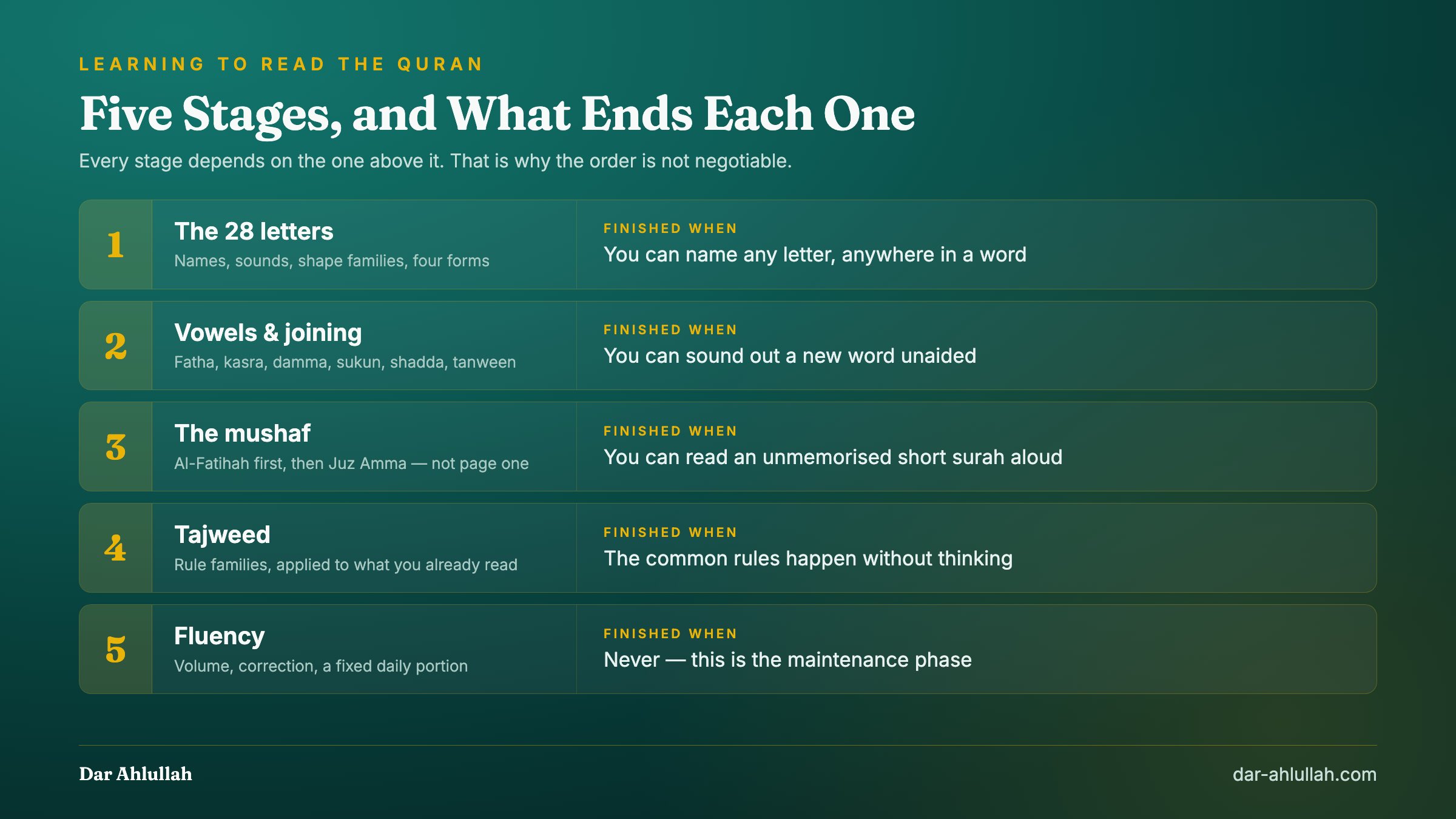
| Stage | Lesson focus | Daily practice between lessons | You have finished when |
|---|---|---|---|
| 1. Letters | Names, sounds, shape families, four forms | 10 minutes naming letters on a real page | You can name any letter, anywhere in a word |
| 2. Qaidah | Vowel marks, sukun, shadda, tanween, joining | 10–15 minutes of Qaidah drills, aloud | You can sound out a new word unaided |
| 3. Mushaf | Al-Fatihah, then Juz Amma, one surah at a time | Read the current surah aloud, twice | You can read an unmemorised short surah aloud |
| 4. Tajweed | Rule families applied to what you already read | Recite the day’s passage; listen to it recited | Common rules happen without thinking |
| 5. Fluency | Volume, correction, gradual expansion | A fixed daily portion, attached to a prayer | Never — this is the maintenance phase |
What Self-Study Can and Cannot Fix
Apps, videos and printed Qaidahs are genuinely useful, and it would be dishonest to pretend otherwise. They are excellent at three things: showing you the letter shapes, giving you unlimited repetitions of a model pronunciation, and letting you drill at eleven at night when no teacher is awake.
There is one thing they cannot do, and it happens to be the thing the whole skill rests on. They cannot hear you. Half of Arabic pronunciation involves distinctions that English does not make, and the defining property of a sound your language does not contain is that you cannot hear yourself getting it wrong. Your ear maps the unfamiliar sound onto the nearest familiar one, your mouth produces the familiar one, and to you the two are identical. Nothing in a recording closes that loop.
This is why the Quran has been transmitted by recitation to a teacher for fourteen centuries rather than by book alone, and why the credential in this field — the ijazah — is granted only after a teacher has heard a student recite. The mechanism is correction, and correction requires a listener.
The practical compromise is not all-or-nothing. A short lesson twice a week for correction, and self-study for the repetitions in between, gets most of the benefit of both. What does not work is self-study alone through stages one and two, because that is precisely where wrong habits are formed, and they are cheap to prevent and expensive to remove.
Six Mistakes That Cost Beginners Months
| Mistake | What it costs |
|---|---|
| Starting at page one, in Al-Baqarah | The hardest possible entry point. Most people stop within a fortnight. |
| Skipping the Qaidah because it looks childish | Decoding speed never gets built, so every later stage runs slower. |
| Learning tajweed rules before you can decode | Arabic terminology memorised in the abstract, applied to nothing. |
| Reading silently | The skill is producing sound. Silent reading hides every error you have. |
| Long sessions, twice a month | Decoding is built by frequency, not duration. Ten minutes daily beats two hours fortnightly. |
| Chasing meaning during the first weeks | Two hard skills at once, and neither reaches the point where it becomes easier. |
Five of the six are the same error in different clothes: doing a later stage before the one it depends on. If you take nothing else from this article, take the order.
How We Run the Beginner Route
For transparency, here is how the five stages map onto the way we teach, so you can compare it against however else you decide to learn.
Everyone starts with a free 30-minute assessment rather than a demonstration lesson. The teacher finds out which of the five stages you are actually at — which is frequently not the one people assume — and proposes a starting point in writing. No card is required to book it, and there is nothing to cancel afterwards.
Lessons are one-to-one, because the entire beginner skill is being heard and corrected, and in a group of eight you recite for about a minute. Teachers are native Arabic speakers who teach in English, and one named teacher stays with you rather than a different face each week — corrections only accumulate if somebody remembers last week’s. If the fit is wrong we rematch you with another certified teacher at no cost.
After every session you get a written report: what was covered, what was corrected, what to practise before the next lesson. For a beginner that report is the practice list, and it is the reason the daily ten minutes has something specific to work on rather than being vague repetition.
Our rate is $9 per teaching hour, which is the same number on every plan — a 30-minute session is $4.50. Starter is $36 a month for eight 30-minute sessions, which is the normal beginner shape; Committed is $70 for eight full hours; Hifz Intensive is $102 for twelve. Siblings get 20%. You can pause or switch plans at any time. The full breakdown is on the pricing page.
FAQs About Learning to Read the Quran
Can an adult really learn to read the Quran from zero?
Yes, and adults have two advantages children do not: they can be told an abstract rule once and apply it, and they chose to be there. What they lack is patience with their own beginner stage, which is the actual obstacle. Our guide to learning the Quran as an adult deals with that part directly.
Do I need to learn Arabic first?
No. Reading and understanding are separate skills, and reading comes first. You can be a competent reciter of the Quran with no ability to hold an Arabic conversation, which is the position of most Muslims in the world. Start comprehension once decoding is no longer consuming all your attention.
How long before I can read Al-Fatihah from the page?
It depends entirely on how far you get through stages one and two, since Al-Fatihah is the first thing you read after them. It is not a matter of a week, and for an adult at a steady couple of lessons a week it is normally a matter of months rather than a year. The honest answer is that the timeline is set by practice frequency more than by anything a teacher controls.
Is the Noorani Qaida the only option?
No. There are several equivalent primers and most academies use one or another. What matters is not which book but that you use one: a graded sequence of drills that adds exactly one new element per page. Any of them will do; skipping the stage will not.
Should I learn tajweed at the same time as the letters?
Not the rules, no. You will absorb a good deal of correct pronunciation by imitation from the first lesson, which is different — that is your teacher shaping the sound as you produce it. Formal rule study belongs at stage four, once you can identify letters and vowels instantly enough to see when a rule applies.
Can I learn from an app instead of a teacher?
Partly. Apps are good for the repetitions and useless for the corrections, because they cannot hear you, and the sounds English does not have are exactly the ones you cannot self-diagnose. The workable combination is a short lesson for correction plus daily self-study for volume.
My child is learning at the mosque. Does this order still apply?
Yes — it is the same sequence, and most maktab and weekend programmes follow it. The one thing worth checking is whether your child is being heard individually and how often, since in a large class the amount of time each child spends actually reciting aloud can be very small.
What if I already memorised surahs by ear but cannot read?
That is common and it is an advantage, not a problem. You already know what the words sound like, so when you reach stage three the text will be familiar and the decoding will have a target. Do stages one and two properly anyway; memory by ear does not transfer to reading on its own.
Conclusion: Start at Al-Fatihah, Not at Page One
The route is short to describe and long to walk: learn the 28 letters in all their forms, add the vowel marks and learn to join, move into Al-Fatihah and the short surahs, apply tajweed to text you can already read, and then keep reading for the rest of your life. Nothing in that list is difficult in itself. The failures are almost always failures of order — a rule learned before the thing it applies to, or a stage skipped because it looked too basic to bother with.
So pick your starting stage honestly, work on one thing at a time, read aloud every day even when it is only ten minutes, and get heard by someone who can correct you. And remember which stage the double reward was promised for: the halting one, the one that feels like failure. That is where you are supposed to be at the beginning.
If you want to know which of the five stages you are actually at, our 30-minute assessment will tell you and put it in writing, whether or not you carry on with us. It is a better starting point than guessing.
Related articles
sajdah tilawah
Sajdah Tilawah: What to Do at a Prostration Verse
Sajdah tilawah is the single prostration that belongs to reciting or hearing one of the Qur'an's verses of prostration. Where those verses are, why the four schools count fourteen, fifteen and eleven of them, how to perform it, and the answers for a desk, a recitation app, a live lesson and a hifz drill.
26 min read
Noorani Qaida
Noorani Qaida: What It Is and How to Actually Finish It
Every Quran teacher says “we will start with the Qaida” as if you already know what that means. Here is what the book is, what each block of lessons trains, why the order is not negotiable, and the five habits that leave people stuck on page nine.
20 min read
Arabic alphabet for beginners
Arabic Alphabet for Beginners: How to Read the Script
An alphabet chart shows you 28 isolated shapes. A page of Arabic shows you the same letters joined, compressed and stripped of their vowels. This is the route across that gap — shape families, four forms, six non-connectors and the marks that make a word readable.
17 min read