
how to teach your child to pray
How to Teach Your Child to Pray: An Age-by-Age Guide for Parents
Dar Ahlullah team 23 min read
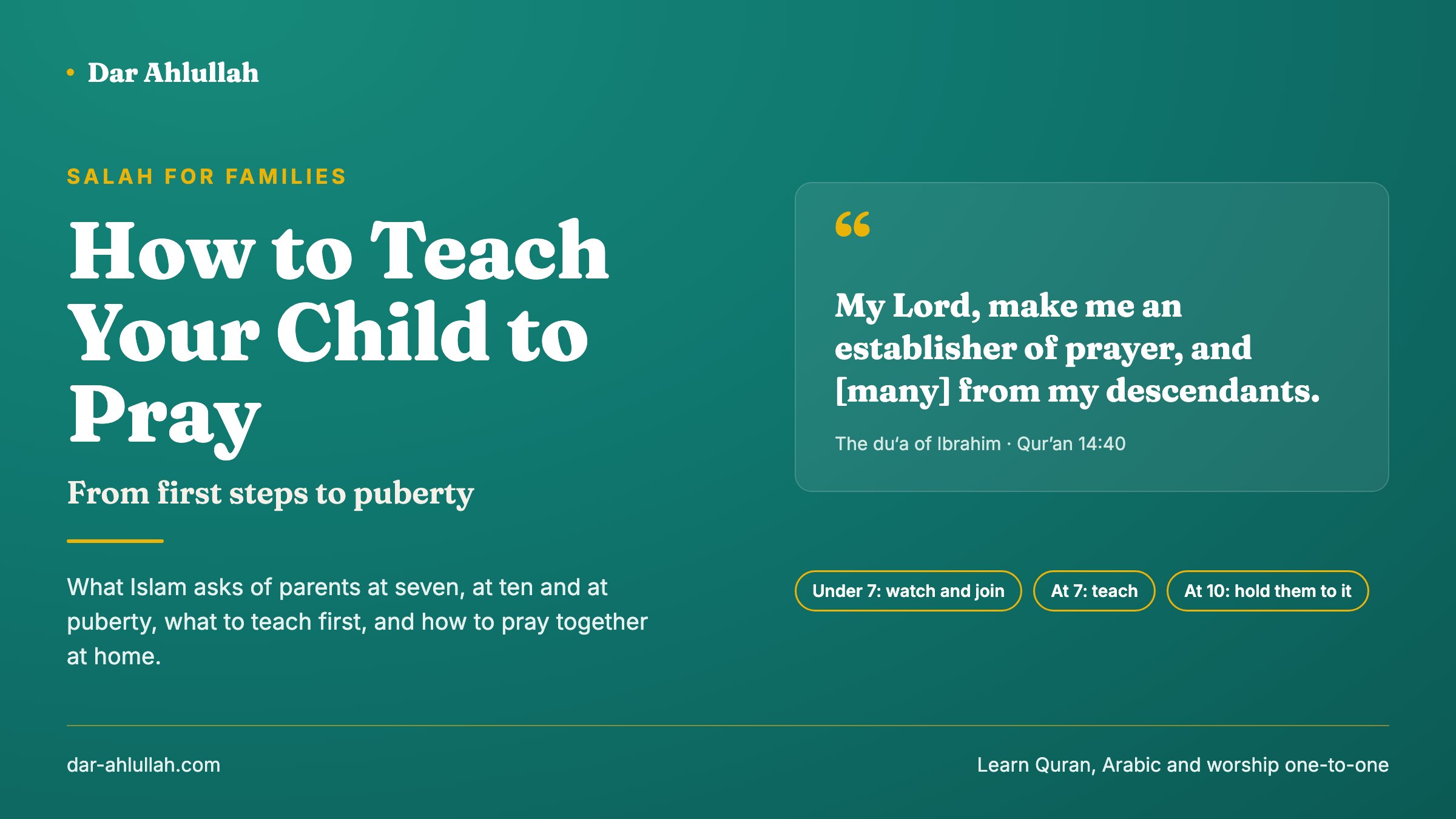
Table of Contents
- Introduction: Your Child Is Already Watching
- The Short Answer
- What Islam Asks of Parents, Stage by Stage
- Before Seven: Watch, Copy, Join
- At Seven: What to Teach, and in What Order
- Praying Together at Home and in the Mosque
- At Ten: What the “Strike” Clause Means, and What It Does Not
- Puberty: When the Prayer Becomes Their Own
- Six Situations, Worked Through
- Seven Mistakes Parents Make
- How We Teach This
- Questions Parents Ask
- Conclusion: The Prayer of Ibrahim
Introduction: Your Child Is Already Watching
You go down into sujud and feel a small hand on your back. Your three-year-old has climbed onto the prayer mat beside you and is copying you a beat late, forehead to the floor, then up again before you are. Four years later the same child asks whether she can pray “properly”, and you realise you are not sure where to start: with wudu, with al-Fatihah, with the movements, or with getting her up for Fajr on a school morning in January.
This guide covers how to teach your child to pray, from the first years to puberty: what Islam asks of you at each age, what to teach and in what order, how to make the prayer something that happens in your home rather than something a child is sent off to do, and what the well-known hadith about ten-year-olds does and does not permit. It belongs to the salah library in our step-by-step guide to how to pray in Islam, which teaches the prayer itself. Here the question is how to pass it on.
One boundary before we begin. We teach Quran, Arabic and the practical fiqh of worship; we are not a fatwa body. Where the schools of Islamic law differ, we set the positions side by side with their sources. Where something below is parenting advice rather than a ruling, we say so.
The Short Answer
- Before seven, nothing is commanded. Let your child see you pray, stand beside you and copy you. The Prophet ﷺ led the prayer carrying his granddaughter Umamah (Sahih al-Bukhari 516).
- At seven, you instruct. “Command your children to pray when they become seven years old” (Sunan Abi Dawud 495). The Hanafi, Shafi‘i and Hanbali schools treat that instruction to parents as obligatory; the Maliki school treats it as recommended (IslamWeb 28789).
- At ten, you hold them to it. The same hadith tells parents to discipline a ten-year-old who does not pray. Scholars restrict that to non-injurious discipline after gentler means have failed, and al-Nawawi held that it is best not to hit at all (SeekersGuidance, Hanafi).
- At puberty, the prayer becomes their own obligation. Until then a child is among those whose actions “are not recorded” (Sunan Abi Dawud 4398). The signs are a wet dream, coarse pubic hair, menstruation in girls, or reaching fifteen lunar years (IslamQA 197392).
- Teach in this order: wudu, the positions, al-Fatihah, one short surah, then the tashahhud and salam. A child who has the first three can already pray beside you.
- Pray together. Children learn the prayer by standing in it. Anas ibn Malik and an orphan boy prayed in a row behind the Prophet ﷺ in Anas’s house, with his mother behind them (Sahih al-Bukhari 727).
What Islam Asks of Parents, Stage by Stage
The Qur’an speaks to the prayer of a household directly: “And enjoin prayer upon your family and be steadfast therein” (Qur’an 20:132). The Prophet Isma‘il “used to enjoin on his people prayer and zakah” (19:55), and Luqman’s advice to his son puts it first in a list of duties: “O my son, establish prayer” (31:17). Behind all of them sits the wider instruction to “protect yourselves and your families from a Fire” (66:6).
The Sunnah turns that into a timetable. The hadith of ‘Abdullah ibn ‘Amr reads in full: “Command your children to pray when they become seven years old, and beat them for it when they become ten years old; and arrange their beds separately” (Sunan Abi Dawud 495, graded authentic by al-Albani). The opening words in Arabic are مُرُوا أَوْلاَدَكُمْ بِالصَّلاَةِ وَهُمْ أَبْنَاءُ سَبْعِ سِنِينَ. Sabrah ibn Ma‘bad’s version uses the word teach: “Teach the boy salat when he is seven years old” (Jami‘ al-Tirmidhi 407, which al-Tirmidhi graded hasan sahih; also Sunan Abi Dawud 494).
Three things follow from the wording.
- The command is addressed to the parent, not the child. A child is not yet accountable: the Prophet ﷺ named “a boy till he reaches puberty” among the three whose actions are not recorded (Sunan Abi Dawud 4398). What the hadith asks for is the adult’s effort.
- It is not only the father’s job. IslamQA explains that the instruction is addressed to everyone responsible for the child: the father first, as the shepherd of his household, with the mother sharing the responsibility. It quotes Ibn Taymiyyah that every person in authority must instruct those under them to pray, “even the children who have not yet reached puberty” (IslamQA 129549).
- The schools differ on how binding it is. The Hanafi, Shafi‘i and Hanbali scholars held that commanding a seven-year-old to pray is obligatory on the parent, and al-Shawkani read the hadith the same way. The Maliki scholars, in their well-known view, held it recommended, so a parent who neglects it has missed a recommended act rather than committed a sin (IslamWeb 28789, citing al-‘Adawi).
The reward runs in the parent’s direction too. “He who guides to good will have a reward like the one who does it” (Sahih Muslim 1893). When a woman held a child up to the Prophet ﷺ at al-Rawha and asked whether the child would be credited with the Hajj, he answered: “Yes, and you will have a reward” (Sahih Muslim 1336a).
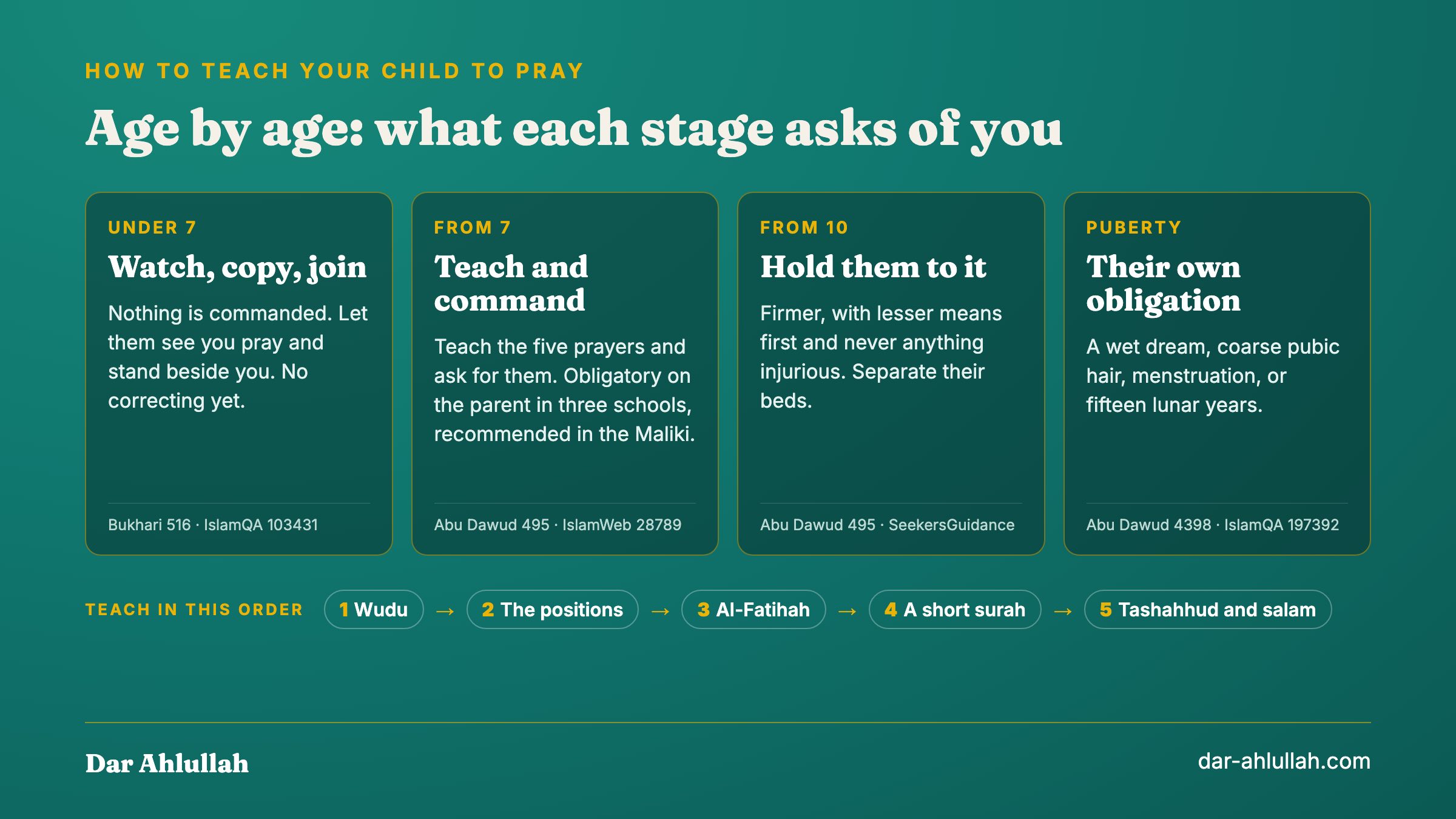
| Age | For the child | For the parent | Source |
|---|---|---|---|
| Under seven | Nothing is required. When they join you, it is practice. | Nothing is commanded. Let them see the prayer and join in. | IslamQA 103431 (Ibn Baz); Bukhari 516 |
| Seven to nine | Not yet obligatory, but now instructed. | Teach and command the five prayers: obligatory in three schools, recommended in the Maliki school. | Abu Dawud 495; IslamWeb 28789 |
| Ten to puberty | Still not obligatory, but held to it. | Firmer accountability, within the limits set out below. Separate their beds. | Abu Dawud 495; SeekersGuidance |
| Puberty onwards | Obligatory. A missed prayer is now a missed obligation. | Advice, example and support; the duty is now the child’s own. | Abu Dawud 4398; IslamQA 197392 |
Before Seven: Watch, Copy, Join
Nothing is commanded before seven. Ibn Baz put it plainly: “Those below the age of seven, whether male or female, are not required to pray” (IslamQA 103431). That is not the same as nothing happening. These are the years in which a child learns that the prayer exists, that the adults she loves stop what they are doing for it, and that the prayer mat is a place she is welcome.
The Sunnah is unusually concrete about small children around the prayer. The Prophet ﷺ led a prayer carrying Umamah, the daughter of his daughter Zaynab: “When he prostrated, he put her down and when he stood, he carried her” (Sahih al-Bukhari 516). In a night prayer he made one prostration so long that the people behind him thought something had happened. Afterwards he explained: “My son was riding on my back and I did not like to disturb him until he had enough” (Sunan an-Nasa’i 1141). And he said of leading the congregation: “When I stand for prayer, I intend to prolong it but on hearing the cries of a child, I cut it short, as I dislike to trouble the child’s mother” (Sahih al-Bukhari 707).
Small children on and around the prayer mat are part of the Sunnah, not an interruption of it. What that looks like at home is our advice rather than a ruling:
- Pray where they can see you, at least some of the time. A parent who always prays behind a closed door has taught a child nothing about prayer by the time it arrives as an instruction at seven.
- Let them stand beside you and copy, without correcting. A four-year-old who bows at the wrong moment is not making a mistake that matters. He is learning that bowing is part of it.
- Give them the short phrases first. Allahu akbar at the start, as-salamu ‘alaykum wa rahmatullah to the right and left at the end. Children like the parts they can join out loud.
- Start al-Fatihah early if they enjoy it. It is the one surah recited in every rak‘ah of every prayer, so it is the best possible first memorisation. Our guide to which surahs to memorise first sets out a separate order for children.
- Do not let the prayer become a chase. A toddler climbing on you does not break your prayer, and the Umamah hadith is the evidence (what invalidates salah); a toddler running back and forth in front of you is covered in our guide to the sutrah.
At Seven: What to Teach, and in What Order
Seven is when the hadith asks you to start instructing, and the instruction is the five daily prayers. It does not say a child must know everything at seven; it says that from seven the parent is teaching and asking. Between seven and ten you have three years before the firmer stage begins. Use them one step at a time, moving on when the last step holds.
The order below is ours. It is built so that a child can pray beside you after the first three steps, and so that each later step adds something to a prayer they are already doing. If you are also deciding when to start formal Quran lessons, that is a separate question with a different answer, covered in what age a child should start learning Quran.
1. Wudu
There is no prayer without wudu, so it comes first. It is also the easiest part to teach, because every step is physical and visible. Do it side by side at the sink until your child can go through the whole sequence without being talked through it. Our step-by-step wudu guide has the order, and what breaks wudu covers the part children forget most: that a trip to the toilet means doing it again.
2. The positions
Standing, raising the hands for Allahu akbar, bowing (ruku‘), rising, prostrating (sujud), sitting, the second prostration, and sitting at the end. Teach these as a sequence of shapes before you attach the words. A child who knows the shapes can pray beside you while the words catch up, and will learn the words faster because they now have somewhere to go.
3. Al-Fatihah
Al-Fatihah is recited in every rak‘ah, so it is the first piece of Qur’an a praying child needs. Teach it a verse at a time, and correct the pronunciation early: a letter learned wrong at seven is harder to put right at twelve. There is no need to keep a child off the prayer mat until it is perfect. For an adult who said he could not memorise anything of the Qur’an, the Prophet ﷺ taught a short remembrance to say instead — “Glory be to Allah, and praise be to Allah, and there is no god but Allah, and Allah is most great, and there is no might and no strength but in Allah” (Sunan Abi Dawud 832). A seven-year-old is not under obligation at all, so let them pray with you and say what they know while al-Fatihah comes.
4. One short surah
In the first two rak‘ahs of each prayer, a short surah follows al-Fatihah. One is enough to start: al-Ikhlas, al-Kawthar and al-‘Asr are all short enough for a first week. Add more later, so the child is not reciting the same one in every prayer for years.
5. The tashahhud and the salam
The tashahhud is the longest text a child has to learn for the prayer, so it comes last. Until it is memorised, a child can sit with you and listen, then give the salam with you. Every word of it, position by position, is in our guide to what to say in salah.
6. The times and the count
Two rak‘ahs for Fajr, four for Dhuhr, four for ‘Asr, three for Maghrib and four for ‘Isha. Put the day’s prayer times somewhere the child can see them and give them the job of announcing when one comes in. A child who keeps the time stops being the person who is reminded and becomes the person who reminds.
| Step | In place when your child… | Our guide |
|---|---|---|
| Wudu | does it alone, in order, without prompting | How to make wudu |
| The positions | moves through a two-rak‘ah prayer beside you without watching you | How to pray in Islam |
| Al-Fatihah | recites it unaided, with the letters right | Which surahs to memorise first |
| A short surah | has at least one ready to follow al-Fatihah | Which surahs to memorise first |
| Tashahhud and salam | sits and finishes the prayer on their own | What to say in salah |
What a girl wears to pray
Before puberty a girl’s prayer is valid without a head covering. The evidence is the wording of the hadith that makes it a condition: “Allah does not accept the prayer of a woman who has reached puberty unless she wears a veil” (Sunan Abi Dawud 641). Ibn Baz drew the conclusion directly, and added that “it is better for her to pray with a head cover if she is seven years old or more” (IslamQA 103431). A prayer garment of her own that she chose herself is an easy way to make that habit hers.
Fajr on a school morning
The instruction at seven covers the five prayers, Fajr included, and Fajr is the one that costs a child sleep. How you get there is a parenting judgement, and here is ours. Start with the prayers your child is awake and at home for, make those reliable, and bring Fajr in once the routine is holding, well before ten rather than at it. A child who goes to bed knowing they will be woken for Fajr, at a bedtime that allows for it, takes it far better than one who is surprised by it.
Praying Together at Home and in the Mosque
A child learns more from standing in a prayer than from hearing about one, and the Sunnah records children doing exactly that. Anas ibn Malik said: “One night an orphan and I offered the prayers behind the Prophet ﷺ in my house and my mother (Umm Sulaym) was standing behind us” (Sahih al-Bukhari 727). In a similar account, after a meal his grandmother Mulaykah had cooked, the Prophet ﷺ told the household: “Get up! I will lead you in the prayer,” and Anas and the orphan lined up behind him (Sahih al-Bukhari 380). Ibn ‘Abbas, then a boy spending the night at his aunt Maymunah’s house, got up to join the Prophet’s night prayer, stood at his left, and was moved round to his right (Sahih al-Bukhari 117).
What that can look like in your home, as advice:
- One prayer a day together. Maghrib suits most households: it is short, it is three rak‘ahs, and it often falls when everyone is home. One reliable congregation does more than five occasional ones.
- Give the child a job. Calling the iqamah, laying out the mats, straightening the row, reminding everyone that the time has come in.
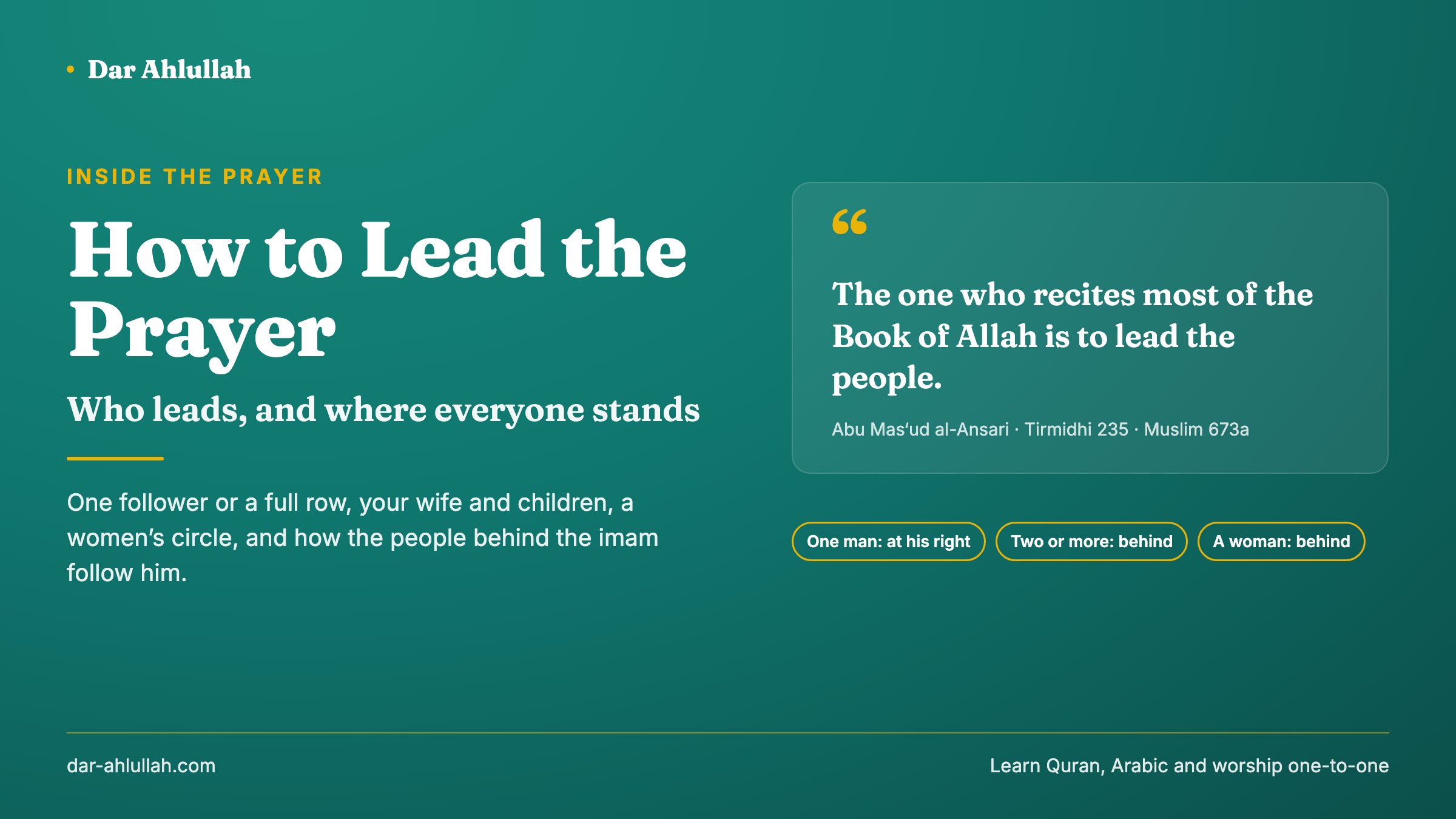
- Put them in the right place. A boy who is your only follower stands at your right, as Ibn ‘Abbas did; two or more stand in a row behind you; women and girls stand behind them. Whether a boy who knows more Qur’an than the adults may lead them is a difference between the schools. All of it is set out in our guide to how to lead the prayer.
- Stay sitting afterwards. The remembrance after the prayer is the easiest part of the whole practice for a child to join. Counting subhanallah, alhamdulillah and Allahu akbar on their fingers is a game a seven-year-old will happily keep the score of. The wordings are in adhkar after salah.
The mosque comes into it from seven too. IslamWeb advises taking children to the congregational prayer from that age, so that they are trained to attend it, and taking younger children only when you can be sure they will not disturb the people praying (IslamWeb 28789). The hadith about the crying child is a reminder that children were in and around the Prophet’s own congregation, and that he adjusted the prayer for them rather than the other way round.
At Ten: What the “Strike” Clause Means, and What It Does Not
This is the part of the hadith parents ask about most, and the part most often quoted without the conditions the scholars attach to it. The words are وَاضْرِبُوهُمْ عَلَيْهَا وَهُمْ أَبْنَاءُ عَشْرِ سِنِينَ, “and beat them for it when they are ten” (Sunan Abi Dawud 495). Here is what a Hanafi answer from SeekersGuidance, checked by Shaykh Faraz Rabbani, sets out (SeekersGuidance 241454):
- The aim is a change in behaviour. Citing Ibn ‘Allan’s Dalil al-Falihin, it reads the word as a command to take whatever means will make the child consistent in prayer.
- If it happens at all, it is non-injurious. Citing the Kuwaiti al-Mawsu‘a al-Fiqhiyya: not hard enough to bruise or injure, not on sensitive parts of the body, no more than three times, and with the hand, never with an object.
- Lesser means come first, and must be exhausted first. If the change can be achieved by something less, that must be used: taking away privileges, or chores as a consequence.
- It is best not to hit at all. Citing al-Nawawi’s commentary on Sahih Muslim. ‘A’ishah reported that the Prophet ﷺ never struck anything with his hand, “neither a woman nor a servant”, except when fighting in the path of Allah (Sahih Muslim 2328a).
- Injurious beating is haram, and so is throwing a child out. The answer calls both strictly prohibited, and says any discipline is to be done with the intention of teaching, “not venting one’s anger”.
IslamWeb puts the same limits in its own words: physical discipline must be intended “to educate and not to avenge”, and must not be abusive (IslamWeb 90356).
Where smacking is against the law
In much of Europe, any physical punishment of a child is illegal. Sweden banned it in 1979, the first country to do so, and as of 2021 so had 22 of the 27 member states of the European Union; France followed in 2019, Scotland in 2020 and Wales in 2022. In the rest of the United Kingdom and in the United States, smacking remains legal (Wikipedia, “Corporal punishment in the home”). The SeekersGuidance answer above was written for a parent who asked whether laws like these meant they had to leave the country. Its answer was no: the civil law of most such countries agrees with Islamic law that harming a child is forbidden. Nothing in the hadith requires a parent to hit. Where hitting is illegal, what is left is the set of means the scholars say to use first anyway.
What firmness at ten can look like
This is advice, built on the “lesser means” the scholars list.
- The prayer stops being a request. It moves onto the same footing as school or homework: not something the child is asked whether they feel like doing.
- Privileges follow it. Screen time, outings and the rest are tied to the day’s prayers, calmly and predictably, not as a punishment announced in anger.
- Check, do not interrogate. A quiet question at Maghrib about which prayers were prayed today does more than a scene in the doorway.
- Separate their beds. The same hadith asks for it at ten, and it belongs to the same message: you are growing up, and things change now.
- Keep the reason in view. Puberty is coming, and with it the obligation. The years from ten to puberty are a rehearsal for the day the prayer is theirs to carry, and a child who knows that is being trusted rather than policed.
Puberty: When the Prayer Becomes Their Own
With puberty, the pen is no longer lifted. IslamQA lists the signs: in boys, a wet dream, the growth of coarse pubic hair, or reaching fifteen lunar years, whichever comes first; in girls the same, with a fourth sign, the start of menstruation (IslamQA 197392). Fifteen lunar years is about fourteen and a half solar years, so even a child who shows no other sign has reached it before their fifteenth birthday.
Several things change at once, and a child should hear about them from you before they arrive, not after:
- The prayer is now an obligation. A prayer missed from here on is a missed obligation, not missed practice. Our guide to how to make up missed prayers covers what that means.
- Ghusl is now needed after a wet dream and, for girls, at the end of each period. Teach how to perform ghusl before the first time it is needed, so the first time is not a panic.
- For girls, the head covering becomes a condition of the prayer (Sunan Abi Dawud 641), and the prayer is not performed during menstruation.
- School hours matter now. In the winter months in much of Europe, Dhuhr and sometimes ‘Asr fall inside the school day. Before puberty a prayer missed at school is lost practice; after it, it is a missed obligation. The conversation with the school about a quiet room and a few minutes is worth having while your child is still nine or ten.
Six Situations, Worked Through
1. Your five-year-old prays beside you and gets half of it wrong
Leave it. Nothing is required of a five-year-old, and correction can wait until seven. What he is learning right now is that he belongs on the prayer mat, and that lesson is easy to undo with too much correction too early.
2. Your eight-year-old prays, but only when reminded
That is normal at eight, and it is what the years between seven and ten are for. Move from reminding to handing over: give her the job of announcing the prayer times, so that the cue starts coming from her rather than from you.
3. You are new to Islam and still learning the prayer yourself
Learn it together. You only need to be one step ahead, and a child who watches a parent learn something carefully is learning more than the prayer. Our guide to the first 90 days as a new Muslim sets out an order for the adult side of this.
4. Your eleven-year-old refuses
Diagnose before you escalate. Refusal usually has a cause you can find: something that is too hard, too long, or tangled up with a fight about something else. Our guide to a child who refuses to learn Quran walks through the common causes and their tells, and most of it applies to the prayer as well. The scholars’ order applies too: the lesser means first. Sometimes the same words land differently from an uncle, an imam or a teacher the child respects.
5. Two children, three years apart
Let the older one teach the younger the positions. Teaching something is a good test of knowing it, and the older child gets a role rather than just another instruction. When both boys pray with you, they stand side by side in a row behind you, and the younger one picks up the timing from the brother next to him.
6. One parent prays and the other does not
The instruction in the hadith reaches everyone responsible for the child, not only the father (IslamQA 129549). The parent who prays carries it, and the advice we would give is to carry it gently, without asking the child to take sides between the two of you.
Seven Mistakes Parents Make
- Starting at seven from nothing. A child who has never seen you pray is being asked to take up a stranger’s habit.
- Teaching everything at once. Wudu, the positions, al-Fatihah, a surah and the tashahhud in one week is a lot of new things to fail at. One step at a time, as above.
- Correcting a four-year-old’s every movement. Before seven, belonging matters more than accuracy.
- Praying where the children never see it. The habit you want them to have should be visible in the house.
- Using the prayer as a punishment. “Go and pray” as the end of an argument teaches a child that prayer is what happens when you are in trouble.
- Reading “beat them at ten” as permission to hurt. The scholars attach conditions to it, and injurious beating is haram on their account. The Prophet ﷺ himself never hit a woman or a servant.
- Saying nothing about puberty until it has arrived. The change from practice to obligation, and the ghusl that comes with it, should never come as news.
How We Teach This
Two parts of this are hard to do alone at home: getting al-Fatihah and the short surahs right letter by letter, and the fiqh a child needs as they approach puberty. Our Quran Reading course takes a child from the Arabic alphabet to reading short surahs, with a teacher correcting each letter out loud, and our Islamic Studies course for kids and teens covers aqeedah, fiqh basics, the seerah and Islamic manners with age-appropriate content, one-to-one with a certified teacher and scheduled in your own timezone.
Teaching is charged at $9 per teaching hour, with monthly plans at $36, $70 and $102 depending on how many hours you want, and a 20% sibling discount on individual plans, which matters for exactly the family this guide is written for. You can pause, upgrade or switch plans at any time, and if a teacher is not the right fit for your child we rematch you with another certified mentor at no extra cost. The first 30-minute assessment is free and does not ask for a card. The programmes are on our courses page.
Questions Parents Ask
At what age should a child start praying in Islam?
Seven is when parents are told to start instructing (Sunan Abi Dawud 495). A child can join the prayer freely before that, and it becomes obligatory on the child at puberty.
Is prayer obligatory for a seven-year-old?
No. What is obligatory, in the Hanafi, Shafi‘i and Hanbali schools, is the parent’s instruction; the Maliki school holds it recommended (IslamWeb 28789). The child is not accountable until puberty (Sunan Abi Dawud 4398).
Does my child’s prayer count before puberty?
Yes. The Prophet ﷺ led children in prayer and moved a boy into place beside him (Sahih al-Bukhari 727; 117), and Ibn Baz rules a young girl’s prayer valid even without a head covering (IslamQA 103431). It is not owed before puberty, so a prayer missed then is not a debt.
Should I wake my seven-year-old for Fajr?
The instruction at seven covers all five prayers, so Fajr is part of what you are working towards. It is not obligatory on the child yet, so how quickly you get there is your judgement. Our suggestion is to build the prayers they are awake for first and bring Fajr in well before ten.
Does a girl need to cover her hair to pray before puberty?
It is not a condition before puberty, but Ibn Baz held it better for a girl of seven or older (IslamQA 103431). After puberty it is a condition of the prayer (Sunan Abi Dawud 641).
Is it allowed to hit a child for not praying?
The hadith mentions it from ten, but the scholars restrict it to non-injurious discipline after every lesser means has been tried, and al-Nawawi held it best not to hit at all. Injurious beating is haram (SeekersGuidance 241454). Where the law forbids any smacking, nothing in the hadith requires you to do it.
Does my toddler climbing on me or walking in front of me break my prayer?
Climbing on you does not: the Prophet ﷺ prayed carrying Umamah (Sahih al-Bukhari 516). For a toddler passing in front of you, see our guide to the sutrah in prayer.
Does my child have to make up prayers missed before puberty?
No, on the view that the prayer was not yet obligatory, so nothing is owed. Al-Tirmidhi does record, under the hadith of seven and ten, that Ahmad and Ishaq held that a boy over ten who leaves a prayer should repeat it (Jami‘ al-Tirmidhi 407). From puberty onwards it is owed, and our guide to making up missed prayers covers what to do when one is missed.
Conclusion: The Prayer of Ibrahim
Among Ibrahim’s du‘as in the Qur’an is one that every parent can borrow: “My Lord, make me an establisher of prayer, and [many] from my descendants. Our Lord, and accept my supplication” (Qur’an 14:40). He asked for himself first, and for his children after.
That is most of the method. Pray where they can see you, let them join before they are asked, teach one step at a time from seven, hold them to it from ten without ever hurting them, and tell them what changes before puberty arrives. For the prayer itself in the same detail, the salah library links every guide we have written on it, including how to lead the prayer for the day your family first stands in a row behind you.
Related articles
child refuses to learn Quran
What to Do When Your Child Refuses to Learn Quran
Refusal is a willingness problem, not a memory problem, and it has five causes that look identical from the outside. Tell them apart first — the fix for each one is different.
15 min read
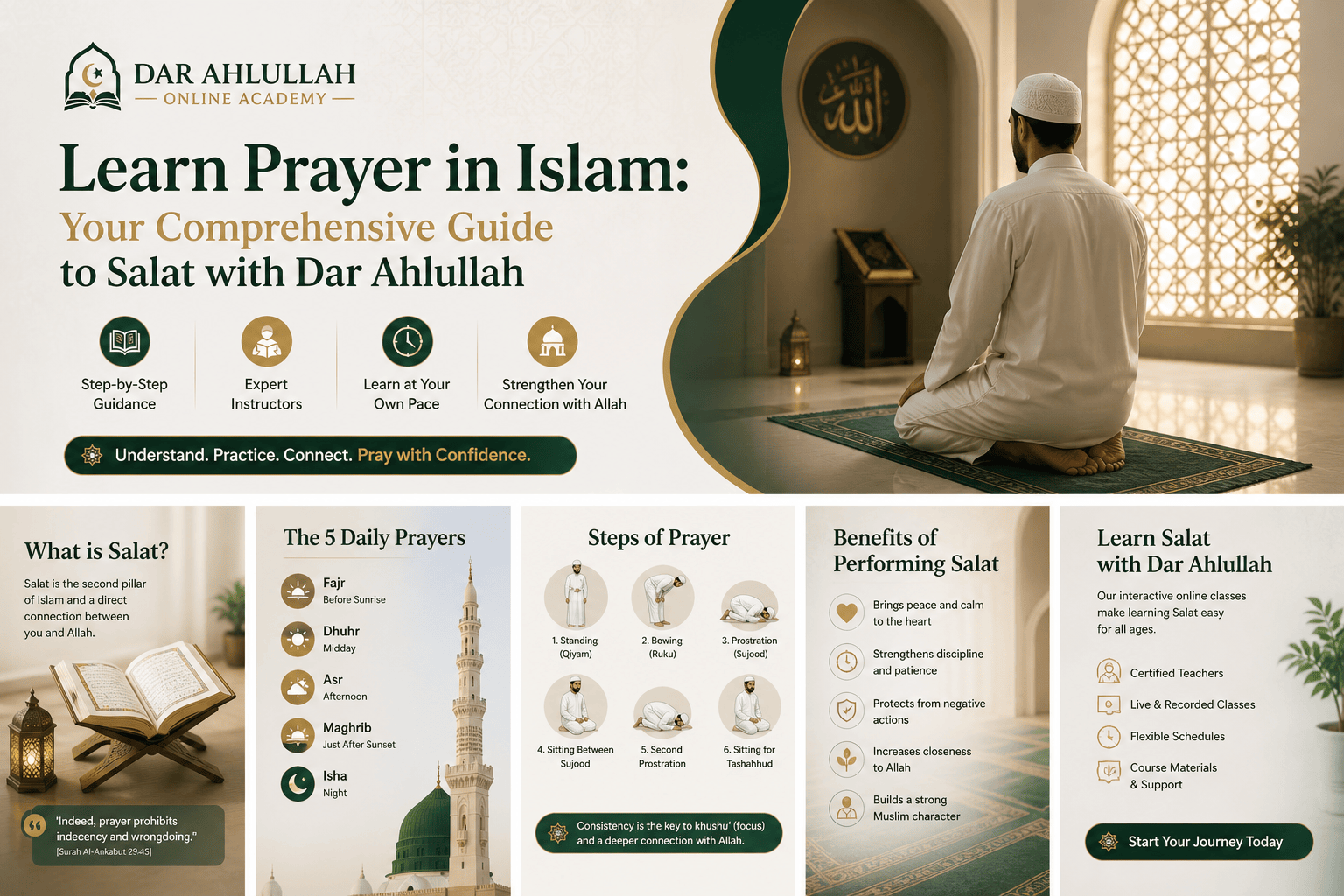
how to pray in Islam
How to Pray in Islam Step by Step: A Beginner's Guide to Salah
Every step of Salah in order, from niyyah to taslim: what to say, how long to hold each position, the five daily prayers, and the mistakes beginners make.
21 min read
how to lead the prayer
How to Lead the Prayer: Who Leads, Where Everyone Stands
Asked to lead the prayer at work or at home? Who has the right to lead, where one follower stands and where two do, where a wife, children and a women's congregation stand, what the imam does from the first takbir to the salam, and the four ways of following him, with each school's position.
27 min read