
how to lead the prayer
How to Lead the Prayer: Who Leads, Where Everyone Stands
Dar Ahlullah team 27 min read
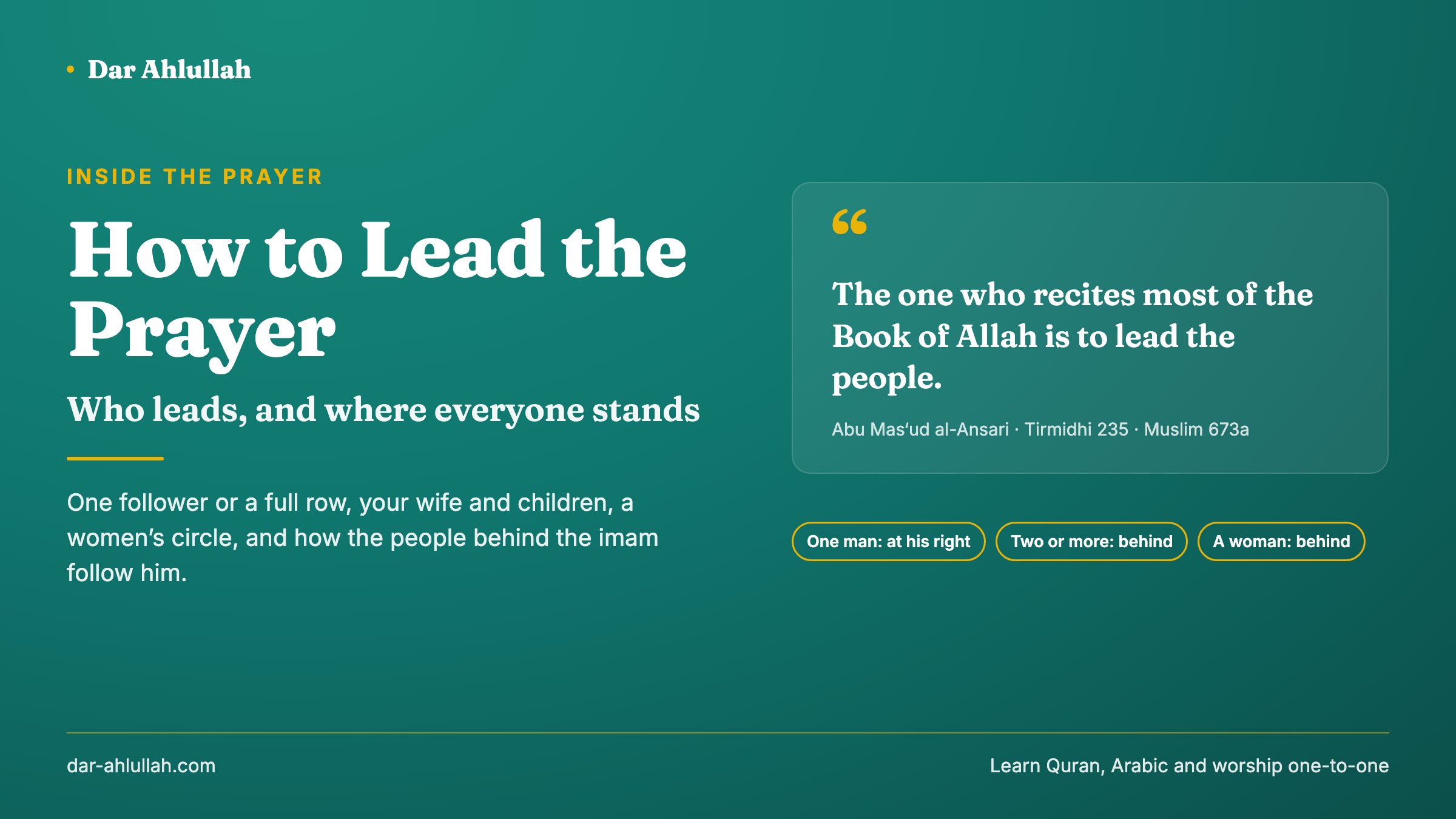
Table of Contents
- Introduction: “You Lead”
- The Short Answer
- Who Should Lead
- Where Everyone Stands
- Before the Takbir: The Imam’s Checklist
- Leading the Prayer, Step by Step
- Following the Imam: Before, With, Just After or Behind
- What the Follower Recites
- The Rows: Straight, Full, and Not Alone Behind
- Seven Situations, Worked Through
- Seven Mistakes People Make
- How We Teach This
- Questions People Ask
- Conclusion: The Boy in the Short Cloak
Introduction: “You Lead”
Three of you meet in the prayer room at work for Zuhr. Someone says the iqamah, everyone looks at everyone else, and the oldest colleague nods at you: “You lead.” Where exactly do you stand? Does the one other brother stand next to you or behind you? Do you say the takbirs out loud, even though Zuhr is a quiet prayer? How long should you make it? And if the youngest of you has memorised far more Qur’an than the rest, should it have been him?
Or it is Maghrib at home: you, your wife, your nine-year-old son and your six-year-old daughter. Who stands where?
This guide covers how to lead the prayer from the moment someone is chosen to the moment the imam turns round after the salam: who has the right to lead, where everyone stands in each common arrangement, what the imam says and does differently from someone praying alone, and how the people behind him follow. It belongs to the salah library in our step-by-step guide to how to pray in Islam, which teaches the prayer itself. Here we assume you can already pray on your own and want to know what changes when other people pray behind you.
One boundary before we begin. We teach Quran, Arabic and the practical fiqh of worship; we are not a fatwa body. Several questions below are real differences between the schools of Islamic law, and we set the positions side by side, with their sources, rather than pick one and call it consensus. The right answer for you is the one your school or your teacher follows.
The Short Answer
- The one who knows the most Qur’an has the first right to lead, then the one who knows the Sunnah best, then the earliest to emigrate, then the eldest (Sahih Muslim 673a). The Maliki, Shafi‘i and Hanafi schools put knowledge of the rulings of prayer first. In a mosque the appointed imam leads; at home, the head of the household.
- One man praying with you stands at your right, never ahead of you. Whether he stands exactly level or a little back is a difference between the schools.
- Two or more men stand in a row behind you. If a second man joins a pair, the imam steps forward or the two step back.
- A woman stands behind the imam, even if she is the only one praying with him, and even if he is her husband.
- At home: the imam in front, men and boys in a row behind him, women and girls in a row behind them.
- A woman leading women stands in the middle of their row, not out in front of it. The Shafi‘i school and IslamQA encourage women’s congregations; the Hanafi school dislikes them.
- As the imam: face the people and straighten the rows, say every takbir loud enough to be followed, recite aloud where the prayer is recited aloud, and keep it light, because behind you are the weak, the sick and the old (Sahih al-Bukhari 703).
- As a follower: move just after the imam, never before him and never with him. Going ahead of him is forbidden, and done knowingly it invalidates the prayer in Ibn ‘Uthaymin’s explanation.
Who Should Lead
The order comes from one hadith, narrated by Abu Mas‘ud al-Ansari:
“The one who recites most of the Book of Allah is to lead the people. If they are equal in recitation, then the most knowledgeable in the Sunnah among them. If they are equal regarding the Sunnah, then the earliest of them to emigrate. If they are equal in their emigration, then the eldest among them. And a man is not to be led in prayer in the place of his authority, and his spot of esteem in his home is not to be sat on without his permission.” (Jami‘ at-Tirmidhi 235; also Sahih Muslim 673a, where the last tier in one wording is the earliest to accept Islam)
The emigration tier belonged to the generation that made the hijrah. Three other things in the hadith still decide who stands in front today.
What “recites most” means
The first Muslims took it literally. When the tribe of ‘Amr ibn Salamah accepted Islam, his father came back from the Prophet ﷺ with the instruction that the one who knew the most Qur’an should lead the prayer. Nobody in the tribe knew more than ‘Amr, who had been memorising verses from the caravans that passed by. “They therefore made me their Imam … and at that time I was a boy of six or seven years” (Sahih al-Bukhari 4302).
IslamQA reads “the one who knows most” as the one who has memorised the most of the Book, not the one with the most beautiful voice. It adds that he must also know the rulings of prayer, because an imam who loses his wudu or misses a rak‘ah and does not know what to do spoils the prayer of everyone behind him (IslamQA 20219).
Recitation or knowledge first? The schools differ
| View | Who comes first | Source |
|---|---|---|
| The wording of the hadith | The one who has memorised the most Qur’an, provided he knows the rulings of prayer. | IslamQA 20219 |
| Malik and al-Shafi‘i, as reported by al-Nawawi | The one with more knowledge of fiqh, “because what he needs of recitation is known but what he needs of fiqh may not be clear.” | IslamQA 20219 |
| Shafi‘i manual (Reliance of the Traveller) | The most learned in the rulings of prayer, even if he has memorised only al-Fatihah; then the one who has memorised the most Qur’an; then the most God-fearing; then the one who has been Muslim longest. | SeekersGuidance (Shafi‘i) |
| Hanafi (Maraqi al-Falah) | The most knowledgeable in the rulings of prayer, then the most accurate reciter. | SeekersGuidance (Hanafi) |
Two points hold across all of them. First, this is about who has the right to lead, not about validity: the Hanafi answer above says plainly that the prayer is not invalid, and the congregation is not sinful, if someone else leads. Second, nobody should be leading who does not know the prayer. The Standing Committee, quoted in the same IslamQA answer, says it is not permissible for someone ignorant of it to lead, unless he is leading others like him and nobody better qualified is there.
The appointed imam and the head of the house
“A man is not to be led in prayer in the place of his authority.” In a mosque, that is the appointed imam: in the Hanafi school he has a greater right to lead than the most knowledgeable or the best reciter present (SeekersGuidance (Hanafi)). At home, it is the head of the household.
Can a boy lead? Can a woman?
A boy. The schools read ‘Amr ibn Salamah’s report differently. In the Shafi‘i school a boy who has not reached puberty may lead, the obligatory prayers included, if he knows the Qur’an and the fiqh of prayer, though an adult is preferred (SeekersGuidance (Shafi‘i)). IslamQA likewise allows a boy who understands the prayer to lead (IslamQA 9933). The Hanafi school does not accept an adult’s prayer, obligatory or voluntary, behind a child: it does not question the report’s authenticity but holds that the decision was the tribe’s own, not an instruction heard from the Prophet ﷺ. It adds that anyone who prayed behind a child in the past does not need to repeat those prayers, because the difference between the schools is a valid one (SeekersGuidance (Hanafi)).
A woman. A woman does not lead men, in an obligatory prayer or a voluntary one (IslamQA 14247), and a mother does not lead her young son, who takes the ruling of a man here (IslamQA 9933). She may lead women. The Prophet ﷺ appointed a mu’adhdhin for Umm Waraqah and “commanded her to lead the inmates of her house in prayer” (Sunan Abi Dawud 592, graded hasan by al-Albani). How she stands is below.
Where Everyone Stands
Most of the questions people ask about congregational prayer are really about this. The arrangements below cover almost every room you will pray in.
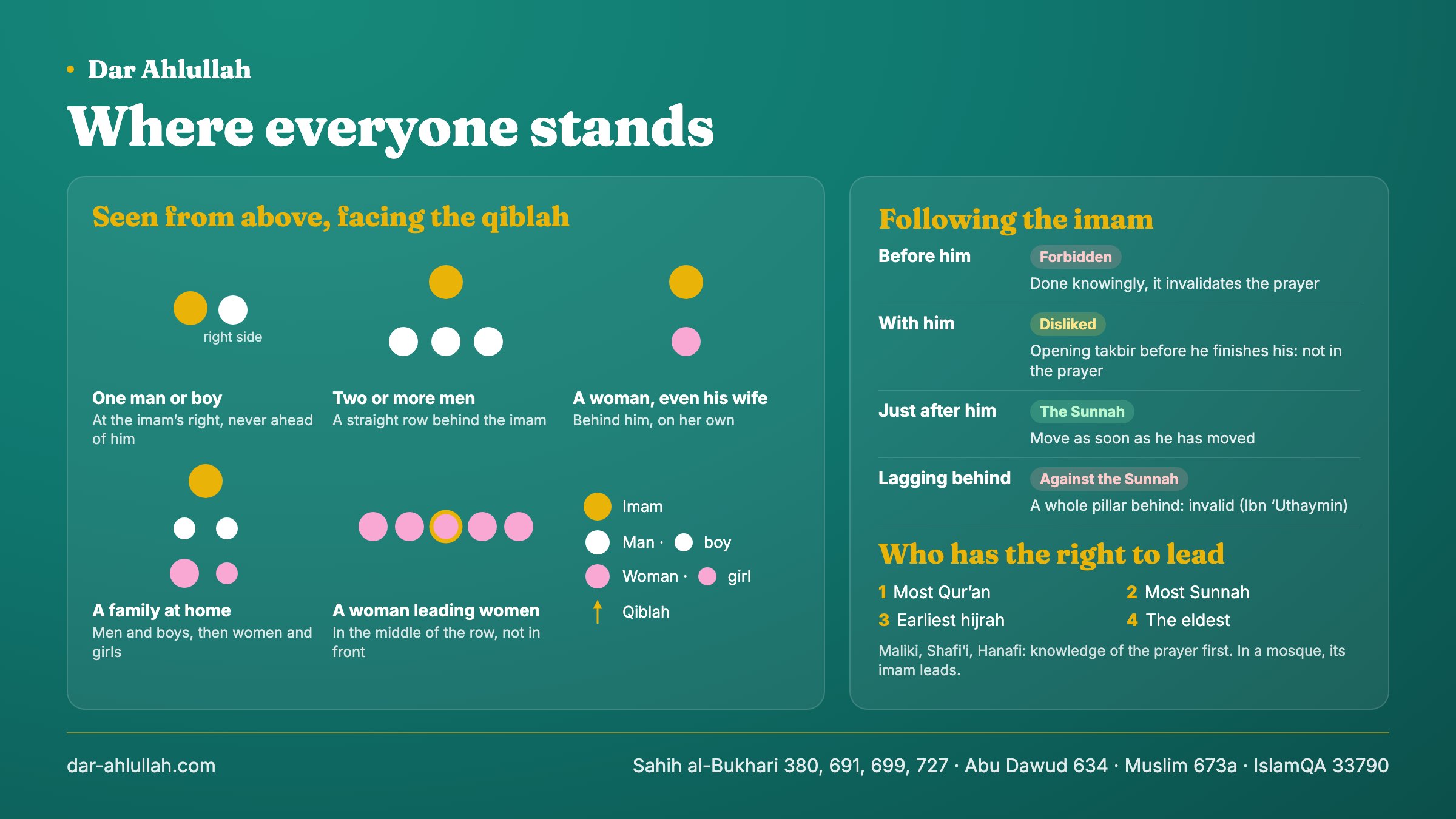
| Who is praying | Where they stand | Evidence |
|---|---|---|
| The imam and one man or boy | At the imam’s right, not ahead of him. | Sahih al-Bukhari 699; IslamQA 3270 |
| The imam and two or more men | In a row behind the imam. | Sunan Abi Dawud 634; Sahih al-Bukhari 380 |
| The imam and one woman, his wife included | Behind him, on her own. | Sahih al-Bukhari 727; IslamQA 5874 |
| A family | The imam; behind him men and boys in one row; behind them women and girls. | Sahih al-Bukhari 380; IslamQA 5874 |
| Women only, three or more | The woman leading stands in the middle of the first row. | IslamQA 12451; SeekersGuidance (Shafi‘i) |
| Two women | As two men: the follower at the right of the one leading. | IslamQA 12451; SeekersGuidance (Shafi‘i) |
One follower: at the right, level or a little back?
Ibn ‘Abbas spent a night in the house of his aunt Maymunah, the Prophet’s wife. When the Prophet ﷺ stood for the night prayer, Ibn ‘Abbas joined him “and stood on his left side but he drew me to his right by holding me by the head” (Sahih al-Bukhari 699). Another narration adds that he moved him round from behind (Sahih al-Bukhari 728). Ibn Hajar reported that some scholars recorded a consensus that a single follower stands to the imam’s right (IslamQA 3270).
How far back is where the schools part:
| School | Where the single follower stands | Source |
|---|---|---|
| Hanbali | Exactly level with the imam, with no gap between them. Al-Albani cites this as the Hanbali position from Manar al-Sabil, and IslamQA follows it. | IslamQA 3270 |
| Hanafi (relied-upon position) | Alongside the imam, measured at the heel. If the heels are level, it does not matter that a follower with bigger feet has his toes further forward, or that a taller follower’s head goes further in sujud. Some Hanafi texts, such as Maraqi al-Falah, say slightly behind, probably as a precaution. | SeekersGuidance (Hanafi) |
| Shafi‘i | Slightly behind: the follower’s toes a little behind the imam’s heel. | SeekersGuidance (Shafi‘i) |
All three keep the follower from getting ahead of the imam, and the Hanafi commentary measures that at the heel. In practice: stand where you would stand to pray, let the other person take his place at your right with his heels at or just behind yours, and if he steps up on your left, do what the Prophet ﷺ did and bring him round behind you to your right.
Standing directly behind the imam when you are his only follower is the opposite mistake. Ibn ‘Abbas once did it out of respect; the Prophet ﷺ pulled him level, and when Ibn ‘Abbas moved back again he asked him why (Musnad Ahmad, graded authentic by al-Albani; quoted in IslamQA 3270).
When a second man arrives
Jabir ibn ‘Abdullah stood at the Prophet’s left, and was moved round to his right. Then Jabbar ibn Sakhr came and stood on the Prophet’s left, “he then took us with his both hands and made us stand behind him” (Sunan Abi Dawud 634, graded sahih by al-Albani). The Hanafi answer gives the same two options: when another person joins, “the imam should step forward, or the followers should step back” (SeekersGuidance (Hanafi)). Whichever has the room, do it with a small step, without turning round.
A woman stands behind, even alone
Anas ibn Malik described a prayer in his family’s house: “an orphan and I offered the prayers behind the Prophet ﷺ in my house and my mother (Um Sulaim) was standing behind us (by herself forming a row)” (Sahih al-Bukhari 727). The Hanafi text quoted earlier makes it explicit: a single male follower, “even if a child,” stands at the imam’s right, but “a single female … should stand (completely) behind her imam” (SeekersGuidance (Hanafi)). For a husband and wife praying at home, IslamQA says the same: “The wife should stand behind the husband” (IslamQA 5874).
This is also the clearest case of someone standing on her own behind the row with the Prophet’s approval, which is why it comes up again in the section on rows.
The family at home
A father with a household behind him has a model in the same house. When Anas’s grandmother Mulaykah invited the Prophet ﷺ to a meal, he led them in prayer: “The orphan (Damira or Ruh) and I aligned behind him and the old lady (Mulaika) stood behind us” (Sahih al-Bukhari 380). IslamQA’s answer to a father praying at home with his wife and his ten- and seven-year-old sons: “Make your two children stand behind you in one row, and their mother can stand behind them.” If their mother is not praying, the two boys still stand behind him in one row (IslamQA 5874).
With only one boy, he is a single male follower, so he stands at your right, and the women stand behind the two of you.
Who stands directly behind the imam
The Prophet ﷺ used to touch the people’s shoulders before the prayer and say: “Let those of you who are sedate and prudent be near me, then those who are next to them, then those who are next to them” (Sahih Muslim 432a). The person behind the imam should be someone who knows the prayer well. That is also the person best placed to correct the imam if he slips.
Women praying together
Ibn Qudamah wrote that when a woman leads other women, “It is Sunnah … for her to stand in the middle of the row in all cases,” and al-Nawawi gave the reason: ‘A’ishah and Umm Salamah led women and stood in the midst of them (IslamQA 12451). In the Shafi‘i school some scholars take “the middle” to mean exactly level with the others, and others allow her to stand very slightly forward so that she can be told apart; both are valid to follow (SeekersGuidance (Shafi‘i)). With only two women, the follower stands at the right, as one man does with another (IslamQA 12451).
Whether women should form their own congregation at all is a real difference. The Shafi‘i school gives women the reward of congregation in an all-women group (SeekersGuidance (Shafi‘i)), and IslamQA calls it mustahabb when women are gathered together (IslamQA 14247). In the Hanafi school it is disliked for a woman to lead women, except in the funeral prayer; the well-known view treats this as prohibitively disliked, while some Hanafi scholars, Ibn al-Humam among them, held a lighter dislike. If it is done, she stands in the middle of them (SeekersGuidance (Hanafi)).
Before the Takbir: The Imam’s Checklist
An imam does four things before he says “Allahu akbar” that someone praying alone never has to.
1. Let the iqamah be called
At home, a boy who has reached the age of discretion, usually seven or above, may say it, “so long as he understands the basic essentials of the prayer” (IslamQA 5874). For a group of women praying together, saying the iqamah is better, though the prayer is valid without it (IslamQA 14247).
2. Turn round and straighten the rows
Anas ibn Malik: “Once the Iqama was pronounced and Allah’s Messenger ﷺ faced us and said, ‘Straighten your rows and stand closer together, for I see you from behind my back’” (Sahih al-Bukhari 719). The Prophet ﷺ called straight rows “essential for a perfect and correct prayer” (Sahih al-Bukhari 723), and the Companions took it physically: “Everyone of us used to put his shoulder with the shoulder of his companion and his foot with the foot of his companion” (Sahih al-Bukhari 725). With three people in an office prayer room this takes five seconds. Do it anyway; it is part of leading.
3. Check what is in front of you
The imam’s sutrah covers everyone behind him, so you are the only one who needs a barrier in front. Our guide to the sutrah in prayer covers what counts and how close to stand.
4. Make sure you can be heard
Everyone behind you moves on your voice. In a big hall, or with a weak voice, someone relays the takbirs. In the Prophet’s final illness, when he came out and sat beside Abu Bakr to lead, “Abu Bakr was repeating the Takbir (Allahu Akbar) of Allah’s Messenger ﷺ for the people to hear” (Sahih al-Bukhari 712).
Leading the Prayer, Step by Step
The prayer itself is the one you already know. What changes is volume, pace and what you are responsible for.
Say the takbirs so they can be followed
“The Imam is to be followed. Say the Takbir when he says it; bow if he bows; if he says ‘Sami‘a l-lahu liman hamidah’, say, ‘Rabbana wa laka l-hamd’, prostrate if he prostrates” (Sahih al-Bukhari 734). The people behind you can only do that if they hear you. So the opening takbir, every takbir of movement, “sami‘ Allahu liman hamidah” and the salam are said loud enough to reach the back row, in every prayer, including the quiet ones.
Recite aloud where the prayer is recited aloud
Fajr and the first two rak‘ahs of Maghrib and ‘Isha are recited aloud; Zuhr, ‘Asr and the remaining rak‘ahs are recited quietly. Our guide to what to say in salah, position by position sets out exactly what is said and how loudly. In the Shafi‘i school, the imam is recommended to pause after reciting al-Fatihah aloud, “long enough for the Ma’mum to recite his Fatiha” (SeekersGuidance (Shafi‘i)). This matters more than it sounds; see what the follower recites below.
When people pray behind you, your mistakes in recitation become theirs to sit through. If your al-Fatihah has errors you have never had checked, our tajweed rules for beginners is the place to start.
Ameen together
“Say Amin when the Imam says it and if the Amin of any one of you coincides with that of the angels then all his past sins will be forgiven” (Sahih al-Bukhari 780).
Rising from ruku‘
You say “sami‘ Allahu liman hamidah” as you rise; the people behind you answer “Allahumma Rabbana laka l-hamd” (Sahih al-Bukhari 796).
Keep it light
This is the instruction aimed most directly at the imam: “If anyone of you leads the people in the prayer, he should shorten it for amongst them are the weak, the sick and the old; and if anyone among you prays alone then he may prolong (the prayer) as much as he wishes” (Sahih al-Bukhari 703).
Mu‘adh ibn Jabal learned it the hard way. He recited Surat al-Baqarah or an-Nisa’ in a night prayer, a farmer who had joined him after a day with his camels left the prayer, and when the man complained, the Prophet ﷺ said three times: “O Mu‘adh! Are you putting the people to trial?” He told him that al-A‘la (87), ash-Shams (91) or al-Layl (92) would have been better, “for the old, the weak and the needy pray behind you” (Sahih al-Bukhari 705). Those three surahs are 19, 15 and 21 verses long. That is the scale “light” was measured on.
The Prophet ﷺ shortened his own prayer for less. “When I start the prayer I intend to prolong it, but on hearing the cries of a child, I cut short the prayer” (Sahih al-Bukhari 709; also 707).
The salam, then turn round
“The Prophet ﷺ used to face us on completion of the prayer” (Sahih al-Bukhari 845). Anyone who joined late now stands to complete what they missed; our guide to joining the prayer late covers their side. What is said after the salam is in adhkar after salah.
If you make a mistake
The people behind you will tell you. “The saying ‘Subhan Allah’ is for men and clapping is for women” (Sahih al-Bukhari 1204; also 1203). What you do next, whether to correct, carry on or add the prostrations of forgetfulness, is in our guide to what to do if you make a mistake in prayer.
The responsibility is real, and so is the relief in it for the people behind you: “If the Imam leads the prayer correctly then he and you will receive the rewards but if he makes a mistake (in the prayer) then you will receive the reward for the prayer and the sin will be his” (Sahih al-Bukhari 694).
Following the Imam: Before, With, Just After or Behind
Shaykh Ibn ‘Uthaymin divides every movement a follower makes into four cases (IslamQA 33790):
| The follower moves | Ruling | Evidence |
|---|---|---|
| Before the imam | Haram. Done knowingly, it invalidates the prayer. Done out of ignorance or forgetfulness, the prayer is valid, but he goes back and does the movement again after the imam. | Sahih al-Bukhari 691; Sunan Abi Dawud 603 |
| With the imam, at the same moment | Makruh. With the opening takbir it is worse: if you say “Allahu akbar” before the imam has finished his, you have not entered the prayer. | IslamQA 33790 |
| Just after the imam | The Sunnah: start each movement as soon as the imam has started his, without doing it at the same time. | Sahih al-Bukhari 811 |
| Behind the imam | With an excuse, such as not hearing him, catch up and carry on. Without one, it goes against the Sunnah; falling a whole pillar behind invalidates the prayer in Ibn ‘Uthaymin’s view. | IslamQA 33790 |
The warning behind the first row of that table is one of the sharpest in the hadith on prayer: “Isn’t he who raises his head before the Imam afraid that Allah may transform his head into that of a donkey or his figure (face) into that of a donkey?” (Sahih al-Bukhari 691). Abu Dawud’s wording spells out the rule: “When he bows, bow; and do not bow until he bows” (Sunan Abi Dawud 603, graded sahih by al-Albani).
The Companions showed what “just after” looks like. Al-Bara’ ibn ‘Azib: “when he said, ‘Sami‘a l-lahu liman hamidah’, none of us would bend his back (to go for prostration) till the Prophet ﷺ had placed his forehead on the ground” (Sahih al-Bukhari 811).
Two practical notes from the same answer. When the imam bows you bow, “even if you have not completed the recitation”; you do not stay standing to finish your surah. And the timing rule is about movements and two particular phrases: saying the other words of the prayer before, with or after the imam does not affect it, “apart from the first takbir and the salam” (IslamQA 33790).
What the Follower Recites
Whether the follower recites al-Fatihah behind the imam is one of the oldest differences in the fiqh of prayer, and it is the one most likely to come up in a mixed congregation.
| Position | Behind the imam | Source |
|---|---|---|
| Hanafi | No recitation at all, in loud or quiet prayers; it is prohibitively disliked, and the imam’s recitation counts for the follower. A report from Imam Muhammad allowing it in quiet prayers is treated as weak in the school. | Darul Iftaa Birmingham |
| Shafi‘i | Al-Fatihah is obligatory for the follower in every rak‘ah, loud or quiet. The imam is recommended to pause after his al-Fatihah in loud prayers so that the followers can recite theirs. | SeekersGuidance (Shafi‘i) |
| Maliki and Hanbali | In the loud rak‘ahs it is not required: the reports from Malik and Ahmad range from disliked to recommended, and Ibn Hajar names the Malikis among those who say the follower does not recite there. In the quiet rak‘ahs the reports range from obligatory to recommended to permitted. | Darul Iftaa Birmingham; IslamQA 10995 |
| Ibn Baz and the Standing Committee | Obligatory in every rak‘ah. Recite in the imam’s pauses, or while he recites if he does not pause. | IslamQA 10995 |
The Standing Committee ends its answer with a line worth keeping: the differences among the scholars on this question “should not be taken as a means to hate one another, and to divide and turn our backs on one another” (IslamQA 10995). Follow your school. If you are the imam and you know there are people behind you who recite, the Shafi‘i pause costs you a few seconds.
The Rows: Straight, Full, and Not Alone Behind
Rows are filled from the front: “Complete the front row, then the one that comes next, and if there is any incompleteness, let it be in the last row” (Sunan Abi Dawud 671, graded sahih by al-Albani).
The hard case is the person who arrives to find the last row full. The Prophet ﷺ “saw a man praying alone behind the row. He ordered him to repeat” (Sunan Abi Dawud 682; Jami‘ at-Tirmidhi 231, both graded sahih). What follows from that is disputed:
| View | Praying alone behind a row |
|---|---|
| Malik, al-Shafi‘i and Abu Hanifah | Valid, with or without an excuse; some of them say it is disliked when there is no excuse. |
| Ahmad, in the view well known in his school | Not valid; the prayer must be repeated. |
| Ibn ‘Uthaymin | Standing in the row is obligatory and a prayer alone behind it is invalid, but the duty falls away when there is no room. If the row is full, pray behind it with the congregation. Do not push forward to stand beside the imam, and do not pull someone back out of the row. |
All three positions are set out, with their evidence, in IslamQA 11199. Both sides of that argument cite the woman standing alone behind the row in Anas’s house: the first group as proof that it can be valid, Ibn ‘Uthaymin as a case where the Sunnah itself provides the excuse.
Related, and settled: do not start your prayer in a hurry before you reach the row. Abu Bakrah bowed outside the row to catch the rak‘ah, and the Prophet ﷺ said, “May Allah increase your eagerness! But do not do it again” (Sunan Abi Dawud 683; Sahih al-Bukhari 783).
Seven Situations, Worked Through
1. Three colleagues in the prayer room at work
Whoever recites best and knows the prayer leads; if nobody is sure, the person the others put forward. The other two make a row behind him. He turns, asks them to straighten, and says the takbirs loud enough to hear even though Zuhr is recited quietly. A short pair of surahs, because someone has a meeting at half past.
2. Just you and one colleague
He stands at your right, heels at or just behind yours depending on your school, never ahead. If he steps up on your left, bring him round behind you to your right. If a third person arrives, either you step forward or the two of them step back.
3. You and your wife
She stands behind you, not beside you, even though she is the only one praying with you (IslamQA 5874).
4. Maghrib with the family
You, your wife, your nine-year-old son and your six-year-old daughter. Your son is the only male follower, so he stands at your right. Your wife and daughter stand in a row behind you. With two sons, both would stand in a row behind you, and the women behind them.
5. Your twelve-year-old son is a hafiz
Can he lead you in an obligatory prayer? In the Shafi‘i school, and in IslamQA’s answer, yes, if he knows the prayer, though an adult is preferred. In the Hanafi school, no; and if you have done it before, you do not need to repeat those prayers (SeekersGuidance (Shafi‘i); IslamQA 9933; SeekersGuidance (Hanafi)).
6. A sisters’ circle at ‘Asr
One of them leads from the middle of the row. ‘Asr is recited quietly anyway. In a loud prayer, the Shafi‘i school has her recite aloud unless non-mahram men can hear (SeekersGuidance (Shafi‘i)). If the group follows the Hanafi school, it dislikes women forming their own congregation, so in that school they would normally pray individually.
7. You know only a few short surahs
That is enough to lead a light prayer. The surahs the Prophet ﷺ named for Mu‘adh were al-A‘la, ash-Shams and al-Layl, and in the Shafi‘i reasoning the only recitation the prayer requires is al-Fatihah (SeekersGuidance (Shafi‘i)). What you cannot do without is a correct al-Fatihah and knowing what to do when something goes wrong. If you want more to choose from, our guide to which surahs to memorize first gives an order that works.
Seven Mistakes People Make
- The wife standing beside her husband. In a prayer of two, she stands behind him.
- The single male follower standing behind the imam. He stands at the imam’s right. The Prophet ﷺ pulled Ibn ‘Abbas level when he stepped back.
- Edging ahead of the imam. Measure at the heels. Getting ahead of him is the one position every school rules out.
- Racing the imam. Going down with him, or before him, instead of just after him.
- Saying the opening takbir before the imam has finished his. Then you have not entered the prayer at all.
- A long prayer on people who did not choose it. Lengthen it when you pray alone.
- An imam who mutters the takbirs. In a quiet prayer the recitation is quiet, but the takbirs are not. Nobody can follow what they cannot hear.
How We Teach This
The first qualification the hadith names for leading is recitation, and the second is knowing the Sunnah of the prayer. Those are the two things we teach. Our Quran and tajweed courses take your al-Fatihah and your surahs to the point where you would be comfortable with someone listening behind you, and fiqh basics, congregational prayer among them, are part of our Islamic Studies course, one-to-one.
Dar Ahlullah runs one-to-one live sessions with certified teachers, scheduled in your own timezone. Teaching is charged at $9 per teaching hour, with monthly plans at $36, $70 and $102 depending on how many hours you want, and a 20% discount for siblings. You can pause, upgrade or switch plans at any time, and if a teacher is not the right fit we rematch you with another certified mentor at no extra cost. If you would like to see where your recitation stands before committing to anything, the 30-minute assessment is free and does not ask for a card. The details are on our pricing page.
Questions People Ask
Where does the follower stand when only two people pray together?
At the imam’s right, not ahead of him. The Hanbali school has him exactly level, the Hanafi relied-upon position has the heels level, and the Shafi‘i school has him slightly behind (IslamQA 3270; SeekersGuidance (Hanafi); SeekersGuidance (Shafi‘i)). A woman praying with one man stands behind him.
Does my wife stand next to me or behind me when we pray together?
Behind you, even when she is your only follower (IslamQA 5874; Sahih al-Bukhari 727).
Who should lead the prayer?
The one who knows the most Qur’an, then the one who knows the Sunnah best, then the eldest (Sahih Muslim 673a). The Maliki, Shafi‘i and Hanafi schools put knowledge of the rulings of prayer first. The appointed imam of a mosque, and the head of the house at home, take precedence in their own place.
Can a child lead the prayer?
The Shafi‘i school and IslamQA allow a boy who understands the prayer to lead, obligatory prayers included, though an adult is preferred. The Hanafi school does not, but does not require adults who prayed behind a child in the past to repeat those prayers.
Can a woman lead the prayer?
She may lead women, standing in the middle of their row; she does not lead men (IslamQA 14247; IslamQA 12451). The Hanafi school dislikes women forming their own congregation except for the funeral prayer.
Do I have to recite al-Fatihah behind the imam?
It depends on your school: the Shafi‘i school says yes, in every rak‘ah; the Hanafi school says no, in any prayer; the Maliki and Hanbali schools say not in the loud rak‘ahs, with reports ranging from obligatory to recommended in the quiet ones.
What happens if I bow or rise before the imam?
If you did it knowingly, the prayer is invalid in Ibn ‘Uthaymin’s explanation. If you did it by mistake, go back and do the movement again after the imam (IslamQA 33790).
Someone joined me while I was praying alone. Am I now the imam?
Ibn ‘Abbas joined the Prophet’s night prayer after it had begun, and the Prophet ﷺ moved him to his right and carried on (Sahih al-Bukhari 699). The schools differ on the details of the imam’s intention, especially in obligatory prayers, so ask your teacher how your school treats it.
How long should the imam make the prayer?
Light. The Prophet ﷺ told imams to shorten it for the weak, the sick and the old, and named al-A‘la, ash-Shams and al-Layl as the kind of surahs to recite (Sahih al-Bukhari 703; 705).
Is my prayer valid if I pray alone behind a full row?
Valid in the Maliki, Shafi‘i and Hanafi schools; not valid in the view well known among the Hanbalis. Ibn ‘Uthaymin held that the obligation to stand in the row falls away when the row is full (IslamQA 11199).
Conclusion: The Boy in the Short Cloak
The tribe that made ‘Amr ibn Salamah their imam did not ask who was oldest, loudest or most respected. They asked who knew the most Qur’an, and the answer was a boy of six or seven. His cloak was too short and left him partly uncovered, a woman of the tribe complained, and they bought cloth and made him a shirt. “I had never been so happy with anything before as I was with that shirt” (Sahih al-Bukhari 4302).
Whatever your school says about a boy leading adults, that is the qualification the hadith puts first. The rest of this guide, who stands where and when to move, you can learn in an afternoon. The recitation takes longer, and it is the part the people behind you will hear. For the rest of the prayer in the same detail, the salah library links every guide we have written on it, including how to pray Jumu‘ah, the congregation most people join every week.
Related articles
sutrah
Sutrah in Prayer: What It Is and Who May Walk Past You
A sutrah is the barrier you pray behind. What counts as one, how close to stand, where you may walk past someone praying, who carries the sin when there is no way round, and what each school says about the hadith of the woman, the donkey and the black dog.
27 min read
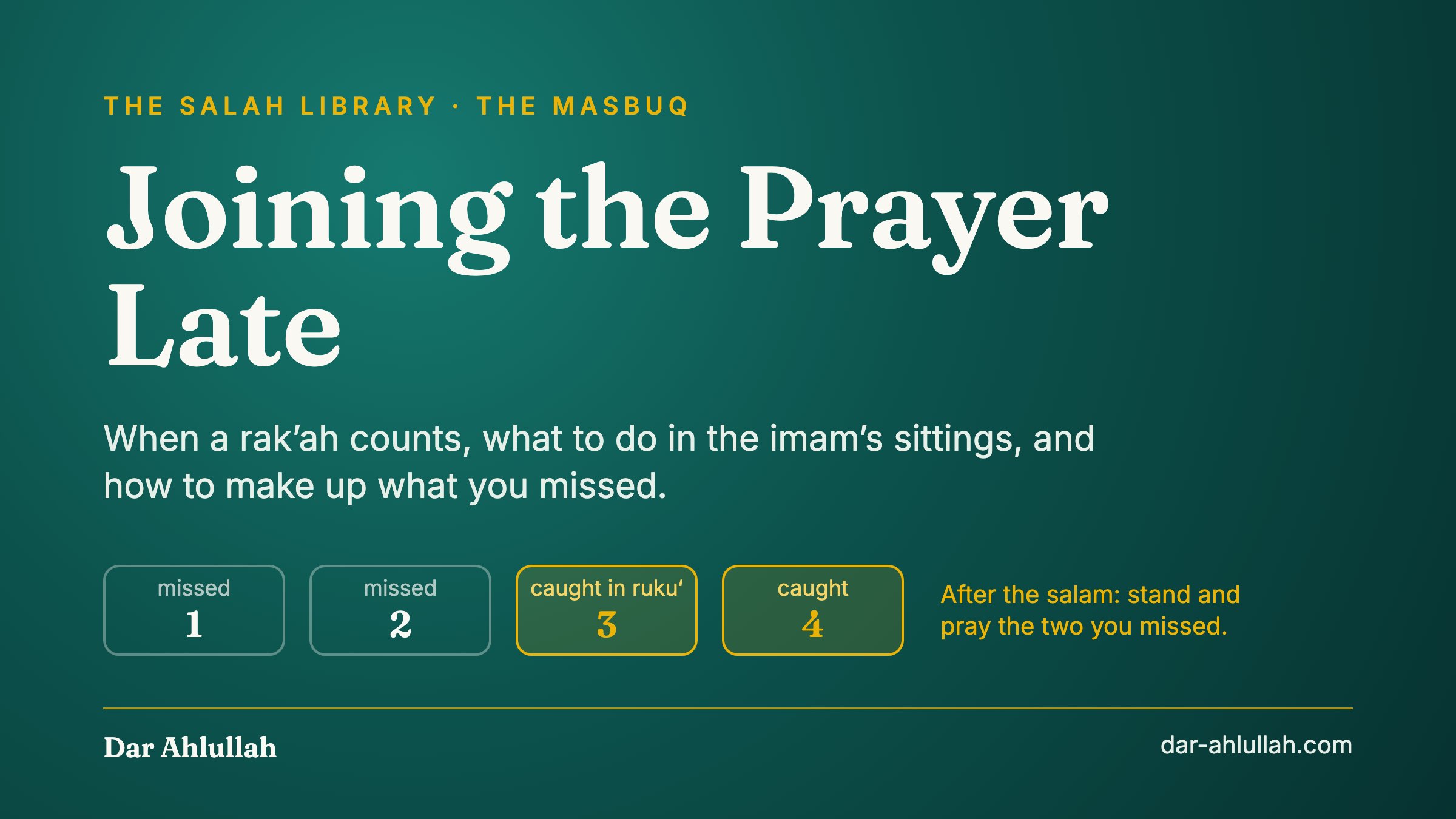
joining the prayer late
Joining the Prayer Late: How to Make Up Missed Rak’ahs
Joining the prayer late has a short, exact procedure: say the takbir standing, join the imam wherever he is, count the rak'ah only if you reached ruku' before he rose, and complete what you missed after his salam. This guide works through every prayer and arrival point, and explains why the person beside you may make up the same rak'ahs with a different recitation.
20 min read
tahiyyat al-masjid
Tahiyyat al-Masjid: How to Pray the Greeting of the Mosque
Tahiyyat al-masjid is two rak'ahs prayed on entering a mosque, before sitting. The method, the prayers that fulfil it for you, what to do if you already sat, the iqamah, the Friday khutbah and forbidden times by school, and whether a prayer room counts.
24 min read