
child refuses to learn Quran
What to Do When Your Child Refuses to Learn Quran
Dar Ahlullah team 15 min read

Table of Contents
- Introduction: The Standoff at the Kitchen Table
- The Short Answer: Diagnose, De-escalate, Shrink, Hold
- Refusing Is Not the Same Problem as Forgetting
- What “I Don’t Want To” Actually Means: Five Causes
- What the Scholars Say About Forcing a Child
- What to Stop Doing This Week
- The Two-Week Reset
- Shrink Until He Complies, Then Hold There
- Rebuilding the Association: What Actually Creates Love
- When the Teacher, Not the Child, Is the Variable
- The Same Refusal Means Different Things at 6, 10 and 14
- The Half of This That Is Not Technique
- Questions Parents Ask
- Conclusion: You Are Managing a Relationship, Not a Syllabus
Introduction: The Standoff at the Kitchen Table
It is 6:40 in the evening. The laptop is open, the teacher is waiting, and your child is somewhere between the sofa and the stairs saying the sentence you have started to dread: I don’t want to.
You try the reasonable version first. Then the firm version. Then the one you regret on the way to bed, the one that ends with the tablet confiscated and a child crying about the Qur’an. Nobody memorised anything. What actually got learned that evening was an association, and it was the wrong one.
Almost every parent who teaches their child Qur’an arrives here at some point. It is not a sign that you have failed, and it is very rarely a sign that your child has rejected his religion. But it is a signal, and the single most useful thing you can do is stop treating it as a discipline problem long enough to find out what it is a signal of.
Refusal is a symptom. It has causes, the causes look identical from the outside, and the fix for each one is different — which is why generic advice (“make it fun”, “be patient”, “use rewards”) so often does nothing. This guide is about telling the causes apart first.
The Short Answer: Diagnose, De-escalate, Shrink, Hold
If you read nothing else:
- Diagnose. Find out which of the five causes below you are actually dealing with. Do this before changing anything.
- De-escalate. Take the confrontation out of the room for two weeks. You cannot rebuild a positive association while you are still fighting nightly.
- Shrink. Cut the daily portion until your child can complete it without a battle — even if that is three minutes and one line.
- Hold. Keep it at that size, every day, until compliance is boring and automatic. Only then grow it, slowly.
The instinct is to do the opposite: push harder, add time, add pressure. That reliably converts a scheduling problem into a relationship problem, and relationship problems take years to undo.
Refusing Is Not the Same Problem as Forgetting
These two get treated as one thing and they are not. Separating them is the first diagnostic move, because they have opposite fixes.
Forgetting is a memory failure. The child is trying, showing up, and the material is not sticking. That is normal to hifz, it is a revision-load problem, and it is solved by freezing new memorisation and rebuilding the old — which is the subject of our guide on what to do when your child forgets their Qur’an memorization.
Refusing is a willingness failure. The child may be perfectly capable. He is declining to engage. Adding revision here makes it worse, because the volume is not the thing that is broken.
A quick test: ask your child to recite something he knows well and has no obligation to perform right now — in the car, with no lesson pending, no audience. If he does it happily, you have a refusal problem, not a memory problem. If he stumbles and gets embarrassed, you may have both, and the reading or memory issue is what is generating the refusal.
What “I Don’t Want To” Actually Means: Five Causes
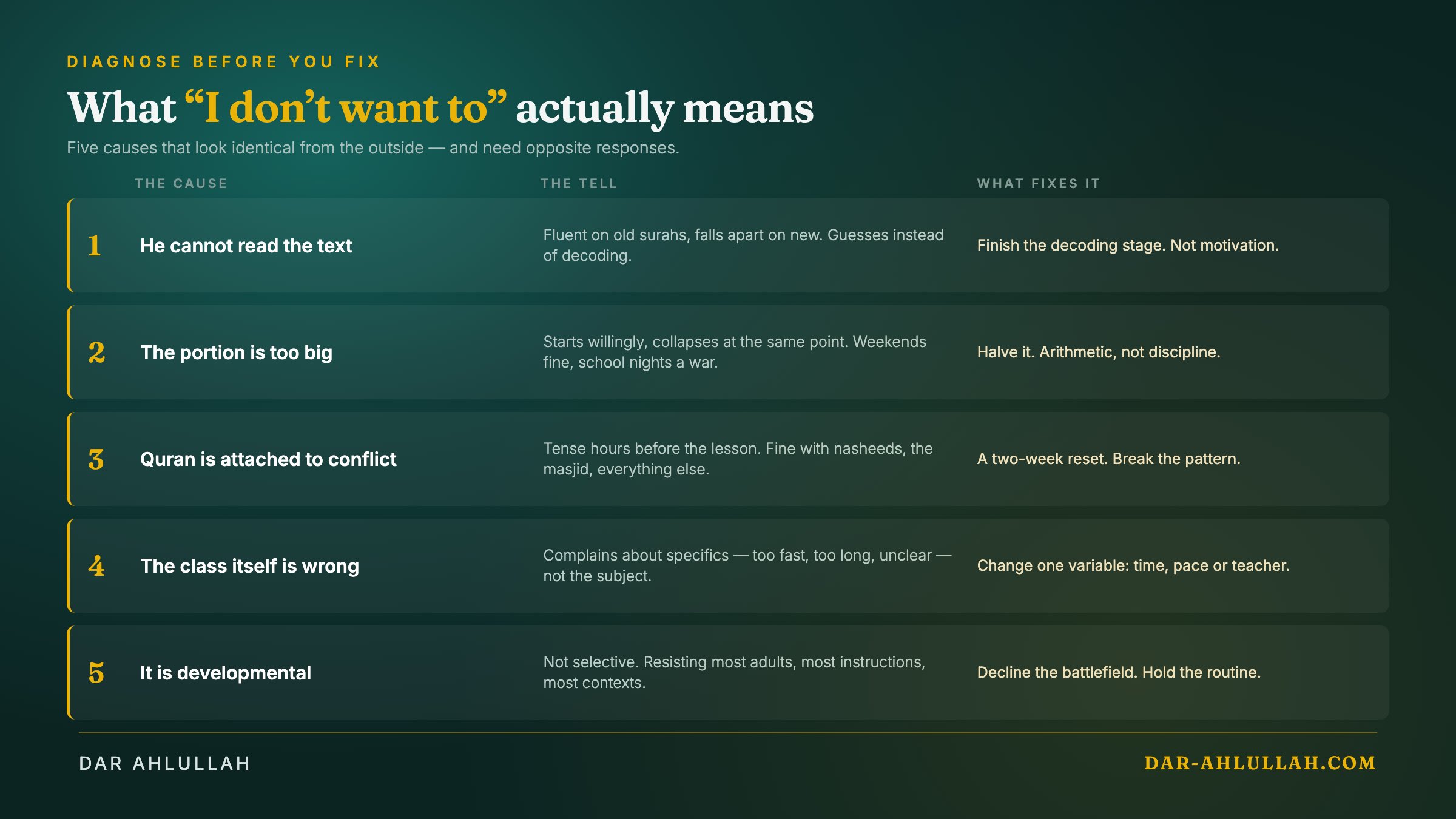
Children almost never say why. They say “I don’t want to,” because that is the only sentence available to them. Here is what it usually stands in for.
1. He cannot actually read the text
This is the most common cause and the most frequently missed, because it looks exactly like laziness. A child who has to decode every letter is spending all of his effort on mechanics and has none left for meaning or memory. Twenty minutes of that is genuinely exhausting, and avoiding it is a rational response, not a moral failing.
The tell: he is fluent on the surahs he learned by ear years ago and falls apart on anything new. He guesses at words rather than sounding them out. He resists reading far more than he resists listening.
If this is your child, the fix is not motivation. It is going back and finishing the decoding stage properly — the Noorani Qaida route, or a structured restart on how to read the Qur’an for beginners. Refusal frequently disappears on its own once reading stops being painful.
2. The portion is too big
A daily target set in an ambitious week and never revised downward becomes a wall the child hits every single evening. Children do not negotiate portion size; they refuse the whole session instead, because refusing all of it is the only lever they have.
The tell: he starts willingly and collapses partway through, most nights, at roughly the same point. He asks “how much more?” repeatedly. Weekends are fine and school nights are a war.
This is a load problem, and it is solved with arithmetic, not discipline. Our guide to the after-school Arabic and Qur’an routine covers how to size a weekday session that survives a school term.
3. Qur’an has become attached to conflict
If the last thirty sessions ended in raised voices, your child is no longer refusing the Qur’an. He is refusing the argument, and the Qur’an is simply the reliable predictor of it. This is the most serious of the five, and the only one where continuing as normal actively deepens the damage.
The tell: the resistance starts before the session, sometimes hours before. He is tense at the mention of it. He is fine with Islamic content in every other form — nasheeds, stories, the masjid — and specifically hostile to the lesson.
4. The class itself is wrong
Wrong time of day, wrong pace, wrong teacher, wrong format. A child put in front of a screen at 8 p.m. after a full school day is being asked to do focused work at his least capable hour, and no amount of willingness survives that.
The tell: he complains about the specifics rather than the subject — the teacher talks too fast, it goes on too long, he does not understand what he is being asked to do. He engages fine with Qur’an outside the class.
5. It is developmental and not about Qur’an at all
Around six or seven, and again in early adolescence, children push back on adult-directed activity as a matter of course. It is a stage, it is broad, and Qur’an gets caught in it alongside homework, bedtime and vegetables.
The tell: the refusal is not selective. He is resisting most instructions, from most adults, in most contexts. Singling out the Qur’an lesson as the battlefield is a choice you can decline to make.
IslamQA’s answer to a father whose son had stopped memorising makes exactly this point — before responding, look for the underlying cause, whether that is peer influence, overload, boredom, or the ordinary turbulence of adolescence (IslamQA 97083).
What the Scholars Say About Forcing a Child
Parents in this situation are usually caught between two fears: that being soft means abandoning a duty, and that being hard will push the child away permanently. The scholarly answers on this are more balanced than either instinct.
The duty itself is not in question. It rests on Surah at-Tahrim 66:6 — “O you who believe, protect yourselves and your families from a Fire” — which the scholars read as an instruction to teach children obedience to Allah, not merely to wish it for them. IslamQA cites this verse in both of the answers most relevant here, and is explicit that a parent does not get to withdraw from guidance because of one bad episode (IslamQA 97083).
What is questioned is the method. The same body of answers is consistent that escalation is counterproductive. On dealing with stubborn children, IslamQA states the principle plainly: stubbornness is to be met with “wisdom, deliberation and patience,” because responding to stubbornness with stubbornness produces more of it (IslamQA 279342). That answer also warns specifically against demeaning character labels — calling a child lazy, careless, or ungrateful — and against punishment beyond ordinary discipline.
The prophetic model cited there is worth sitting with. Anas ibn Malik served the Prophet (peace and blessings be upon him) for ten years and reported that he was never spoken to contemptuously, never asked why he had done something or why he had not (al-Bukhari 6038; Muslim 2309). The same collections record the Prophet shortening his own prayer because he heard a child crying and did not want to burden the mother (an-Nasa’i 1141). This is not a model of indulgence. It is a model in which the adult carries the cost of the child’s limitation rather than transferring it to the child.
And there is a limit on what pressure can achieve at all, which the Qur’an states about the Prophet himself: “Indeed, you do not guide whom you like, but Allah guides whom He wills” (28:56). A parent is responsible for the teaching, the environment, and the du’a. The outcome was never in their hands.
The practical synthesis: keep the obligation, drop the escalation. Continue to require the lesson; stop making the requirement a nightly test of wills.
What to Stop Doing This Week
Before adding any technique, remove what is actively working against you. Most parents get a visible improvement from subtraction alone.
- Stop negotiating during the session. Set the portion beforehand, in a calm moment. Mid-lesson renegotiation teaches that resistance changes the terms.
- Stop using Qur’an as the punishment or the thing punishment is attached to. “No tablet until you finish your Qur’an” makes the Qur’an the obstacle between your child and everything he wants.
- Stop the character labels. “You never want to do anything” is a description a child will grow into. IslamQA’s answer on stubbornness suggests inverting it: name the positive trait, then the behaviour — you are usually so careful, so how did this happen?
- Stop comparing him to a sibling or cousin. Children vary by design; the answer on individual differences puts it as Allah having “created His creation and caused them to vary in characteristics, nature and attitude” (IslamQA 145050). Comparison breeds resentment, not effort.
- Stop extending the session because it went badly. Adding fifteen minutes as a consequence guarantees the next session starts worse.
The Two-Week Reset
If cause 3 is in play — Qur’an attached to conflict — you need a deliberate break in the pattern. Two weeks is usually enough to change what your child expects when the lesson is mentioned.
| Period | What changes | What stays |
|---|---|---|
| Days 1–3 | No memorisation at all. Listening only — a recitation playing while he draws, eats, or falls asleep. No response required. | The time slot. Same hour, every day. |
| Days 4–7 | Reading only, from material he already knows well. The goal is fluency and a win, not new ground. | The slot, plus three to five minutes maximum. |
| Days 8–14 | Reintroduce one line of new material. One. Ending early on a success is the point. | The slot, and the rule that it always ends calmly. |
Two rules make or break this. First, the slot never moves — predictability is what stops the nightly negotiation, and a habit that happens at the same time stops being a decision. Second, you end the session, not your child, and you end it before he wants to stop. A child who is stopped while still willing comes back willing.
You will feel like you are going backwards. You are: deliberately, and for a fortnight, in exchange for a child who does not brace when you open the mushaf.
Shrink Until He Complies, Then Hold There
After the reset, the temptation is to return to the old target. Don’t. Find the size he can complete without a battle and stay there far longer than feels productive.
The rule: the correct portion is the largest one he completes calmly, every day, for two weeks. If there is a battle three nights in a row, it is too big — halve it. If it has been effortless for a fortnight, add a small amount and watch.
This is the same principle that governs adult hifz under time pressure, and it holds for the same reason: consistency compounds and intensity does not. Our guide on memorising Qur’an with a full-time job works through the arithmetic in the adult version of this problem.
On daily amount, IslamQA’s guidance for teaching young children is that the portion “should be small, varying from one child to another depending on intelligence and memory” (IslamQA 32436) — the variation is expected, not a defect in your child.
Rebuilding the Association: What Actually Creates Love
Compliance is the floor, not the goal. The separate work is making the Qur’an something your child associates with warmth rather than obligation. IslamQA’s answer on how to make a young child love the Qur’an is concrete about this (IslamQA 320722):
- Fill the house with recitation. Play a proficient reciter in the background — the answer names Shaykh al-Husari — so the sound is familiar long before it is homework.
- Recite where he can hear you. Not at him. Near him. Children absorb what they see adults do voluntarily.
- Mark the milestones publicly. The answer recommends gathering the family to honour the child on finishing each juz’. A completion that the people he loves take seriously is worth more than a sticker chart.
- Get a capable teacher at the right stage. Enthusiasm at home does not substitute for competent instruction once memorisation begins in earnest.
Rewards do have a place, and the answer on stubbornness endorses star charts and small privileges. Use them for showing up rather than for performance — you want the habit reinforced, not the child’s good days.
When the Teacher, Not the Child, Is the Variable
Parents are slow to consider this one, because it feels like making excuses. It is not. A teacher can be genuinely competent and still be the wrong match for a particular child, and a mismatch produces refusal that looks exactly like defiance.
Signs the pairing is the problem rather than your child:
- He engages with Qur’an in every setting except this class.
- He cannot tell you what he was asked to do — not won’t, cannot. The instruction is not landing.
- The pace never adjusts. The same amount is set whether last week went well or badly.
- He is corrected constantly and praised rarely, and has started pre-emptively apologising.
- He was fine with a previous teacher and the decline dates from the change.
A shy child paired with a brisk teacher will go quiet and be read as uncooperative. A fast child paired with a slow one will get bored and be read as disruptive. Neither is a character problem; both are solved by changing one variable.
This is a normal request, not a complaint, and worth raising early rather than after a term of decline. At Dar Ahlullah a rematch with another certified mentor is available at no extra cost — and you can pause, upgrade or switch plans at any time, so the pairing is never something a family is locked into. If you are starting from scratch and want the level assessed before committing, the free 30-minute assessment is designed for exactly that, with no card required.
The Same Refusal Means Different Things at 6, 10 and 14
The words are identical at every age. What is behind them is not, and the response should differ accordingly.
| Age | Usually means | What works |
|---|---|---|
| 4–6 | The session is longer than the attention span. Rarely about Qur’an at all. | Very short sessions, listening-heavy, physical proximity. Nothing that resembles school. |
| 7–9 | Decoding is hard, or the portion outgrew the child. The classic hidden-reading-problem window. | Test the reading honestly. Fix mechanics before touching motivation. |
| 10–12 | Competing load — school stepped up, and Qur’an is the flexible item in a full week. | Re-plan the week openly, with the child in the room. Protect a smaller slot rather than defending a bigger one. |
| 13+ | Autonomy. Being told is now part of the objection, and sometimes there are real questions underneath. | Hand over choices — which surah, which time, which teacher. Answer the questions seriously; take them to someone who can if you cannot. |
If you are still deciding when to begin formal lessons at all, our guide on what age a child should start learning Qur’an covers readiness signals, and online Qur’an classes for kids covers how a structured programme is usually staged.
The Half of This That Is Not Technique
Everything above is method, and method matters. But parents in this position tend to carry a fear that no schedule addresses: that the refusal is a verdict on their child’s relationship with Allah, and that they are watching it go wrong.
Three things are worth holding onto.
A child refusing a lesson is not a child rejecting his religion. Seven-year-olds refuse things. That is most of what being seven consists of. The meaning adults read into it is usually imported.
The obligation is on the effort, not the result. Allah told the Prophet directly that guidance was not his to hand over (28:56). If it was not in his hands, it is not in yours. You are asked to teach, provide, model and pray — not to guarantee.
Your own recitation does more than your instruction. The single most repeated piece of advice in the scholarly answers on this subject is that children copy what they see adults choose to do. A parent who reads daily where the child can see is running the more persuasive argument.
And keep making du’a for him by name. It costs nothing, it is the part of this you can always do, and it is the part the sources treat as most consequential.
Questions Parents Ask
Is it wrong to force my child to learn Qur’an?
The duty to teach is not optional, and IslamQA is explicit that a parent should not withdraw from guiding a child because of a difficult episode. But the scholarly answers consistently favour gradual, patient methods over coercion, warning that meeting stubbornness with stubbornness produces more stubbornness (IslamQA 279342). Keep the requirement; change the pressure.
My child was fine last year and now refuses. What changed?
Most often the load, not the child. School steps up, the Qur’an target does not come down, and the week no longer fits. Re-plan the week before assuming a change of heart.
Should I stop lessons entirely for a while?
Better to shrink than to stop. Stopping breaks the habit and makes restarting a fresh negotiation. Three minutes a day preserves the routine; zero rebuilds it from nothing.
He says Qur’an class is boring. Is that a real reason?
Usually it is the only word available for something more specific — too hard, too long, too fast, or nothing is being explained. Ask what part is boring rather than whether it is.
My child memorised well before and now refuses to revise.
Check whether he can still recite what he holds. If revision has become the daily experience of failing, the refusal is protective rather than lazy — and that is the forgetting problem, handled in our guide to lost memorization.
Do rewards work, or do they spoil the intention?
Scholarly answers on encouraging children endorse prizes at milestones, and celebrating a completed juz’ with the family is recommended outright (IslamQA 320722). Reward attendance and effort rather than performance, and let the reward fade as the habit sets.
What if I do not read Arabic myself?
You can still own the routine, the slot, the listening and the encouragement, and hand the technical correction to the teacher. Our guide on teaching your child Arabic at home covers what a non-Arabic-speaking parent can genuinely do.
Conclusion: You Are Managing a Relationship, Not a Syllabus
A child who refuses Qur’an is telling you something in the only vocabulary he has. The work is translation: is this reading, load, association, fit, or age? Each answer points somewhere different, and the wrong fix applied confidently is what turns a two-week problem into a two-year one.
Diagnose before you change anything. Take the fight out of the room. Cut the portion until it is almost embarrassingly small, and hold it there until it is boring. Keep the slot fixed, end every session while he is still willing, and let the household’s ordinary relationship with recitation do the persuading that instruction cannot.
You are responsible for the teaching, the environment and the du’a. The rest was never yours to carry.
Related articles
what age should a child start learning Quran
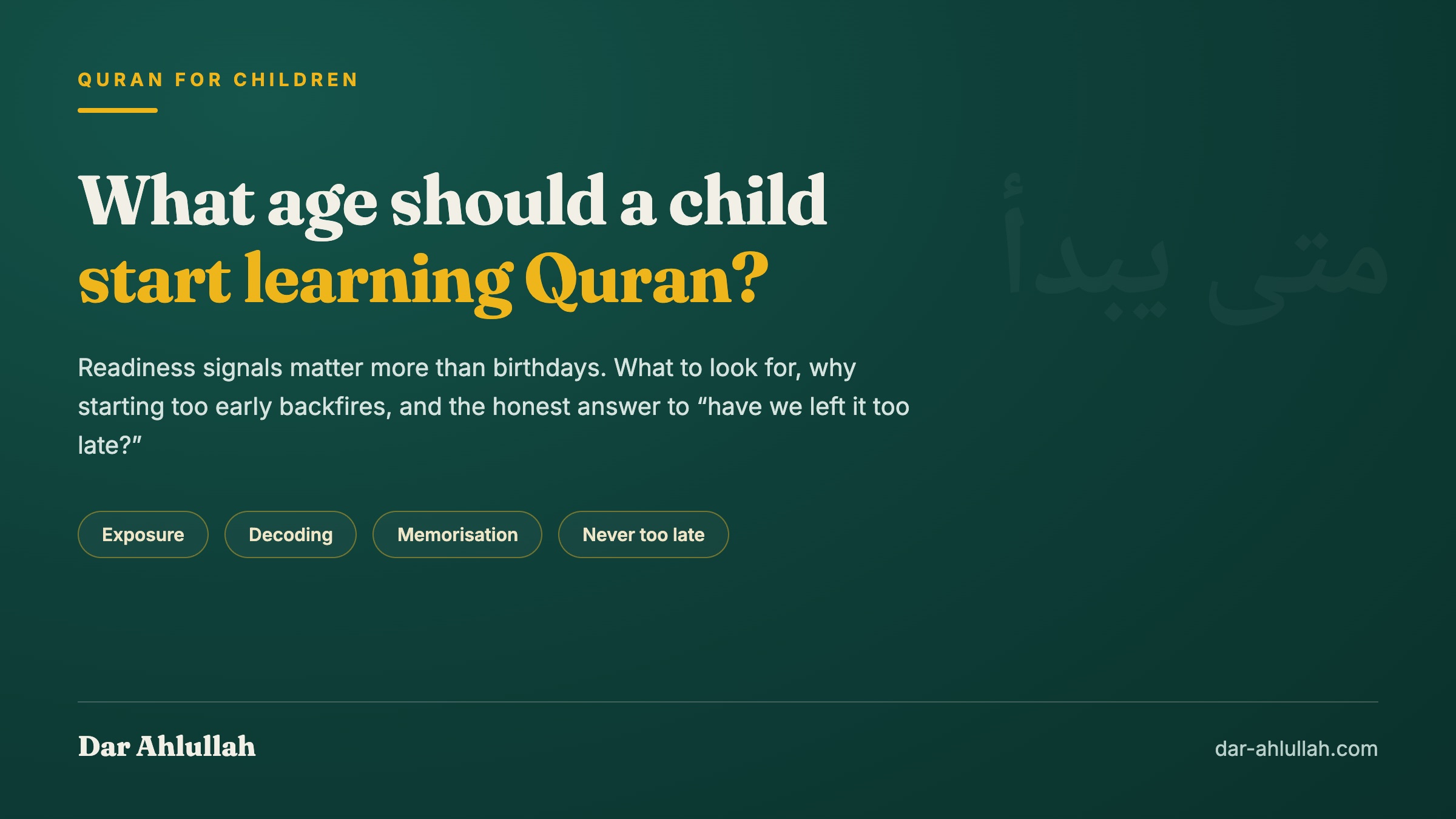
What Age Should a Child Start Learning Quran? Readiness, Not Birthdays
There is no age on the calendar that makes a child ready, and the number you are looking for does not exist. Here are the readiness signals that actually matter, what each age band can realistically do, why starting formal lessons too early costs years, and the honest answer to whether you have left it too late.
19 min read
how to help a child who forgot Quran memorization
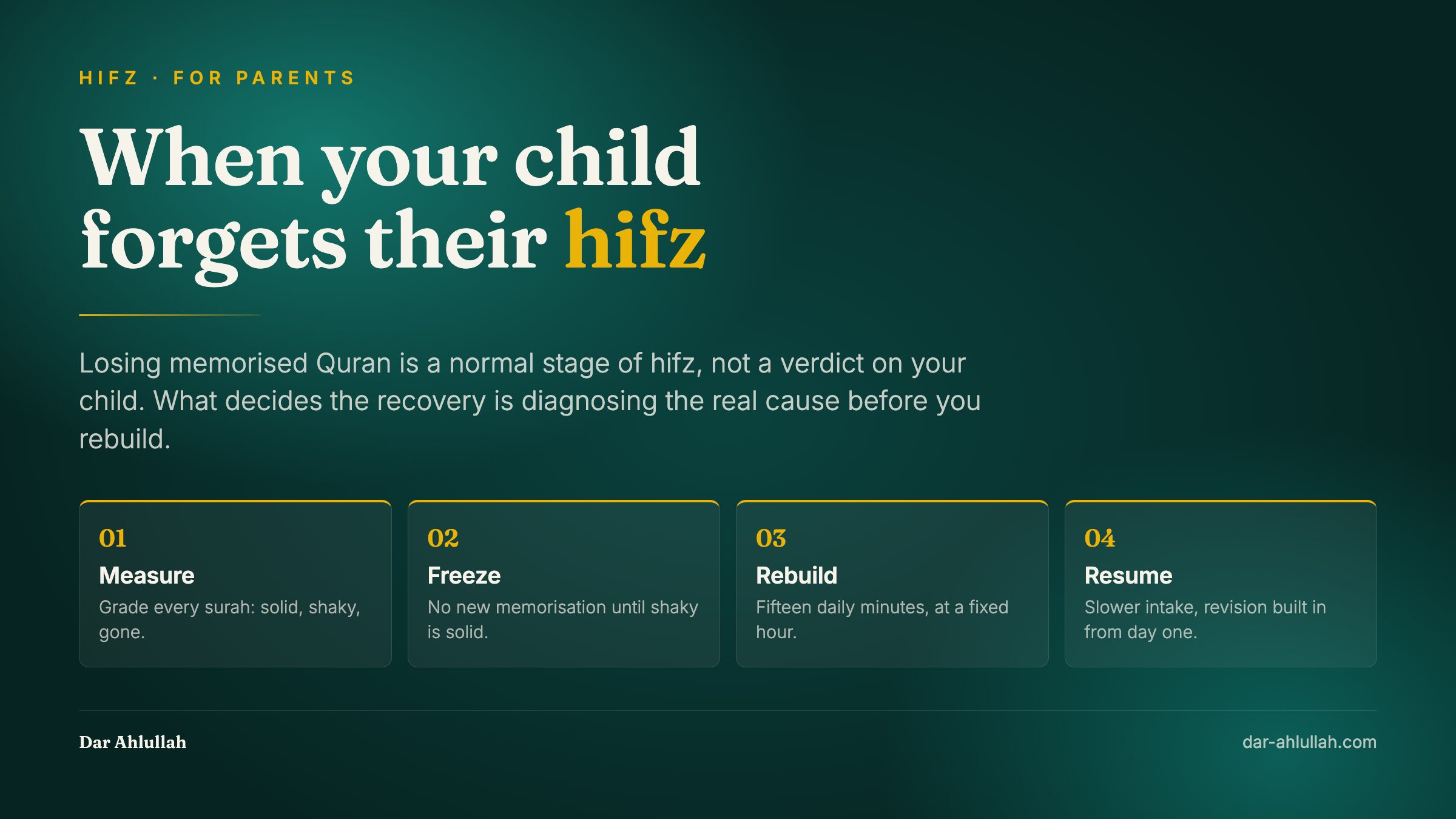
What to Do When Your Child Forgets Their Quran Memorization
Losing memorised Quran is a normal stage of hifz, not a verdict on your child. What decides the recovery is finding the real cause first, then freezing new material while the old is rebuilt.
22 min read

after school Arabic program
After-School Arabic & Quran Program: Balancing School and Deen
Fitting Arabic and Quran around a Western school day is a scheduling problem, not a motivation problem. Here is the weekly plan, the right time slot, and how to keep it alive through exam season.
8 min read