
what age should a child start learning Quran
What Age Should a Child Start Learning Quran? Readiness, Not Birthdays
Dar Ahlullah team 19 min read
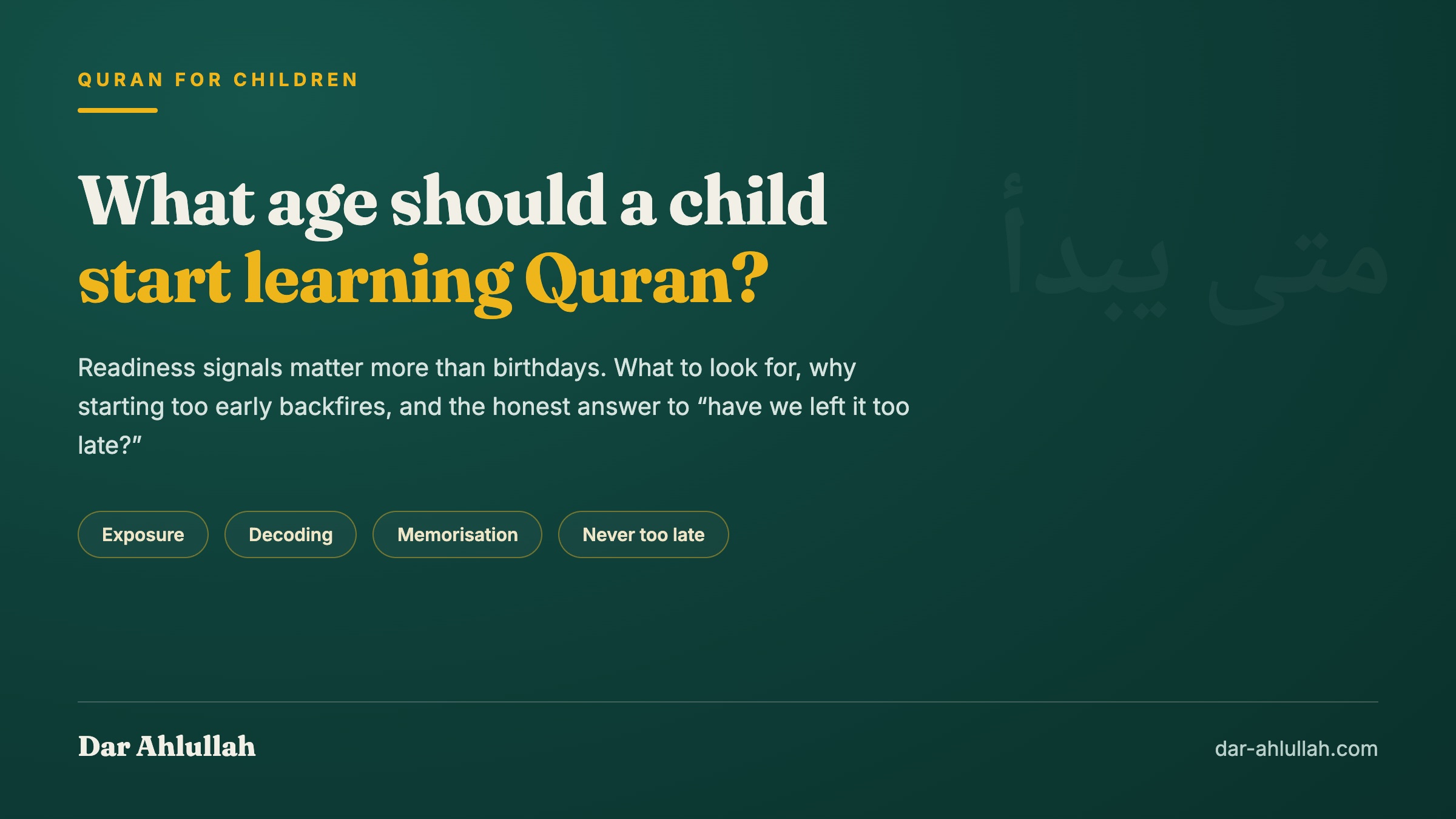
Table of Contents
- Introduction: The Question Under the Question
- The Short Answer
- Four Readiness Signals That Beat Any Birthday
- Three Different Things Parents Call “Learning Quran”
- What Each Age Band Can Realistically Do
- What Starting Too Early Actually Costs
- Have You Left It Too Late?
- What a Parent Who Speaks No Arabic Can Do at Home
- Lesson Length by Age, and Why It Is a Scheduling Argument
- Telling a Good Children’s Teacher From a Bad One
- How We Handle Age and Readiness
- Questions Parents Ask About Starting Age
- Conclusion: The Window Is Wider Than You Think
Introduction: The Question Under the Question
Almost nobody asks this question neutrally. When a parent types “what age should a child start learning Quran” into a search box, there is usually a second question underneath it, and it is one of two: have I left this too late, or am I pushing my four-year-old into something he is not ready for. The first comes with guilt attached. The second comes with the memory of a lesson that ended in tears.
Both anxieties are reasonable and both are answerable, but not with a number. The reason every article you have read gives you a different age — three, four, five, seven — is that they are answering different questions without saying so. Playing recitation to a toddler and enrolling a child in structured lessons with a teacher are not the same activity, do not have the same prerequisites, and do not belong to the same stage of a child’s life. Collapse them into one question and no answer can be right.
This guide separates them. It sets out what readiness actually looks like — the four things a child needs to be able to do before formal lessons make sense, none of which are age — and then walks through what is realistic at each stage, from infancy through the teenage years and into adulthood. It covers what starting too early costs, which is more than people expect and is paid in the child’s willingness rather than in money. It answers the “too late” question directly, including for an eleven-year-old, a teenager and a parent asking on their own behalf. And it deals with the practical reality that most parents reading this do not speak Arabic themselves, which changes what you can and cannot do at home.
If you want the wider picture of how Quran study is structured and what the route looks like end to end, our complete guide to learning Quran online covers the whole path. This article stays on one decision: when to start, and how to tell.
The Short Answer
Exposure starts at birth. Structured decoding lessons start when a child shows readiness, which for most children falls somewhere between four and seven with genuinely wide variation on either side. Memorisation as a serious project starts later still, usually once reading is fluent. And there is no upper age at which learning to read the Quran correctly stops being achievable.
Scholars commonly point to around the age of seven as the point at which children are taught to pray, and many teachers take that as a sensible marker for beginning structured religious instruction more broadly. It is worth being clear about what that marker is and is not. It is a reference point for when formal teaching typically begins. It is not a deadline, not a starting gun, and not a claim that a child who begins at nine has missed anything important.
The reason a single number cannot work is that children of the same age differ enormously in the specific capacities this requires. A five-year-old who will sit with a teacher for fifteen minutes and repeat a sound back accurately is ready. A seven-year-old who cannot yet tolerate correction from an adult who is not his mother is not, and enrolling him anyway will produce a term of expensive frustration followed by a child who associates the Quran with being told he is wrong.
So the useful question is not “is my child old enough” but “can my child do these four things yet”. Those four things are observable this week, in your own home, without a teacher’s assessment.
Four Readiness Signals That Beat Any Birthday
Readiness for structured Quran lessons is made of four capacities, and a child who has all four will do well at five while a child missing two will struggle at eight. None of them are about intelligence and none of them are about piety.
1. Can sustain one short focused block
The child needs to be able to give attention to a single task, directed by someone else, for roughly ten to fifteen minutes without the whole thing collapsing. Not an hour. Not even half an hour. One short block, on a task he did not choose, where he is not permitted to switch to something more interesting halfway through.
The easiest way to check is to look at something he already does with an adult: a bedtime story he has to sit through, a puzzle finished rather than abandoned, a drawing task set by a teacher at school. If nothing in his week looks like that yet, formal lessons will not create the capacity, they will just be the place where its absence shows up.
2. Can repeat a sound back and adjust when corrected
This is the specific skill Quran lessons at the early stage are built on. The teacher makes a sound, the child copies it, the teacher says “not quite, listen again”, and the child tries again with a change. Every part of that loop has to work, and the last part is the one that fails.
Plenty of young children will happily repeat a sound. Far fewer will accept being told the repetition was wrong and try a second time without either shutting down or losing interest. You can test this in thirty seconds with a silly noise: make a sound, ask him to copy it, tell him it was close but not right, make it again. What he does next is the signal.
3. Understands that written marks stand for sounds
A child does not need to be reading in English before starting Arabic, and waiting for full literacy is not necessary. What helps enormously is that he has grasped the underlying idea — that the shapes on a page are not pictures, that they stand for sounds, and that the same shape makes the same sound every time.
Most children arrive at this somewhere in their first year or two of school, and you can usually see it happening: they start pointing at letters on packaging, asking what a word says, or noticing that their own name begins with a particular shape. A child who has that concept can be taught that ب makes a sound. A child who has not will treat the Arabic letters as drawings to memorise, which works for about a fortnight and then stops working.
4. Can work with an adult who is not you
This one matters more for online lessons than parents expect, and it is the signal most often ignored. A child who will only cooperate when a parent is in arm’s reach, or who performs for a parent rather than engaging with the teacher, is not going to get much from a one-to-one session with someone on a screen.
Some children have this at three because they have been in nursery. Some do not have it at seven. It is not a character flaw and it develops, but it is a prerequisite rather than something the lessons will fix. If a child has the other three signals and not this one, a short trial with you sitting quietly beside him — visibly present, deliberately silent — is a reasonable bridge for a few weeks.
What is not a readiness signal
Three things get mistaken for readiness with some regularity, and all three mislead:
- Having memorised short surahs by ear. This is genuinely lovely and says nothing about reading readiness. A three-year-old can reproduce a surah he has heard a hundred times the same way he reproduces a song, and it tells you his auditory memory works, not that he is ready to decode script.
- A sibling or cousin who started at that age. The variance between children in exactly these four capacities is large, and it does not predict where they end up. The child who starts eighteen months later frequently overtakes.
- Age on its own. Which is the whole point of this section. A birthday changes nothing on the day it happens.
Three Different Things Parents Call “Learning Quran”
Most of the confusion about starting age comes from one conflation. “Learning Quran” covers three activities with completely different prerequisites, difficulty and payoff, and parents routinely ask about one while meaning another.
| Track | What it is | When it starts | What it costs |
|---|---|---|---|
| Exposure | Hearing the Quran recited, regularly, in the background of ordinary life. No task, no correction, no expectation. | Infancy. There is no lower limit. | Nothing. It is the highest-leverage thing on this list and the only free one. |
| Decoding | Learning to turn Arabic script into correct sound — letters, their joined forms, vowel marks, and the rules that govern length and stopping. This is Qaida work. | When the four readiness signals are present, commonly between four and seven. | A teacher, contact time and steady practice over months. |
| Memorisation | Committing text to memory and retaining it, which requires ongoing revision indefinitely. | After reading is fluent. Attempting it earlier memorises the errors too. | The most demanding of the three by a wide margin, in time and in discipline. |
Exposure is the one parents underrate and it is the one that costs nothing. A child who has heard Quranic Arabic since infancy arrives at his first lesson with the sound system already partly installed. He is not startled by letters that do not exist in English. He has an intuition for rhythm and pause. He does not need to be persuaded that this is a normal thing for people to do, because it has always been in the house. None of that requires a teacher, a subscription, or the child’s cooperation. It requires a speaker and a habit.
The practical version is unglamorous: pick one reciter and play the same short surahs at the same point in the day — the school run, breakfast, the hour before bed. Variety is worth less than repetition here. The point is familiarity, and familiarity comes from hearing the same thing many times, not many things once.
Decoding is the track that actually needs a teacher and a start date. When people ask about starting age, this is nearly always what they mean without knowing it. It is the stage the Noorani Qaida exists for, and our guide to the Noorani Qaida explains what the book trains and why its sequence is not negotiable. It is a skill built by repetition with correction, which is why it needs someone listening and why it cannot be done by playing audio.
Memorisation is the track parents most often start too soon. A child who has not consolidated decoding can still memorise, because memorisation from a teacher’s voice does not require reading at all. What he cannot do is memorise accurately from the page, and errors installed at this stage are unusually durable — the text has been rehearsed hundreds of times with the mistake in it. This is the single most common reason a hifz programme has to go backwards. Our overview of online hifz programmes sets out what the commitment actually looks like before a family takes it on.
What Each Age Band Can Realistically Do
These bands are descriptions, not prescriptions. A child can sit a band above or below where his birthday puts him and nothing is wrong. Read them as “what is usually achievable” rather than “what should be happening”.
Under four
Exposure only, and that is not a consolation prize. At this age the useful work is entirely auditory and environmental: recitation playing regularly, hearing a parent recite in prayer, being present when older siblings have their lessons. Some children will pick up short surahs by ear and some will not, and neither predicts anything.
What does not work at this age is formal lessons, and it is worth being blunt about why. A two-year-old cannot sustain a directed task, cannot process correction, and cannot yet hold the idea that a shape stands for a sound. A lesson is therefore twenty minutes of a stranger asking him to do things he cannot do. Parents who try this usually report that the child “did well” for two or three sessions — novelty carries it — and then refused. The refusal is the honest data point.
Four to six
The band where readiness typically arrives, unevenly. Some children in this range are ready for structured lessons and some are eighteen months away, and the four signals are how you tell rather than the birthday.
What is realistic for a ready five-year-old: recognising the Arabic letters reliably, producing them with reasonable accuracy, beginning to handle short vowels, and sitting for short frequent sessions. What is not realistic: long sessions, independent practice without an adult, or progress that runs in a straight line. Expect plateaus and expect weeks that go backwards. At this age the primary objective is not a page count. It is that the child ends each session willing to come to the next one, because willingness at five is what makes ten possible.
Seven to ten
The most productive band for decoding, and the one where a child who started earlier and a child starting fresh tend to converge faster than parents expect. Attention span has extended, school has made the letter-to-sound concept second nature, and the child can now practise between lessons with only light supervision.
A child starting from zero at eight is not behind in any meaningful sense. He will move through the early stages faster than a five-year-old would, because he understands explanations rather than needing everything demonstrated repeatedly. He also carries less of the accumulated resistance that a badly handled early start produces. If you are starting here, start here without apology.
This is also the band where memorisation can begin to sit alongside reading rather than in front of it, once decoding is solid enough that the child can read a new page correctly at a slow pace.
Eleven and up
Everything is still available and one thing changes: the child’s own buy-in becomes the deciding variable. Below about ten, a parent can largely set the schedule and the child works within it. Above it, a young person who has decided this is not for him will not learn regardless of how good the teacher is, and a young person who has decided he wants it will move remarkably quickly.
The practical implication is that the conversation shifts from arranging lessons to agreeing them. Involve the young person in choosing the teacher and the time slot. Say plainly what the goal is and how long it should take. Self-consciousness also arrives around here — older children hate being bad at things in front of other people — which is a strong argument for one-to-one rather than a group of younger children who are further ahead.
Adults
Included here because a striking number of parents researching this question are really asking on their own behalf and have not admitted it yet. Adults learn to decode Arabic script successfully all the time, and the profile is predictable: faster through the conceptual parts, slower through articulation, and limited mainly by embarrassment rather than by capacity. Our guide to learning the Quran as an adult deals with that properly, and there is a side benefit for the family — a parent who is visibly learning changes what the child thinks this activity is.
What Starting Too Early Actually Costs
The cost of starting too early is not wasted money. It is resistance, and resistance is expensive because it does not expire when the term does.
Here is the mechanism. A child who is not yet able to sustain a directed task is put into a lesson that requires exactly that. He cannot succeed, so the session becomes a sequence of corrections and prompts to focus. He learns, quite reasonably, that this activity is one where he is repeatedly found wanting. Because the material is the Quran, and because the adults around him treat it as important, the association attaches to something much larger than a lesson slot. Then the family stops, waits a year, and tries again with a child who now has a settled opinion about what Arabic lessons are like.
Undoing that costs considerably more than the eighteen months of waiting would have. It usually means a new teacher, a deliberately undemanding restart, and a period where the only goal is that the child does not dread it. A family that waits until readiness arrives skips all of that.
How to recognise that you have pushed too early
The signals are behavioural rather than academic, and they show up outside the lesson as often as in it:
- The pre-lesson state has changed. Stalling, needing the toilet at the exact start time, sudden tiredness, negotiating the length before it begins. One-off means nothing. A pattern over three or four weeks is the clearest signal available.
- He performs for you rather than working with the teacher. Looking at you after every answer, waiting for your nod, going quiet when you leave the room. It means he is managing your reaction rather than doing the task, and no learning is happening underneath it.
- Nothing survives the week. Material that was solid on Monday is gone by Thursday, repeatedly. Some forgetting is normal. Total forgetting usually means the session was endured rather than absorbed.
- The language has become global. “I hate Arabic” rather than “this page is hard”. When a specific difficulty has generalised into a category, the association has already formed.
- Tears more than once. A hard session that ends in frustration happens. A pattern is a pattern.
What to do about it
Do not push harder and do not add sessions. In order of what to try: shorten the session before you do anything else, because half the problem is usually duration rather than content. Then change what the session is for — a few weeks of listening and repeating with no page and no progress target resets the association at low cost. Then consider whether the teacher is right for a young child, which is a different question from whether the teacher is good, and is dealt with below. If none of that shifts it, stop, keep exposure going in the background, and return in six to twelve months. A pause taken deliberately is a completely different thing from a child who quit.
Have You Left It Too Late?
No, and this deserves a more useful answer than reassurance.
Being precise about it: the ability to learn to read the Quran correctly does not close. Decoding Arabic script is a learnable skill with a defined syllabus and a known endpoint, and people acquire it at eleven, at nineteen, at forty and at sixty. Reverts learn it as adults routinely. The syllabus does not change with age and neither does the outcome. An adult who works through the Qaida properly reads the mushaf correctly, the same as a child who does.
What does change with age is worth naming honestly rather than pretending otherwise, and it is two things.
Memorisation gets harder. Not impossible, harder. Adults who take on hifz generally find the retention work more demanding than children do, which is why hifz programmes have always leaned young. But memorisation is one track of three, and it is the optional one. A person who reads the Quran correctly and understands more of it every year is not failing because he memorised less than someone else.
Unfamiliar sounds take more deliberate work. Younger children tend to pick up unfamiliar articulations by imitation with less conscious effort, while older learners often need the sound explained, located in the mouth, and drilled. Any teacher who has taught both age groups will tell you this. It is a difference in method and in how much repetition is needed, not a ceiling — the older learner gets there, having thought about it more.
Set against those, older learners bring three advantages that are easy to undercount. They understand explanations rather than needing endless demonstration, so the conceptual parts of the syllabus compress dramatically. They chose to be there, which removes the entire motivation problem that dominates teaching young children. And they can practise independently without an adult organising it.
The specific cases
An eleven-year-old who has never started. This is a good position, not a bad one. He will move through letter recognition and vowel marks faster than a five-year-old and can practise on his own. The one thing to manage is dignity: he should not be put in a group with six-year-olds who are ahead of him.
A teenager. Entirely doable and entirely dependent on whether he wants it. If he does, expect fast progress. If he does not, arranging lessons will not manufacture the wanting, and the honest move is to work on the wanting first — usually through meaning and translation rather than through more drilling.
You, the parent. Also doable, and the obstacle is almost never capacity. It is the discomfort of reading badly in front of another adult, which is why one-to-one with a consistent teacher works far better than a group. It also does more for your child’s attitude than any amount of encouragement, because a child who watches a parent be a beginner learns that being a beginner is normal.
What a Parent Who Speaks No Arabic Can Do at Home
Most parents asking this question cannot read Arabic themselves, and the useful thing is to be exact about the division of labour rather than vague and encouraging about it.
What you can do, and it is a lot
- Run the exposure track entirely. This needs no Arabic at all and it is the highest-value thing on the list. One reciter, the same short surahs, at a fixed point in the day.
- Protect the schedule. Consistency is worth more than intensity at every age in this article, and consistency is a parent’s job. Same days, same times, device charged, quiet room, no negotiation about whether it happens.
- Sit through the lesson without participating. Being present and silent does two things: it tells you what is actually happening in the sessions, and it means you know what was covered when it is time to practise.
- Run recognition practice with an answer key. You do not need to read Arabic to hold up a card and check what the teacher wrote on the back. Letter and vowel recognition is testable by any parent with a list.
- Hear fluency, even without accuracy. You can tell whether your child is reading smoothly or hesitating at every letter, whether he is looking at the page or reciting from memory, and whether he can do today what he could do last week. That is genuinely useful information and it does not require Arabic.
- Learn alongside him. The most effective option and the one parents skip. Being three lessons ahead is enough to be useful.
What you cannot do, and should not attempt
- Correct pronunciation. Arabic distinguishes sounds English does not — two letters an English ear hears as h, three that collapse into s. You cannot hear the difference, which means you cannot tell whether a correction is needed, and a confident wrong correction from a parent is harder to undo than the original error.
- Judge whether tajweed is right. Same reason. A recitation can sound beautiful to you and carry errors a teacher hears immediately.
- Decide when to move on. Pages completed is not the measure; whether the previous skill is automatic is. That is a teacher’s judgement.
- Be the enforcer inside the lesson. If discipline during sessions is being outsourced to you from the next room, the format or the teacher is wrong.
For the wider question of building Arabic into home life when you do not speak it, our guide to teaching your child Arabic at home covers what is realistic to run yourself and what needs handing over.
Lesson Length by Age, and Why It Is a Scheduling Argument
For young children, two short sessions beat one long session at the same total cost, and this is a point about how the skill is built rather than a point about buying more lessons.
Three reasons it holds. First, attention: a six-year-old’s productive window is short, and the back half of a long session is not learning, it is attendance. Second, decay: decoding is a motor skill that fades between sessions, so a week-long gap means every lesson opens with a review of the last one and the actual new material gets a fraction of the time. Third, correction: what a young child needs is many small corrected repetitions spread over time, not many corrections in one sitting, which is simply overwhelming.
Rough guidance, adjusted to the child in front of you rather than the number:
- Four to six: fifteen to twenty minutes of real work, three or four times a week if possible. Stop while it is still going well. Ending on success is worth more than the last five minutes of content.
- Seven to ten: thirty minutes, two to four times a week. This is where the standard half-hour session fits naturally.
- Eleven and up: thirty to forty-five minutes, twice a week or more. Longer becomes viable, though frequency still beats duration for anything involving articulation.
- Adults: up to an hour is fine, and most adults over-buy duration and under-buy frequency. Two half-hours a week outperform one hour for the same money.
The scheduling consequence is that a plan should be sliced into whatever unit fits the child rather than the other way round. Eight half-hour sessions and four one-hour sessions cost the same and are not equivalent for a six-year-old. If a provider will not split the time, that is a constraint on their operations, not a fact about how children learn. Our breakdown of what online Quran classes cost goes through how pricing structures differ and what to compare.
One further note on timing within the day. A young child’s lesson placed after a full school day and an hour of activities is being scheduled into his worst window, and parents then conclude he is not ready when what he is is tired. Where time zones allow, put it earlier or on a weekend morning before deciding the child cannot manage it.
Telling a Good Children’s Teacher From a Bad One
At this age, patience and pacing matter more than credentials. A teacher with deep knowledge who cannot hold a six-year-old’s attention will teach him less than a well-trained teacher with ordinary qualifications who can. Both matter, but for young children the ordering is not close.
What to watch for in a trial session, all of it observable in twenty minutes:
- Who is talking. The child should be producing sound for most of the session. A teacher who explains at length is teaching an adult in a child’s slot.
- The pause after a question. Good teachers of young children wait, visibly, and let the silence sit. Rushing to fill it trains the child to wait for the answer rather than attempt it.
- One correction at a time. Young children cannot process three simultaneous fixes. A teacher who corrects the letter, the vowel and the pace in one breath will get none of them.
- Modelling rather than describing. “Listen, then say it” works at six. An explanation of where the sound forms in the throat does not, however accurate it is.
- Memory of last week. A teacher who opens by returning to the specific letter the child got wrong last time is tracking him. One who opens by asking where they got to is not.
- How the session ends. Deliberately on something the child can do, so the last thirty seconds are a success rather than a struggle. This is a small thing that decides whether he comes back willingly.
- Response to a bad day. Every young child has sessions where nothing works. Watch whether the teacher adapts or pushes through the plan.
The red flags mirror those. A teacher who talks most of the lesson; who praises everything identically, so praise carries no information; who measures progress by pages rather than by whether the previous skill is automatic; who asks the parent to enforce attention; or who shames a wrong answer even lightly. Add one more: a different teacher each week. Continuity is most of the value at this stage, because the useful thing a teacher accumulates is a memory of which sounds this particular child gets wrong. A rotating roster cannot hold that.
Trial sessions are worth using properly. Sit in, watch for the list above rather than for warmth, and if the fit is wrong, say so and change. Choosing wrongly and staying out of politeness costs a child months. Our guide to choosing an online Quran academy covers the wider set of questions to ask before committing.
How We Handle Age and Readiness
We teach children and adults one-to-one over Zoom, and there are three things about the format that bear directly on everything above.
The first is that lessons are one-to-one rather than grouped, which means the pace follows the child rather than the middle of a class. For a young child that is the difference between a session where he is producing sound for twenty minutes and one where he waits his turn. It also means an eleven-year-old starting from zero is never sitting alongside younger children who are further ahead.
The second is that time is scheduled in whatever blocks suit the learner. Our teachers work across time zones, so a family in the US or UK can put a young child’s sessions in a morning or early-evening slot rather than at the end of an exhausted day, and can split their plan into short frequent sessions rather than one long weekly one. Both male and female teachers are available, which for some families is a practical requirement rather than a preference.
The third is the free trial session, which is the honest way to answer the readiness question. Twenty minutes with a teacher tells you more about whether your child can sit, repeat, accept correction and engage with an adult on a screen than any checklist can, including this one. If the answer is that he is not ready yet, that is a useful thing to find out at no cost.
Our rate is $9 per teaching hour across every plan — $36, $70 and $102 a month, sliced into whatever session length fits — and the full breakdown is on our pricing page. If you want to find out where your child actually is, book the free trial session. For what lessons look like week to week once they start, our page on online Quran classes for kids goes through the detail.
Questions Parents Ask About Starting Age
Is three too young to start Quran lessons?
For formal lessons, almost always yes. A three-year-old generally cannot sustain a directed task, process correction, or hold the idea that a written shape stands for a sound. Exposure at three is excellent and worth doing daily. A lesson slot at three usually produces two novel sessions followed by refusal.
My child is eleven and has not started. Is it too late?
No. Eleven is a good starting point rather than a late one. He will move through letter recognition and vowel marks faster than a young child would, because he understands explanations, and he can practise independently. The thing to manage is not capacity but dignity, which is an argument for one-to-one rather than a group.
Should my child learn to read English before starting Arabic?
Not necessarily, but the underlying concept helps. What matters is that he has grasped that written marks stand for sounds, which usually emerges in the first year or two of school. Full English literacy is not a prerequisite, and children learn two scripts side by side without difficulty.
Can my child start memorising before he can read?
He can memorise by ear, and many young children do, which is fine as an activity in itself. What he cannot do is memorise accurately from the page, and memorisation built on shaky decoding installs errors that have been rehearsed hundreds of times. Serious hifz work is better placed after reading is solid.
How do I know if my child is ready or just being difficult?
Look at the four signals rather than the mood. If he can sustain a short directed task elsewhere in his week, copy a sound and adjust it when corrected, understands that letters stand for sounds, and can work with an adult who is not you, he is ready and you are dealing with a behaviour question. If two or more of those are missing, it is readiness rather than attitude.
How many sessions a week does a young child need?
More often and shorter, rather than fewer and longer. Three or four short sessions a week outperform one long one for a four- to six-year-old, because decoding fades between sessions and a long gap means each lesson is spent recovering the last one. The total time can be identical.
My child was doing well and has suddenly stopped cooperating. What happened?
Most often one of three things: the sessions are too long for him, the material moved on before the previous step was automatic, or the timing in the day is wrong. Shorten the session first, since duration is the most common cause and the easiest to test. If a pattern of stalling and dread has already set in over several weeks, a deliberate pause with exposure continuing is better than pushing through.
I do not speak Arabic. Can I still help?
Substantially, as long as you stay on your side of the line. You can run exposure, protect the schedule, sit in on lessons, test letter recognition against an answer key, and hear whether your child is fluent or hesitating. You cannot correct pronunciation, because the sounds English lacks are exactly the ones you cannot hear, and a confident wrong correction is harder to undo than the original error.
What age is best for starting hifz?
After reading is fluent rather than at a particular age, though in practice that often lands somewhere in the eight-to-twelve range for children who started decoding early. Retention work does tend to come more easily to children than to adults, which is why programmes lean young, but the prerequisite is reading rather than the birthday.
Conclusion: The Window Is Wider Than You Think
The number you came looking for does not exist, and its absence is good news. There is no age at which a door closes, and there is no age at which enrolment guarantees anything. There is a set of capacities a child needs before structured lessons make sense, all four of which you can check yourself this week, and there is an exposure track that costs nothing and can start today regardless of how old your child is.
If your child is very young, play recitation and wait. If he is four to six, test the four signals rather than the calendar, start short, and treat his willingness to return as the metric that matters. If he is seven to ten, start now and expect faster progress than you have been led to fear. If he is eleven or older, involve him in the decision and protect his dignity. And if you are the one who never learned, the honest answer is that the syllabus does not care how old you are — only that somebody competent is listening while you read.
The mistake worth avoiding is not starting a year late. It is starting a year early, badly, and spending three years undoing it.
Related articles
child refuses to learn Quran
What to Do When Your Child Refuses to Learn Quran
Refusal is a willingness problem, not a memory problem, and it has five causes that look identical from the outside. Tell them apart first — the fix for each one is different.
15 min read
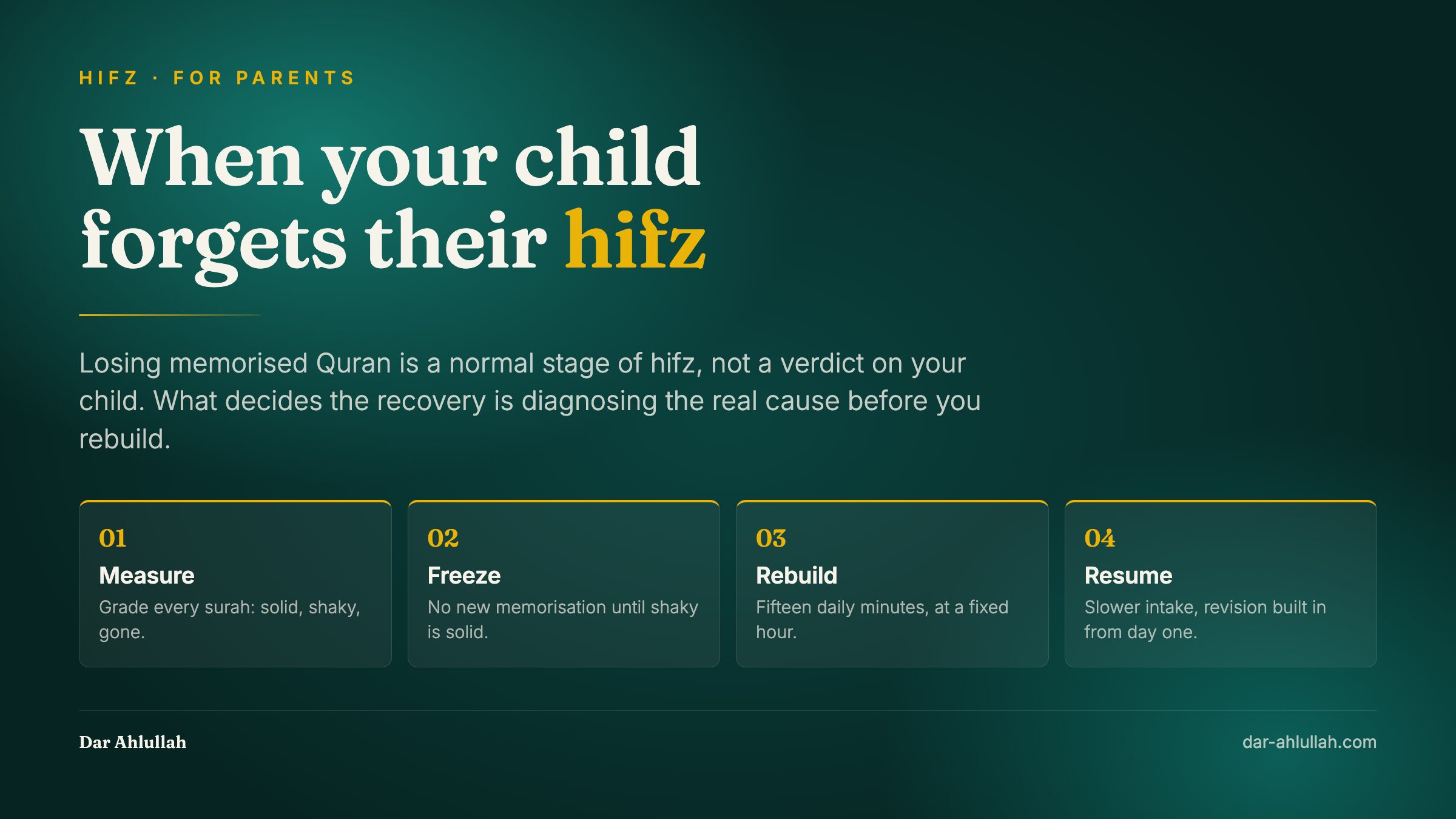
how to help a child who forgot Quran memorization
What to Do When Your Child Forgets Their Quran Memorization
Losing memorised Quran is a normal stage of hifz, not a verdict on your child. What decides the recovery is finding the real cause first, then freezing new material while the old is rebuilt.
22 min read
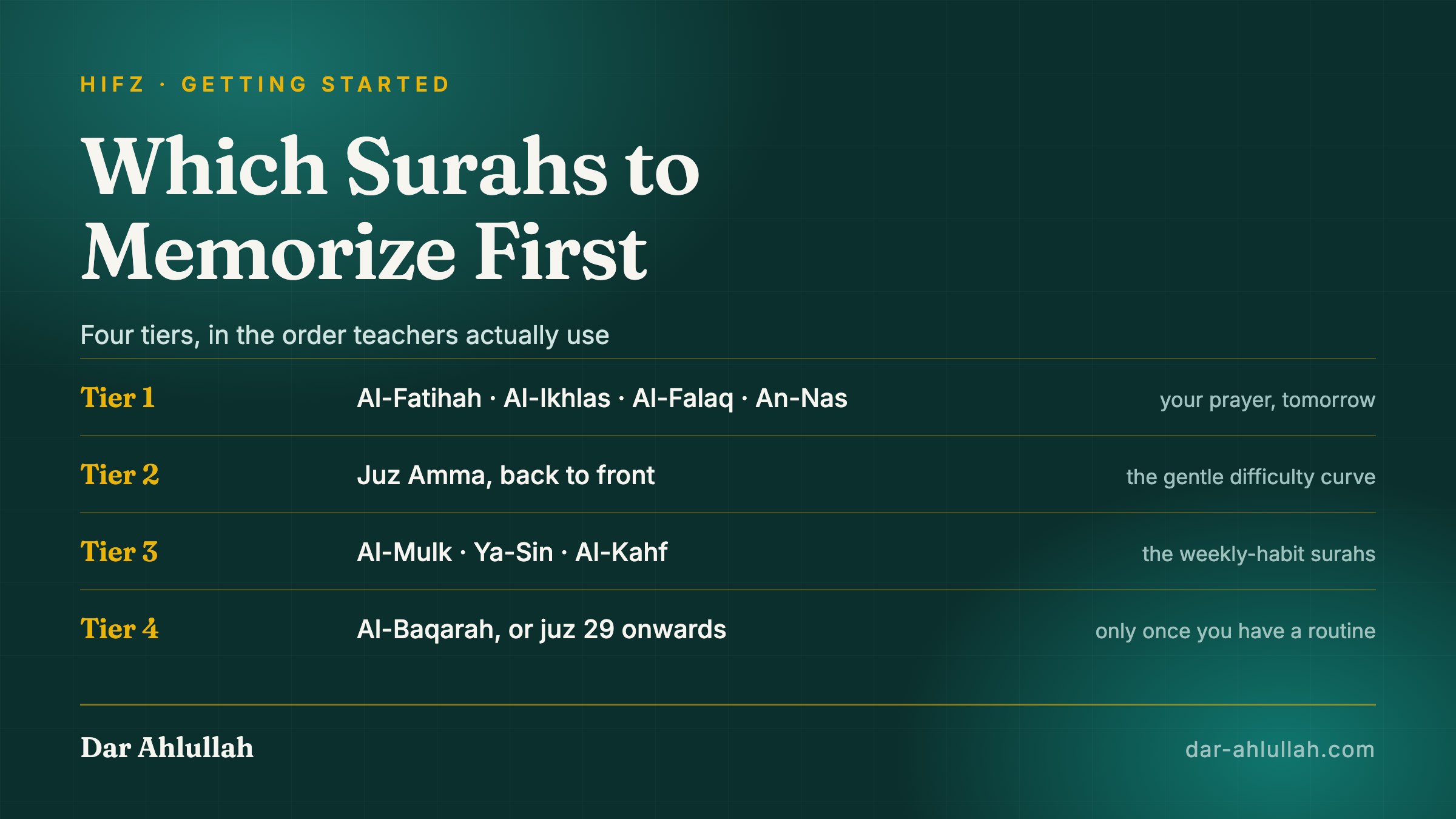
which surahs to memorize first
Which Surahs to Memorize First: A Practical Order
Almost nobody asking which surahs to memorize first is really asking about surahs. Here is the order teachers actually use, the reason behind each step, and the point where beginners lose a year.
15 min read