
Arabic alphabet for beginners
Arabic Alphabet for Beginners: How to Read the Script
Dar Ahlullah team 17 min read
Table of Contents
- Introduction: The Chart Is Not the Bottleneck
- The Short Answer: Four Moves That Get You Reading
- 1. What Kind of Writing System Arabic Actually Is
- 2. Learn the 28 Letters by Shape, Not by Song
- 3. One Letter, Four Shapes — and Six That Refuse to Join
- 4. The Marks That Make a Word Readable
- 5. From Letters to Words: The Skill Nobody Drills
- 6. When You Open a Mushaf, the Rules Shift Slightly
- A Four-Week Plan You Can Actually Finish
- Five Mistakes That Cost Beginners a Year
- Teaching the Alphabet to Children
- Where a Teacher Changes the Return
- Questions People Ask Before They Start
- Conclusion: Decoding First, Fluency Later
Introduction: The Chart Is Not the Bottleneck
Almost every adult who sets out to read Arabic starts the same way: they print an alphabet chart, learn to recite alif, ba, ta, tha in order, feel a genuine sense of progress — and then open a page of actual Arabic and recognise almost nothing. The letters on the page do not look like the letters on the chart. They are joined, squeezed, half of them are missing their tails, and the vowels they memorised are not written at all.
That gap is not a memory failure. It is a design feature of the script that alphabet charts hide. Arabic letters change shape depending on where they sit in a word, most of them join to their neighbours, and short vowels are marks rather than letters. A chart shows you 28 isolated forms; a page shows you the same 28 letters in joined form, in continuous ligature, at speed. The chart is the first hour of the work, not the work.
This guide is a practical route through the Arabic alphabet for beginners that accounts for that gap from the start. It assumes you speak no Arabic, have never written right to left, and want to reach the point where you can look at a line of the Quran and sound it out correctly — slowly at first, which is exactly how everyone begins. If you are still deciding how to structure your Arabic study more broadly, our guide to learning Arabic as a non-native speaker sets out the whole path; this article is the very first stage of it, done properly.
The Short Answer: Four Moves That Get You Reading
If you read nothing else on this page, do these four things, in this order. They are not a curriculum. They are the minimum sequence that takes a beginner from a printed chart to a page of real text without stalling in between.
- Learn the letters in shape families, not alphabetical order. Arabic has far fewer distinct skeletons than letters. Learn one skeleton and its dot patterns together and you absorb three or four letters at once, and you stop confusing them the moment they appear joined.
- Learn each letter in all four of its positions from day one. Isolated, initial, medial, final. Learning the isolated form alone is the single most common reason a beginner cannot read a word that contains letters they “know”.
- Learn the vowel marks with the letters, not after them. A letter without a harakah is only half a syllable. Drill ba, bi, bu from the first week, and reading becomes a decoding skill rather than a recognition quiz.
- Read aloud, daily, from a fully vowelled text. Ten minutes of reading real vowelled Arabic out loud beats an hour of flashcards, because it is the only drill that exercises all three skills together: recognising the shape, joining it to its neighbour, and giving it a sound.
Everything below is the detail behind those four, plus a four-week schedule that puts them on a calendar.
1. What Kind of Writing System Arabic Actually Is
Two facts about the script explain most of what confuses beginners, and both are worth understanding before you memorise a single letter.
First, Arabic is written and read from right to left. Numbers inside a text run the other way, left to right, which looks strange for about a week and then stops registering. There are no capital letters and no separate print-versus-cursive distinction: the printed script is joined, so what you learn to read is also what you learn to write.
Second, and more importantly, the Arabic alphabet is an abjad. Its 28 letters represent consonants and long vowels. The short vowels — the a, i and u sounds that hold a word together — are not letters at all. They are small marks written above and below the line, and in ordinary adult Arabic, newspapers, novels, road signs, they are simply left out. A fluent reader supplies them from vocabulary and grammar, the way an English reader supplies the missing sound in an abbreviation.
That has a direct consequence for how you should learn. Beginners read vowelled text, where every mark is printed. The Quran is printed fully vowelled, which is why it is often easier for a beginner to sound out than a news headline, despite its vocabulary being older and richer. Your first months of reading should be spent almost entirely on vowelled material, and you should not treat unvowelled text as a failure of your reading — it is a later skill that rests on vocabulary you have not built yet.
2. Learn the 28 Letters by Shape, Not by Song
The traditional order — alif, ba, ta, tha, jim, ha, kha — is the order for dictionaries and for reciting the alphabet. It is a poor order for learning to read, because it scatters visually identical letters across the sequence and gives you no way to tell them apart under pressure.
The efficient route is to group letters by their skeleton, the shape they share, and learn the dots as the thing that distinguishes them. Arabic uses one, two or three dots, placed above or below, to turn one skeleton into several letters. Learn the skeleton once and the family comes almost free:
| Shared skeleton | Letters in the family | What separates them |
|---|---|---|
| The “boat” | ب ت ث — ba, ta, tha | One dot below, two above, three above |
| The “hook” | ج ح خ — jim, ha, kha | One dot inside, none, one dot above |
| The “half-moon” | د ذ — dal, dhal | No dot, one dot above |
| The “curve” | ر ز — ra, zay | No dot, one dot above |
| The “comb” | س ش — sin, shin | No dots, three dots above |
| The “loop and tail” | ص ض — sad, dad | No dot, one dot above |
| The “paddle” | ط ظ — ta, dha | No dot, one dot above |
| The “eye” | ع غ — ayn, ghayn | No dot, one dot above |
| The “bowl” | ف ق — fa, qaf | One dot above, two dots above |
Nine skeletons account for nineteen letters. The remaining nine — ا ك ل م ن ه و ي and the hamza ء — are visually distinct enough to learn individually. Approached this way the alphabet stops being a list of 28 unrelated shapes and becomes a much shorter set of shapes plus a dot system, which is how a fluent reader actually perceives it.
The sounds English does not have
Several Arabic consonants have no English equivalent, and pretending otherwise builds a pronunciation habit you will spend months undoing. ح and ع are produced in the throat; خ and غ further back still; ص ض ط ظ are the emphatic counterparts of س د ت ذ, produced with the tongue raised and the whole syllable darkened; ق is a k made far back against the soft palate. Transliteration cannot carry any of this. These eight or so letters are the reason a beginner should hear a teacher or a reciter say each letter, out loud, and be corrected — the visual half of the alphabet you can teach yourself, the audio half you largely cannot.
3. One Letter, Four Shapes — and Six That Refuse to Join
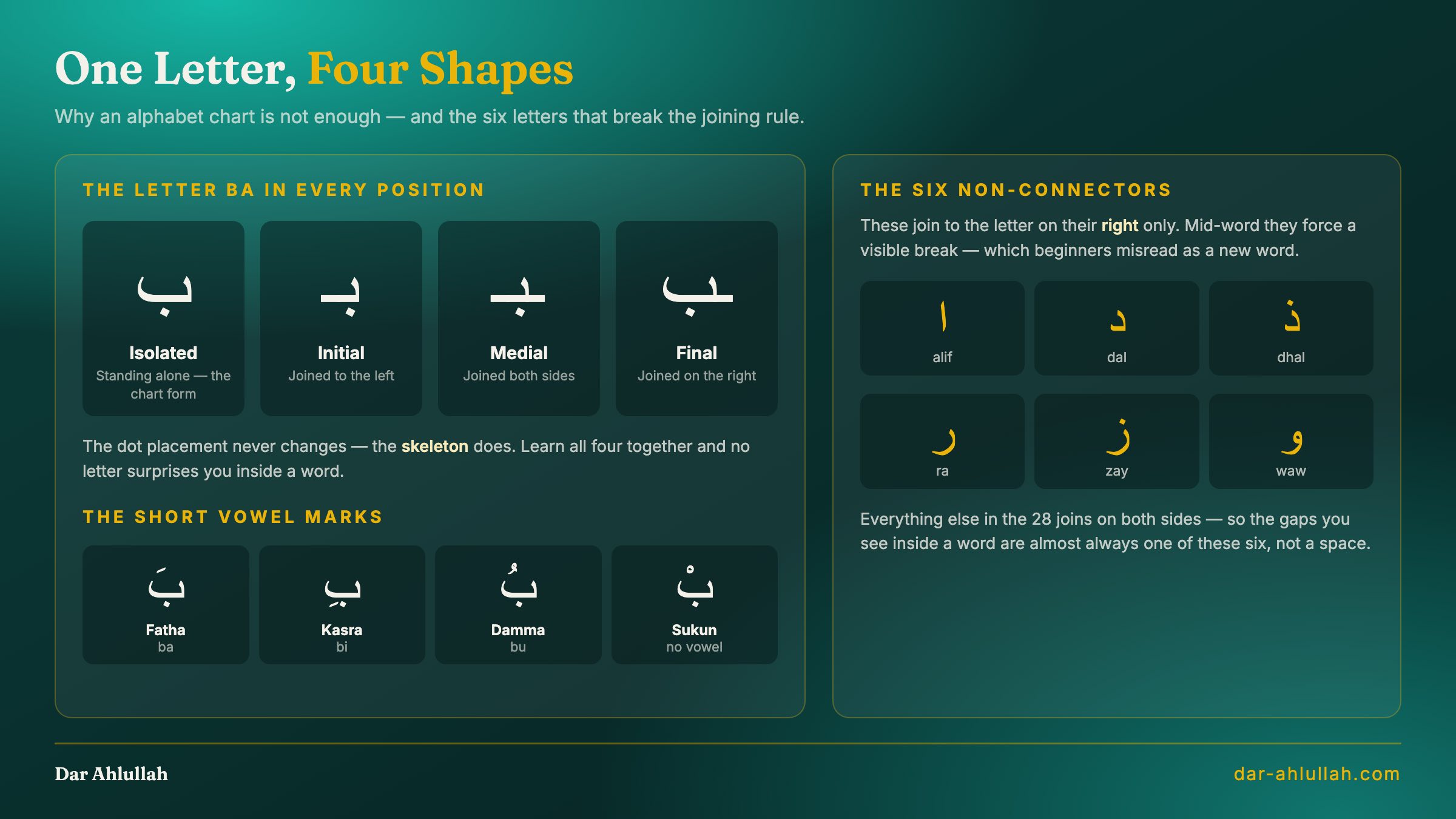
This is the section that closes the gap between the chart and the page. Arabic script is joined, and most letters take a different shape depending on their position in the word:
- Isolated — standing alone, the form printed on alphabet charts.
- Initial — at the start of a word, joined to the letter on its left.
- Medial — in the middle, joined on both sides, usually the most compressed shape.
- Final — at the end, joined on its right, usually the shape that keeps the full tail.
The compression is what surprises people. In its isolated form ه (ha) is a rounded loop; in the middle of a word it becomes a small angular figure that a beginner will not recognise as the same letter unless they were taught it as one. The same is true of ع, غ, ك and م. Learn all four forms together, from the first day, and none of them ever ambushes you.
There is one clean exception, and it is worth memorising as a set. Six letters — ا alif, د dal, ذ dhal, ر ra, ز zay and و waw — join only to the letter on their right, never to the one on their left. They are usually called non-connectors. When one appears mid-word it forces a visible break in the writing, which is why a single Arabic word can look like two or three separate chunks. Beginners routinely misread those breaks as word boundaries and lose the sentence. Knowing the six by heart fixes that permanently, and it is a five-minute piece of learning that pays back for years.
Two more shape facts belong here, because they account for a large share of the remaining confusion. When ل lam is followed by ا alif the pair is written as a single fused ligature, لا, which appears constantly and is not a separate letter. And the letter ة (ta marbuta, the “tied ta”) appears only at the end of a word, marks most feminine nouns, and is pronounced as a t when the word is joined to what follows and as a soft h when you stop on it.
4. The Marks That Make a Word Readable
The consonants are the skeleton; the diacritical marks are what turn them into pronounceable syllables. There are fewer of them than beginners fear, and the whole system can be learned in an afternoon and drilled over a fortnight.
| Mark | Where it sits | What it does |
|---|---|---|
| Fatha | Short stroke above the letter | Short a — بَ is ba |
| Kasra | Short stroke below the letter | Short i — بِ is bi |
| Damma | Small loop above the letter | Short u — بُ is bu |
| Sukun | Small circle above the letter | No vowel — the consonant closes the syllable |
| Shadda | Small w shape above the letter | Doubles the consonant, and it is held audibly |
| Tanween | The vowel mark written twice | Adds an -n sound: -an, -in, -un |
Alongside the short vowels sit the three long vowels, and this is where the abjad logic becomes visible. Long ā, ū and ī are written with the letters ا, و and ي respectively — the same letters that elsewhere act as consonants. A long vowel is roughly twice the length of its short counterpart, and the difference is not decorative: it changes meaning, and in Quranic recitation the precise lengthening is governed by the rules of tajweed.
Two marks deserve special attention because beginners consistently rush them. Shadda is not a spelling detail — the doubled consonant is genuinely held, and skipping it makes a word sound like a different word. And sukun is what produces closed syllables, which is what gives Arabic its rhythm; a reader who quietly inserts a vowel wherever a sukun appears will never sound like the recitation they are trying to imitate.
5. From Letters to Words: The Skill Nobody Drills
Between “I know the letters” and “I can read” there is a specific, trainable skill: joining. It is the ability to look at a cluster of joined shapes, split it into letters, attach each vowel, and produce syllables at speed. Almost nobody drills it deliberately, which is why so many learners plateau with a complete alphabet and no reading ability.
The traditional teaching method drills exactly this, and it is worth borrowing whether or not you study with a teacher. It moves in four stages:
- Letter plus vowel. Say every letter with each of the three short vowels in turn: ba, bi, bu; ta, ti, tu; tha, thi, thu. Out loud, all the way through the alphabet. This is the drill that makes vowel marks automatic.
- Two-letter combinations. Join pairs and read them: ba-ta, bi-ti, ta-ba. Nonsense syllables are fine and in fact preferable here, because they force decoding instead of recall.
- Three-letter words. Most Arabic roots are three consonants, so three-letter words are the natural next unit and thousands of real words sit at this length.
- Vowelled sentences. Short, fully vowelled lines read aloud, slowly, with someone or something correct to compare against.
Two practical notes. Write as you read: forming the letters by hand, right to left, in all four positions, embeds the shapes far faster than reading alone, and costs nothing but a notebook. And do the whole thing out loud. Silent reading of a script you cannot yet pronounce trains recognition without pronunciation, and the two have to grow together or the second never catches up.
6. When You Open a Mushaf, the Rules Shift Slightly
Most people learning this alphabet are learning it to read the Quran, so it helps to know in advance that a printed mushaf looks a little different from a modern Arabic book.
The Quran is conventionally printed in Uthmani orthography, which preserves an older spelling convention, rather than the modern imla’i spelling used for everyday Arabic. Some words carry an extra alif that is written but not pronounced, or a long vowel written with a small superscript mark rather than a full letter. None of this is a different alphabet, and none of it needs solving before you start — but it does mean that if you learn to read from a mushaf, a modern newspaper will spell a handful of familiar words in a slightly unfamiliar way, and vice versa. Neither is wrong.
A mushaf also carries markings a language textbook does not: stop signs indicating where a reciter may or should pause, sajdah markers, and in many editions colour-coding for tajweed rules. Those belong to recitation rather than to the alphabet, and they come after decoding is solid. When you reach that stage, our walkthrough of the tajweed rules for beginners picks up precisely where this article stops.
One more thing worth knowing early
The definite article in Arabic is ال (al-), and it behaves in one of two ways depending on the letter that follows it. Before the fourteen sun letters the l is not pronounced at all; the following consonant is doubled instead, which is why الشمس is read ash-shams, not al-shams. Before the other fourteen, the moon letters, the l is pronounced normally: القمر is al-qamar. You will meet this in the first line you ever read, so it is better learned now than discovered as a mistake later.
A Four-Week Plan You Can Actually Finish
This is a schedule, not a promise about your speed — people move at genuinely different rates, and a learner doing twenty focused minutes a day will beat one doing two hours a fortnight. The value of the sequence is the order, not the calendar. Adjust the pace and keep the order.
| Week | Focus | What “done” looks like |
|---|---|---|
| 1 | Shape families and their dots; write each letter by hand | You can name any isolated letter on sight and write it from memory |
| 2 | The four positional forms; the six non-connectors; the lam-alif ligature | You can point to where one letter ends and the next begins in a joined word |
| 3 | Short vowels, sukun, shadda, tanween, the three long vowels | You can read ba, bi, bu through the whole alphabet without hesitating |
| 4 | Joining drills into three-letter words, then short vowelled lines | You can sound out a vowelled line you have never seen, slowly, unaided |
A natural first text at the end of week four is Surah Al-Fatihah, which is short, fully vowelled, and almost certainly already familiar to your ear — a considerable advantage, because you can check your decoding against a recitation you know. Read a line, then listen to it, then read it again. That loop is the whole method.
Once the decoding is stable, meaning becomes the next frontier, and it arrives faster than most people expect: a modest core of high-frequency vocabulary covers a large share of the running words in the Quran. Our breakdown of the most common words in the Quran is the sensible next step after this one, and it is far more motivating once you can read the words rather than only recognise them.
Five Mistakes That Cost Beginners a Year
- Learning only the isolated forms. The most expensive mistake on this list. You finish the chart, open a book, and cannot read a word — then conclude you have a bad memory rather than an incomplete lesson.
- Leaning on transliteration. Latin-letter transliteration is a crutch that becomes a cage. It cannot represent ع, ح, ق or the emphatic letters, so every hour spent reading it trains a pronunciation you will later have to unlearn. Use it for a week if you must, then drop it.
- Skipping the vowel marks. Reading consonant skeletons and guessing the vowels works for a fluent reader with a large vocabulary. For a beginner it is guessing, and it hardens into a habit that is difficult to break.
- Reading silently. Recognition without production means you can identify letters but cannot say a word. The two skills have to be built together.
- Never being corrected. Self-study handles the shapes well. It handles the throat letters and the emphatics badly, because you cannot hear what you are doing wrong — and a mispronunciation practised for three months is much harder to fix than one caught on day three.
Teaching the Alphabet to Children
Children are not small adults on this particular subject, and the differences are worth knowing if you are teaching your own.
Young children usually acquire the sounds more accurately than adults, including the throat letters, and they generally do it by imitation rather than explanation. What they lack is the adult's ability to reason about a system: a six-year-old will not benefit from a table of shape families or a discussion of abjads. For them the route is short, frequent sessions — ten to fifteen minutes is plenty — heavy on repetition, writing and hearing correct pronunciation, and light on theory.
Sequence matters just as much, though. A child who learns the isolated letters and then meets joined text hits exactly the same wall an adult does. Introduce the joined forms and the vowel marks early, in tiny doses, and the wall never appears. If you are building this into a home routine alongside everything else, our guide on teaching your child Arabic at home covers the scheduling side in detail.
Where a Teacher Changes the Return
A fair assessment: roughly half of this material is genuinely self-teachable. The shapes, the dot families, the four positions, the six non-connectors, the vowel marks — all of that is visual, unambiguous, and available in any decent book or app. If your budget or schedule allows for nothing else, you can make real progress alone.
The other half is audio, and audio is where self-study quietly fails. You cannot hear yourself the way a listener hears you. The distinction between س and ص, between ت and ط, between ه and ح, is not one an English-speaking ear picks up unprompted, and a beginner reading aloud into an empty room has no way to know that their ق has been a k for two months. The correction has to come from outside, early, and repeatedly.
That is the case for a live teacher at this specific stage, and it is a narrow, honest one: not because the alphabet is difficult, but because pronunciation is the one part of it you cannot audit yourself. At Dar Ahlullah every learner starts with a free 30-minute assessment session — no card required — where a certified teacher listens to where you actually are and recommends a starting point. Teaching is billed at $9 per teaching hour with monthly plans, siblings receive a 20% discount, and you get a written report after every session so you can see exactly which letters were corrected and what to drill before the next one. If the fit is not right, we rematch you with another teacher at no extra cost. Book the free assessment and start with your pronunciation checked rather than guessed.
Questions People Ask Before They Start
How long does it take to learn to read Arabic?
Honestly, it depends on how often you practise rather than on how many weeks pass. Reading here means decoding — converting shapes and marks into correct sounds — not comprehension. Decoding is a mechanical skill and it responds to short daily practice far better than to long weekend sessions. Understanding what you read is a separate, longer project built on vocabulary and grammar.
Do I need to learn to write Arabic too?
You do not need calligraphy, but you should write. Forming the letters by hand in all four positions is the fastest way to internalise the differences between shapes that look similar in print, and it takes only a notebook and a few minutes a day.
Should I learn Modern Standard Arabic or Quranic Arabic first?
For the alphabet the question does not arise — the script, the letters, the vowel marks and the joining rules are identical for both. The choice only matters once you move to vocabulary and grammar, and we compare the two paths in detail in Quranic Arabic vs Modern Standard Arabic.
Is it too late to start as an adult?
No. Adults learn the visual system faster than children do, because they can reason about patterns rather than memorise by exposure. What adults lose is some pronunciation flexibility, and that is exactly the part a teacher can correct. Our guide to learning Quranic Arabic effectively is written for adult beginners throughout.
Can I skip the alphabet and learn from transliteration?
You can for a short while, and many people do, but it caps you. Transliteration cannot represent several Arabic consonants, so it teaches an approximation of the sound; and the moment you want to read the Quran directly, follow a class, or use a dictionary, you are back at the alphabet having lost the intervening months.
Why do the vowel marks disappear in most Arabic writing?
Because fluent readers do not need them: vocabulary and grammar make the vowels predictable from context. Beginners do need them, which is why beginner material, children's books and the Quran are printed fully vowelled. Read vowelled text until the vocabulary is there, and the transition happens on its own.
Conclusion: Decoding First, Fluency Later
The Arabic alphabet has a reputation for difficulty that the script itself does not deserve. Twenty-eight letters built on nine or so repeated skeletons, four positional forms, six letters that refuse to join leftwards, and a small set of marks that supply the vowels — that is the whole system. It is smaller than the English spelling system by a wide margin, and considerably more regular: once you know how a letter is written and marked, you know how it is pronounced.
What defeats beginners is sequence, not difficulty. Learn the shapes in families, learn all four forms from the start, learn the vowels alongside the letters rather than after them, read aloud every day, and get the sounds you cannot hear in yourself corrected by someone who can. Do that and the page stops being a wall of decoration and becomes text — slowly at first, then, one day sooner than you expect, without thinking about it at all.
Related articles
how to improve Arabic speaking skills
How to Improve Your Arabic Speaking Skills as an Adult
You can read Arabic fluently and still freeze when someone speaks to you. Reading is recognition; speaking is retrieval, and they are trained separately. Here is which Arabic to speak, and the five drills that work with nobody else in the room.
16 min read
Quranic Arabic vs Modern Standard Arabic
Quranic Arabic vs Modern Standard Arabic: Which Should You Learn First?
They share a grammar and diverge in vocabulary and register, so the choice is not which language to learn but which few thousand words you want to own at the end of year one. A decision guide by goal, not by prestige.
16 min read
Arabic for non-native speakers
Best Way to Learn Arabic for Non-Native Speakers
Discover the most effective ways to learn Arabic as a non-native speaker — the tips, resources and strategies that help you master it faster.
31 min read