
most common words in the Quran
The Most Common Words in the Quran: 13 Roots That Cover 10,000+ Words
Dar Ahlullah team 16 min read
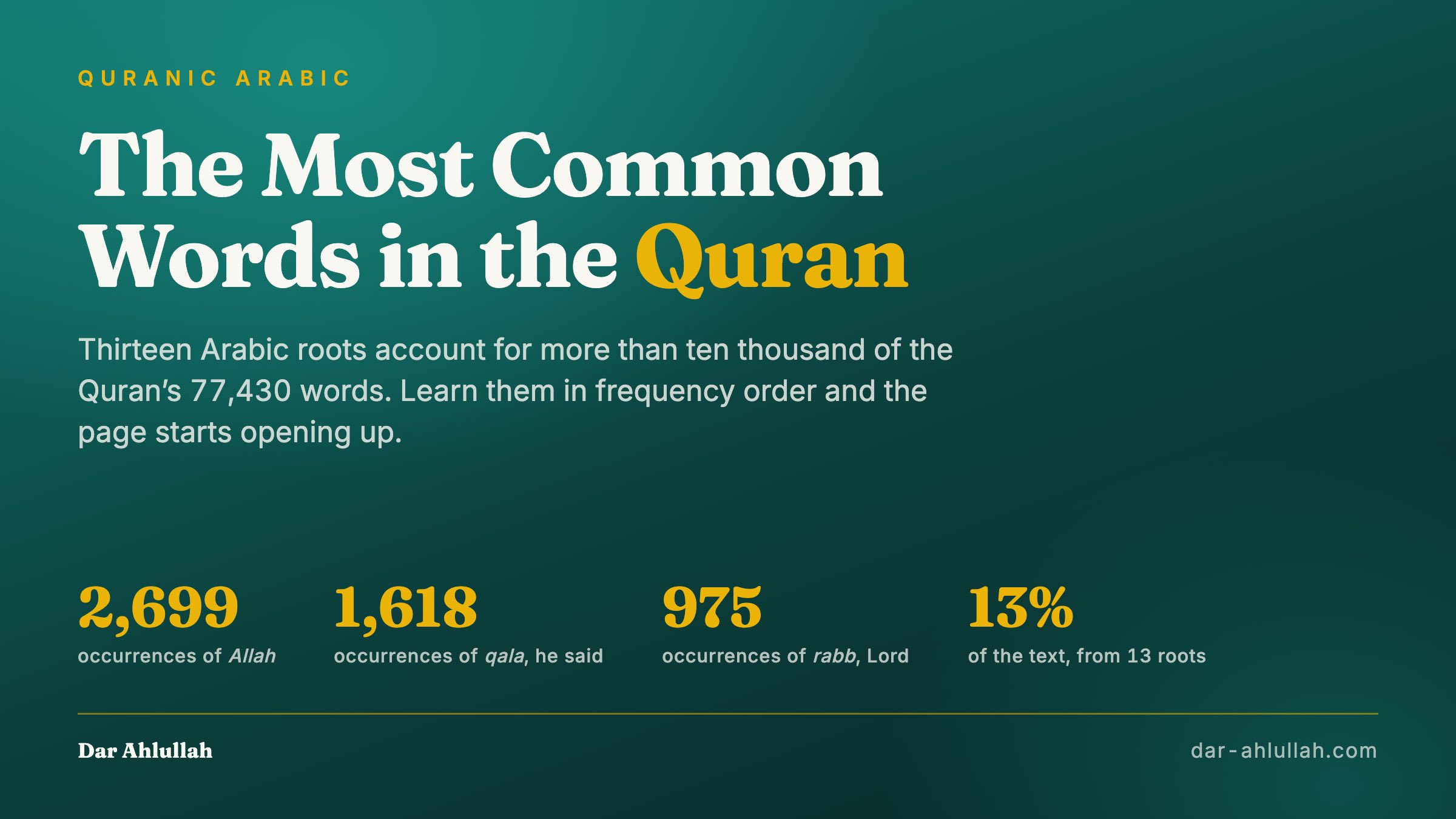
Table of Contents
- Introduction: You Already Know More Than You Think
- The Short Answer: Thirteen Roots, Ten Thousand Words
- Why Frequency Beats the Order in a Textbook
- The Thirteen Most Common Roots, Counted
- The Words That Beat All of These
- Start With Al-Fatiha, Not With a Word List
- Why Arabic Rewards Learning Roots Rather Than Words
- A Four-Week Plan for Someone With Forty Minutes a Week
- Where Frequency-First Stops Working
- Five Mistakes That Waste the First Six Months
- How We Teach Vocabulary at Dar Ahlullah
- FAQs About Quranic Vocabulary
- Conclusion: Start With What Repeats
Introduction: You Already Know More Than You Think
Most adults who can recite the Quran but not understand it assume the gap is enormous. The book has 114 chapters and, by the Quranic Arabic Corpus’s count, 6,236 numbered verses. Somewhere in there is a vocabulary that feels like it must run to tens of thousands of words, and the obvious conclusion is that understanding what you recite is a project for someone with more time than you have.
That conclusion is wrong, and it is wrong for a boring statistical reason. Language is not distributed evenly. In every language a small set of words does most of the work, and the Quran is no exception — it is a text of roughly 77,430 words of Quranic Arabic, but those words are drawn from a much smaller set of roots, and a handful of those roots appear on almost every page.
This guide is about the most common words in the Quran: which ones they actually are, how often each one really occurs, and how to learn them in an order that pays you back fastest. Every count below comes from the Quranic Arabic Corpus, a morphologically annotated corpus of the Quran maintained at the University of Leeds, and every one is linked so you can check it yourself. Nothing here is a memorable-sounding round number.
If you are earlier in the journey and still deciding what kind of Arabic to study at all, our complete guide to Arabic for non-native speakers is the better starting point, and our comparison of Quranic Arabic and Modern Standard Arabic explains why the two are not the same course. Come back here when you have decided the Quran is the target.
The Short Answer: Thirteen Roots, Ten Thousand Words
Add up the thirteen roots listed further down this page and they account for 10,317 occurrences in the Quran. Against a total of 77,430 words, that is a little over 13% of the entire text from thirteen units of vocabulary.
Put differently: on an average page of the Quran, roughly one word in eight is built from one of thirteen roots you could learn properly in a fortnight. Learn a few dozen more and the density climbs sharply, because frequency in any natural text falls away steeply after the top of the list rather than gently.
That is the whole argument for a frequency-first approach. It is not that vocabulary is all you need — it is not, and the section on limits below is blunt about that. It is that the first hundred words you learn are worth vastly more than the second hundred, and the order in which you meet them is therefore a decision worth making deliberately instead of leaving to whichever chapter your textbook opens with.
Why Frequency Beats the Order in a Textbook
A conventional Arabic course introduces vocabulary by theme: the classroom, the family, the market, the airport. That is a sensible design for someone moving to Cairo. It is a poor design for someone whose goal is to follow the meaning of what they recite in salah, because the Quran does not talk about airports and does talk, constantly, about knowledge, mercy, belief, the earth, the heavens and the Day.
The mismatch is not small. A learner three months into a general Arabic course can order a coffee and still not recognise rabb — a word that occurs 975 times in the book they read every day. A learner three months into a frequency-first approach cannot order the coffee but recognises perhaps a fifth of the words in most short surahs. Neither is better in the abstract. They are optimised for different outcomes, and the mistake is choosing the first while wanting the second.
There is also a motivational argument, and it is not a soft one. Frequency-first study is self-reinforcing: every word you learn is a word you then meet again within days, because that is what frequency means. The reinforcement is free and it arrives on schedule. Thematic vocabulary decays quietly instead, because nothing in your week happens to contain it.
The Thirteen Most Common Roots, Counted
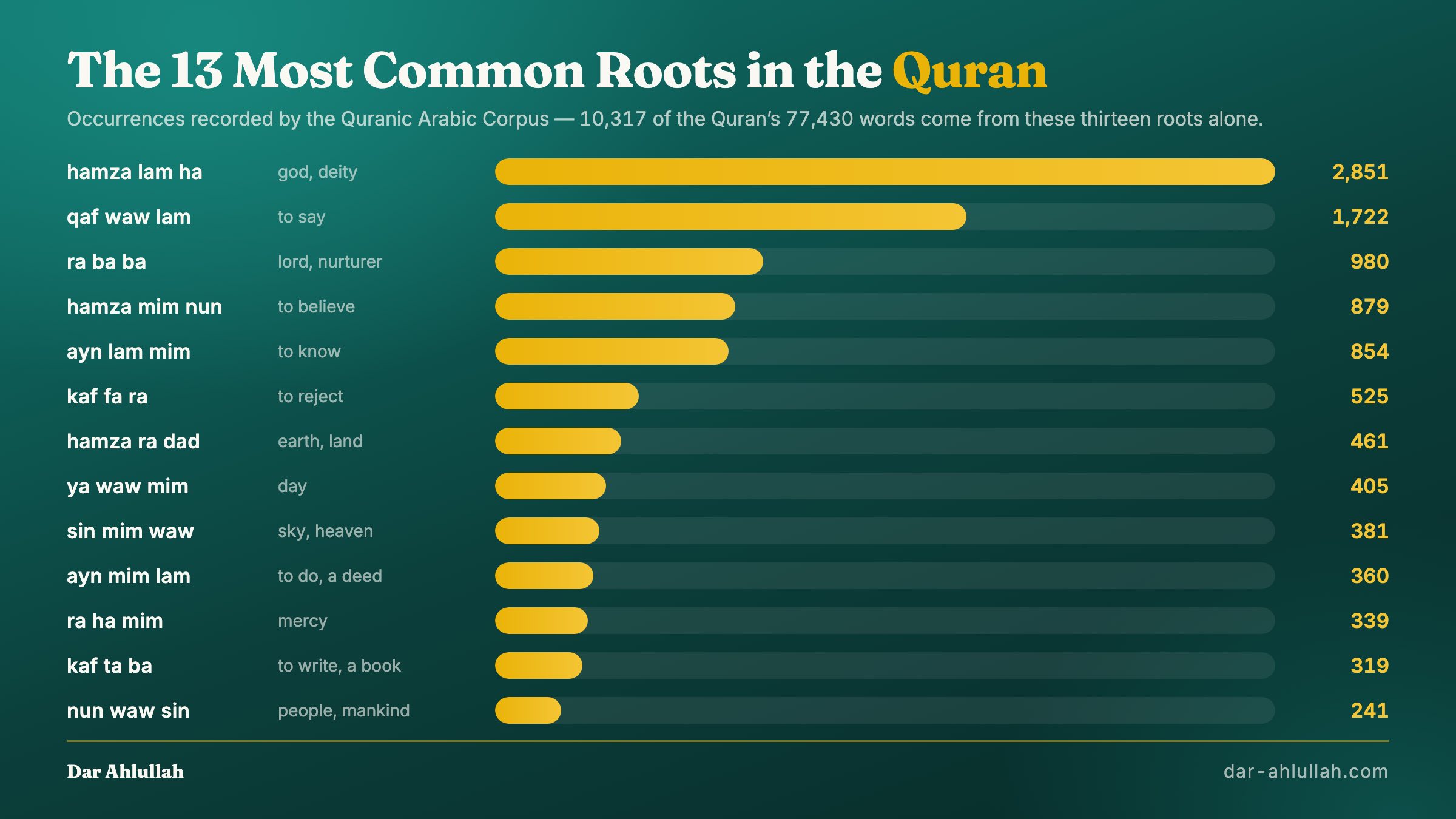
The table below lists thirteen of the highest-frequency roots in the Quran with the exact counts recorded by the Quranic Arabic Corpus. Each root links to its dictionary entry, where you can see every derived form and every verse it occurs in.
| Root | Core meaning | Occurrences | Most common form |
|---|---|---|---|
| أ ل ه — hamza lam ha | god, deity | 2,851 | Allah (2,699); ilah, a god (147) |
| ق و ل — qaf waw lam | to say | 1,722 | qala, he said (1,618) |
| ر ب ب — ra ba ba | lord, master, one who nurtures | 980 | rabb, Lord (975) |
| أ م ن — hamza mim nun | to believe; to be secure | 879 | amana, he believed (537); mu’min, believer (202) |
| ع ل م — ayn lam mim | to know | 854 | alima, he knew (382); alim, all-knowing (163) |
| ك ف ر — kaf fa ra | to reject, to disbelieve | 525 | kafara, he disbelieved (289); kafirun (129) |
| أ ر ض — hamza ra dad | earth, land | 461 | ard, the earth (all 461) |
| ي و م — ya waw mim | day | 405 | yawm, day (all 405) |
| س م و — sin mim waw | height, sky, heaven | 381 | sama, heaven (310) |
| ع م ل — ayn mim lam | to do, to work; a deed | 360 | amila, he did (276); amal, deed (71) |
| ر ح م — ra ha mim | mercy, compassion | 339 | rahim (116); rahmat (114); rahman (57) |
| ك ت ب — kaf ta ba | to write; a book, a decree | 319 | kitab, book (260) |
| ن و س — nun waw sin | people, mankind | 241 | nas, mankind (all 241) |
Two things in that table are worth pausing on, because they change how you should study rather than merely what you should study.
The first is the shape of the distribution. The top root occurs almost twelve times as often as the thirteenth. Frequency lists are always this lopsided, and it means the payoff for learning word number 5 is enormously larger than the payoff for learning word number 200. Spend your first sessions at the top of the list and do not feel behind for still being there in week three.
The second is that several of these roots are not single words but whole semantic families. Amana gives you the verb to believe, the noun iman for faith, the participle mu’min for a believer, and the divine name al-Mu’min — 879 occurrences across seventeen derived forms from one three-letter skeleton. You are not learning 879 things. You are learning one thing that shows up 879 times wearing different clothes.
The Words That Beat All of These
An honest article has to say this plainly: the roots above are the most frequent roots, and the corpus dictionary is organised by root. They are not the most frequent words in the Quran. That title belongs to the function words — the prepositions, pronouns, particles and conjunctions that carry no root entry because they are grammatical machinery rather than vocabulary.
Words like مِن (min, from), فِي (fi, in), عَلَى (ala, upon), إِنَّ (inna, indeed), لَا (la, not), مَا (ma, what / not), الَّذِينَ (alladhina, those who) and the attached pronouns -hu, -hum, -ka and -na outnumber every content word in the book. They are also, mercifully, a closed set: there are a few dozen of them and no more are being invented.
This matters practically because function words are what turn recognised vocabulary into understood sentences. You can know rabb, alamin and hamd and still not know that al-hamdu lillahi rabbi’l-alamin means “all praise belongs to Allah, Lord of the worlds” — because the meaning is carried by the li- prefix and the grammatical relationship between the nouns, neither of which is vocabulary.
The workable division of effort is therefore: learn the closed set of particles and pronouns as one short, finite project early on, and let the open-ended content vocabulary accumulate afterwards in frequency order. Most self-taught learners do the reverse, build a large passive word list, and stay stuck at recognising nouns in a sentence they cannot parse.
Start With Al-Fatiha, Not With a Word List
There is a better place to start than any list, including the one above: the passage you already recite more than any other.
Surah al-Fatiha is seven verses and fewer than thirty words. In the five obligatory prayers there are seventeen rak’ahs, and al-Fatiha is recited in every one of them. Whatever else is true about your Arabic, you say those thirty words seventeen times a day, every day, for the rest of your life.
Now look at what is in them. Allah, from the most frequent root in the Quran. Rabb, the third. Rahman and rahim, both from the mercy root. Yawm, day. Alladhina, one of the highest-frequency function words in the book. Nabudu and nastain, first-person plural verbs that teach you the na- prefix you will meet thousands of times. Six of the thirteen roots in the table above appear in the first surah, and the grammatical patterns in those seven verses recur across the whole Quran.
So the first assignment is not a deck of flashcards. It is: understand al-Fatiha word by word, to the point where you know what each word means as you say it in prayer rather than reconstructing the translation afterwards. That is a week of work, it is immediately usable seventeen times a day, and it front-loads a disproportionate share of the highest-frequency vocabulary in the book.
Then continue the same way into the short surahs of the last juz’, which most people already have memorised. Al-Ikhlas, al-Falaq and an-Nas are fifteen verses between them and contain ahad, samad, rabb, nas, malik, ilah and sharr — more high-frequency vocabulary per minute of study than any beginner textbook chapter will give you, in text you can already pronounce without effort.
Why Arabic Rewards Learning Roots Rather Than Words
Arabic builds almost its entire vocabulary from three-consonant roots poured into fixed patterns. The root carries a field of meaning; the pattern tells you what kind of word it has become.
Take ك ت ب (k-t-b), which occurs 319 times and has to do with writing. Kataba is “he wrote”. Kitab is a book. Maktub is “written” or “decreed”. Katib is a writer or scribe. Each of those is a different pattern applied to the same three letters, and the patterns are the same patterns everywhere in the language. Once you know that fail is the doer of an action, you get katib (writer), alim (knower), amil (doer), kafir (rejecter) and several hundred more for the price of one rule.
This is why root-based study compounds in a way that word-based study does not. Learn 100 words in a European language and you know 100 words. Learn 100 Arabic roots along with the six or seven commonest patterns and you can recognise, or at least guess accurately at, several times that many actual words in the text — including ones you have never met.
The practical version: whenever you learn a new Quranic word, spend one extra minute identifying its root and asking what else you already know from it. That habit turns isolated vocabulary into a network, and networks survive in memory in a way that lists do not. Our guide to learning Quranic Arabic effectively goes through the pattern system in more detail than there is room for here.
A Four-Week Plan for Someone With Forty Minutes a Week
Most adults doing this are doing it around a job and a family. The plan below assumes two twenty-minute sessions a week plus the recitation you already do, which is a realistic budget rather than an aspirational one.
| Week | Focus | What “done” looks like |
|---|---|---|
| 1 | Al-Fatiha, word by word | You can say what every word in the surah means, in order, without looking. You notice the meaning while praying at least once. |
| 2 | The closed set: min, fi, ila, ala, an, bi-, li-, wa-, fa-, inna, la, ma, man, alladhi, alladhina | You can spot them instantly in an unfamiliar verse and say what each one does, even when you do not know the words around them. |
| 3 | Attached pronouns (-hu, -ha, -hum, -ka, -kum, -i, -na) and the top five roots from the table | You can break rabbukum, rabbi, rabbana and rabbihim into root plus ending without hesitating. |
| 4 | Al-Ikhlas, al-Falaq and an-Nas, applying weeks 1–3 | You read all three with comprehension rather than recall, and you can name the root of most words in them. |
Three rules make this work. Study inside real verses, never in isolation — a word learned in Ayat al-Kursi is anchored to a context you will meet again, and a word learned on a flashcard is anchored to nothing. Review in salah, which is free repetition you are already performing. And keep the daily dose small: five new words absorbed properly beat fifty skimmed, and the difference shows up in month three rather than week one.
What this plan will not do is teach you to produce Arabic. That is a deliberate omission. Reading comprehension and speaking are different skills with different training, and mixing them at the start doubles the workload for a goal most Quran learners do not have. Our article on study habits for non-native Arabic learners covers the wider case for anyone who does want to speak as well.
Where Frequency-First Stops Working
Frequency is an excellent way to choose the first few hundred words and a poor way to run the whole project. There are three points where it stops being the right tool, and knowing them in advance saves a plateau later.
Vocabulary is not grammar
Knowing every word in a verse does not mean understanding the verse. Arabic marks the role of a noun with case endings, and a shift from -u to -a can change who is doing what to whom. You can go a long way on vocabulary alone, but there is a ceiling, and the way through it is a structured introduction to nahw rather than another thousand words.
Frequency says nothing about importance
Some of the most consequential words in the Quran are rare. Terms tied to a single ruling, a single story or a single theological point may occur twice in the whole book and matter enormously in those two places. A frequency list is a study sequence, not a ranking of significance, and treating it as the latter produces a confident reader with real gaps.
Meaning is not always the dictionary entry
Taqwa is routinely translated “fear of God” and routinely mistaught by that translation; the root has to do with guarding and shielding oneself. Kufr is broader than the English “disbelief” and carries a sense of covering over something known. Sabr is not quite “patience”. These gaps between an Arabic word and its usual English gloss are exactly where a teacher earns their fee, because a dictionary will not warn you that you have misunderstood — you will simply carry the wrong meaning forward for years without anything contradicting it.
Five Mistakes That Waste the First Six Months
- Learning words with no verse attached. A word list is a list of things you will recognise and not understand. Anchor every word to a verse you can recite.
- Starting with grammar theory. A term of formal nahw before you have any vocabulary to apply it to is the fastest route to quitting. Roughly a hundred high-frequency words first, then grammar, then more vocabulary.
- Reading the translation instead of the Arabic. Translations are useful and they are also a crutch that quietly removes the need to process the Arabic at all. Read the verse first, guess, then check.
- Chasing breadth too early. Understanding al-Fatiha and the last ten surahs completely is worth more than understanding a scattered 10% of the whole Quran, because the first gives you a foundation and the second gives you a plateau.
- Studying silently. The Quran is an oral text and your recitation is already daily practice. Say the words aloud as you learn them and the two activities reinforce each other instead of running in parallel.
How We Teach Vocabulary at Dar Ahlullah
Our Arabic and Quran sessions are one-to-one, sixty or thirty minutes, with the same native Arabic-speaking teacher each week rather than whoever is free. For a student whose goal is understanding what they recite, that continuity is the mechanism: the teacher knows which roots you met three weeks ago and can build the next verse around them instead of restarting.
Every session ends with a written report — what was covered, what was corrected, what to practise before next time. For vocabulary work that report doubles as your review list, which removes the main reason self-study collapses: nobody remembers what they were supposed to revise.
Our rate is $9 per teaching hour, and every plan is that same number: Starter is $36 a month for eight thirty-minute sessions, Committed is $70 for eight full hours, and Hifz Intensive is $102 for twelve. Siblings get 20%. You can pause or switch plans at any time, and if the teacher is not the right fit we rematch you at no cost. The full breakdown is on our pricing page.
The starting point is a free thirty-minute assessment rather than a demonstration lesson: the teacher works out what you can already read, what you already understand, and where in the sequence above you should actually begin. No card is required to book it, and you get the assessment in writing whether or not you continue.
FAQs About Quranic Vocabulary
How many words do I need to understand the Quran?
There is no single honest number, because “understand” covers everything from following the gist of a familiar surah to reading an unfamiliar page unaided. What can be said precisely is the shape of the curve: the thirteen roots in the table above cover 10,317 of the Quran’s 77,430 words on their own, and the return on each additional word falls steadily after that. Learn the top few hundred and most short surahs become largely transparent; unfamiliar long passages take considerably more.
What is the single most common word in the Quran?
Among content words, the proper noun Allah, which the Quranic Arabic Corpus records 2,699 times, from a root occurring 2,851 times in total. Counting every word rather than only content words, the short function words — min, fi, la, ma, the attached pronouns — are more frequent still.
Should I learn Quranic Arabic or Modern Standard Arabic first?
If the goal is understanding the Quran, start with Quranic Arabic; the vocabulary you need is different and the frequency list above is why. The two overlap heavily in grammar and diverge in vocabulary, which we go through properly in our comparison of Quranic Arabic and Modern Standard Arabic.
Do I need to know Arabic grammar to use a frequency list?
Not to begin. You can get through the first few hundred words and al-Fatiha with no formal grammar at all, and that is the right order. But grammar is not optional forever — without it you will recognise words in a verse and still not know how they relate to each other, which is a genuine ceiling rather than a slow patch.
Is memorising the Quran a good way to learn the vocabulary?
It is an excellent way, provided you memorise with meaning rather than by sound alone. Memorising a page whose words you understand fixes both at once and makes the review far more durable. Memorising phonetically produces fluent recitation and no comprehension, which is the outcome most adults are trying to correct in the first place. Our guide to online hifz covers the revision side of that.
Can I do this from an app instead of a teacher?
Partly. Apps are good at spaced repetition and at telling you what a word means. They are poor at telling you that your understanding of a word is subtly wrong, that your pronunciation has drifted, or that you are ready to move on — and those are the judgements that determine whether six months of study produces progress or a plateau. Use both if you like; do not expect the app to do the diagnosis.
How long before I notice a difference in salah?
For al-Fatiha specifically, days rather than weeks — it is thirty words and you recite it seventeen times a day, so the repetition does most of the work for you. Beyond that it depends on how much of the Quran you have memorised and how regularly you study. The honest answer is that the first noticeable change is usually in a passage you already knew by heart, not in new material.
Conclusion: Start With What Repeats
The gap between reciting the Quran and understanding it is real, and it is much narrower than it looks from the outside. The text is 77,430 words, but they are not 77,430 different words — thirteen roots alone account for more than ten thousand of them, and the words you meet most often are the ones you can learn first.
So begin where the repetition already is. Understand al-Fatiha completely. Learn the particles and pronouns as one finite project. Take the top of the frequency list rather than the front of a textbook, always inside verses you can already recite, and let salah do your revision for you. That sequence is short enough to start this week and it puts the payoff in the first month rather than the first year.
If you would like someone to work through it with you and tell you honestly where to start, our thirty-minute assessment is free and there is nothing to cancel afterwards.
Related articles
how to improve Arabic speaking skills
How to Improve Your Arabic Speaking Skills as an Adult
You can read Arabic fluently and still freeze when someone speaks to you. Reading is recognition; speaking is retrieval, and they are trained separately. Here is which Arabic to speak, and the five drills that work with nobody else in the room.
16 min read
Quranic Arabic vs Modern Standard Arabic
Quranic Arabic vs Modern Standard Arabic: Which Should You Learn First?
They share a grammar and diverge in vocabulary and register, so the choice is not which language to learn but which few thousand words you want to own at the end of year one. A decision guide by goal, not by prestige.
16 min read
Arabic alphabet for beginners
Arabic Alphabet for Beginners: How to Read the Script
An alphabet chart shows you 28 isolated shapes. A page of Arabic shows you the same letters joined, compressed and stripped of their vowels. This is the route across that gap — shape families, four forms, six non-connectors and the marks that make a word readable.
17 min read