
Tajweed rules for beginners
Tajweed Rules for Beginners: A Plain-English Guide
Dar Ahlullah team 14 min read
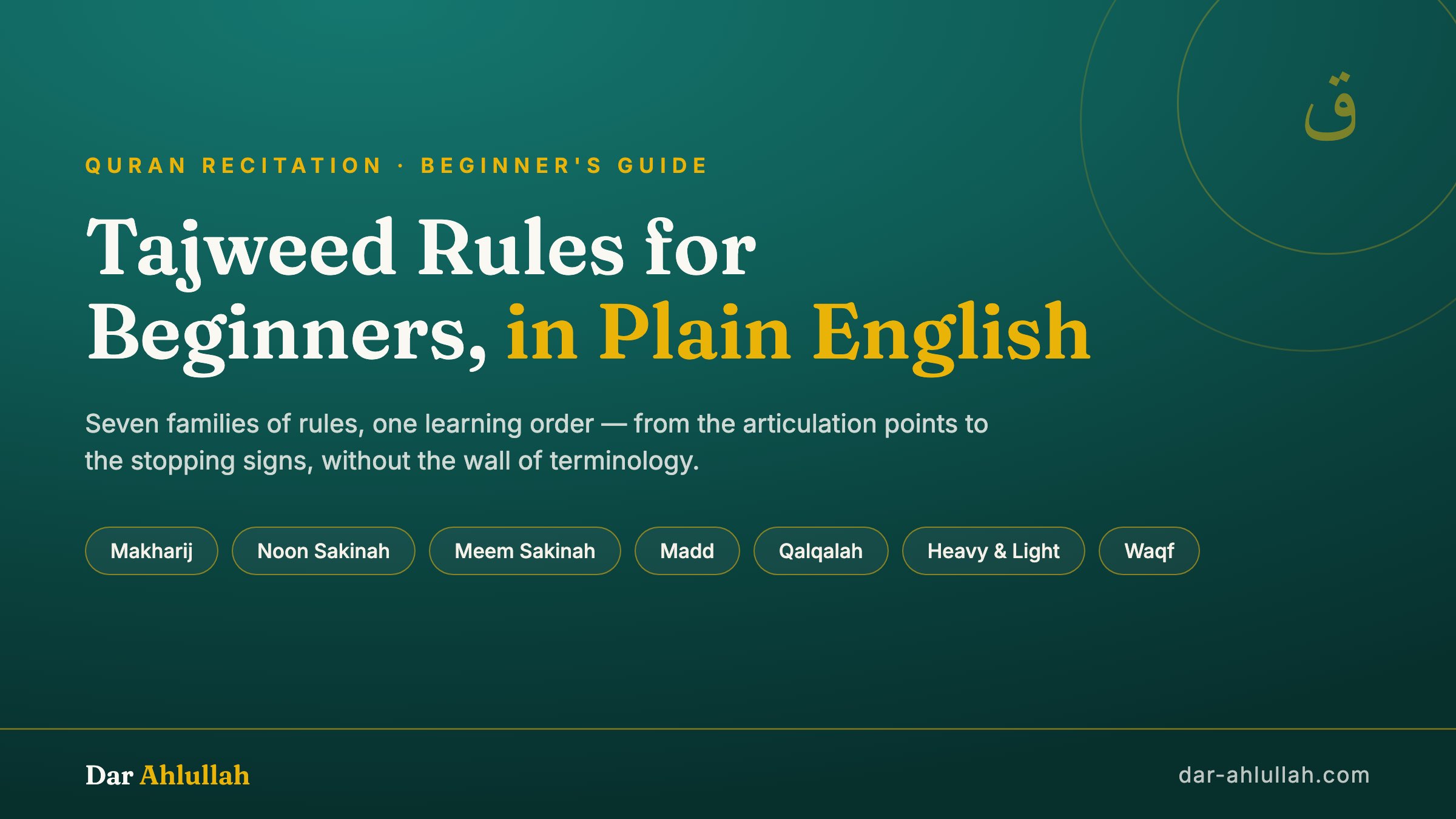
Table of Contents
- Introduction: Why Tajweed Feels Harder Than It Is
- The Short Answer: Seven Rule Families, One Learning Order
- Before the Rules: Makharij, or Where Each Letter Lives
- Noon Sakinah and Tanween: The Four Rules You Meet in Every Verse
- Meem Sakinah: Three Rules, One Pair of Lips
- Madd: How Long to Hold a Vowel
- Qalqalah: The Five Bouncing Letters
- Tafkheem and Tarqeeq: Heavy and Light Letters
- Waqf: Where to Stop and Where Not To
- The Learning Order That Actually Works
- The Beginner Mistakes Worth Fixing First
- Why You Cannot Hear Your Own Mistakes
- FAQs About Tajweed Rules for Beginners
- Conclusion: One Rule at a Time, Out Loud
Introduction: Why Tajweed Feels Harder Than It Is
Open any traditional Tajweed textbook and you meet a wall of terminology before you meet a single verse: izhar, idgham, iqlab, ikhfa, ghunnah, qalqalah, madd munfasil, madd muttasil. It reads like a syllabus for a linguistics degree, and for many beginners that first page is where the project quietly ends.
Here is the reframe that makes it manageable. Tajweed is not hundreds of rules. It is roughly seven families of rules, each family answers one plain question — what do I do when a noon has no vowel? how long do I stretch this sound? where may I pause? — and you never need to learn them all at once. The Quran itself describes the goal in one line: “and recite the Quran with measured recitation” (Surah Al-Muzzammil, 73:4). Everything in this guide is machinery in service of that single instruction: slow, deliberate, correct.
It is also worth saying at the start that struggling is not failure. The Prophet ﷺ said that the one who is skilled in reciting the Quran will be with the noble angels, and that the one who recites with difficulty, stumbling through it, receives two rewards — the hadith is in Sahih Muslim. The reward structure is built for beginners. You are not late; you are exactly where the system expects you to be.
This article is a spoke of our complete guide to learning Quran online, and it does one job: explain each rule family in plain English, give you the learning order that works, and tell you honestly which parts you can absorb from a page and which parts require a listener.
The Short Answer: Seven Rule Families, One Learning Order
If you keep only one section of this guide, keep this one.
- Makharij — the articulation points. Where in the mouth and throat each of the 28 letters is produced. This is the foundation everything else stands on.
- Noon sakinah and tanween — four rules (izhar, idgham, iqlab, ikhfa) that govern what happens to an unvowelled noon sound. You will apply these in almost every verse you ever read.
- Meem sakinah — the same idea for the letter meem, with three rules instead of four.
- Madd — elongation. How many counts to hold a long vowel, from the default two up to six.
- Qalqalah — five letters that get a slight echoing bounce when they carry no vowel.
- Tafkheem and tarqeeq — which letters are pronounced heavy (with a full mouth) and which light.
- Waqf — stopping. The small signs above the script that tell you where a pause is required, allowed, or discouraged.
Learn them in that order, one family at a time, applying each to real verses before moving on. A beginner working steadily through this sequence with a teacher is applying the core rules within months, not years — and the order matters more than the pace.
Before the Rules: Makharij, or Where Each Letter Lives
Every Tajweed rule assumes you can produce the 28 letters from the right place, so this is where honest study begins. The classical framework, standardised by the scholar Ibn al-Jazari, counts seventeen articulation points distributed across five regions: the empty space of the mouth and throat, the throat itself, the tongue, the lips, and the nasal passage.
You do not need to memorise the seventeen points as a list. You need to solve, one at a time, the letters that do not exist in English — and there are only a handful. The usual troublemakers for English speakers are:
- ع (‘ayn) and ح (haa) — produced from the middle of the throat, with no English equivalent. The most common substitute errors are a plain vowel for ‘ayn and an ordinary h for haa.
- خ (khaa) and غ (ghayn) — the upper throat. Khaa is the rasp in Scottish “loch”; ghayn is its voiced twin, close to a French r.
- ق (qaaf) — a k produced much deeper, from the very back of the tongue against the soft palate.
- ض (daad), ط (taa), ظ (dhaa), ص (saad) — the emphatic letters, made with the tongue raised so the whole sound darkens. Substituting their light twins (d, t, dh, s) is the single most common pronunciation fault, and it can change meaning.
That last point is why makharij cannot be skipped: Arabic is full of word pairs separated by exactly one articulation point. The classic example is qalb with qaaf, meaning heart, and kalb with kaaf, meaning dog. Getting the letter’s home wrong does not make your recitation accented — it makes it a different word.
Work on makharij with a mirror, exaggerating at first, and expect it to feel physically strange for a few weeks. These are muscle positions English never asks for, and they train exactly the way any physical skill does: slowly, then suddenly.
Noon Sakinah and Tanween: The Four Rules You Meet in Every Verse
This is the family most books teach first after the letters, because it pays for itself immediately. A noon sakinah is the letter noon carrying no vowel; tanween is the doubled end-vowel (-an, -in, -un) that produces the same n sound at the end of a word. The question the family answers: what happens to that n sound when it collides with the next letter?
The answer depends entirely on which letter comes next, and there are exactly four outcomes:
| Rule | Triggered by | What you do with the n |
|---|---|---|
| Izhar (clarity) | The six throat letters: ء ه ع ح غ خ | Pronounce it plainly and move on. No nasalisation, no lingering. |
| Idgham (merging) | The six letters of يرملون | The n disappears into the next letter. With ي ن م و the merge keeps a nasal hum (ghunnah); with ل and ر it is clean. |
| Iqlab (conversion) | The letter ب (baa) only | The n turns into a light m, hummed through the nose for two counts before the baa. |
| Ikhfa (hiding) | The remaining fifteen letters | The n is neither fully pronounced nor fully merged: the tongue hovers off its point and the sound becomes a two-count nasal hum coloured by the coming letter. |
Two practical notes. First, the nasal hum — ghunnah — is a sound you hold for roughly two counts, and its length is the thing beginners most often get wrong: they either skip it entirely or stretch it into a drone. Second, you do not memorise fifteen ikhfa letters; you memorise the six izhar letters and the shorthand word for the idgham six, remember that baa stands alone, and everything else is ikhfa by elimination.
Read any page of the mushaf and you will meet this family a dozen times. That is why it is taught early: it converts directly into audible improvement within the first weeks.
Meem Sakinah: Three Rules, One Pair of Lips
Once the noon family is in place, meem sakinah takes an afternoon to understand, because it is the same logic with fewer cases. A meem with no vowel meets the next letter, and one of three things happens:
- Idgham shafawi — the next letter is another meem: the two merge into one pressed meem with a two-count ghunnah.
- Ikhfa shafawi — the next letter is baa: the lips close lightly on the meem and the sound is hummed rather than released.
- Izhar shafawi — any other letter: pronounce the meem clearly and move on.
Shafawi just means “of the lips”, which is where every meem is made. The only genuinely new skill in this family is restraint: beginners tend to pop the meem before waw and faa, precisely the places the rule asks for extra clarity without an explosive release.
Madd: How Long to Hold a Vowel
Madd is the family that gives recitation its shape and its music, and it answers a question English never asks precisely: exactly how long is a long vowel?
The unit is the harakah, one count — roughly the time it takes to open or close a finger at your natural reciting pace. The default is simple: the three long vowels (alif, and the vowel forms of waw and yaa) are held for two counts. This is madd tabee’i, natural elongation, and it needs no sign in the text.
The longer madds happen when something interrupts the long vowel:
- A hamza follows in the same word (madd muttasil): stretch to four or five counts. The mushaf marks it with a small wavy line over the vowel.
- A hamza begins the next word (madd munfasil): commonly stretched to four or five counts in the Hafs recitation most of the world reads.
- A permanent sukoon or doubled letter follows (madd lazim): the full six counts. This is the long, unmistakable stretch in words like wa-lad-daaalleen at the end of Al-Fatihah.
- You are stopping on the word (madd ‘arid): the pause creates a temporary sukoon, and you may hold two, four, or six counts — consistency being the rule: whichever length you choose, keep it for the rest of that recitation.
Beginners overthink madd because the names are intimidating, but in practice your ear does most of the work: within a few weeks of listening to a careful reciter and counting along, the two-count default and the six-count lazim become automatic, and the four-to-five band covers nearly everything else.
Qalqalah: The Five Bouncing Letters
Five letters — ق ط ب ج د, collected in the mnemonic qutb jad — carry a property called qalqalah: when one of them appears with no vowel, it is released with a slight echoing bounce instead of being held closed. Say the English word “stopped” and notice how the p can either stay sealed or pop slightly on release; qalqalah is a controlled version of that pop.
The bounce comes in grades. Mid-word, it is light. At the end of a verse where you stop, it is stronger — and strongest of all when the stopped letter is doubled, as in the final word of Surah Al-Masad. The most common beginner fault is adding a vowel after the bounce, turning a crisp qad into qad-uh. The bounce is an echo, not a syllable.
Tafkheem and Tarqeeq: Heavy and Light Letters
Every Arabic letter is pronounced either heavy — with the back of the tongue raised, filling the mouth, darkening the vowel — or light. Seven letters are always heavy: خ ص ض غ ط ق ظ, gathered in the mnemonic khussa daghtin qidh. Most of the rest are always light. Two letters switch by context, and they are the two this section exists for:
- Raa is heavy when it carries a fatha or damma (or follows one), and light when it carries a kasra. The word rabb opens heavy; the word rizq opens light.
- The laam of the word Allah is heavy after a fatha or damma — qul huwa-llahu — and light after a kasra, as in bismillah.
Heaviness is the part of Tajweed most clearly learned by ear rather than by chart. Recordings help; a teacher repeating the minimal pairs back to you helps far more, because the difference between a heavy and a light raa is felt in the tongue before it is heard in the room.
Waqf: Where to Stop and Where Not To
The final family is not about sound at all but about breath: where you may pause. Arabic sentences carry meaning across verse boundaries, and stopping in the wrong place can strand half a sentence — so the mushaf is annotated with small conventional signs above the line:
| Sign | Name | What it asks of you |
|---|---|---|
| م | Lazim | Stop. Continuing would distort the meaning. |
| لا | Laa | Do not stop here (unless a verse ends; stopping on verse ends is always acceptable). |
| ج | Jaa’iz | Stopping and continuing are equally fine. Breathe if you need to. |
| صلى | Sali | Continuing is preferred, stopping permitted. |
| قلى | Qali | Stopping is preferred, continuing permitted. |
| ∴ … ∴ | Mu’anaqah | Twin sign: stop at one of the pair, never both. |
Waqf is deliberately last in the learning order. It assumes you can already read fluently enough to plan a breath ahead, and it rewards a growing sense of what the verses mean — which is also the point in most students’ journey where Quranic vocabulary starts to matter. Our guide to the most common words in the Quran pairs naturally with this stage.
The Learning Order That Actually Works
The families above were presented in their learning order, and the order is not arbitrary. Each stage assumes the one before it: there is no point polishing noon rules with letters produced from the wrong place, and no point drilling waqf signs before you can read a line without spelling it out.
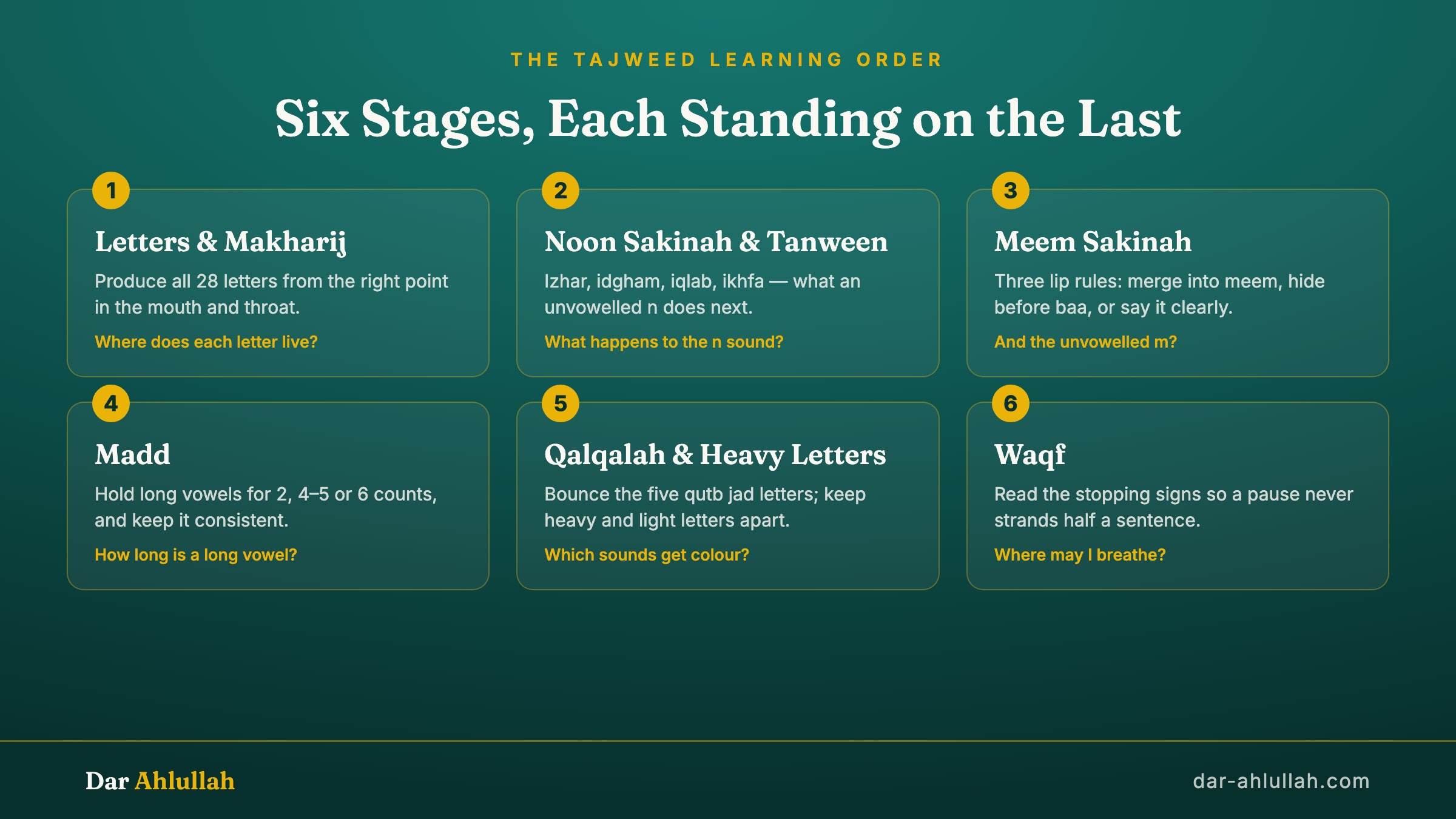
A realistic shape for self-paced study with weekly lessons looks like this: letters and makharij until the hard letters are reliable rather than perfect; noon sakinah and tanween applied to short surahs you already know; meem sakinah folded in quickly afterwards; then madd counting, then qalqalah and heaviness as refinements to reading that already flows; waqf last, growing alongside comprehension. Moving one stage back is always allowed and usually wise — the students who progress fastest are the ones most willing to re-drill stage one.
If you prefer that sequence delivered as a syllabus with a teacher pacing it for you, that is essentially what a structured online Tajweed course is: the same ladder, with someone watching your footing.
The Beginner Mistakes Worth Fixing First
Not all errors are equal, and classical scholarship makes exactly this distinction: clear errors (lahn jali) that change letters, vowels, or meaning, and subtle errors (lahn khafi) that violate refinements like ghunnah lengths without touching meaning. Beginners routinely spend their effort backwards — polishing subtleties while clear errors sit unexamined. Priority order:
- Emphatic-letter substitution. Reading saad as seen, taa as ta, daad as dal. These change words, which makes them the most important faults on this page.
- Vowel errors. A fatha read as a kasra changes grammar and meaning as surely as a wrong letter. Slow down; the vowels are the sentence.
- Invented vowels after sukoon. The qad-uh problem from the qalqalah section, and its cousin: breaking consonant clusters English finds uncomfortable.
- Skipped ghunnah. Reading through iqlab and ikhfa positions as plain n. Meaning survives, but this is the most audible difference between a beginner and a trained reciter.
- Flattened madd. Holding every long vowel for the same length. Fix the six-count lazim positions first; they are few and unmissable.
One reassurance belongs here. Adults sometimes fear they started too late to recite well. The evidence in our teaching experience and in the tradition itself points the other way — the hadith of the two rewards quoted in the introduction was said precisely about the person who finds recitation difficult and persists. We wrote more about the adult path specifically in our guide to learning the Quran as an adult.
Why You Cannot Hear Your Own Mistakes
Everything above can be understood from a page. Roughly half of it cannot be verified from a page, and the reason is mechanical: you produce and monitor your own speech through the same trained habits, so your ear approves what your mouth has always done. An English speaker’s ear files ‘ayn and hamza under the same sound; no amount of silent reading changes that. The fix has been the same for fourteen centuries: recite to someone who can hear the difference, be corrected, repeat. The Prophet ﷺ said, as narrated in Sahih al-Bukhari, “The best among you are those who learn the Quran and teach it” — transmission from person to person is not a workaround, it is the design.
In practice that means the productive setup for a beginner is: this guide (or any decent text) for the concepts, recordings of a careful reciter for the ear, and a live teacher for the feedback loop. The teacher matters most at stages one and two, exactly where self-assessment is least reliable. Our own lessons are built around that loop — every teacher is a native Arabic speaker who teaches in English, sessions are one-to-one, and a written report follows every session recording what was corrected so the same fault is not rediscovered weekly. If you want a professional read on where your recitation actually stands, book a free 30-minute assessment — it costs nothing, needs no card, and you leave with a starting point in writing whether or not you continue with us.
And if your goal runs past correctness into fluency and beauty — reciting whole passages with the rules running on autopilot — that is a distinct stage with its own methods, covered in our guide to online Quran recitation classes.
FAQs About Tajweed Rules for Beginners
Do I need to learn Tajweed before I can read the Quran at all?
No — and sequencing it that way discourages most people. Learn to decode the script first, then layer the rule families onto reading that already exists. Reciting slowly and carefully while still learning the rules is rewarded, not penalised.
How long does it take a beginner to learn the Tajweed rules?
Understanding the rules intellectually takes weeks. Applying them reliably takes months of regular practice, and refinement continues for years — for native Arabic speakers too. A steady rhythm of two short lessons a week with daily ten-minute practice moves faster than occasional long sessions.
Is Tajweed obligatory?
Scholars distinguish between avoiding clear errors that change meaning — which recitation of the Quran requires — and mastering the refinements, which is a virtue pursued to the extent each person can. The practical answer for a beginner is the priority list above: fix meaning-changing faults first and treat everything beyond that as a ladder you climb at your own pace.
Which recitation style do these rules describe?
This guide follows Hafs ‘an ‘Asim, the transmission the large majority of printed mushafs and reciters use. Other transmissions such as Warsh differ in specific rules and madd lengths; if you learned in a Warsh region, learn with a teacher certified in that transmission.
Can children learn these rules?
Children learn the sounds faster than adults and the terminology slower, so children’s programmes teach the same content through imitation and repetition rather than rule names. The learning order is unchanged.
Are apps and recordings enough to learn Tajweed?
They are excellent for the input half — hearing correct recitation and understanding rules. They cannot do the output half, which is hearing you and correcting what you cannot hear yourself. Use them alongside a teacher, not instead of one.
What should I practise on?
Short surahs you already know by heart — Al-Fatihah and the last ten surahs of the mushaf. Because the words are already in memory, all of your attention is free for the sounds, which is the entire point of practice.
Conclusion: One Rule at a Time, Out Loud
Tajweed is a large subject and a small daily practice. The terminology that filled this page compresses into a short honest routine: pick the current stage, read a few lines aloud slowly, apply the one family of rules you are working on, and let someone qualified hear you once or twice a week. Nobody applies seven rule families at once — trained reciters apply them the way drivers apply traffic law, automatically, because each rule was drilled separately until it disappeared into the driving.
Start with the letters. Add the noon rules. Count your madds. Everything else in this guide will still be here when you reach it — and if you want to know exactly which stage you are standing on today, the 30-minute assessment above will tell you in writing.
Related articles
Tajweed course
Online Tajweed Course: Master Quran Recitation with Dar Ahlullah
Enroll in our online Tajweed course and learn to recite the Quran with correct pronunciation and rules, taught by native Arabic-speaking teachers.
18 min read
sajdah tilawah
Sajdah Tilawah: What to Do at a Prostration Verse
Sajdah tilawah is the single prostration that belongs to reciting or hearing one of the Qur'an's verses of prostration. Where those verses are, why the four schools count fourteen, fifteen and eleven of them, how to perform it, and the answers for a desk, a recitation app, a live lesson and a hifz drill.
26 min read
how to read the Quran for beginners
How to Read the Quran for Beginners: A Step-by-Step Route
Reading the Quran is a decoding skill, not a talent — and almost every beginner who stalls stalled on the order, not the difficulty. Here are the five stages, what marks the end of each, and why the Qaidah is the one nobody should skip.
20 min read