
how to revise Quran memorization
What Murajaah Means, and How to Revise Quran Memorization
Dar Ahlullah team 15 min read
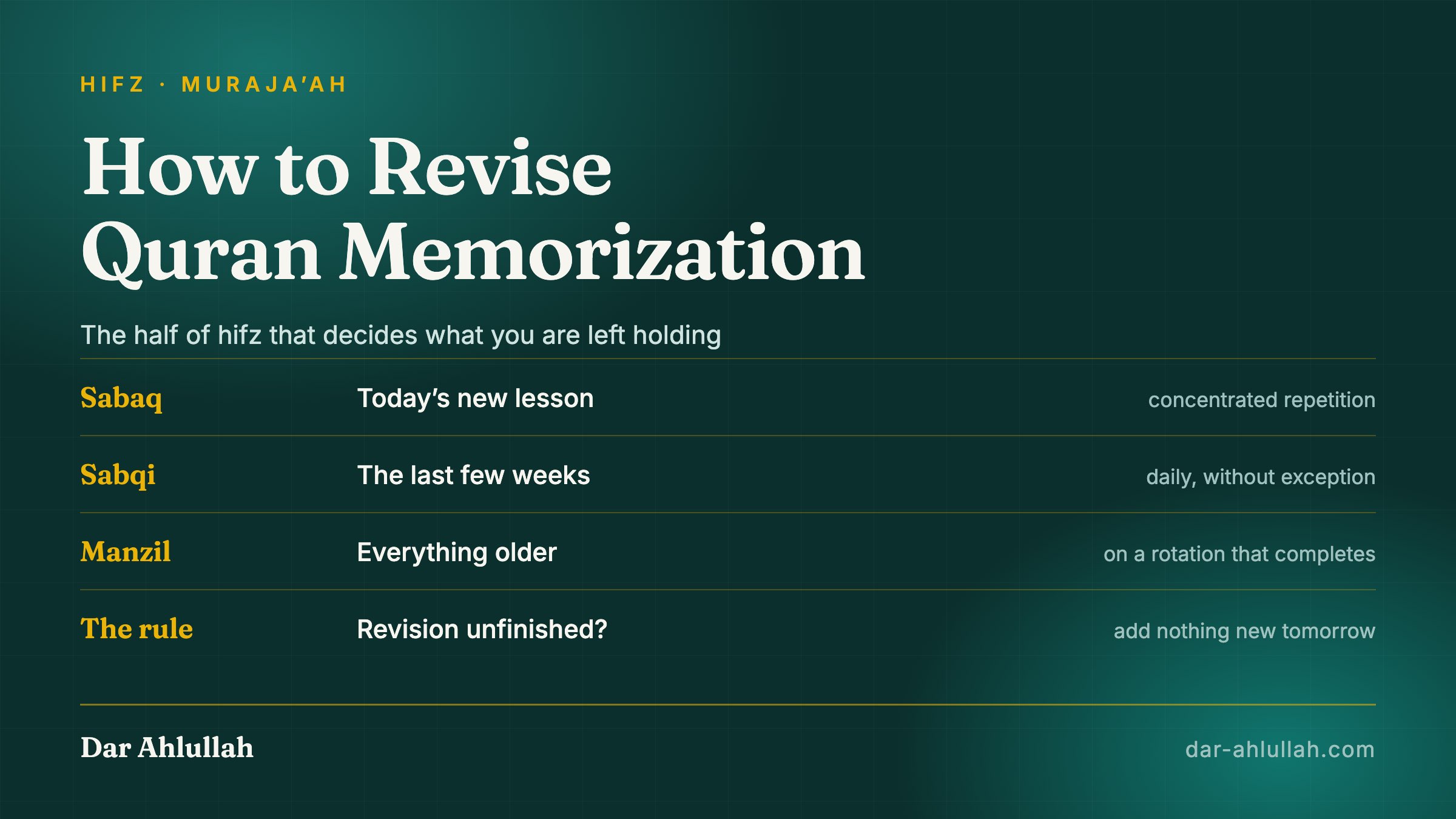
Table of Contents
- Introduction: Everyone Plans the Memorising, Nobody Plans the Revision
- What Murajaah Means, and the Three Streams
- Forgetting Is the Mechanism, Not the Failure
- The Core Rule of Every Working Schedule
- Four Worked Schedules, by How Much You Hold
- The Five-Prayer Split
- Recite From Memory, Not From the Page
- Why Silent Revision Hides Errors
- The Similar Verses, and the Weak-Spot Log
- If You Have Already Forgotten a Lot
- Ramadan, Travel and the Months That Break Routines
- Revision for Children
- How We Run Revision
- Questions People Ask About Muraja’ah
- Conclusion: The Boring Half Is the Half That Decides
Murajaah (Arabic مراجعة, also written muraja'ah) means "reviewing" or "going back over". In Quran memorisation it is the scheduled re-recitation of what you have already memorised, from memory and ideally to a listener, so that it stays. Memorising adds pages; murajaah is what keeps them. Everything below is about doing it in a way that actually holds up over years, not weeks.
Introduction: Everyone Plans the Memorising, Nobody Plans the Revision
Almost every hifz plan you will ever see is a memorisation plan. So many lines a day, so many pages a week, a finishing date. And almost every hifz plan that fails, fails for the same reason: nothing in it described what happens to the pages behind you.
Learning how to revise Quran memorization — muraja’ah — is not a supplementary skill for people who are already good at hifz. It is the larger half of the work, it grows every single week, and it is the part that determines whether what you memorise accumulates or quietly drains away. A student memorising half a page a day with a working revision cycle will end up holding far more than a student memorising two pages a day without one, and will get there in better condition.
This guide covers what muraja’ah actually consists of, how to build a schedule that scales as your load grows, what to do when you have already lost a great deal, and the specific techniques that separate revision that holds from revision that only feels productive.
What Murajaah Means, and the Three Streams
Muraja’ah (مراجعة) simply means review. In hifz it refers to the systematic re-recitation of material you have already memorised, and the traditional structure divides your daily recitation into three streams that run in parallel. The terminology varies by region — the words below come from the subcontinent tradition and are the ones you will hear most often online — but the three-way split is close to universal.
- Sabaq — the new lesson. Today’s fresh material, whatever you are adding.
- Sabqi — the recent lesson. Roughly the last one to four weeks of material, still fragile, revised heavily and daily.
- Manzil (also dhor) — the old material. Everything beyond that window, cycled on a rotation so that all of it comes round regularly.
The point of the split is that these three need completely different treatment. Sabaq needs concentrated attention and many repetitions. Sabqi needs daily contact because it is at the age where memory is most likely to drop it. Manzil needs breadth rather than depth — large amounts recited at reciting pace, often enough that nothing goes more than a few weeks without being touched.
A student who does all three every day is doing muraja’ah correctly. A student who does sabaq and calls the day finished is accumulating debt.
Forgetting Is the Mechanism, Not the Failure
The most useful attitude shift available here: forgetting is not a sign that you memorised badly. Forgetting is what memory does with anything it is not asked to retrieve, and it is why review at increasing intervals — the principle known as spaced repetition — is the basis of every effective revision schedule, in hifz and outside it.
What that principle means in practice is that the right time to revise something is just before you would have lost it. Revise too soon and you spend effort on material that was not at risk; revise too late and you are re-memorising rather than reviewing, at several times the cost. The classical hifz schedules — heavy daily contact for the first weeks, then weekly, then folded into a monthly cycle — are a practical implementation of exactly this, arrived at long before anyone measured it.
So the emotional reading of “I forgot Surah Al-Qiyamah, I must be bad at this” is simply wrong. The correct reading is “Al-Qiyamah went too long without a turn in the rotation”, which is a scheduling problem with a scheduling fix.
The Core Rule of Every Working Schedule
One sentence, and every good revision plan is a way of obeying it:
Your revision load is set by how much you hold; your memorisation load is a choice. So the choice has to shrink as the load grows.
New material costs roughly the same per page whether you hold two juz or twenty. Revision does not — at twenty juz you have ten times the maintenance of a student at two, and the traditional minimum for a hafiz is at least a juz reviewed daily, indefinitely. This is why hifz time rises steadily even as your memorising gets faster, and it is covered in more detail in our guide to how long it takes to memorize the Quran.
The rule gives you a hard test for any plan: if you cannot complete the day’s revision, you may not add new material tomorrow. Not “should not” — may not. Adding on top of unrevised material is how students end up with twelve juz on paper and five in reality, and the gap is invisible until somebody asks them to recite.
Four Worked Schedules, by How Much You Hold
These are starting points to adapt, not prescriptions. All assume you can read the page fluently — if you cannot, the problem to fix first is reading, and our guide to reading the Quran for beginners is the place to start.
Under 1 juz held
Total: 20–30 minutes a day. Sabaq: three to five lines. Sabqi: everything you have memorised in the last two weeks, every day. Manzil: not applicable yet — simply recite everything you hold, in full, twice a week. At this stage revision is nearly free, which is precisely why the habit must be built now rather than when it starts to hurt.
1–5 juz held
Total: 40–60 minutes. Sabaq: half a page. Sabqi: the last three to four weeks, daily. Manzil: half a juz a day, on a rotation that brings everything round within ten days. Recite one full juz from memory to a listener each week.
5–15 juz held
Total: 1–1.5 hours. Sabaq: half a page to a page. Sabqi: the last month, daily. Manzil: one juz a day, rotating — so nothing goes more than about two weeks untouched. This is the stage where most people first feel the squeeze, and where the temptation to cut manzil in favour of new pages is strongest. Cutting manzil here is what produces the students who reach twenty juz and can reliably recite eight.
15+ juz, and after completion
Total: 1.5–2.5 hours. Sabaq: a page, or nothing at all if revision is behind. Manzil: one to two juz a day minimum, which brings the whole Quran round roughly monthly. After completing hifz, sabaq disappears and manzil becomes the entire practice — permanently. Anyone who completes and then stops loses material fast, and re-memorising a degraded juz costs far more than maintaining it ever would have.
The Five-Prayer Split
The most durable practical trick in revision is not a technique for memorising — it is a technique for fitting an hour of recitation into a day that does not have a spare hour in it.
Take your daily manzil target and divide it across the five prayers. If your target is one juz, that is roughly four pages attached to each prayer:
| Prayer | Revision slot | Why it works |
|---|---|---|
| Fajr | 4 pages | Freshest recall of the day; nothing has claimed your attention yet. |
| Dhuhr | 4 pages | Short break in the working day; needs no preparation. |
| Asr | 4 pages | The slot most likely to be missed — protect it deliberately. |
| Maghrib | 4 pages | Natural transition point at home. |
| Isha | 4 pages | Last contact before sleep, which is when consolidation happens. |
Nothing about this is mystical. It works because five twelve-minute blocks attached to something you already do every day are far more likely to happen than one sixty-minute block that has to displace something else. It also spreads retrieval across the day rather than massing it, which is better for retention than a single long session of the same total length.
Recite From Memory, Not From the Page
This is the technique distinction that matters most, and the one most commonly got wrong.
Reading your memorised pages from the mushaf feels like revision. It is not, or at least it is a much weaker version of it. Reading is recognition; revision needs retrieval — producing the text with nothing in front of you. The effort of retrieval is what strengthens the memory, and the reason the page feels comfortable is precisely that it is doing the work for you.
So the working method is:
- Recite the passage from memory, out loud, with the mushaf closed.
- When you stop or stumble, do not immediately look. Sit with it for a few seconds and try to produce it.
- Only then open the page, check, and mark the spot.
- Recite the whole passage again, from memory, start to finish.
Step two is the uncomfortable one and it is the one that pays. The moment of failed retrieval is where the memory is repaired. Skip it by looking immediately and you have converted an effective revision into a comfortable read-through.
One exception worth naming: reading from the page is the right tool when you are re-learning material that has degraded badly, because there is nothing to retrieve yet. It is a recovery technique, not a maintenance one.
Why Silent Revision Hides Errors
Two categories of error survive private revision indefinitely.
Pronunciation drift. Over months of solo recitation, articulation slides — a heavy letter softens, a lengthening shortens, a stop lands in the wrong place. You cannot hear it because your ear has drifted along with your tongue. This is the same reason our tajweed rules for beginners guide argues that rules on paper do not fix pronunciation; only somebody listening does.
Confident errors. Worse, and more common than people expect. A verse ending you have consistently recited wrong feels exactly as certain as a verse ending you have recited right. Self-checking cannot catch it, because the thing you would check against is the same faulty memory. Only an external listener with the text finds these.
You do not need a listener every day. Two or three times a week, reciting a substantial portion from memory to somebody competent, catches both categories before they set. This is the single strongest practical argument for a teacher in hifz — not for the instruction, for the listening.
The Similar Verses, and the Weak-Spot Log
Ask any hafiz where recitation actually derails and the answer is not obscure vocabulary. It is the mutashabihat — passages that appear in more than one place with small differences, or verses that begin identically and then diverge. You reach one, your memory takes the wrong branch, and you finish somewhere three surahs away without noticing.
Blanket revision does not fix these, because the problem is not weak memory of either passage — it is competition between two strong ones. What fixes them is targeted work:
- Keep a weak-spot log. A single notebook or note file. Every time you stumble, write the exact location and what you did wrong. Nothing else — the value is in the list, not in the prose.
- Revise the pair together. When two passages compete, deliberately recite them back to back so the difference becomes the thing you have memorised, rather than each version in isolation.
- Attach a marker. Most people need a hook — the word that differs, the position on the page, the surah’s theme at that point. Understanding the meaning is genuinely useful here, which is one of the strongest practical arguments for pairing hifz with learning Quranic Arabic.
- Review the log weekly. Ten minutes on the twenty entries in your log will do more than an extra half juz of general revision.
The log has a second benefit: it turns a vague sense of “I’m shaky in juz 21” into a list of eleven specific places, which is a problem you can actually finish.
If You Have Already Forgotten a Lot
Very common, and entirely recoverable. The instinct is to start again from the beginning, which is both demoralising and unnecessary. Do this instead.
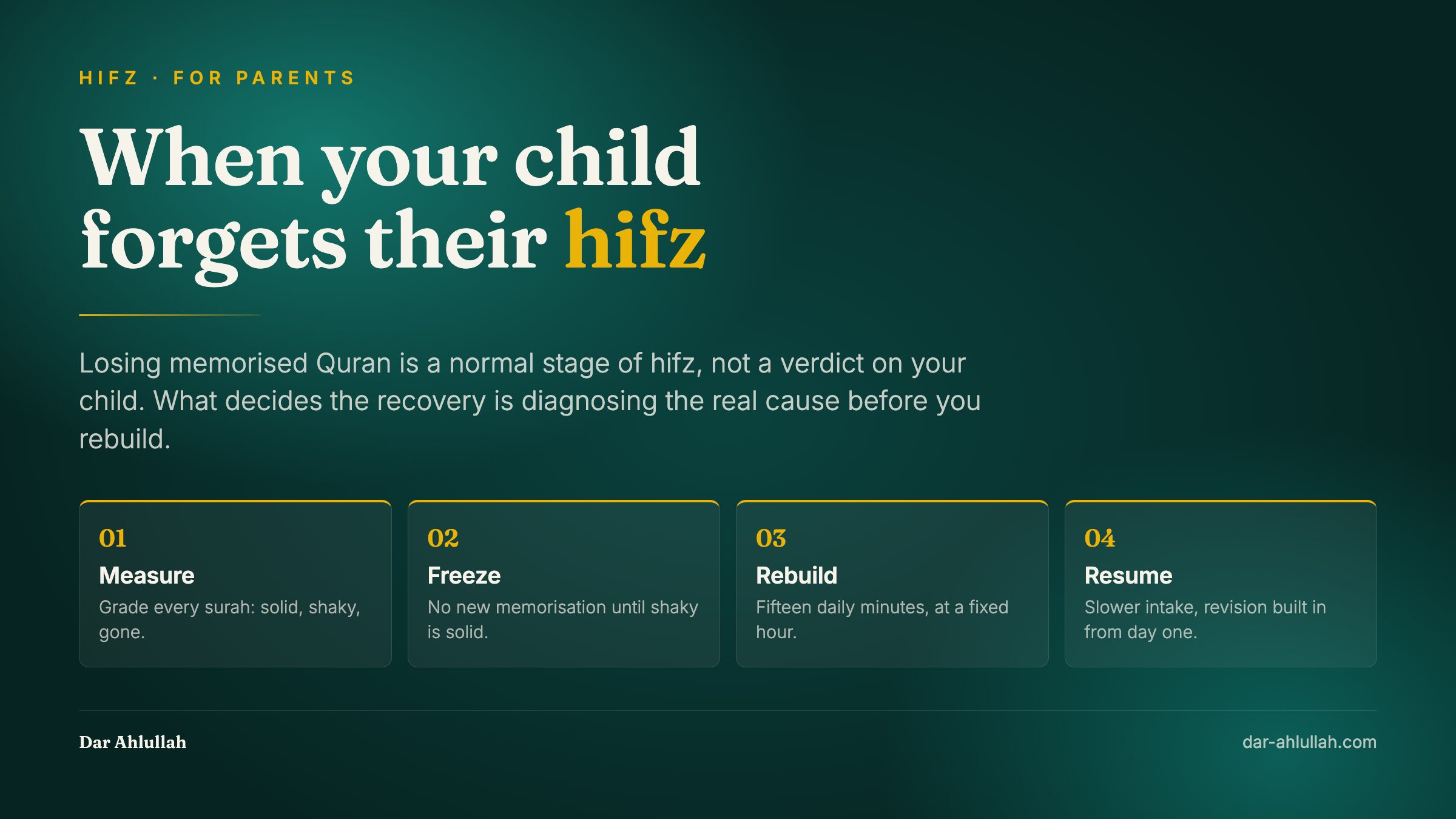
- Stop adding new material. Completely, until the recovery is done. This is not negotiable — you cannot fill a bucket while it is leaking.
- Audit what you actually hold. Go juz by juz and try to recite each from memory. Grade each one: solid, shaky, or gone. Most people find the true picture is better than they feared in some places and worse in others.
- Recover the shaky before the gone. Material that is nearly there comes back in a fraction of the time, and the early wins are what keep you in the process. The pages rated “gone” are effectively new memorisation and should be treated as such — later.
- Rebuild the rotation first, at whatever size fits. Better to hold five juz on a working ten-day cycle than to hold fifteen juz on no cycle at all. Get a rotation running that you can actually complete, then extend it.
- Only then resume new material, and at a rate that leaves the rotation intact.
Recovery is usually far faster than people expect — material you once memorised properly returns at several times the speed it went in. What is slow is the audit, because it is uncomfortable. Do it anyway; a plan built on an honest inventory is worth more than a year of guessing.
Ramadan, Travel and the Months That Break Routines
Every hifz journey contains months where the schedule is impossible. Planning for them is the difference between a pause and a collapse.
Have a minimum viable day. Decide now what the smallest acceptable version of your revision is — say a quarter juz, from memory, in one sitting. On bad days you do that and nothing else, and the streak survives. A routine that only exists in full-size form is a routine that ends the first busy week.
In Ramadan, swap the ratio, do not drop the practice. Recitation opportunities multiply and memorisation time shrinks. Reduce or suspend sabaq and let manzil expand into the extra recitation — taraweeh and personal reading are revision if you approach them as revision.
When travelling, protect retrieval, not volume. Reciting from memory needs no mushaf, no desk and no quiet room. Half your normal manzil, done in transit, keeps the rotation alive. The failure mode is skipping entirely because conditions were not ideal.
Returning after a real break: audit before resuming. The single worst move is to pick up the schedule where you left it as though nothing happened. Spend a week finding out what is still there.
Revision for Children
Children memorise readily and lose material just as readily, and they will not build a revision rotation on their own. Three adjustments work:
Make revision the visible part. If the only thing anyone asks about is what was newly memorised this week, that is what the child will optimise for. Ask instead to hear something from two months ago.
Keep sessions short and frequent. Ten to fifteen minutes of revision, most days, comfortably beats an hour at the weekend — for children even more than for adults, because attention is the binding constraint.
Use the prayer. A child who recites a different memorised surah in each prayer is running a revision rotation without anyone calling it one. It is the least effortful maintenance available at this stage, and it is exactly why which surahs to memorize first matters — the surahs that fit into daily worship revise themselves.
How We Run Revision
At Dar Ahlullah, revision is part of the session rather than homework reported on. The pattern in a one-to-one hifz lesson is: the student recites manzil from memory first, then sabqi, and new material is taken only if what came before held. That ordering is deliberate — when new material comes first, revision is what gets dropped when time runs short, and over months that is the whole problem in miniature.
The listening is the part that is genuinely hard to replicate alone: confident errors and pronunciation drift are invisible from the inside. Sessions run with a certified teacher, and if the pairing is not right we will rematch you with another certified mentor at no extra cost. You can pause, upgrade or switch plans at any time. Our rate is about $9 per teaching hour — the pricing page shows how the plans are built on it, and a complimentary 30-minute assessment is the way to find out what you currently hold before anyone plans anything.
Questions People Ask About Muraja’ah
How much should I revise each day?
Enough that nothing you hold goes more than two to three weeks without being recited. In practice that means roughly half a juz daily up to five juz held, a juz daily from five to fifteen, and one to two juz daily beyond that.
How long should I revise new material before it is safe?
Treat anything from the last month as fragile and revise it daily. After that it can move into the general rotation. The first week is where most losses happen, so it deserves the heaviest contact.
Is it better to revise from memory or from the mushaf?
From memory, almost always — retrieval is what strengthens the memory, and reading is recognition rather than retrieval. Use the page only for checking after you stumble, or when re-learning material that has degraded past the point of recall.
Should I revise or memorise if I only have fifteen minutes?
Revise. Every time. New material added on top of an unrevised pile does not accumulate; it just moves the losses further back where you cannot see them.
What do I do when I keep confusing two similar verses?
Stop revising them separately and start reciting them back to back, so the difference is what you memorise. Log the location, review the log weekly, and use the meaning of each passage as the marker for which branch to take.
How often do I need someone to listen to me?
Two or three times a week is enough to catch pronunciation drift and confident errors before they set. Daily is better during the first weeks of any new material.
Can an app replace a revision schedule?
An app can run the schedule and it does that well — spaced intervals, rotation tracking, reminders. What it cannot do is tell you that what you recited was wrong. Use it for the timetable, not for the checking.
I lost most of my hifz years ago. Is it worth restarting?
Yes, and it will go faster than the first time. Material once memorised properly comes back at a fraction of the original cost. Start with an honest audit, recover the shaky portions first, and rebuild a rotation you can actually complete before adding anything new.
Does revision ever stop?
No. Completing thirty juz converts the work entirely into maintenance rather than ending it — the traditional expectation is at least a juz daily, for life. Knowing that at the start leads to better plans than discovering it at the end.
Conclusion: The Boring Half Is the Half That Decides
Memorising is the visible half of hifz and revision is the half that determines what you are left holding. Every schedule that works obeys the same rule — revision load is set by what you hold, new material is the part you get to choose, and so new material is the part that gives way.
Build the rotation while it is small and costs you ten minutes. Recite from memory rather than from the page. Get somebody competent to listen two or three times a week. Keep a log of the places you stumble and work it deliberately. And on the day you cannot finish your revision, do not add a new line — that single rule, kept for a few years, is most of the difference between the students who accumulate and the students who start over.
If you want to see how this fits into a full programme, our guide to memorising the Quran online covers the structure around it, and our complete guide to learning Quran online sets out the wider route.
Related articles
how to help a child who forgot Quran memorization
What to Do When Your Child Forgets Their Quran Memorization
Losing memorised Quran is a normal stage of hifz, not a verdict on your child. What decides the recovery is finding the real cause first, then freezing new material while the old is rebuilt.
22 min read

how to memorize Quran with a full time job
How to Memorize Quran With a Full Time Job: A Schedule That Survives Your Week
Working adults rarely lose hifz for lack of time. They lose it because the time never had a fixed address in the week — and the first genuinely busy fortnight takes it back.
20 min read

how to memorize similar verses in the Quran
How to Memorize Similar Verses in the Quran (Mutashabihat)
The places where recitation derails are not the unfamiliar verses. They are the familiar ones — the passages that resemble each other so closely that memory takes the wrong branch.
17 min read