
fiqh for beginners
Fiqh for Beginners: What to Learn First, and in What Order
Dar Ahlullah team 16 min read
Table of Contents
- Introduction: The Word Behind Every “Is This Allowed?”
- The Short Answer: What Fiqh Is
- Fiqh, Sharia, Aqeedah: Three Words That Are Not Synonyms
- The Five Categories Every Ruling Falls Into
- Where the Rulings Actually Come From
- What to Learn First: A Beginner’s Order
- Madhhabs: What They Are, and Which One You Are
- Why Two Teachers Give You Two Answers
- Six Mistakes Beginners Make With Fiqh
- The Questions That Come Up Living in the West
- How We Teach Fiqh at Dar Ahlullah
- FAQs About Fiqh for Beginners
- Conclusion: Learn the Rules You Use Every Day
Introduction: The Word Behind Every “Is This Allowed?”
Almost every practical question a Muslim asks is a fiqh question, whether or not the word comes up. Can I combine two prayers on a long flight? Does this mouthwash break my fast? Is my paycheque affected by the interest my bank pays me? What do I do when the only place to pray is a stairwell at work?
These arrive faster than anyone can look them up one at a time, and looking them up one at a time is exactly what most people end up doing — a search, a forum thread, three answers that contradict each other, and a decision made on whichever one sounded most confident. That method works until it does not, and it never builds anything. After a year of it you still have no idea how the next question will be answered, because you never learned how any of the previous ones were.
The alternative is to spend a small amount of time on the system rather than the individual verdicts. This guide takes fiqh for beginners literally: what the word means, how it relates to sharia and to creed, the five categories every ruling gets sorted into, where the rulings come from, what to learn in what order, and what a madhhab is — without assuming any Arabic or any prior study.
If you have recently entered Islam and want the wider sequence of what to learn month by month, that is laid out in our guide to your first 90 days in Islam. This page is the practice half of that sequence, in more depth. The belief half is aqeedah for beginners.
The Short Answer: What Fiqh Is
The Arabic word fiqh means deep understanding — not information, but the kind of grasp that lets you work something out. As a field of study, fiqh is the science of working out what a Muslim should do: the rulings that govern worship, transactions, family life and daily conduct, derived from the Qur’an and the Sunnah by qualified scholars.
Two features of it surprise beginners, and both are worth accepting early rather than discovering the hard way.
- It is human work on divine sources. The sources are revelation; the derivation is scholarship. That is why fiqh has schools, differences of opinion and a literature of argument, while the six articles of faith do not. Difference is a feature of the subject, not evidence that someone is getting it wrong.
- The part you need is small. The fiqh of purification and prayer — the part you use several times a day, every day — is a few weeks of study. The vast libraries are inheritance law, commercial contracts and cases you may never meet. Beginners routinely mistake the size of the library for the size of the entry requirement.
The classical framing helps here. In the well-known hadith of Jibril, recorded in Sahih Muslim, religion is presented in three limbs: islam (the outward practice), iman (belief) and ihsan (excellence of the heart). Fiqh is the science of the first limb. Aqeedah is the science of the second. Neither substitutes for the other, and studying one without the other produces a predictable kind of lopsidedness.
Fiqh, Sharia, Aqeedah: Three Words That Are Not Synonyms
These three get used interchangeably in English-language discussion, including by people who should know better, and the confusion causes real problems. Once separated they stay separate.
| Term | What it refers to | Can it differ between scholars? |
|---|---|---|
| Sharia | The revealed law itself — what God has commanded, as contained in the Qur’an and the Sunnah. | No. It is the source material, not an opinion about it. |
| Fiqh | Scholars’ understanding and derivation of that law: the worked-out rulings for actual cases. | Yes, and legitimately so. Different qualified readings of the same texts. |
| Aqeedah | What a Muslim believes — God, angels, books, messengers, the last day, divine decree. | No. The six articles are not a menu. |
The practical consequence is a habit worth building: when a question arrives, notice which of the three it belongs to before trying to answer it. “Does God have a form?” is aqeedah. “Do I have to repeat wudu after touching my dog?” is fiqh. Beginners often carry a fiqh question into a creed discussion, receive an answer that does not fit, and conclude the whole subject is beyond them — when the question simply went to the wrong desk.
It also defuses a common anxiety. Hearing that two scholars disagree about a fiqh ruling does not mean one of them is disagreeing with God. It means two trained readers of the same evidence reached different conclusions about how it applies — which is what the science is for.
The Five Categories Every Ruling Falls Into
Almost everything a beginner finds confusing about “halal and haram” comes from working with two boxes when the tradition uses five. Most of life is not in either extreme box.
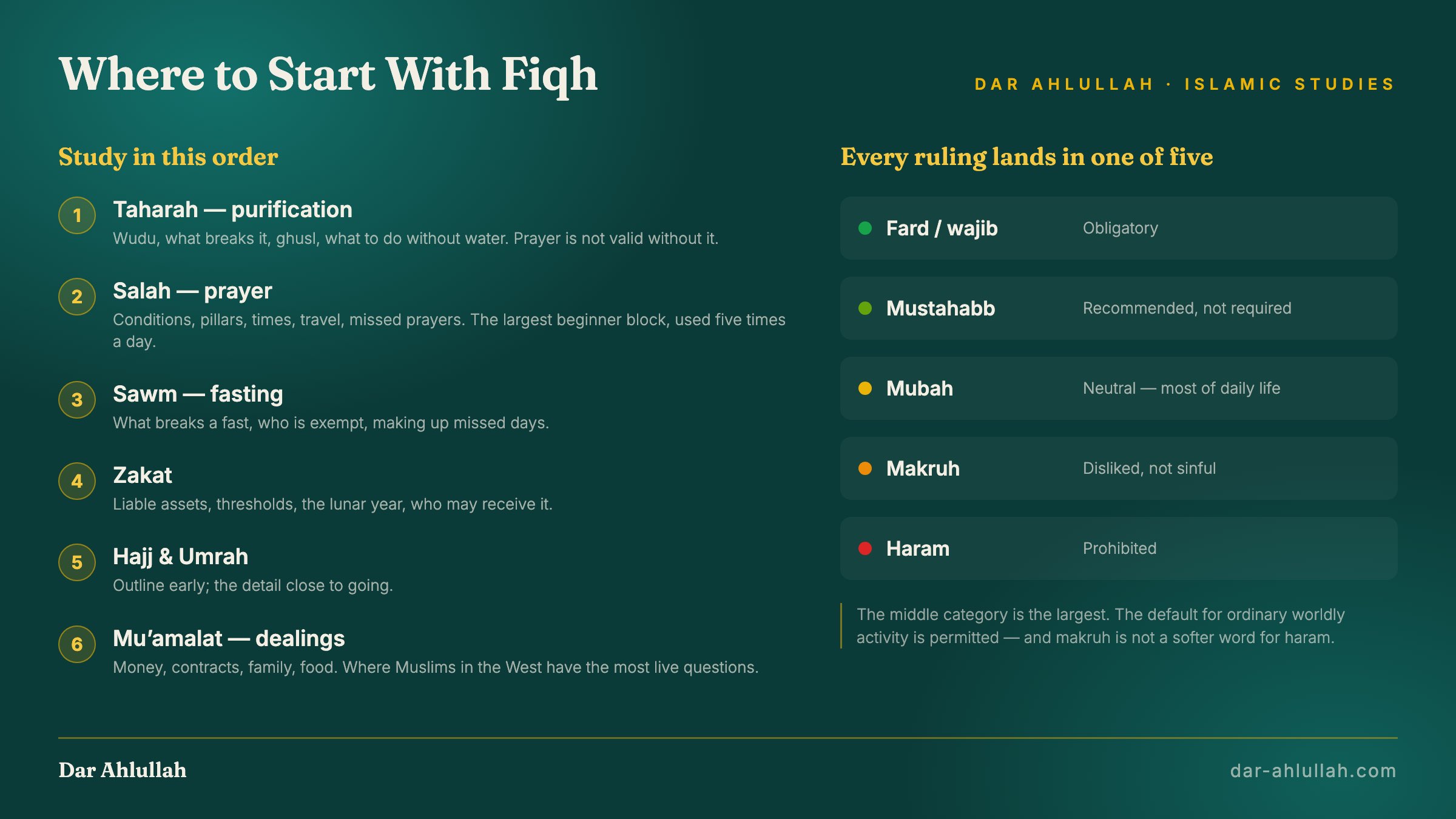
- Fard / wajib (obligatory) — required. Leaving it is sinful. The five daily prayers, fasting Ramadan.
- Mustahabb (recommended) — rewarded when done, not sinful when left. Voluntary prayers, extra charity.
- Mubah (permitted) — neutral. Most of what you did today. No ruling attaches to it either way.
- Makruh (disliked) — better avoided, but not sinful.
- Haram (prohibited) — forbidden. Leaving it is required.
Three things follow immediately. First, the middle category is enormous: the default for ordinary human activity is permitted, and the burden of proof sits on whoever claims otherwise. Second, “makruh” is not a soft way of saying haram, and treating it as one produces a religion that feels like a minefield. Third, when someone tells you something is haram, a reasonable next question is which category they mean and on what basis — not as a challenge, but because the answer is often “makruh in my school” or “my teacher preferred avoiding it”.
Alongside the five categories sits a rule about intention. The hadith that opens Sahih al-Bukhari — that actions are judged by their intentions — is placed first in that collection deliberately, because it governs everything after it. The same physical act can be worship or habit depending on what it was for. Fiqh describes the outward form; intention supplies what the form is for.
Where the Rulings Actually Come From
Fiqh is not a list somebody wrote. It is derived, and the derivation follows an order that has been broadly agreed for over a thousand years.
- The Qur’an. The primary text. Some rulings are stated in it directly — the steps of wudu are given in Surah al-Ma’idah, verse 6, in the order that is still followed today.
- The Sunnah. The Prophet’s words, actions and approvals, as preserved in the authenticated hadith collections. Most of the detail of how to pray comes from here rather than from the Qur’an, which commands prayer without describing every posture.
- Ijma’ (consensus). Where the qualified scholars of an era agreed, that agreement is binding on later generations.
- Qiyas (analogy). Extending a ruling from a case the texts address to a new case that shares its operative cause. This is how the tradition handles things nobody in the seventh century could have asked about.
The fourth source is the one that answers the question every modern beginner eventually asks: how can a body of law formed centuries ago say anything about cryptocurrency, or organ donation, or a mortgage product invented last year? It does so by identifying why an older ruling exists and asking whether the new case shares that reason. Whether it does is often exactly what scholars are arguing about.
None of these four is a tool for personal use, which is the honest and slightly unwelcome part. Deriving rulings requires command of Arabic, of the hadith sciences and of legal theory, held simultaneously. What a beginner does instead is stated plainly in the Qur’an: ask those who have knowledge. Knowing how the answers are produced is what lets you ask well, follow the reasoning, and tell a scholarly answer from an opinion with a confident tone.
What to Learn First: A Beginner’s Order
Fiqh is conventionally taught in a fixed sequence, and the sequence is not arbitrary — each stage is a prerequisite for the next, and the earliest stages are the ones you use most often. Follow it and you are never studying something you cannot yet apply.
1. Taharah (purification)
Always first, because prayer is not valid without it. What makes you need wudu, what breaks it, how to perform it, when a full ghusl is required, and what to do when there is no water. This is a week of study and it removes a surprising amount of daily anxiety. Our step-by-step guide to wudu covers the method itself.
2. Salah (prayer)
The largest single block in beginner fiqh and worth the time, because you will use it five times a day for the rest of your life. Conditions, pillars, what invalidates it, the prayer times, how to shorten and combine while travelling, what to do when you arrive late or miss one entirely, and the prostration for forgetfulness. Our beginner’s guide to salah walks through the prayer itself; the fiqh layer is the rulings around it.
3. Sawm (fasting)
What breaks a fast and what does not, who is exempt, how to make up missed days, and what compensation applies when a fast is broken deliberately. Seasonal, but everyone wants it in the weeks before Ramadan and that is the worst time to start. The voluntary fasts outside Ramadan — Mondays and Thursdays, the white days, ‘Arafah — have rules of their own, set out in our guide to voluntary fasting in Islam.
4. Zakat
Which assets are liable, the thresholds, the lunar year, the rate, and who may receive it. More arithmetic than the earlier topics and genuinely useful, since most people carry assets the rules were not obviously written for — a pension, shares, a business inventory.
5. Hajj and Umrah
Usually studied close to going, since the detail does not survive long in memory unused. Learn the outline early so you know what you are saving for and what it will require.
6. Mu’amalat (dealings)
Everything outside worship: earning and spending, contracts, marriage and divorce, inheritance, food and drink. This is where a Muslim in Europe or America has the most live questions and the least available guidance, which is why it deserves a teacher rather than a search engine.
Two notes on pacing. Do not wait to finish one stage before praying — you learn to pray while learning the rulings about prayer, not afterwards. And do not attempt the whole sequence in a month; the topics that matter most are the first two, and they reward being learned properly rather than quickly.
Madhhabs: What They Are, and Which One You Are
Sooner or later somebody asks which madhhab you follow, and the question lands strangely if nobody has explained what one is.
A madhhab is a school of legal method. Over the first few centuries of Islam, several major scholars developed consistent, documented approaches to deriving rulings — how to weigh a hadith against a general Qur’anic principle, what to do when reports conflict, how far analogy may be pushed. Four Sunni schools were preserved with their full reasoning intact and are named after their founding scholars: the Hanafi, Maliki, Shafi’i and Hanbali schools. They differ on method, and therefore on some of the details of practice, while agreeing on the essentials.
Three things beginners are relieved to hear:
- They are not sects. All four are recognised as valid within Sunni Islam. Following one is following the reasoning of a qualified scholar, which is what a non-specialist is supposed to do.
- You do not need to choose on day one. Most people end up practising the school their teacher or local community follows, which is how it has usually worked. Choosing consciously later, if you want to, is entirely possible.
- The differences are mostly small. Where the hands rest in prayer, whether saying “amin” aloud is preferred, what precisely nullifies wudu. Real differences that a scholar can trace, but not different religions, and not worth the volume at which they are sometimes argued online.
The one thing worth avoiding is assembling a personal school from whichever position is easiest in each case. Not because ease is bad — the tradition has genuine concessions and they exist to be used — but because a ruling taken out of its school often depends on other rulings from the same school that you did not take. Consistency is what stops the outcome from being incoherent.
Why Two Teachers Give You Two Answers
This is the single most destabilising experience for a new student, so it is worth naming the causes. When two qualified people answer the same question differently, it is usually one of these:
- They follow different schools. The most common reason, and the least interesting. Both answers are correct within their own method.
- They read the evidence differently. A hadith one scholar grades as strong another grades as weak; a verse one reads as general another reads as specific to its occasion.
- They understood your situation differently. Fiqh answers are frequently case-specific. Ask about travel and the answer depends on distance, duration and intent — and if you left those out, you got an answer to a different question.
- One of them is not qualified. This also happens, particularly online, where confidence is distributed independently of training.
What to do about it: ask the person for the basis of the answer, not just the answer. A qualified teacher will tell you which school they are answering from and roughly what it rests on, without being defensive, because that is a normal question in this subject. Someone who reacts as though you have challenged them has told you something useful either way.
Six Mistakes Beginners Make With Fiqh
1. Starting with the hardest topics
Inheritance shares and the finer points of financial contracts are absorbing, and they are not where a beginner belongs. If you cannot yet state confidently what breaks your wudu, that is the topic in front of you.
2. Treating search results as rulings
A page with no named author, no school stated and no evidence cited is not a fatwa; it is a paragraph. The problem is not always that it is wrong, but that you cannot tell.
3. Assuming everything is haram until proven otherwise
The default for ordinary worldly activity runs the other way. Beginners who invert it end up exhausted, and often more scrupulous about coffee than about backbiting.
4. Collecting rulings instead of learning the system
A hundred memorised verdicts will not answer the hundred and first. Understanding why a ruling is what it is generalises; the verdict alone does not.
5. Confusing culture with fiqh
A great deal of what is presented as Islamic law is regional custom that has travelled alongside it. Both may be fine, but knowing which is which matters enormously if your family and your religion are not from the same place.
6. Delaying practice until the study is finished
The study is never finished. Pray with what you know now, correct it as you learn, and accept that early prayers being imperfect is the normal shape of learning rather than a reason to postpone.
The Questions That Come Up Living in the West
Most beginner fiqh material is written for a context where the surrounding society handles the logistics of practice. In London, Toronto or Berlin it does not, and the questions that follow are ordinary rather than exotic — but they are the ones that go unanswered.
- Prayer at work and school. Where, when the building has no prayer room. How to combine when a shift makes a time impossible. What counts as a valid excuse and what is merely inconvenient.
- Food and ingredients. What the rulings actually require, as opposed to the maximally cautious position, and how to read a label without a two-hour investigation per item.
- Money. Interest on a current account, workplace pensions, mortgages, insurance that is legally required. These have real scholarly discussion behind them and deserve a teacher rather than a forum.
- Family who are not Muslim. Attending celebrations, eating at their table, what to do about inherited property and end-of-life arrangements.
- Ramadan at high latitude. Where summer daylight runs to nineteen hours or more, there are established scholarly positions on how to fast. Very few beginners have heard that the question was ever addressed.
None of these has a one-line answer, which is precisely why they are worth putting to someone who can ask you follow-up questions before answering.
How We Teach Fiqh at Dar Ahlullah
Fiqh sits inside our Islamic Studies track, and it is taught one-to-one and live rather than as recorded lectures, for a specific reason: in this subject almost all the value is in the follow-up question. A recording can explain what breaks a fast. It cannot answer “so what about the inhaler I use every morning?”, which is the question you actually had.
Our teachers are native Arabic speakers who teach in English, which matters here more than in most subjects, because a fiqh answer is only as useful as the explanation that comes with it. Sessions follow the order above — purification, then prayer, then outward — adapted to what you already know, and you can study fiqh alongside learning to pray and alongside Qur’an rather than in sequence after them.
A written report goes out after every session, which in this subject doubles as a personal reference: three months in, you have a record of the rulings you were taught and the reasoning behind each one, in the order you met them. Teaching runs at $9 per teaching hour, the same as everything else we do, and if the teacher fit is wrong we rematch you with another certified teacher at no cost. You can also pause or switch at any time.
The starting point is a free 30-minute assessment. For Islamic studies that conversation is mostly diagnostic — what you know, what you have been asked lately and could not answer, which questions in your own life are currently unresolved — and the mentor proposes a starting point from there. No card is required, and you get the plan in writing whether or not you continue. You can see the full Islamic Studies course outline alongside our Qur’an and Arabic tracks.
FAQs About Fiqh for Beginners
What does fiqh mean in simple terms?
Fiqh is the science of working out what a Muslim should do — the practical rulings for worship, money, family and daily conduct, derived by scholars from the Qur’an and the Sunnah. In one sentence: aqeedah is what you believe, fiqh is what you do.
How long does it take to learn basic fiqh?
The fiqh of purification and prayer — the part you use every day — is a matter of weeks at a session a week. Adding fasting and zakat takes it to a few months. Beyond that the subject is open-ended in the way any serious field is, but the point where daily practice stops raising unresolved questions comes much earlier than most people expect.
Do I need to know Arabic to study fiqh?
No. The subject is taught entirely in English at beginner level and most non-Arabic-speaking Muslims learn it that way. You will pick up perhaps thirty Arabic terms along the way, which is vocabulary rather than a language requirement. Arabic becomes necessary only if you intend to read the primary legal literature yourself.
Which madhhab should I follow as a new Muslim?
You do not have to decide immediately. Learning with a teacher and practising what they teach is the normal path, and in practice that usually means the school your teacher or local community follows. What is worth avoiding is taking whichever position is easiest from each school case by case, because rulings often depend on other rulings within the same school.
What is the difference between fiqh and sharia?
Sharia is the revealed law itself — what God has commanded, in the Qur’an and the Sunnah. Fiqh is scholars’ understanding of it: the worked-out rulings for actual cases. Sharia does not vary; fiqh can, because it involves human interpretation. The two words are often used interchangeably in English, which is the source of a good deal of confusion.
Can I just look up rulings online instead of studying?
For a one-off question from a reputable, clearly attributed source, that is reasonable. As a method it fails, for two reasons: you cannot assess a source you have no framework for, and case-specific questions need someone who can ask you about your circumstances before answering. Study the framework, then look things up within it.
Is fiqh only about halal and haram?
No, and that framing is the most common beginner distortion. There are five categories, not two, and the largest by far is the neutral middle. Fiqh is also concerned with validity — whether a prayer, a fast or a contract counts — which is a separate question from whether an act is sinful.
Should I study fiqh or aqeedah first?
Alongside each other, with a bias towards whichever is more urgent for you right now. Someone who has just entered Islam and cannot yet pray needs purification and prayer immediately; the six articles of faith can proceed in parallel over the following weeks. Waiting to finish one before starting the other means going months without something you need daily.
Conclusion: Learn the Rules You Use Every Day
Fiqh has a reputation for being vast, and the reputation is earned by its libraries rather than by its beginner syllabus. The beginner syllabus is purification, then prayer, then fasting and zakat — the things you do daily, weekly and annually — plus enough of the system to recognise a well-founded answer when you hear one.
So do the small version properly. Learn what breaks your wudu and what invalidates your prayer, in that order, with someone you can ask. Get comfortable with five categories instead of two. Understand that scholars differ and why, so the next disagreement you meet is informative rather than unsettling. And leave inheritance shares and contract law where they are until they are actually your problem.
Do that alongside learning to pray and alongside your Qur’an, and within a few months the daily anxiety of not knowing is mostly gone — replaced not by a hundred memorised verdicts, but by knowing where a question belongs, who to ask, and how to tell when you have received a real answer.
If you would like the first session to be a conversation about which of your own unresolved questions to start with, our free 30-minute assessment is exactly that — and there is nothing to cancel afterwards.
Related articles
aqeedah for beginners
Aqeedah for Beginners: The Six Articles of Faith, Explained Simply
Aqeedah is the subject that answers what a Muslim believes, as distinct from what a Muslim does. The core of it is six articles of faith — short enough to learn in an afternoon, and the foundation everything else rests on.
17 min read

new Muslim guide
A New Muslim Guide to Your First 90 Days in Islam
The problem is never the amount to learn, it is the order. Here is a month-by-month sequence for the first 90 days after your shahada: prayer first, the 28 letters second, and what to deliberately postpone.
14 min read
khushu in salah
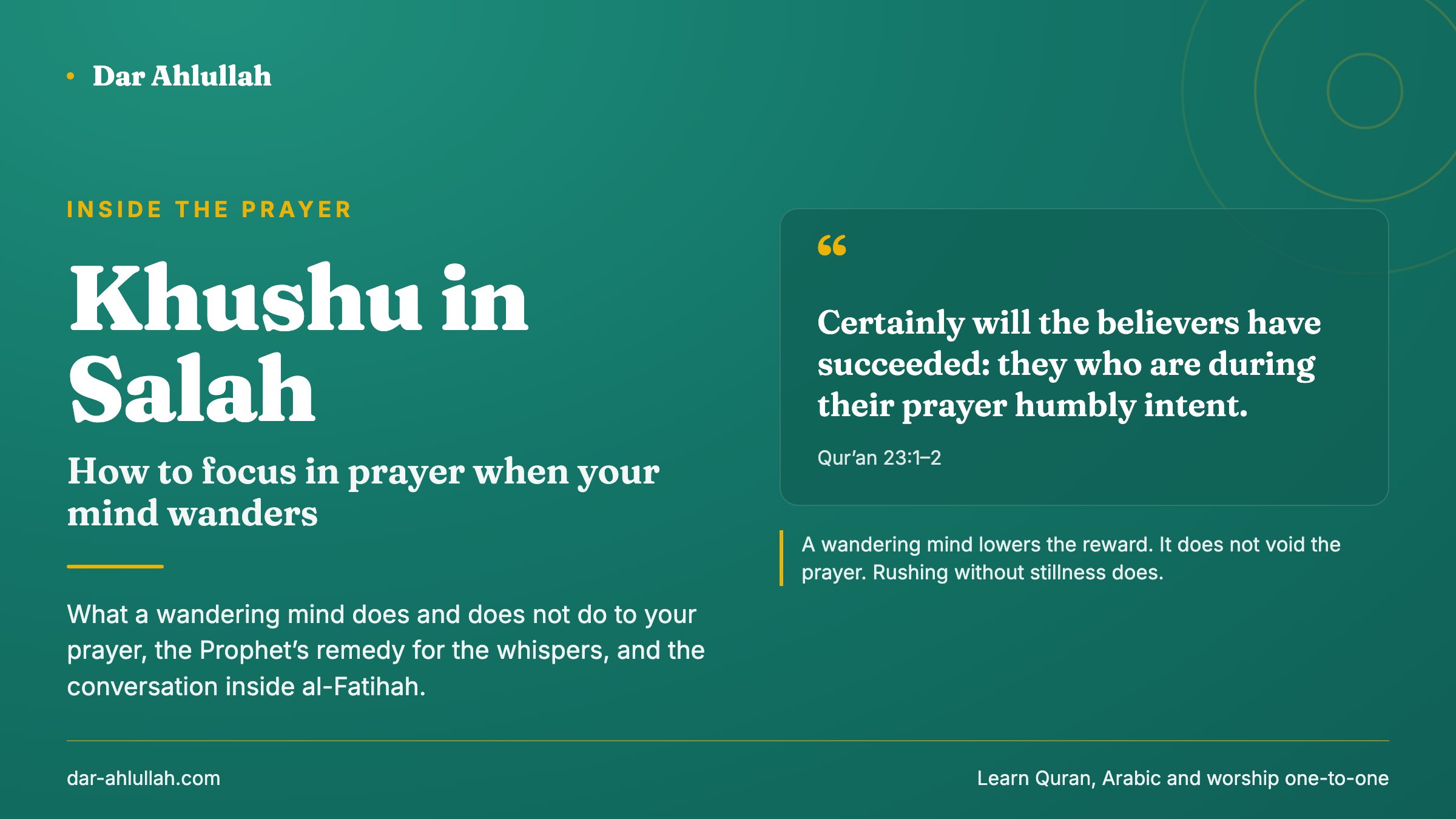
Khushu in Salah: How to Focus in Prayer When Your Mind Wanders
Khushu is stillness of the body and presence of the heart in prayer. What a wandering mind does and does not do to your salah, what the Sunnah gives you before the takbir, inside the prayer and when the whispers come, and how a non-Arabic speaker learns to mean the words.
26 min read