
how to learn Quranic Arabic
How to Learn Quranic Arabic Effectively: A Dar Ahlullah Guide for Beginners
Dar Ahlullah team 34 min read

Have you ever wondered how to learn Quranic Arabic effectively, unlocking a deeper connection with the divine text? Many aspire to understand the Quran directly, but the path often seems daunting, shrouded in linguistic complexities. What if I told you that mastering the language of the Quran is not an unattainable dream, but a journey made accessible through structured and engaging methods? This complete Dar Ahlullah guide is meticulously crafted for beginners, debunking common misconceptions and presenting a clear, actionable roadmap. We'll explore into proven strategies that transform the challenging task of learning Quranic Arabic into a fulfilling and enriching experience, equipping you with the essential tools and insights to embark on this profound linguistic and spiritual adventure.
Table of Contents

This guide provides a complete roadmap for beginners embarking on the journey to learn Quranic Arabic effectively. Below is an outline of the topics covered to assist you in handling this transformative process.
- Introduction: Why Learning Quranic Arabic is a Transformative Journey with Dar Ahlullah
- Understanding the Foundation: What is Quranic Arabic?
- The Dar Ahlullah Method: Best Methods for Quranic Arabic for Beginners
- Effective Strategies and Resources When You Learn Quranic Arabic
- Common Challenges and How to Overcome Them in Your Journey to Learn Quranic Arabic
- Progression and Advanced Learning: Beyond the Basics of How to Learn Quranic Arabic
- Data/Comparison Tables To Aid Your Learning
- Key Takeaways: Your Blueprint to Learn Quranic Arabic Effectively
- Conclusion: Embark on Your Journey to Learn Quranic Arabic Today!
- Frequently Asked Questions (FAQ) About How to Learn Quranic Arabic
Your Learning Path at a Glance
This organized structure is designed to take you from foundational understanding to practical application, equipping you with the knowledge and tools necessary to profoundly understand the Quran.
With this roadmap in hand, let us explore into the profound 'why' behind learning Quranic Arabic and how Dar Ahlullah is poised to guide you.
Introduction: Why Learning Quranic Arabic is a Transformative Journey with Dar Ahlullah

Additionally, having glimpsed the journey ahead through our table of contents, it is essential to first understand the profound motivations and unparalleled advantages that accompany the decision to learn Quranic Arabic. Many aspire to deepen their connection with the Divine word, yet the linguistic barrier often seems daunting. Understanding how to learn Quranic Arabic effectively unlocks a direct, unfiltered engagement with the sacred text.[1]
The Spiritual and Practical Benefits of Understanding the Quran Directly
Foremost, learning Quranic Arabic offers an unparalleled spiritual upliftment. The Quran, as the verbatim word of God, contains layers of meaning, eloquence, and profound wisdom that are often diminished or lost in translation. Directly understanding its verses allows for a more personal, intimate, and reflective engagement, turning recitation into a moving conversation rather than a mere utterance. For instance, the renowned Islamic scholar Imam Al-Ghazali eloquently stated:
"The Quran is the physician of souls, the light of hearts, and the guide of mankind."
Beyond the spiritual, there are significant practical benefits. Being able to comprehend the Quran means a deepened understanding of daily prayers (Salat), a richer appreciation for Islamic concepts and history, and improved Arabic comprehension for other religious texts. Imagine the clarity gained when you grasp the nuances of each word during your prayers. What's more, individuals learn how to learn Quranic Arabic to engage with its timeless messages, which have guided communities for centuries. Wanting to understand the Quran without a translator in between is one of the most common reasons adults start studying Arabic at all. For those interested in starting their studies with expert instructors, Dar Ahlullah offers complete courses tailored to beginners.
How Dar Ahlullah's Approach Revolutionizes Learning Quranic Arabic
Dar Ahlullah stands apart in its dedication to providing a structured and supportive environment for students to master Quranic Arabic. Their methodology emphasizes not just memorization, but deep contextual understanding and practical application. Many struggle to find a reliable path for how to learn Quranic Arabic, but Dar Ahlullah simplifies this process through expert instruction, complete curricula, and personalized support. Their approach is designed to be accessible, effective, and engaging, transforming what might seem like a formidable task into an achievable goal for every dedicated student. Learn more about their mission and approach on their About page.
Ready to Start Your Journey?
Discover how Dar Ahlullah can help you understand the Quran deeply.
Register NowWhat You'll Discover in This Guide on How to Learn Quranic Arabic Effectively
This complete guide details the precise steps and strategies employed by Dar Ahlullah to equip beginners with the tools to understand the Quran. Readers will gain insights into effective learning techniques, valuable resources, and practical advice on overcoming common hurdles. This resource aims to serve as your ultimate reference for how to learn Quranic Arabic, ensuring that your journey is both enriching and successful. We are committed to demonstrating that with the right guidance, anyone can unlock the profound beauty of the Quranic text.
Understanding the Foundation: What is Quranic Arabic?

Also, having established the profound 'why' behind this transformative journey, it becomes important to clearly define 'what' Quranic Arabic is, distinguishing its specific characteristics from other forms of Arabic. Without this foundational understanding, efforts to learn how to learn Quranic Arabic can often lead to confusion or misinterpretation.
Distinguishing Quranic Arabic from Modern Standard Arabic
It is a common misconception that all forms of Arabic are interchangeable. However, Quranic Arabic, often referred to as Classical Arabic, is distinct from Modern Standard Arabic (MSA) and various colloquial dialects. Quranic Arabic represents the pinnacle of Arabic linguistic purity and eloquence, as it was preserved from the 7th century CE. MSA, while derived from Classical Arabic, has evolved to accommodate modern terminology and communication, making it the lingua franca of print media, education, and formal broadcasting today. Colloquial dialects, on the other hand, are the spoken languages of daily life, varying significantly from region to region.[2]
For example, while MSA might use the word “”سيارة” (sayyarah) for car, classical texts might use “”مركبة” (markabah) which is more general. Or consider grammatical structures, where Quranic Arabic often employs more complex sentence structures and a richer vocabulary of synonyms and antonyms, demanding a deeper philological understanding. A key resource in understanding these linguistic differences is the Lughat al-Quran project, which offers detailed insights into its grammar.
Key Characteristics and Grammar Nuances of the Quran's Language
Quranic Arabic is characterized by its unparalleled eloquence (balagha) and precision. Its grammar (nahw) and morphology (sarf) are highly systematic and intricate, providing multiple layers of meaning depending on word form, root, and context. Key features include the extensive use of verbal nouns (masadir), sophisticated rhetorical devices, and an emphasis on triliteral root words, from which a vast array of verbs and nouns are derived. Mastery of these roots is fundamental to learning how to learn Quranic Arabic. What's more, the use of diacritical marks (harakat) is important, as their absence or presence completely alters meaning. This linguistic rigor ensures that every word in the Quran carries profound significance.
Here's a simplified comparison:
| Feature | Quranic Arabic (Classical) | Modern Standard Arabic (MSA) |
|---|---|---|
| Vocabulary | Richer, poetic, emphasis on root words, archaic terms | Contemporary, simplified, new technical terms |
| Grammar | Strict adherence to classical rules, complex structures | Slightly streamlined, more direct structures |
| Rhetoric | High eloquence (balagha), extensive literary devices | Functional, communicative, less emphasis on literary artistry |
| Use Case | Religious texts, classical literature, poetry | News, education, formal communication |
Why Context is important When You Begin to Learn Quranic Arabic
Understanding the context (Asbab al-Nuzul - reasons for revelation) behind each verse is paramount when embarking on how to learn Quranic Arabic. The Quran was revealed over 23 years, responding to specific events, questions, and circumstances in the early Muslim community. Knowing these contexts sheds light on the intended meaning, prevents misinterpretations, and deepens one's appreciation of its timeless guidance. For example, a verse revealed during a period of persecution might carry a different weight than one revealed during a time of peace and prosperity. Ignoring context can lead to an incomplete or even erroneous understanding of the divine message. Reliable tafsir (exegesis) works, such as those by Al-Tabari or Ibn Kathir, provide invaluable contextual details. Also, various academic sources, like the Resources on the Arabic Language of the Qur'an, explore into the etymological and historical backgrounds of Quranic terms.
Did You Know?
According to linguistic analyses, the Quran uses roughly 80,000 words, but these are derived from approximately 1,800 unique root words. Mastering these roots is a powerful shortcut to unlocking vast vocabulary.
With a clearer understanding of the unique linguistic situation of Quranic Arabic, we can now confidently explore the structured, effective methodology employed by Dar Ahlullah to navigate this situation.
The Dar Ahlullah Method: Best Methods for Quranic Arabic for Beginners

In addition, with a clear understanding of what Quranic Arabic entails, its unique characteristics, and significant distinctions, we now turn our focus to the practical pathway for acquisition: the meticulously designed Dar Ahlullah Method. This structured approach is engineered to provide beginners with the most effective strategy for how to learn Quranic Arabic. It dismantles the complexities of the language into manageable, progressive steps, ensuring a solid foundation for every student. Dar Ahlullah's curriculum is not merely about memorization; it's about building a deep understanding and appreciation for the language of the Quran. Therefore, for those asking themselves, ‘What are the best methods for how to learn Quranic Arabic effectively?’, the answer lies in a complete, step-by-step methodology that prioritises clarity and comprehension.
The beauty of the Quran lies in its language. To grasp its message directly rather than through translation, a structured learning path is indispensable.[3]
Step 1: Mastering the Arabic Alphabet and Basic Reading (Qaida)
The journey for how to learn Quranic Arabic at Dar Ahlullah begins with the fundamental building blocks: the Arabic alphabet. Students are introduced to each letter, its various forms, and its correct pronunciation. This phase meticulously covers the Noorani Qaida, a time-tested syllabus designed to teach beginners to read Arabic with proper articulation. Emphasis is placed on phonetics and the distinct sounds that differentiate Arabic from other languages. By the end of this step, students can confidently read Arabic script, preparing them for more complex linguistic elements.
Step 2: Building Foundational Vocabulary and Common Roots
Following alphabetic mastery, students advance to acquiring essential Quranic vocabulary. This stage focuses on frequently occurring words and, crucially, the underlying root letters from which a multitude of words are derived. Understanding root words is paramount in Quranic Arabic, as it unlocks the meanings of many related terms. Dar Ahlullah employs repetition, context-based learning, and interactive exercises to embed this vocabulary firmly. This strategic approach significantly accelerates the process of understanding Quranic texts, making it easier to see how to learn Quranic Arabic systematically.
Step 3: Understanding Essential Quranic Grammar and Morphology (Sarf & Nahw)
With a growing vocabulary, the next critical step is to explore into the grammar (Nahw) and morphology (Sarf) of Quranic Arabic. This stage demystifies sentence structure, verb conjugations, noun declensions, and the patterns of word formation. Dar Ahlullah simplifies these often-intimidating concepts into digestible lessons, using examples directly from the Quran. Students learn to identify different parts of speech, understand their functions, and grasp the nuances of Arabic syntax. This grammatical foundation is important for those who truly want to understand how to learn Quranic Arabic beyond mere recitation.
Step 4: Practical Application Through Quranic Verses and Short Surahs
Theory is cemented through practice. In this phase, students apply their acquired knowledge by translating and understanding actual Quranic verses and short Surahs. This hands-on application not only reinforces grammar and vocabulary but also provides direct spiritual engagement with the text. Teachers guide students through the intricacies of meaning, context, and interpretation, transforming abstract linguistic rules into living, breathing understanding. This practical immersion is a cornerstone of proving how to learn Quranic Arabic effectively at Dar Ahlullah. For further opportunities, explore our Courses.
Step 5: Incorporating Tajweed for Beautiful Recitation
Finally, the method culminates in the study and application of Tajweed, the rules governing correct Quranic pronunciation and recitation. Tajweed ensures that each letter is pronounced with its proper articulation point (makhraj) and attributes (sifat), preserving the beauty and integrity of the Quranic text. This step is about refining recitation to the highest standard, making the learning of how to learn Quranic Arabic a overall experience that encompasses both intellectual comprehension and spiritual connection. A 2018 study by the Islamic Relief Worldwide charity highlighted that correct Tajweed significantly enhances the spiritual impact of Quranic recitation for listeners and reciters alike, underscoring its importance.
These foundational steps, while critical, are most effective when supported by a variety of external aids and resources that amplify learning, which we will explore next.
Effective Strategies and Resources When You Learn Quranic Arabic
Building on this, beyond the structured curriculum of the Dar Ahlullah Method, accelerating your journey to learn Quranic Arabic effectively requires integrating a range of supplementary strategies and leveraging modern resources. These additional approaches can significantly deepen comprehension and foster faster progress.
Digital Tools and Apps Recommended by Dar Ahlullah
To begin with, the digital age offers a plethora of tools that can complement traditional learning. Dar Ahlullah frequently recommends several digital applications that assist learners in mastering script, vocabulary, and grammar. For instance, apps like Quran Companion or Arabic keyboard apps can facilitate consistent interaction with the Arabic language. Websites offering interactive exercises for verb conjugations or noun declensions also prove invaluable. Users seeking to learn Quranic Arabic in a dynamic way often find these digital aids enhance engagement and make practice more accessible anytime, anywhere.
Top Digital Tools for Quranic Arabic
- Quranic Dictionary Apps: Instant access to root words and their meanings.
- Arabic Keyboard Trainers: Practice typing Arabic to familiarize with the script.
- Grammar Practice Platforms: Interactive drills for syntax and morphology.
- Flashcard Apps (e.g., Anki): Customizable for personalized vocabulary retention.
Benefits of Digital Learning
- Flexibility: Learn at your own pace and schedule.
- Portability: Access resources on the go via smartphones or tablets.
- Instant Feedback: Many apps provide immediate correction for exercises.
- Engagement: Gamified elements can make learning more enjoyable.
Enrolling in Dedicated Courses: The Dar Ahlullah Learning Approach
What's more, while supplementary tools are beneficial, a dedicated, structured course remains the cornerstone for anyone serious about how to learn Quranic Arabic effectively. Dar Ahlullah’s complete programs are meticulously designed for beginners, providing a clear progression path from foundational elements to more complex structures. These courses offer expert instruction, peer interaction, and curated materials that simplify the learning process. The emphasis is on understanding, not just memorization, ensuring that learners grasp the intricacies of the language.
Learning a language as rich as Arabic needs structure. A well-designed curriculum takes the student through the complexities in order and makes sure the fundamentals are solid before harder material arrives.
The Power of Immersion: Listening to Quranic Recitations
Another powerful strategy to enhance learning is active listening to Quranic recitation. Regular exposure trains the ear to recognize phonetics, rhythm, and intonation, which are important for both pronunciation and comprehension. Learners should listen attentively, trying to associate sounds with words they are learning. Many resources offer recitations with synchronized text and translation, allowing for a multifaceted learning experience. Studies suggest that passive exposure to a language, when combined with active study, can significantly improve acquisition rates. According to a 2018 study published in the Journal of Language Teaching, learners who incorporate audio immersion show better pronunciation and listening comprehension skills.
Utilizing Flashcards and Spaced Repetition for Vocabulary Retention
Indeed, vocabulary acquisition is often a major hurdle when trying to learn Quranic Arabic. Flashcards, particularly those integrated with spaced repetition systems (SRS), are exceptionally effective. SRS algorithms optimize review intervals, showing learners words right before they are likely to forget them, thereby maximizing long-term retention. This method is far superior to rote memorization. Learners can create their own flashcards or use existing decks, focusing on high-frequency Quranic vocabulary and root words. This systematic approach ensures that valuable study time is spent efficiently.[4]
| Learning Strategy | Primary Benefit | How it Helps Learn Quranic Arabic |
|---|---|---|
| Digital Apps | Accessibility & Practice | Interactive drills for script, grammar, and vocabulary building. |
| Dedicated Courses | Structured Progress & Expertise | Systematic curriculum, expert guidance, and community support. |
| Audio Immersion | Pronunciation & Ear Training | Familiarizes with phonetics, intonation, and natural flow of the language. |
| Spaced Repetition Flashcards | Efficient Vocabulary Retention | Optimizes review schedules to solidify memory of new words and roots. |
Forming Study Groups and Seeking Conversation Partners
Lastly, human interaction remains invaluable. Forming study groups or seeking conversation partners, even for basic practice, can significantly reinforce learning. This provides an opportunity to articulate thoughts, ask questions, and hear different perspectives, all of which deepen understanding. While finding native speakers for intensive Quranic Arabic conversation might be challenging for beginners, even practicing simple sentences based on learned grammar points with peers can build confidence and solidify knowledge. This collaborative environment fosters a sense of community and provides mutual encouragement.
While these strategies and resources significantly enhance the learning process, common hurdles inevitably arise. Understanding and preparing for these challenges is the next important step in maintaining consistent progress.
Common Challenges and How to Overcome Them in Your Journey to Learn Quranic Arabic
As with any endeavor of significant learning, the journey to master Quranic Arabic presents its unique set of challenges. Understanding these common hurdles, and, more importantly, how to surmount them, is key to sustained progress.
Overcoming the Initial Difficulty of Arabic Script
Initially, one of the most prominent obstacles for many learners is the Arabic script itself. Its cursive nature, right-to-left direction, and diacritical marks can seem daunting. To overcome this, consistent and systematic practice is essential. Beginners should focus on recognizing individual letters and their different forms (initial, medial, final). Tracing exercises, writing practice, and using interactive apps specifically designed for script recognition can make a significant difference. Daily short practice sessions are more effective than infrequent long ones. For instance, dedicating just 15 minutes a day to writing Arabic letters can build muscle memory rapidly. Dar Ahlullah’s foundational modules specifically address this, providing guided steps to master the script.
Staying Motivated and Consistent with Your Studies
Second, maintaining motivation and consistency is a universal challenge in language learning. The path to learn Quranic Arabic is a marathon, not a sprint. To combat this, learners should set realistic, achievable goals, breaking down larger objectives into smaller, manageable tasks. For example, instead of aiming to read the entire Quran in a month, focus on mastering one chapter or a specific set of vocabulary. Celebrating small victories, such as understanding a new grammatical concept or accurately translating a verse, provides positive reinforcement. Finding an accountability partner or joining Dar Ahlullah’s community forums can also provide external motivation and support. Remember, even a little progress each day adds up substantially over time.
Dealing with Complex Grammatical Structures
Also, the rich and intricate grammar of Quranic Arabic can often feel overwhelming. Complex verb conjugations, noun declensions, and sentence structures require focused attention. The most effective strategy is to break down complex rules into smaller, digestible components. Visual aids, such as charts and diagrams illustrating verb patterns, can be incredibly helpful. Engaging in focused drills for specific grammatical concepts, rather than trying to absorb everything at once, allows for deeper understanding. Dar Ahlullah’s methodology deconstructs these complexities, presenting them in a logical, step-by-step manner that is easy for beginners to follow, reinforcing concepts through practical examples from the Quran.
Strategies for Tackling Grammar
Breaking down rules, using visual aids, and consistent, focused drills are key. Relate new grammatical concepts to familiar structures from your native language where possible, to create mental anchors.
Finding the Right Mentors and Community Support
Lastly, isolation can hinder progress. The importance of seeking guidance from experienced mentors and engaging with a supportive community cannot be overstated. A good teacher provides clarity, corrects mistakes, and offers encouragement. Dar Ahlullah excels in this aspect, connecting students with qualified instructors and building a vibrant learning community where questions are welcomed, and insights are shared. This supportive environment is important for handling difficulties and staying committed to your goal to learn Quranic Arabic. Learners can use discussion boards, live Q&A sessions, and study groups to interact with peers and instructors, ensuring they never feel alone in their journey. This collective effort significantly eases the perceived difficulty of learning a new language.[5]
By proactively addressing these common challenges, learners establish a strong foundation. This allows for a smooth transition into more advanced aspects of Quranic Arabic, extending comprehension beyond the basics.
7. Progression and Advanced Learning: Beyond the Basics of How to Learn Quranic Arabic
Once the initial challenges are overcome and the foundational elements of Quranic Arabic are firmly established, the path opens to a deeper, more nuanced understanding of the language of the Quran. For those seriously invested in how to learn Quranic Arabic, this next stage is immensely rewarding, unlocking layers of meaning previously inaccessible. This phase is characterized by a shift from basic comprehension to analytical engagement, moving beyond mere translation to profound interpretation.
Delving into Etymology and Root Word Analysis
What's more, advanced learning often involves an in-depth exploration of Arabic etymology and morphology. Understanding the root words (ضَرَبَ, for example, meaning 'to strike' but branching into concepts of travel, parables, and more) allows learners to anticipate meanings, grasp semantic nuances, and appreciate the linguistic interconnectedness of various Quranic terms. This analytical skill is important for anyone dedicated to truly discerning the message of the Quran.
Studying Tafsir (Exegesis) in Conjunction with Arabic
Subsequently, the study of Tafsir, or Quranic exegesis, becomes an indispensable tool. Engaging with classical and contemporary commentaries on the Quran, written by esteemed scholars, significantly deepens one's understanding. However, to truly benefit from Tafsir, a strong command of Quranic Arabic is paramount. It allows the learner to critically evaluate differing interpretations and directly engage with the source material, rather than relying solely on translations of the Tafsir itself.
The language of the Quran rewards depth: the further you go, the more you find. Proper linguistic tools are what make that depth reachable.
Engaging in Quranic Arabic Conversation Practice (Dar Ahlullah's Role)
Also, progress in how to learn Quranic Arabic extends to active engagement. This includes participating in analytical discussions, critically evaluating Quranic passages, and even attempting to express one's own understanding in Arabic. Dar Ahlullah, for instance, offers advanced programs designed to foster these capacities, providing structured environments where learners can engage in 'conversation' – not just in spoken form, but in textual analysis and academic discourse. These programs facilitate a transition from passive reception to active linguistic and intellectual participation, including opportunities to discuss and debate interpretations, bridging the gap between theory and practical application.
Literary Appreciation and Rhetorical Analysis
Finally, advanced learners also cultivate an appreciation for the Quran's unparalleled literary artistry. This involves studying balagha (rhetoric) and stylistic features, recognizing the divine eloquence that makes the Quran miraculous. Such analysis enriches the spiritual experience, demonstrating the careful arrangement of words and phrases to convey profound meanings. To further solidify this understanding and equip learners with practical decision-making tools, we will now provide comparative tables that visually articulate key differences and advantages within the learning situation.[6]
8. Data/Comparison Tables To Aid Your Learning
To provide a clearer perspective and facilitate informed decisions on your learning journey, this section offers concise comparative tables summarizing key aspects and distinguishing features. These visual aids are especially helpful for someone considering how to learn Quranic Arabic and weighing their options.
Table 1: Comparison of Popular Quranic Arabic Learning Resources
| Resource Type | Pros | Cons | Target Audience |
|---|---|---|---|
| Dar Ahlullah (Structured Programs) | complete curriculum, expert teachers, strong community, integrated Tajweed, live interaction, structured progression. | Requires commitment (time/effort), subscription fee. | Committed beginners to advanced, seeking overall, supported learning. |
| Online Platforms (e.g., Apps, MOOCs) | Flexibility, often self-paced, accessible from anywhere, variety of content. | Lack of live interaction, inconsistent quality, limited individualized feedback, high dropout rates. | Self-motivated learners, those seeking supplementary learning or basic exposure. |
| Traditional Madrasas/Institutes | Immersive environment, direct teacher interaction, strong community ties. | Geographical limitations, rigid schedules, often less flexible curriculum, paced by group. | Learners seeking a traditional, in-person educational experience. |
| Self-Study Books/Courses | Cost-effective, self-paced, foundational knowledge. | Lack of feedback, no speaking practice, requires high self-discipline, can lead to incorrect pronunciation/understanding. | Highly disciplined individuals, those with prior linguistic experience. |
Table 2: Key Differences: Modern Standard Arabic vs. Quranic Arabic Grammar
Understanding the Nuance
While sharing a common linguistic root, significant differences exist that are critical for anyone asking how to learn Quranic Arabic effectively. Ignoring these can lead to misinterpretations.
| Feature | Modern Standard Arabic (MSA) | Quranic Arabic |
|---|---|---|
| Vocabulary | Includes modern terms, scientific vocabulary, international loanwords. | Archaic, classical vocabulary; specific religious connotations; rich in synonymy & semantic depth. |
| Verb Forms | Fewer 'rare' or archaic conjugations; more standardized usage. | More frequent use of certain archaic or less common verb forms; classical conjugations. |
| Sentence Structure | More often SVO (Subject-Verb-Object); follows modern grammatical conventions. | Predominantly VSO (Verb-Subject-Object); highly flexible, often poetic word order for emphasis. |
| Usage of Particles | Standardized, clear distinctions in use of prepositions, conjunctions. | Finer semantic nuances for particles; a single particle can have multiple, sometimes profound, meanings depending on context. |
Table 3: Dar Ahlullah's Curriculum vs. Other Common Approaches for Beginners
Also, discerning the most effective methodology is central to successful learning. Dar Ahlullah differentiates itself significantly in its approach to how to learn Quranic Arabic for beginners.
| Feature | Dar Ahlullah's Approach | Other Common Approaches |
|---|---|---|
| Pace | Structured, gradual, allows for thorough foundational understanding without rushing. | Often too fast or too slow; inconsistent, or focused solely on rote memorization. |
| Teacher Support | Live, interactive classes with qualified native Arabic-speaking instructors; personalized feedback. | Pre-recorded lessons; limited or no direct teacher interaction; generic feedback if any. |
| complete Nature | Integrates grammar, vocabulary, Tajweed, morphology, and contextual understanding from day one. | Often compartmentalized; grammar taught separately from reading or pronunciation. |
| Integration of Tajweed | Fundamental component from the start, ensuring correct pronunciation and recitation. | Often an afterthought or optional separate course; not integrated into core language learning. |
| Community & Motivation | Strong sense of community; peer interaction, shared goals, structured motivation. | Isolated learning; high risk of demotivation due to lack of support. |
Armed with these insights and comparative data, the core message of this guide can now be distilled into actionable takeaways, providing a clear blueprint for effective learning.
9. Key Takeaways: Your Blueprint to Learn Quranic Arabic Effectively
Having explored the profound benefits, practical methods, supportive resources, and critical distinctions in learning Quranic Arabic, it is essential to consolidate these insights into a concise, actionable blueprint for your success. This section provides the fundamental principles for how to learn Quranic Arabic successfully.
- Consistency is Key in Your Journey
- Embrace Structured Learning like Dar Ahlullah's Approach
- use Diverse Resources and Tools
- Practice Regularly with Authentic Texts
- Seek Guidance and Community Support
- Focus on Understanding, Not Just Memorization
- Celebrate Small Victories Along the Way
Regular, even short, study sessions are far more effective than sporadic long ones. Build a habit and stick with it.
A well-designed curriculum, like that offered by Dar Ahlullah, provides a clear path, preventing overwhelm and ensuring progressive mastery.
Combine textbooks, audio lessons, dictionaries, and digital apps. Varied input strengthens comprehension and retention.[7]
The Quran itself is your primary textbook. Read, recite, and analyze portions regularly to internalize vocabulary and grammar.
Learning is easier with expert teachers and a supportive peer group. Don't hesitate to ask questions and engage with fellow students.
While memorization has its place, true understanding of the grammar, morphology, and context is what unlocks the Quran's depth.
Acknowledge your progress, no matter how small. This boosts motivation and reinforces your commitment to learning.
With this clear blueprint in hand, the call to action is clear: to formally embark on this enriching journey, and discover the Dar Ahlullah advantage firsthand.
10. Conclusion: Embark on Your Journey to Learn Quranic Arabic Today!
As this complete guide draws to a close, a powerful truth emerges: the journey to how to learn Quranic Arabic is not merely academic, but a deeply personal and enriching quest accessible to all. We have laid out the pathways, and now, the invitation awaits. The ability to directly connect with the Divine message, understand its intricacies, and appreciate its unparalleled beauty is a spiritual privilege that transforms lives.
Recap of the Benefits and the Dar Ahlullah Advantage
We've highlighted the immense spiritual, intellectual, and personal benefits of learning Quranic Arabic. From unlocking deeper meanings in prayer to building a profound connection with Islamic heritage, the advantages are undeniable. Dar Ahlullah stands out with its meticulously structured curriculum, expert native-speaking teachers, integrated Tajweed instruction, and a supportive community, providing an optimal environment for beginners to successfully master how to learn Quranic Arabic.
Next Steps for Aspiring Learners in the US
For those in the United States and beyond, the opportunity to embark on this journey is readily available. The first step towards realizing your goal of learning Quranic Arabic through a proven methodology is to explore Dar Ahlullah's offerings. We encourage you to visit our Courses page to review our programs and consider signing up for a complimentary demo class. This allows you to experience our live, interactive learning environment firsthand.
A Call to Action to Begin Your Quranic Arabic Journey
Therefore, do not delay the pursuit of this invaluable knowledge. Take the decisive step today. The transformative potential of understanding the Quran in its original language is immense. Dar Ahlullah is dedicated to making this journey accessible, effective, and enriching for every student. This complete guide aims to address your initial queries and provide a solid foundation. For further specific questions, please consult our Frequently Asked Questions section.[8]
Frequently Asked Questions (FAQ) About How to Learn Quranic Arabic
To further support your journey and address common queries, this section compiles frequently asked questions regarding the process of learning Quranic Arabic, particularly within the context of Dar Ahlullah's offerings.
Best Practices for Learning Quranic Arabic
Also, consistent daily practice, active participation in classes, and utilizing Dar Ahlullah's supplementary resources are key. This combination accelerates the learning process for anyone wondering how to learn Quranic Arabic effectively.
| Method | Benefit | Dar Ahlullah Integration |
|---|---|---|
| Structured Curriculum | Systematic progression | Core foundational courses |
| Live Teacher Interaction | Immediate feedback & clarification | Online live classes |
| Regular Review | Reinforce learning | Quizzes, homework, practice sessions |
Q5: Do I need to be a Muslim to learn Quranic Arabic?
A: Not at all. Learning Quranic Arabic is open to individuals of all faiths and backgrounds. Many non-Muslims study it for academic interest, to understand Islamic culture, or for linguistic enrichment. Dar Ahlullah welcomes everyone who wishes to understand the language of the Quran. For more details on courses, visit our Courses page.
"Learning a language is having one more window from which to look at the world."
Q6: What specific materials do I need to get started with Dar Ahlullah?
A: Typically, you will need:
- A reliable internet connection.
- A computer or tablet with a webcam and microphone.
- A copy of the Quran (physical or digital).
- Dar Ahlullah provides its own textbooks and workbooks, tailored to the curriculum, which are made available to enrolled students.
Q7: How can I practice speaking Quranic Arabic if it's primarily a written language?
A: While classical Quranic Arabic is not a spoken vernacular, 'speaking' in this context refers to effective recitation, articulating the correct pronunciation (Tajweed), and engaging in analytical discussions about the text. Dar Ahlullah integrates Tajweed practice, encourages students to read aloud, and facilitates interactive sessions where students can discuss meanings and grammatical structures. This builds confidence in articulating Quranic concepts correctly and eloquently.
We hope this complete guide, from the initial spiritual motivations to practical methodologies and essential resources, empowers you to confidently embark on your journey to learn Quranic Arabic effectively with Dar Ahlullah. May your path be blessed with understanding and insight.
Conclusion
Learning Quranic Arabic, though a profound journey, is made accessible through a structured and dedicated approach. As this Dar Ahlullah Guide for Beginners outlines, success hinges on setting clear goals, mastering the basics of grammar and vocabulary, and consistent practice. Engaging with the Quran through listening and reading, and utilizing reputable resources like the Dar Ahlullah courses, are important steps. Remember, patience and perseverance are your greatest allies in understanding the divine message. We encourage you to take the first step today and embark on this enriching path with Dar Ahlullah, unlocking a deeper connection to the Quran.
FAQ
- Q: How long does it take to learn Quranic Arabic?
- A: The time frame varies greatly depending on individual dedication and learning methods, but consistent study for 1-2 years can build a strong foundation.
- Q: Is it necessary to learn classical Arabic to understand the Quran?
- A: Yes, Quranic Arabic is a form of classical Arabic, so learning classical Arabic is essential for a deep understanding.
- Q: What are the best resources for a beginner?
- A: Reputable online courses like those offered by Dar Ahlullah, textbooks focusing on grammar and vocabulary, and audio resources are highly recommended.
- Q: Can I learn Quranic Arabic by myself?
- A: While self-study is possible, structured courses and a teacher can provide guidance, correct mistakes, and motivate you, often leading to faster progress.
- Q: How important is memorization in learning Quranic Arabic?
- A: Memorizing key vocabulary, common phrases, and grammatical rules can significantly accelerate your learning and comprehension.
- Q: What is the most challenging aspect of learning Quranic Arabic?
- A: Many find the complex grammatical structures (sarf and nahw) and the extensive vocabulary to be the most challenging, requiring consistent effort.
- Q: Should I start with reading or speaking?
- A: For Quranic Arabic, it's generally best to start with reading and understanding the script, then grammar and vocabulary, as speaking isn't the primary goal for beginners.
Sources & References
- How to Learn Arabic for Quran The Quranic Arabic Program (quranicma.com) — This source from QuranicMA.com outlines a structured program for learning Quranic Arabic. It likely covers the methodologies and curriculum offered to help individuals understand the language of the Quran.
- Learn Quranic Arabic: Your Gateway to Understanding the Holy Book (sunaan.com) — Sunaan.com provides a guide on learning Quranic Arabic, emphasizing its importance for a deeper comprehension of the Quran. It likely details various aspects of the learning process.
- Quranic Arabic (bayyinah.com) — Bayyinah.com's page on Quranic Arabic likely discusses their approach or resources for studying the language. It could include information about courses, programs, or methodologies advocated by Bayyinah Institute.
- How to Learn Quranic Arabic Effectively: A Dar Ahlullah Guide for Beginners (qurangrace.com) — QuranGrace.com presents a guide for beginners on how to effectively learn Quranic Arabic, potentially drawing from Dar Ahlullah's methodologies. It likely covers foundational steps and strategies for new learners.
- Quranic Arabic: An Introduction (quranbookonline.com) — Quranbookonline.com provides an introduction to Quranic Arabic, likely covering its significance and basic elements. It might serve as a starting point for those looking to understand the language.
- 4 Basic Steps to Understand Quranic Arabic for Beginners (athanacademy.com) — AthanAcademy.com outlines four basic steps to help beginners understand Quranic Arabic. This article likely provides a structured, foundational approach for new students.
- How long does it take to learn Quranic Arabic? (equrancoaching.com) — EQuranCoaching.com addresses the common question of how long it takes to learn Quranic Arabic. This article likely discusses factors influencing learning duration and provides realistic expectations.
- How Long to Learn Quranic Arabic? (quranica.com) — Quranica.com explores the duration required to learn Quranic Arabic effectively. This article likely provides estimates, discusses various learning paces, and offers advice on maximizing progress.
Related articles
how to improve Arabic speaking skills
How to Improve Your Arabic Speaking Skills as an Adult
You can read Arabic fluently and still freeze when someone speaks to you. Reading is recognition; speaking is retrieval, and they are trained separately. Here is which Arabic to speak, and the five drills that work with nobody else in the room.
16 min read
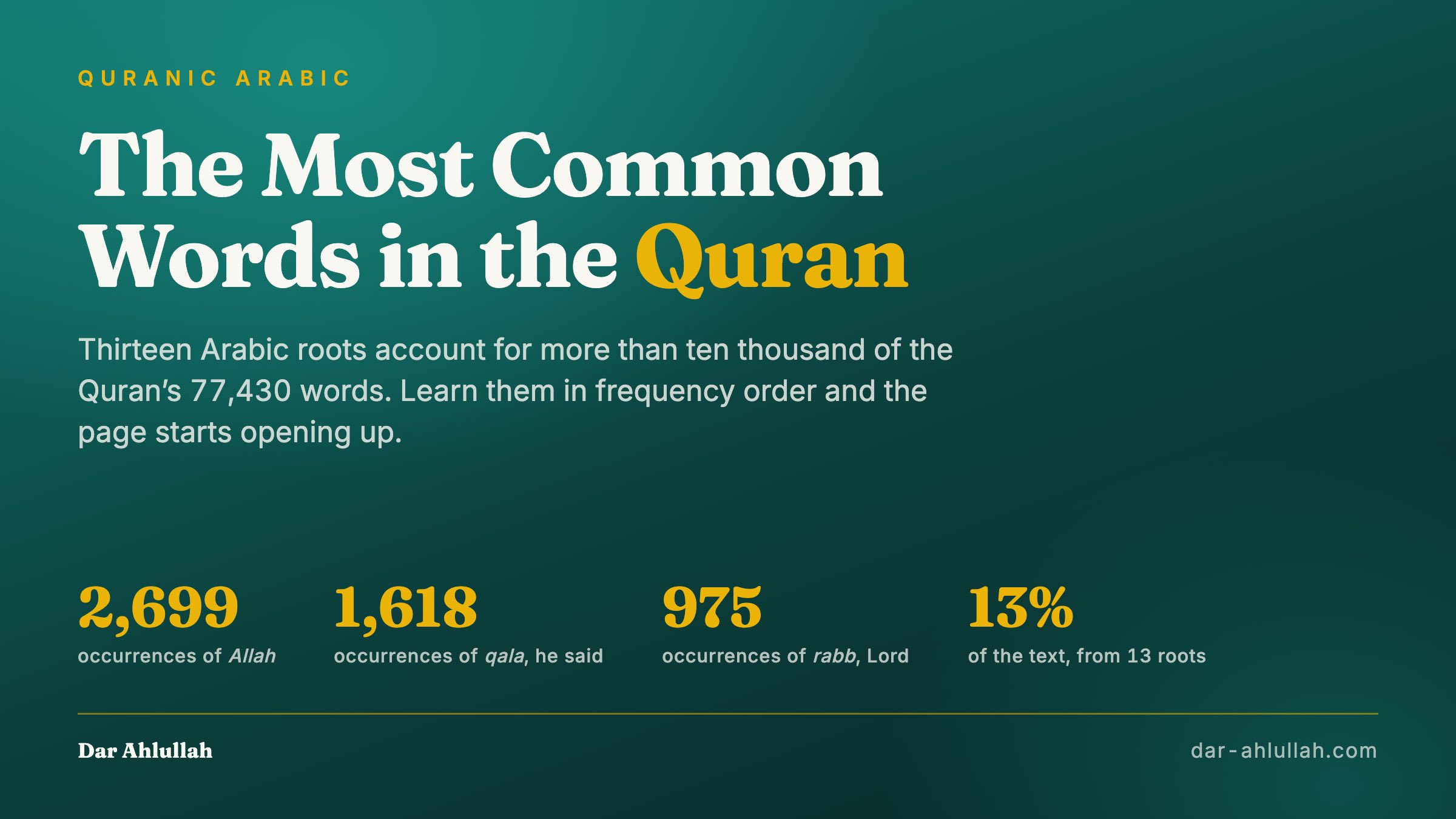
most common words in the Quran
The Most Common Words in the Quran: 13 Roots That Cover 10,000+ Words
Thirteen Arabic roots account for more than ten thousand of the Quran's 77,430 words. Learning them in frequency order is the shortest route from reciting to understanding.
16 min read
Quranic Arabic vs Modern Standard Arabic
Quranic Arabic vs Modern Standard Arabic: Which Should You Learn First?
They share a grammar and diverge in vocabulary and register, so the choice is not which language to learn but which few thousand words you want to own at the end of year one. A decision guide by goal, not by prestige.
16 min read