
how to make dua
How to Make Dua: The Sunnah Etiquette, Accepted Times and What Blocks It
Dar Ahlullah team 19 min read
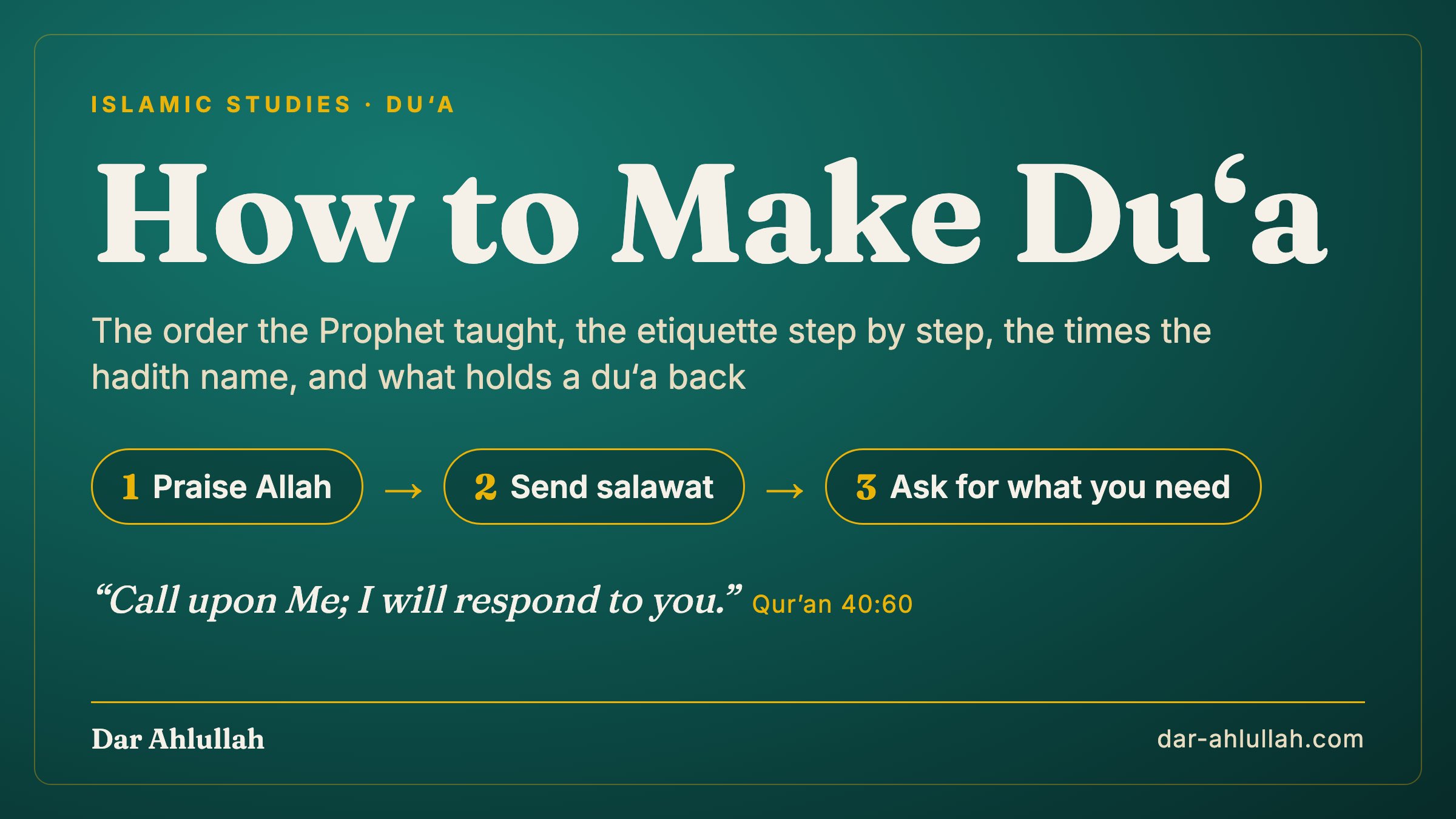
Table of Contents
- Introduction: Asking Is the Worship
- The Short Answer
- What Du‘a Is
- How to Make Du‘a, Step by Step
- When Du‘a Is Answered: The Times the Sunnah Names
- What Holds a Du‘a Back
- Wiping the Face Afterwards: Where the Scholars Stand
- Du‘a in Your Own Language
- Five Short Du‘as Worth Learning in Arabic
- Six Mistakes to Avoid
- How We Teach This
- Questions People Ask
- Conclusion: He Is Near
Introduction: Asking Is the Worship
Most Muslims were never taught how to make du‘a. They learned the hand position by copying a parent, picked up a few Arabic lines by ear, and filled in the rest themselves: a quick request after the prayer, a longer one when something goes wrong. That is not a failure. Outside the prayer du‘a has no fixed form, and Allah answers people who know no Arabic at all. But the Sunnah does show how the Prophet ﷺ asked, which moments he pointed to, and what he said holds a du‘a back. Knowing those changes the way you ask.
This article sets that out from the sources: what du‘a is, a step-by-step method with the evidence for each step, the times the hadith name and how each report is graded, what blocks a du‘a, where the scholars stand on wiping the face afterwards, and five short du‘as worth learning in Arabic. Every ruling is attributed to the hadith, scholar or fatwa that holds it; none of them is a ruling of ours. If you are new to Islam and du‘a is among the first things you are learning, our guide to your first 90 days as a Muslim places it alongside the other foundations.
The Short Answer
- Du‘a is worship, and it is open to everyone. “Supplication is itself the worship” (Sunan Abi Dawud 1479, sahih per al-Albani), and Allah says: “Call upon Me; I will respond to you” (40:60).
- The order the Prophet ﷺ taught is praise, then salawat, then your request (Jami‘ at-Tirmidhi 3477, sahih per al-Albani).
- The etiquette is short. Wudu if you can, face the qiblah, raise your hands with the palms up, call on Allah by His names, ask decisively and expecting an answer, keep your voice low, and repeat it. Only asking Allah alone is a condition; the rest are recommended, and each has its source below.
- Some moments are singled out. The last third of the night, sujud, between the adhan and the iqamah, the end of the obligatory prayers, an hour on Friday, the day of ‘Arafah, and the du‘a of the traveller, the wronged and a parent.
- Some things hold it back. Asking for sin or for cutting family ties, giving up, living on unlawful earnings, overreaching in what you ask, and cursing yourself or your family.
- Wiping the face afterwards is a real difference of opinion. Hanafi texts and al-Nawawi recommend it; Ibn Taymiyyah and Ibn ‘Uthaymin held it is not prescribed, and the hadith reports on it are graded weak.
- Outside the prayer, ask in your own language. Inside the prayer the schools differ; the safe path is short Arabic du‘as there and everything else after the salam.
What Du‘a Is
Du‘a means calling on Allah: asking Him for good, or asking Him to turn harm away. The Prophet ﷺ did not treat it as something added to worship. He said “Supplication is itself the worship”, and then recited the verse as his proof:
“And your Lord says, ‘Call upon Me; I will respond to you.’ Indeed, those who disdain My worship will enter Hell [rendered] contemptible.” (Qur’an 40:60; the hadith is in Sunan Abi Dawud 1479 and Jami‘ at-Tirmidhi 2969, both sahih per al-Albani)
The verse calls the same act “calling upon Me” and “My worship”. Three things follow from that.
- It is made to Allah alone. “When you ask, ask Allah, and when you seek aid, seek Allah’s aid” (Tirmidhi 2516, sahih per al-Albani). Ibn Baz names this the most important condition of du‘a, without which none is accepted (IslamQA 13506).
- It needs no go-between. “And when My servants ask you concerning Me — indeed I am near. I respond to the invocation of the supplicant when he calls upon Me” (2:186).
- Not asking is not humility. “He who does not ask Allah, He gets angry with him” (Tirmidhi 3373, hasan per al-Albani, da‘if per Zubair ‘Ali Za’i).
How to Make Du‘a, Step by Step
The steps below are the etiquette scholars drew from the Prophet’s ﷺ own du‘as; Ibn Baz’s list of them is reproduced in IslamQA 36902. Read them as a description of how he asked, not as a checklist you must pass. Apart from asking Allah alone, a du‘a made without any of them is still a du‘a.
1. Make wudu if you can
When Abu Musa brought him the dying request of a Companion who asked for his forgiveness to be sought, the Prophet ﷺ “asked for water, performed ablution and then raised hands, saying, ‘O Allah, forgive ‘Ubaid, Abu ‘Amir’” (Sahih al-Bukhari 4323). That is the example for wudu before du‘a. It is not a condition. ‘A’ishah reported that he remembered Allah at all times (Sahih Muslim 373), a report that sits in Sahih Muslim’s book on menstruation, under the chapter heading on remembering Allah when one is in a state of major impurity and at other times. Du‘a on your period, without wudu, in bed or on a train is still du‘a.
2. Face the qiblah
Before Badr he “turned his face towards the Qibla, then he stretched his hands and began his supplication to his Lord”, and kept on until his cloak slipped from his shoulders (Sahih Muslim 1763). Al-Nawawi drew from this that facing the qiblah and raising the hands are both recommended in du‘a (quoted in IslamQA 36902). If you cannot face it, ask anyway.
3. Raise your hands, palms up
“Your Lord is generous and is too shy to turn away empty the hands of His servant when he raises them to Him” (Sunan Abi Dawud 1488, sahih per al-Albani). “When you make requests to Allah, do so with the palms of your hands, and not backs, upwards” (Sunan Abi Dawud 1486, hasan sahih per al-Albani). Anas saw him raise his hands “till I saw the whiteness of his armpits” (Sahih al-Bukhari 6341). Ibn ‘Uthaymin held that the hands are held together rather than spread apart, saying that separating them has no basis in the Sunnah (al-Sharh al-Mumti‘ 4/25, quoted in IslamQA 36902).
One report seems to say the opposite. Anas said he raised his hands in no du‘a except the prayer for rain (Sahih al-Bukhari 1031). Al-Bukhari answers it himself: in Sahih al-Bukhari 3565 he follows the same words of Anas with Abu Musa’s report that the Prophet ﷺ made du‘a, raised his hands, “and I saw the whiteness of his armpits”. Read together, the reports are about how high, not whether: in the prayer for rain his hands went higher than anywhere else, as our guide to salat al-istisqa describes.
4. Begin with praise, then send salawat
A man prayed and then asked, “O Allah, forgive me, and have mercy upon me.” The Prophet ﷺ said: “You have rushed, O praying person. When you perform Salat and then sit, then praise Allah with what He is deserving of, and send Salat upon me, then call upon Him” (Jami‘ at-Tirmidhi 3476, sahih per al-Albani). In the next report the order is spelled out: praise of Allah, then blessings on the Prophet, then “let him ask whatever he likes after that” (Tirmidhi 3477).
The praise can be Alhamdu lillahi rabbil-‘alamin, or praise in your own words. The shortest salawat is Allahumma salli ‘ala Muhammad. Our guide to how to send salawat on the Prophet has the full wordings he taught.
5. Call on Him by His names
“And to Allah belong the best names, so invoke Him by them” (7:180). Match the name to the request: Ya Rahman when you ask for mercy, Ya Ghafur when you ask for forgiveness, Ya Razzaq when you ask for provision. Our guide to memorising the 99 names of Allah turns this into a plan.
6. Ask decisively, and expect an answer
“When anyone of you appeal to Allah for something, he should ask with determination and should not say, ‘O Allah, if You wish, give me’, for nobody can force Allah to do something against His Will” (Sahih al-Bukhari 6338). “Call upon Allah while being certain of being answered, and know that Allah does not respond to a supplication from a heart that is heedless and distracted” (Jami‘ at-Tirmidhi 3479, hasan per al-Albani, da‘if per Zubair ‘Ali Za’i). And in a hadith qudsi Allah says: “I am just as My slave thinks I am” (Sahih al-Bukhari 7405). Name what you actually need. Du‘a is not the place for vague politeness.
7. Keep your voice low, and repeat it
“Call upon your Lord in humility and privately; indeed, He does not like transgressors” (7:55). Zakariyya is praised because “he called to his Lord a private supplication” (19:3). When the Companions raised their voices on a journey, the Prophet ﷺ said: “O people! Be kind to yourselves, for you are not calling upon a deaf or an absent one” (Sahih al-Bukhari 6384).
Repeating is Sunnah. When the Quraysh dumped a camel’s entrails on his back as he prostrated at the Ka‘bah, he “raised his head and said thrice, ‘O Allah! Punish Quraish’” (Sahih al-Bukhari 240), and a narration of the same event in Sahih Muslim adds that he loved to repeat a supplication three times (Sahih Muslim 1794c).
8. When you pray for someone, include yourself
“Whenever the Messenger of Allah ﷺ would mention someone and supplicate for him, he would begin with himself” (Jami‘ at-Tirmidhi 3385, sahih per al-Albani). Praying for another Muslim when they are absent carries its own reward: the angel replies, “and the same for you” (Sahih Muslim 2732).
When Du‘a Is Answered: The Times the Sunnah Names
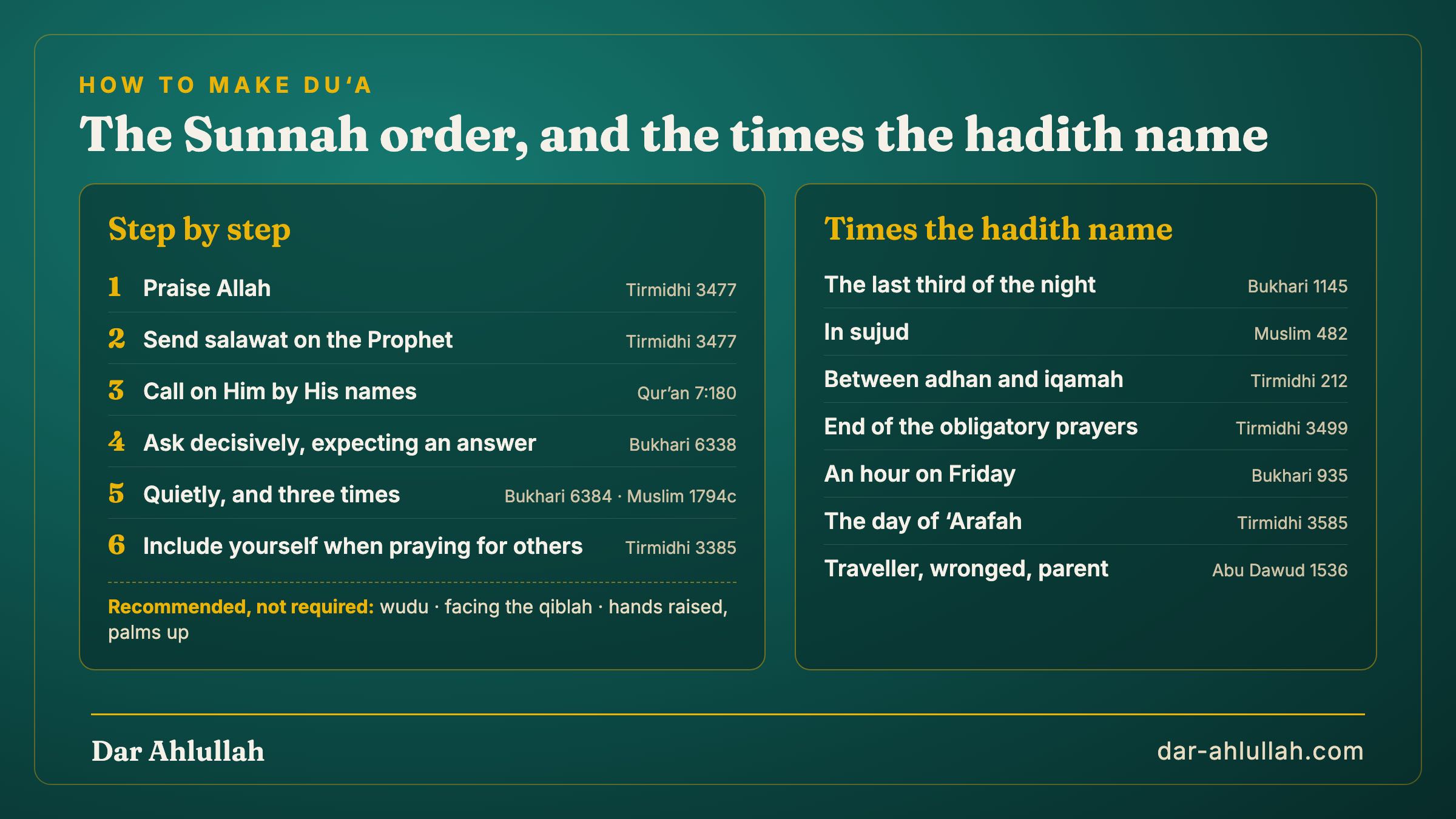
No hadith forbids du‘a at any hour. The forbidden times apply to voluntary prayer, not to asking. But the hadith single out moments when an answer is especially hoped for. IslamQA 22438 collects them; the table gives each with its own source and grade.
| Moment | What the hadith says | Source and grade |
|---|---|---|
| The last third of the night | Allah descends to the nearest heaven and asks who is calling on Him, that He may answer | Bukhari 1145 |
| In sujud | “The nearest a servant comes to his Lord is when he is prostrating, so make supplication” | Muslim 482 |
| Between the adhan and the iqamah | “Not rejected” | Abu Dawud 521, Tirmidhi 212; sahih per al-Albani |
| The end of the obligatory prayers | Asked which du‘a is most likely heard: “the last part of the night, and at the end of the obligatory prayers” | Tirmidhi 3499; hasan per al-Albani, da‘if per Zubair ‘Ali Za’i |
| An hour on Friday | An hour in which a Muslim who asks is given what he asks; he indicated how short it is | Bukhari 935 |
| The day of ‘Arafah | “The best of supplication is the supplication of the Day of ‘Arafah” | Tirmidhi 3585; hasan per al-Albani, da‘if per Zubair ‘Ali Za’i |
| Laylat al-Qadr | ‘A’ishah asked what to say on it and was taught a du‘a for pardon | Tirmidhi 3513; sahih per al-Albani |
| The traveller, the wronged, a parent | “Three supplications are answered, there being no doubt about them” | Abu Dawud 1536, Tirmidhi 1905; hasan per al-Albani |
| For a Muslim in their absence | The angel says “and the same for you” | Muslim 2732 |
| At the call to prayer, and in rain | “Two are not rejected, or seldom rejected”; a second chain adds “while it is raining” | Abu Dawud 2540, sahih per al-Albani; the rain wording classed sahih by al-Albani in Sahih al-Jami‘ 3078 (IslamQA 22438) |
| When a rooster crows | “Ask for Allah’s blessings”, for it has seen an angel | Bukhari 3303 |
Two of these moments have their own guides: the night in how to pray tahajjud, and the minutes before the prayer in how to respond to the adhan.
Which hour on Friday?
The hadith do not agree on a single hour, and neither do the scholars. IslamQA calls two views the strongest in evidence (IslamQA 112165):
- From when the imam sits on the minbar until the prayer ends. Abu Musa’s report (Sahih Muslim 853). Muslim called it the soundest hadith on the subject, and al-Nawawi held it to be the only sound view (Ibn Hajar, Fath al-Bari 2/421).
- The last hour after ‘Asr, until sunset. “Seek it in the last hour after the afternoon prayer” (Sunan Abi Dawud 1048, Sunan an-Nasa’i 1389, sahih per al-Albani). Ahmad said most of the hadith support it, and Ibn ‘Abd al-Barr called it the soundest view.
Ibn al-Qayyim held that both are hours of response (Zad al-Ma‘ad 1/394). The practical answer follows: ask inside the Jumu‘ah prayer itself, in sujud and before the salam, and again in the last hour before Maghrib. Our guide to how to pray Jumu‘ah covers the rest of the day.
“At the end of the prayer”: before or after the salam?
The Arabic in Tirmidhi 3499 is dubur of the prayers, and scholars differed over whether it means the last part of the prayer or the time after it (IslamQA 22438). Ibn Taymiyyah and Ibn al-Qayyim held that it is before the salam, since the dubur of a thing is part of it. Ibn ‘Uthaymin put it this way: what is narrated of du‘a at the end of the prayer is before the salam, and what is narrated of dhikr is after it, because Allah says, “When you have completed the prayer, remember Allah” (4:103). On that view, the moment to ask is the final sitting, after the tashahhud and salawat; the minutes after the salam are for the remembrance set out in our guide to adhkar after salah.
Graded apart
Two moments are widely quoted on reports whose grades are split. Ask at them by all means, since du‘a is open at every hour, but know that the promise attached to them is disputed.
- The fasting person when breaking the fast. “There are three whose supplication is not rejected: the fasting person when he breaks his fast…” (Tirmidhi 3598): da‘if per al-Albani and Ahmad Shakir, hasan per Bashar ‘Awwad. A second report (Ibn Majah 1753) is da‘if per al-Albani and hasan per Shu‘ayb al-Arna’ut.
- Drinking Zamzam. “The water of Zamzam is for whatever it is drunk for” (Ibn Majah 3062): sahih per al-Albani, da‘if per Shu‘ayb al-Arna’ut and Zubair ‘Ali Za’i.
What Holds a Du‘a Back
The same hadith that promise an answer name what stands in its way.
- Asking for sin, or for cutting family ties. The promise of an answer excludes both (Sahih Muslim 2735; Jami‘ at-Tirmidhi 3573, hasan sahih per al-Albani).
- Giving up. “The supplication of any one of you is answered as long as he is not hasty and says: I supplicated and was not answered” (Sahih al-Bukhari 6340).
- Unlawful earnings. The Prophet ﷺ described a dishevelled, dusty traveller raising his hands and calling “O Lord, O Lord”, while his food, drink and clothing were unlawful, and asked how such a man could be answered (Sahih Muslim 1015).
- Overreaching in what you ask. ‘Abdullah ibn Mughaffal heard his son ask for “a white palace on the right of Paradise” and told him: “O my son, ask Allah for Paradise and seek refuge in Him from Hell-Fire, for I heard the Messenger of Allah ﷺ say: In this community there will be some people who will exceed the limits in purification as well as in supplication” (Sunan Abi Dawud 96, sahih per al-Albani). It is the transgression 7:55 warns against.
- Cursing yourself or your family. “Do not invoke curse on yourselves, and do not invoke curse on your children… and do not invoke curse on your property, lest you happen to do it at a time when Allah is asked for something and grants your request” (Sunan Abi Dawud 1532, sahih per al-Albani). Words said in anger are still words said to Allah.
An answer is also not always the thing you named. “There is not a Muslim on the earth who calls upon Allah with any supplication, except that Allah grants it to him, or turns away from him the like of it in evil” (Tirmidhi 3573). Our guide to salat al-hajah works through what to do when the answer is slow, with the prayer of need step by step.
Wiping the Face Afterwards: Where the Scholars Stand
Many Muslims were taught to pass their palms over their face when a du‘a ends; others were taught that doing so has no basis. Both are being taught something a school or a major scholar holds.
| Position | Who holds it | Source |
|---|---|---|
| Recommended after du‘a | Hanafi texts: al-Fatawa al-Hindiyyah, al-Haskafi’s al-Durr al-Mukhtar, Ibn ‘Abidin’s Radd al-Muhtar | Faraz Rabbani and Abu Usamah (Qibla); Mufti Ebrahim Salejee: “It is mustahab” |
| Recommended outside the prayer, not after the qunut inside it | Shafi‘i: al-Nawawi in al-Tahqiq. The school’s texts differ, and Zakariyya al-Ansari held against wiping | ShafiiFiqh (islamqa.org) |
| Reported, with a difference of opinion | Maliki: al-Nafrawi, al-Fawakih al-Dawani | SeekersGuidance, Maliki |
| Not prescribed | Imam Ahmad (“It is not known that anyone used to wipe his face after making du‘a except al-Hasan”), Ibn Taymiyyah, al-‘Izz ibn ‘Abd al-Salam, Ibn ‘Uthaymin | IslamQA 39174 |
The dispute is about the hadith. Each report that describes the wiping is graded da‘if by modern graders: Tirmidhi 3386, which at-Tirmidhi himself called gharib, and Abu Dawud 1485 and 1492, after the first of which Abu Dawud noted that every chain of it is weak. Ibn Hajar held that taken together they rise to hasan (Bulugh al-Maram, quoted in the Qibla answer above); Ibn Taymiyyah held that the one or two reports “cannot be taken as evidence”, while the raising of the hands rests on many sound ones (IslamQA 39174). If you follow a school, follow it here. In either case, it is not a reason to correct someone else.
Du‘a in Your Own Language
Outside the prayer, ask in whatever language your heart speaks. The fatwas collected in our salat al-hajah guide allow du‘a in any language after the salam, and that guide sets out the four schools on du‘a in another language inside the prayer, where the Shafi‘i school holds that composing one invalidates it. The path that is safe on every view is short Arabic du‘as you understand inside the prayer, and everything else in your own words after it.
Your own words are enough. But the Prophet ﷺ “liked comprehensive supplication and abandoned other kinds” (Sunan Abi Dawud 1482, sahih per al-Albani), and a handful of his short du‘as cover more than a long list of requests can.
Five Short Du‘as Worth Learning in Arabic
| Wording | Meaning | Source |
|---|---|---|
| Rabbana atina fid-dunya hasanah, wa fil-akhirati hasanah, wa qina ‘adhaban-nar | Our Lord, give us in this world [that which is] good and in the Hereafter [that which is] good, and protect us from the punishment of the Fire | Qur’an 2:201; his most frequent du‘a (Bukhari 6389) |
| Allahumma innaka ‘afuwwun tuhibbul-‘afwa fa‘fu ‘anni | O Allah, You are Pardoning and love to pardon, so pardon me | Tirmidhi 3513; sahih per al-Albani |
| Ya Muqallibal-qulub, thabbit qalbi ‘ala dinik | O Changer of the hearts, keep my heart firm upon Your religion | Tirmidhi 2140; sahih per al-Albani and Ahmad Shakir |
| La ilaha illa anta, subhanaka, inni kuntu minaz-zalimin | There is no deity except You; exalted are You. Indeed, I have been of the wrongdoers | Qur’an 21:87; the du‘a of Yunus, “no Muslim man supplicates with it for anything” but he is answered (Tirmidhi 3505, sahih per al-Albani) |
| Rabbi zidni ‘ilma | My Lord, increase me in knowledge | Qur’an 20:114 |
For the protective words said each morning and evening, see our guide to morning and evening adhkar; for a decision, the du‘a in our guide to how to pray istikhara.
Six Mistakes to Avoid
- Adding “if You will”. It sounds humble, but the Prophet ﷺ forbade it in du‘a: ask with determination (Bukhari 6338).
- Stopping because nothing seems to happen. Giving up is the one thing the hadith names as cutting the answer off (Bukhari 6340).
- Cursing in anger. “May you never…” said to your own child is a du‘a too (Abu Dawud 1532).
- Shouting it. You are not calling one who is deaf or absent (Bukhari 6384), and the Qur’an asks for du‘a “in humility and privately” (7:55).
- Saving du‘a for the special times. The times in the table add to “Call upon Me; I will respond to you”; they do not limit it. Ask now, and ask again in the last third of the night.
- Treating a weak report as a rule. Wiping the face is not a condition of an answer, and neither is avoiding it. The same goes for the promised answer at iftar or with Zamzam: hope for it, but do not build certainty on a disputed grade.
How We Teach This
Most of what this article describes can be practised tonight in English. What takes longer is the Arabic: reading the Qur’anic du‘as correctly, so that atina, ‘afuwwun and minaz-zalimin come out as words rather than remembered sounds, and knowing enough of the language to mean each phrase as you say it. That is the work a teacher shortens.
Dar Ahlullah runs one-to-one live sessions with certified teachers, scheduled in your own timezone, in Quran, Arabic and Islamic Studies. Teaching is charged at $9 per teaching hour, with monthly plans at $36, $70 and $102 depending on how many hours you want, and a 20% discount for siblings. You can pause, upgrade or switch plans at any time, and if a teacher is not the right fit we rematch you with another certified mentor at no extra cost. The first step is a free 30-minute assessment that does not ask for a card — the details are on our pricing page.
Questions People Ask
How do I make du‘a step by step?
Make wudu if you can, face the qiblah and raise your hands with the palms up. Begin by praising Allah, send salawat on the Prophet ﷺ, then ask for what you need, calling on Allah by His names, decisively and expecting an answer. Keep your voice low and repeat it three times (Tirmidhi 3477; Bukhari 6338; Muslim 1794c).
Do I need wudu to make du‘a?
No. Wudu before du‘a follows the Prophet’s ﷺ example (Bukhari 4323), but it is not a condition; he remembered Allah at all times (Muslim 373).
Can I make du‘a on my period?
Yes. The prayer is not open to you, but du‘a, dhikr and asking in your own words are.
Can I make du‘a in English?
Outside the prayer, yes. Inside the prayer the schools differ, so keep to short Arabic du‘as there and ask in English after the salam.
What is the best time to make du‘a?
The last third of the night (Bukhari 1145) and sujud (Muslim 482) have the strongest evidence. Between the adhan and the iqamah, the end of the obligatory prayers and an hour on Friday are also named in the hadith.
Should I wipe my face after du‘a?
Scholars differ. Hanafi texts and al-Nawawi recommend it; Ibn Taymiyyah and Ibn ‘Uthaymin held it is not prescribed, because the reports describing it are weak. Follow your school.
Do I have to raise my hands?
No. Raising the hands is recommended etiquette (Abu Dawud 1488), not a condition, and many du‘as, such as those in sujud or the final sitting, are made without it.
How many times should I repeat a du‘a?
Three is the Sunnah: he loved to repeat a supplication three times (Muslim 1794c). Nothing limits how often you return to the same request on other days.
Why has my du‘a not been answered?
Check what the hadith name: a request for sin or for cutting ties, unlawful earnings, and giving up. Then remember that an answer may come as a harm turned away rather than the thing you named (Tirmidhi 3573).
Can I make du‘a for something specific, like a job?
Yes. Name it plainly and ask decisively (Bukhari 6338). The only limits the hadith set are sin and cutting family ties (Muslim 2735).
Conclusion: He Is Near
Du‘a needs no appointment, no language and no intermediary. The Sunnah adds an order to it (praise, salawat, then the request), an etiquette of wudu, the qiblah, raised hands and a low voice, and a set of moments when the answer is especially hoped for. Learn those, learn a few of his comprehensive du‘as in Arabic, and keep asking in your own words in between.
“And when My servants ask you concerning Me — indeed I am near. I respond to the invocation of the supplicant when he calls upon Me” (2:186).
Related articles
common Islamic phrases
Common Islamic Phrases: What They Mean, When to Say Them and the Reply
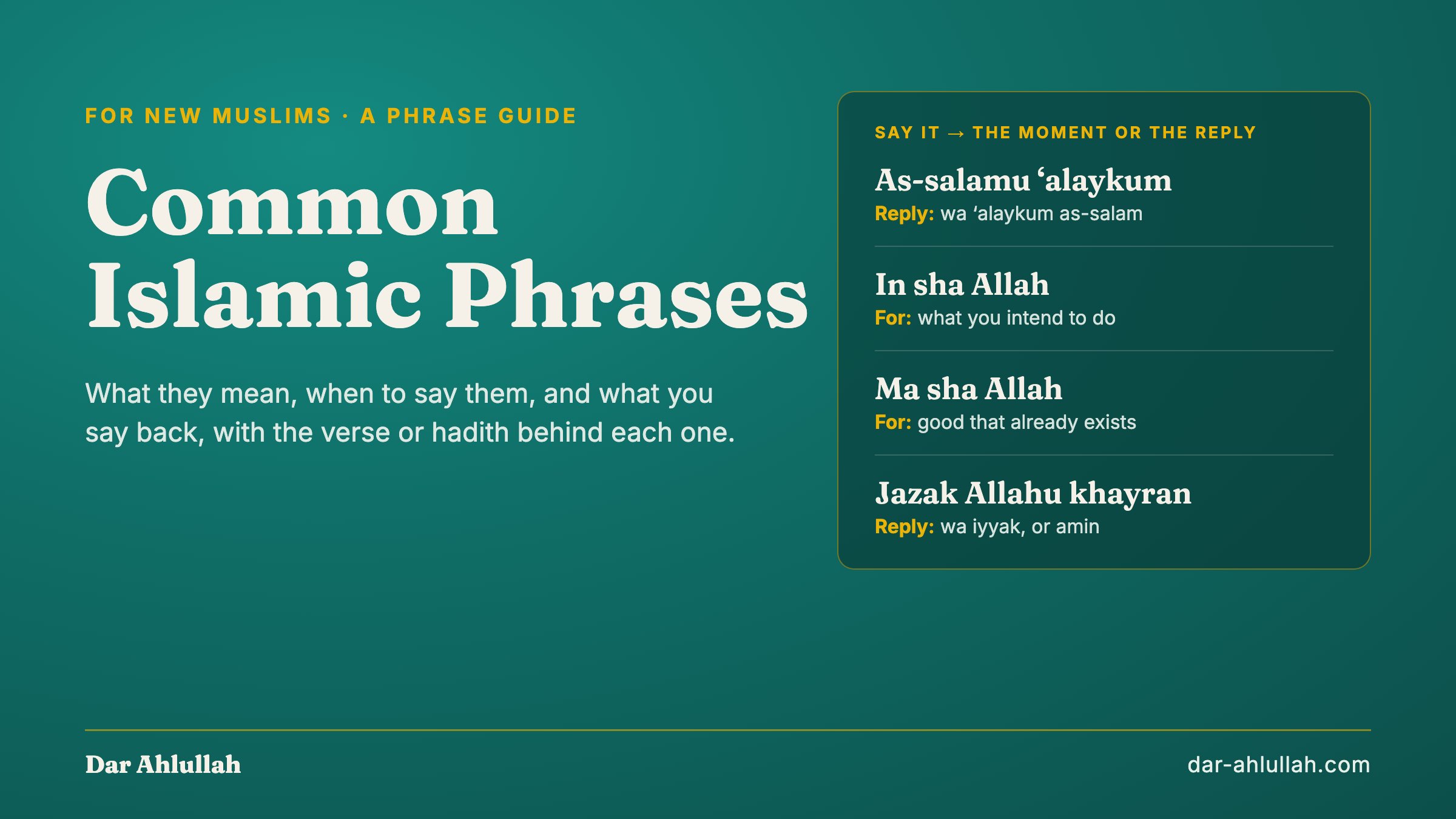
In sha Allah, ma sha Allah, jazak Allahu khayran, the salam and the sneeze: what each common Islamic phrase means, the moment it belongs to, what you say back, and the verse or hadith behind it, with the scholars' positions where they differ.
24 min read
salawat on the Prophet
How to Send Salawat on the Prophet: Wordings, Times and Rulings
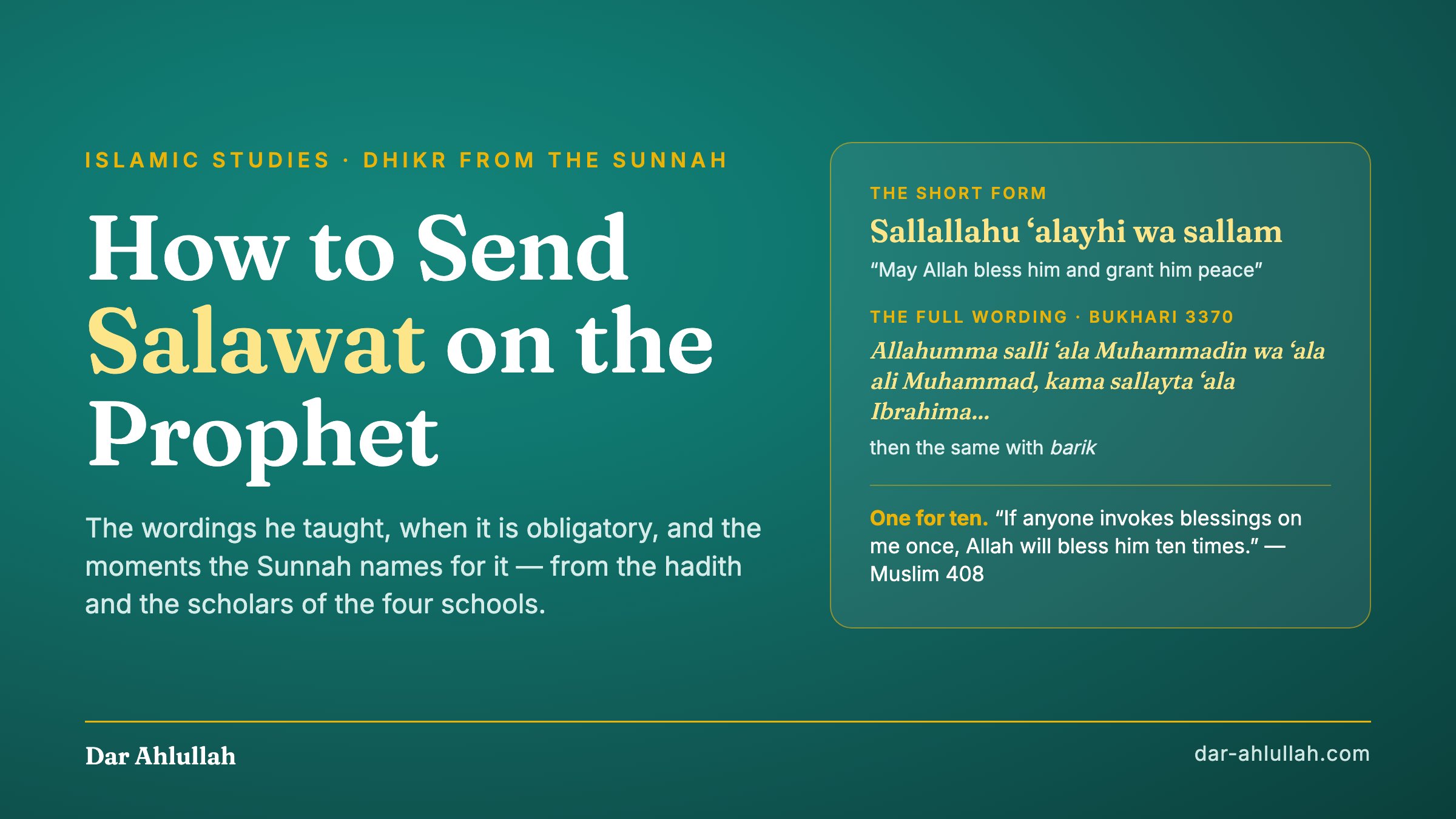
How to send salawat on the Prophet ﷺ, from the sources: the four wordings he taught, the short forms, the four views on when it is obligatory, the moments the Sunnah names for it, what it earns, writing SAW and PBUH, and where composed durood stands.
19 min read
how to pray salat al-hajah
How to Pray Salat al-Hajah: The Prayer of Need
Salat al-hajah is two rak'ahs prayed when you need something, then asking Allah for it. The four reports behind it and their grades, the method step by step, du'as with sound chains, asking in English inside the prayer by school, and what to do when the answer is slow.
25 min read