
salawat on the Prophet
How to Send Salawat on the Prophet: Wordings, Times and Rulings
Dar Ahlullah team 19 min read
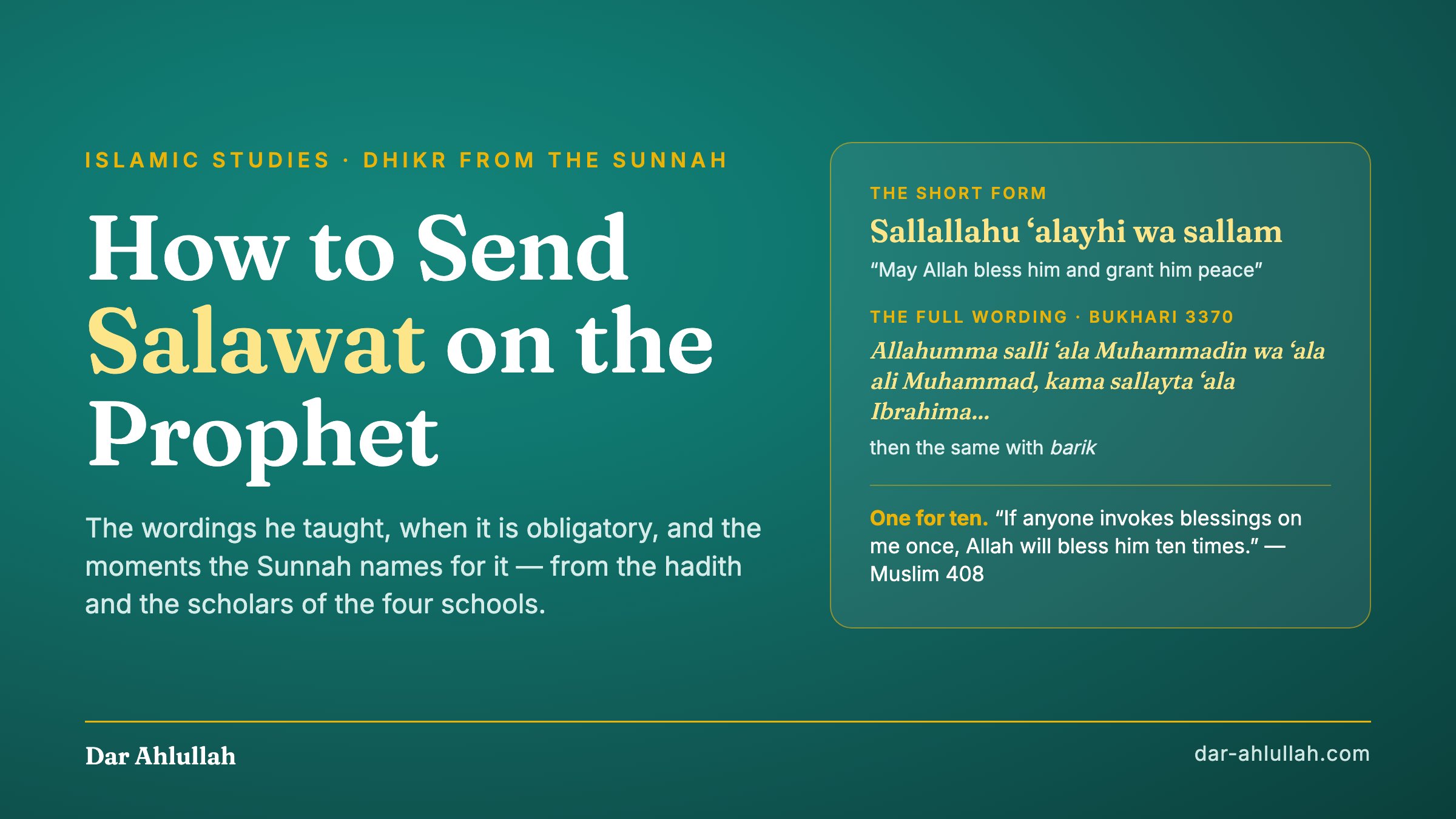
Table of Contents
- Introduction: The Words That Follow His Name
- The Short Answer
- What Salawat Means
- The Wordings He Taught
- The Short Forms, and Wordings of Your Own
- Is It Obligatory? Four Views
- When You Hear or Say His Name
- The Moments the Sunnah Names
- How Much, and Is There a Number?
- What It Earns, and What Leaving It Costs
- Writing It: SAW, PBUH and ﷺ
- Durood Not Found in the Hadith
- Five Mistakes to Avoid
- How We Teach This
- Questions People Ask
- Conclusion: Ten for One
Introduction: The Words That Follow His Name
Anyone who has prayed has said it: the long sentence after the tashahhud that begins Allahumma salli ‘ala Muhammad. Most Muslims also know the short form that follows his name in a talk, a khutbah or a conversation, sallallahu ‘alayhi wa sallam. Far fewer have been taught what connects the two. When is saying it a duty and when is it a virtue? Why did the Companions ask him for its exact wording? And what should you make of the long durood printed in pocket booklets, each with its promised reward?
This article answers those questions from the sources: what salawat means, the wordings the Prophet ﷺ taught, the four views on when it is obligatory, the moments the Sunnah names for it, what it earns, how to write it, and where the composed forms stand. Every ruling is attributed to the hadith, scholar or fatwa that holds it; none of them is a ruling of ours. The prayer that carries the most familiar wording is set out in our step-by-step guide to salah.
The Short Answer
- Salawat means asking Allah to bless the Prophet ﷺ. The command is in the Qur’an: “O you who have believed, ask [Allah to confer] blessing upon him and ask [Allah to grant him] peace” (33:56).
- The fullest wording is the one he taught for the prayer. Allahumma salli ‘ala Muhammadin wa ‘ala ali Muhammad… (Bukhari 3370). The shortest complete form in everyday speech is sallallahu ‘alayhi wa sallam, “may Allah bless him and grant him peace”.
- When it is obligatory is a real disagreement. Every time his name is mentioned; once in a lifetime; in every prayer; or recommended only. All four views are held by major scholars (IslamQA 227203).
- Once earns ten. “If anyone invokes blessings on me once, Allah will bless him ten times” (Muslim 408).
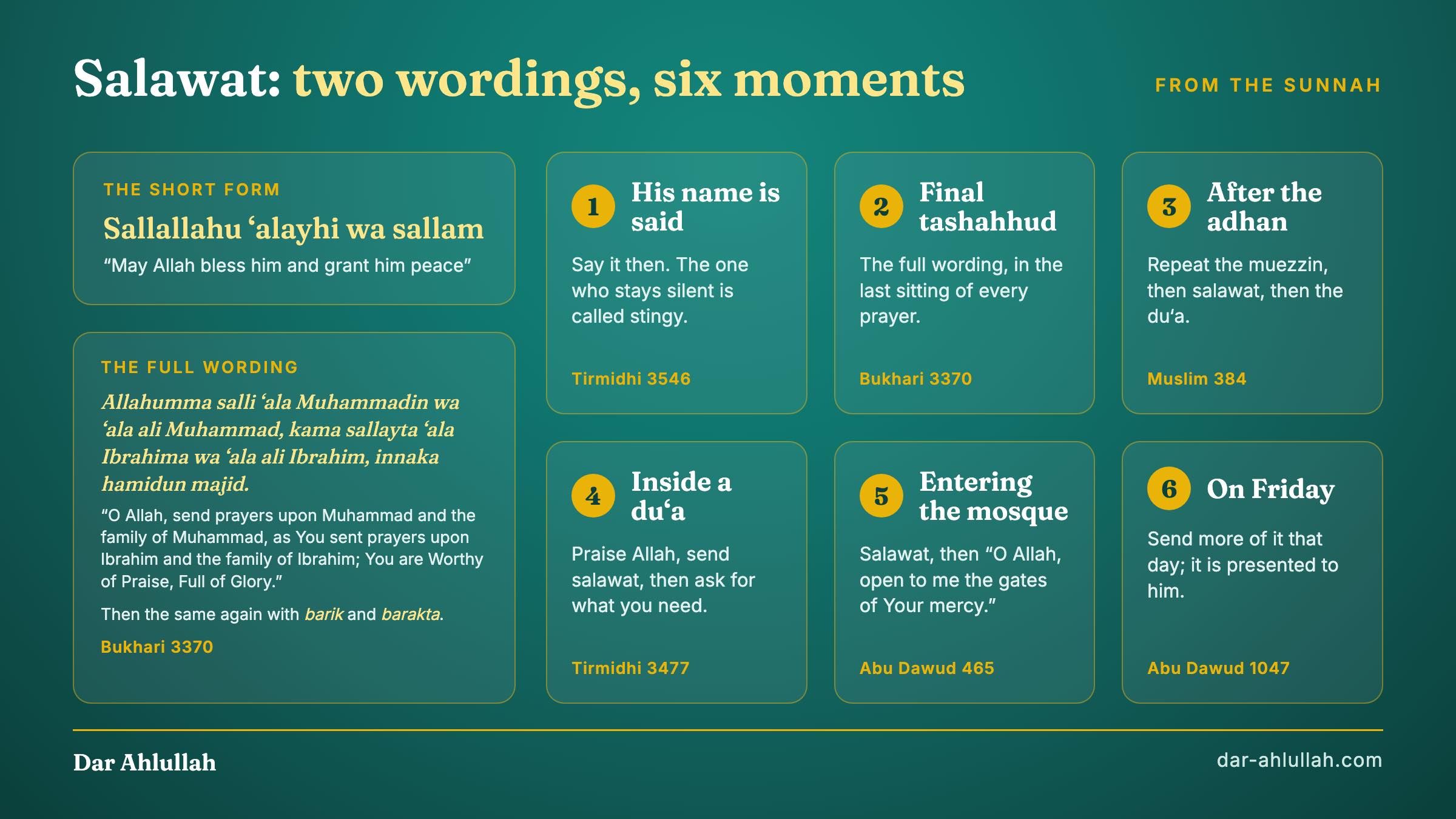
- The Sunnah names particular moments for it. The final tashahhud, after the adhan, inside a du‘a, on entering the mosque, and in abundance on Friday.
- In writing, write it out. Ibn Baz held that the blessing should be written in full rather than as “S” or “SAWS” (IslamQA 47976).
- Composed durood is disputed. Some scholars permit any sound wording while holding the narrated ones superior (Mufti Muhammad ibn Adam); wordings with objectionable meanings are to be avoided, and rewards attached to them are baseless (Darul Iftaa Chicago).
What Salawat Means
Salawat is the plural of salah, the same word as the prayer. The verse that commands it uses it three ways in one sentence:
“Indeed, Allah confers blessing upon the Prophet, and His angels [ask Him to do so]. O you who have believed, ask [Allah to confer] blessing upon him and ask [Allah to grant him] peace.” (Qur’an 33:56)
The word cannot mean the same thing from Allah as it does from the angels and from us. Al-Bukhari recorded the explanation of Abu al-‘Aliyah, one of the early Qur’an commentators: “Allah’s salah is His praising him before the angels, and the salah of the angels is their supplication” (quoted in Ibn Kathir’s tafsir of 33:56). Our salawat belongs to the second kind. It is a du‘a: we are not blessing the Prophet ﷺ ourselves, we are asking Allah to.
The verse also commands two things, not one. Sallu is the blessing; sallimu taslima is the greeting of peace. That is why the common short form carries both halves: salla Allahu ‘alayhi wa sallam. It is also why the Companions put their question the way they did, as the next section shows.
The Wordings He Taught
The Companions already knew one half of the command. Ka‘b ibn ‘Ujrah reported: “We know how to greet you, but how to invoke Allah for you?” (Bukhari 4797). The translation of Bukhari 3370 glosses the greeting they knew as the one “in the prayer”: the tashahhud’s as-salamu ‘alayka ayyuhan-Nabiyyu. The blessing they asked to be taught, and he taught it. The same question reached him from several Companions, and the reports preserve slightly different wordings. All four below are authentic:
| Narrated by | What is distinctive | Source |
|---|---|---|
| Ka‘b ibn ‘Ujrah | The full wording said in the prayer: salli and barik, on Muhammad and the family of Muhammad, as on Ibrahim and the family of Ibrahim, closing innaka hamidun majid | Bukhari 3370, Bukhari 6357 |
| Abu Humayd as-Sa‘idi | “On Muhammad and on his wives and on his offspring” in place of “the family of Muhammad” | Bukhari 3369 |
| Abu Sa‘id al-Khudri | “On Muhammad, Your slave and Your Messenger” (‘abdika wa rasulika) | Bukhari 6358 |
| Abu Mas‘ud al-Ansari | Adds fil-‘alamin, “among all the worlds”, before the closing | an-Nasa’i 1285 |
The first is the one most Muslims learn, and the one said in the final sitting of every prayer:
Allahumma salli ‘ala Muhammadin wa ‘ala ali Muhammad, kama sallayta ‘ala Ibrahima wa ‘ala ali Ibrahim, innaka hamidun majid. Allahumma barik ‘ala Muhammadin wa ‘ala ali Muhammad, kama barakta ‘ala Ibrahima wa ‘ala ali Ibrahim, innaka hamidun majid.
“O Allah, send prayers upon Muhammad and upon the family of Muhammad, as You sent prayers upon Ibrahim and upon the family of Ibrahim; You are indeed Worthy of Praise, Full of Glory. O Allah, send blessings upon Muhammad and upon the family of Muhammad, as You sent blessings upon Ibrahim and upon the family of Ibrahim; You are indeed Worthy of Praise, Full of Glory.”
Its two halves are identical except for one verb: salli/sallayta becomes barik/barakta. Learn the first half properly and you have nearly all of the second. Our guide to what to say in salah shows where it sits in the final sitting, after the tashahhud and before the closing du‘a.
Notice what the wording does. It asks for him what Allah already gave Ibrahim and his family, and it ends on two of Allah’s names, al-Hamid and al-Majid. The salawat is a du‘a in the full sense, closing on Allah’s names the way Ibrahim’s own du‘a closes in the Qur’an: “Indeed You are the Hearing, the Knowing” (2:127).
The Short Forms, and Wordings of Your Own
Outside the prayer, most salawat is short. When his name comes up in speech, the usual response is sallallahu ‘alayhi wa sallam, which answers both commands of 33:56 in four words. Allahumma salli ‘ala Muhammad, “O Allah, bless Muhammad”, is the shortest form of the asking itself.
Is a short form, or a wording nobody narrated, enough? The fatwas below say yes outside the prayer, with a clear order of preference. Mufti Muhammad ibn Adam writes that the Shariah “has not fixed a specific method” of sending blessings, so any wording fulfils the duty, but that the salawat of the prayer has been fixed and must be said as taught. He quotes al-Sakhawi, the author of the classic work on salawat, citing Majd al-Din: there is “leniency in the matter in terms of adding and subtracting words”, yet “it is more virtuous and better to send blessings upon the Messenger of Allah with the words that he taught us” (Mufti Muhammad ibn Adam). Darul Ifta Birmingham likewise answers that “any wording may be used”.
So the order is simple. In the prayer, say the narrated wording. Outside it, any sound wording counts and the narrated ones are best. Composed forms whose wording is disputed have their own section below.
Is It Obligatory? Four Views
The verse is a command. What the command requires, and how often, is one of the oldest disagreements on the subject. Ibn al-Qayyim lays out the positions in Jala’ al-Afham, quoted by IslamQA 227203:
| View | Held by (as reported) | Main reasoning |
|---|---|---|
| Obligatory every time his name is mentioned | At-Tahawi (Hanafi), al-Halimi (Shafi‘i); al-Mawsu‘ah al-Fiqhiyyah adds at-Turtushi and Ibn al-‘Arabi (Maliki), Abu Hamid al-Isfara’ini (Shafi‘i) and Ibn Battah (Hanbali) | The hadiths that call the one who stays silent a miser and pray against him |
| Obligatory once in a lifetime | Narrated from Abu Hanifah, Malik, ath-Thawri and al-Awza‘i; ‘Iyad and Ibn ‘Abd al-Barr called it the view of the majority | A general command does not require repetition; doing it once fulfils it |
| Obligatory in every prayer, in the final tashahhud | Ash-Shafi‘i, and Ahmad in the later of his two reports | The Companions asked how to send it in the prayer, and he taught them |
| Recommended, not obligatory | Others, per Ibn al-Qayyim | The command read as encouragement |
IslamQA adds that the hadiths of warning “support the view of those who say that it is obligatory to send blessings upon the Prophet every time his name is mentioned”, and quotes al-Fakihani inclining to that view (IslamQA 227203).
How do the schools apply this today? Two examples, from the answers of their own teachers:
- Hanafi. Citing Ibn ‘Abidin’s Radd al-Muhtar: it is fard once in a lifetime; wajib “once in each gathering that his blessed name is audibly mentioned”; recommended, not required, each further time the name is repeated in that gathering; and not required merely for thinking of him (SeekersGuidance, Hanafi). Darul Ifta Birmingham also holds it wajib on hearing or saying his name, with one recitation discharging a sitting in which the name recurs, while “the desirable act is to recite the noble duruud every time”.
- Shafi‘i. “According to many scholars” it is obligatory at every mention, but “the relied upon position” of the school is that it is obligatory only in the prayer, and so recommended at each mention (SeekersGuidance, Shafi‘i).
In practice the views meet more than they part. Every school recommends saying it whenever the name is mentioned, and none considers the believer who says it every time to have done too much. The disagreement is about whether the one who stays silent is sinning.
When You Hear or Say His Name
Whether it is a duty or a strong recommendation, the moment for it is the moment the name is said. On the view that it is obligatory at each mention, IslamQA explains that it should be said straight away; a short gap does not matter; and someone who forgot and remembers much later can still send it (IslamQA 227203).
Some states are excused. The Hanafi answer above names being in prayer or in the bathroom, and lists reciting the Qur’an and calling the adhan among the times you are unable to send it (SeekersGuidance, Hanafi). On that answer, his name occurring in a surah you are reciting does not oblige you to stop.
The adhan has a rule of its own. When the muezzin says ashhadu anna Muhammadan rasulullah, the taught response is to repeat his words. Saying sallallahu ‘alayhi wa sallam at that line is not part of it; the salawat comes after the adhan ends (IslamQA 100859). Our guide on how to respond to the adhan covers that sequence line by line.
The Moments the Sunnah Names
Beyond the mention of his name, the hadiths attach salawat to particular moments. Each has its own evidence:
In the final tashahhud
The wording in Bukhari 3370 is the one said after the tashahhud in the last sitting of every prayer. Ash-Shafi‘i, and Ahmad in his later report, held it obligatory there (IslamQA 227203). It belongs to the final sitting only; in the middle sitting of a three- or four-rak‘ah prayer you say the tashahhud and stand, as our salah recitations guide sets out.
After the adhan
“When you hear the Mu’adhdhin, repeat what he says, then invoke a blessing on me”, and then ask Allah for al-wasilah for him (Muslim 384). Repeat, then salawat, then the du‘a, in that order.
Inside any du‘a
The Prophet ﷺ heard a man supplicating in his prayer without praising Allah or sending salawat, and said, “This one has rushed.” Then he taught the order: begin by praising Allah, then send salawat on the Prophet, “then let him supplicate after that, whatever he wishes” (Tirmidhi 3477; Abu Dawud 1481). Al-Albani and Ahmad Shakir graded it sahih. A statement of ‘Umar ibn al-Khattab adds that a du‘a “stops between the heavens and the earth” and nothing of it rises “until you send Salat upon your Prophet” (Tirmidhi 486); Ahmad Shakir and al-Albani graded it hasan, Zubair ‘Ali Za’i weak. The shape this gives a du‘a: praise, salawat, your request.
Entering the mosque
“When any of you enters the mosque he should invoke blessing on the Prophet and then he should say: O Allah, open to me the gates of Thy mercy” (Abu Dawud 465, graded sahih by al-Albani).
In the funeral prayer
After the second takbir of the janazah, the salawat said in the tashahhud is recited. Our guide to salat al-janazah gives the whole sequence.
On Friday, in abundance
“Among the most excellent of your days is Friday… so invoke more blessings on me that day, for your blessings will be submitted to me” (Abu Dawud 1047). Al-Albani graded it sahih and Shu‘ayb al-Arna’ut sahih li-ghayrihi; Zubair ‘Ali Za’i graded it weak. Our guide to the Friday prayer covers the rest of the day.
Morning and evening
A report of ten salawat in the morning and ten in the evening, promising his intercession, is graded apart: al-Dimyati called its chain good and al-Albani weak. Our guide to the morning and evening adhkar sets it beside the sound core of those adhkar.
How Much, and Is There a Number?
No hadith fixes a daily count. The clearest report on quantity has no number at all. Ubayy ibn Ka‘b told the Prophet ﷺ that he made much du‘a and asked how much of it to give to salawat. A quarter? “As you wish, but if you add more it would be better for you.” Half? Two-thirds? The same answer each time. “Should I make all of my Salat for you?” “Then your problems would be solved and your sins would be forgiven” (Tirmidhi 2457). Ahmad Shakir, al-Albani and Bashar ‘Awwad graded it hasan; Zubair ‘Ali Za’i graded it weak.
A second report often quoted, “The person closest to me on the Day of Judgement is the one who sent the most Salat upon me” (Tirmidhi 484), is disputed: Ahmad Shakir and al-Albani graded it weak, Bashar ‘Awwad hasan.
The practical reading: there is no ceiling and no quota. Many people tie a regular amount to a regular time, such as after a prayer or on the way to work, and that is a habit, not a requirement. What the hadith does not support is a fixed number presented as Sunnah with a specific promised reward.
What It Earns, and What Leaving It Costs
The rewards are stated plainly, and their chains are strong:
- Ten for one. “If anyone invokes blessings on me once, Allah will bless him ten times” (Muslim 408; also Abu Dawud 1530).
- Ten sins, ten degrees. Anas reported the addition: Allah “will erase ten sins from him, and will raise him ten degrees in status” (an-Nasa’i 1297, graded sahih by al-Albani).
- It reaches him wherever you are. “Do not make my grave a place of festivity. But invoke blessings on me, for your blessings reach me wherever you may be” (Abu Dawud 2042). “Allah has angels who travel around on Earth conveying to me the Salams of my Ummah” (an-Nasa’i 1282). “If any one of you greets me, Allah returns my soul to me and I respond to the greeting” (Abu Dawud 2041, hasan).
The warnings are just as plain:
- “The stingy person is the one before whom I am mentioned, and he does not send Salat upon me” (Tirmidhi 3546, graded sahih by al-Albani and Ahmad Shakir).
- “May the man before whom I am mentioned — and he does not send Salat upon me — be humiliated” (Tirmidhi 3545, graded hasan sahih by al-Albani and Ahmad Shakir).
Abu Dawud 2042 carries a lesson of its own. It joins the salawat to a prohibition on making his grave a place of festivity: you do not need to travel to send it, and the distance makes no difference to whether it arrives.
Writing It: SAW, PBUH and ﷺ
Writing raises a question speech does not: is an abbreviation enough? Ibn Baz held that it is not. Just as salawat is prescribed in the prayer, the khutbah, du‘a and after the adhan, “so it is more important to do so when writing his name in a book, letter, article and so on”. He said the blessing should be written in full, not as “S” or “SAWS”, because the abbreviation does not fulfil the command, loses the virtue, and may not even be understood by the reader (IslamQA 47976). Darul Ifta Birmingham likewise holds that just as the salawat is wajib in speech when the name is said, it is wajib in writing when the name is written.
The same reasoning applies to “PBUH”. Many publishers, this site included, use ﷺ, a single character that renders the whole Arabic phrase salla Allahu ‘alayhi wa sallam. The fatwas quoted here address letter abbreviations and do not rule on that character either way. Whatever you write, the reader who sees his name still says the blessing aloud or under their breath.
Durood Not Found in the Hadith
Pocket booklets of durood often include long composed forms: Durood Taj, Durood Tunajjina, Salat an-Nariyah (also called at-Tafrijiyyah), and the collections of Dala’il al-Khayrat. They are not narrated from the Prophet ﷺ. Where they stand depends on two separate questions: is a non-narrated wording allowed at all, and is this particular wording sound?
| Form | View | Source |
|---|---|---|
| Any sound non-narrated wording | Permissible and rewarded, provided it is not treated as Sunnah or as superior to the narrated forms; Dala’il al-Khayrat is cited as an example | Mufti Muhammad ibn Adam |
| Durood Tunajjina | Permissible to recite; the rewards ascribed to it are baseless | Darul Iftaa Chicago |
| Durood Taj | Permitted on the same conditions by one Hanafi mufti, who warns that its line calling the Prophet the “averter of affliction” is shirk if meant as him alone repelling it; to be avoided for its “potentially objectionable meanings” according to another | Mufti Muhammad ibn Adam; Darul Iftaa Chicago |
| Salat an-Nariyah | Not established from the Sunnah; its wording is ambiguous and “may create doubt of shirk”, so abstain from it completely | fatwa.ca |
Even the permissive answer sets limits. The composed forms “are not Wajib or Sunna”, must not be considered established through the Sunnah, and the narrated forms remain superior. That answer also separates two kinds of claimed benefit: worldly benefits that scholars reported from their own experience, and specific rewards in the Hereafter, which it is “wrong to mention and believe in” unless established from Allah or His Messenger (Mufti Muhammad ibn Adam).
The same caution applies to the rewards printed beside short forms. Asked about a durood said to make seventy thousand angels write good deeds for a year, Darul Ifta Birmingham traced the closest report to al-Tabarani’s al-Mu‘jam al-Awsat and noted that “most scholars have not graded it to be very strong”, while affirming that sending salawat in any wording is virtuous.
The simplest position satisfies every view above. The narrated wordings carry no dispute, cost nothing to learn, and earn the ten-for-one of Muslim 408.
Five Mistakes to Avoid
- Leaving it out of du‘a. The Prophet ﷺ called a du‘a without praise and salawat rushed (Tirmidhi 3477). Praise Allah, send salawat, then ask.
- Adding it inside the adhan. Repeat the muezzin’s words as they are; the salawat comes when the adhan ends (IslamQA 100859).
- Saying it in the middle sitting. In a three- or four-rak‘ah prayer the salawat belongs to the final sitting; in the first you say the tashahhud and stand.
- Writing “SAW”. Ibn Baz held that the blessing should be written in full (IslamQA 47976).
- Treating a composed durood as Sunnah, or trusting its printed reward. Even the scholar who permits composed forms says they are not Sunnah and that claiming Hereafter rewards for them is wrong (Mufti Muhammad ibn Adam); another calls their ascribed rewards baseless (Darul Iftaa Chicago).
How We Teach This
Most of the salawat is short enough to learn in an afternoon. The full Ibrahimiyyah wording takes longer, and it is the one most often mispronounced, because it is usually learned by ear and never checked. Two things help. The first is reading the Arabic correctly, so that sallayta, barakta and hamidun majid come out as words rather than remembered sounds. The second is enough Arabic to know what you are asking for each time you say it.
Dar Ahlullah runs one-to-one live sessions with certified teachers, scheduled in your own timezone, in Quran, Arabic and Islamic Studies. Teaching is charged at $9 per teaching hour, with monthly plans at $36, $70 and $102 depending on how many hours you want, and a 20% discount for siblings. You can pause, upgrade or switch plans at any time, and if a teacher is not the right fit we rematch you with another certified mentor at no extra cost. The first step is a free 30-minute assessment that does not ask for a card — the details are on our pricing page.
Questions People Ask
How do I send salawat on the Prophet?
Say sallallahu ‘alayhi wa sallam when his name is mentioned, or Allahumma salli ‘ala Muhammad. The fullest wording is the one taught for the prayer: Allahumma salli ‘ala Muhammadin wa ‘ala ali Muhammad, kama sallayta ‘ala Ibrahima wa ‘ala ali Ibrahim, innaka hamidun majid, and its barik half (Bukhari 3370).
What is the difference between salawat and durood?
None in meaning. Salawat is the Arabic word; durood (durud) is the Persian word for the same thing, used widely in Urdu and South Asian English (Wikipedia: Salawat).
Is it obligatory to say salawat every time I hear his name?
The scholars differ. At-Tahawi and al-Halimi held it obligatory every time; Abu Hanifah and Malik are reported as holding it obligatory once in a lifetime; the Shafi‘i school’s relied-upon view makes it obligatory only in the prayer; and the Hanafi school as taught today makes it wajib once per gathering in which the name is heard (IslamQA 227203; SeekersGuidance). All recommend saying it every time.
What is the best wording of salawat?
The wordings the Prophet ﷺ taught when asked, above all the Ibrahimiyyah wording said in the prayer (Bukhari 3370). Al-Sakhawi called sending blessings with the words he taught “more virtuous and better”.
How many times should I send salawat a day?
No number is fixed. When Ubayy ibn Ka‘b asked how much of his du‘a to give to it, the answer was “as you wish”, and more was better (Tirmidhi 2457, hasan per al-Albani).
Can I say salawat in English?
Outside the prayer, the fatwas quoted above hold that no wording is fixed, so a sincere “O Allah, bless Muhammad” is a salawat. In the prayer, say the narrated Arabic wording.
Is it wrong to write SAW or PBUH?
Ibn Baz held that the blessing should be written in full rather than abbreviated (IslamQA 47976), and Darul Ifta Birmingham holds writing it to be wajib when the name is written.
Is Durood Taj allowed?
Hanafi muftis differ: one permits it on condition that it is not treated as Sunnah or as superior to the narrated forms; another advises avoiding it because of objectionable meanings, and calls the rewards attached to it baseless.
Why do we send salawat at the start of a du‘a?
Because the Prophet ﷺ taught that order: praise Allah, then send salawat, then ask for what you need (Tirmidhi 3477).
Conclusion: Ten for One
Salawat is a du‘a the Qur’an commands and the Prophet ﷺ worded himself. Its full form is already in every prayer you pray. Its short form takes four words, and Allah returns each one tenfold. The scholars disagree about when leaving it is a sin; they do not disagree about saying it whenever his name is mentioned, after the adhan, inside your du‘as and often on Friday.
Learn the Ibrahimiyyah wording well enough to say it with meaning, say sallallahu ‘alayhi wa sallam whenever his name is mentioned, and begin your du‘as the way he taught. “Indeed, you are of a great moral character” (68:4).
Related articles
how to make dua
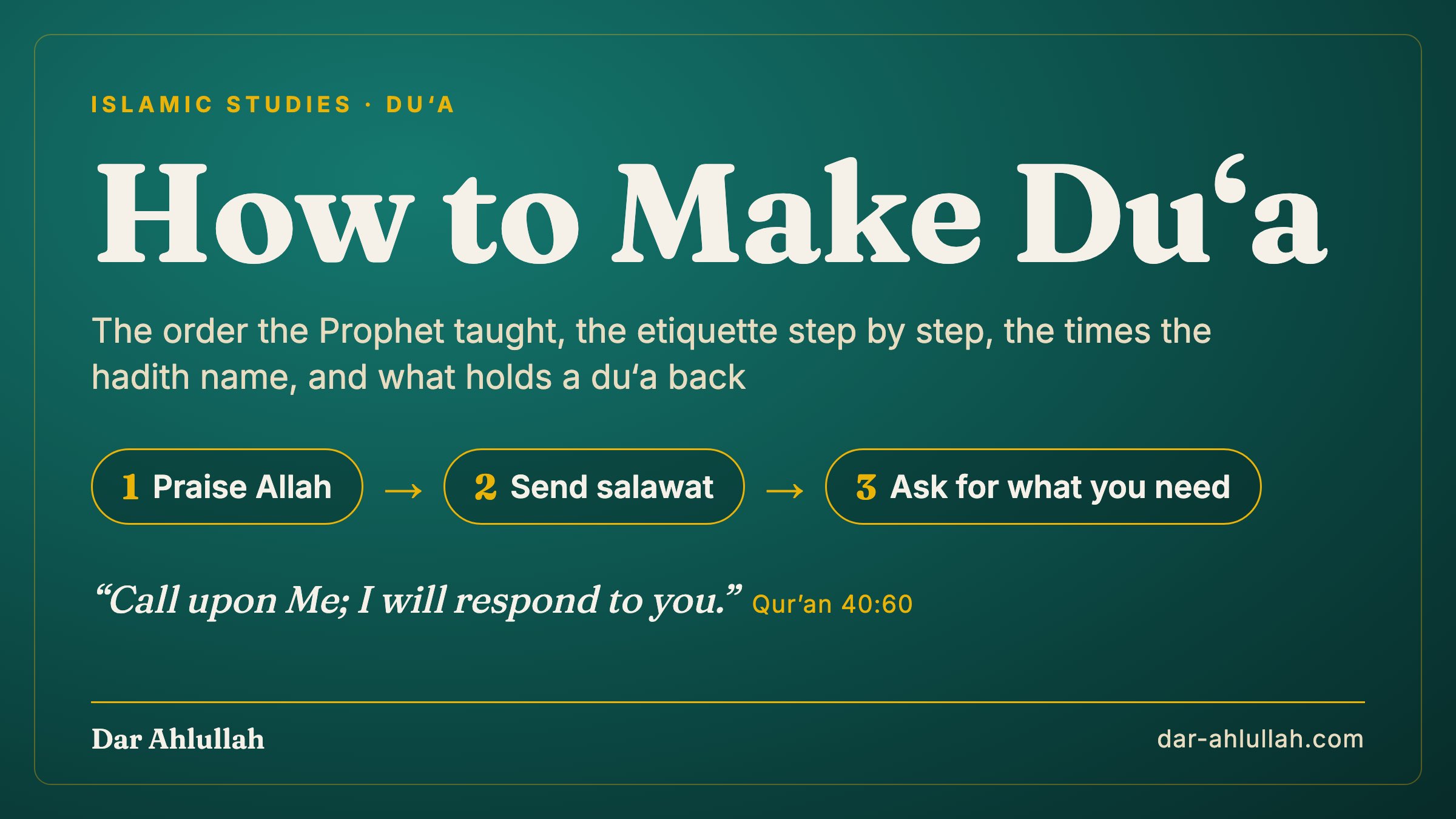
How to Make Dua: The Sunnah Etiquette, Accepted Times and What Blocks It
How to make du‘a from the sources: the order the Prophet ﷺ taught, the etiquette step by step with the evidence for each, the times the hadith name and how they are graded, what holds a du‘a back, and where the scholars stand on wiping the face.
19 min read
morning and evening adhkar
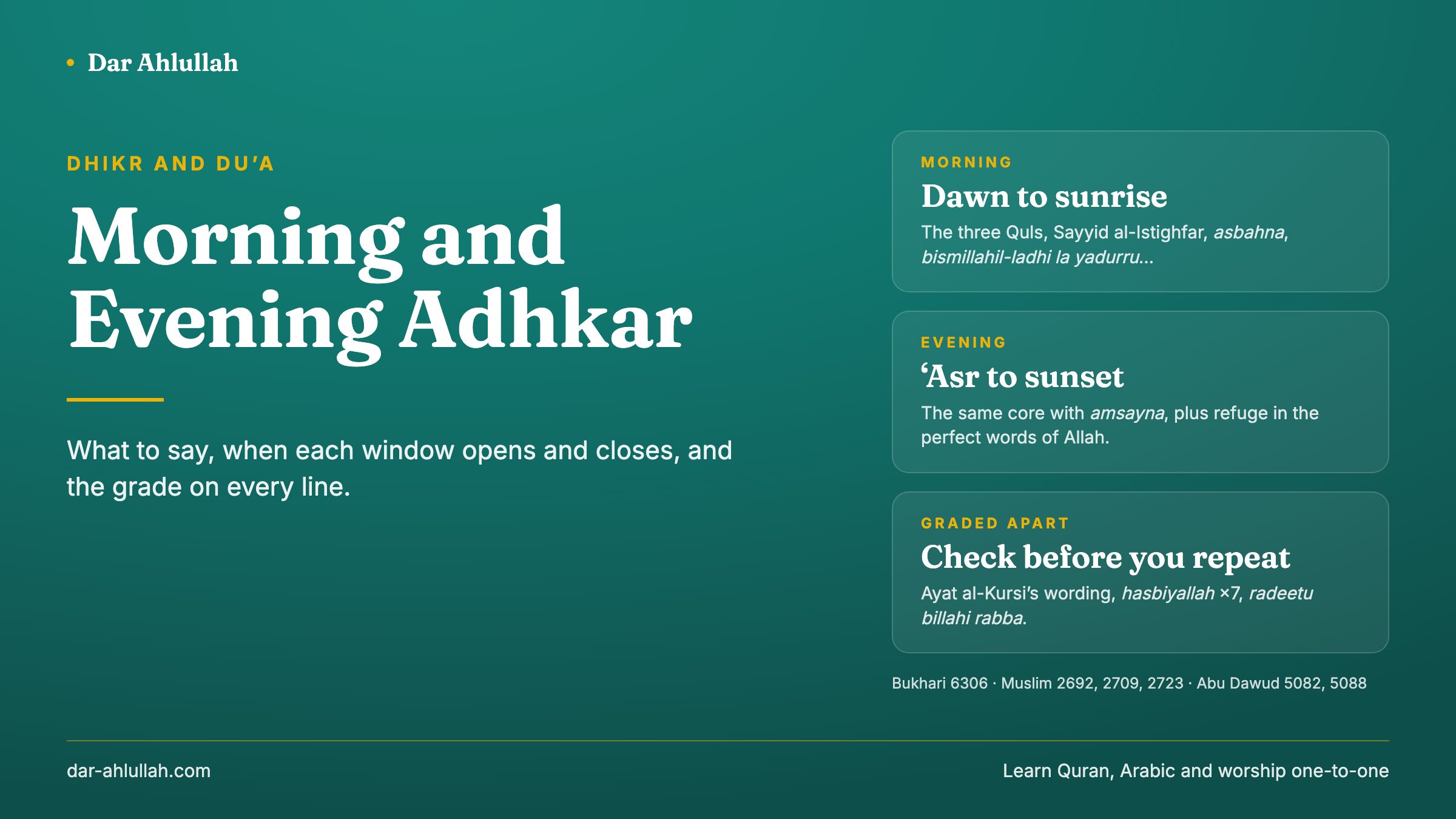
Morning and Evening Adhkar: What to Say and When
Morning and evening adhkar from the sound reports: the windows from dawn to sunrise and from 'Asr to sunset, the core set with the source and count of each line, and the grade printed on the popular additions the hadith scholars dispute, from Ayat al-Kursi to hasbiyallah seven times.
29 min read
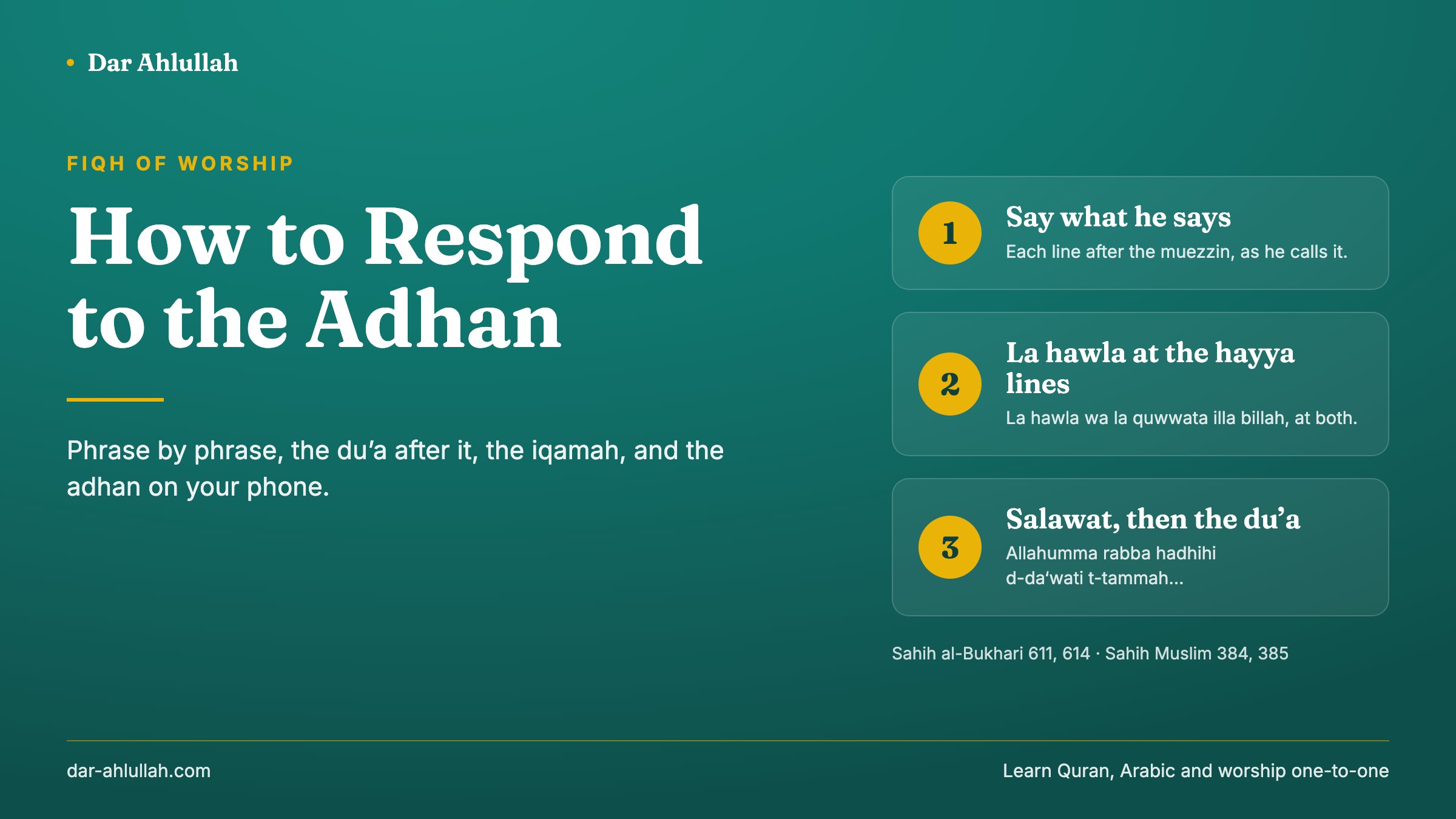
how to respond to the adhan
How to Respond to the Adhan: What to Say and the Dua After
How to respond to the adhan: repeat each phrase after the muezzin, say la hawla wa la quwwata illa billah at the two hayya lines, then send salawat and say the du'a after the adhan. This guide sets out every step from the sound reports, prints the grade on the additions people argue about, and lays out the two scholarly answers on the adhan from a phone app.
29 min read