
99 names of Allah
How to Memorize the 99 Names of Allah: Which List, and a Plan That Sticks
Dar Ahlullah team 20 min read
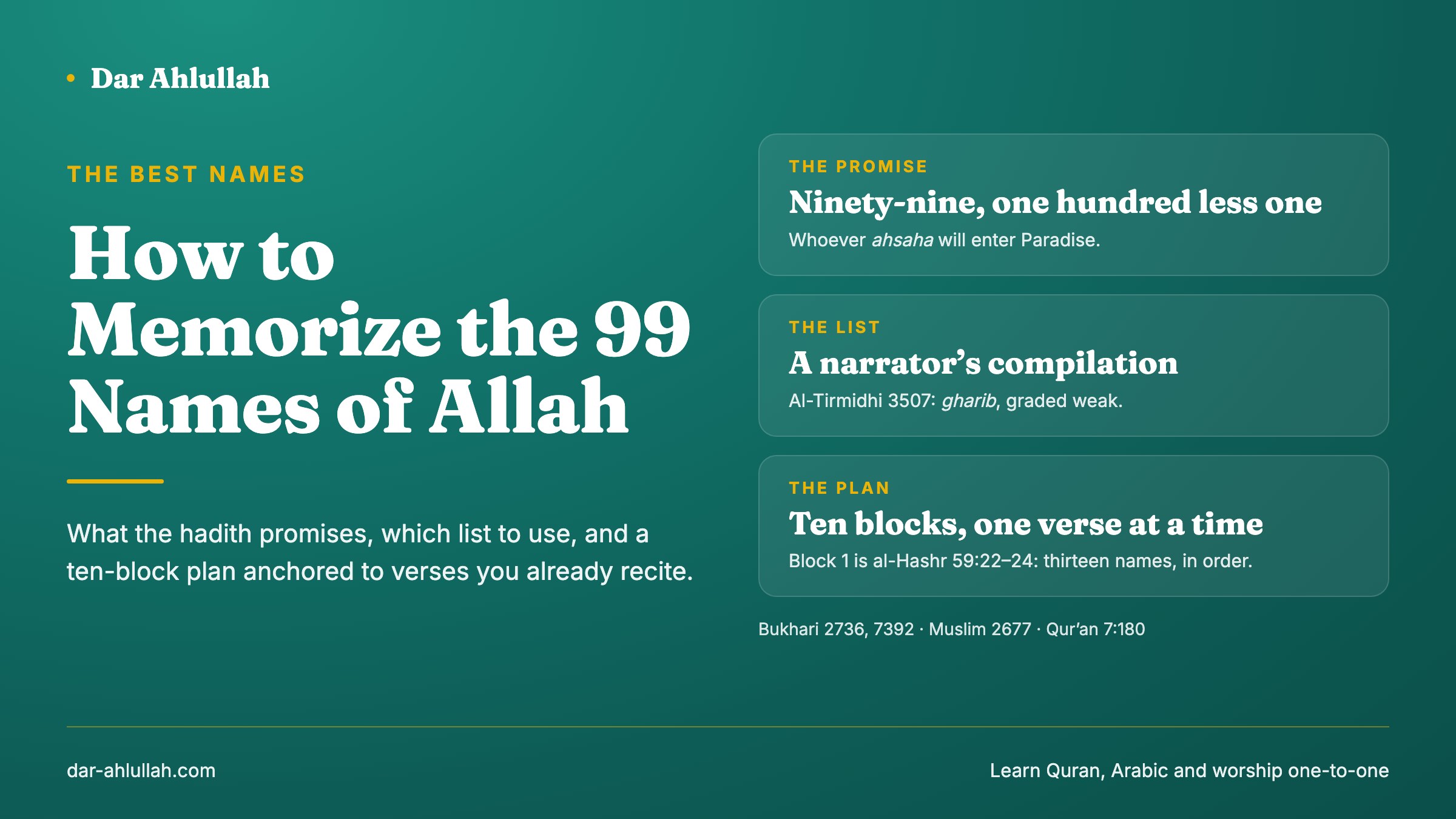
Table of Contents
- Introduction: A Promise With a Number in It
- The Short Answer
- What the Hadith Promises, Word by Word
- Allah Has More Than Ninety-Nine Names
- Which List? The One on Your Poster Comes From a Narrator
- Read the Names as Arabic, Not as Sounds
- The Ten-Block Plan
- Making Them Stay: Spacing and Testing Yourself
- Beyond Memorizing: Understanding, Living and Calling on Him by Them
- Five Mistakes to Avoid
- Teaching the Names to Children
- How We Teach This
- Questions People Ask
- Conclusion: A Number, a Promise and a Lifetime
Introduction: A Promise With a Number in It
Most Muslims meet the ninety-nine names of Allah as a list: a poster in a mosque corridor, a screen in an app, a nasheed a child brings home from weekend school. Then they meet the hadith behind the list — “Allah has ninety-nine names, one hundred less one, and whoever ahsaha will enter Paradise” — and a reasonable ambition forms: learn them all.
Three questions arrive with that ambition. Which ninety-nine, given that the lists online do not quite agree? What does the promise actually ask of you — reciting a list, knowing it by heart, or something more? And how do you get ninety-nine unfamiliar Arabic words to stay in your head past the first fortnight?
This article answers all three from the sources. It sets out what the authentic hadith says and what it does not, where the familiar list comes from and how hadith scholars graded it, and then a practical plan: ten blocks, each anchored to a verse or a pattern you can hold on to, with a review routine built on what memory research has found about spacing and self-testing. Nothing here is a ruling of ours; every position is attributed to the scholar who holds it. If you are new to Islam, our guide to your first 90 days as a Muslim shows where this fits, and our introduction to aqeedah covers the belief about Allah’s names and attributes that sits underneath it.
The Short Answer
- The promise is authentic. “Allah has ninety-nine names, one hundred less one; whoever ahsaha will enter Paradise” is in Sahih al-Bukhari (2736, 7392) and Sahih Muslim (2677).
- The list is not part of it. No narration in al-Bukhari or Muslim names the ninety-nine. The list most apps print comes from one narration in al-Tirmidhi (3507), which al-Tirmidhi himself called gharib and which Ahmad Shakir, al-Albani and Zubair Ali Zai grade weak.
- Allah has more than ninety-nine names. Al-Nawawi reported the scholars’ agreement on this. The hadith attaches a reward to ninety-nine of them; it does not set a ceiling.
- Ahsaha is more than reciting. Explanations of the word include memorising the names, understanding them, acting on what they mean and calling on Allah by them (Qur’an 7:180).
- How to memorise them: learn in ten small blocks, each tied to a verse or a pattern; test yourself from memory before you look; review each block the next day, then a few days later, then weekly.
- A realistic pace: a block every three days covers the list in about a month; a block a week takes ten weeks and leaves more room for review.
What the Hadith Promises, Word by Word
Abu Hurayrah reported that the Messenger of Allah ﷺ said: “Allah has ninety-nine names, one hundred less one; whoever ahsaha will enter Paradise” (Sahih al-Bukhari 2736 and 7392; Sahih Muslim 2677). A narration in Muslim adds: “Allah is witr (One), and He loves what is odd.” The number is stated twice, as ninety-nine and as one hundred less one, and it is attached to a promise. What the hadith does not contain, in any of these narrations, is a list.
The word that carries the promise
Everything turns on ahsaha (أحصاها), from a root that means to count. Translators have struggled with it, and one widely used English translation of al-Bukhari renders it three different ways in three places: “whoever knows them” (2736), “whoever believes in their meanings and acts accordingly” (6410), and “he who memorized them all by heart” (7392). Translations of Muslim give “commits them to memory” and “enumerates them”.
Al-Bukhari left his own note. Straight after the narration at 7392 he glosses the Qur’anic form of the same verb: ahsaynahu, “We have counted it”, means hafiznahu, “We have preserved it” — kept it, as a memoriser keeps what he has learned.
Later explanations widen it. The answer on IslamQA 1392 sets out the learning the hadith refers to as four things: memorising the names; understanding their meanings; acting on them — whoever learns that Allah is al-Ahad associates nothing with Him, whoever learns that He is ar-Razzaq seeks provision from no one else, whoever learns that He is ar-Rahim does not despair of His mercy; and calling on Allah by them, as He says: “To Allah belong the best names, so invoke Him by them” (7:180).
So memorising is the first step of ahsaha, not the whole of it. That is why this article gives the memorising a plan and then spends a section on what comes after it.
Allah Has More Than Ninety-Nine Names
A natural misreading of the hadith is that Allah has exactly ninety-nine names. Al-Nawawi, in his commentary on Sahih Muslim, reported that the scholars were unanimously agreed this is not its meaning: “The point is that one may enter Paradise by learning them, not that the number is limited to these names.” Ibn Hazm did take the limited reading, and the majority did not follow him (both quoted in IslamQA 41003).
The evidence usually given is a du‘a the Prophet ﷺ taught for distress and grief, narrated by Ibn Mas‘ud, in which the worshipper asks Allah “by every name belonging to You which You have named Yourself with, or revealed in Your Book, or taught to any of Your creation, or kept with Yourself in the knowledge of the unseen” (Musnad Ahmad 3704, graded sahih by al-Albani in al-Silsilah al-Sahihah 199). Names kept in the knowledge of the unseen are, by definition, names no list contains. Ibn Taymiyyah drew the conclusion in one line: “This indicates that Allah has more than ninety-nine names” (Majmu‘ al-Fatawa 6/374).
Ibn ‘Uthaymin’s comparison is the easiest way to hold it. Someone who says “I have a hundred horses I have prepared for the cause of Allah” is not saying he owns only a hundred horses; he is saying these hundred are set aside for a purpose. The hadith sets aside ninety-nine names with a reward attached; it does not count everything there is (Majmu‘ Fatawa Ibn ‘Uthaymin 1/122, via the same answer). If distress is what brought you here, our article on the prayer of need sets out the prayer and du‘as the Prophet ﷺ turned to when something weighed on him.
Which List? The One on Your Poster Comes From a Narrator
Neither al-Bukhari nor Muslim lists the names. The list most people know — beginning ar-Rahman, ar-Rahim, al-Malik, al-Quddus and ending ar-Rashid, as-Sabur — comes from one narration in al-Tirmidhi’s collection, through al-Walid ibn Muslim (Jami‘ al-Tirmidhi 3507).
Al-Tirmidhi graded it himself, straight after narrating it. He called it gharib, said he knew it only through Safwan ibn Salih, and added that although the hadith reaches us from Abu Hurayrah by other routes, “we do not know, in much of the narrations, mention of the names except in this hadith”, and that another chain which does mention them “has no sound isnad.” The modern graders printed with the hadith — Ahmad Shakir, al-Albani and Zubair Ali Zai — all grade this narration da‘if, while the short version without the list (3506) is graded sahih by Shakir and al-Albani. IslamQA adds that Ibn Hajar classed the listed version weak in al-Talkhis al-Habir (4/172), reporting the same from Ibn Hazm and al-Bayhaqi, and that Ibn Taymiyyah did too, in Majmu‘ al-Fatawa (22/482) (IslamQA 72318).
The explanation many hadith scholars give is that the names are not from the Prophet ﷺ at all: one of the narrators gathered them from the Qur’an and hadith and attached them to the report. The Hanafi hadith-checking service Hadith Answers states that view, notes that Ibn Hajar still called al-Tirmidhi’s chain the closest to authenticity of the chains that list names (Fath al-Bari, under hadith 6410), and adds that the scholars who held the view did not forbid using the list.
A second list that does not match
Ibn Majah narrates the hadith with its own ninety-nine (Sunan Ibn Majah 3861), and it is a different list. It opens with Allah, al-Wahid, as-Samad, al-Awwal rather than ar-Rahman, and it includes al-Jamil, al-Qarib, ar-Rabb, al-Burhan and ash-Shadid, none of which is in al-Tirmidhi’s. Two lists attached to the same sentence cannot both be the Prophet’s ﷺ wording, which is a good part of why the scholars read them as the work of narrators.
Copies of al-Tirmidhi’s list also differ slightly among themselves. The version on Wikipedia, like many posters, numbers ar-Rahman as the first name and as-Sabur as the ninety-ninth, with al-Ahad beside al-Wahid; the Arabic text of 3507 in the online hadith editions has no al-Ahad, so its ninety-nine begin with the name Allah itself. If your app and your poster disagree by one name, that is one place they part.
What later scholars did instead
Because no authentic text fixes the ninety-nine, scholars compiled the names directly from the Qur’an and the authentic Sunnah. One widely used compilation is Shaykh Muhammad ibn Salih al-‘Uthaymin’s, in his al-Qawa‘id al-Muthla, which IslamQA points readers to; IslamQA also notes that the names found in the Qur’an and Sunnah number more than a hundred (1392). Comparing those compilations with al-Tirmidhi’s list, Wikipedia’s article summarises twenty-one names in the familiar list that Ibn ‘Uthaymin, Shaykh ‘Abd al-Muhsin al-‘Abbad and others did not find established as names in the texts — among them al-Khafid, al-Mu‘izz, al-Mudhill, ad-Darr, an-Nafi‘, al-Baqi and as-Sabur.
That does not mean those words say anything untrue of Allah. The Qur’an itself says to Him, “You honor whom You will and You humble whom You will” (3:26). The question the scholars were asking is narrower: whether a description of what Allah does has been given to us as one of His names.
| Source | What it contains | Standing |
|---|---|---|
| Bukhari 2736, 7392; Muslim 2677 | The number, ninety-nine, and the promise of Paradise for whoever ahsaha | Sahih, by agreement |
| Tirmidhi 3506 | The same promise, no list | Sahih (Shakir, al-Albani) |
| Tirmidhi 3507 | The familiar list, ar-Rahman to as-Sabur, via al-Walid ibn Muslim | Gharib per al-Tirmidhi; da‘if per Shakir, al-Albani, Zubair Ali Zai, Ibn Hajar, Ibn Taymiyyah |
| Ibn Majah 3861 | A different list of ninety-nine | Differs from 3507 throughout; read by many scholars as narrators’ work |
| Ibn ‘Uthaymin, al-Qawa‘id al-Muthla | Names compiled from the Qur’an and authentic Sunnah | A scholar’s compilation, not a hadith |
So which should you memorise?
Our suggestion, not a ruling: if you already know the familiar list, keep it — most of its names are among those the compilers did find in the texts — but stop treating its wording or its order as the Prophet’s ﷺ, and learn which of its names are the ones in question. If you are starting from nothing, start with names you can find in verses you recite, which is exactly what the plan below does: its first block is a passage of the Qur’an. Either way, when you call on Allah by a name in du‘a, prefer the names you can point to in the Qur’an or the authentic Sunnah.
Read the Names as Arabic, Not as Sounds
Ninety-nine unconnected sounds are hard to hold. Ninety-nine Arabic words are much easier, because Arabic builds its words from three-letter roots set into a small number of patterns, and the names share both. Ten minutes spent on how they are built saves hours of rote repetition.
Roots: families of names
Many of the names come in families that share a root. Learn the root once and you have the core meaning of every member.
| Root | Names in the familiar list | The shared idea |
|---|---|---|
| r-h-m | ar-Rahman, ar-Rahim | Mercy |
| gh-f-r | al-Ghaffar, al-Ghafur | Forgiving, covering over |
| q-d-r | al-Qadir, al-Muqtadir | Power |
| gh-n-y | al-Ghaniyy, al-Mughni | Richness, freedom from need |
| w-l-y | al-Waliyy, al-Wali | Closeness, protection, charge over |
| ‘-l-w | al-‘Aliyy, al-Muta‘ali | Height |
| m-j-d | al-Majīd, al-Mājid | Glory |
| h-k-m | al-Hakam, al-Hakim | Judgement, wisdom |
| k-b-r | al-Kabir, al-Mutakabbir | Greatness |
Patterns: what the shape of a name tells you
The pattern a root is set into adds meaning of its own. Two patterns are worth knowing before you start:
- The doubled middle letter (fa‘‘al). Al-Ghaffar, al-Qahhar, al-Wahhab, ar-Razzaq and al-Fattah stand next to each other in the familiar list, all on the same pattern, which Arabic uses for doing something again and again or in abundance: the One who forgives and forgives, who gives and gives. Al-Jabbar and at-Tawwab are on the same pattern elsewhere in the list.
- The mu- prefix. Al-Mu’min, al-Muhaymin, al-Musawwir, al-Mu‘izz, al-Mudhill, al-Mubdi’, al-Mu‘id, al-Muhyi, al-Mumit: the prefix marks the doer of an action — the Fashioner, the One who begins, who brings back, who gives life, who causes death.
None of this requires you to study grammar first. It means that when you meet al-Ghaffar beside al-Ghafur you notice the family, and when you meet al-Muhyi you can already guess it names a doer of something. If you want to go further, our article on the most common words in the Qur’an shows how the same root-and-pattern habit opens up the rest of the Book.
The Ten-Block Plan
The plan follows the order of the familiar list, al-Tirmidhi 3507, because that is the list most readers already half know, and splits its names after Allah into ten blocks of six to fourteen. Each block has a handle: a passage of the Qur’an that holds the names in order, a shared pattern, or pairs of opposites. Where two names close a verse together, the verse is given, so that each pair becomes something you already recite rather than something new to learn.
| Block | Names | The handle |
|---|---|---|
| 1 | ar-Rahman, ar-Rahim, al-Malik, al-Quddus, as-Salam, al-Mu’min, al-Muhaymin, al-‘Aziz, al-Jabbar, al-Mutakabbir, al-Khaliq, al-Bari’, al-Musawwir | The last three verses of Surat al-Hashr (59:22–24) contain all thirteen, in this order. Memorise the passage and the block comes with it. |
| 2 | al-Ghaffar, al-Qahhar, al-Wahhab, ar-Razzaq, al-Fattah, al-‘Alim | Five names on the doubled-middle pattern, then al-‘Alim. |
| 3 | al-Qabid, al-Basit, al-Khafid, ar-Rafi‘, al-Mu‘izz, al-Mudhill | Three pairs of opposites: withholds and extends, lowers and raises, honours and humbles (compare 3:26). |
| 4 | as-Sami‘, al-Basir, al-Hakam, al-‘Adl, al-Latif, al-Khabir, al-Halim, al-‘Azim | Four pairs. As-Sami‘u l-Basir closes 42:11; al-Latifu l-Khabir closes 67:14 and 6:103. |
| 5 | al-Ghafur, ash-Shakur, al-‘Aliyy, al-Kabir, al-Hafiz, al-Muqit, al-Hasib | Ghafurun shakur (35:34); al-‘Aliyyu l-Kabir (22:62); then three names of watching over all things: hafiz (11:57), muqit (4:85), hasib (4:86). |
| 6 | al-Jalil, al-Karim, ar-Raqib, al-Mujib, al-Wasi‘, al-Hakim, al-Wadud, al-Majīd | Qaribun mujib (11:61); wasi‘an hakima (4:130); al-Wadud and al-Majīd close consecutive verses of Surat al-Buruj (85:14–15). |
| 7 | al-Ba‘ith, ash-Shahid, al-Haqq, al-Wakil, al-Qawiyy, al-Matin, al-Waliyy, al-Hamid, al-Muhsi | Dhu l-quwwati l-matin (51:58); al-Waliyyu l-Hamid closes 42:28. |
| 8 | al-Mubdi’, al-Mu‘id, al-Muhyi, al-Mumit, al-Hayy, al-Qayyum, al-Wajid, al-Mājid, al-Wahid, as-Samad, al-Qadir, al-Muqtadir, al-Muqaddim, al-Mu’akhkhir | Seven pairs: begins and brings back; gives life and causes death; al-Hayyu l-Qayyum from Ayat al-Kursi (2:255); al-Wajid and al-Mājid; al-Wahid beside as-Samad (112:2); the two q-d-r names; brings forward and puts back. |
| 9 | al-Awwal, al-Akhir, az-Zahir, al-Batin, al-Wali, al-Muta‘ali, al-Barr, at-Tawwab, al-Muntaqim, al-‘Afuww, ar-Ra’uf, Malik al-Mulk, Dhu l-Jalali wa l-Ikram | The four of 57:3, in order; Malik al-Mulk opens 3:26; Dhu l-Jalali wa l-Ikram is 55:27 and the last verse of Surat ar-Rahman (55:78). |
| 10 | al-Muqsit, al-Jami‘, al-Ghaniyy, al-Mughni, al-Mani‘, ad-Darr, an-Nafi‘, an-Nur, al-Hadi, al-Badi‘, al-Baqi, al-Warith, ar-Rashid, as-Sabur | Rich and enriches; withholds, harms, benefits; light and guide; then the closing run to as-Sabur. |
If your list includes al-Ahad, it belongs in block 8 beside al-Wahid. If you are using a compilation such as Ibn ‘Uthaymin’s instead, the handles still work: the verse anchors above are Qur’an, and every compilation includes the names in them.
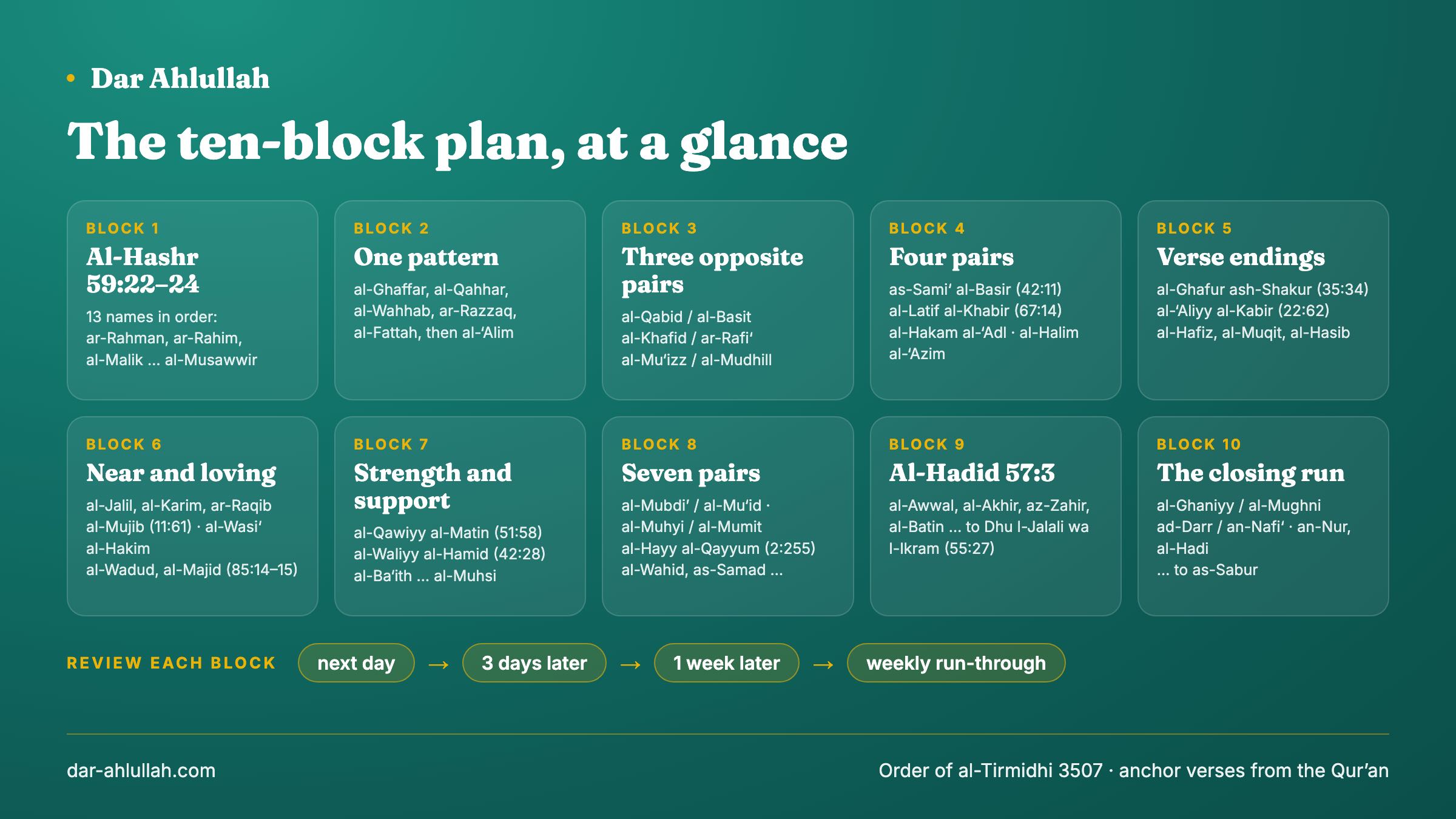
Take a block every three days and the list is done in a month. Take a block a week and it takes ten weeks, but each week leaves more room for review — and review is where names actually stick.
Making Them Stay: Spacing and Testing Yourself
Two findings from memory research do most of the work, and both apply to the names exactly as they apply to Qur’an memorisation.
Spread the practice out. Cepeda and colleagues pooled 839 assessments of distributed practice from 317 experiments and found that spacing study across separate sessions improves later recall, and that the best gap between sessions grows the longer you want to remember (Cepeda et al., 2006, Psychological Bulletin). Ten minutes a day will do more than seventy minutes on a Sunday.
Test yourself; do not just reread. In Roediger and Karpicke’s experiments, students who took recall tests on a passage remembered substantially more of it two days and a week later than students who spent the time restudying it — even though restudying made students more confident (Roediger & Karpicke, 2006, Psychological Science). For the names, that means covering the list and saying what comes next before you look, not reading it through one more time.
A ten-minute daily routine
- Recall first. Before anything new, say the previous block from memory — each name and its meaning — then check.
- Learn the new block with its handle. For block 1, that means reciting 59:22–24 until the passage runs on its own. For the pairs, learn each pair as one unit and say its verse.
- Write it out. Write the block from memory, in Arabic if you read it or in transliteration if you do not yet, with a one-word meaning beside each name.
- Use one the same day. Pick one name from today’s block and call on Allah by it in a du‘a after a prayer.
The review calendar
Review each block the next day, again about three days later, again a week later, and then fold it into a weekly run-through of everything you hold. This is the same new, recent and old split that Qur’an teachers use in hifz, and our guide to revising Qur’an memorisation explains it in depth. Once the whole list is in, saying all ten blocks through once a week is a light load to carry.
Beyond Memorizing: Understanding, Living and Calling on Him by Them
If ahsaha includes understanding, acting and calling on Allah by His names, then memorising is the door rather than the room. Four habits carry you through it.
Learn one meaning properly each week
Choose one name a week and read the verses around it. Ar-Razzaq in 51:58 closes a passage about why the jinn and mankind were created at all; al-Latif al-Khabir in 67:14 answers the question “Does He who created not know?” A name met inside its verse carries far more than a one-word gloss can.
Let each name change something you do
The pattern from IslamQA’s explanation is worth repeating: al-Ahad means you associate nothing with Him, ar-Razzaq means you seek provision from no one else, ar-Rahim means you do not despair of His mercy. Every name has a consequence of that kind, and noticing it is the difference between knowing a list and knowing the One it names.
Call on Him by the name that fits
“To Allah belong the best names, so invoke Him by them” (7:180). In practice that means matching the name to the request: Ya Rahman, irhamni — O Most Merciful, have mercy on me; Ya Ghafur, ighfir li — O Forgiving, forgive me; Ya Tawwab, tub ‘alayya — O Acceptor of repentance, turn to me (IslamQA 1392). The adhkar you may already say are full of this — the morning and evening set includes Ya Hayyu ya Qayyum, bi rahmatika astaghith, two names from block 8 in one line. Our guide to the morning and evening adhkar sets them out with their sources.
Hear them at the ends of verses
Many verses close on one or two of the names, and IslamQA’s advice to anyone collecting them is simply to pay attention to those endings. Once you know the pairs, you will hear them everywhere in your recitation. That habit pays twice if you are memorising Qur’an: verses that close on similar pairs of names are one of the commonest causes of slips, which our guide to memorising similar verses works through.
Five Mistakes to Avoid
- Treating the list as the Prophet’s ﷺ wording. The number and the promise are his; the familiar list is a narrator’s gathering, graded weak.
- Thinking ninety-nine is the limit. The scholars agreed it is not.
- Learning sounds without meanings. A name you cannot explain is hard to keep and harder to use in du‘a.
- Cramming. A weekend marathon fades faster than ten minutes a day, for the reasons the spacing research gives.
- Trusting charts of numbers and promised results. You will meet tables promising a specific benefit for repeating one name a set number of times. Ask for the source. None of the reports quoted in this article contains anything of the kind.
Teaching the Names to Children
Children can follow the same plan in smaller pieces. Three adjustments help:
- Start with the pairs of opposites in blocks 3 and 8. A pair gives a child two names for the effort of one idea: Allah gives life and causes death; He raises and He lowers.
- Attach names to what they already recite. Ar-Rahman and ar-Rahim are in the basmalah that opens al-Fatihah; al-Hayy al-Qayyum is in Ayat al-Kursi; as-Samad is in Surat al-Ikhlas.
- Keep each meaning to one sentence they can say back. “Ar-Razzaq: Allah gives everyone their provision.” A sentence a child can repeat is a sentence they can be tested on tomorrow.
For the wider question of how children keep what they memorise, our guide to helping a child who has forgotten their Qur’an memorisation applies here almost word for word.
How We Teach This
The names sit where our three subjects meet. They are Qur’an, because so many of them close verses you will recite; they are Arabic, because each one is a root and a pattern; and they are belief. A teacher helps with all three, and especially with the part a list cannot do — hearing the names pronounced correctly and getting your recitation of the anchor passages right.
Dar Ahlullah runs one-to-one live sessions with certified teachers, scheduled in your own timezone, in Quran, Arabic and Islamic Studies; the Islamic Studies course, which covers Aqeedah and Fiqh basics with the Seerah, is designed for children and teens. Teaching is charged at $9 per teaching hour, with monthly plans at $36, $70 and $102 depending on how many hours you want, and a 20% discount for siblings. You can pause, upgrade or switch plans at any time, and if a teacher is not the right fit we rematch you with another certified mentor at no extra cost. The first step is a free 30-minute assessment that does not ask for a card — the details are on our pricing page.
Questions People Ask
How long does it take to memorize the 99 names of Allah?
At three names a day, about a month; on the ten-block plan at a block a week, ten weeks. Most of the time goes on review rather than first learning: a block learned and never revisited will not be there in a month, while a few minutes of recall each day keeps the earlier blocks alive.
Is the list of 99 names authentic?
The hadith that Allah has ninety-nine names, and that whoever ahsaha enters Paradise, is authentic (Bukhari 2736, Muslim 2677). The list attached to it in al-Tirmidhi (3507) is graded weak — by al-Tirmidhi’s own remark, and by Ibn Hajar, Ibn Taymiyyah, al-Albani and others.
Does Allah have only 99 names?
No. Al-Nawawi reported the scholars’ agreement that the hadith does not limit His names, and the du‘a narrated by Ibn Mas‘ud mentions names Allah has kept with Himself in the knowledge of the unseen.
Which list of the 99 names should I memorize?
Either the familiar list, knowing what it is, or a compilation drawn from the Qur’an and Sunnah such as Ibn ‘Uthaymin’s. Whichever you use, do not treat its wording or order as the Prophet’s ﷺ, and in du‘a prefer names you can find in the texts.
What does “whoever enumerates them” mean?
The Arabic word is ahsaha. Al-Bukhari glossed its Qur’anic form as “preserved”, and scholars’ explanations extend it to understanding the names, acting on them and calling on Allah by them.
Do I need to know Arabic to learn the names?
No, but a little helps a lot. Each name is a root and a pattern, and recognising the root of al-Ghaffar in al-Ghafur halves the work. Reading the Arabic also lets you find the names in the verses you recite.
Is al-Ahad one of the 99 names?
Allah is described as ahad, One, in Surat al-Ikhlas (112:1). Whether al-Ahad appears in a printed list depends on the copy: some versions of al-Tirmidhi’s list include it beside al-Wahid, and the text of 3507 in the online hadith editions does not.
Can I memorize the names in a different order?
Yes. The order of the familiar list is a narrator’s, not the Prophet’s ﷺ, so nothing is lost by grouping the names your own way. The block order above is simply the one that matches what most people have already half learned.
Conclusion: A Number, a Promise and a Lifetime
The promise is short and authentic: ninety-nine names, and Paradise for whoever ahsaha. The list most of us grew up with is a narrator’s gathering of names rather than the Prophet’s ﷺ own wording, and Allah’s names do not stop at ninety-nine. None of that is a reason not to learn them. It is a reason to learn them carefully.
Start with a passage of the Qur’an that hands you thirteen names in order, read the rest as Arabic words with families and patterns, test yourself before you look, and review on a widening gap. Then do the part no plan can do for you: understand each name, let it change something, and call on Him by it. “Whichever name you call,” the Qur’an says, “to Him belong the best names” (17:110).
Related articles
ruqyah
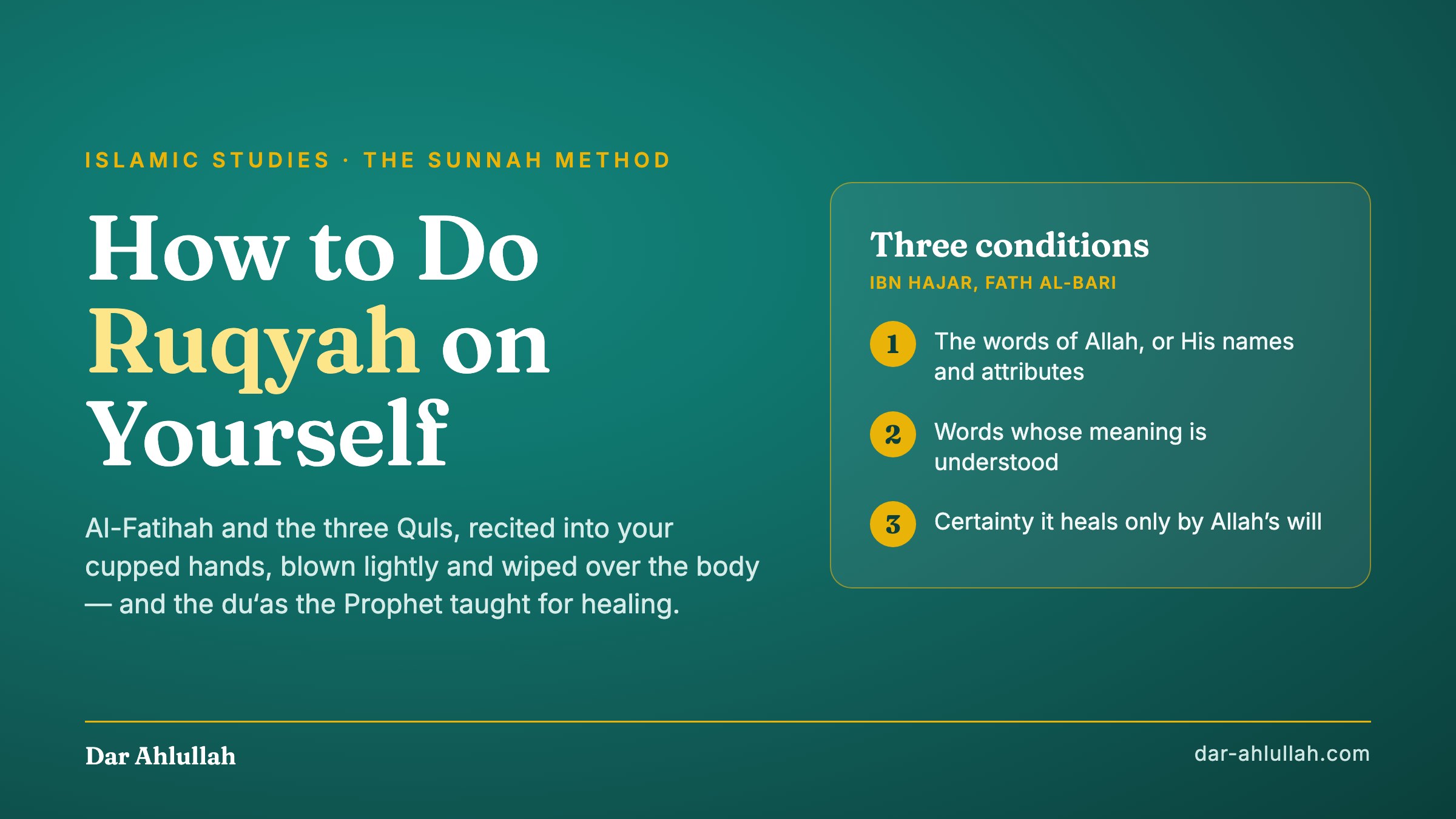
How to Do Ruqyah on Yourself: The Sunnah Method, Step by Step
How to do ruqyah on yourself, from the sources: the surahs and du‘as the Prophet ﷺ used, how to blow and wipe, reciting over water, ruqyah for the evil eye, the three conditions that keep it clear of shirk, and why it goes alongside a doctor, not instead of one.
23 min read
how to make dua
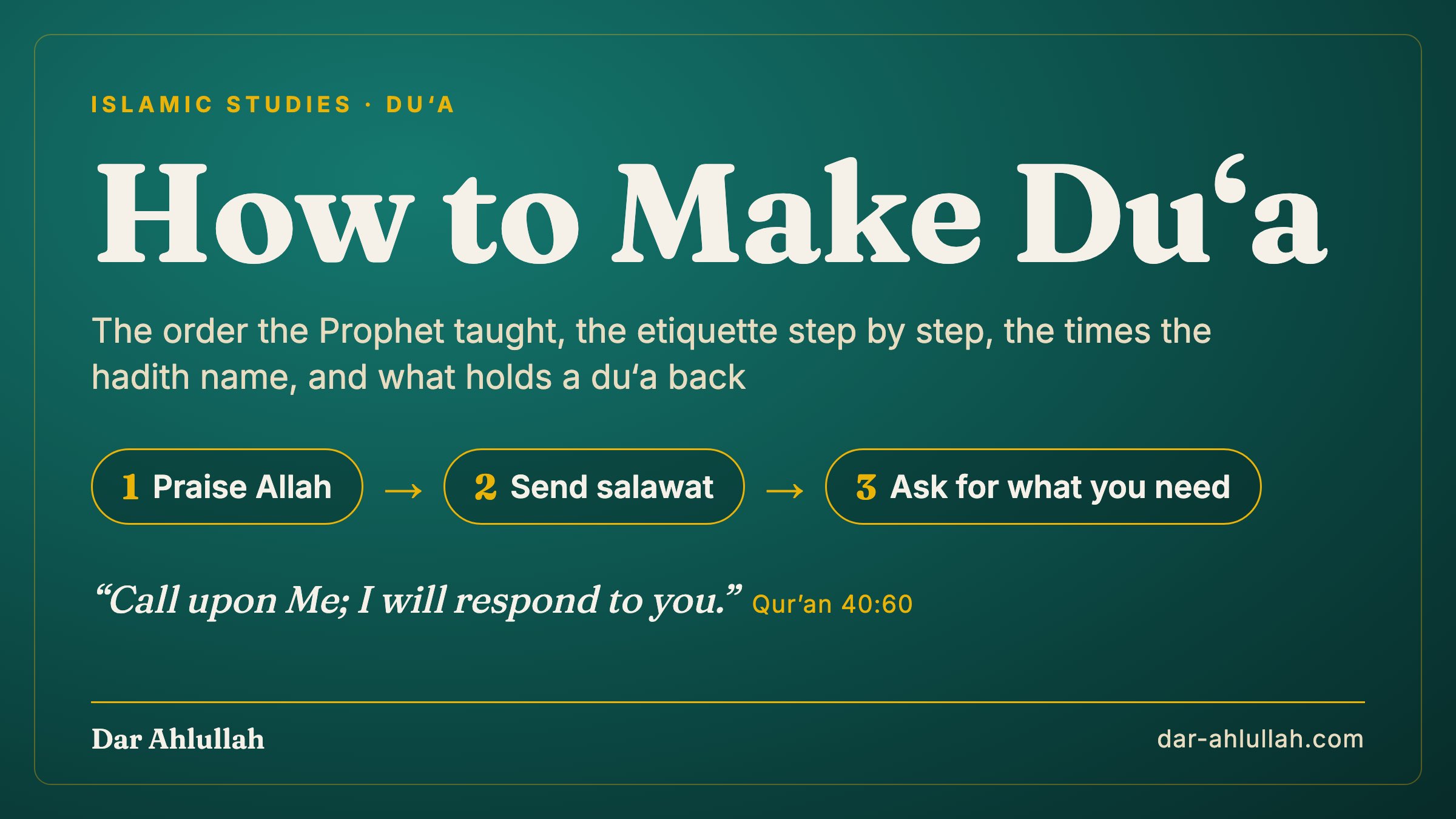
How to Make Dua: The Sunnah Etiquette, Accepted Times and What Blocks It
How to make du‘a from the sources: the order the Prophet ﷺ taught, the etiquette step by step with the evidence for each, the times the hadith name and how they are graded, what holds a du‘a back, and where the scholars stand on wiping the face.
19 min read
morning and evening adhkar
Morning and Evening Adhkar: What to Say and When
Morning and evening adhkar from the sound reports: the windows from dawn to sunrise and from 'Asr to sunset, the core set with the source and count of each line, and the grade printed on the popular additions the hadith scholars dispute, from Ayat al-Kursi to hasbiyallah seven times.
29 min read