
common Islamic phrases
Common Islamic Phrases: What They Mean, When to Say Them and the Reply
Dar Ahlullah team 24 min read
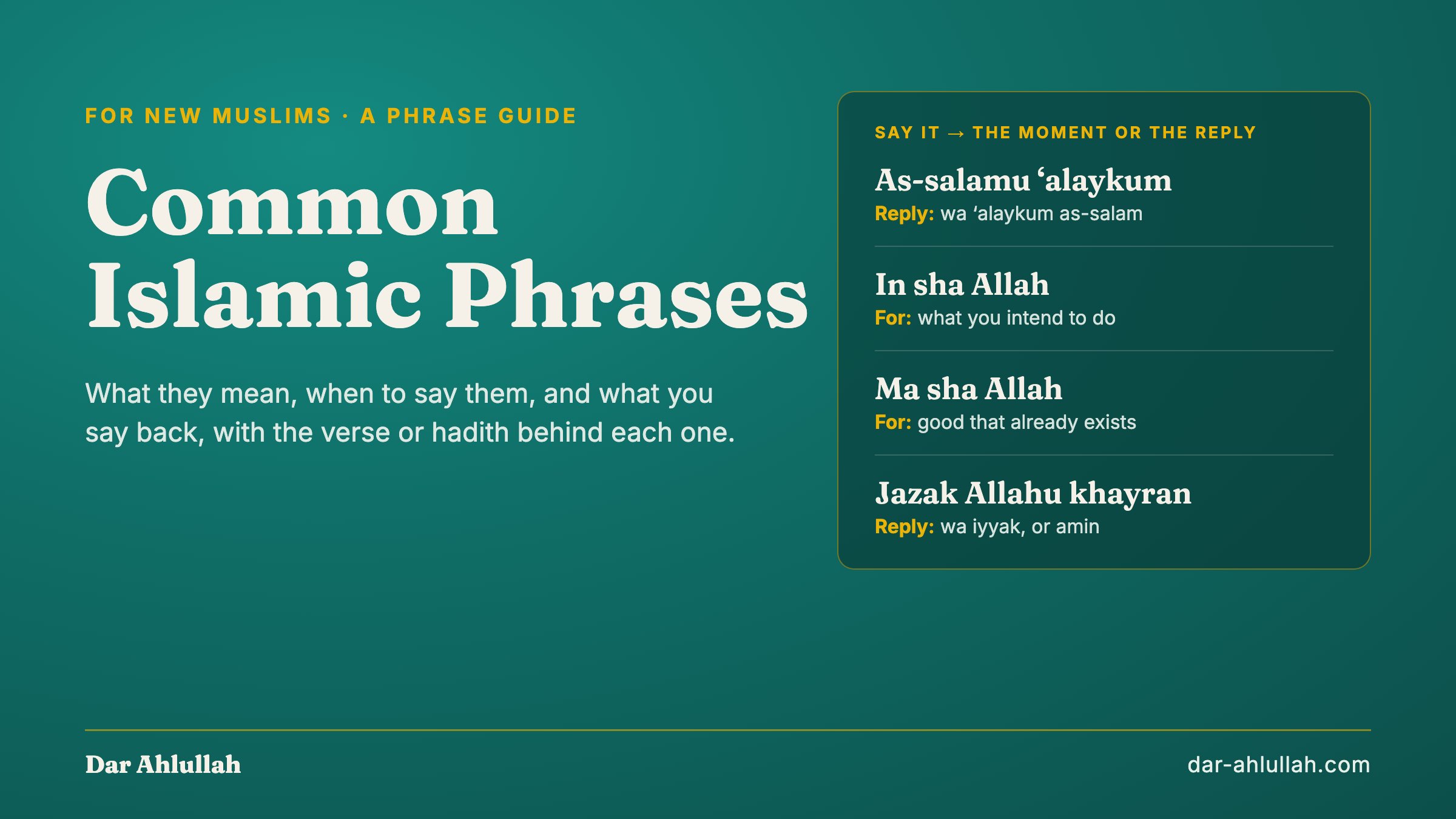
Table of Contents
- Introduction: The Words You Hear Before Anyone Explains Them
- The Short Answer
- Quick Reference: 15 Phrases, When to Say Them and the Reply
- As-Salamu ‘Alaykum: The Greeting and How to Return It
- Greeting Non-Muslim Family and Colleagues
- In Sha Allah (Inshallah): For What You Intend to Do
- Ma Sha Allah (Mashallah), Tabarak Allah and Barak Allahu Fik
- Alhamdulillah, and the Sneezing Exchange
- SubhanAllah and Allahu Akbar: Surprise and Joy
- Bismillah: Before You Begin
- Jazak Allahu Khayran: Saying Thank You
- Inna Lillahi wa Inna Ilayhi Raji‘un: For Any Loss
- Wallahi: A Phrase That Is Also an Oath
- Writing Them Down: Spelling and Abbreviations
- Six Common Mistakes
- How We Teach This
- Questions People Ask
- Conclusion: Small Words, Said on Purpose
Introduction: The Words You Hear Before Anyone Explains Them
In your first weeks as a Muslim you will hear more Arabic in conversation than in the prayer. Someone at the mosque says as-salamu ‘alaykum and waits for your reply. A friend answers “How are you?” with alhamdulillah. A plan for next week ends with in sha Allah, a photo of a newborn gets ma sha Allah, and a small favour is thanked with jazak Allahu khayran. Nobody stops to explain them, because to everyone else in the room they are as automatic as “bless you”.
This guide explains the common Islamic phrases you will hear most: what each one means word by word, the moment it belongs to, what you say back, and the verse or hadith it comes from. Where scholars differ on how a phrase is used (greeting non-Muslim relatives, the evil eye, the reply to a thank-you, even how to spell in sha Allah), the positions are set out with the name of whoever holds each one. None of the rulings here are ours. If you are in your first months as a Muslim, our guide to your first 90 days places these alongside the things worth learning first.
The Short Answer
- The greeting is as-salamu ‘alaykum, and the reply is wa ‘alaykum as-salam. The Qur’an asks you to return a greeting with a better one or the same (4:86), and each added phrase, wa rahmatullah and wa barakatuh, adds reward (Abu Dawud 5195, sahih per al-Albani).
- In sha Allah (“if Allah wills”) goes with something you intend to do. The Qur’an attaches it to plans (18:23–24). It is not a polite way of saying no, and it does not belong inside a du‘a (Bukhari 6339).
- Ma sha Allah (“what Allah has willed”) is for good that already exists. When you admire something that belongs to someone else, the Sunnah instruction is to ask for blessing on it: barak Allahu fik or laka (Ibn Majah 3509, sahih per al-Albani).
- Alhamdulillah (“all praise is for Allah”) after a sneeze, after food and drink, and at good or bad news. The sneeze has a three-line exchange, and the Prophet ﷺ taught all three lines (Bukhari 6224).
- Jazak Allahu khayran (“may Allah reward you with good”) is the fullest thanks (Tirmidhi 2035, sahih per al-Albani). No fixed reply is narrated, so wa iyyak, amin and similar replies are all fine.
- Inna lillahi wa inna ilayhi raji‘un is for any loss, not only a death (2:156; Muslim 918).
- Wallahi is an oath. A habitual “no, by Allah” in passing is not held against you (2:225; Bukhari 4613), but a deliberate oath that you break needs expiation (5:89).
Quick Reference: 15 Phrases, When to Say Them and the Reply
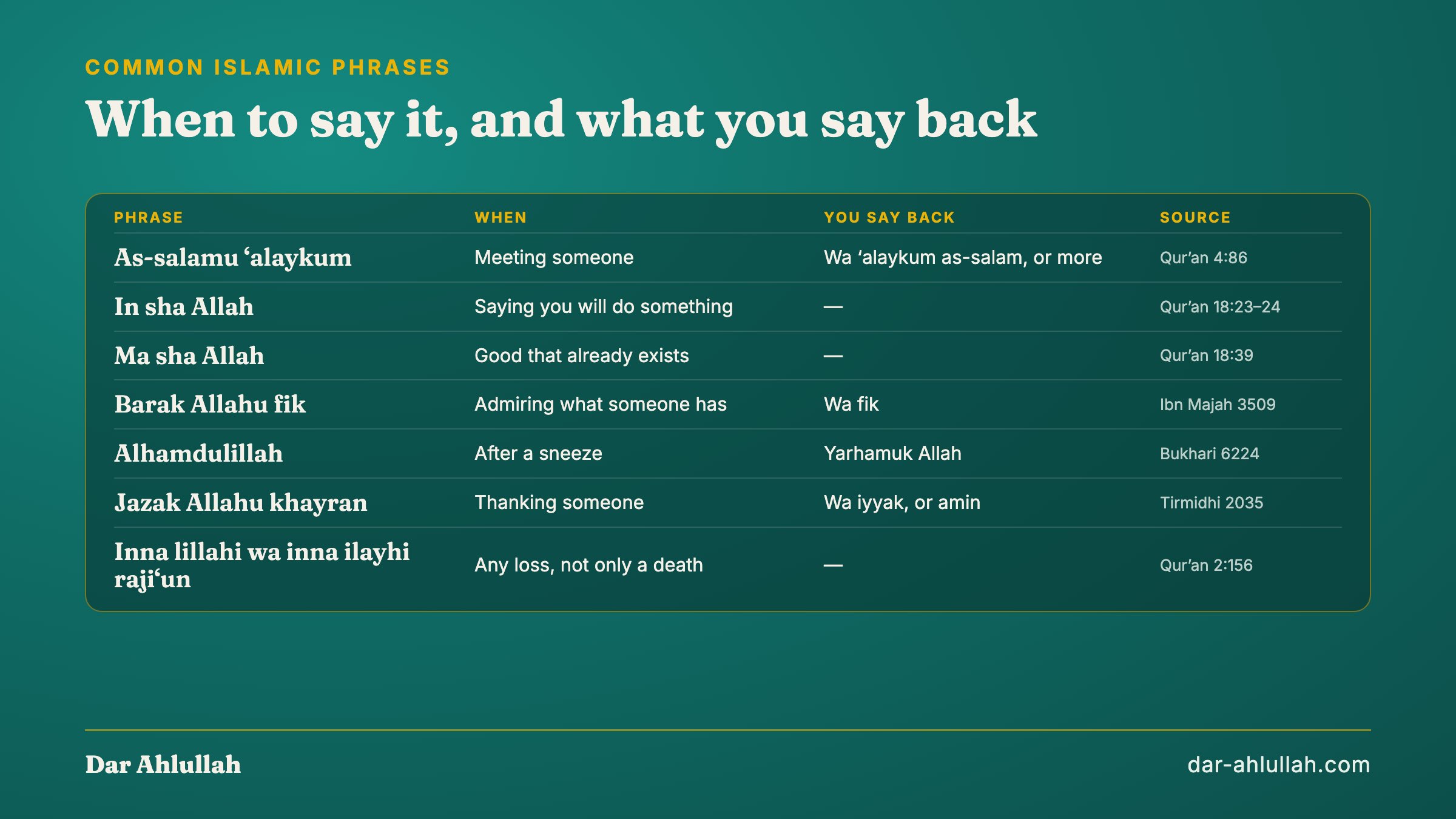
The table is the page to come back to. Each row is explained further down, with the full wording of its source.
| Phrase | Meaning | When | What you say back | Source |
|---|---|---|---|---|
| As-salamu ‘alaykum السَّلَامُ عَلَيْكُمْ | Peace be upon you | When you meet someone or join a gathering | Wa ‘alaykum as-salam, or more | 4:86; Bukhari 6227 |
| Bismillah بِسْمِ اللَّهِ | In the name of Allah | Before eating, and at the start of wudu | — | Bukhari 5376 |
| Alhamdulillah الْحَمْدُ لِلَّهِ | All praise is for Allah | After sneezing, after food and drink, at good or bad news | To a sneezer: yarhamuk Allah | Bukhari 6224; Muslim 2734 |
| Yarhamuk Allah يَرْحَمُكَ اللَّهُ | May Allah have mercy on you | To someone who sneezed and praised Allah | Yahdikumullahu wa yuslihu balakum | Bukhari 6224 |
| In sha Allah إِنْ شَاءَ اللَّهُ | If Allah wills | When you say you will do something | — | 18:23–24 |
| Ma sha Allah مَا شَاءَ اللَّهُ | What Allah has willed [has happened] | Seeing good that already exists, especially your own | — | 18:39 |
| Tabarak Allah تَبَارَكَ اللَّهُ | Blessed is Allah | Admiring something, so that your eye does not harm it | — | Ibn ‘Uthaymin, via IslamQA 130786 |
| Barak Allahu fik بَارَكَ اللَّهُ فِيكَ | May Allah bless you | Admiring what someone has; congratulating them | Usually wa fik (and you) | Ibn Majah 3509; Bukhari 5155 |
| SubhanAllah سُبْحَانَ اللَّهِ | Glory be to Allah | Surprise, or something that should not be so | — | Bukhari 283 |
| Allahu akbar اللَّهُ أَكْبَرُ | Allah is greater | Joy at good news | — | Bukhari 3348 |
| Jazak Allahu khayran جَزَاكَ اللَّهُ خَيْرًا | May Allah reward you with good | Thanking someone | Wa iyyak, amin, or the same back | Tirmidhi 2035 |
| Inna lillahi wa inna ilayhi raji‘un إِنَّا لِلَّهِ وَإِنَّا إِلَيْهِ رَاجِعُونَ | We belong to Allah, and to Him we return | Any loss or bad news | — | 2:156; Muslim 918 |
| Astaghfirullah أَسْتَغْفِرُ اللَّهَ | I ask Allah’s forgiveness | After a slip; three times after each obligatory prayer | — | Muslim 591 |
| La hawla wa la quwwata illa billah لَا حَوْلَ وَلَا قُوَّةَ إِلَّا بِاللَّهِ | There is no power and no strength except through Allah | When a task feels too heavy; in reply to two lines of the adhan (see responding to the adhan) | — | Bukhari 6384 |
| Wallahi وَاللَّهِ | By Allah | Swearing an oath | — | 5:89; Bukhari 6646 |
The endings change with the person you are speaking to, which is why you will hear several versions of the same phrase. Jazak and fik address one man, jazaki and fiki one woman, and jazakum and fikum a group. The plural form is also used politely to a single person, the way the greeting itself, ‘alaykum, is plural.
As-Salamu ‘Alaykum: The Greeting and How to Return It
As-salamu ‘alaykum means “peace be upon you”. The hadith trace it back to the first human being. When Allah created Adam, He told him to go and greet a group of angels and listen to their reply, “for that will be your greeting and the greeting of your offspring”. Adam said as-salamu ‘alaykum, and the angels answered as-salamu ‘alayka wa rahmatullah, adding “and the mercy of Allah” (Bukhari 6227).
The three lengths
The greeting has a short, a middle and a full form, and the hadith count the reward of each. A man came to the Prophet ﷺ and said as-salamu ‘alaykum; the Prophet returned it and said, “Ten.” A second said as-salamu ‘alaykum wa rahmatullah: “Twenty.” A third said as-salamu ‘alaykum wa rahmatullahi wa barakatuh, “peace be upon you, and the mercy of Allah and His blessings”: “Thirty” (Sunan Abi Dawud 5195, sahih per al-Albani).
Returning it
The reply reverses the words: wa ‘alaykum as-salam, “and upon you be peace”, lengthened in the same way. The Qur’an sets the rule for every greeting:
“And when you are greeted with a greeting, greet [in return] with one better than it or [at least] return it [in a like manner]. Indeed Allah is ever, over all things, an Accountant.” (Qur’an 4:86)
So if someone gives you the short form, you can answer with the middle or the full one, and if they give you the full form, you return the full form. Returning the greeting is the first of the five rights a Muslim has over another in the Prophet’s ﷺ list, alongside visiting the sick, following the funeral, accepting an invitation and answering a sneeze (Bukhari 1240).
He also tied the greeting to something larger than manners. Entering Paradise depends on faith, he said, faith on loving one another, and he pointed to one practice that produces that love: spreading the salam among yourselves (Sahih Muslim 54). Nor is it reserved for people you know. Asked which qualities of Islam are good, he answered: to feed people, and to greet those you know and those you do not know (Bukhari 12).
One time not to greet: during the Friday khutbah, when talking is not allowed. Our guide to how to pray Jumu‘ah covers that case.
Greeting Non-Muslim Family and Colleagues
For anyone who comes to Islam as an adult this question arrives early, because parents, siblings and colleagues are often not Muslim. The scholars agree on part of the answer and differ on the rest, so here is where each position stands.
Where they agree: you answer
Every view quoted here has you answer a non-Muslim who greets you: Ibn ‘Uthaymin calls it required by the general command in 4:86, and the Hanafi text below says there is nothing wrong in it. The Prophet ﷺ said, “If the people of the Scripture greet you, then you should say (in reply), wa ‘alaykum (and on you)” (Bukhari 6258).
Where they differ: whether you may greet first
- Not with the salam, and not at all without a reason. Shaykh Ibn ‘Uthaymin held that greeting a non-Muslim first is prohibited, citing the hadith “Do not greet the Jews and the Christians before they greet you” (Sahih Muslim 2167), and he extended that to beginning with words such as “welcome” (Majmu‘ al-Fatawa 3/33). He added that some scholars allow answering a non-Muslim who clearly says as-salamu ‘alaykum with ‘alaykum as-salam. IslamQA, quoting him, adds that where there is a need to greet first, an ordinary greeting other than the salam carries no sin (IslamQA 48966, citing al-Mawsu‘ah al-Fiqhiyyah 25/168).
- Permitted for a reason, including family. The same IslamQA answer quotes Ibn al-Qayyim in Zad al-Ma‘ad (2/424): “A group of scholars said: It is permissible to greet him first if that serves a purpose, or for fear of his harm, or because of blood ties, or for a reason that requires that.”
- The Hanafi position. Shaykh Muhammad ibn Adam al-Kawthari quotes al-Haskafi: a believer may greet a non-Muslim with the salam if he has a need from him, and otherwise it is prohibitively disliked; the reply to their salam should go no further than wa ‘alaykum. He suggests an everyday greeting such as “good morning” instead, and cites Ibn ‘Abidin for a wording to use with those who understand Arabic, as-salamu ‘ala man ittaba‘a al-huda, “peace be upon whoever follows the guidance” (Darul Iftaa, via islamqa.org 7787).
He also cites the hadith in which the Prophet ﷺ passed a gathering of Muslims, idolaters and Jews and greeted them before inviting them to Islam (Bukhari 6254). Al-Bukhari placed it under the chapter heading on greeting a gathering of Muslims and non-Muslims.
In practice: keep returning every greeting your family gives you, and use the ordinary greetings of your language with them. Whether you may open with the salam itself is the point of difference, so ask the teacher whose method you follow which view to act on, rather than switching between them.
In Sha Allah (Inshallah): For What You Intend to Do
In sha Allah is three Arabic words: in (if), sha’a (He willed) and Allah. It means “if Allah wills”, and its home in the Qur’an is a direct instruction about plans:
“And never say of anything, ‘Indeed, I will do that tomorrow,’ except [when adding], ‘If Allah wills.’ And remember your Lord when you forget [it] and say, ‘Perhaps my Lord will guide me to what is nearer than this to right conduct.’” (Qur’an 18:23–24)
The Prophet ﷺ told a story about what leaving it out costs. The Prophet Sulayman said he would go round his wives that night and each would bear a son who would fight in Allah’s cause. His companion told him to say “if Allah wills”, and he forgot. Only one of them gave birth, to a child born incomplete. “If Solomon had said, ‘If Allah will,’ he would not have been unsuccessful in his action, and would have attained what he had desired” (Bukhari 6720).
Its ruling
Darul Uloom Deoband’s fatwa department gives the ruling plainly: it is recommended (mustahabb) to say in sha Allah when you intend or plan to do something in the future, but not obligatory, so leaving it out is not a sin (Darul Uloom Deoband, fatwa 419/412).
It is not a polite no
In everyday speech in sha Allah is sometimes used to mean “probably not”. The scholars do not accept that use. IslamWeb answers someone who claimed a broken “in sha Allah” promise was not a lie: saying it while intending to break the promise “does not change the fact that such an action is considered a lie and an intentional breach of promise”, and it quotes Ibn Rajab, reporting al-Awza‘i, that this is both lying and breaking the promise. If you meant to do it and could not, there is no blame: that is exactly what the phrase was for (IslamWeb 293485).
It can carry hope
The phrase is not only for your own plans. When the Prophet ﷺ visited the sick he would say la ba’s, tahurun in sha Allah, “no harm, it is a purification, if Allah wills” (Bukhari 3616; some English translations render the phrase as “May Allah cure you”, but the Arabic has in sha Allah). Said that way, it is hope for something good that only Allah can bring about.
It does not belong in a du‘a
The one place it should not go is a request to Allah. “None of you should say: ‘O Allah, forgive me if You wish; O Allah, be merciful to me if You wish,’ but he should always appeal to Allah with determination, for nobody can force Allah to do something against His Will” (Bukhari 6339). So “O Allah, give me a good job, in sha Allah” is the wrong shape. Ask decisively, as our guide to how to make du‘a explains with the rest of the etiquette.
Ma Sha Allah (Mashallah), Tabarak Allah and Barak Allahu Fik
Ma sha Allah looks like in sha Allah with one word changed, and that word moves it from the future to the present. It means “what Allah has willed [has happened]”. Its source is the parable of the two gardens, where a believer rebukes his proud companion:
“And why did you, when you entered your garden, not say, ‘What Allah willed [has occurred]; there is no power except in Allah’?” (Qur’an 18:39)
The rule of thumb follows from the meanings. In sha Allah is for what you hope will happen; ma sha Allah is for good that is already in front of you.
Admiring something, and the evil eye
Many Muslims say ma sha Allah to keep the evil eye away from something they admire. The Sunnah wording for that moment is slightly different. When ‘Amir ibn Rabi‘ah praised Sahl ibn Hunayf’s skin and Sahl collapsed, the Prophet ﷺ asked, “Why would anyone of you kill his brother? If he sees something that he likes, then let him pray for blessing for him” (Sunan Ibn Majah 3509, sahih per al-Albani). Praying for blessing means barak Allahu fik or laka, “may Allah bless you” or “bless it for you”.
IslamQA sets out how the scholars divide the phrases between them (IslamQA 130786):
- For your own things, ma sha Allah la quwwata illa billah. Shaykh Ibn ‘Uthaymin said this is for the person who admires his own wealth, “lest he admire himself and feel proud”, as the owner of the garden should have said.
- For someone else’s, a prayer for blessing. He said that if you fear envy or the evil eye you say ma sha Allah, tabarak Allah, and that the best, if you fear you have already affected someone, is tabarak Allahu ‘alayka, “may Allah bless it for you”, because of the hadith above.
- Both together. The Standing Committee, in its collected fatwas, says the one who admires should remember Allah and pray for blessing: say ma sha Allah la quwwata illa billah and pray for blessing for that person.
The same answer flags a weak report. The hadith promising that whoever says ma sha Allah la quwwata illa billah over his family, wealth or child will see no harm in it but death (Abu Ya‘la, from Anas) is graded da‘if. So the phrase is good to say, but it is not a charm; the instruction in the sound hadith is to ask for blessing. If you are worried that the evil eye has already struck, our guide to how to do ruqyah on yourself covers the remedies the Sunnah teaches.
A practical version, then, for a friend’s new baby: ma sha Allah, barak Allahu lakum.
Congratulations
Barak Allahu laka is also how the Prophet ﷺ congratulated people. When ‘Abd al-Rahman ibn ‘Awf told him he had married, he said, “May Allah bless you,” and told him to hold a wedding meal (Bukhari 5155). His full congratulation on a marriage was barak Allahu laka, wa baraka ‘alayka, wa jama‘a baynakuma fi khayr: “May Allah bless for you, and may He bless on you, and combine both of you in good” (Sunan Abi Dawud 2130, sahih per al-Albani).
Alhamdulillah, and the Sneezing Exchange
Alhamdulillah means “all praise is for Allah”. Al-Fatihah, which you recite in every rak‘ah, begins its praise with it, so you already say it at least seventeen times a day in the obligatory prayers. Outside the prayer, the Sunnah names several moments for it.
After a sneeze
The sneeze comes with a fixed exchange of three lines. “If anyone of you sneezes, he should say al-hamdu lillah, and his (Muslim) brother or companion should say to him, yarhamuk Allah (may Allah bestow His mercy on you). When the latter says yarhamuk Allah, the former should say, yahdikumullahu wa yuslihu balakum (may Allah give you guidance and improve your condition)” (Bukhari 6224).
The middle line depends on the first. Two men sneezed near the Prophet ﷺ; he answered one and not the other, and when the second asked why, he said, “That man praised Allah, but you did not praise Allah” (Bukhari 6225). When the sneezer does praise Allah, every Muslim who hears it should answer (Bukhari 6226), and answering the sneeze is one of the five rights in Bukhari 1240. Inside the prayer this changes: replying to a sneezer is speech, and our article on what invalidates salah explains why.
After food and drink
“Allah is pleased with His servant who eats a morsel of food and praises Him for it, or drinks a drink and praises Him for it” (Sahih Muslim 2734).
At good news and bad
‘A’ishah reported that when the Prophet ﷺ saw something he liked he said al-hamdu lillahil-ladhi bi ni‘matihi tatimmus-salihat, “praise is to Allah by Whose grace good deeds are completed”, and when he saw something he disliked he said al-hamdu lillahi ‘ala kulli hal, “praise is to Allah in all circumstances” (Sunan Ibn Majah 3803, hasan per al-Albani; Zubair ‘Ali Za’i graded it da‘if). The second is the one you will hear when someone shares hard news. It is not denial; it is praise that does not depend on the day going well.
SubhanAllah and Allahu Akbar: Surprise and Joy
SubhanAllah, “glory be to Allah”, declares Allah free of every fault. In conversation it marks surprise, often at something that should not be so. Abu Hurayrah once slipped away from the Prophet ﷺ because he was in a state of major impurity and did not want to sit with him. When he came back and explained, the Prophet said, “Subhan Allah! A believer never becomes impure” (Bukhari 283).
Allahu akbar, “Allah is greater”, is the phrase that opens every prayer, and outside it the Companions used it for joy. When the Prophet ﷺ told them, “I hope that you will be one-fourth of the people of Paradise,” they shouted “Allahu akbar!”, and again at one-third, and again at half (Bukhari 3348).
Both phrases, with alhamdulillah, are also the counted dhikr after each prayer, covered in our guide to adhkar after salah, and they run through the morning and evening adhkar. A phrase you say in passing and the same words counted after the prayer are one practice at two different speeds.
Bismillah: Before You Begin
Bismillah means “in the name of Allah”. The clearest instruction about it is the one the Prophet ﷺ gave a boy in his care who was reaching all over the dish: “O boy! Mention the Name of Allah and eat with your right hand, and eat of the dish what is nearer to you” (Bukhari 5376).
If you forget at the start, there is a wording for remembering halfway through: bismillahi awwalahu wa akhirahu, “in the name of Allah at the beginning and at the end of it” (Sunan Abi Dawud 3767, sahih per al-Albani). It is also said at the start of wudu, which our wudu guide walks through step by step.
Jazak Allahu Khayran: Saying Thank You
Jazak Allahu khayran means “may Allah reward you with good”. It is a du‘a, not just a thank-you, and the hadith rates it highly: “Whoever some good was done to him, and he says: ‘May Allah reward you in goodness’ then he has done the most that he can of praise” (Jami‘ at-Tirmidhi 2035, sahih per al-Albani; Zubair ‘Ali Za’i graded it da‘if). Its point is that the person who helped you is owed more than you can repay, so you ask Allah to repay them.
What do you say back?
People are often corrected over this, and there is nothing to correct. Shaykh Muhammad Abasoomar of HadithAnswers writes that he has found no reply in the hadith; some say amin and some say wa iyyak (“and you too”), and “both make sense and will not be wrong, although they are not proven from the Hadith”. The narration in Ibn Hibban where the Prophet ﷺ answered wa antum fa jazakumullahu khayran was him telling the Ansar that they were the ones who deserved to be thanked, not a standard reply (HadithAnswers, via islamqa.org 122246).
Inna Lillahi wa Inna Ilayhi Raji‘un: For Any Loss
This is the phrase you will hear when someone dies, but its source is wider than death:
“Who, when disaster strikes them, say, ‘Indeed we belong to Allah, and indeed to Him we will return.’ Those are the ones upon whom are blessings from their Lord and mercy. And it is those who are the [rightly] guided.” (Qur’an 2:156–157)
The Prophet ﷺ added a du‘a to it for “any Muslim who suffers some calamity”: Allahumma ajurni fi musibati wa akhlif li khayran minha, “O Allah, reward me for my affliction and give me something better than it in exchange.” Umm Salamah narrated it. When her husband Abu Salamah died she said the words while wondering which Muslim could be better than him, and the Prophet ﷺ later proposed to her (Sahih Muslim 918).
So it is said for a lost job, a failed exam or a broken phone as well as a death. For the prayer over the deceased itself, see our guide to salat al-janazah.
Wallahi: A Phrase That Is Also an Oath
Wallahi means “by Allah”, and unlike everything else on this page it has legal weight: it is an oath. Three texts set out how it works.
- Swear only by Allah. The Prophet ﷺ heard ‘Umar swearing by his father and said, “Allah forbids you to swear by your fathers, so whoever has to take an oath, he should swear by Allah or keep quiet” (Bukhari 6646). “I swear on my mother’s life” is the habit to drop.
- Habitual oaths in passing are not held against you. “Allah does not impose blame upon you for what is unintentional in your oaths, but He imposes blame upon you for what your hearts have earned” (2:225). ‘A’ishah said this was revealed about a man saying “No, by Allah” and “Yes, by Allah” in ordinary talk (Bukhari 4613; Bukhari 6663).
- A deliberate oath you break needs expiation. The expiation is feeding ten needy people, or clothing them, or freeing a slave, and for whoever cannot, fasting three days. The verse ends: “But guard your oaths” (5:89).
The lesson is not to stop saying it, but to stop saying it carelessly. If you mean a promise, say it; if you only mean “honestly”, an oath is more than the moment needs.
Writing Them Down: Spelling and Abbreviations
A message you may be forwarded claims that writing “inshallah” as one word means “create Allah”. Both scholars below reject that claim; they differ on whether the one-word spelling is acceptable.
- All spellings are fine. Shaykh Ebrahim Desai writes that transliteration has no fixed standard, so “inshallah”, “insha Allah” and “in sha Allah” are all permissible. He also points out that the Arabic imperative “create” is a different word, anshi’, so the claim fails on its own terms (AskImam, via islamqa.org 81391).
- Write the separated form. Mufti Waseem Khan of Darul Uloom Trinidad and Tobago agrees it does not mean “create Allah”, but holds that one-word “Inshallah” is not the correct spelling and that it should be written “Inshaa’ Allah”, following the three Arabic words, ان شاء الله. He also discourages shorthand such as “slmz” for the salam, since the letters do not convey the greeting (Darul Uloom Trinidad and Tobago).
If you want a spelling that satisfies both answers, write it as three words. The salawat after the Prophet’s ﷺ name, and whether “pbuh” or “SAW” is enough in writing, is covered in our guide to sending salawat on the Prophet.
Six Common Mistakes
- Using in sha Allah to mean no. If you do not intend to come, say so. Saying it while intending the opposite is a lie and a broken promise (IslamWeb 293485).
- Putting in sha Allah into a du‘a. Ask Allah decisively, not “if You wish” (Bukhari 6339).
- Swapping in sha Allah and ma sha Allah. One looks forward, the other looks at what is already here. “I’ll pass the exam, ma sha Allah” has the wrong tense.
- Treating ma sha Allah as a charm. The sound hadith tells you to pray for blessing on what you admire (Ibn Majah 3509); the report promising protection for the phrase alone is weak (IslamQA 130786).
- Passing on the “create Allah” message, or correcting someone’s reply to jazak Allahu khayran. Both muftis quoted above reject the first claim, and the second has no fixed sunnah reply to enforce.
- Swearing by anything other than Allah, or swearing by Him carelessly. Swear by Allah or keep quiet (Bukhari 6646), and keep your oaths (5:89).
How We Teach This
These phrases are often the first Arabic a new Muslim says out loud, and the sounds are where it goes wrong: the ‘ayn in ‘alaykum, the ha from the throat in alhamdulillah, the doubled letters in inna lillahi. Hearing them is not the same as saying them, and a teacher who listens to you say each one is the quickest fix. The meanings are the other half: once you know what each word is doing, you stop saying ma sha Allah about next week.
Dar Ahlullah runs one-to-one live sessions with certified teachers, scheduled in your own timezone, in Quran, Arabic and Islamic Studies; see the courses for what each covers. Teaching is charged at $9 per teaching hour, with monthly plans at $36, $70 and $102 depending on how many hours you want, and a 20% discount for siblings. You can pause, upgrade or switch plans at any time, and if a teacher is not the right fit we rematch you with another certified mentor at no extra cost. The first step is a free 30-minute assessment that does not ask for a card — the details are on our pricing page.
Questions People Ask
What is the difference between in sha Allah and ma sha Allah?
In sha Allah (“if Allah wills”) is for the future: something you intend or hope to do (18:23–24). Ma sha Allah (“what Allah has willed”) is for good that already exists, as the owner of the garden should have said on entering it (18:39).
How do I reply to as-salamu ‘alaykum?
Say wa ‘alaykum as-salam, and add wa rahmatullahi wa barakatuh if you can, since the Qur’an asks for a better reply or an equal one (4:86) and each addition is counted (Abu Dawud 5195).
What do I say back to jazak Allahu khayran?
There is no reply fixed in the hadith. Wa iyyak and amin “will not be wrong”, and returning the du‘a is a du‘a too, but none of them should be treated as the sunnah reply (HadithAnswers).
Can I say as-salamu ‘alaykum to my non-Muslim parents?
The scholars differ. All agree you return their greeting (4:86). Ibn ‘Uthaymin held that you should not greet them first with the salam (IslamQA 48966); the Hanafi texts allow it when there is a need and otherwise recommend an ordinary greeting (islamqa.org 7787); and Ibn al-Qayyim reports scholars who permitted it because of blood ties. Follow the view of the teacher you learn with.
Is it inshallah or in sha Allah?
The claim that “inshallah” means “create Allah” is rejected by the muftis who have answered it. Shaykh Ebrahim Desai regards every spelling as permissible; Mufti Waseem Khan holds that it should be written as separate words, matching the Arabic ان شاء الله. Writing it as three words satisfies both.
What do you say when someone sneezes?
If they say alhamdulillah, you say yarhamuk Allah, and they answer yahdikumullahu wa yuslihu balakum (Bukhari 6224). If they do not praise Allah, the reply is not owed (Bukhari 6225).
Does saying ma sha Allah protect against the evil eye?
The instruction in the sound hadith is to pray for blessing on what you admire (Ibn Majah 3509). Scholars recommend saying ma sha Allah with it, but the report promising protection for ma sha Allah la quwwata illa billah on its own is weak (IslamQA 130786).
Conclusion: Small Words, Said on Purpose
Every phrase on this page is a short act of remembrance tucked into ordinary life: a greeting that is a prayer for peace, a plan that leaves room for Allah’s will, a compliment that asks for blessing, a thank-you that hands the repayment to Allah, and a loss met with a reminder of where everything returns. Learn the meanings, learn the replies, and use them because you mean them. That is what turns a habit you picked up from the people around you into something you do on purpose.
Related articles
how to make dua
How to Make Dua: The Sunnah Etiquette, Accepted Times and What Blocks It
How to make du‘a from the sources: the order the Prophet ﷺ taught, the etiquette step by step with the evidence for each, the times the hadith name and how they are graded, what holds a du‘a back, and where the scholars stand on wiping the face.
19 min read
new Muslim guide
A New Muslim Guide to Your First 90 Days in Islam
The problem is never the amount to learn, it is the order. Here is a month-by-month sequence for the first 90 days after your shahada: prayer first, the 28 letters second, and what to deliberately postpone.
14 min read
salawat on the Prophet
How to Send Salawat on the Prophet: Wordings, Times and Rulings
How to send salawat on the Prophet ﷺ, from the sources: the four wordings he taught, the short forms, the four views on when it is obligatory, the moments the Sunnah names for it, what it earns, writing SAW and PBUH, and where composed durood stands.
19 min read