
Noorani Qaida
Noorani Qaida: What It Is and How to Actually Finish It
Dar Ahlullah team 20 min read
Table of Contents
- Introduction: The Book Everyone Assumes You Already Know
- The Short Answer: What the Noorani Qaida Is and Is Not
- Where the Noorani Qaida Came From
- What Is Actually Inside It, Lesson by Lesson
- Why the Order Is the Entire Point
- How Long It Takes, and Why Published Timelines Mislead
- Choosing an Edition Without Overthinking It
- Five Habits That Stall People Halfway Through
- Can You Self-Study It? What a Listener Adds
- Adults Working Through a Children’s Book
- What Comes After the Last Page
- How We Place Students on It
- Questions People Ask About the Noorani Qaida
- Conclusion: Thirty-Two Pages, Then the Mushaf
Introduction: The Book Everyone Assumes You Already Know
Somewhere in your first week of Quran lessons, a teacher will say “we will start with the Qaida” in the same tone someone might say “we will start with the alphabet” — as if you already know what that means. Nobody explains it, because in the households where most Quran teachers grew up, this book was simply on the shelf next to the mushaf and every child went through it before they were old enough to remember.
If you did not grow up in one of those households, the Noorani Qaida arrives as a mystery: a thin, brightly coloured book of Arabic letters with no English on the page, handed to you with the instruction to start at the beginning. You cannot tell how long it is meant to take, whether you are supposed to memorise it, why lesson four looks almost identical to lesson three, or what happens when you finish. So you either grind through it without understanding the design, or you decide it is beneath you and ask to skip ahead to a real surah — which is the single most expensive mistake available at this stage.
This guide is the explanation nobody gives you. What the book is, who wrote it and why, what each block of lessons is training, why the sequence is not negotiable, roughly how long it takes and why every number you read online is unreliable, and the specific habits that leave people stuck on page nine for four months. If you want the wider view of how this fits into learning to recite at all, our complete guide to learning Quran online sets out the whole route; this article zooms in on the one book that route depends on.
The Short Answer: What the Noorani Qaida Is and Is Not
The Noorani Qaida is a short graded primer — the widely circulated scan runs to thirty-two pages — that teaches you to decode Arabic script well enough to read the Quran aloud. It moves from isolated letters, to letters joined into words, to vowel marks, to the marks that lengthen and stop and double sounds, and finally to a handful of short rules of recitation applied to real Quranic words.
Three things it is not, each of which causes a predictable misunderstanding:
- It is not an Arabic language course. Nothing in it is translated and none of it teaches vocabulary or grammar. You finish it able to pronounce Arabic accurately and understand none of it. That is by design, and it is not a defect — understanding is a separate track that runs later or alongside.
- It is not a tajweed textbook. It introduces a small subset of recitation rules at the end, embedded in practice rather than explained as theory. The systematic treatment comes afterwards.
- It is not something to memorise. The pages are drill material. Nobody recites the Qaida from memory; you work through them until the decoding is automatic and then you never open it again.
What it is is the thing that turns letters into reading. Recognising the twenty-eight letters is a matter of a few weeks and is where our guide to the Arabic alphabet for beginners stops. Converting a page of joined, marked-up Arabic into sound at conversational speed is a different skill, and the Qaida is the standard apparatus for building it.
Where the Noorani Qaida Came From
The name is worth unpacking, because it explains the book. Qaida (قاعدة) means a base or foundation — the same root as the word for a rule or a grounding principle. Nooraniyah derives from noor, light. The full name, القاعدة النورانية, is usually rendered Al-Qaidah An-Nooraniyah, and both halves are doing work: it is the foundation course, and it is named for its compiler, Shaykh Noor Muhammad.
The primer is attributed to Shaykh Noor Muhammad Haqqani, a scholar of the Indian subcontinent, and the scanned copy held in the Internet Archive’s Islamic books collection carries that attribution on the item itself. Biographical detail beyond that is thin and inconsistently reported across the sites that repeat it, so treat specific dates you encounter with some caution; the book’s provenance is well established even where its author’s biography is not.
The problem it was built to solve is the same problem its users have today. Across the subcontinent were enormous Muslim populations for whom Arabic was a liturgical script rather than a spoken language — people who needed to read the Quran correctly without ever learning to speak Arabic. A primer that assumed no prior Arabic, used no translation, and worked identically regardless of the learner’s mother tongue was the practical answer. That design choice is precisely why it travelled: from the subcontinent through the Arab world and then to Europe, North America and Australia, wherever Muslim families needed to teach Quranic reading to children who spoke something else at home.
It is also why the book contains no English. A page of pure Arabic script works the same for a Bengali child, a French convert and a Somali grandmother. The moment you add a translation column you have built a book for one audience.
What Is Actually Inside It, Lesson by Lesson
Editions differ in layout, colour and the number of practice rows, but the sequence is remarkably stable across them, and you can follow it in any public scan of the book. Here is what each block is training, in order.
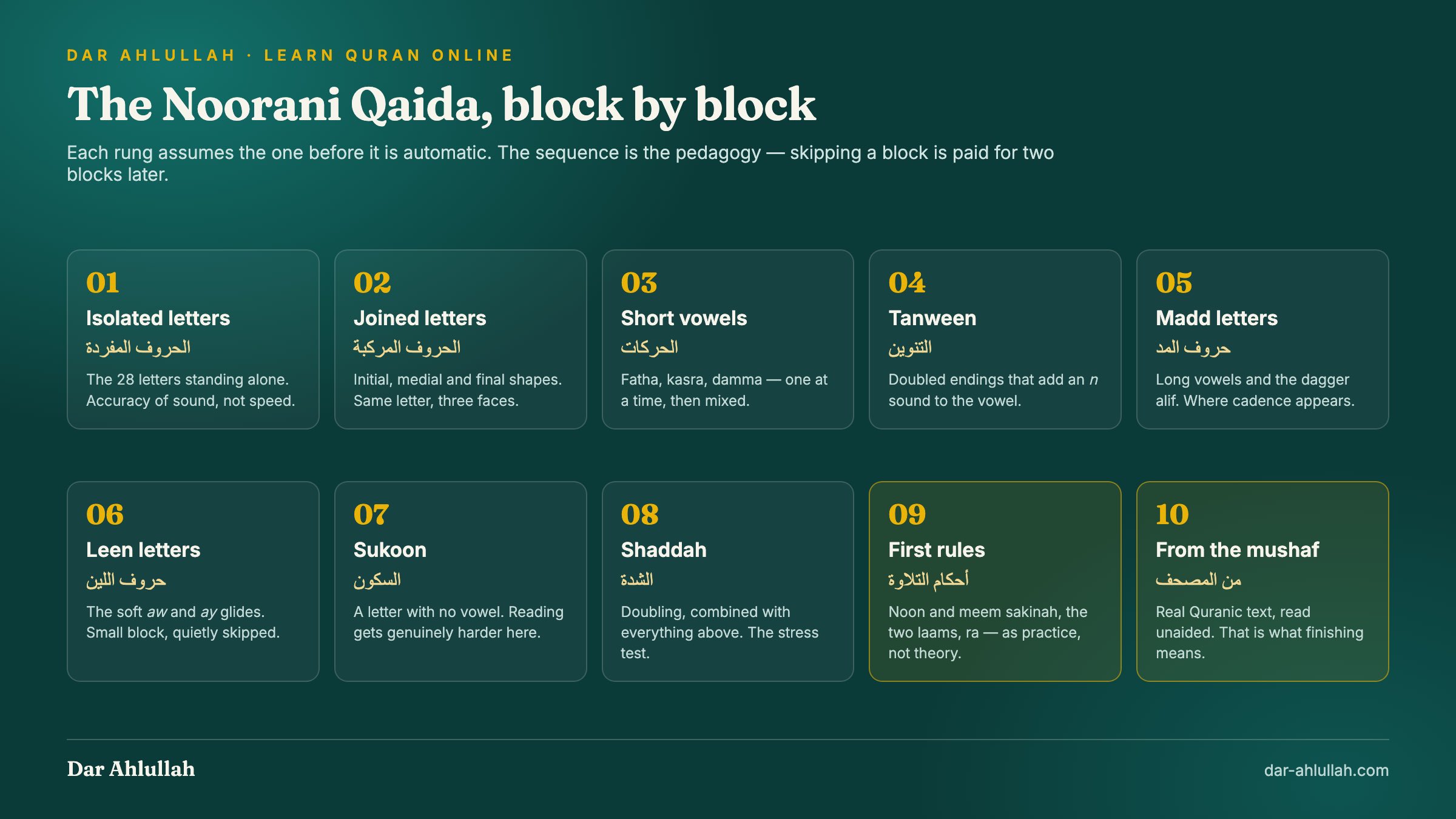
1. Isolated letters
The twenty-eight letters in their standalone form, presented for recognition and correct articulation. The goal here is not speed but accuracy of sound: several Arabic letters have no English equivalent and are routinely flattened onto the nearest familiar sound by beginners who have never been corrected.
2. Joined letters
The same letters in their initial, medial and final shapes, joined into two-, three- and four-letter combinations that are usually meaningless. This is the block people find pointless and it is arguably the most valuable in the book. Arabic letters change shape depending on position, and until you can read ب as the same letter whether it appears as بـ, ـبـ or ـب, you are not reading, you are decoding a puzzle each time.
3. Short vowels
The harakat arrive: fatha, kasra and damma. Wikipedia’s reference on Arabic diacritics describes fatha as “a small diagonal line placed above a letter” for a short a, kasra as “a similar diagonal line below a letter” for a short i, and damma as “a small curl-like diacritic placed above a letter” for a short u. The Qaida drills them one at a time, then mixed, then across joined letters — which is why lesson four looks like lesson three with extra marks.
4. Tanween
Doubled vowel marks at the end of a word, which as the same reference puts it “indicate that the vowel is followed by the consonant n.” Two fathas, two kasras, two dammas. Simple in principle, and a reliable source of hesitation in practice because the eye has to take in the mark and the position at once.
5. Madd letters
The long vowels: alif, waw and ya functioning as elongation rather than as consonants, along with the dagger alif — “a short vertical stroke on top of a letter” indicating a long a where no alif is written. This block is where recitation starts to sound like recitation rather than like a list, because length is what gives the Quran its cadence.
6. Leen letters
Waw and ya carrying a sukoon after a fatha, producing the soft aw and ay glides. A small block, easy to skim, and the reason many self-taught readers pronounce خَوْف and بَيْت slightly wrong for years.
7. Sukoon
The mark that says a letter carries no vowel — “a circle-shaped diacritic placed above a letter” indicating “that the letter to which it is attached is not followed by a vowel.” This is where reading gets genuinely harder, because you are now combining a voweled letter with an unvoweled one and holding both in the same breath group.
8. Shaddah
The doubling mark, described in the same reference as “a diacritic shaped like a small written Latin w” used “to indicate gemination (consonant doubling or extra length).” The Qaida then combines it with everything already learned: shaddah with tanween, shaddah with madd, shaddah on a letter followed by sukoon. This block is the book’s stress test.
9. First rules of recitation
Only near the end does the book introduce actual tajweed content, and it does so as practice rather than theory: the behaviour of a silent noon and tanween before different letters, the silent meem, the two kinds of laam in al-, heavy and light letters, the rules governing ra, and stopping marks. You are not asked to name these rules. You are asked to read words in which they occur until the sound is right.
10. Practice from the mushaf
The final pages are real Quranic text, usually short surahs from the end of the mushaf, read with everything the book has installed. Finishing the Qaida means reading those pages without the teacher supplying anything.
Why the Order Is the Entire Point
The most common request a Quran teacher hears from an adult beginner is to skip the Qaida and start on Surah al-Fatihah, and the reasoning is always sensible: the goal is the Quran, so why spend months on meaningless syllables? The answer is that the Qaida is not a slower route to the same place. It is the only route that produces a reader rather than a reciter of memorised sounds.
Read a page of the mushaf on day one and you are solving several problems simultaneously: which letter is this in this position, what vowel is on it, is it long or short, does it double, where does the breath stop. A beginner cannot hold all of that, so the mind quietly substitutes the easier task — recall. You hear the teacher say the line, you repeat the line, and within a week you are reproducing audio from memory while your eyes travel across the page in parallel. It feels exactly like reading. It is not reading, and the difference only surfaces months later on a page you have never heard, at which point you are back at the beginning with the added problem of having to unlearn a habit.
The Qaida forecloses that shortcut on purpose. Its middle blocks are deliberately meaningless combinations precisely so that there is nothing to recall — the only way through the row is to decode it. Every rung isolates one new variable and holds everything else constant, which is why the pages look so repetitive. The repetition is the mechanism. Our guide to how to read the Quran for beginners places this stage in the wider five-part progression; here the point is narrower: skipping it does not save the months, it spends them later and at a worse exchange rate.
There is a scriptural framing for the patience this requires. The instruction in Surah al-Muzzammil is to recite the Quran tartila — with measured, unhurried recitation. The Qaida is the training apparatus for exactly that quality, and hurrying through it is self-defeating in a fairly literal sense.
How Long It Takes, and Why Published Timelines Mislead
Search for this and you will find confident numbers — three months, six months, forty lessons — on academy websites that do not say where the figure came from, and the figures do not agree with each other. Treat them as marketing rather than data, because the honest answer is that completion time depends on four variables that vary enormously between learners.
| Variable | Why it moves the timeline |
|---|---|
| Contact time per week | Two 30-minute sessions and four 60-minute sessions are a fourfold difference in corrected reading. Nothing else in the list matters as much. |
| Practice between sessions | Decoding is a motor skill. Ten minutes daily beats an hour on Saturday, and no practice at all turns every lesson into a review of the last one. |
| Age and prior script exposure | A learner who already reads Urdu, Farsi or Pashto arrives knowing the letterforms and moves through the early blocks quickly. A learner starting from the Latin alphabet does not. |
| Whether anyone is listening | An uncorrected error becomes a habit in about a fortnight, and unpicking it costs more than learning it correctly would have. |
A more useful way to think about it is in checkpoints rather than dates. You are on track when you can read a row of unfamiliar joined letters without pausing to identify each one; when short vowels no longer require a conscious step; when a shaddah changes what you say without you thinking about it; and when you can read an unseen line of the final surahs at a steady pace. Those milestones are checkable this week. A calendar date four months out is not.
One practical consequence: ask your teacher which block you are in and what marks its completion. A teacher working from the structure above can answer in a sentence. If the answer is a general reassurance, you have learned something about the lesson plan.
Choosing an Edition Without Overthinking It
Editions of the Noorani Qaida differ more in presentation than in substance, and the choice matters far less than people expect. The main variations:
- Colour-coded versus plain. Many modern printings colour the letters by articulation group or highlight the vowel marks. For children this genuinely helps; for adults it is a preference. The risk with heavy colour-coding is dependence — a reader who has learned to spot the red mark can stumble on an ordinary black-and-white mushaf. If you use a coloured edition, move to a plain page before you finish.
- Script style. Most editions are set in a naskh face close to the printed mushaf, which is what you want. Avoid anything decorative; the goal is that the letterforms you drill are the letterforms you will meet.
- With or without an accompanying recording. Audio helps between lessons, but only as a model to imitate after a teacher has corrected you, never as your first exposure to a sound.
- Print versus screen. Print, if you have the choice. Learners follow lines with a finger at this stage and pinch-zooming interrupts the reading rhythm more than people realise.
You do not need to buy anything to start. The scan linked above is freely readable, and a great many teachers simply share pages from a standard edition. Spend the deliberation on the teacher instead; the book is the least variable part of this equation.
Five Habits That Stall People Halfway Through
People rarely abandon the Qaida because it is difficult. They stall on one of five habits, all of which are fixable and none of which are obvious from the inside.
1. Writing transliteration above the line
The instinct to pencil ba, ta, tha above the Arabic is overwhelming and it quietly destroys the exercise. Once the Latin is on the page your eye reads the Latin, and every drill you complete trains the wrong recognition pathway. You can reach the last page this way and still be unable to read a clean mushaf. If you have already started doing it, get a fresh copy rather than erasing — the memory of where the notes were is enough to prompt you.
2. Reading silently
Every line in this book is meant to be produced out loud. Silent reading exercises recognition but not articulation, and articulation is half of what is being built — the points of articulation number seventeen across the throat, tongue, lips, nose and mouth, and none of them are trained by looking. Learners who practise silently arrive at their lesson able to identify everything and pronounce half of it.
3. Skipping ahead when a page feels easy
The blocks look repetitive because they are testing automaticity, not comprehension. Understanding what a shaddah does takes thirty seconds; reading it correctly without hesitating takes a week of rows. A page that feels easy on the third line is not finished until it is easy on the thirtieth, and the cost of moving early is paid two blocks later when several unconsolidated skills have to combine.
4. Practising without anyone listening
You cannot hear your own errors in a sound you have never correctly produced. The classic case is the pair of letters that both sound like an English h, or the three that flatten into an English s: to an untrained ear your version and the correct version are identical, so repetition makes the wrong one permanent. This is the specific reason self-study plateaus, and it is discussed further below.
5. Treating it as a race against a sibling or a class
Progress through the Qaida is genuinely uneven between learners of the same age, and the variance says little about eventual outcomes. A child pushed forward to keep pace with a cousin acquires exactly the gaps the sequence exists to prevent. If you are teaching your own children at home, our guide to teaching Arabic at home covers keeping the pace honest without turning it into a competition.
Can You Self-Study It? What a Listener Adds
Partly, and it is worth being precise about which parts.
You can self-study letter recognition, the shapes letters take in different positions, what each vowel mark means, and the visual logic of the whole system. That is genuinely half the book, and a motivated adult with a free scan and a decent recording can cover it.
What you cannot self-study is whether the sound leaving your mouth is the right one. Arabic distinguishes sounds that English does not: two letters an English speaker hears as h, three that collapse into s, two into d, two into t. Because the distinction does not exist in your phonology, you cannot perceive the error in your own production — you will hear yourself saying the correct sound. No amount of listening to a beautiful recitation fixes this, because the problem is not the model, it is the feedback loop.
That is what a teacher supplies at this stage, and it is a narrower job than people imagine: listening to you produce a letter, telling you where in the mouth or throat it should be forming, modelling it, and making you repeat it until it is right. Tajweed knowledge matters here — Wikipedia’s reference describes tajwid as “giving every letter its right in reciting the Quran” and treats knowledge of its rules as a community duty — but at the Qaida stage the teacher is mostly functioning as an ear you do not have yet.
The practical compromise most adults land on: self-study the recognition work between sessions, and use paid contact time almost entirely for reading aloud and being corrected. A lesson in which the teacher does most of the talking is a lesson in which nothing was diagnosed.
Adults Working Through a Children’s Book
The Qaida is illustrated for seven-year-olds and most adults feel faintly ridiculous opening it. Three things worth knowing.
You will move faster than the children, in some blocks. An adult grasps the logic of the writing system in one explanation where a child needs it demonstrated repeatedly. The early blocks often compress considerably.
You will move slower in others. Articulation is the reverse: children acquire unfamiliar sounds more readily than adults, whose speech muscles have spent decades on one phonology. The letters that a child picks up by imitation may take an adult weeks of deliberate work. This is normal and it is not a sign that you started too late.
Self-consciousness is the real obstacle. Adults hate reciting badly in front of another person, so they under-read in lessons, practise silently, and volunteer less — which removes precisely the correction they are paying for. The fix is structural rather than motivational: one-to-one rather than group, the same teacher every week so the discomfort has somewhere to go, and an explicit agreement that you will do most of the reading. Our guide to learning the Quran as an adult deals with this at length, because it is the thing that ends more adult attempts than difficulty ever does.
For children, the considerations are different — attention span, session length, and keeping the habit alive across a school term. Our guide to online Quran classes for kids covers that side.
What Comes After the Last Page
Finishing the Qaida is not the end of anything except the Qaida. What it buys you is the ability to open the mushaf at a page you have never seen and produce it, slowly but correctly. Three things typically follow.
Fluency work. Correct but halting reading becomes correct and continuous only through volume — reading pages, out loud, regularly, without the teacher supplying words. This stage has no textbook and is largely mileage.
Systematic tajweed. The Qaida embedded a handful of rules as practice; now they get named, explained and extended — the categories of madd and their counts of beats, the full treatment of noon and meem sakinah, idgham and ikhfa, the rules of ra and lam. Our guide to tajweed rules for beginners is the natural next stop, and it is much easier to follow once the decoding underneath it is automatic.
Memorisation, if that is the goal. Hifz built on shaky decoding memorises the errors along with the text, which is why serious programmes insist on completing this stage first. If a certified chain of transmission is eventually the aim, our explanation of what an ijazah in Quran recitation is describes what that path requires.
How We Place Students on It
We use the Qaida the way most academies do, with two specifics worth stating because they are the parts that vary.
The first is placement. Students do not start at page one by default. The free 30-minute assessment exists to find out where the decoding actually breaks — a learner who reads letters confidently but guesses at sukoon starts at the sukoon block, not at the alphabet — and you receive that placement in writing whether or not you continue. No card is required to book it.
The second is continuity. One native Arabic-speaking teacher is assigned to a student and stays with them, because the whole value of a teacher at this stage is an accumulating memory of which letters you get wrong. A pooled roster cannot do that, however good each individual lesson looks. If the fit is not right we rematch at no cost, and a written report goes out after every session saying what was covered and what to practise.
Our rate is $9 per teaching hour across every plan — $36 a month for eight 30-minute sessions, $70 for eight full hours, $102 for twelve — with 20% off for siblings, and you can pause or switch plans at any time. If you want to start, book the free assessment and we will tell you which block of the Qaida you actually belong in.
Questions People Ask About the Noorani Qaida
Do I have to finish the Noorani Qaida before touching the Quran?
Not literally — most teachers have students reading short surahs alongside the later blocks, and there is nothing wrong with that. What you should not do is replace the Qaida with the mushaf early on, because reading real text before decoding is automatic reliably becomes recall rather than reading.
Is the Noorani Qaida only for children?
No. It is illustrated for children because that is who historically used it, but the content is a decoding syllabus with no age assumptions. Adults use the same book, usually faster through the early blocks and slower through articulation.
What is the difference between the Noorani Qaida and Noor Al-Bayan?
They are two primers aimed at the same outcome, differing in presentation and in how quickly they introduce joined text. Teachers tend to have a preference based on training rather than on any strong evidence that one produces better readers. Either is fine; what matters far more is that whoever teaches it listens to you read.
Can I learn the Noorani Qaida from YouTube?
You can learn to recognise everything in it from YouTube. You cannot learn whether your own pronunciation is correct, because the sounds English lacks are exactly the ones you cannot self-diagnose. Video is a good supplement between lessons and a poor substitute for one.
Where can I get the Noorani Qaida for free?
A scanned copy sits in the Internet Archive’s Islamic books collection, linked earlier in this article, and many teachers share pages directly. There is no need to buy a specific edition to begin.
My child finished the Qaida but still reads slowly. Is something wrong?
Almost certainly not. Finishing the book means decoding correctly, not fluently — fluency comes from volume of reading afterwards, and slow-but-accurate is exactly the right state to leave this stage in. Slow and guessing is the state to worry about, and it usually means a block was passed before it was consolidated.
Does the Noorani Qaida teach tajweed?
Partially, and at the end. It introduces a subset of rules as practice rather than theory — enough to read the final surahs correctly — and leaves the systematic treatment to a dedicated course afterwards.
Will finishing it help me understand Arabic?
No, and it is not meant to. Understanding requires vocabulary and grammar, which this book deliberately omits so that it works for learners of any mother tongue. The two tracks run independently, and many students work on both at once.
Conclusion: Thirty-Two Pages, Then the Mushaf
For a book that generates so much impatience, the Noorani Qaida is remarkably modest: a short primer, a fixed sequence, meaningless syllables in the middle, real Quranic text at the end. Everything about its design is aimed at one outcome — that you can open a page you have never heard recited and read it correctly — and every shortcut people take with it trades that outcome for the feeling of faster progress.
So the advice is unglamorous. Work through the blocks in order. Read every line out loud. Do not write Latin letters above the Arabic. Get somebody who knows the seventeen articulation points to listen to you at least twice a week, and ask them which block you are in and what marks its completion. Then finish it, close it, and open the mushaf — which is the only reason any of this was ever worth doing.
Related articles
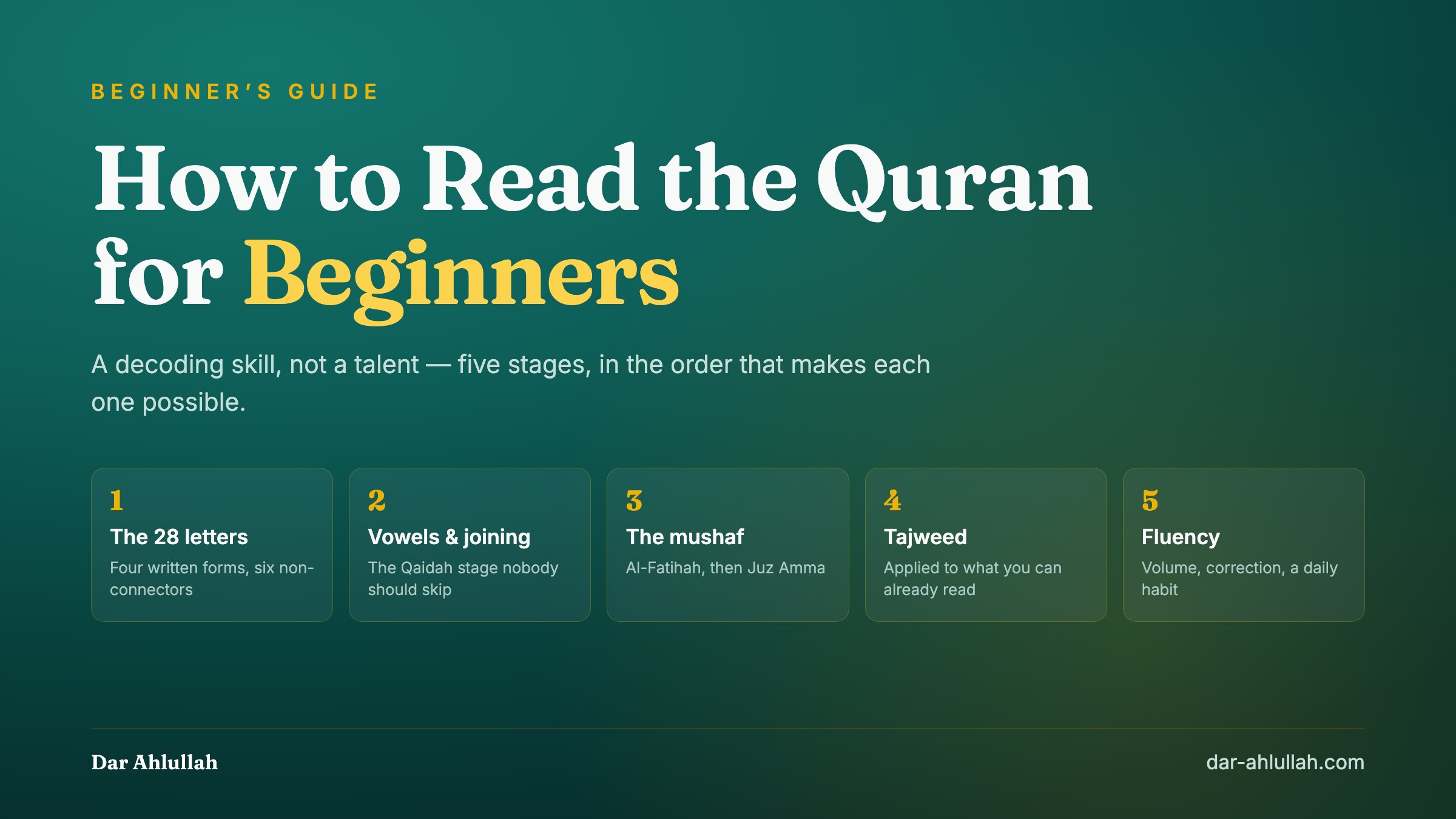
how to read the Quran for beginners
How to Read the Quran for Beginners: A Step-by-Step Route
Reading the Quran is a decoding skill, not a talent — and almost every beginner who stalls stalled on the order, not the difficulty. Here are the five stages, what marks the end of each, and why the Qaidah is the one nobody should skip.
20 min read
sajdah tilawah
Sajdah Tilawah: What to Do at a Prostration Verse
Sajdah tilawah is the single prostration that belongs to reciting or hearing one of the Qur'an's verses of prostration. Where those verses are, why the four schools count fourteen, fifteen and eleven of them, how to perform it, and the answers for a desk, a recitation app, a live lesson and a hifz drill.
26 min read
how long does it take to learn to read the Quran
How Long Does It Take to Learn to Read the Quran? An Honest Answer
Every academy quotes a different number and none of them say what they are measuring. Here is the honest version: four different goals people confuse, the hours each one really costs, what those hours look like at two versus four lessons a week, and the specific habits that stretch a four-month job into two years.
19 min read