
how to memorize similar verses in the Quran
How to Memorize Similar Verses in the Quran (Mutashabihat)
Dar Ahlullah team 17 min read

Table of Contents
- Introduction: The Mistakes Are Not Where You Expect Them
- What Mutashabihat Means — and the Word’s Other Meaning
- Why Similarity Is the Hardest Thing for Memory to Hold
- The Four Ways Verses Resemble Each Other
- Why Ordinary Revision Does Not Fix Them
- The Method: Six Steps That Actually Separate a Pair
- The Mutashabihat Log
- Meaning Is the Strongest Marker You Have
- Four Things Not to Do
- Similar Verses and Children
- Before You Finish, and After
- How We Handle Similar Verses in Lessons
- Questions People Ask About Similar Verses
- Conclusion: Memorise the Difference, Not the Verse
Introduction: The Mistakes Are Not Where You Expect Them
When people picture the hard part of memorising the Qur’an, they picture the unfamiliar: a long verse, a rare word, a passage of dense legal detail. Then they start reciting to a teacher and discover the truth. The places where recitation actually derails are the familiar ones. You reach a phrase you know perfectly well, your memory takes a turn it has taken a hundred times before, and forty seconds later you are in a different surah entirely and you have no idea when it happened.
These are the mutashabihat — the similar verses. Passages that appear in more than one place with small differences, verses that open identically and then diverge, refrains that recur so often that their positions blur together. Learning how to memorize similar verses in the Quran is a separate skill from memorising, and it is the skill that decides whether your hifz is reliable under pressure — in front of a teacher, leading prayer, or reciting in taraweeh where nobody is going to prompt you.
This guide covers what these passages are, why memory finds them uniquely difficult, the four distinct shapes they take with worked examples from the text, and the method that separates a confused pair for good rather than for a week.
What Mutashabihat Means — and the Word’s Other Meaning
First, a terminology fork worth getting right, because searching the word online drops you into the wrong conversation about half the time.
Mutashabihat (متشابهات) simply means “resembling one another”. The word appears in the Qur’an itself, in Surah Ali ‘Imran 3:7, where it is contrasted with muhkamat — the clear, foundational verses. In that verse, and therefore in the whole discipline of tafsir, mutashabihat refers to verses whose meaning is not fully determinate. That is a theological subject with its own long literature, and it has nothing to do with what we are discussing here.
In hifz, the same word is used for something entirely practical: verses whose wording resembles other verses. No ambiguity of meaning is implied. A pair of mutashabihat in the memoriser’s sense can be two perfectly clear verses that happen to share fourteen words out of sixteen. The overlap in terminology is unfortunate but the two senses are not related, and the classical scholarly tradition has a whole genre of works devoted to the second kind — books whose entire purpose is to list the resembling passages side by side and mark what differs.
Throughout this article, mutashabihat means the memoriser’s sense: similar wording.
Why Similarity Is the Hardest Thing for Memory to Hold
The reason these passages are difficult is not that either one is weakly memorised. It is that both are strongly memorised, and they compete.
The mechanism has a name outside hifz. Interference theory describes how two memories can block each other’s retrieval: older material obstructing newer (proactive interference) or newer material obstructing older (retroactive interference). The critical finding for our purposes is that similarity between the two competing memories amplifies the effect — the more alike two items are, the more forcefully each degrades access to the other, and the more they behave as one blurred item rather than two distinct ones.
That single fact explains almost everything about mutashabihat, including why they get worse as you progress. A student holding two juz has few opportunities to confuse anything. A student holding twenty has memorised most of the recurring phrases in several contexts, so the number of competing pairs rises faster than the number of pages. This is also why more repetition of each passage separately is the wrong prescription: repeating two similar things in isolation strengthens both, which is precisely the condition that produces the interference.
What reduces interference, per the same literature, is making the items distinguishable — giving each a distinct retrieval cue rather than more volume. In hifz terms: you do not need the verse memorised harder. You need the difference memorised.
The Four Ways Verses Resemble Each Other
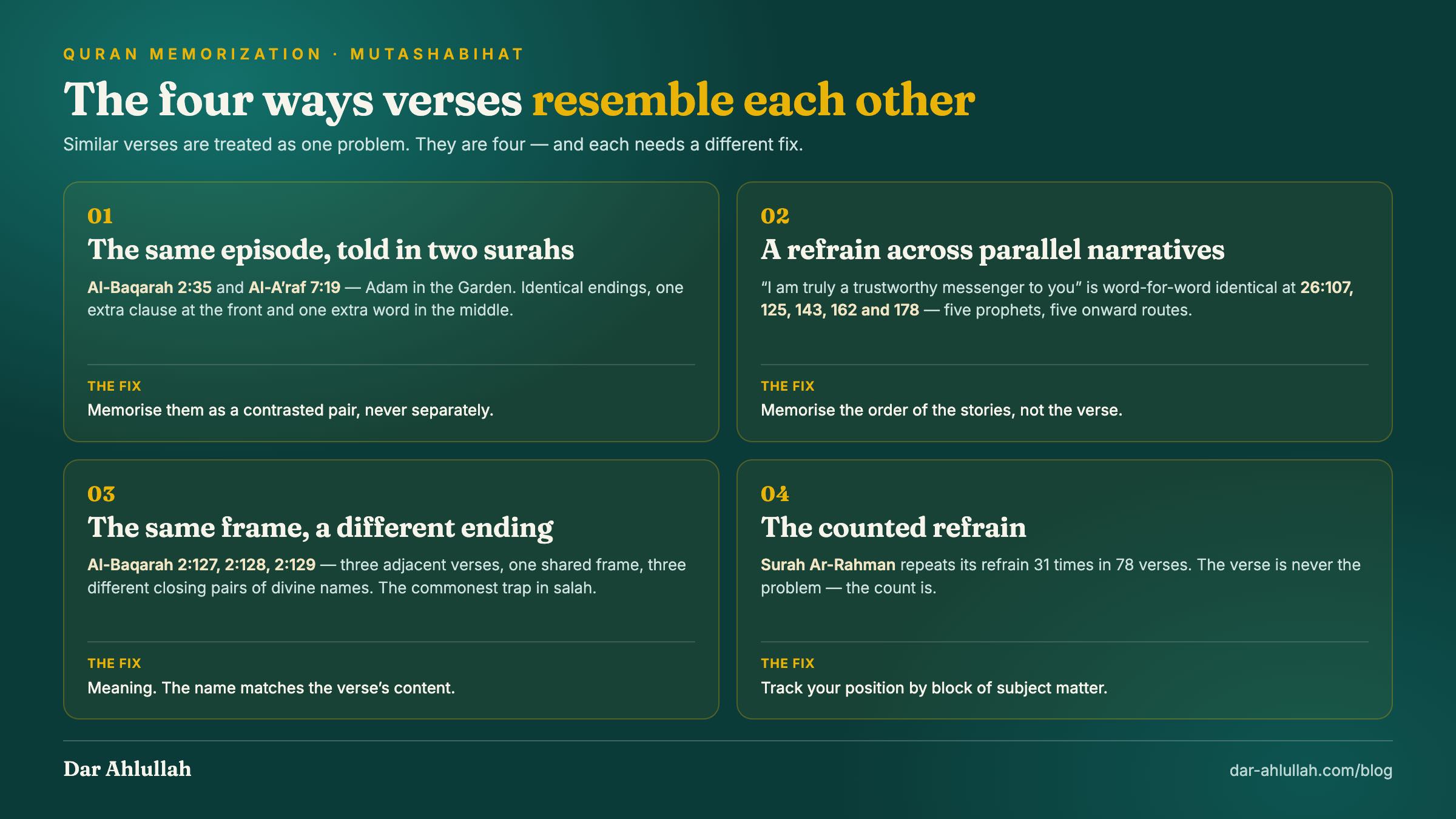
Similar verses are usually treated as one undifferentiated problem, which is part of why people struggle with them. They come in four recognisable shapes, and each responds to a different fix.
Type 1: The same episode told in two surahs
The clearest textbook case. Compare Al-Baqarah 2:35 with Al-A’raf 7:19. Both address Adam about dwelling in the Garden, both forbid the tree, and both end with the identical phrase وَلَا تَقْرَبَا هَذِهِ الشَّجَرَةَ فَتَكُونَا مِنَ الظَّالِمِينَ.
The differences sit at the front and in the middle. Al-Baqarah opens وَقُلْنَا يَا آدَمُ and continues وَكُلَا مِنْهَا رَغَدًا حَيْثُ شِئْتُمَا. Al-A’raf opens simply وَيَا آدَمُ and continues فَكُلَا مِنْ حَيْثُ شِئْتُمَا. So: one extra clause at the start, one extra word in the middle, and identical endings. That is the whole difference, and if you have not deliberately noted it, your memory will pick whichever version it met first and use it in both places.
This type is everywhere the Qur’an narrates the same event twice — the story of Musa across Al-A’raf, Ta-Ha, Ash-Shu’ara, An-Naml and Al-Qasas being the largest cluster of it. The fix is comparison: you memorise the two versions as a contrasted pair, never separately.
Type 2: A refrain repeated across parallel narratives
Surah Ash-Shu’ara tells five prophetic stories in sequence, and each messenger says the same sentence to his people. The verse إِنِّي لَكُمْ رَسُولٌ أَمِينٌ — “I am truly a trustworthy messenger to you” — is word-for-word identical at 26:107 (Nuh), 26:125 (Hud), 26:143 (Salih), 26:162 (Lut) and 26:178 (Shu’ayb).
Here nothing at all differs in the verse itself. What differs is what comes next, because each story continues into its own material. Reciting Ash-Shu’ara, you arrive at the refrain and your memory has five valid onward routes and no way to choose between them. Students who lose their place in this surah almost never lose the refrain — they finish it perfectly and then continue into the wrong prophet’s story.
The fix for this type is not the verse. It is the junction: you memorise the sequence of the five stories as a list, so the refrain hands off to a position rather than to a memory.
Type 3: The same frame, a different ending
The most common single trap in the whole Qur’an, and the one that produces the most errors in salah. Many verses close with a pair of divine names, and the frame that introduces them is often identical.
Three consecutive verses in the du’a of Ibrahim show it perfectly. Al-Baqarah 2:127 ends إِنَّكَ أَنتَ السَّمِيعُ الْعَلِيمُ. The very next verse, 2:128, ends إِنَّكَ أَنتَ التَّوَّابُ الرَّحِيمُ. And 2:129 ends إِنَّكَ أَنتَ الْعَزِيزُ الْحَكِيمُ. Same six-letter frame, three different closings, in three adjacent verses.
Multiply that across the whole text — عَزِيزٌ حَكِيمٌ, غَفُورٌ رَحِيمٌ, عَلِيمٌ حَكِيمٌ, سَمِيعٌ عَلِيمٌ and their relatives recurring in hundreds of places — and you have the single largest source of confident errors in recitation. The reciter does not hesitate. They finish the verse fluently with the wrong pair of names.
The fix here is the only one that reliably works for endings: meaning. The name that closes a verse is almost always connected to its content, and once you can feel why this verse ends with forgiveness and that one with might, the guessing stops.
Type 4: The counted refrain
Some surahs are built on repetition. Surah Ar-Rahman repeats فَبِأَيِّ آلَاءِ رَبِّكُمَا تُكَذِّبَانِ — “Then which of your Lord’s favours will you both deny?” — 31 times across its 78 verses. Al-Mursalat, Al-Qamar and At-Takathur all use the same architecture on a smaller scale.
The verse is never the problem. The count is. You cannot recall how many times you have already said it, so you either repeat a cycle or skip one, and in a long surah recited from memory neither error announces itself.
The fix is structural: stop treating the surah as a stream of verses and learn it as a set of blocks — this many refrains in the passage about creation, this many in the passage about the two gardens. You then track your position by block, not by count.
Why Ordinary Revision Does Not Fix Them
Most students respond to a mutashabihat error the way they respond to any error: they revise more. It rarely helps, and understanding why saves a lot of wasted months.
General revision is volume applied to material you already hold. But as we saw above, the problem is not that either passage is weak — it is that they are both strong and mutually interfering. Reciting each of them separately, more often, reinforces exactly the condition that causes the error. You can revise a confused pair for a year, each half in its own session, and remain equally likely to derail, because you have never once been required to choose between them.
There is a second reason, and it is the more dangerous of the two. Mutashabihat errors are silent from the inside. When you take the wrong branch, the recitation continues fluently — correct tajweed, correct Arabic, real verses of the Qur’an, just the wrong ones. Nothing feels like a mistake. This is the class of error our guide to revising Quran memorization calls a confident error, and it is why self-checking cannot catch it: the memory you would check against is the same memory that produced the error.
So mutashabihat need two things ordinary revision does not supply: deliberate contrast, and an external listener.
The Method: Six Steps That Actually Separate a Pair
This is the whole procedure. It takes about ten minutes per pair, once.
- Catch it at the moment it happens. The instant you derail, stop. Do not restart and push through — that is how a pair goes unrecorded for another six months. Note where you were and where you ended up.
- Open both places side by side. Two ribbons, two tabs, two printed pages, whatever you have. You cannot separate passages you have never seen simultaneously, and almost nobody has actually looked at their confused pairs together.
- Locate the fork, precisely. Read forward through both until the wording stops matching, and mark that exact word. Not “these two verses are similar” — the specific word where they part. Everything before the fork is shared and needs no work at all; the fork is the entire problem, and it is usually one or two words wide.
- Find out why they differ. Read the translation of both passages in context. There is nearly always a reason — a different addressee, a different stage of the story, a different divine name matching a different theme. This step is what converts an arbitrary pair into two things that could not be otherwise.
- Attach one marker to each side. One only, and make it concrete: the extra word, the position on the page, the surah’s subject at that point. Two markers is one too many to retrieve at reciting speed.
- Drill the pair back to back. Recite the shared portion, then side A’s continuation. Immediately recite the shared portion again, then side B’s. Alternate five or six times. This is the step that does the work, because it is the only one that forces the choice you keep getting wrong.
Then leave it, and let it come round again in your normal rotation. Step six builds the distinction; the rotation is what proves it held.
The Mutashabihat Log
One notebook page, or one note on your phone. Every pair you separate gets a row, and you re-read the log weekly. Ten minutes on your own log will do more for the reliability of your recitation than an extra half juz of general revision.
| Column | What goes in it | Why it earns its place |
|---|---|---|
| The two locations | Surah and verse for both sides | Lets you reopen the pair in seconds instead of hunting for it |
| The fork word | The exact word where they diverge | Turns a vague resemblance into a one-word problem |
| Which way you went wrong | “In Al-A’raf I recite the Baqarah wording” | Errors have a direction; the fix is asymmetric |
| Your marker | The single cue for each side | The thing you will actually retrieve mid-recitation |
| Last checked | A date | Old entries are usually solved; recent ones need the drill again |
The log has a quieter benefit too. “I am shaky in juz 21” is a feeling you cannot act on. “I have nine confused pairs, seven of them Type 3” is a task list you can finish in a fortnight.
Meaning Is the Strongest Marker You Have
Every serious approach to similar verses converges on the same conclusion: understanding what you are reciting is not a bonus for the mutashabihat, it is the primary tool.
The reason is mechanical rather than pious. A memoriser working purely from sound has, at the fork, two acoustically similar options and no basis for choosing. A memoriser who understands the passage has a reason — this verse is about a promise, so it closes with mercy; that one is about a judgement, so it closes with might. The meaning supplies the distinct retrieval cue that similarity destroyed, which is exactly what the interference literature says you need.
This does not require full fluency in Arabic. It requires enough to know which words are in front of you and roughly what each one does — a much smaller target than conversational Arabic, and the one our guide to learning Quranic Arabic effectively is built around. Even reading a translation of the two passages during step four of the method above will separate most Type 1 and Type 3 pairs on its own.
It is also the reason a hafiz who understands the text can often self-correct a wrong branch two words in, while one working from sound alone rides it all the way to the end of the page.
Four Things Not to Do
Do not memorise a confused pair separately “until each one is solid”. Both are already solid. That is the problem. Separate practice is the one form of work guaranteed not to help.
Do not skip ahead to a list of everybody else’s mutashabihat. Reference works listing similar passages are genuinely useful, but they are useful for looking things up. Working through hundreds of pairs you have never actually confused introduces competition where none existed, which is the opposite of the goal. Your log is the priority list, and it is short.
Do not rely on where the verse sits on your page. Page position is a real and legitimate cue — but it belongs to one printing. Change mushaf and every visual marker you built silently stops working, which is why memorising from a single consistent print matters more than people expect.
Do not assume silence means it is fixed. A pair you have not derailed on in three weeks may be separated, or may simply not have come round in a context that forces the choice. The test is reciting it to somebody, from memory, without warning.
Similar Verses and Children
Children hit mutashabihat earlier than adults expect, because the short surahs of Juz ‘Amma are dense with near-identical phrasing and rhyme. A child memorising from the end of the Qur’an will meet Type 3 and Type 4 within their first few months.
Three adjustments help. First, name the problem out loud: a child who is told “these two are twins, we are going to learn how to tell them apart” treats the confusion as a normal task rather than as personal failure. Second, do the contrast drill as a game — the parent recites the shared opening and the child has to complete the correct one on cue, alternating unpredictably. That is step six of the method with better packaging, and children take to it far more readily than to repetition. Third, keep the log for them; a seven-year-old will not maintain one, and the parent’s list of six twin pairs is exactly what the teacher needs to see.
Choosing a sensible memorisation order helps too, since some sequences front-load the confusable material more than others — our guide to which surahs to memorize first covers how to sequence the early stage.
Before You Finish, and After
Mutashabihat work changes character depending on where you are.
While you are still adding new material, deal with pairs as they surface and no faster. Every new juz creates its own crop of them, and a pair you separate now may be re-confused by material you memorise next year. Catch, log, drill, move on. Do not let mutashabihat become a project that displaces memorising — how the two loads trade off against each other is covered in our guide to how long it takes to memorize the Quran.
After completing thirty juz, the balance inverts. New memorisation ends, revision becomes the whole practice, and the similar verses become the main remaining source of error — the thing that separates a hafiz who can be relied on to lead prayer from one who cannot. At that stage a systematic pass becomes worth it: work surah by surah through the places where recitation has ever wobbled, and expect the list to be a few dozen entries long rather than hundreds. The wider structure that sits around this is set out in our guide to memorising the Qur’an online.
How We Handle Similar Verses in Lessons
At Dar Ahlullah, mutashabihat are treated as their own item in a one-to-one hifz session rather than as incidental mistakes. When a student takes a wrong branch, the teacher does not simply supply the right word and move on — the pair gets opened side by side, the fork gets located, and the contrast drill happens in the lesson while the error is still fresh. The pair then goes on a list the teacher carries forward, and it gets tested again unannounced weeks later.
The unannounced part is the piece that is genuinely hard to replicate alone. Mutashabihat errors feel correct from the inside, so the only reliable detector is somebody who knows the text listening to you recite from memory without warning. Sessions run one-to-one with a certified teacher, and if the pairing is not right we will rematch you with another certified mentor at no extra cost. If you want to find out which pairs are actually costing you, a free 30-minute assessment with a mentor — no card required — will surface more of them in half an hour than a month of solo revision.
Questions People Ask About Similar Verses
What are mutashabihat in Quran memorization?
Verses whose wording closely resembles other verses — the same episode narrated in two surahs, a refrain repeated across parallel passages, or an identical opening frame with a different ending. In hifz the term refers to similarity of wording, not the separate tafsir sense found in Surah Ali ‘Imran 3:7, which concerns verses whose meaning is not fully determinate.
Why do I keep mixing up two verses I know perfectly?
Because you know both of them perfectly. Similar memories interfere with each other’s retrieval, and the effect grows stronger the more alike they are. The passages are not weak; they are competing, which is a different problem and needs a different fix.
Will more repetition fix a confused pair?
Not if you repeat each side separately, which is what most people do. That strengthens both competitors and leaves the choice between them untrained. What works is reciting the shared portion and alternating between the two continuations, back to back, so the difference is what gets memorised.
Should I work through a book of mutashabihat?
As a reference to look pairs up in, yes. As a syllabus to work through from the beginning, no — deliberately studying hundreds of pairs you have never confused creates competition that was not there before. Start from your own log of actual errors; it will be far shorter than you expect.
Does understanding Arabic really help with similar verses?
More than anything else does, especially for verses that differ only in their closing divine names. Meaning gives you a reason to prefer one branch over the other, where sound alone gives you two equally plausible options. You need enough Arabic to know what the words are doing, not conversational fluency.
Is it normal to lose my place in Surah Ash-Shu’ara?
Entirely. Five prophets say the identical sentence at 26:107, 26:125, 26:143, 26:162 and 26:178, and the verse itself gives you no clue which story you are in. Memorise the order of the five stories as a list, and the refrain will hand off to a position rather than to a guess.
How do I keep count of a repeated refrain like the one in Ar-Rahman?
Do not count. Learn the surah as blocks of subject matter and note how many refrains sit in each block, then track your position by block. Counting to thirty-one while reciting is not something memory does reliably.
Should I fix similar verses before I carry on memorising?
No — handle them as they surface, in the ten minutes a pair takes, and keep memorising. New material will generate new pairs regardless, so a project to clear them all before continuing has no natural end. The one exception is after completing thirty juz, when a systematic pass becomes worthwhile.
Can I catch these errors on my own?
Rarely, because a wrong branch is fluent, grammatical and made of real Qur’anic text — nothing about it feels like a mistake. Recording yourself and checking against the mushaf works but is slow. Reciting from memory to somebody who knows the text is the reliable method, and unannounced beats scheduled.
Conclusion: Memorise the Difference, Not the Verse
Similar verses are not a sign that your hifz is weak. They are a predictable consequence of it being strong: the more of the Qur’an you hold, the more of its recurring phrases you have memorised in several places at once, and the more often two solid memories will compete at the same fork.
Which means the work is not more repetition. It is contrast. Catch the derailment when it happens, open both passages together, find the exact word where they part, learn why they part, attach one marker to each side, and drill the two continuations back to back until the choice is automatic. Log the pair, review the log weekly, and get somebody to test you without warning.
Done that way, a confused pair costs about ten minutes and then stops costing anything. Left alone, it stays in your recitation for years and you will never once notice it happening. If you want the wider route into memorisation that this sits inside, our complete guide to learning Qur’an online is the place to start.
Related articles

how to memorize Quran with a full time job
How to Memorize Quran With a Full Time Job: A Schedule That Survives Your Week
Working adults rarely lose hifz for lack of time. They lose it because the time never had a fixed address in the week — and the first genuinely busy fortnight takes it back.
20 min read
how to revise Quran memorization
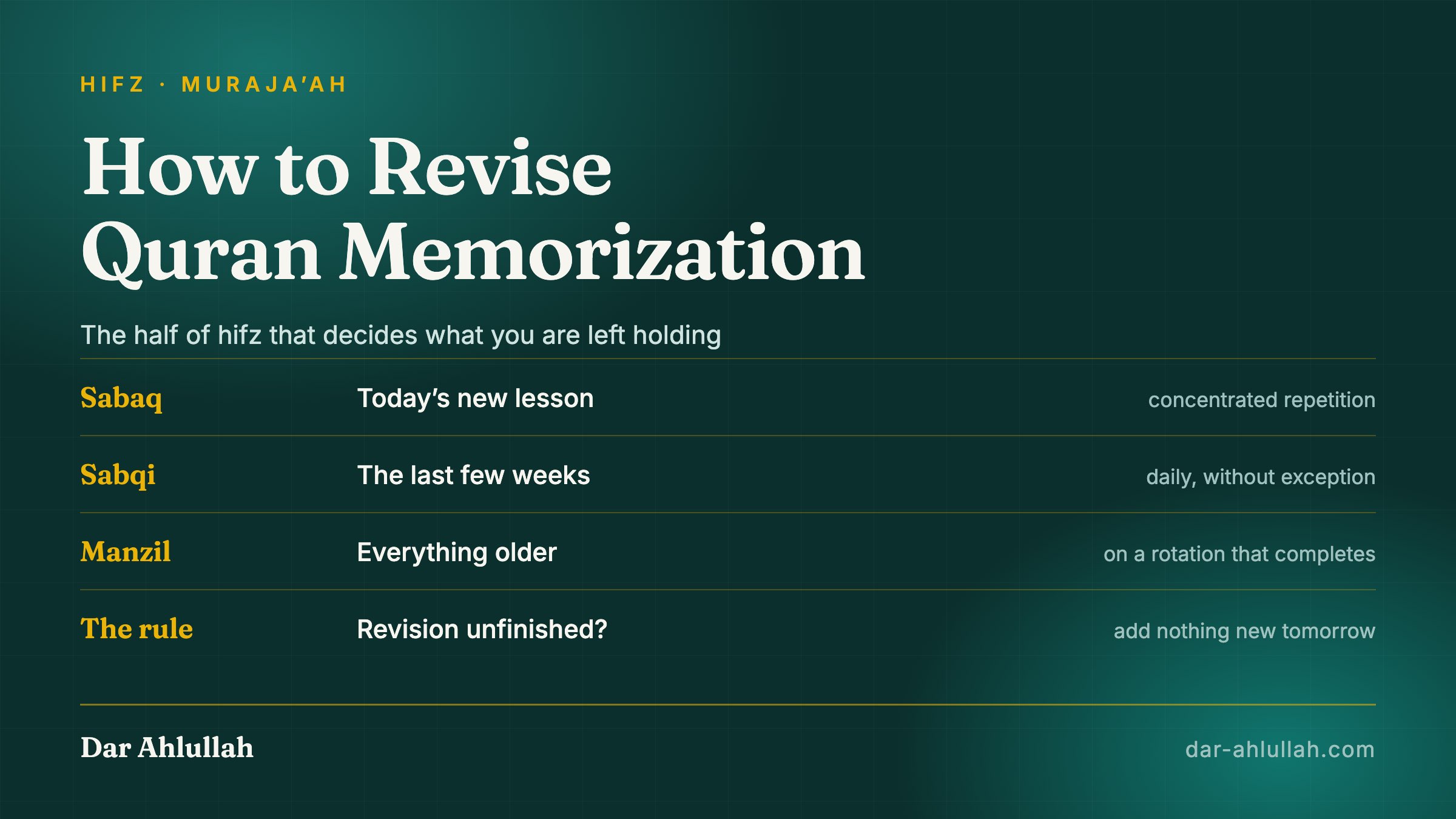
What Murajaah Means, and How to Revise Quran Memorization
Every hifz plan is a memorisation plan, and almost every one that fails, fails because nothing in it described what happens to the pages behind you.
15 min read

memorize Quran online
Online Hifz Program: How to Memorize the Quran Online (Step-by-Step Plan)
Yes, you can memorize Quran online — with the right plan. Learn the daily Sabaq–Sabqi–Manzil cycle, pick a realistic weekly schedule, and see how 1-on-1 online Hifz classes with certified teachers keep you accountable.
8 min read